AIIMS B.Sc Nursing 2027 Sample Paper
Finished viewing? Save it for later —
Download AIIMS B.Sc Nursing 2027 Sample Paper (PDF · 10 pages)About AIIMS B.Sc Nursing 2027 Sample Paper
AIIMS B.Sc Nursing 2027 Sample Paper is available here for free download. Published by AIIMS for AIIMS B.Sc Nursing, this sample paper can be viewed online or downloaded as a PDF (10 pages). Candidates preparing for AIIMS B.Sc Nursing can use AIIMS B.Sc Nursing 2027 Sample Paper to understand the exam pattern, the type of questions asked, and the overall difficulty level.
Frequently Asked Questions
How can I download AIIMS B.Sc Nursing 2027 Sample Paper?
Open this page and click the Download button to save AIIMS B.Sc Nursing 2027 Sample Paper as a PDF. It is completely free on AglaSem Docs.
Is AIIMS B.Sc Nursing 2027 Sample Paper free to download?
Yes. AIIMS B.Sc Nursing 2027 Sample Paper can be viewed online and downloaded as a PDF free of cost on AglaSem Docs.
How many pages does AIIMS B.Sc Nursing 2027 Sample Paper have?
AIIMS B.Sc Nursing 2027 Sample Paper contains 10 pages, which you can read online or download together as a single PDF.
Where can I find more AIIMS B.Sc Nursing study material?
You can find more AIIMS B.Sc Nursing question papers, sample papers, syllabus, and answer keys on AglaSem Docs.
AIIMS B.Sc Nursing 2027 Sample Paper – Text
Read the full text of this sample paper below — useful to quickly search, copy and reference the content online without downloading the PDF.
📄 View text version (10 pages)
Page 1
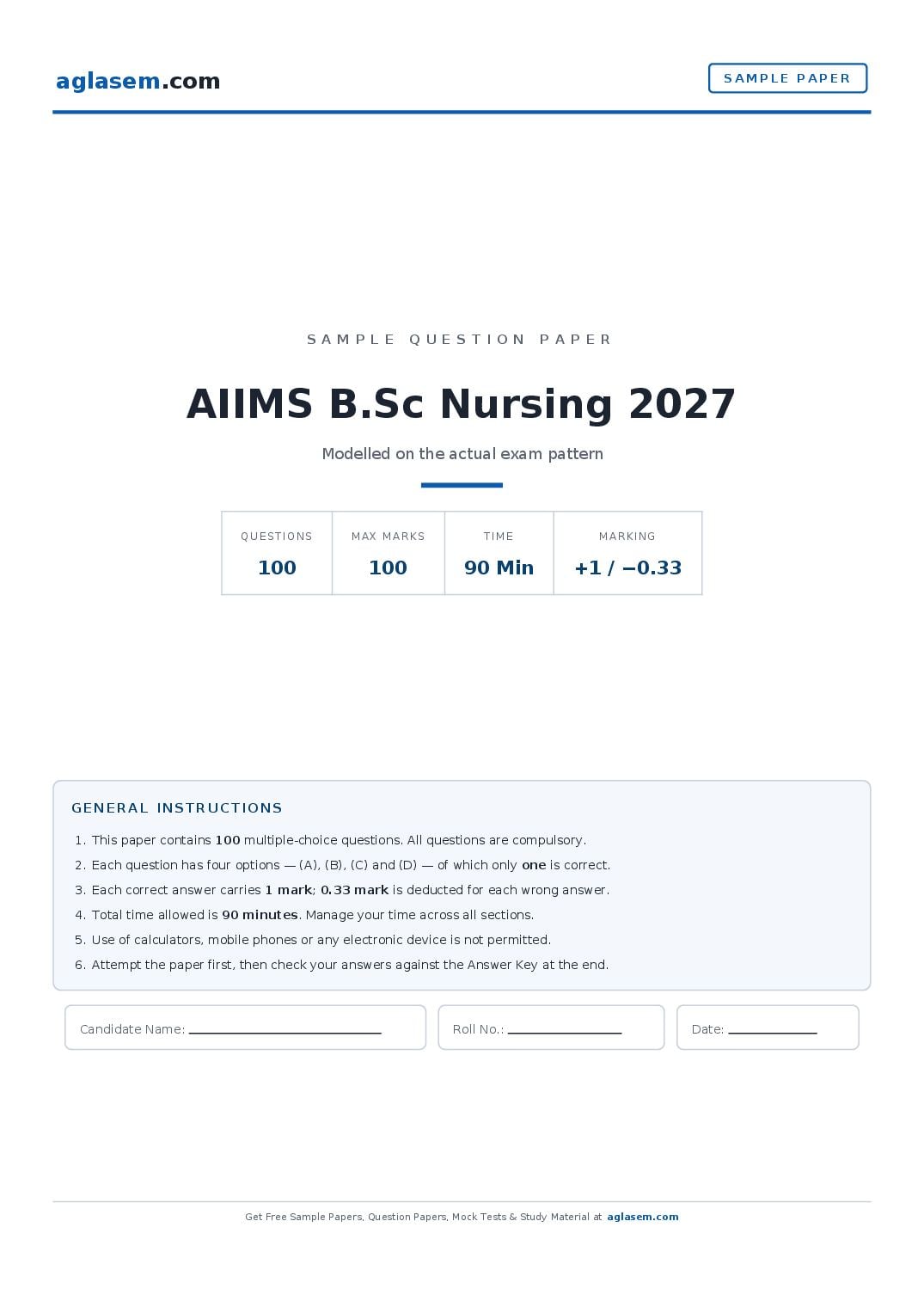
S A M P L E Q U E S T I O N P A P E R
AIIMS B.Sc Nursing 2027
Modelled on the actual exam pattern
.
QUESTIONS MAX MARKS TIME MARKING
100 100 90 Min +1 / −0.33
GENERAL INSTRUCTIONS
1. This paper contains 100 multiple-choice questions. All questions are compulsory.
2. Each question has four options — (A), (B), (C) and (D) — of which only one is correct.
3. Each correct answer carries 1 mark; 0.33 mark is deducted for each wrong answer.
4. Total time allowed is 90 minutes. Manage your time across all sections.
5. Use of calculators, mobile phones or any electronic device is not permitted.
6. Attempt the paper first, then check your answers against the Answer Key at the end.
Candidate Name: Roll No.: Date:
Page 2
AIIMS B.Sc Nursing 2027
SAMPLE QUESTION PAPER
Questions 100 Max Marks 100 Time 90 Min Marking +1 / −0.33
Attempt all questions. Choose the one correct option for each.
PHYSICS
1. Earthquakes are recorded using a: 2. An echo is produced due to the ____ of sound.
(A) Seismograph (A) reflection
(B) Barometer (B) refraction
(C) Telescope (C) absorption
(D) Hygrometer (D) diffraction
3. The nearest star to the Earth is: 4. Electric current is the flow of electric:
(A) The Moon (A) Mass
(B) The Sun (B) Pressure
(C) Polaris (C) Heat
(D) Sirius (D) Charge
5. The twinkling of stars is due to: 6. The SI unit of temperature is:
(A) Reflection (A) Celsius
(B) Atmospheric refraction (B) Fahrenheit
(C) Dispersion (C) Joule
(D) Total absorption (D) Kelvin
7. A device that converts electrical energy into 8. Like poles of two magnets:
mechanical energy is a:
(A) Repel each other
(A) Generator (B) Attract each other
(B) Transformer (C) Have no effect
(C) Electric motor (D) Melt
(D) Battery
9. The splitting of white light into its seven colours is 10. A freely suspended magnetic compass needle points
called: towards:
(A) Reflection (A) East-West
(B) Refraction (B) North-South
(C) Absorption (C) Upwards
(D) Dispersion (D) Downwards
Page 3
(A) Decibel (A) Newton
(B) Hertz (B) Joule
(C) Watt (C) Pascal
(D) Newton (D) Watt
13. According to Ohm's law, voltage V equals: 14. Electric power P is given by (V = voltage, I = current):
(A) I / R (A) V / I
(B) I x R (B) V x I
(C) R / I (C) I / V
(D) I x I x R (D) V + I
15. Atmospheric pressure is measured using a: 16. The SI unit of electric charge is:
(A) Barometer (A) Coulomb
(B) Thermometer (B) Ampere
(C) Voltmeter (C) Volt
(D) Ammeter (D) Ohm
17. Short-sightedness (myopia) is corrected using a: 18. Newton's first law of motion is also called the law of:
(A) Convex lens (A) Inertia
(B) Plane mirror (B) Gravitation
(C) Concave lens (C) Conservation
(D) Cylindrical lens (D) Reflection
19. The image formed on the retina of the human eye is: 20. Which of the following is a good insulator of
electricity?
(A) Virtual and erect
(B) Virtual and inverted (A) Copper
(C) Real and inverted (B) Iron
(D) Real and erect (C) Aluminium
(D) Rubber
21. The coloured part of the human eye is the: 22. Temperature is measured using a:
(A) Pupil (A) Barometer
(B) Iris (B) Thermometer
(C) Retina (C) Hygrometer
(D) Cornea (D) Ammeter
23. The energy possessed by a body due to its motion is 24. Atmospheric humidity is measured using a:
called:
(A) Barometer
(A) Potential energy (B) Thermometer
(B) Chemical energy (C) Ammeter
(C) Nuclear energy (D) Hygrometer
(D) Kinetic energy
Page 4
(A) Low voltage (A) Newton
(B) Static charge (B) Watt
(C) Excessive current (C) Ampere
(D) Magnetism (D) Joule
27. Long-sightedness (hypermetropia) is corrected using 28. The speed of light in vacuum is approximately:
a:
(A) 3 x 10⁸ m/s
(A) Concave lens (B) 3 x 10⁶ m/s
(B) Plane mirror (C) 3 x 10⁵ m/s
(C) Prism (D) 3 x 10¹⁰ m/s
(D) Convex lens
29. Sound cannot travel through: 30. The bending of light when it passes from one medium
to another is called:
(A) Solids
(B) Vacuum (A) Reflection
(C) Liquids (B) Diffraction
(D) Gases (C) Refraction
(D) Dispersion
CHEMISTRY
31. Which gas is commonly used to disinfect drinking 32. The smallest particle of an element that retains its
water? properties is a(n):
(A) Oxygen (A) Atom
(B) Hydrogen (B) Molecule
(C) Chlorine (C) Ion
(D) Helium (D) Electron
33. The chemical symbol of chlorine is: 34. The gas usually released when a metal reacts with a
dilute acid is:
(A) C
(B) Ch (A) Oxygen
(C) Cr (B) Carbon dioxide
(D) Cl (C) Hydrogen
(D) Chlorine
35. The common name of calcium carbonate (marble, 36. Chlorophyll in green plants contains the element:
limestone) is:
(A) Magnesium
(A) Baking soda (B) Iron
(B) Common salt (C) Calcium
(C) Limestone (D) Sodium
(D) Gypsum
Page 5
(A) H (A) Citric acid
(B) He (B) Formic acid
(C) Hg (C) Acetic acid
(D) Ho (D) Oxalic acid
39. An acid turns blue litmus paper: 40. Diamond and graphite are allotropes of:
(A) Blue (A) Silicon
(B) Red (B) Sulphur
(C) Green (C) Iron
(D) Colourless (D) Carbon
41. The chemical symbol of gold is: 42. The chemical symbol of nitrogen is:
(A) Au (A) Ni
(B) Ag (B) Na
(C) Gd (C) N
(D) Go (D) Ne
43. The hardest natural substance is: 44. The atomic number of oxygen is:
(A) Graphite (A) 6
(B) Diamond (B) 7
(C) Iron (C) 8
(D) Quartz (D) 16
45. A base turns red litmus paper: 46. The chemical symbol of iron is:
(A) Red (A) Ir
(B) Blue (B) In
(C) Green (C) I
(D) Colourless (D) Fe
47. In a neutral atom, the number of electrons equals the 48. The gas that humans breathe out in large amounts is:
number of:
(A) Oxygen
(A) Neutrons (B) Nitrogen
(B) Nucleons (C) Carbon dioxide
(C) Ions (D) Hydrogen
(D) Protons
49. The chemical symbol of potassium is: 50. The chemical symbol of silver is:
(A) P (A) Ag
(B) Po (B) Si
(C) K (C) Au
(D) Pt (D) Sr
Page 6
(A) Nitrogen (A) S
(B) Carbon dioxide (B) So
(C) Hydrogen (C) Na
(D) Oxygen (D) Sd
53. The most abundant gas in the Earth's atmosphere is: 54. The atomic number of carbon is:
(A) Nitrogen (A) 4
(B) Oxygen (B) 6
(C) Carbon dioxide (C) 8
(D) Hydrogen (D) 12
55. The chemical formula of carbon dioxide is: 56. The process of a liquid changing into vapour is called:
(A) CO (A) Condensation
(B) CO2 (B) Sublimation
(C) C2O (C) Evaporation
(D) O2 (D) Freezing
57. The acid present in citrus fruits such as lemon is: 58. The acid present in the human stomach (gastric juice)
is:
(A) Acetic acid
(B) Citric acid (A) Hydrochloric acid
(C) Lactic acid (B) Sulphuric acid
(D) Tartaric acid (C) Nitric acid
(D) Citric acid
59. LPG (cooking gas) mainly contains: 60. The atomic number of hydrogen is:
(A) Methane (A) 2
(B) Hydrogen (B) 0
(C) Chlorine (C) 1
(D) Butane (D) 3
BIOLOGY
61. The basic structural and functional unit of life is the: 62. The longest bone in the human body is the:
(A) Tissue (A) Stapes
(B) Cell (B) Tibia
(C) Organ (C) Femur
(D) Atom (D) Humerus
63. The normal blood pressure of a healthy adult is 64. The 'universal solvent' is:
about:
(A) Alcohol
(A) 90/60 mm Hg (B) Water
(B) 140/100 mm Hg (C) Oil
(C) 120/80 mm Hg (D) Mercury
(D) 160/120 mm Hg
Page 7
about:
(A) Cerebrum
(A) 35 C (B) Cerebellum
(B) 39 C (C) Medulla
(C) 42 C (D) Pons
(D) 37 C
67. The vitamin also known as ascorbic acid is: 68. The structural and functional unit of the nervous
system is the:
(A) Vitamin A
(B) Vitamin D (A) Nephron
(C) Vitamin K (B) Axon
(D) Vitamin C (C) Dendrite
(D) Neuron
69. Deficiency of iodine in the diet causes: 70. Which vitamin is essential for blood clotting?
(A) Rickets (A) Vitamin A
(B) Scurvy (B) Vitamin C
(C) Anaemia (C) Vitamin K
(D) Goitre (D) Vitamin D
71. The branch of medicine dealing with the heart and its 72. The liquid (fluid) part of blood is called:
diseases is:
(A) Serum
(A) Nephrology (B) Lymph
(B) Dermatology (C) Platelet
(C) Cardiology (D) Plasma
(D) Orthopaedics
73. The normal resting heart rate of a healthy adult is 74. The green pigment used by plants for photosynthesis
about: is:
(A) 60 (A) Haemoglobin
(B) 72 (B) Melanin
(C) 90 (C) Carotene
(D) 100 (D) Chlorophyll
75. Most absorption of digested food takes place in the: 76. The largest gland in the human body is the:
(A) Stomach (A) Liver
(B) Large intestine (B) Pancreas
(C) Small intestine (C) Thyroid
(D) Oesophagus (D) Salivary gland
77. The largest organ of the human body is the: 78. Deficiency of vitamin A causes:
(A) Skin (A) Scurvy
(B) Liver (B) Rickets
(C) Brain (C) Night blindness
(D) Lungs (D) Goitre
Page 8
(A) Goitre (A) Femur
(B) Rickets (B) Radius
(C) Scurvy (C) Rib
(D) Anaemia (D) Stapes
81. Which blood component is mainly responsible for 82. Which blood cells mainly fight infection?
clotting?
(A) Red blood cells
(A) Red blood cells (B) Platelets
(B) Platelets (C) Plasma
(C) White blood cells (D) White blood cells
(D) Plasma
83. The universal recipient blood group is: 84. The exchange of gases in the lungs takes place in the:
(A) AB positive (A) Bronchi
(B) O negative (B) Alveoli
(C) A positive (C) Trachea
(D) B negative (D) Pharynx
85. The number of pairs of chromosomes in a human body 86. White blood cells are also called:
cell is:
(A) Erythrocytes
(A) 21 (B) Thrombocytes
(B) 22 (C) Platelets
(C) 23 (D) Leucocytes
(D) 24
87. Deficiency of vitamin D causes: 88. Which cell organelle is known as the 'powerhouse of
the cell'?
(A) Scurvy
(B) Rickets (A) Nucleus
(C) Goitre (B) Ribosome
(D) Anaemia (C) Mitochondria
(D) Golgi apparatus
89. The structural and functional unit of the kidney is the: 90. The process by which green plants prepare their own
food is called:
(A) Neuron
(B) Nephron (A) Respiration
(C) Alveolus (B) Transpiration
(D) Villus (C) Photosynthesis
(D) Digestion
Page 9
91. The BCG vaccine gives protection against: 92. World Blood Donor Day is observed every year on:
(A) Tuberculosis (A) 1 December
(B) Polio (B) 12 May
(C) Tetanus (C) 7 April
(D) Measles (D) 14 June
93. The headquarters of the World Health Organization 94. Who is regarded as the 'Father of Medicine'?
(WHO) is located in:
(A) Aristotle
(A) New York (B) Hippocrates
(B) Geneva (C) Charaka
(C) Paris (D) Louis Pasteur
(D) London
95. The vaccine for smallpox was developed by: 96. World AIDS Day is observed every year on:
(A) Louis Pasteur (A) 7 April
(B) Alexander Fleming (B) 12 May
(C) Jonas Salk (C) 1 December
(D) Edward Jenner (D) 14 June
97. 'DNA' stands for: 98. World Health Day is observed every year on:
(A) Dinucleic Acid (A) 7 April
(B) Deoxyribose Nuclear Acid (B) 1 December
(C) Deoxyribonucleic Acid (C) 12 May
(D) Dextro Nucleic Acid (D) 2 October
99. Penicillin was discovered by: 100. Florence Nightingale is regarded as the founder of
modern:
(A) Louis Pasteur
(B) Edward Jenner (A) Surgery
(C) Alexander Fleming (B) Pharmacy
(D) Robert Koch (C) Nursing
(D) Physiotherapy
ANSWER KEY
1. (A) 2. (A) 3. (B) 4. (D) 5. (B) 6. (D) 7. (C)
8. (A) 9. (D) 10. (B) 11. (A) 12. (A) 13. (B) 14. (B)
15. (A) 16. (A) 17. (C) 18. (A) 19. (C) 20. (D) 21. (B)
22. (B) 23. (D) 24. (D) 25. (C) 26. (D) 27. (D) 28. (A)
29. (B) 30. (C) 31. (C) 32. (A) 33. (D) 34. (C) 35. (C)
36. (A) 37. (B) 38. (C) 39. (B) 40. (D) 41. (A) 42. (C)
43. (B) 44. (C) 45. (B) 46. (D) 47. (D) 48. (C) 49. (C)
Page 10
57. (B) 58. (A) 59. (D) 60. (C) 61. (B) 62. (C) 63. (C)
64. (B) 65. (D) 66. (A) 67. (D) 68. (D) 69. (D) 70. (C)
71. (C) 72. (D) 73. (B) 74. (D) 75. (C) 76. (A) 77. (A)
78. (C) 79. (D) 80. (D) 81. (B) 82. (D) 83. (A) 84. (B)
85. (C) 86. (D) 87. (B) 88. (C) 89. (B) 90. (C) 91. (A)
92. (D) 93. (B) 94. (B) 95. (D) 96. (C) 97. (C) 98. (A)
99. (C) 100. (C)
Document Details
| Board / Org | AIIMS |
| Exam | AIIMS B.Sc Nursing |
| Type | Sample Paper |
| Pages | 10 |
| Language | english |
| Updated | 24 Sep 2026 |