MBOSE Class 12 Question Paper 2020 for Chemistry New Course
Finished viewing? Save it for later —
Download MBOSE Class 12 Question Paper 2020 for Chemistry New Course (PDF · 12 pages)About MBOSE Class 12 Question Paper 2020 for Chemistry New Course
MBOSE Class 12 Question Paper 2020 for Chemistry New Course is available here for free download. Published by Meghalaya Board for Class 12, this question paper can be viewed online or downloaded as a PDF (12 pages). Candidates preparing for Class 12 can use MBOSE Class 12 Question Paper 2020 for Chemistry New Course to understand the exam pattern, the type of questions asked, and the overall difficulty level.
Frequently Asked Questions
How can I download MBOSE Class 12 Question Paper 2020 for Chemistry New Course?
Open this page and click the Download button to save MBOSE Class 12 Question Paper 2020 for Chemistry New Course as a PDF. It is completely free on AglaSem Docs.
Is MBOSE Class 12 Question Paper 2020 for Chemistry New Course free to download?
Yes. MBOSE Class 12 Question Paper 2020 for Chemistry New Course can be viewed online and downloaded as a PDF free of cost on AglaSem Docs.
How many pages does MBOSE Class 12 Question Paper 2020 for Chemistry New Course have?
MBOSE Class 12 Question Paper 2020 for Chemistry New Course contains 12 pages, which you can read online or download together as a single PDF.
Where can I find more Class 12 study material?
You can find more Class 12 question papers, sample papers, syllabus, and answer keys on AglaSem Docs.
MBOSE Class 12 Question Paper 2020 for Chemistry New Course – Text
Read the full text of this question paper below — useful to quickly search, copy and reference the content online without downloading the PDF.
📄 View text version (12 pages)
Page 1
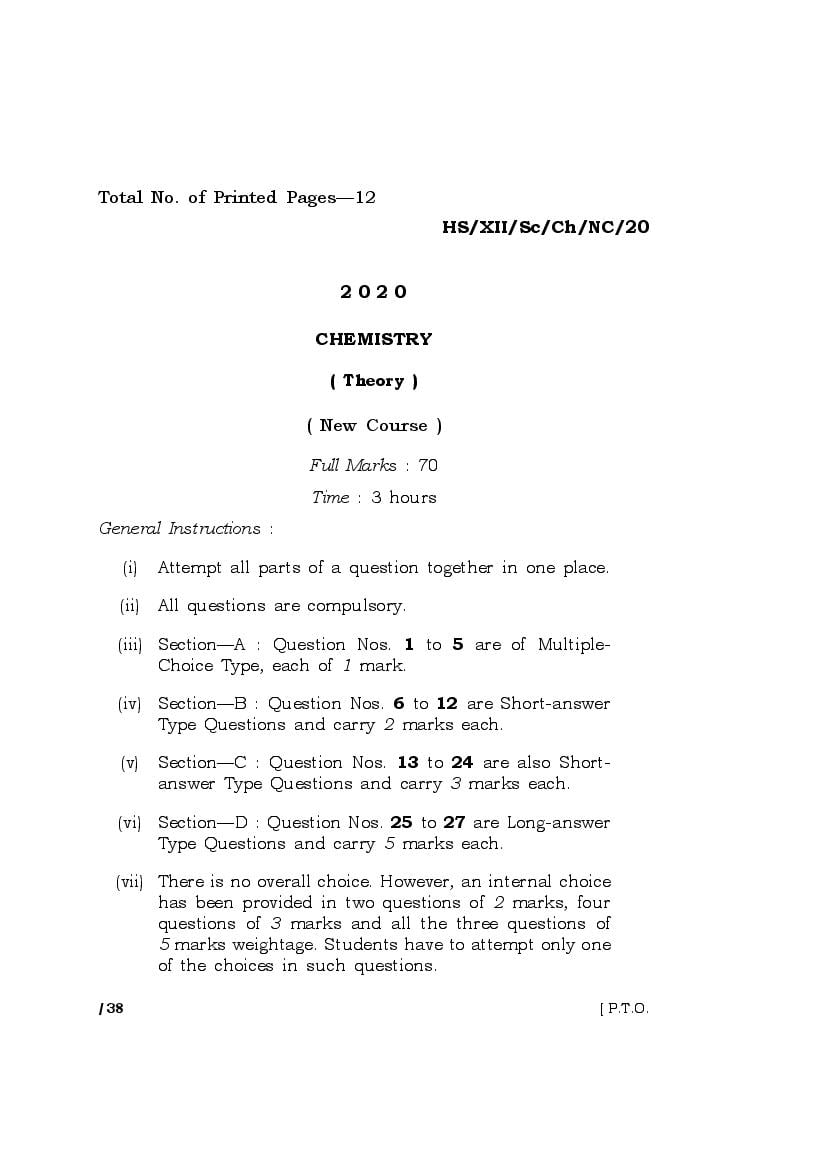
HS/XII/Sc/Ch/NC/20
2020
CHEMISTRY
( Theory )
( New Course )
Full Marks : 70
Time : 3 hours
General Instructions :
(i) Attempt all parts of a question together in one place.
(ii) All questions are compulsory.
(iii) Section—A : Question Nos. 1 to 5 are of Multiple-
Choice Type, each of 1 mark.
(iv) Section—B : Question Nos. 6 to 12 are Short-answer
Type Questions and carry 2 marks each.
(v) Section—C : Question Nos. 13 to 24 are also Short-
answer Type Questions and carry 3 marks each.
(vi) Section—D : Question Nos. 25 to 27 are Long-answer
Type Questions and carry 5 marks each.
(vii) There is no overall choice. However, an internal choice
has been provided in two questions of 2 marks, four
questions of 3 marks and all the three questions of
5 marks weightage. Students have to attempt only one
of the choices in such questions.
/38 [ P.T.O.
Page 2
(viii) Use of non-programmable ordinary scientific
calculators and log table is allowed.
(ix) Mobile Phones and Pagers are not allowed inside the
Examination Hall.
SECTION—A
Choose and write the correct answers for the following in the
Answer Script :
1. To get n-type semiconductors, impurity to be added to
silicon should have the following number of valence
electrons
(a) 2
(b) 3
(c) 1
(d) 5 1
2. The coagulating power of an electrolyte for a sol
decreases in the order
(a) Na + Ba 2+ Al3+
(b) Ba 2 Al3 Na
(c) Al3 Ba 2 Na
(d) Al3 Na Ba 2 1
HS/XII/Sc/Ch/NC/20/38 [ Contd.
Page 3
3. Fe, Co and Ni are
(a) ferrimagnetic materials
(b) anti-ferromagnetic materials
(c) ferromagnetic materials
(d) diamagnetic materials 1
4. Which of the following reagents will give a primary
alcohol on reacting with a Grignard reagent? 1
(a) Methanal
(b) Ethanal
(c) Propanone
(d) Benzaldehyde
5. Denaturation of proteins destroys
(a) primary structure of proteins
(b) secondary structure of proteins
(c) tertiary structure of proteins
(d) both secondary and tertiary structures of proteins 1
HS/XII/Sc/Ch/NC/20/38 [ P.T.O.
Page 4
SECTION—B
6. A 5% solution of non-volatile solute in water has vapour
pressure 745 mm at 373 K. Calculate the molar mass of
the solute. 2
7. For a reaction, the first-order rate constant at 600 K is
1
1 6 105 s 1. If the activation energy is 209 kJ mol ,
calculate the rate constant of the reaction at 700 K. 2
8. Either
(a) Transition metals and their many compounds act as
a good catalyst. Why? 1
(b) Why does light green Fe2+ solution change to brown
on exposure to air? 1
Or
(c) Write down the steps involved in the preparation of
KMnO4 from MnO2. 2
9. (a) How will you distinguish between pentan-2-ol and
pentan-3-ol? 1
(b) Give the equation with conditions for the preparation
of diethylether from ethanol. 1
HS/XII/Sc/Ch/NC/20/38 [ Contd.
Page 5
10. Either
(a) Arrange the following compounds in increasing
order of their acid strength : 1
H2O, CH3OH, C2H5OH, C6H5OH
(b) Write the product of the following reaction : 1
Or
(c) Write the product of the following reaction with
mechanism : 2
H SO
C 2H5 OH 2 4 ?
443 K
11. (a) Aniline does not undergo Friedel-Crafts reaction.
Give reason. 1
(b) Arrange the following in increasing order of basic
strength : 1
12. (a) What do you mean by carbylamine reaction? What
is its importance? 1
(b) Why aromatic primary amines cannot be prepared
by Gabriel phthalimide synthesis? 1
HS/XII/Sc/Ch/NC/20/38 [ P.T.O.
Page 6
SECTION—C
13. (a) What type of defect can arise when solid is heated? 1
(b) An element has a body-centered cubic structure
with cell edge of 288 pm. The density of the element
is 7·2 g/cm3. How many atoms are present in 208 g
of the element? 2
14. (a) For cooking pulses, generally salt is added in the
beginning. Give reason. 1
(b) What is the full form of RO water? Is it healthier to
drink? 1
(c) Name two concentration terms which have no effect
on temperature change. 1
15. Either
(a) Define half-life period of a chemical reaction. 1
(b) What is the overall order of the reaction
CHCl3 Cl2 CCl 4 HCl
with rate expression, r [CHCl3 ][Cl2 ]1/2 ? Is this
reaction an elementary reaction? Give reason. 2
Or
(c) For a first-order reaction, prove that
t99·9% 10 t50% 2
Or
t99·9% 10 t1/2
(d) Write Arrhenius equation and indicate the terms
involved. 1
HS/XII/Sc/Ch/NC/20/38 [ Contd.
Page 7
16. (a) Differentiate between colloidal sol and a gel. 1
(b) What is autocatalysis? 1
(c) How does adsorption of a gas depend on its critical
temperature? 1
17. Either
(a) Define roasting of ores. For what type of ores is it
used? 1
(b) State with equations how you will obtain ‘blister’
copper from copper ‘matte’. 2
Or
(c) How will you extract zinc from zinc blende? Give all
the equations involved. 2
(d) Write the names and formulae of two ores of iron. 1
18. (a) Which state of sulphur exhibits paramagnetism and
why? 1
(b) Dry chlorine gas does not act as a bleaching agent.
Give reason. 1
(c) Draw the structure of HClO4. 1
19. What are lanthanoids? Give their general electronic
configurations. What is lanthanoid contraction? 3
HS/XII/Sc/Ch/NC/20/38 [ P.T.O.
Page 8
20. Either
(a) Calculate the coordination number of Co in
[Co(en)3 ]3 . 1
(b) Write the IUPAC name of [Ag (NH3 )2 ] [Ag (CN)2 ]. 1
(c) What is crystal field splitting? 1
Or
(d) Write the structures of the geometrical isomers
of [Co (NH3 )3 Cl3 ]. 1
(e) Explain why [Co (NH3 )6 ]3 is an inner orbital
complex, whereas [Ni(NH3 )6 ]2 is an outer orbital
complex. (Atomic nos. of Co and Ni are 27 and 28,
respectively) 2
21. (a) Write the products of the following reactions : 1
(i) C2H5 I KNO2 ?
(ii) C2H5 I AgCN ?
(b) Write the reaction with conditions for conversion of
2-methylpropene into 1-bromo-2-methylpropane. 1
(c) How do the bond lengths in C—X bonds
(X F, Cl, Br, I) vary and why? 1
22. (a) What do you mean by non-reducing sugar? Give an
example. 1
(b) Define denaturation of proteins. 1
(c) What is invert sugar? Why is it so called? 1
HS/XII/Sc/Ch/NC/20/38 [ Contd.
Page 9
23. Either
(a) Write the equation for the preparation of low-density
and high-density polythene. 2
(b) Give the common name and IUPAC name of the
monomer of natural rubber. 1
Or
(c) What do you mean by homopolymer and copolymer?
Give an example of each. 2
(d) Name a copolymer which is used for making non-
breakable plastic crockery. 1
24. (a) Give example of the following (any two) : 1
Antacid, Antipyretic, Analgesic, Antibiotic
(b) What are preservatives? Give an example. 1
(c) What environmental problem is related to the use of
highly branched alkyl detergents? 1
SECTION—D
25. Either
(a) Fluorine has only –1 oxidation state, but other
halogens have oxidation states as +1, +3, +5 and +7
also. Give reasons. 1
(b) Give the structure of PCl5 molecule in gaseous or
liquid state. Are all the P—Cl bonds equivalent?
Justify your answer. 2
HS/XII/Sc/Ch/NC/20/38 [ P.T.O.
Page 10
(c) Write the manufacture of HNO3 by Ostwald’s process
with stepwise equations. 2
Or
(d) H—P—H bond angle in PH3 is less than H—N—H
bond angle in NH3. Give reason. 1
(e) Draw the structure of H3PO2 and account for its
reducing behaviour on the basis of its structure. 2
(f) Mention the theory and conditions required to
maximize the yield of ammonia for its synthesis by
Haber’s process. 2
26. Either
(a) How does formic acid differ from other carboxylic
acids? 2
(b) Identify the compounds A to D in the following
sequence of reactions : 2
(c) Give the IUPAC name of
1
HS/XII/Sc/Ch/NC/20/38 [ Contd.
Page 11
Or
(d) How will you distinguish between propanal and
propanone? 1
(e) Convert toluene to 3-nitrobenzoic acid. 1
(f) Complete the following reaction and name the
products :
2
(g) With chemical equation and conditions, name an
aldehyde which can produce primary alcohol with
Grignard’s reagent. 1
27. Either
(a) Why limiting molar conductivity of CH3COOH
cannot be determined experimentally? 1
(b) How many coulombs of charge are required to
produce 20·0 g of calcium from calcium chloride? 2
(c) The conductivity of 0·00241 M acetic acid is
–5 –1
7·896 × 10 S cm . Calculate its molar conductivity
for acetic
and its degree of dissociation. (Given m
acid = 390·5 S cm2 mol–1) 2
HS/XII/Sc/Ch/NC/20/38 [ P.T.O.
Page 12
Or
(d) Calculate E cell and G for the reaction
Cu2 (aq) Fe(s) Fe2 (aq) Cu(s)
Given that
E 0·34 V
Cu2 / Cu
E 2 0 · 44 V 2
Fe / Fe
(e) Can a nickel spatula be used to stir a solution of
copper sulphate? Give reason for your answer : 1½
E 2 0·25 V
Ni /Ni
E Cu2
/Cu
0·34 V
(f) Calculate m at 298 K of NH4OH at infinite
dilution, given
(OH ) 174 S cm2 mol 1
(Cl ) 66 S cm 2 mol 1
(NH 4Cl) 130 S cm 2 mol 1 1½
HS/XII/Sc/Ch/NC/20/38 20K
Document Details
| Board / Org | Meghalaya Board |
| Exam | Class 12 |
| Type | Question Paper |
| Pages | 12 |
| Updated | 01 May 2026 |