MBOSE Class 12 Question Paper 2020 for Physics New course
Finished viewing? Save it for later —
Download MBOSE Class 12 Question Paper 2020 for Physics New course (PDF · 11 pages)About MBOSE Class 12 Question Paper 2020 for Physics New course
MBOSE Class 12 Question Paper 2020 for Physics New course is available here for free download. Published by Meghalaya Board for Class 12, this question paper can be viewed online or downloaded as a PDF (11 pages). Candidates preparing for Class 12 can use MBOSE Class 12 Question Paper 2020 for Physics New course to understand the exam pattern, the type of questions asked, and the overall difficulty level.
Frequently Asked Questions
How can I download MBOSE Class 12 Question Paper 2020 for Physics New course?
Open this page and click the Download button to save MBOSE Class 12 Question Paper 2020 for Physics New course as a PDF. It is completely free on AglaSem Docs.
Is MBOSE Class 12 Question Paper 2020 for Physics New course free to download?
Yes. MBOSE Class 12 Question Paper 2020 for Physics New course can be viewed online and downloaded as a PDF free of cost on AglaSem Docs.
How many pages does MBOSE Class 12 Question Paper 2020 for Physics New course have?
MBOSE Class 12 Question Paper 2020 for Physics New course contains 11 pages, which you can read online or download together as a single PDF.
Where can I find more Class 12 study material?
You can find more Class 12 question papers, sample papers, syllabus, and answer keys on AglaSem Docs.
MBOSE Class 12 Question Paper 2020 for Physics New course – Text
Read the full text of this question paper below — useful to quickly search, copy and reference the content online without downloading the PDF.
📄 View text version (11 pages)
Page 1
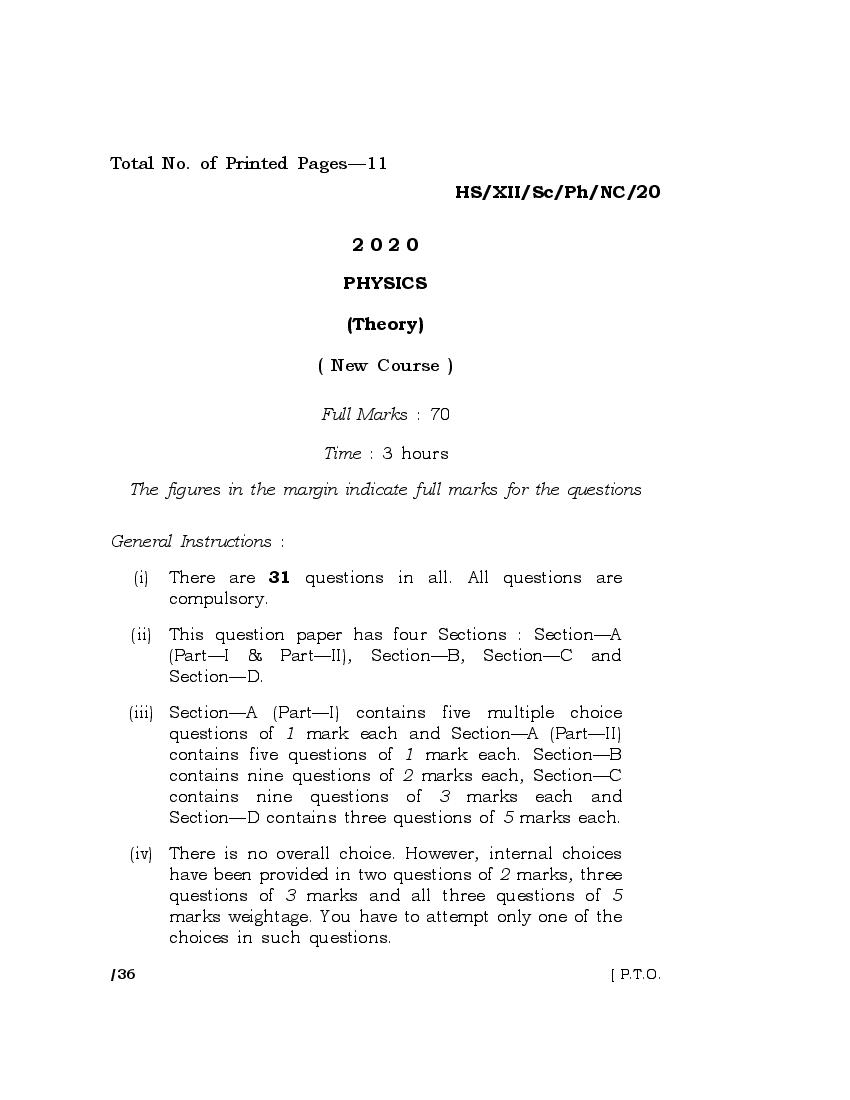
HS/XII/Sc/Ph/NC/20
2020
PHYSICS
(Theory)
( New Course )
Full Marks : 70
Time : 3 hours
The figures in the margin indicate full marks for the questions
General Instructions :
(i) There are 31 questions in all. All questions are
compulsory.
(ii) This question paper has four Sections : Section—A
(Part—I & Part—II), Section—B, Section—C and
Section—D.
(iii) Section—A (Part—I) contains five multiple choice
questions of 1 mark each and Section—A (Part—II)
contains five questions of 1 mark each. Section—B
contains nine questions of 2 marks each, Section—C
contains nine questions of 3 marks each and
Section—D contains three questions of 5 marks each.
(iv) There is no overall choice. However, internal choices
have been provided in two questions of 2 marks, three
questions of 3 marks and all three questions of 5
marks weightage. You have to attempt only one of the
choices in such questions.
/36 [ P.T.O.
Page 2
(v) You may use the following values of physical constants,
wherever necessary :
c = 3 ×10⁸ m s–1
h = 6·63 × 10–34 J s
e = 1·6 × 10–19 C
0 = 4 × 10⁻⁷ T m A–1
0 = 8·854 × 10–12 C2 N–1 m–2
me = 9·1 × 10–31 kg
Mass of neutron = 1·675 × 10–27 kg
Mass of proton = 1·673 × 10–27 kg
Avogadro’s number = 6·023 × 1023 per gram mole
Boltzmann constant = 1·38 × 10–23 J K–1
SECTION—A
PART—I
( Multiple choice type questions )
Choose the correct option from the following : 1×5=5
1. The flux in a coil of 50 turns changes from 0·3 Wb to
0·5 Wb in 8 seconds. The induced e.m.f. in the coil is
(A) 10 volts
(B) 0·6 volt
(C) –12 volts
(D) –1·25 volts 1
HS/XII/Sc/Ph/NC/20/36 [ Contd.
Page 3
2. Lenz’s law is a consequence of
(A) Ohm’s law
(B) back e.m.f. due to current
(C) law of conservation of energy
(D) law of conservation of charge 1
3. When light travels from an optically rarer medium to an
optically denser medium, the velocity of light decreases
because of change in
(A) frequency
(B) wavelength
(C) amplitude
(D) phase 1
4. To demonstrate the phenomenon of interference, we
require
(A) two sources which emit radiations of same frequency
(B) two sources which emit radiations of different
wavelengths
(C) two sources which emit radiations of nearly the
same frequency
(D) two sources which emit radiations of the same
frequency and have a definite phase relationship 1
HS/XII/Sc/Ph/NC/20/36 [ P.T.O.
Page 4
5. A conductor of radius r and length l has resistance 10 .
The conductor is stretched in such a way that its volume
is maintained constant and its length is increased by
10% of its original length. The resistance of the stretched
conductor is
(A) 8
(B) 100
(C) 12·10
(D) 20 1
PART—II
( Very short answer type questions )
Answer each of the following questions in 1 sentence/step :
1×5=5
6. The magnetic susceptibility of a substance is
1·66 105 . Name the type of magnetic substance it
represents. 1
7. Write the following radiations in the ascending order of
their frequencies : 1
Microwaves, Ultraviolet rays, X-rays and Infrared rays
8. How does the maximum kinetic energy of electron
emitted vary with work function of the metal? 1
HS/XII/Sc/Ph/NC/20/36 [ Contd.
Page 5
9. The radius of the innermost electron orbit of hydrogen
atom is 5 ·3 1011 m. What are the radii of the n = 2 and
n = 3 orbits ? 1
10. A power transmission line feeds input power at 2300 V
to a step-down transformer with its primary windings
having 4000 turns. What should be the number of
turns in the secondary in order to get an output power
at 230 V? 1
SECTION—B
( Short answer type–I questions )
Answer each of the following questions within 20 to 30 words,
wherever applicable : 2×9=18
11. Either
When resistances are connected in series, the effective
resistance increases. Why? 2
Or
What are carbon resistors? A carbon resistor is marked
in coloured bands in the sequence Blue, Green, Orange
and Gold. What is the resistance and tolerance value of
the resistor? 2
12. Write the relation of e.m.f. of a cell and its internal
resistance. What is the condition under which the
potential difference between the terminals of the cell and
its e.m.f. are equal? 2
HS/XII/Sc/Ph/NC/20/36 [ P.T.O.
Page 6
13. What is inductive reactance? Show how a purely
inductive circuit offers zero resistance to direct
current. 2
14. Either
Show that the effective power of two thin lenses in
contact is the sum of the power of each lens. 2
Or
Derive the relation between critical angle and refractive
index. 2
15. What is the effect on interference fringes in Young’s
double-slit experiment due to the following operations? 2
(a) Separation between the slits is increased
(b) The (monochromatic) source is replaced by another
(monochromatic) source of shorter wavelength
16. How is nuclear radius related to the mass number?
Obtain approximately the ratio of nuclear radii of gold
isotope 79 Au197 and silver isotope 47 Ag107 . 2
17. (a) In the hypothetical fission reaction
236
92 X a Y 144 36 Z b 30n1
what are the values of a and b ?
(b) What is a chain reaction? 2
HS/XII/Sc/Ph/NC/20/36 [ Contd.
Page 7
18. From the given circuit, find the value of current flowing
through the 2 resistor. Assume that D1 and D2 are two
ideal diodes : 2
19. What is V-I characteristic of a p-n junction diode? Draw
the V-I characteristics of a diode in—
(a) forward bias;
(b) reverse bias. ½+1½=2
SECTION—C
( Short answer type–II questions )
Answer each of the following questions within 30 to 40 words,
wherever applicable : 3×9=27
20. Three capacitors of capacitances 2 pF, 3 pF and 4 pF are
connected in parallel.
(a) What is the total capacitance of the combination?
(b) Determine the charge on each capacitor if the
combination is connected to a 100 V supply. 3
HS/XII/Sc/Ph/NC/20/36 [ P.T.O.
Page 8
21. What is the relationship between current and magnetic
moment of a current-carrying circular loop? Use the
expression to derive the magnetic dipole moment of a
revolving electron. 3
22. Either
(a) A closed loop is held stationary in the magnetic field
between the north and south poles of two permanent
magnets held fixed. Can we hope to generate current
in the loop by using very strong magnets?
(b) A closed loop moves normal to a constant electric
field between the plates of a large capacitor. Is
current induced in the loop—
(i) when it is wholly inside the region between the
capacitor plates;
(ii) when it is partially outside the plates of the
capacitor? 3
Or
Describe the principle and working of a transformer. 3
23. How are electromagnetic waves produced? Find the
wavelength of electromagnetic waves of frequency
5 1019 Hz in free space. Give its two applications.
1+1+1=3
24. (a) Plot a graph showing the variation of photoelectric
current with anode potential for two light beams of
same wavelength but different intensities.
HS/XII/Sc/Ph/NC/20/36 [ Contd.
Page 9
(b) The work function of cesium metal is 2·14 eV.
When light of frequency 6 1014 Hz is incident on
the metal surface, photoemission of electron occurs.
What is the maximum kinetic energy of the emitted
electron? 1+2=3
25. Either
(a) From the law of radioactive decay, show that the
total rate of decay, R R0e t, where the symbols
have their usual meanings.
(b) Derive the relationship between half-life of a
radioactive substance and its decay constant. 2+1=3
Or
Derive the expression for the total energy of an electron
in the nth orbit of hydrogen atom. 3
26. Either
Name the device which is used as voltage regulator.
Draw the necessary circuit diagram and explain its
working. 3
Or
With circuit diagram, distinguish between LED and
photodiode. What is dark current? 2+1=3
27. (a) Why do we prefer an objective of large aperture in a
telescope?
(b) A small telescope has an objective lens of focal
length 144 cm and an eyepiece of focal length
6·0 cm. What is the magnifying power of the
telescope? 2+1=3
HS/XII/Sc/Ph/NC/20/36 [ P.T.O.
Page 10
28. From the following circuit, using Kirchhoff’s rule, find the
current that flows through the 8 resistor : 3
SECTION—D
( Long answer type questions )
Answer each of the following questions within 70 to 80 words,
wherever applicable : 5×3=15
29. Either
With the help of a labelled diagram, state the underlying
principle of a cyclotron. Explain clearly how it works to
accelerate the charged particles. Is there an upper limit
on the energy acquired by the particle? Give reason.
1+2+2=5
Or
Derive the torque on a rectangular current-carrying loop
placed in a uniform magnetic field. Draw suitable
figures. Write one application of this principle. 4+½+½=5
HS/XII/Sc/Ph/NC/20/36 [ Contd.
Page 11
30. Either
(a) State Gauss’s law. Calculate the flux due to 1 C of
positive charge.
(b) Use Gauss’s law to obtain the expression for the
electric field due to a uniformly charged infinite
plane sheet. 2+3=5
Or
(a) Distinguish between polar and non-polar dielectrics.
(b) A dielectric slab of thickness t is inserted between
the plates of a parallel-plate capacitor separated by
distance d (t d ) . Obtain the capacitance of this
capacitor. 2+3=5
31. Either
What is an unpolarized light? Explain with the help of
a suitable diagram how an unpolarized light can be
polarized by reflection from a transparent medium. Write
the expression for Brewster’s angle in terms of refractive
index of denser medium. 1+3+1=5
Or
Draw a ray diagram to show the refraction of light
through a glass prism. Hence, obtain the relation for
angle of deviation in terms of angle of incidence, angle of
emergence and angle of prism. What is the refractive
index of the material of the prism? 1+2+2=5
HS/XII/Sc/Ph/NC/20/36 20K—4400
Document Details
| Board / Org | Meghalaya Board |
| Exam | Class 12 |
| Type | Question Paper |
| Pages | 11 |
| Updated | 30 Apr 2026 |