TIFR GS 2023 Question Paper Chemistry
Finished viewing? Save it for later —
Download TIFR GS 2023 Question Paper Chemistry (PDF · 17 pages)About TIFR GS 2023 Question Paper Chemistry
TIFR GS 2023 Question Paper Chemistry is available here for free download. Published by TIFR for TIFR GS, this question paper can be viewed online or downloaded as a PDF (17 pages). Candidates preparing for TIFR GS can use TIFR GS 2023 Question Paper Chemistry to understand the exam pattern, the type of questions asked, and the overall difficulty level.
Frequently Asked Questions
How can I download TIFR GS 2023 Question Paper Chemistry?
Open this page and click the Download button to save TIFR GS 2023 Question Paper Chemistry as a PDF. It is completely free on AglaSem Docs.
Is TIFR GS 2023 Question Paper Chemistry free to download?
Yes. TIFR GS 2023 Question Paper Chemistry can be viewed online and downloaded as a PDF free of cost on AglaSem Docs.
How many pages does TIFR GS 2023 Question Paper Chemistry have?
TIFR GS 2023 Question Paper Chemistry contains 17 pages, which you can read online or download together as a single PDF.
Where can I find more TIFR GS study material?
You can find more TIFR GS question papers, sample papers, syllabus, and answer keys on AglaSem Docs.
TIFR GS 2023 Question Paper Chemistry – Text
Read the full text of this question paper below — useful to quickly search, copy and reference the content online without downloading the PDF.
📄 View text version (17 pages)
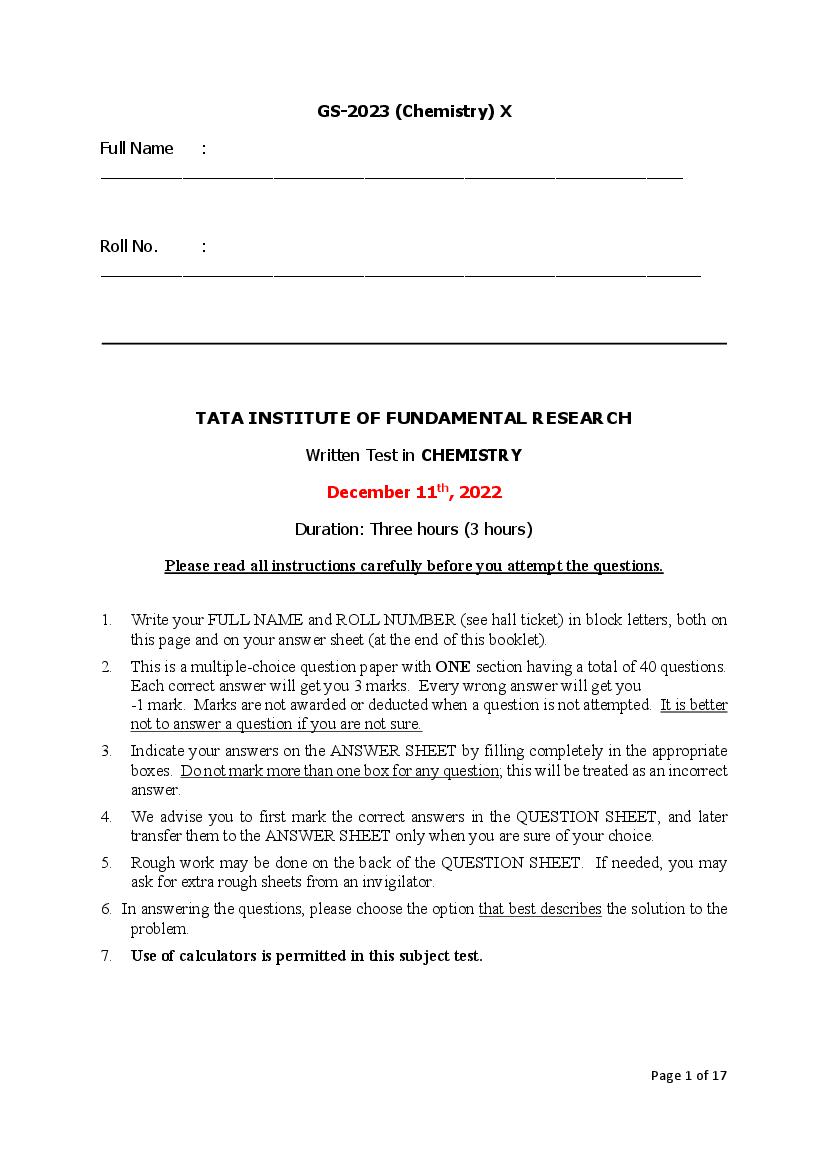
Page 1
Full Name :
________________________________________________________________
Roll No. :
__________________________________________________________________
TATA INSTITUTE OF FUNDAMENTAL RESEARCH
Written Test in CHEMISTRY
December 11th, 2022
Duration: Three hours (3 hours)
Please read all instructions carefully before you attempt the questions.
1. Write your FULL NAME and ROLL NUMBER (see hall ticket) in block letters, both on
this page and on your answer sheet (at the end of this booklet).
2. This is a multiple-choice question paper with ONE section having a total of 40 questions.
Each correct answer will get you 3 marks. Every wrong answer will get you
-1 mark. Marks are not awarded or deducted when a question is not attempted. It is better
not to answer a question if you are not sure.
3. Indicate your answers on the ANSWER SHEET by filling completely in the appropriate
boxes. Do not mark more than one box for any question; this will be treated as an incorrect
answer.
4. We advise you to first mark the correct answers in the QUESTION SHEET, and later
transfer them to the ANSWER SHEET only when you are sure of your choice.
5. Rough work may be done on the back of the QUESTION SHEET. If needed, you may
ask for extra rough sheets from an invigilator.
6. In answering the questions, please choose the option that best describes the solution to the
problem.
7. Use of calculators is permitted in this subject test.
Page 1 of 17
Page 2
Avogadro number = 6.02´1023 mol-1 e = 1.6´10-19 C
RT/F = 0.0257 V at 25°C h = 6.626´10-34 J s
Faraday constant = 96500 C/mol c = 3´108 m s-1
Boltzmann constant kB = 1.38´10-23 J K-1 R = 8.314 J K-1 mol-1
Mass of an electron = 9.109´10-31 kg
1. If A and B are two operators that do not commute, which amongst the following is the
correct statement (here [A, B] = AB – BA is the commutator and {A, B} = AB + BA
is the anticommutator):
A) A and B can be measured simultaneously with zero error.
B) exp(A) exp(B) = exp(A + B)
C) exp(A) exp(B) = exp(A + B + ½ [A, B] + 1/12 [A, [A,B]] - 1/12 [B, [A, B]] + …)
D) exp(A) exp(B) = exp(A + B + ½ {A, B} + 1/12 {A, {A,B}} - 1/12 {B, {A, B}} +
…)
2. Consider the bound states of the following three potentials:
(1) V(x) = x2: harmonic potential
(2) V(x) = x4: quartic potential
(3) V(x) = (1-exp(-a (x-x0)))2: morse potential
If ΔE(n) = E(n+1) – E(n) is the difference between the (n+1)th and nth bound states
of a potential, which of the following statements is true:
A) ΔE(n) is constant for all three potentials
B) ΔE(n) is constant for potential (1), but monotonically decreases for potentials (2)
and (3)
C) ΔE(n) is constant for potential (1), monotonically increasing for potential (2), and
monotonically decreasing for potential (3)
D) Insufficient information provided
3. Based on Crystal Field Stabilization Energy, predict the order of binding constants for
the following divalent metal ion to ethylenediaminetetra-acetic acid
A) Mn(II) < Fe(II) < Co(II) < Ni(II) < Zn (II) < Cu(II)
Page 2 of 17
Page 3
C) Mn(II) < Fe(II) < Co(II) < Zn (II) < Ni(II) < Cu (II)
D) Mn(II) < Cu(II) < Co(II) < Zn (II) < Ni(II) < Fe(II)
4. Predict the product of the following reaction.
A)
B)
C)
Page 3 of 17
Page 4
5. Predict the order of basicity.
A)
B)
C)
D)
6. A mixture of four compounds is separated on a silica thin layer chromatography plate.
Page 4 of 17
Page 5
A)
B)
C)
D)
7. Estimate the minimum uncertainty in the speed of an electron in a hydrogen atom given
that the atomic diameter is 1 Å.
A) 540 nm/s
B) 520 m/s
C) 580 km/s
D) 500 Å/s
8. Consider a quantum particle trapped in a 1-d box (potential energy zero inside the box
and infinity outside) of length L. What can be said about the probability of finding the
particle, Pc, at the center of the box in the n=1 and n=2 states for this system if the
box length is doubled.
Page 5 of 17
Page 6
B) Pc decreases for both states
C) Pc is unchanged for n=1 but decreases for n=2
D) Pc is unchanged for both states
9. Consider a solid lattice formed out of identical atoms. Each atom is constrained to its
equilibrium position 𝑥! by a harmonic potential of the form 𝑉 = 0.5𝑘(𝑥 − 𝑥! )" ; where
𝑘 is the spring constant. If this system is heated, then the atomic positions will fluctuate
about their equilibrium positions. Which of the following is true for the relation between
the root mean square deviations (RMSD) of atomic fluctuations and temperature (T):
A) 𝑅𝑀𝑆𝐷 ∝ 𝑇 #/"
B) 𝑅𝑀𝑆𝐷 ∝ 𝑇 %/"
C) 𝑅𝑀𝑆𝐷 ∝ 𝑇 "/#
D) 𝑅𝑀𝑆𝐷 ∝ 𝑇
10. The vector triple product of any three vectors in 3 dimensions: (𝒃 × 𝒂) × 𝒄 is always
equal to
A) (𝒃 ∙ 𝒄)𝒂 − (𝒂 ∙ 𝒄)𝒃
B) (𝒃 ∙ 𝒄)𝒂 − (𝒃 ∙ 𝒂)𝒄
C) (𝒄 ∙ 𝒂)𝒃 − (𝒃 ∙ 𝒄)𝒂
D) (𝒃 ∙ 𝒂)𝒄 − (𝒂 ∙ 𝒄)𝒃
1 2 1 3
11. A = 7 < and B = 7 <. If |A| represents the determinant of matrix A and |B|
3 4 2 4
represents the determinant of matrix B, which of the following statements is most
appropriate:
A) |A| ≠ |B| as A and B are different.
B) |A| = |B| as the rows and columns in A and B have been interchanged.
Page 6 of 17
Page 7
D) Both statements b and c.
12. You are given a string of length L. What is the area of the largest rectangle you can
construct with it?
A) L
B) L2/4
C) L2/2
D) L2/16
13. You are monitoring an isomerization reaction like a protein folding reaction. You find
that the rate constant (𝑘) of the reaction does not vary with temperature. Assuming
!"#∗
Arrhenius kinetics of the type 𝑘 = 𝑘& 𝑒 ' %& , where Δ𝐺 ∗ = Δ𝐻∗ − 𝑇Δ𝑆 ∗ . Here the
activation enthalpy (Δ𝐻∗ ), the activation entropy (Δ𝑆 ∗ ) and 𝑘& are all independent of
temperature. What can you conclude about the reaction?
A) That Δ𝐻∗ ≈ 0
B) That Δ𝑆 ∗ ≈ 0
C) That Δ𝐺 ∗ is independent of temperature
D) That Δ𝐺 ∗ < 0.
14. For an endothermic chemical reaction which of the following statement is correct:
A) With increasing temperature forward rate increases and backward rate decreases
B) With increasing temperature backward rate increases and forward rate decreases
C) With increasing temperature, both forward and backward rate increases
D) With increasing temperature, forward rate increases and backward rate stays
unaffected
15. Consider a process of separating isotopes of helium 3He from 4He using a process of
gas effusion-based separation. Given that one starts the separation process from a
mixture with natural abundance of 3He = 0.000134% and 4He = 99.999866%, how
many effusion steps are needed to get 3He with a purity of at least 99%?
A) 100 steps
B) 94 steps
C) 941 steps
Page 7 of 17
Page 8
16. Consider the following molecule:
Assuming that the delocalised pi-electron system can be described by the particle in 1-
D box model, estimate the wavelength region where the lowest energy electronic
transition is expected to appear? (Note that the C-C single bond length is 1.54 Angstrom
and C-C double bond length is 1.35 Angstrom)
A) 200 – 300 nm
B) 1200 – 1400 nm
C) 3000 – 3200 nm
D) 500 – 600 nm
17. Consider the following equation where c is a real number :
f(x) = x # − 2x " + 6x + c = 0
What is the maximum number of real roots this equation can have?
A) 1
B) 0
C) 3
D) 2
18. The value of change in enthalpy (DH) at 298 K and one bar for the reaction described
by
2H2(g)+O2(g) → 2H2O (l)
is -572 kJ. What is change in internal energy (DU) for this reaction (assume ideal
behavior):
A) -106 kJ
Page 8 of 17
Page 9
C) -7702 kJ
D) -233 kJ
19. Calculate the number of ways of dividing 10 distinguishable objects into three groups
containing 2,5 and 3 objects:
A) 5598
B) 8100
C) 678
D) 2520
20. Molar entropy change upon melting of ice at 1 atm at 273 K
A) Would be 0
B) Would depend on latent heat of melting
C) Would be independent of temperature
D) Would be independent of pressure
21. In gas chromatography, what is the basis of the separation of the mixture of molecules
on a solid stationary phase,
A) molecular weight of the molecules
B) size of the molecules
C) polarity of the molecules
D) polarity and molecular weight of the molecules
22. The low-resolution mass spectrum of 2-chlorohexane exhibits a group of signals
associated with the intact molecule at m/z 120, 121, 122 and 123. What isotopes are
responsible for the signal at m/z 122?
A) 12C, 35Cl, 1H
Page 9 of 17
Page 10
C) 12C, 37Cl, 1H
D) 13C, 37Cl, 1H
23. Dissolving CoCl2 in water produces a pale pink solution due to the formation of
[Co(H2O)6 ]+2. On adding HCl it forms [Co(Cl)4]-2. Which of the following
statements is false
A) Both the complexes have spin allowed transitions.
B) Only [Co(Cl)4]-2 has Laporte allowed transitions.
C) Both the complexes have Laporte allowed transitions.
D) Only [Co(H2O)6]+2 has Laporte allowed transitions.
24. If standard potential of the reaction 2H2O(l) = O2(g, 1bar) + 4H+(aq) + 4e- is
E0 = -1.23 V. At ambient condition, i.e. at 25oC and pH =7, what is the oxidation
potential of pure water according to this reaction?
A) -0.41 V
B) -2.62 V
C) -0.817 V
D) -1.41 V
25. What is the value of 𝑖 log%) 𝑖 " , where 𝑖 = √−1
A) Real number
B) Complex number
C) Cannot be calculated
D) None of the above
26. The acidity of molecules is usually measured by a parameter called the pKa. The pKa
of regular bulk water is 15.7. Arrange the pKa of water in decreasing trend of acidity
for the following water solubilized aqua complexes: Ca2+, Fe2+, Mn2+, Fe3+
Page 10 of 17
Page 11
B) Fe3+ > Fe2+ > Mn2+ > Ca2+
C) Fe2+ > Mn2+ > Ca2+ > Fe3+
D) Mn2+ > Ca2+ > Fe2+ > Fe3+
27. To the naked eye, oceans are always blue. With this premise, we compare a pool of
regular water versus that of heavy water (D2O). Why will the pool of heavy water
always look more transparent than regular water? Is it due to:
A) Rayleigh Scattering
B) Kinetic Isotope effects
C) Absorption
D) Marine life cannot be sustained in D2O
28. Predict the major product in the following transformation.
A) A
B) B
C) C
D) D
Page 11 of 17
Page 12
penetrates the tissues through passive diffusion.
Where would ibuprofen be absorbed preferentially?
A) Mouth
B) Stomach
C) Intestine
D) Mouth and intestine
30. Predict the correct product of the following reaction?
A) A
B) B
C) C
D) D
31. Which of the following operators is Hermitian ?
A) -d/dx
Page 12 of 17
Page 13
C) d/dx
D) x + d/dx
32. In the 1D particle-in-a-box problem, which of the following is NOT true for the
wavefunction?
A) The wavefunction is an eigenfunction of kinetic energy operator
B) The wavefunction is an eigenfunction of momentum operator
C) The number of nodes increases as one goes to higher energy states
D) The probability density close to the walls increases as we go to higher excited
states
33. Which of the following is NOT a linear operator?
A) d/dx
B) ∫ dx
C) ( )2
D) d2/dx2
34. For a given first-order reaction, if 63.5% of the material is reacted in 100 s, what is
the half-life of the reaction?
A) 69 s
B) 91 s
C) 154 s
D) 32 s
35. The mass spectrum of a non-polar organic compound shows M+, M++2 and M++4
peaks at the ratio of 9:6:1. The compound could be
(A) 1, 3 - Dichlorobenzene
(B) 1, 4 - Dibromobenzene
Page 13 of 17
Page 14
(D) 1, 1 - Difluoroethylene
36. Identify the pair of enantiomers.
CHO CHO CH2OH CHO
HO H H Cl Cl H HO H
H Cl HO H HO H Cl H
CH2OH CH2OH CHO CH2OH
I II III IV
A) I & II
B) III & IV
C) I & IV
D) II & III
Page 14 of 17
Page 15
hν
A)
A) B) C) D)
B)
A) B) C) D)
C)
B) C) D)
D)
C) D)
38. Predict the product
1. EtONa
CH2(CO2Et)2
2. CH3CH2Br
3. H+,
A)
A) CO2H B) CO2H C) CO2Et D) CO2H
CO2H
B)
CO2H B) CO2H C) CO2Et D) CO2H
CO2H
C)
CO2H C) CO2Et D) CO2H
Page 15 of 17
Page 16
CO2Et D) CO2H
39. Predict the product
ONO hν
A)
OH
N
A) OH B) OH
N
OH
B)
C) OH D) O
N
O OH
OH B) OH N
N A) OH B) OH
OH
C) N
OH
D) O
O C) OH D) O
N
O
OH B) OH
D)
N
OH
D) O
O
1 −2
40. If A = 7 <, find the smallest eigenvalue of A10
1 4
Page 16 of 17
Page 17
B) 59049
C) 1024
D) 0.999
Page 17 of 17
Document Details
| Board / Org | TIFR |
| Exam | TIFR GS |
| Type | Question Paper |
| Pages | 17 |
| Updated | 23 Oct 2026 |