DUET Question Paper 2019 for MA Linguistics
Finished viewing? Save it for later —
Download DUET Question Paper 2019 for MA Linguistics (PDF · 11 pages)About DUET Question Paper 2019 for MA Linguistics
DUET Question Paper 2019 for MA Linguistics is available here for free download. Published by NTA for DUET, this question paper can be viewed online or downloaded as a PDF (11 pages). Candidates preparing for DUET can use DUET Question Paper 2019 for MA Linguistics to understand the exam pattern, the type of questions asked, and the overall difficulty level.
Frequently Asked Questions
How can I download DUET Question Paper 2019 for MA Linguistics?
Open this page and click the Download button to save DUET Question Paper 2019 for MA Linguistics as a PDF. It is completely free on AglaSem Docs.
Is DUET Question Paper 2019 for MA Linguistics free to download?
Yes. DUET Question Paper 2019 for MA Linguistics can be viewed online and downloaded as a PDF free of cost on AglaSem Docs.
How many pages does DUET Question Paper 2019 for MA Linguistics have?
DUET Question Paper 2019 for MA Linguistics contains 11 pages, which you can read online or download together as a single PDF.
Where can I find more DUET study material?
You can find more DUET question papers, sample papers, syllabus, and answer keys on AglaSem Docs.
DUET Question Paper 2019 for MA Linguistics – Text
Read the full text of this question paper below — useful to quickly search, copy and reference the content online without downloading the PDF.
📄 View text version (11 pages)
Page 1
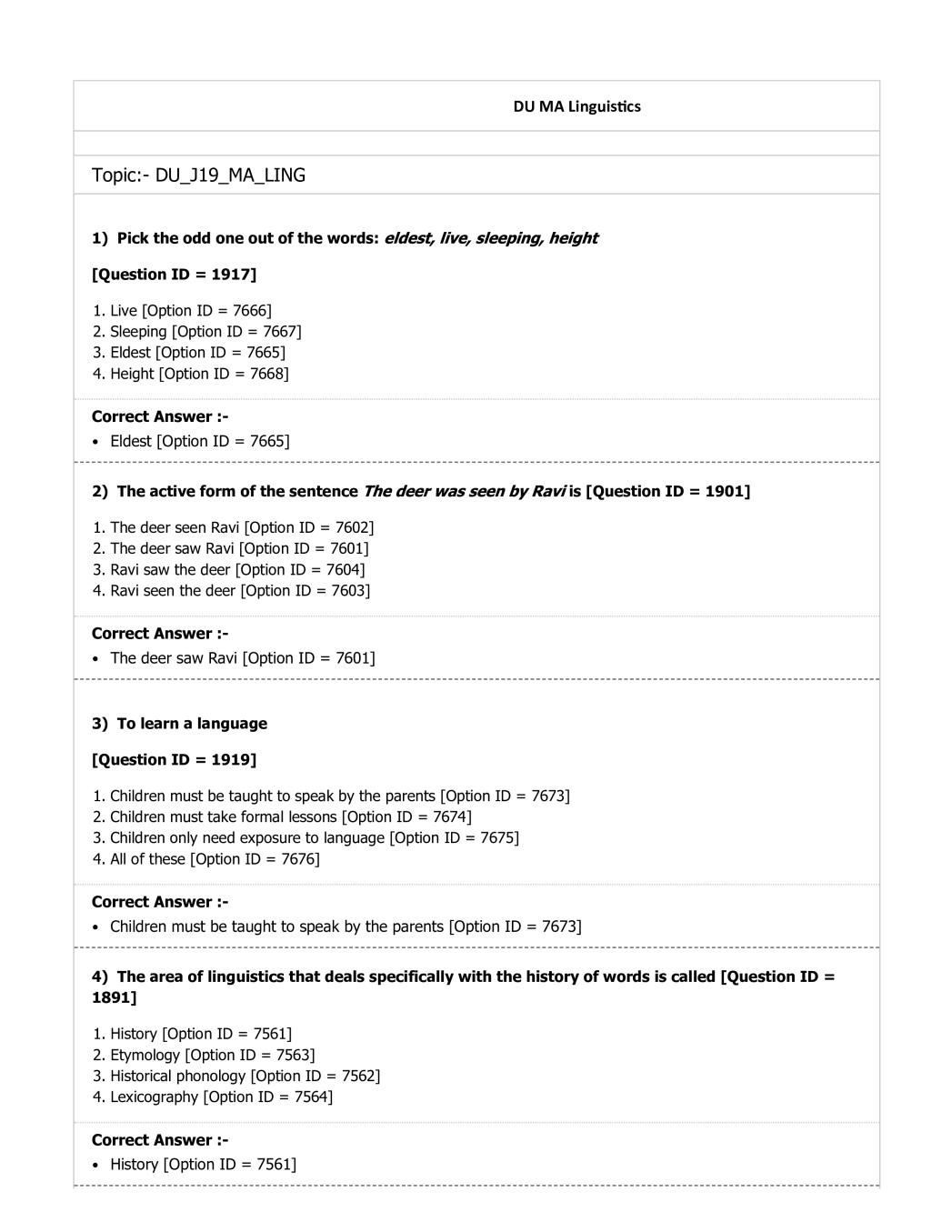
Topic:- DU_J19_MA_LING
1) Pick the odd one out of the words: eldest, live, sleeping, height
[Question ID = 1917]
1. Live [Option ID = 7666]
2. Sleeping [Option ID = 7667]
3. Eldest [Option ID = 7665]
4. Height [Option ID = 7668]
Eldest [Option ID = 7665]
2) The active form of the sentence The deer was seen by Ravi is [Question ID = 1901]
1. The deer seen Ravi [Option ID = 7602]
2. The deer saw Ravi [Option ID = 7601]
3. Ravi saw the deer [Option ID = 7604]
4. Ravi seen the deer [Option ID = 7603]
The deer saw Ravi [Option ID = 7601]
3) To learn a language
[Question ID = 1919]
1. Children must be taught to speak by the parents [Option ID = 7673]
2. Children must take formal lessons [Option ID = 7674]
3. Children only need exposure to language [Option ID = 7675]
4. All of these [Option ID = 7676]
Children must be taught to speak by the parents [Option ID = 7673]
4) The area of linguistics that deals specifically with the history of words is called [Question ID =
1891]
1. History [Option ID = 7561]
2. Etymology [Option ID = 7563]
3. Historical phonology [Option ID = 7562]
4. Lexicography [Option ID = 7564]
History [Option ID = 7561]
Page 2
1. None of these [Option ID = 7680]
2. Object-verb-subject [Option ID = 7679]
3. Subject-verb-object [Option ID = 7678]
4. Subject-object-verb [Option ID = 7677]
Subject-object-verb [Option ID = 7677]
6) In the sentence Kim will send Lee a gift, a gift is best described as [Question ID = 1885]
1. An adjunct [Option ID = 7537]
2. An indirect object [Option ID = 7540]
3. A direct object [Option ID = 7539]
4. A subject [Option ID = 7538]
An adjunct [Option ID = 7537]
7) The principle language spoken in Daman & Diu is [Question ID = 1916]
1. Gujarati [Option ID = 7661]
2. Marathi [Option ID = 7662]
3. Konkani [Option ID = 7664]
4. Kannada [Option ID = 7663]
Gujarati [Option ID = 7661]
8) In the sentence The burnt cake started smelling, the word burnt is [Question ID = 1884]
1. A noun [Option ID = 7536]
2. An adverb [Option ID = 7533]
3. A verb [Option ID = 7535]
4. An adjective [Option ID = 7534]
An adverb [Option ID = 7533]
9) The words steel and steal are [Question ID = 1882]
1. Different in one sound [Option ID = 7526]
2. Different in one letter [Option ID = 7525]
3. One sound and one letter [Option ID = 7528]
4. No difference [Option ID = 7527]
Different in one letter [Option ID = 7525]
10) Tulu is spoken primarily in the state of [Question ID = 1906]
Page 3
2. Gujarat [Option ID = 7622]
3. Telangana [Option ID = 7621]
4. Sikkim [Option ID = 7623]
Telangana [Option ID = 7621]
11) The appropriate “Tag Question” for the sentence The boy is sleeping is [Question ID = 1900]
1. Doesn’t he? [Option ID = 7598]
2. Isn’t he? [Option ID = 7597]
3. Hasn’t he? [Option ID = 7600]
4. Didn’t it? [Option ID = 7599]
Isn’t he? [Option ID = 7597]
12) The area of linguistics that deals specifically with language and brain is [Question ID = 1883]
1. Lexicography [Option ID = 7532]
2. Psycholinguistics [Option ID = 7529]
3. Semantics [Option ID = 7531]
4. Morphology [Option ID = 7530]
Psycholinguistics [Option ID = 7529]
13) The area of Linguistics that deals specifically with the science of speech-sounds is called
[Question ID = 1923]
1. Syntax [Option ID = 7692]
2. Phonetics [Option ID = 7691]
3. Semantics [Option ID = 7689]
4. Morphology [Option ID = 7690]
Semantics [Option ID = 7689]
14) A Linguist is best described as a person who [Question ID = 1875]
1. Analyses languages [Option ID = 7500]
2. Speaks many languages [Option ID = 7497]
3. Knows many scripts [Option ID = 7498]
4. Learns many languages [Option ID = 7499]
Speaks many languages [Option ID = 7497]
15) A major goal of linguistics is [Question ID = 1874]
1. The deeper understanding of linguistic knowledge [Option ID = 7495]
Page 4
3. The learning of as many languages as possible [Option ID = 7496]
4. The building of vocabulary [Option ID = 7494]
The study of English and foreign languages [Option ID = 7493]
16) Among the words weapon, chair, success, knife, the odd word out is [Question ID = 1887]
1. Weapon [Option ID = 7546]
2. Chair [Option ID = 7545]
3. Knife [Option ID = 7548]
4. Success [Option ID = 7547]
Chair [Option ID = 7545]
17) In which of the following words, is the letter ‘o’ used for the same sound?
cool road dot node
A B C D
[Question ID = 1922]
1. C and D [Option ID = 7686]
2. B and D [Option ID = 7685]
3. B and C [Option ID = 7688]
4. A and C [Option ID = 7687]
B and D [Option ID = 7685]
18) An example of a tonal language is [Question ID = 1902]
1. Chinese [Option ID = 7606]
2. English [Option ID = 7607]
3. Hindi [Option ID = 7605]
4. German [Option ID = 7608]
Hindi [Option ID = 7605]
19) A person who has acquired the ability to communicate effectively in three or more languages
can be described as [Question ID = 1876]
1. Metalingual [Option ID = 7504]
2. None of these [Option ID = 7503]
3. Multilingual [Option ID = 7502]
4. Monolingual [Option ID = 7501]
Monolingual [Option ID = 7501]
Page 5
[Question ID = 1915]
1. Indo-European languages [Option ID = 7657]
2. Uralic languages [Option ID = 7659]
3. Semitic languages [Option ID = 7658]
4. None of them [Option ID = 7660]
Indo-European languages [Option ID = 7657]
21) The possessive pronoun form of he is [Question ID = 1896]
1. Boy’s [Option ID = 7581]
2. His [Option ID = 7584]
3. Ram’s [Option ID = 7582]
4. Him [Option ID = 7583]
Boy’s [Option ID = 7581]
22) The relationship between the words situation and situate is best described as [Question ID =
1881]
1. Adjective - Noun [Option ID = 7523]
2. Noun - Adjective [Option ID = 7522]
3. Noun - Verb [Option ID = 7524]
4. Noun - Noun [Option ID = 7521]
Noun - Noun [Option ID = 7521]
23) In the following sentence, which among the four sections has an error?
I am understanding your question.
(A) (B) (C) (D)
[Question ID = 1890]
1. D [Option ID = 7560]
2. B [Option ID = 7558]
3. A [Option ID = 7557]
4. C [Option ID = 7559]
A [Option ID = 7557]
24) In the following words, which of the italicized and bold letters represent the same sound?
ea
(i) t ee
(ii) r l (iii) rea (iv) b r ea
[Question ID = 1911]
Page 6
2. (ii) and (iv) [Option ID = 7642]
3. (i) and (ii) [Option ID = 7643]
4. (i) and (iii) [Option ID = 7641]
(i) and (iii) [Option ID = 7641]
25) In the following words, which of the italicised and bold letters represent the same sound?
(i)phone ph
(ii) u ill (iii) rou gh
(iv) plough
[Question ID = 1908]
1. (iii) and (iv) [Option ID = 7630]
2. (ii) and (iv) [Option ID = 7632]
3. (i) and (ii) [Option ID = 7629]
4. (i) and (iii) [Option ID = 7631]
(i) and (ii) [Option ID = 7629]
26) The number of distinct spoken sounds in the sentence Come at once! is [Question ID = 1889]
1. 9 [Option ID = 7553]
2. 7 [Option ID = 7555]
3. 10 [Option ID = 7556]
4. 8 [Option ID = 7554]
9 [Option ID = 7553]
27) The number of distinct spoken sounds in the word though is [Question ID = 1888]
1. 6 [Option ID = 7552]
2. 2 [Option ID = 7551]
3. 3 [Option ID = 7549]
4. 4 [Option ID = 7550]
3 [Option ID = 7549]
28) The term “Brahui” is the name of [Question ID = 1879]
1. An archaeological site [Option ID = 7516]
2. A living language [Option ID = 7513]
3. An ancient dynasty [Option ID = 7515]
4. An ancient script [Option ID = 7514]
A living language [Option ID = 7513]
29) Which of these are synonyms? [Question ID = 1912]
Page 7
2. Grey - Cloudy [Option ID = 7648]
3. Dense - Sparse [Option ID = 7646]
4. Express - Convey [Option ID = 7647]
Dated - Modern [Option ID = 7645]
30) Which of these languages belong to the same language family as Sinhala? [Question ID = 1918]
1. Gujarati [Option ID = 7672]
2. Manipuri [Option ID = 7669]
3. Santhali [Option ID = 7670]
4. Mundari [Option ID = 7671]
Manipuri [Option ID = 7669]
31) Which of the following deals with the formation of words? [Question ID = 1905]
1. Phonology [Option ID = 7618]
2. Phonetics [Option ID = 7617]
3. Syntax [Option ID = 7620]
4. Morphology [Option ID = 7619]
Phonetics [Option ID = 7617]
32) Which of the following languages does not belong to the same language family as the other
three? [Question ID = 1921]
1. Marathi [Option ID = 7682]
2. German [Option ID = 7681]
3. Telugu [Option ID = 7683]
4. Assamese [Option ID = 7684]
German [Option ID = 7681]
33) Match the following:
(i) Meghalaya A. Kokborok
(ii) Jharkhand B. Tangkhul
(iii) Manipur C. Mundari
(iv) Tripura D. Garo
[Question ID = 1877]
1. i-D; ii-C; iii-B; iv-A [Option ID = 7506]
2. i-D; ii-A; iii-C; iv-B [Option ID = 7507]
3. i-C; ii-D; iii-A; iv-B [Option ID = 7505]
4. i-B; ii-D; iii-A; iv-C [Option ID = 7508]
Page 8
34) Introduction and Appendix are [Question ID = 1880]
1. Hypernyms [Option ID = 7517]
2. Synonyms [Option ID = 7520]
3. Antonyms [Option ID = 7519]
4. Homonyms [Option ID = 7518]
Hypernyms [Option ID = 7517]
35) The sentence Ravi haven’t slept, is ungrammatical because of [Question ID = 1899]
1. Tense [Option ID = 7593]
2. Gender [Option ID = 7595]
3. Agreement [Option ID = 7596]
4. Aspect [Option ID = 7594]
Tense [Option ID = 7593]
36) The sentence Madhu arrived by tomorrow is wrong because of [Question ID = 1895]
1. Tense [Option ID = 7580]
2. Word order [Option ID = 7577]
3. Number [Option ID = 7579]
4. Agreement [Option ID = 7578]
Word order [Option ID = 7577]
37) The sentence, The hamburger envies the cat, is ungrammatical because [Question ID = 1892]
1. Envy must have a non-human subject [Option ID = 7566]
2. Envy must have a non-human object [Option ID = 7565]
3. Envy must have a human subject [Option ID = 7567]
4. Envy must have a human object [Option ID = 7568]
Envy must have a non-human object [Option ID = 7565]
38) The sentence, Mary wept the sofa, is ungrammatical because [Question ID = 1893]
1. Weepis an intransitive verb [Option ID = 7572]
2. Weepis a transitive verb [Option ID = 7571]
3. The word order is wrong [Option ID = 7569]
4. The sentence is incomplete [Option ID = 7570]
The word order is wrong [Option ID = 7569]
Page 9
1. Tumbler [Option ID = 7541]
2. Sing [Option ID = 7543]
3. Glass [Option ID = 7544]
4. Attention [Option ID = 7542]
Tumbler [Option ID = 7541]
40) Which of the following language families does Konkani belong to? [Question ID = 1878]
1. Austro-Asiatic [Option ID = 7510]
2. None of these [Option ID = 7512]
3. Dravidian [Option ID = 7511]
4. Indo-European [Option ID = 7509]
Indo-European [Option ID = 7509]
41) Which of the following languages belong to the same language family?
(i) Hindi (ii) Chinese (iii) English (iv) Hebrew [Question ID = 1909]
1. (i) and (iii) [Option ID = 7633]
2. (i) and (ii) [Option ID = 7635]
3. (ii) and (iii) [Option ID = 7634]
4. (ii) and (iv) [Option ID = 7636]
(i) and (iii) [Option ID = 7633]
42) Which of the following languages belong to the same language family?
(i) Tamil (ii) Tulu (iii) Sanskrit (iv) Mundari [Question ID = 1910]
1. (i) and (ii) [Option ID = 7637]
2. (i) and (iii) [Option ID = 7639]
3. (ii) and (iii) [Option ID = 7638]
4. (ii) and (iv) [Option ID = 7640]
(i) and (ii) [Option ID = 7637]
43) Which of the following is an abstract noun? [Question ID = 1898]
1. Opinion [Option ID = 7590]
2. Bag [Option ID = 7591]
3. Running [Option ID = 7589]
4. Lemonade [Option ID = 7592]
Running [Option ID = 7589]
Page 10
1. English and Odia are members of the same language family [Option ID = 7656]
2. The difference between a language and a dialect is that a dialect has no script [Option ID = 7653]
3. Sign languages cannot be truly considered languages [Option ID = 7655]
4. Scheduled languages are the languages of scheduled tribes [Option ID = 7654]
The difference between a language and a dialect is that a dialect has no script [Option ID = 7653]
45) Which one of the following is a mass noun? [Question ID = 1897]
1. Rice [Option ID = 7585]
2. Book [Option ID = 7586]
3. Cup [Option ID = 7587]
4. Umbrella [Option ID = 7588]
Rice [Option ID = 7585]
46) Which one of the following is not recognized as a classical language in India? [Question ID =
1904]
1. Marathi [Option ID = 7615]
2. Tamil [Option ID = 7613]
3. Sanskrit [Option ID = 7616]
4. Malayalam [Option ID = 7614]
Tamil [Option ID = 7613]
47) Which one of the following does not contain a front vowel? [Question ID = 1907]
1. Abandon [Option ID = 7628]
2. Say [Option ID = 7626]
3. Sign [Option ID = 7625]
4. Goose [Option ID = 7627]
Sign [Option ID = 7625]
48) Which one of the following is true? [Question ID = 1903]
1. Sanskrit is not a Scheduled Language [Option ID = 7610]
2. Bhojpuri and Magahi are Scheduled Languages [Option ID = 7612]
3. Scheduled languages are spoken by the Scheduled Tribes of India [Option ID = 7611]
4. Santali and Maithili are Scheduled Languages [Option ID = 7609]
Santali and Maithili are Scheduled Languages [Option ID = 7609]
49) The past form for a non-existent word like blop should be [Question ID = 1894]
Page 11
2. Blops [Option ID = 7576]
3. Bliped [Option ID = 7574]
4. Blip [Option ID = 7573]
Blip [Option ID = 7573]
50) Toda is a language spoken by a community living in [Question ID = 1913]
1. Tamil Nadu [Option ID = 7652]
2. Bihar [Option ID = 7650]
3. Mizoram [Option ID = 7651]
4. Orissa [Option ID = 7649]
Orissa [Option ID = 7649]