UGC NET Dance Question Paper 2018
Finished viewing? Save it for later —
Download UGC NET Dance Question Paper 2018 (PDF · 40 pages)About UGC NET Dance Question Paper 2018
UGC NET Dance Question Paper 2018 is available here for free download. Published by NTA for UGC National Eligibility Test, this question paper can be viewed online or downloaded as a PDF (40 pages). Candidates preparing for UGC National Eligibility Test can use UGC NET Dance Question Paper 2018 to understand the exam pattern, the type of questions asked, and the overall difficulty level.
Frequently Asked Questions
How can I download UGC NET Dance Question Paper 2018?
Open this page and click the Download button to save UGC NET Dance Question Paper 2018 as a PDF. It is completely free on AglaSem Docs.
Is UGC NET Dance Question Paper 2018 free to download?
Yes. UGC NET Dance Question Paper 2018 can be viewed online and downloaded as a PDF free of cost on AglaSem Docs.
How many pages does UGC NET Dance Question Paper 2018 have?
UGC NET Dance Question Paper 2018 contains 40 pages, which you can read online or download together as a single PDF.
Where can I find more UGC National Eligibility Test study material?
You can find more UGC National Eligibility Test question papers, sample papers, syllabus, and answer keys on AglaSem Docs.
UGC NET Dance Question Paper 2018 – Text
Read the full text of this question paper below — useful to quickly search, copy and reference the content online without downloading the PDF.
📄 View text version (40 pages)
Page 1
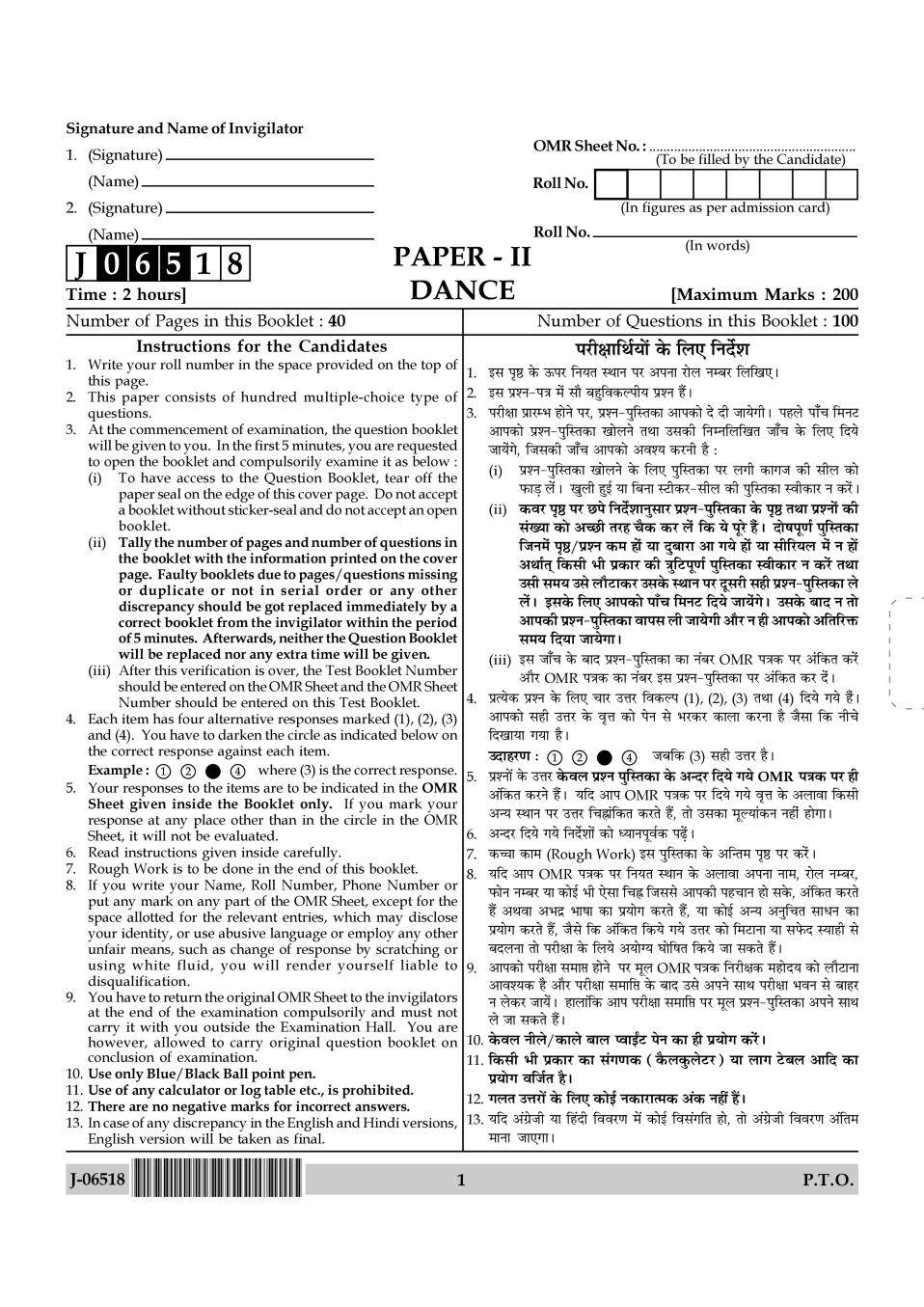
OMR Sheet No. : ..........................................................
1. (Signature) (To be filled by the Candidate)
(Name) Roll No.
2. (Signature) (In figures as per admission card)
(Name) Roll No.
(In words)
J 0 6 5 1 8 PAPER - II
Time : 2 hours] DANCE [Maximum Marks : 200
Number of Pages in this Booklet : 40 Number of Questions in this Booklet : 100
Instructions for the Candidates ¬⁄UˡÊÊÁÕ¸ÿÙ¢ ∑§ Á‹∞ ÁŸŒ¸‡Ê
1. Write your roll number in the space provided on the top of
1. ß‚ ¬ÎDU ∑§ ™§¬⁄U ÁŸÿà SÕÊŸ ¬⁄U •¬ŸÊ ⁄UÙ‹U Ÿê’⁄U Á‹Áπ∞–
this page.
2. This paper consists of hundred multiple-choice type of 2. ß‚ ¬˝‡Ÿ-¬òÊ ◊¢ ‚ÊÒ ’„ÈÁfl∑§À¬Ëÿ ¬˝‡Ÿ „Ò¥–
questions. 3. ¬⁄UˡÊÊ ¬˝Ê⁄êU÷ „ÙŸ ¬⁄U, ¬˝‡Ÿ-¬ÈÁSÃ∑§Ê •Ê¬∑§Ù Œ ŒË ¡ÊÿªË– ¬„‹U ¬UÊ°ø Á◊Ÿ≈U
3. At the commencement of examination, the question booklet •Ê¬∑§Ù ¬˝‡Ÿ-¬ÈÁSÃ∑§Ê πÙ‹Ÿ ÃÕÊ ©‚∑§Ë ÁŸêŸÁ‹Áπà ¡Ê°ø ∑§ Á‹∞ ÁŒÿ
will be given to you. In the first 5 minutes, you are requested ¡Êÿ¢ª, Á¡‚∑§Ë ¡Ê°ø •Ê¬∑§Ù •fl‡ÿ ∑§⁄UŸË „Ò —
to open the booklet and compulsorily examine it as below :
(i) ¬˝‡Ÿ-¬ÈÁSÃ∑§Ê πÙ‹Ÿ ∑§ Á‹∞ ¬ÈÁSÃ∑§Ê ¬⁄U ‹ªË ∑§Êª¡ ∑§Ë ‚Ë‹ ∑§Ê
(i) To have access to the Question Booklet, tear off the
paper seal on the edge of this cover page. Do not accept »§Ê«∏ ‹¢U– πÈ‹Ë „È߸ ÿÊ Á’ŸÊ S≈UË∑§⁄U-‚Ë‹U ∑§Ë ¬ÈÁSÃ∑§Ê SflË∑§Ê⁄U Ÿ ∑§⁄¢U–
a booklet without sticker-seal and do not accept an open (ii) ∑§fl⁄U ¬ÎDU ¬⁄U ¿U¬ ÁŸŒ¸‡ÊÊŸÈ‚Ê⁄U ¬˝‡Ÿ-¬ÈÁSÃ∑§Ê ∑§ ¬ÎDU ÃÕÊ ¬˝‡ŸÙ¢ ∑§Ë
booklet. ‚¢ÅÿÊ ∑§Ù •ë¿UË Ã⁄U„ øÒ∑§ ∑§⁄U ‹¢U Á∑§ ÿ ¬Í⁄U „Ò¢U– ŒÙ·¬Íáʸ ¬ÈÁSÃ∑§Ê
(ii) Tally the number of pages and number of questions in Á¡Ÿ◊¢ ¬ÎDU/¬˝‡Ÿ ∑§◊ „Ù¢ ÿÊ ŒÈ’Ê⁄UÊ •Ê ªÿ „Ù¢ ÿÊ ‚ËÁ⁄Uÿ‹U ◊¢ Ÿ „Ù¢
the booklet with the information printed on the cover •ÕʸØ Á∑§‚Ë ÷Ë ¬˝∑§Ê⁄U ∑§Ë òÊÈÁ≈U¬Íáʸ ¬ÈÁSÃ∑§Ê SflË∑§Ê⁄U Ÿ ∑§⁄¢U ÃÕÊ
page. Faulty booklets due to pages/questions missing
or duplicate or not in serial order or any other ©‚Ë ‚◊ÿ ©‚ ‹Uı≈UÊ∑§⁄U ©‚∑§ SÕÊŸ ¬⁄U ŒÍ‚⁄UË ‚„Ë ¬˝‡Ÿ-¬ÈÁSÃ∑§Ê ‹
discrepancy should be got replaced immediately by a ‹¢– U ß‚∑§ Á‹∞ •Ê¬∑§Ù ¬Ê°ø Á◊Ÿ≈U ÁŒÿ ¡Êÿ¢ª– ©‚∑§ ’ÊŒ Ÿ ÃÙ
correct booklet from the invigilator within the period •Ê¬∑§Ë ¬˝‡Ÿ-¬ÈÁSÃ∑§Ê flʬ‚ ‹Ë ¡ÊÿªË •ı⁄U Ÿ „Ë •Ê¬∑§Ù •ÁÃÁ⁄UQ§
of 5 minutes. Afterwards, neither the Question Booklet ‚◊ÿ ÁŒÿÊ ¡ÊÿªÊ–
will be replaced nor any extra time will be given. (iii) ß‚ ¡Ê°ø ∑§ ’ÊŒ ¬˝‡Ÿ-¬ÈÁSÃ∑§Ê ∑§Ê Ÿ¥’⁄U OMR ¬òÊ∑§ ¬⁄U •¢Á∑§Ã ∑§⁄¢U
(iii) After this verification is over, the Test Booklet Number
should be entered on the OMR Sheet and the OMR Sheet
•Uı⁄U OMR ¬òÊ∑§ ∑§Ê Ÿ¥’⁄U ß‚ ¬˝‡Ÿ-¬ÈÁSÃ∑§Ê ¬⁄U •¢Á∑§Ã ∑§⁄U Œ¢–
Number should be entered on this Test Booklet. 4. ¬˝àÿ∑§ ¬˝‡Ÿ ∑§ Á‹∞ øÊ⁄U ©ûÊ⁄U Áfl∑§À¬ (1), (2), (3) ÃÕÊ (4) ÁŒÿ ªÿ „Ò¢–
4. Each item has four alternative responses marked (1), (2), (3) •Ê¬∑§Ù ‚„Ë ©ûÊ⁄U ∑§ flÎûÊ ∑§Ù ¬Ÿ ‚ ÷⁄U∑§⁄U ∑§Ê‹Ê ∑§⁄UŸÊ „Ò ¡Ò‚Ê Á∑§ ŸËø
and (4). You have to darken the circle as indicated below on ÁŒπÊÿÊ ªÿÊ „Ò–
the correct response against each item. ©ŒÊ„⁄UáÊ — ¡’Á∑§ (3) ‚„Ë ©ûÊ⁄U „Ò–
Example : where (3) is the correct response. 5. ¬˝‡ŸÊ¥ ∑§ ©ûÊ⁄U ∑§fl‹ ¬˝‡Ÿ ¬ÈÁSÃ∑§Ê ∑§ •ãŒ⁄U ÁŒÿ ªÿ OMRU ¬òÊ∑§ ¬⁄U „Ë
5. Your responses to the items are to be indicated in the OMR
•¥Á∑§Ã ∑§⁄UŸ „Ò¥– ÿÁŒ •Ê¬ OMRU ¬òÊ∑§ ¬⁄U ÁŒÿ ªÿ flÎûÊ ∑§ •‹ÊflÊ Á∑§‚Ë
Sheet given inside the Booklet only. If you mark your
response at any place other than in the circle in the OMR •ãÿ SÕÊŸ ¬⁄U ©ûÊ⁄U ÁøqÊ¢Á∑§Ã ∑§⁄Uà „Ò¥, ÃÙ ©‚∑§Ê ◊ÍÀUÿÊ¢∑§Ÿ Ÿ„Ë¢ „٪ʖ
Sheet, it will not be evaluated. 6. •ãŒ⁄U ÁŒÿ ªÿ ÁŸŒ¸‡ÊÙ¢ ∑§Ù äÿÊŸ¬Ífl¸∑§ ¬…∏¢U–
6. Read instructions given inside carefully. 7. ∑§ìÊÊ ∑§Ê◊ (Rough Work) ß‚ ¬ÈÁSÃ∑§Ê ∑§ •ÁãÃ◊ ¬ÎDU ¬⁄U ∑§⁄¢U–
7. Rough Work is to be done in the end of this booklet. 8. ÿÁŒ •Ê¬ OMR ¬òÊ∑§ ¬⁄U ÁŸÿà SÕÊŸ ∑§ •‹ÊflÊ •¬ŸÊ ŸÊ◊, ⁄UÊ‹ Ÿê’⁄U,
8. If you write your Name, Roll Number, Phone Number or
put any mark on any part of the OMR Sheet, except for the
»§ÊŸ Ÿê’⁄U ÿÊ ∑§Ê߸ ÷Ë ∞‚Ê Áøq Á¡‚‚ •Ê¬∑§Ë ¬„øÊŸ „Ê ‚∑§, •¥Á∑§Ã ∑§⁄UÃ
space allotted for the relevant entries, which may disclose „Ò¥ •ÕflÊ •÷Œ˝ ÷Ê·Ê ∑§Ê ¬˝ÿʪ ∑§⁄Uà „Ò¥, ÿÊ ∑§Ê߸ •ãÿ •ŸÈÁøà ‚ÊœŸ ∑§Ê
your identity, or use abusive language or employ any other ¬˝ÿʪ ∑§⁄Uà „Ò¥, ¡Ò‚ Á∑§ •¥Á∑§Ã Á∑§ÿ ªÿ ©ûÊ⁄U ∑§Ê Á◊≈UÊŸÊ ÿÊ ‚»§Œ SÿÊ„Ë ‚
unfair means, such as change of response by scratching or ’Œ‹ŸÊ ÃÊ ¬⁄UˡÊÊ ∑§ Á‹ÿ •ÿÊÇÿ ÉÊÊÁ·Ã Á∑§ÿ ¡Ê ‚∑§Ã „Ò¥–
using white fluid, you will render yourself liable to 9. •Ê¬∑§Ù ¬⁄UˡÊÊ ‚◊Ê# „ÙŸ §¬⁄U ◊Í‹ OMR ¬òÊ∑§ ÁŸ⁄UˡÊ∑§ ◊„ÙŒÿ ∑§Ù ‹Uı≈UÊŸÊ
disqualification. •Êfl‡ÿ∑§ „Ò •ı⁄U ¬⁄UˡÊÊ ‚◊ÊÁ# ∑§ ’ÊŒ ©‚ •¬Ÿ ‚ÊÕ ¬⁄UˡÊÊ ÷flŸ ‚ ’Ê„⁄U
9. You have to return the original OMR Sheet to the invigilators Ÿ ‹∑§⁄U ¡Êÿ¢– „Ê‹Ê¥Á∑§ •Ê¬ ¬⁄UˡÊÊ ‚◊ÊÁ# ¬⁄U ◊Í‹ ¬˝‡Ÿ-¬ÈÁSÃ∑§Ê •¬Ÿ ‚ÊÕ
at the end of the examination compulsorily and must not
carry it with you outside the Examination Hall. You are ‹ ¡Ê ‚∑§Ã „Ò¥–
however, allowed to carry original question booklet on 10. ∑§fl‹ ŸË‹/∑§Ê‹ ’Ê‹U åflÊßZ≈U ¬Ÿ ∑§Ê „Ë ¬˝ÿʪ ∑§⁄¢U–
conclusion of examination. 11. Á∑§‚Ë ÷Ë ¬˝∑§Ê⁄U ∑§Ê ‚¢ªáÊ∑§ (∑Ò§‹∑ȧ‹≈U⁄U) UÿÊ ‹Êª ≈U’‹ •ÊÁŒ ∑§Ê
10. Use only Blue/Black Ball point pen. ¬˝ÿÙª flÁ¡¸Ã „Ò–
11. Use of any calculator or log table etc., is prohibited.
12. ª‹Ã ©ûÊ⁄UÊ¥ ∑§ Á‹∞ ∑§Ê߸ Ÿ∑§Ê⁄UÊà◊∑§ •¥∑§ Ÿ„Ë¥ „Ò¥–
12. There are no negative marks for incorrect answers.
13. In case of any discrepancy in the English and Hindi versions, 13. ÿÁŒ •¥ª˝¡Ë ÿÊ Á„¥ŒË Áflfl⁄UáÊ ◊¥ ∑§Ê߸ Áfl‚¥ªÁà „Ê, ÃÊ •¥ª˝¡Ë Áflfl⁄UáÊ •¥ÁÃ◊
English version will be taken as final. ◊ÊŸÊ ¡Ê∞ªÊ–
J-06518 !J-06518-PAPER-II! 1 P.T.O.
Page 2
PAPER - II
Note : This paper contains hundred (100) objective type questions of two (2) marks each. All
questions are compulsory.
Read the following paragraph and answer question numbers 1 to 5 :
“Whether Bharata was a historical person or whether the author gave himself the name
Bharata is a question more difficult to answer. If the work is organic whole reflecting a single
vision it would follow that the writer was a historical person who by volition made no attempt to
reveal his personal identity because he believed that he represented and shared a school of thought.
He was investigating a field; he was developing a theory within a larger history of discourse and
laying out the broad parameters, rather than stating an individual or personal position.
Logically, the mode of presentation is one of a dialogue between Bharata and Sages. It is the
inquiry into the nature of drama that unfolds the origin, theory and technique of drama and
theatre with all its components of speech, word, body-language, gesture, costuming, decor and
the inner states or temperaments. Judging from the above it would be reasonable to assume that
whoever Bharata was, he did belong to a community of artists, actors, dancers, poets, musicians,
who shared a world-view - a mythology, was conversant with a textual tradition of the Vedas and
was acquainted with and adept in actual performance and practice. How else would one
understand a text couched in a language of mythology with repeated references to Vedic texts and
rituals or ‘Yagna’ as also to performance rites, ‘Puja-s’ ?”
- Dr. Kapila Vatsyayan
Bharata - The Natyasastra
,
ɺ
1. Pick the odd one out :
Bharata belonged to a community of :
(1) artists (2) actors (3) dancers (4) acrobats
2. The mode of presentation is one of a dialogue between :
(1) Bharata and Tandu (2) Bharata and Sages
(3) Bharata and Narada (4) Bharata and Kohala
3. Assertion (A) : Bharata believed that he represented and shared a school of thought.
Reason (R) : He was developing a theory within a larger history of discourse.
Code :
(1) (A) true, (R) false (2) (A) false, (R) true
(3) (A) and (R) both false (4) (A) and (R) both true
4. Bharata was a historical person because :
(1) he gave himself the name.
(2) the work reflected a single vision.
(3) the text has references to Vedic texts.
(4) he was acquainted with an actual performance.
J-06518 !J-06518-PAPER-II! 2 Paper-II
Page 3
¬˝‡Ÿ-¬òÊ - II
ÁŸŒ¸‡Ê — ß‚ ¬˝‡Ÿ-¬òÊ ◊¥ ‚ÊÒ (100) ’„È-Áfl∑§À¬UËÿ ¬˝‡Ÿ „Ò¥– ¬˝àÿ∑§ ¬˝‡Ÿ ∑§ ŒÙ (2) •¢∑§ „Ò¥– ‚÷Ë ¬˝‡Ÿ •ÁŸflÊÿ¸ „Ò¥–
ÁŸêŸ ¬Ò⁄Uʪ˝Ê»§ ∑§Ê ¬Á…∏∞ ÃÕÊ ¬˝‡Ÿ ‚¥ÅÿÊ 1 ‚ 5 ∑§ ©ûÊ⁄U ŒËÁ¡∞ —
““ÄÿÊ ÷⁄Uà ∞∑§ ∞ÁÄÊÁ‚∑§ √ÿÁÄà ÕÊ ÿÊ ÄÿÊ ‹π∑§ Ÿ Sflÿ¥ ∑§Ê ÷⁄Uà ∑§Ê ŸÊ◊ ÁŒÿÊ ∞∑§ ¬˝‡Ÿ „Ò Á¡‚∑§Ê ©ûÊ⁄U ŒŸÊ
∑§Á∆UŸ „Ò¥– ÿÁŒ ⁄UøŸÊ ‚ÊflÿflË ‚¥¬Íáʸ „Ò ¡Ê ∞∑§ „Ë ŒÎÁc≈U ∑§Ê ¬˝ÁÃÁ’Áê’à ∑§⁄UÃÊ „Ò ß‚∑§Ê •ŸÈ‚⁄UáÊ ∑§⁄UªÊ Á∑§ ‹π∑§
∞ÁÄÊÁ‚∑§ √ÿÁÄà ÕÊ Á¡‚Ÿ ‚¥∑§À¬‡ÊÁÄà ‚ •¬ŸË √ÿÁÄêà ¬„øÊŸ ∑§Ê ¬˝∑§≈U ∑§⁄UŸ ∑§Ê ∑§Ê߸ ¬˝ÿàŸ Ÿ„Ë¥ Á∑§ÿÊ ÄÿÊ¥Á∑§
©‚∑§Ê Áfl‡flÊ‚ ÕÊ Á∑§ ©‚Ÿ ∞∑§ ÁfløÊ⁄UœÊ⁄UÊ ∑§Ê ¬˝ÁÃÁŸÁœàfl Á∑§ÿÊ •ÊÒ⁄U ©‚ ‚ʤÊÊ Á∑§ÿÊ– fl„ ∞∑§ ˇÊòÊ ∑§Ê •ãfl·áÊ ∑§⁄U ⁄U„Ê
ÕÊ, fl„ ßÁÄʂ ∑§ √ÿʬ∑§ ¬˝’¥œ ∑§ •¥Œ⁄U Á‚hÊãà ∑§Ê Áfl∑§Ê‚ ∑§⁄U ⁄U„Ê ÕÊ •ÊÒ⁄U √ÿÁÄêà ÿÊ ÁŸ¡Ë ÁSÕÁà ’ÃÊŸ ∑§Ë •¬ˇÊÊ
√ÿʬ∑§ ◊ÊŸŒ¥«U SÕÊÁ¬Ã ∑§⁄U ⁄U„Ê ÕÊ–
ÃÊÁ∑¸§∑§ ŒÎÁc≈U ‚ ÷⁄Uà •ÊÒ⁄U ´§Á·ÿÊ¥ ∑§ ’Ëø ¬˝SÃÈÃË∑§⁄UáÊ ∑§Ê Ã⁄UË∑§Ê ‚¥flÊŒ „Ò¥– ÿ„ ŸÊ≈U∑§ ∑§Ë ¬˝∑ΧÁà ∑§Ë ¡Ê°ø „Ò ¡Ê
ŸÊ≈U∑§ •ÊÒ⁄U ⁄¥Uª◊¥ø ∑§ ©Œ˜ª◊, Á‚hÊãà •ÊÒ⁄U Ã∑§ŸË∑§ ∑§Ê ß‚∑§ flÊŒ, ‡ÊéŒ, ‚¥∑§Ã÷Ê·Ê, ߇ÊÊ⁄UÊ, flSòÊ ‚í¡Ê, •‹¥∑§⁄UáÊ •ÊÒ⁄U
•Ê¥ÃÁ⁄U∑§ ÁSÕÁà ÿÊ Sfl÷Êfl ÉÊ≈U∑§Ê¥ ∑§ ‚ÊÕ ©¡Êª⁄U ∑§⁄UÃÊ „Ò– ©¬ÿȸÄà ∑§ •ÊœÊ⁄U ¬⁄U ÁŸáʸÿ ∑§⁄Uà „È∞ ÿ„ ◊ÊŸŸÊ ©Áøà „ʪÊ
Á∑§ ÷⁄Uà ¡Ê ÷Ë ÕÊ fl„ ∑§‹Ê∑§Ê⁄UÊ¥, •Á÷ŸÃÊ•Ê¥, ŸÎàÿÊ¥ªŸÊ•Ê¥, ∑§ÁflÿÊ¥, ‚¥ªËÃ∑§Ê⁄UÊ¥ ∑§ ‚◊ÈŒÊÿ ‚ ÕÊ Á¡‚Ÿ Áfl‡fl ŒÎÁc≈U - ∞∑§
Á◊Õ∑§ ∑§Ê ‚ʤÊÊ Á∑§ÿÊ, flŒÊ¥ ∑§ ◊Í‹¬Ê∆U Áfl·ÿ∑§ ¬⁄Uê¬⁄UÊ ◊¥ ÁŸ¬ÈáÊ ÕÊ •ÊÒ⁄U flÊSÃÁfl∑§ ¬˝Œ‡Ê¸Ÿ ÃÕÊ •èÿÊ‚ ‚ ¬Á⁄UÁøà •ÊÒ⁄U ŒˇÊ
ÕÊ– ∑§Ê߸ flÒÁŒ∑§ ¬Ê∆UÊ¥ •ÊÒ⁄U •ŸÈc∆UÊŸÊ¥ ÿÊ “ÿôÊ” •ÊÒ⁄U ∑§◊¸∑§Ê¥«UÊ¥, “¬Í¡Ê” ∑§Ê ‚¥¬ÛÊ ∑§⁄UŸ ∑§ ’Ê⁄U-’Ê⁄U ‚¥Œ÷ÊZ ∑§ ‚ÊÕ Á◊Õ∑§Ëÿ
÷Ê·Ê ◊¥ √ÿÄà ¬Ê∆U ∑§Ê ∑Ò§‚ ‚◊¤Ê ‚∑§ÃÊ „Ò?””
- «UÊÚ. ∑§Á¬‹Ê flÊàSÿÊÿŸ
÷⁄Uà - Œ ŸÊ≈˜Uÿ‡ÊÊSòÊ
1. Áfl·◊ ∑§Ê øÈÁŸ∞ —
÷⁄Uà __________ ‚◊ÈŒÊÿ ∑§ Õ–
(1) ∑§‹Ê∑§Ê⁄U (2) •Á÷ŸÃÊ (3) ŸÃ¸∑§ (4) ∑§‹Ê’Ê¡
2. ¬˝SÃÈÃË∑§⁄UáÊ ∑§Ê Ã⁄UË∑§Ê __________ ∑§ ’Ëø ∞∑§ ‚¥flÊŒ „Ò–
(1) ÷⁄Uà •ÊÒ⁄U Ã¥«ÈU (2) ÷⁄Uà •ÊÒ⁄U ´§Á·
(3) ÷⁄Uà •ÊÒ⁄U ŸÊ⁄UŒ (4) ÷⁄Uà •ÊÒ⁄U ∑§Ê„‹
3. •Á÷∑§ÕŸ (A) : ÷⁄Uà ∑§Ê Áfl‡flÊ‚ ÕÊ Á∑§ ©‚Ÿ ∞∑§ ÁfløÊ⁄UœÊ⁄UÊU ∑§Ê ¬˝ÁÃÁŸÁœàfl Á∑§ÿÊ •ÊÒ⁄U ©‚ ‚ʤÊÊ Á∑§ÿÊ–
Ã∑¸§ (R) : fl„ ¬˝’¥œ ∑§ √ÿʬ∑§ ßÁÄʂ ∑§ •¥Œ⁄U ∞∑§ Á‚hÊãà Áfl∑§Á‚à ∑§⁄U ⁄U„ Õ–
∑ͧ≈U —
(1) (A) ‚„Ë, (R) ª‹Ã (2) (A) ª‹Ã, (R) ‚„Ë
(3) (A) •ÊÒ⁄U (R) ŒÊŸÊ¥ ª‹Ã (4) (A) •ÊÒ⁄U (R) ŒÊŸÊ¥ ‚„Ë
4. ÷⁄Uà ∞ÁÄÊÁ‚∑§ √ÿÁÄÃ Õ ÄÿÊ¥Á∑§ —
(1) ©ã„Ê¥Ÿ Sflÿ¥ ∑§Ê ŸÊ◊ ÁŒÿÊ–
(2) ⁄UøŸÊ Ÿ ∞∑§ „Ë ŒÎÁc≈U ∑§Ê ¬˝ÁÃÁ’Áê’à Á∑§ÿÊ–
(3) ¬Ê∆U ◊¥ flÒÁŒ∑§ ¬Ê∆UÊ¥ ∑§Ê ‚¥Œ÷¸ „Ò–
(4) fl„ flÊSÃÁfl∑§ ¬˝Œ‡Ê¸Ÿ ‚ ¬Á⁄UÁøà Ֆ
J-06518 !J-06518-PAPER-II! 3 Paper-II
Page 4
List - I List - II
(a) Yagna (i) Body language
(b) Components of theatre (ii) The origin of drama
(c) Puja (iii) Vedic rituals
(d) Nature of drama (iv) Performance rites
Code :
(a) (b) (c) (d)
(1) (iii) (iv) (i) (ii)
(2) (i) (ii) (iii) (iv)
(3) (iii) (ii) (iv) (i)
(4) (ii) (iv) (i) (iii)
6. Assertion (A) : The phenomenon of folk-art tradition is a social organisation which belongs
to specific communities.
Reason (R) : The folk-art forms like Bhavai or Ramlila do not have the tradition of
Guru-Shisya parampara.
Code :
(1) (A) is false, (R) is true. (2) (A) is true, (R) is false.
(3) Both (A) and (R) are true. (4) Both (A) and (R) are false.
7. Match the List - I with List - II :
List - I List - II
(a) Munnalal Shukla (i) Odissi
(b) Ramli Ibrahim (ii) Bharatanatyam
(c) Santa Dhananjayan (iii) Sattriya
(d) Ghankanta Bora (iv) Kathak
Code :
(a) (b) (c) (d)
(1) (iv) (i) (ii) (iii)
(2) (ii) (i) (iv) (iii)
(3) (iii) (ii) (i) (iv)
(4) (i) (iii) (ii) (iv)
8. Which is the correct sequence of the ornaments in order of wearing from Top to Bottom ?
(1) Bahichudi, Kapa, Puspachuda, Tayita
(2) Kapa, Tayita, Puspachuda, Bahichudi
(3) Puspachuda, Kapa, Tayita, Bahichudi
(4) Tayita, Puspachuda, Kapa, Bahichudi
J-06518 !J-06518-PAPER-II! 4 Paper-II
Page 5
‚ÍøË - I ‚ÍøË - II
(a) ÿôÊ (i) ‚¥∑§Ã ÷Ê·Ê
(b) ⁄¥Uª◊¥ø ∑§ ÉÊ≈U∑§ (ii) ŸÊ≈U∑§ ∑§Ê ©Œ˜ª◊
(c) ¬Í¡Ê (iii) flÒÁŒ∑§ •ŸÈc∆UÊŸ
(d) ŸÊ≈U∑§ ∑§Ë ¬˝∑ΧÁà (iv) ¬˝Œ‡Ê¸Ÿ ∑§◊¸∑§Ê¥«U
∑ͧ≈U —
(a) (b) (c) (d)
(1) (iii) (iv) (i) (ii)
(2) (i) (ii) (iii) (iv)
(3) (iii) (ii) (iv) (i)
(4) (ii) (iv) (i) (iii)
6. •Á÷∑§ÕŸ (A) : ‹Ê∑§∑§‹Ê ¬⁄Uê¬⁄UÊ ∑§Ë ÉÊ≈UŸÊ ∞∑§ ‚Ê◊ÊÁ¡∑§ ‚¥ª∆UŸ „Ò ¡Ê ÁflÁ‡Êc≈U ‚◊ÈŒÊÿÊ¥ ∑§Ë „ÊÃË „Ò–
Ã∑¸§ (R) : ‹Ê∑§∑§‹Ê ‡ÊÒ‹Ë ¡Ò‚ ÷flÊß ÿÊ ⁄UÊ◊‹Ë‹Ê ◊¥ ªÈL§-Á‡Êcÿ ¬⁄Uê¬⁄UÊ Ÿ„Ë¥ „Ò–
∑ͧ≈U —
(1) (A) ª‹Ã, (R) ‚„Ë „Ò– (2) (A) ‚„Ë, (R) ª‹Ã „Ò–
(3) (A) •ÊÒ⁄U (R) ŒÊŸÊ¥ ‚„Ë „Ò¥– (4) (A) •ÊÒ⁄U (R) ŒÊŸÊ¥ ª‹Ã „Ò¥–
7. ‚ÍøË - I ∑§Ê ‚ÍøË - II ‚ ‚È◊Á‹Ã ∑§ËÁ¡∞ —
‚ÍøË - I ‚ÍøË - II
(a) ◊ÈÛÊÊ‹Ê‹ ‡ÊÈÄ‹Ê (i) •ÊÁ«U‡ÊË
(b) ⁄UÊ◊‹Ë ß’˝ÊÁ„◊ (ii) ÷⁄UßÊ≈˜ÿ◊
(c) ‡ÊÊ¥ÃÊ œŸ¥¡ÿŸ (iii) ‚ûÊÁ⁄UÿÊ
(d) ÉÊŸ∑§Ê¥Ã ’Ê⁄UÊ (iv) ∑§Õ∑§
∑ͧ≈U —
(a) (b) (c) (d)
(1) (iv) (i) (ii) (iii)
(2) (ii) (i) (iv) (iii)
(3) (iii) (ii) (i) (iv)
(4) (i) (iii) (ii) (iv)
8. •Ê÷Í·áÊÊ¥ ∑§Ê ™§¬⁄U ‚ ŸËø ¬„ŸŸ ∑§ ∑˝§◊ ∑§Ê ‚„Ë ∑˝§◊ ∑§ÊÒŸ-‚Ê „Ò?
(1) ’Ê„ËøÈ«∏Ë, ∑§¬Ê, ¬Èc¬øÈ«∏Ê, ÃÊßÃÊ
(2) ∑§¬Ê, ÃÊßÃÊ, ¬Èc¬øÈ«∏Ê, ’Ê„ËøÈ«∏Ë
(3) ¬Èc¬øÈ«∏Ê, ∑§¬Ê, ÃÊßÃÊ, ’Ê„ËøÈ«∏Ë
(4) ÃÊßÃÊ, ¬Èc¬øÈ«∏Ê, ∑§¬Ê, ’Ê„ËøÈ«∏Ë
J-06518 !J-06518-PAPER-II! 5 Paper-II
Page 6
(1) Pallavi (2) Chali (3) Jatiswaram (4) Vaddanamu
10. ‘Jugalbandi’ is a presentation of :
(1) Sawal - Jawab (2) Tatkar (3) Abhinaya (4) Gatbhava
11. Assertion (A) : Kathakali can only be performed to the traditional attakathas with
mythological characters.
Reason (R) : Kathakali has a rigid structural form with no possibility for elaboration and
self-expression.
Code :
(1) Both (A) and (R) are true. (2) Both (A) and (R) are false.
(3) (A) is true and (R) false. (4) (A) is false and (R) true.
12. Match the List - I with List - II :
List - I List - II
(a) Pallavi (i) Kathak
(b) Tatkar (ii) Bharatanatyam
(c) Varnam (iii) Kathakali
(d) Kalasam (iv) Odissi
Code :
(a) (b) (c) (d)
(1) (iii) (ii) (iv) (i)
(2) (iv) (i) (ii) (iii)
(3) (ii) (i) (iv) (iii)
(4) (ii) (iii) (i) (iv)
13. Identify the correct sequence according to seniority of age :
(1) Padma Subramaniam, Rukmini Devi Arundale, Balasaraswati, Malavika Sarukkai
(2) Balasaraswati, Rukmini Devi Arundale, Padma Subramaniam, Malavika Sarukkai
(3) Malavika Sarukkai, Balasaraswati, Padma Subramaniam, Rukmini Devi Arundale
(4) Rukmini Devi Arundale, Malavika Sarukkai, Balasaraswati, Padma Subramaniam
14. Pick the odd one out :
(1) Chenda (2) Edakka (3) Chengila (4) Primalu
15. In Odissi, ‘Chala’ is a movement of :
(1) Feet (2) Head (3) Torso (4) Wrist
J-06518 !J-06518-PAPER-II! 6 Paper-II
Page 7
(1) ¬À‹flË (2) øÊ‹Ë (3) ¡ÁÃSfl⁄U◊ (4) flgŸÊ◊È
10. ¡Èª‹’ãŒË __________ ∑§Ê ¬˝SÃÈÃË∑§⁄UáÊ „Ò–
(1) ‚flÊ‹-¡flÊ’ (2) ÃÃ∑§Ê⁄U (3) •Á÷Ÿÿ (4) ªÃ÷Êfl
11. •Á÷∑§ÕŸ (A) : ∑§Õ∑§‹Ë ∑§Ê Á◊Õ∑§Ëÿ øÁ⁄UòÊÊ¥ ∑§ ‚ÊÕ ∑§fl‹ •^∑§ÕÊ ¬⁄Uê¬⁄UÊ ◊¥ •Á÷ŸËà Á∑§ÿÊ ¡Ê ‚∑§ÃÊ „Ò–
Ã∑¸§ (R) : ∑§Õ∑§‹Ë ∞∑§ ∑§∆UÊ⁄U ‚¥⁄UøŸÊà◊∑§ ‡ÊÒ‹Ë „Ò Á¡‚∑§ ÁflSÃÊ⁄U ÃÕÊ •Êà◊-•Á÷√ÿÁÄà ∑§Ë ∑§Ê߸
‚¥÷ÊflŸÊ Ÿ„Ë¥ „Ò–
∑ͧ≈U —
(1) (A) •ÊÒ⁄U (R) ŒÊŸÊ¥ ‚„Ë „Ò¥– (2) (A) •ÊÒ⁄U (R) ŒÊŸÊ¥ ª‹Ã „Ò¥–
(3) (A) ‚„Ë „Ò •ÊÒ⁄U (R) ª‹Ã „Ò– (4) (A) ª‹Ã „Ò •ÊÒ⁄U (R) ‚„Ë „Ò–
12. ‚ÍøË - I ∑§Ê ‚ÍøË - II ∑§ ‚ÊÕ ‚È◊Á‹Ã ∑§ËÁ¡∞ —
‚ÍøË - I ‚ÍøË - II
(a) ¬À‹flË (i) ∑§Õ∑§
(b) Ãà∑§Ê⁄U (ii) ÷⁄UßÊ≈˜Uÿ◊
(c) fláʸ◊ (iii) ∑§Õ∑§‹Ë
(d) ∑§‹Ê‚◊ (iv) •ÊÁ«‡ÊË
∑ͧ≈U —
(a) (b) (c) (d)
(1) (iii) (ii) (iv) (i)
(2) (iv) (i) (ii) (iii)
(3) (ii) (i) (iv) (iii)
(4) (ii) (iii) (i) (iv)
13. •ÊÿÈ ∑§Ë fl⁄UËÿÃÊ ∑§ •ŸÈ‚Ê⁄U ‚„Ë ∑˝§◊ ∑§Ë ¬„øÊŸ ∑§ËÁ¡∞ —
(1) ¬kÊ ‚È’˝rÊÁáÿ◊, L§ÁÄ◊áÊË ŒflË •L§á«U‹, ’Ê‹Ê‚⁄USflÃË, ◊Ê‹Áfl∑§Ê ‚L§Ä∑§Ê߸
(2) ’Ê‹Ê‚⁄USflÃË, L§ÁÄ◊áÊË ŒflË •L§á«U‹, ¬kÊ ‚È’˝rÊÁáÿ◊, ◊Ê‹Áfl∑§Ê ‚L§Ä∑§Ê߸
(3) ◊Ê‹Áfl∑§Ê ‚L§Ä∑§Ê߸, ’Ê‹Ê‚⁄USflÃË, ¬kÊ ‚È’˝rÊÁáÿ◊, L§ÁÄ◊áÊË ŒflË •L§á«U‹
(4) L§ÁÄ◊áÊË ŒflË •L§á«U‹, ◊Ê‹Áfl∑§Ê ‚L§Ä∑§Ê߸, ’Ê‹Ê‚⁄USflÃË, ¬kÊ ‚È’˝rÊÁáÿ◊
14. Áfl·◊ øÈÁŸ∞ —
(1) øã«∏Ê (2) ß«∏Ä∑§Ê (3) øÁãª‹Ê (4) Á¬˝◊‹Í
15. •Ê«Ë‡ÊË ◊¥ “øÊ‹Ê” __________ ‚¥øÊ‹Ÿ „Ò–
(1) ¬ÊŒ (2) Á‚⁄U (3) œ«∏ (4) ∑§‹Ê߸
J-06518 !J-06518-PAPER-II! 7 Paper-II
Page 8
Reason (R) : ‘Astapadi’ was acted out and sung as an accompaniment to dance by the
Maharis inside the Jagannath Temple.
Code :
(1) (A) true and (R) false (2) (R) true and (A) false
(3) Both (A) and (R) are true (4) Both (A) and (R) are false
17. Match the List - I with List - II :
List - I List - II
(a) Ukkuta (i) Starting a dance after beat
(b) Usi (ii) Swinging movements of the body
(c) Oopu (iii) Oral rhythmic syllables
(d) Vesham (iv) A character with specific make-up and costume
Code :
(a) (b) (c) (d)
(1) (iii) (ii) (iv) (i)
(2) (ii) (i) (iii) (iv)
(3) (iii) (i) (ii) (iv)
(4) (ii) (iii) (iv) (i)
18. Arrange the correct sequence of Folk dances from North to South :
(a) Rasleela (b) Bhagoria (c) Hafiza (d) Mathuri
Code :
(1) (a), (c), (b), (d) (2) (d), (c), (a), (b)
(3) (c), (a), (b), (d) (4) (b), (a), (c), (d)
19. The ‘Padma Vibhusan’ Awardee Kathak Maestro is :
(1) Rammohan Maharaj (2) Birju Maharaj
(3) Deepak Maharaj (4) Acchhan Maharaj
20. Pick the odd one out :
(1) Thumari (2) Radha Nartan (3) Javali (4) Kumin
21. Assertion (A) : In Manipuri dance, the total body articulations follow the basic motif of 8,
which is embedded in the hierarchy of the race and is highlighted in every
step of the dance arrangement.
Reason (R) : The age old symbol of ‘the snake biting its own tail’ called the Pakhangba is
manifested in all movements and the curve of 8 has become the foundation
of the technique of the dance form.
Code :
(1) (A) true, (R) false (2) (A) false, (R) true
(3) (A) and (R) both true (4) (A) and (R) both false
J-06518 !J-06518-PAPER-II! 8 Paper-II
Page 9
Ã∑¸§ (R) : ¡ªÛÊÊÕ ◊¥ÁŒ⁄U ∑§ ÷ËÃ⁄U ◊„ÊÁ⁄UÿÊ¥ ∑§ mÊ⁄UÊ ŸÎàÿ ∑§ ‚¥ªÃ ∑§ M§¬ ◊¥ “•c≈U¬ÁŒ” ∑§Ê •Á÷Ÿÿ •ÊÒ⁄U
ªÊÿŸ Á∑§ÿÊ ¡ÊÃÊ ÕÊ–
∑ͧ≈U —
(1) (A) ‚„Ë •ÊÒ⁄U (R) ª‹Ã– (2) (R) ‚„Ë •ÊÒ⁄U (A) ª‹Ã–
(3) (A) •ÊÒ⁄U (R) ŒÊŸÊ¥ ‚„Ë „Ò¥– (4) (A) •ÊÒ⁄U (R) ŒÊŸÊ¥ ª‹Ã „Ò¥–
17. ‚ÍøË - I ∑§Ê ‚ÍøË - II ‚ ‚È◊Á‹Ã ∑§ËÁ¡∞ —
‚ÍøË - I ‚ÍøË - II
(a) ©Ä∑ȧ≈U (i) ’Ë≈U ∑§ ¬‡øÊØ ŸÎàÿ •Ê⁄Uê÷ ∑§⁄UŸÊ
(b) ©‚Ë (ii) ‡Ê⁄UË⁄U ∑§ ¤ÊÍ‹Ÿ ∑§Ë ªÁÃ
(c) ™§¬È (iii) ◊ÊÒÁπ∑§ ‹ÿÊà◊∑§ •ˇÊ⁄U
(d) fl‡Ê◊˜ (iv) ÁflÁ‡Êc≈U M§¬-‚îÊÊ •ÊÒ⁄U flSòÊ-‚îÊÊ ∑§ ‚ÊÕ øÁ⁄UòÊ
∑ͧ≈U —
(a) (b) (c) (d)
(1) (iii) (ii) (iv) (i)
(2) (ii) (i) (iii) (iv)
(3) (iii) (i) (ii) (iv)
(4) (ii) (iii) (iv) (i)
18. ‹Ê∑§ ŸÎàÿÊ¥ ∑§Ê ©ûÊ⁄U ‚ ŒÁˇÊáÊ ∑§Ë •Ê⁄U ‚„Ë ∑˝§◊ √ÿflÁSÕà ∑§ËÁ¡∞ —
(a) ⁄UÊ‚‹Ë‹Ê (b) ÷ªÊÁ⁄UÿÊ (c) „»§Ë¡Ê (d) ◊ÊÕÈ⁄UË
∑ͧ≈U —
(1) (a), (c), (b), (d) (2) (d), (c), (a), (b)
(3) (c), (a), (b), (d) (4) (b), (a), (c), (d)
19. “¬Œ˜◊ Áfl÷Í·áÊ” ‚ ‚ê◊ÊÁŸÃ ∑§Õ∑§ •ÊøÊÿ¸ „Ò¥ —
(1) ⁄UÊ◊◊Ê„Ÿ ◊„Ê⁄UÊ¡ (2) Á’⁄U¡Í ◊„Ê⁄UÊ¡
(3) ŒË¬∑§ ◊„Ê⁄UÊ¡ (4) •ëøŸ ◊„Ê⁄UÊ¡
20. Áfl·◊ øÈÁŸ∞ —
(1) ∆ÈU◊⁄UË (2) ⁄UÊœÊ ŸÃ¸Ÿ (3) ¡Êfl‹Ë (4) ∑ȧÁ◊Ÿ
21. •Á÷∑§ÕŸ (A) : ◊ÁáʬÈ⁄UË ŸÎàÿ ◊¥, ‚¥¬Íáʸ ‡Ê⁄UË⁄U ‚¥ÁœÿÊ¡Ÿ 8 ∑§ ◊Í‹ ÷Êfl ∑§Ê •ŸÈ‚⁄UáÊ ∑§⁄UÃÊ „Ò ¡Ê Á∑§ ŸS‹ ∑§
•ŸÈ∑˝§◊ ◊¥ •¥Ã—SÕÊÁ¬Ã „Ò •ÊÒ⁄U ŸÎàÿ √ÿflSÕÊ ∑§ ¬˝àÿ∑§ ∑§Œ◊ ◊¥ ©¡Êª⁄U Á∑§∞ ª∞ „Ò¥–
Ã∑¸§ (R) : ‚Ê¥¬ ∑§ mÊ⁄UÊ •¬Ÿ ¬°Í¿U ∑§Ê ∑§Ê≈UŸÊ Á¡‚ ¬πÊ¥Ç’Ê ∑§„Ê ¡ÊÃÊ „Ò, fl„ ¬˝ÊøËŸ ¬˝ÃË∑§ ‚÷Ë
ªÁÃ÷¥ÁªÿÊ¥ •ÊÒ⁄U 8 ∑§ fl∑˝§ ◊¥ √ÿÄà „ÊÃÊ „Ò •ÊÒ⁄U ŸÎàÿ M§¬ ∑§Ë Ã∑§ŸË∑§ ∑§Ê •ÊœÊ⁄U ’Ÿ ªÿÊ „Ò–
∑ͧ≈U —
(1) (A) ‚„Ë, (R) ª‹Ã– (2) (A) ª‹Ã, (R) ‚„Ë–
(3) (A) •ÊÒ⁄U (R) ŒÊŸÊ¥ ‚„Ë– (4) (A) •ÊÒ⁄U (R) ŒÊŸÊ¥ ª‹Ã–
J-06518 !J-06518-PAPER-II! 9 Paper-II
Page 10
List - I List - II
(a) Tahiya (i) Manipuri
(b) Kalchutti Padakam (ii) Bharatanatyam
(c) Marai (iii) Kathakali
(d) Vaakchutti (iv) Odissi
Code :
(a) (b) (c) (d)
(1) (iv) (iii) (i) (ii)
(2) (i) (ii) (iv) (iii)
(3) (iv) (ii) (i) (iii)
(4) (iii) (iv) (ii) (i)
23. Arrange the correct sequence of Folk instruments from South to North.
(a) Lezim (b) Nadaswaram
(c) Ravanhattha (d) Rabab
Code :
(1) (a), (b), (c), (d) (2) (b), (a), (c), (d)
(3) (d), (c), (a), (b) (4) (c), (d), (a), (b)
24. The famous and reputed Kuchipudi institution in Chennai was founded by :
(1) Ravi Vempati (2) Vempati Chinna Satyam
(3) Vedantam Satyanarayan (4) Anuradha Jonalagadda
25. Assertion (A) : India is a singing and dancing nation where no event - social, religious or
national - is complete without music and dance.
Reason (R) : The love for dance is seen on temple walls, musical compositions and in the
eye of camera.
Code :
(1) (A) false, (R) true (2) (A) true, (R) false
(3) (A) and (R) both false (4) (A) and (R) both true
26. Put in correct sequence according to development in Western Ballet :
(a) Classical Ballet (b) Court Ballet
(c) Romantic Ballet (d) Modern Ballet
Code :
(1) (a), (b), (c), (d) (2) (b), (c), (a), (d)
(3) (b), (a), (c), (d) (4) (c), (a), (d), (b)
27. Pick the odd one out :
(1) Changu (2) Mala (3) Ramtali (4) Ghuduki
J-06518 !J-06518-PAPER-II! 10 Paper-II
Page 11
‚ÍøË - I ‚ÍøË - II
(a) ÃÊ„ËÿÊ (i) ◊ÁáʬÈ⁄UË
(b) ∑§‹øÈ^Ë ¬Œ∑§◊ (ii) ÷⁄UßÊ≈˜Uÿ◊
(c) ◊⁄UÊß (iii) ∑§Õ∑§‹Ë
(d) flÊ∑˜§øÈ^Ë (iv) •ÊÁ«U‡ÊË
∑ͧ≈U —
(a) (b) (c) (d)
(1) (iv) (iii) (i) (ii)
(2) (i) (ii) (iv) (iii)
(3) (iv) (ii) (i) (iii)
(4) (iii) (iv) (ii) (i)
23. ‹Ê∑§ flÊlÿ¥òÊÊ¥ ∑§Ê ŒÁˇÊáÊ ‚ ©ûÊ⁄U ∑§Ë •Ê⁄U ‚„Ë ∑˝§◊ ‹ªÊßÿ–
(a) ‹Á¡◊ (b) ŸÊŒSfl⁄U◊
(c) ⁄UÊfláÊ„àÕÊ (d) ⁄U’Ê’
∑ͧ≈U —
(1) (a), (b), (c), (d) (2) (b), (a), (c), (d)
(3) (d), (c), (a), (b) (4) (c), (d), (a), (b)
24. øÛÊ߸ ◊¥ ∑ȧøˬȫ∏Ë ‡ÊÊSòÊËÿ ŸÎàÿ ∑§Ë ¬˝Á‚h •ÊÒ⁄U ¬˝ÁÃÁc∆Uà ‚¥SÕÊ ∑§Ë SÕʬŸÊ __________ Ÿ ∑§Ë ÕË–
(1) ⁄UÁfl flê¬≈UË (2) flê¬≈UË ÁøÛÊÊ ‚àÿ◊
(3) flŒÊãÃ◊ ‚àÿŸÊ⁄UÊÿáÊ (4) •ŸÈ⁄UÊœÊ ¡ÊŸÊ‹ªaÊ
25. •Á÷∑§ÕŸ (A) : ÷Ê⁄Uà ªÊÿŸ •ÊÒ⁄U ŸÎàÿ ∑§Ê ⁄UÊc≈˛U „Ò ¡„Ê° ∑§Ê߸ ÷Ë ‚Ê◊ÊÁ¡∑§, œÊÁ◊¸∑§ ÿÊ ⁄UÊc≈˛UËÿ ‚◊Ê⁄UÊ„ ‚¥ªËà •ÊÒ⁄U
ŸÎàÿ ∑§ Á’ŸÊ ¬Í⁄UÊ Ÿ„Ë¥ „ÊÃÊ „Ò–
Ã∑¸§ (R) : ŸÎàÿ ∑§ ¬˝Áà ¬˝◊ ◊¥ÁŒ⁄UÊ¥ ∑§Ë ŒËflÊ⁄UÊ¥, ‚¥ªËà ⁄UøŸÊ•Ê¥ •ÊÒ⁄U ∑Ò§◊⁄U ∑§Ë •Ê°π ◊¥ ŒπÊ ¡ÊÃÊ „Ò–
∑ͧ≈U —
(1) (A) ª‹Ã, (R) ‚„Ë (2) (A) ‚„Ë, (R) ª‹Ã
(3) (A) •ÊÒ⁄U (R) ŒÊŸÊ¥ ª‹Ã (4) (A) •ÊÒ⁄U (R) ŒÊŸÊ¥ ‚„Ë
26. flS≈UŸ¸ ’Ò‹ ◊¥ Áfl∑§Ê‚ ∑§ •ŸÈ‚Ê⁄U ‚„Ë ∑˝§◊ ◊¥ ⁄UÁπ∞ —
(a) Ä‹ÊÁ‚∑§‹ ’Ò‹ (b) ∑§Ê≈¸U ’Ò‹
(c) ⁄UÊ◊Ê¥Á≈U∑§ ’Ò‹ (d) ◊ÊÚ«UŸ¸ ’Ò‹
Code :
(1) (a), (b), (c), (d) (2) (b), (c), (a), (d)
(3) (b), (a), (c), (d) (4) (c), (a), (d), (b)
27. Áfl·◊ øÈÁŸ∞ —
(1) øÊãªÍ (2) ◊Ê‹Ê (3) ⁄UÊ◊ÃÊ‹Ë (4) ÉÊÈ«ÈU∑§Ë
J-06518 !J-06518-PAPER-II! 11 Paper-II
Page 12
(1) Yakshagana (2) Kamsale (3) Kargam (4) Teyyam
29. Assertion (A) : Originally Folk forms like Dollu Kunitha, Tepattam and Ottam Thullal were
meant to be performed by male dancers only.
Reason (R) : The division of dances to be performed by men and women was not
transgressed in traditional society.
Code :
(1) Both (A) and (R) are true (2) (A) is false and (R) is true
(3) Both (A) and (R) are false (4) (A) is true and (R) is false
30. Match the List - I with List - II :
List - I List - II
(a) Assam (i) Dalkhai
(b) Manipur (ii) Yakshagana
(c) Karnataka (iii) Ankiyanata
(d) Odissa (iv) Laiharoba
Code :
(a) (b) (c) (d)
(1) (iii) (iv) (i) (ii)
(2) (iv) (i) (iii) (ii)
(3) (iii) (iv) (ii) (i)
(4) (i) (iii) (iv) (ii)
31. Match the List - I with List - II :
List - I List - II
(a) Mukteswar (i) Madhya Pradesh
(b) Ellora Ajanta (ii) Odissa
(c) Brihadeswar (iii) Maharashtra
(d) Khajuraho (iv) Tamil Nadu
Code :
(a) (b) (c) (d)
(1) (iv) (ii) (iii) (i)
(2) (ii) (iii) (iv) (i)
(3) (iii) (i) (iv) (ii)
(4) (i) (iv) (iii) (ii)
J-06518 !J-06518-PAPER-II! 12 Paper-II
Page 13
(1) ÿˇÊªÊŸ (2) ∑§◊‚Ê‹ (3) ∑§⁄Uª◊ (4) ÃÒƒÿ◊
29. •Á÷∑§ÕŸ (A) : ◊Í‹ M§¬ ‚ «UÊ‹Í ∑ȧÁŸÕÊ, ìûÊ◊ •ÊÒ⁄U •Ê^◊ ÕÈÀ‹Ê‹ ¡Ò‚Ë ‹Ê∑§ ‡ÊÒÁ‹ÿÊ° ∑§fl‹ ¬ÈL§· ŸÃ¸∑§Ê¥
mÊ⁄UÊ •Á÷ŸËà Á∑§∞ ¡ÊŸ ∑§ Á‹∞ ÕË¥–
Ã∑¸§ (R) : ¬ÈL§·Ê¥ •ÊÒ⁄U ◊Á„‹Ê•Ê¥ ∑§ mÊ⁄UÊ •Á÷ŸËà Á∑§∞ ¡ÊŸ „ÃÈ ŸÎàÿÊ¥ ∑§Ê Áfl÷Ê¡Ÿ ∑§Ê ¬⁄Uê¬⁄Uʪà ‚◊Ê¡ ◊¥
•ÁÃ∑˝§◊áÊ Ÿ„Ë¥ „ÊÃÊ ÕÊ–
∑ͧ≈U —
(1) (A) •ÊÒ⁄U (R) ŒÊŸÊ¥ ‚„Ë „Ò¥– (2) (A) ª‹Ã „Ò •ÊÒ⁄U (R) ‚„Ë „Ò–
(3) (A) •ÊÒ⁄U (R) ŒÊŸÊ¥ ª‹Ã „Ò¥– (4) (A) ‚„Ë „Ò •ÊÒ⁄U (R) ª‹Ã „Ò–
30. ‚ÍøË - I ∑§Ê ‚ÍøË - II ‚ ‚È◊Á‹Ã ∑§ËÁ¡∞ —
‚ÍøË - I ‚ÍøË - II
(a) •Ê‚◊ (i) ŒÊ‹πÊ߸
(b) ◊ÁáʬÈ⁄U (ii) ÿˇÊªÊŸ
(c) ∑§ŸÊ¸≈U∑§ (iii) •¥∑§ËÿŸÊ≈U
(d) •ÊÁ«U‡ÊÊ (iv) ‹Ê߸„⁄UÊ’Ê
∑ͧ≈U —
(a) (b) (c) (d)
(1) (iii) (iv) (i) (ii)
(2) (iv) (i) (iii) (ii)
(3) (iii) (iv) (ii) (i)
(4) (i) (iii) (iv) (ii)
31. ‚ÍøË - I ∑§Ê ‚ÍøË - II ∑§ ‚ÊÕ ‚È◊Á‹Ã ∑§ËÁ¡∞ —
‚ÍøË - I ‚ÍøË - II
(a) ◊ÈÄÇfl⁄U (i) ◊äÿ ¬˝Œ‡Ê
(b) ∞‹Ê⁄UÊ •¡ãÃÊ (ii) ©Á«∏‚Ê
(c) ’΄Œ‡fl⁄U (iii) ◊„Ê⁄UÊc≈˛U
(d) π¡È⁄UÊ„Ê (iv) ÃÁ◊‹ŸÊ«ÈU
∑ͧ≈U —
(a) (b) (c) (d)
(1) (iv) (ii) (iii) (i)
(2) (ii) (iii) (iv) (i)
(3) (iii) (i) (iv) (ii)
(4) (i) (iv) (iii) (ii)
J-06518 !J-06518-PAPER-II! 13 Paper-II
Page 14
(1) Cheraw, Kandyan dance, Butoh, Wayang
(2) Kandyan dance, Butoh, Wayang, Cheraw
(3) Wayang, Cheraw, Kandyan dance, Butoh
(4) Butoh, Wayang, Cheraw, Kandyan dance
33. Pick the odd one out of string puppets theatre :
(1) Katputli (2) Putala naach
(3) Choliyattam (4) Kalasutri Bahulia
34. ‘Ramgarh’ is famous for :
(1) Natyashala (2) Karan (3) Sthanak (4) Temple
35. Assertion (A) : “Dance and the Camera” festival of New York remains the longest running
dance film festival.
Reason (R) : All Indians of America love going to see this festival.
Code :
(1) (A) true, (R) false (2) (A) and (R) both false
(3) (A) false, (R) true (4) (A) and (R) both true
36. Match the List - I with List - II :
List - I List - II
(a) Oggukatha (i) Kerala
(b) Nautanki (ii) Telangana
(c) Tiraiyattam (iii) Tripura
(d) Hajagiri (iv) Uttar Pradesh
Code :
(a) (b) (c) (d)
(1) (ii) (iv) (i) (iii)
(2) (i) (iii) (ii) (iv)
(3) (iv) (ii) (i) (iii)
(4) (ii) (iv) (iii) (i)
37. Pick the odd one out :
(1) Jhumur (2) Baul (3) Nachhni (4) Giddha
38. Tamasha Folk Theatre is similar to :
(1) Prahasana (2) Nataka (3) Ramlila (4) Nautanki
J-06518 !J-06518-PAPER-II! 14 Paper-II
Page 15
(1) ø⁄Ufl, ∑Ò§ã«UËÿŸ ŸÎàÿ, ’ÍÃÊ„, flÊÿ¥ª
(2) ∑Ò§ã«UËÿŸ ŸÎàÿ, ’ÍÃÊ„, flÊÿ¥ª, ø⁄Ufl
(3) flÊÿ¥ª, ø⁄Ufl, ∑Ò§ã«UËÿŸ ŸÎàÿ, ’ÍÃÊ„
(4) ’ÍÃÊ„, flÊÿ¥ª, ø⁄Ufl, ∑Ò§ã«UËÿŸ ŸÎàÿ
33. ÁS≈¥˛Uª ¬¬≈˜U‚ ÁÕ∞≈U⁄U ◊¥ ‚ Áfl·◊ øÈÁŸ∞ —
(1) ∑§∆U¬ÈÃ‹Ë (2) ¬ÈÃ‹Ê ŸÊø
(3) øÊ‹ËÿÊ^◊ (4) ∑§Ê‹‚ÈòÊË ’„ÈÁ‹ÿÊ
34. ⁄UÊ◊ª…∏ __________ ∑§ Á‹∞ ¬˝Á‚h „Ò–
(1) ŸÊ≈˜Uÿ‡ÊÊ‹Ê (2) ∑§⁄UŸ (3) SÕÊŸ∑§ (4) ◊¥ÁŒ⁄U
35. •Á÷∑§ÕŸ (A) : ãÿÍÿÊÚ∑¸§ ∑§Ê ““«UÊ¥‚ •ÊÒ⁄U ∑Ò§◊⁄UÊ”” ©à‚fl ‚’‚ ‹¥’Ê ø‹Ÿ flÊ‹Ê ŸÎàÿ Á»§À◊ ©à‚fl „Ò–
Ã∑¸§ (R) : •◊Á⁄U∑§Ê ∑§ ‚’ ÷Ê⁄UÃËÿ ß‚ ©à‚fl ∑§Ê ŒπŸÊ ¬‚¥Œ ∑§⁄Uà „Ò¥–
∑ͧ≈U —
(1) (A) ‚„Ë, (R) ª‹Ã (2) (A) •ÊÒ⁄U (R) ŒÊŸÊ¥ ª‹Ã
(3) (A) ª‹Ã, (R) ‚„Ë (4) (A) •ÊÒ⁄U (R) ŒÊŸÊ¥ ‚„Ë
36. ‚ÍøË - I ∑§Ê ‚ÍøË - II ∑§ ‚ÊÕ ‚È◊Á‹Ã ∑§ËÁ¡∞ —
‚ÍøË - I ‚ÍøË - II
(a) •ÊªÈ∑§ÕÊ (i) ∑§⁄U‹
(b) ŸÊÒ≈¥U∑§Ë (ii) Ë¥ªÊŸÊ
(c) ÁÃ⁄ÒUÿÊûÊ◊ (iii) ÁòʬÈ⁄UÊ
(d) „¡Áª⁄UË (iv) ©ûÊ⁄U ¬˝Œ‡Ê
∑ͧ≈U —
(a) (b) (c) (d)
(1) (ii) (iv) (i) (iii)
(2) (i) (iii) (ii) (iv)
(3) (iv) (ii) (i) (iii)
(4) (ii) (iv) (iii) (i)
37. Áfl·◊ øÈÁŸ∞ —
(1) ¤ÊÈ◊È⁄U (2) ’Ê©‹ (3) ŸÊìÊŸË (4) ÁªhÊ
38. Ã◊ʇÊÊ ‹Ê∑§ ŸÊ≈˜Uÿ __________ ∑§ ‚ŒÎ‡Ê „Ò–
(1) ¬˝„‚Ÿ (2) ŸÊ≈U∑§ (3) ⁄UÊ◊‹Ë‹Ê (4) ŸÊÒ≈¥U∑§Ë
J-06518 !J-06518-PAPER-II! 15 Paper-II
Page 16
culture.
Reason (R) : Mohini Attam only modified the technique of Kathakali and Bharatanatyam
and made it into a popular, light hearted technique.
Code :
(1) (A) is false, (R) true (2) Both (A) and (R) are true
(3) Both (A) and (R) are false (4) (A) is true, (R) is false
40. Match the List - I with List - II :
List - I List - II
(a) Madhubani Painting (i) Maharashtra
(b) Basohli Painting (ii) Mithila art
(c) Warli Painting (iii) Tamil Nadu
(d) Tanjore Painting (iv) Himachal Pradesh
Code :
(a) (b) (c) (d)
(1) (iv) (ii) (iii) (i)
(2) (i) (iv) (ii) (iii)
(3) (ii) (iv) (i) (iii)
(4) (i) (ii) (iii) (iv)
41. Pick the odd one out :
(1) Chhou (2) Teyyam (3) Tamasha (4) Mohiniattam
42. Aarya Koothu is another name for :
(1) Theru koothu (2) Veethi Bhagavatam
(3) Bhagavata Mela Natakam (4) Tiranokku
43. Assertion (A) : Contemporary Artists and Companies working in the fields of classical
ballet, modern ballet, jazz, show dance or other popular dances are doing
Contemporary Dance.
Reason (R) : Different terms like modern dance, post-modern dance, ‘new’ dance,
experimental dance, dance improvisation as well as other terms in different
languages are used for Contemporary Dance.
Code :
(1) (A) false, (R) true (2) (A) true, (R) false
(3) (A) and (R) both false (4) (A) and (R) both true
J-06518 !J-06518-PAPER-II! 16 Paper-II
Page 17
Ã∑¸§ (R) : ◊ÊÁ„ŸË •Ê≈˜U≈U◊ Ÿ ∑§fl‹ ∑§Õ∑§‹Ë •ÊÒ⁄U ÷⁄UßÊ≈˜Uÿ◊ ∑§Ë Ã∑§ŸË∑§ ◊¥ ‚¥‡ÊÊœŸ Á∑§ÿÊ •ÊÒ⁄U ß‚
‹Ê∑§Á¬˝ÿ, ¬˝‚ÛÊÁøûÊ Ã∑§ŸË∑§ ’ŸÊÿÊ–
∑ͧ≈U —
(1) (A) ª‹Ã „Ò, (R) ‚„Ë „Ò– (2) (A) •ÊÒ⁄U (R) ŒÊŸÊ¥ ‚„Ë „Ò¥–
(3) (A) •ÊÒ⁄U (R) ŒÊŸÊ¥ ª‹Ã „Ò¥– (4) (A) ‚„Ë „Ò, (R) ª‹Ã „Ò–
40. ‚ÍøË - I ∑§Ê ‚ÍøË - II ‚ ‚È◊Á‹Ã ∑§ËÁ¡∞ —
‚ÍøË - I ‚ÍøË - II
(a) ◊œÈ’ŸË ÁøòÊ∑§‹Ê (i) ◊„Ê⁄UÊc≈˛U
(b) ’‚Ê„‹Ë ÁøòÊ∑§‹Ê (ii) Á◊ÁÕ‹Ê ∑§‹Ê
(c) flʋ˸ ÁøòÊ∑§‹Ê (iii) ÃÁ◊‹ŸÊ«ÈU
(d) Ã¥¡ÊÒ⁄U ÁøòÊ∑§‹Ê (iv) Á„◊Êø‹ ¬˝Œ‡Ê
∑ͧ≈U —
(a) (b) (c) (d)
(1) (iv) (ii) (iii) (i)
(2) (i) (iv) (ii) (iii)
(3) (ii) (iv) (i) (iii)
(4) (i) (ii) (iii) (iv)
41. Áfl·◊ øÈÁŸ∞ —
(1) ¿UÊ™§ (2) Ãÿ◊ (3) Ã◊ʇÊÊ (4) ◊ÊÁ„ŸË •Ê^◊
42. •Êÿ¸ ∑ͧÕÈ __________ ∑§Ê ŒÍ‚⁄UÊ ŸÊ◊ „Ò–
(1) ÕL§ ∑ͧÕÈ (2) flËÕË ÷ªflÃ◊˜
(3) ÷ʪflà ◊‹Ê ŸÊ≈U∑§◊ (4) ÁÃ⁄UÊŸÊÄ∑ȧ
43. •Á÷∑§ÕŸ (A) : Ä‹ÊÁ‚∑§‹ ’Ò‹, •ÊœÈÁŸ∑§ ’Ò‹, ¡Ê$¡, ‡ÊÊ «UÊã‚ ÿÊ •ãÿ ‹Ê∑§Á¬˝ÿ ŸÎàÿÊ¥ ∑§ ˇÊòÊ ◊¥ ∑§Ê◊ ∑§⁄U ⁄U„
‚◊∑§Ê‹ËŸ ∑§‹Ê∑§Ê⁄U •ÊÒ⁄U ∑¥§¬ÁŸÿÊ¥ ‚◊∑§Ê‹ËŸ ŸÎàÿ ∑§⁄U ⁄U„ „Ò¥–
Ã∑¸§ (R) : ◊ÊÚ«UŸ¸ «UÊ¥‚, ¬ÊS≈U-◊ÊÚ«UŸ¸ «UÊ¥‚, “ãÿÍ” «UÊ¥‚, ∞Ä‚¬Á⁄U◊¥≈U‹ «UÊ¥‚, «UÊ¥‚ ßê¬˝ÍflÊß¡‡ÊŸ •ÊÒ⁄U ÁflÁ÷ÛÊ
÷Ê·Ê•Ê¥ ◊¥ •ãÿ ¬ŒÊ¥ ∑§Ê ‚◊∑§Ê‹ËŸ ŸÎàÿ ◊¥ ¬˝ÿʪ „ÊÃÊ „Ò–
∑ͧ≈U —
(1) (A) ª‹Ã, (R) ‚„Ë „Ò– (2) (A) ‚„Ë, (R) ª‹Ã „Ò–
(3) (A) •ÊÒ⁄U (R) ŒÊŸÊ¥ ª‹Ã „Ò¥– (4) (A) •ÊÒ⁄U (R) ŒÊŸÊ¥ ‚„Ë „Ò¥–
J-06518 !J-06518-PAPER-II! 17 Paper-II
Page 18
List - I List - II
(a) Ramker (i) Laos
(b) Mohlam (ii) Malayasia
(c) Bangsawan (iii) Cambodia
(d) Ramakien (iv) Thailand
Code :
(a) (b) (c) (d)
(1) (iii) (i) (ii) (iv)
(2) (i) (ii) (iv) (iii)
(3) (iv) (iii) (i) (ii)
(4) (ii) (iv) (iii) (i)
45. Pick the odd one out :
(1) Noh (2) Bon Odori (3) Dragon Dance (4) Kabuki
46. Gaba is bamboo dance from :
(1) Burma (2) Sri Lanka (3) Malaysia (4) Java
47. Assertion (A) : Gender is not a particularly important issue in the art of dance in India
today.
Reason (R) : Dance as a total activity that is, as a product of purpose, design,
choreography, training and staging, showed a division of labour by gender
from its earliest history till about 18th Century in India.
Code :
(1) (A) and (R) both false (2) (A) false, (R) true
(3) (A) and (R) both true (4) (A) true, (R) false
48. Match the List - I with List - II :
List - I List - II
(a) Lucinda Childs (i) Travelling Light
(b) Meryl Tankard (ii) Masks, Props and Mobiles
(c) Merce Cunningham (iii) Dance No. I
(d) Alwin Nikolais (iv) Suite by chance
Code :
(a) (b) (c) (d)
(1) (iii) (i) (iv) (ii)
(2) (i) (ii) (iii) (iv)
(3) (ii) (iii) (iv) (i)
(4) (iv) (i) (ii) (iii)
J-06518 !J-06518-PAPER-II! 18 Paper-II
Page 19
‚ÍøË - I ‚ÍøË - II
(a) ⁄UÊ◊∑§⁄U (i) ‹Ê•Ê‚
(b) ◊Ê„‹◊ (ii) ◊‹Á‡ÊÿÊ
(c) ’¥ª‚flŸ (iii) ∑§ê’ÊÁ«UÿÊ
(d) ⁄UÊ◊Á∑§∞Ÿ (iv) ÕÊß‹Ò¥«U
∑ͧ≈U —
(a) (b) (c) (d)
(1) (iii) (i) (ii) (iv)
(2) (i) (ii) (iv) (iii)
(3) (iv) (iii) (i) (ii)
(4) (ii) (iv) (iii) (i)
45. Áfl·◊ øÈÁŸ∞ —
(1) ŸÊ„ (2) ’ÊÚŸ •Ê«UÊÁ⁄U (3) «Ò˛UªŸ «UÊ¥‚ (4) ∑§Ê’ÈÁ∑§
46. ªÊ’Ê __________ ∑§Ê ’Òê’Í «UÊ¥‚ „Ò–
(1) ’◊ʸ (2) üÊË‹¥∑§Ê (3) ◊‹Á‡ÊÿÊ (4) ¡ÊflÊ
47. •Á÷∑§ÕŸ (A) : •Ê¡ ∑§ ÷Ê⁄Uà ◊¥ ŸÎàÿ ∑§‹Ê ◊¥ Á‹¥ª Áfl‡Ê· M§¬ ‚ ◊„àfl¬Íáʸ ◊ÈgÊ Ÿ„Ë¥ „Ò–
Ã∑¸§ (R) : ‚¥¬Íáʸ Á∑˝§ÿÊ∑§‹Ê¬ ∑§ M§¬ ◊¥ ŸÎàÿ •ÕʸØ ©g‡ÿ, Á«U¡ÊÿŸ, ŸÎàÿ ∑§‹Ê, ¬˝Á‡ÊˇÊáÊ •ÊÒ⁄U ◊¥øŸ ∑§
©à¬ÊŒ ∑§ M§¬ ◊¥ ß‚Ÿ •¬Ÿ ¬˝ÊøËŸÃ◊ ßÁÄʂ ‚ ‹ª÷ª 18flË¥ ‚ŒË Ã∑§ ÷Ê⁄Uà ◊¥ Á‹¥ª
•ÊœÊÁ⁄Uà üÊ◊ Áfl÷Ê¡Ÿ ¬˝ŒÁ‡Ê¸Ã Á∑§ÿÊ–
∑ͧ≈U —
(1) (A) •ÊÒ⁄U (R) ŒÊŸÊ¥ ª‹Ã „Ò¥– (2) (A) ª‹Ã, (R) ‚„Ë–
(3) (A) •ÊÒ⁄U (R) ŒÊŸÊ¥ ‚„Ë „Ò¥– (4) (A) ‚„Ë, (R) ª‹Ã–
48. ‚ÍøË - I ∑§Ê ‚ÍøË - II ∑§ ‚ÊÕ ‚È◊Á‹Ã ∑§ËÁ¡∞ —
‚ÍøË - I ‚ÍøË - II
(a) ‹ÍÁ‚•Êã«UÊ øÊßÀ«˜U‚ (i) ≈˛ÒUflÁ‹¥ª ‹Êß≈U
(b) ◊Á⁄U‹ ≈Uã∑§Ê«¸U (ii) ◊ÊSÄ‚, ¬˝ÊÚå‚ ∞¥«U ◊Ê’ÊßÀ‚
(c) ◊‚¸ ∑§ÁŸ¥ÉÊ◊ (iii) «UÊ¥‚ Ÿê’⁄U I
(d) •ÊÚÁÀflŸ ÁŸ∑§Ê‹Êß‚ (iv) ‚Í≈U ’Êß øÊ¥‚
∑ͧ≈U —
(a) (b) (c) (d)
(1) (iii) (i) (iv) (ii)
(2) (i) (ii) (iii) (iv)
(3) (ii) (iii) (iv) (i)
(4) (iv) (i) (ii) (iii)
J-06518 !J-06518-PAPER-II! 19 Paper-II
Page 20
(1) Tutu (2) Bare feet (3) Corset (4) Pointe
50. Fawn Tian is :
(1) Peacock dance (2) Candle dance (3) Fan dance (4) Plate dance
51. Assertion (A) : Bedhaya, the court dance of Java, is a skillful dance by men and women
performed traditionally on drum beats.
Reason (R) : Bedhaya is aimed at entertaining the king and his subjects and often includes
comedical movements.
Code :
(1) (A) true, (R) false (2) (A) false, (R) true
(3) (A) and (R) true (4) (A) and (R) false
52. Match the List - I with List - II :
List - I List - II
(a) Pina Bausch (i) Witch Dance
(b) Mary Wigman (ii) The Green Table
(c) Hanya Holm (iii) Tanz Theatre
(d) Kurt Jooss (iv) Metropolitan Daily
Code :
(a) (b) (c) (d)
(1) (i) (ii) (iii) (iv)
(2) (ii) (iv) (i) (iii)
(3) (iv) (iii) (ii) (i)
(4) (iii) (i) (iv) (ii)
53. Arrange the correct sequence according to Historical facts :
(a) Bharatnatyam (b) Ban in temple
(c) Legal battle (d) Dasi Attam
Code :
(1) (d), (c), (b), (a) (2) (a), (b), (c), (d)
(3) (d), (c), (a), (b) (4) (b), (d), (c), (a)
54. Pick the odd one out :
(1) Beethoven (2) Tchaikovsky
(3) John Cage (4) Rudolf Nureyev
J-06518 !J-06518-PAPER-II! 20 Paper-II
Page 21
(1) ≈ÈU≈ÍU (2) πÊ‹Ë ¬Ò⁄U (3) ∑§ÊÚ‚¸≈U (4) ¬Êßã≈U
50. »§ÊÚŸ ÁÕʟ „Ò —
(1) ◊ÿÍ⁄U ŸÎàÿ (2) ∑Ò¥§«U‹ ŸÎàÿ (3) ¬¥πÊ ŸÎàÿ (4) å‹≈U ŸÎàÿ
51. •Á÷∑§ÕŸ (A) : ¡ÊflÊ ∑§Ê Œ⁄U’Ê⁄U ŸÎàÿ ’œÊÿÊ ∞∑§ ∑§Ê҇ʋ¬Íáʸ ŸÎàÿ „Ò Á¡‚ ¬ÈL§·Ê¥ •ÊÒ⁄U ◊Á„‹Ê•Ê¥ ∑§ mÊ⁄UÊ
¬⁄Uê¬⁄Uʪà M§¬ ‚ …∏Ê‹ ∑§Ë Õʬ ¬⁄U Á∑§ÿÊ ¡ÊÃÊ „Ò–
Ã∑¸§ (R) : ’œÊÿÊ ∑§Ê ©g‡ÿ ⁄UÊ¡Ê •ÊÒ⁄U ©‚∑§Ë ¬˝¡Ê ∑§Ê ◊ŸÊ⁄¥U¡Ÿ ∑§⁄UŸÊ „Ò •ÊÒ⁄U ’„ÈœÊ „ÊSÿ¬Íáʸ ªÁÃ÷¥ªË
‡ÊÊÁ◊‹ „ÊÃÊ „Ò–
∑ͧ≈U —
(1) (A) ‚„Ë, (R) ª‹Ã (2) (A) ª‹Ã, (R) ‚„Ë
(3) (A) •ÊÒ⁄U (R) ‚„Ë (4) (A) •ÊÒ⁄ (R) ª‹Ã
52. ‚ÍøË - I ∑§Ê ‚ÍøË - II ∑§ ‚ÊÕ ‚È◊Á‹Ã ∑§ËÁ¡∞ —
‚ÍøË - I ‚ÍøË - II
(a) Á¬ŸÊ ’ÊÚ‡Ê (i) Áflø «UÊ¥‚
(b) ◊Ò⁄UË ÁflÇ◊ÒŸ (ii) Œ ª˝ËŸ ≈U’‹
(c) „ÊãÿÊ „ÊÀ◊ (iii) ≈UÊã¡ ÁÕ∞≈U⁄U
(d) ∑ȧ≈¸U ¡ÍS‚ (iv) ◊≈˛UʬÊÁ‹≈UŸ «U‹Ë
∑ͧ≈U —
(a) (b) (c) (d)
(1) (i) (ii) (iii) (iv)
(2) (ii) (iv) (i) (iii)
(3) (iv) (iii) (ii) (i)
(4) (iii) (i) (iv) (ii)
53. ∞ÁÄÊÁ‚∑§ ÃâÿÊ¥ ∑§ •ŸÈ‚Ê⁄U ‚„Ë ∑˝§◊ ∑§Ê √ÿflÁSÕà ∑§ËÁ¡∞ —
(a) ÷⁄UßÊ≈˜Uÿ◊ (b) ◊¥ÁŒ⁄U ◊¥ ¬˝ÁÃ’¥œ
(c) ∑§ÊŸÍŸË ‹«∏Ê߸ (d) ŒÊ‚Ë •^◊
∑ͧ≈U —
(1) (d), (c), (b), (a) (2) (a), (b), (c), (d)
(3) (d), (c), (a), (b) (4) (b), (d), (c), (a)
54. Áfl·◊ øÈÁŸ∞ —
(1) ’ËÕÊflŸ (2) øÊß∑§ÊflS∑§Ë
(3) ¡ÊÚŸ ∑§¡ (4) M§«UÊÚÀ»§ ŸÍ⁄Uÿfl
J-06518 !J-06518-PAPER-II! 21 Paper-II
Page 22
performance art and promoted fresh system of dance composition.
Reason (R) : The philosophical movement, post-modernism, is mostly a result against
the philosophical supposition and principles of the modern period of Western
history.
Code :
(1) (A) false, (R) true (2) (A) true, (R) false
(3) (A) and (R) both false (4) (A) and (R) both true
56. Match the List - I with List - II :
List - I List - II
(a) Gambu (i) An ensemble of upto thirty musical instruments
(b) Gamelan (ii) Court dance drama
(c) Golek (iii) A female group dance performed as an opening number
(d) Gabor (iv) Dance inspired from puppetry
Code :
(a) (b) (c) (d)
(1) (i) (ii) (iii) (iv)
(2) (ii) (i) (iv) (iii)
(3) (iii) (iv) (i) (ii)
(4) (iv) (iii) (ii) (i)
57. Arrange the correct sequence of choreography of Kumudini Lakhia from the earliest :
(a) Atah-kim (b) Sama Samvedan
(c) Dhabkar (d) The coat
Code :
(1) (a), (b), (c), (d) (2) (c), (a), (d), (b)
(3) (d), (a), (b), (c) (4) (c), (d), (a), (b)
58. Pick the odd one out of the choreographic works of Aditi Mangaldas :
(1) Footprints on Water
(2) Now Is
(3) Textures of Silence and Rhythms of sound
(4) Chhaya Purush
59. In Ballet de la Nuit, Louis XIV portrayed :
(1) The Rising Sun (2) The Setting Sun
(3) The Rising Moon (4) The Setting Moon
J-06518 !J-06518-PAPER-II! 22 Paper-II
Page 23
◊¥ ©¬ÿÈÄà „Ò •ÊÒ⁄U ŸÎàÿ ‚¥⁄UøŸÊ ∑§Ë Ÿß¸ ¬hÁà ∑§Ê ’…∏ÊflÊ ÁŒÿÊ–
Ã∑¸§ : ŒÊ‡Ê¸ÁŸ∑§ •Ê¥ŒÊ‹Ÿ, ©ûÊ⁄U-•ÊœÈÁŸ∑§ÃÊflÊŒ ◊ÈÅÿÃÿÊ ¬Ê‡øÊàÿ ßÁÄʂ ∑§ •ÊœÈÁŸ∑§ ∑§Ê‹ ∑§
ŒÊ‡Ê¸ÁŸ∑§ ∑§À¬ŸÊ ÃÕÊ Á‚hÊãÃÊ¥ ∑§ ÁflL§h ¬Á⁄UáÊÊ◊ „Ò–
∑ͧ≈U —
(1) (A) ª‹Ã, (R) ‚„Ë– (2) (A) ‚„Ë, (R) ª‹Ã–
(3) (A) •ÊÒ⁄U (R) ŒÊŸÊ¥ ª‹Ã– (4) (A) •ÊÒ⁄U (R) ŒÊŸÊ¥ ‚„Ë–
56. ‚ÍøË - I ∑§Ê ‚ÍøË - II ‚ ‚È◊Á‹Ã ∑§ËÁ¡∞ —
‚ÍøË - I ‚ÍøË - II
(a) ªÊê’Í (i) ÃË‚ flÊl ÿ¥òÊÊ¥ Ã∑§ ∑§Ê ‚◊Í„
(b) ª◊‹ÊŸ (ii) Œ⁄U’Ê⁄UË ŸÎàÿ ŸÊ≈U∑§
(c) ªÊ‹∑§ (iii) ¬„‹ Ÿê’⁄U ∑§ M§¬ ◊¥ ‚¥¬ÛÊ ŸÊ⁄UË ‚◊Í„ ŸÎàÿ
(d) ªÒ’⁄U (iv) ∑§∆U¬ÈÃ‹Ë ∑§ π‹ ‚ ¬˝Á⁄Uà ŸÎàÿ
∑ͧ≈U —
(a) (b) (c) (d)
(1) (i) (ii) (iii) (iv)
(2) (ii) (i) (iv) (iii)
(3) (iii) (iv) (i) (ii)
(4) (iv) (iii) (ii) (i)
57. ∑ȧ◊ÈÁŒŸË ‹ÁπÿÊ ∑§Ë ŸÎàÿ∑§‹Ê ∑§Ê ¬˝Ê⁄¥U÷ ‚ ‚„Ë ∑˝§◊ ◊¥ √ÿflÁSÕà ∑§ËÁ¡∞ —
(a) •Ã—Á∑§◊ (b) ‚◊ ‚êflŒŸÊ
(c) …∏’∑§Ê⁄U (d) Œ ∑§Ê≈U
∑ͧ≈U —
(1) (a), (b), (c), (d) (2) (c), (a), (d), (b)
(3) (d), (a), (b), (c) (4) (c), (d), (a), (b)
58. •ÁŒÁà ◊¥ª‹ŒÊ‚ ∑§Ë ŸÎàÿ¬⁄U∑§ ∑ΧÁÃÿÊ¥ ◊¥ ‚ Áfl·◊ ∑§Ê øÈÁŸ∞ —
(1) »È§≈UÁ¬˝¥≈˜U‚ •ÊÚŸ flÊ≈U⁄U
(2) ŸÊ™§ ß¡
(3) ≈UÄ‚ø‚¸ •ÊÚ»§ ‚Êß‹ã‚ ∞¥«U Á⁄UŒ˜ê‚ •ÊÚ»§ ‚Ê©ã«U
(4) ¿UÊÿÊ ¬ÈL§·
59. ’Ò‹ «U ‹Ê ŸÈß≈U ◊¥ ‹Í߸ XIV Ÿ ¬˝SÃÈà Á∑§ÿÊ —
(1) Œ ⁄UÊßÁ¡¥ª ‚Ÿ (2) Œ ‚Á≈¥Uª ‚Ÿ
(3) Œ ⁄UÊßÁ¡¥ª ◊ÍŸ (4) Œ ‚Á≈¥Uª ◊ÍŸ
J-06518 !J-06518-PAPER-II! 23 Paper-II
Page 24
hold true in respect to past and present teaching practices for all forms.
Reason (R) : It is not at all necessary for dancers to learn music, language and stage
craft.
Code :
(1) (A) and (R) both true (2) (A) false, (R) true
(3) (A) true, (R) false (4) (A) and (R) both false
61. Assertion (A) : The spirit that lies behind Burmese drama is evoked by the music, the visual
impact of the character type presented in elaborate classical dance costume
and the stylization of the dance appropriate to that character.
Reason (R) : The pattern of Burmese drama arises from the original theatrical impulse
and continued theatrical taste of Burma : dance, song and clowning
sometimes have more seniority than drama.
Code :
(1) (A) true, (R) false (2) (A) false, (R) true
(3) (A) and (R) both true (4) (A) and (R) both false
62. Match the List - I with List - II :
List - I List - II
(a) Paper Doll (i) Mallika Sarabhai
(b) One voice (ii) Aditi Mangaldas
(c) Inter-rupted (iii) Padmini Chettur
(d) Sita’s Daughters (iv) Surjit Nongmeikapam
Code :
(a) (b) (c) (d)
(1) (iii) (iv) (ii) (i)
(2) (i) (ii) (iii) (iv)
(3) (iv) (iii) (i) (ii)
(4) (ii) (i) (iv) (iii)
63. Pick the odd one out :
(1) Cinderella (2) Von Rothbart (3) Princess Odette (4) Prince Siegfried
64. Assertion (A) : Arjuna who comes in the disguise as Bruhannala was much valued as
dancer.
Reason (R) : The dance of a trans-gender was special for the society.
Code :
(1) (A) and (R) both true (2) (A) and (R) both false
(3) (A) false, (R) true (4) (A) true, (R) false
J-06518 !J-06518-PAPER-II! 24 Paper-II
Page 25
flø◊ÊŸ Á‡ÊˇÊáÊ ¬˝ø‹ŸÊ¥ ∑§ ‚¥’¥œ ◊¥ ∑§Ê߸ ÷Ë ∑§ÕŸ ‚„Ë „ʪʖ
Ã∑¸§ (R) : ŸÃ¸∑§Ê¥ ∑§ Á‹∞ ‚¥ªËÃ, ÷Ê·Ê •ÊÒ⁄U ◊¥ø ∑§‹Ê ‚ËπŸÊ ∑§Ã߸ •Êfl‡ÿ∑§ Ÿ„Ë¥ „Ò–
∑ͧ≈U —
(1) (A) •ÊÒ⁄U (R) ŒÊŸÊ¥ ‚„Ë „Ò¥– (2) (A) ª‹Ã, (R) ‚„Ë–
(3) (A) ‚„Ë, (R) ª‹Ã– (4) (A) •ÊÒ⁄U (R) ŒÊŸÊ¥ ª‹Ã–
61. •Á÷∑§ÕŸ (A) : ’◊˸ ŸÊ≈U∑§ ∑§ ¬Ë¿U ¡Ê ÷Êfl „Ò fl„ ‚¥ªËà mÊ⁄UÊ ©à¬ÛÊ „ÊÃÊ „Ò, ¡Ê Áfl‡ÊŒ˜ ‡ÊÊSòÊËÿ ŸÎàÿ flSòÊ ‚îÊÊ
•ÊÒ⁄U ©‚ øÁ⁄UòÊ ∑§ ‚◊ÈÁøà ŸÎàÿ ∑§ ‡ÊÒ‹Ë∑§⁄UáÊ ◊¥ ¬˝SÃÈà øÁ⁄UòÊ ¬˝∑§Ê⁄U ∑§Ê ŒÎ‡ÿ ¬˝÷Êfl „ÊÃÊ „Ò–
Ã∑¸§ (R) : ’◊˸ ŸÊ≈U∑§ ∑§Ê ¬Ò≈UŸ¸ ’◊ʸ ∑§ ◊Í‹ ŸÊ≈U∑§Ëÿ ¬˝⁄UáÊÊ •ÊÒ⁄U ‚Ãà ŸÊ≈U∑§Ëÿ L§Áø ‚ ©à¬ÛÊ „ÊÃÊ „Ò —
ŸÎàÿ, ªËà •ÊÒ⁄U ∑§÷Ë-∑§÷Ë ◊‚π⁄UʬŸ ∑§Ë ŸÊ≈U∑§ ‚ •Áœ∑§ flÁ⁄Uc∆UÃÊ „ÊÃË „Ò–
∑ͧ≈U —
(1) (A) ‚„Ë, (R) ª‹Ã– (2) (A) ª‹Ã, (R) ‚„Ë–
(3) (A) •ÊÒ⁄U (R) ŒÊŸÊ¥ ‚„Ë– (4) (A) •ÊÒ⁄U (R) ŒÊŸÊ¥ ª‹Ã–
62. ‚ÍøË - I ∑§Ê ‚ÍøË - II ∑§ ‚ÊÕ ‚È◊Á‹Ã ∑§ËÁ¡∞ —
‚ÍøË - I ‚ÍøË - II
(a) ¬¬⁄U «UÊÚ‹ (i) ◊ÁÀ‹∑§Ê ‚Ê⁄UÊ÷Ê߸
(b) flŸ flÊÚß‚ (ii) •ÁŒÁà ◊¥ª‹ŒÊ‚
(c) ßã≈U⁄Uå≈U«U (iii) ¬ÁŒ˜◊ŸË øûÊÍ⁄U
(d) ‚ËÃÊ¡ «UÊÚ≈U‚¸ (iv) ‚È⁄U¡Ëà ŸÊ°ª◊߸∑§¬◊
∑ͧ≈U —
(a) (b) (c) (d)
(1) (iii) (iv) (ii) (i)
(2) (i) (ii) (iii) (iv)
(3) (iv) (iii) (i) (ii)
(4) (ii) (i) (iv) (iii)
63. Áfl·◊ øÈÁŸ∞ —
(1) Á‚ã«˛U‹Ê (2) flÊÚŸ ⁄UÊÚՒø (3) Á¬˝ã‚‚ •Ê«U≈˜U≈U (4) Á¬˝¥‚ ‚˪»˝§Êß«U
64. •Á÷∑§ÕŸ (A) : •¡¸ÈŸ ¡Ê ’΄ÛÊ‹Ê ∑§ fl‡Ê ◊¥ •ÊÃÊ „Ò ∑§Ê ŸÃ¸∑§ ∑§ M§¬ ◊¥ ’„Èà „Ë •Áœ∑§ ◊ÊŸ ÕÊ–
Ã∑¸§ (R) : ‚◊Ê¡ ∑§ Á‹∞ Á∑§ÛÊ⁄U ∑§Ê ŸÎàÿ Áfl‡Ê· ÕÊ–
∑ͧ≈U —
(1) (A) •ÊÒ⁄U (R) ŒÊŸÊ¥ ‚„Ë– (2) (A) •ÊÒ⁄U (R) ŒÊŸÊ¥ ª‹Ã–
(3) (A) ª‹Ã, (R) ‚„Ë– (4) (A) ‚„Ë, (R) ª‹Ã–
J-06518 !J-06518-PAPER-II! 25 Paper-II
Page 26
List - I List - II
(a) Conditions of Carriage (i) Geeta Chandran
(b) Gandhi (ii) Astad Deboo
(c) Broken Pane (iii) Anita Ratnam
(d) Million Sitas (iv) Preethi Athreya
Code :
(a) (b) (c) (d)
(1) (iv) (i) (ii) (iii)
(2) (i) (ii) (iii) (iv)
(3) (ii) (iii) (iv) (i)
(4) (iii) (iv) (i) (ii)
66. Arrange the correct sequence according to seniority from old to young :
(a) Shantivardhan (b) Bharat Sharma
(c) Mayuri Upadhya (d) Manjushri Chaki Sarkar
Code :
(1) (a), (d), (b), (c) (2) (b), (a), (c), (d)
(3) (d), (a), (b), (c) (4) (c), (d), (a), (b)
67. Pick the odd one out of choreographers for films :
(1) Vazhuvoor Ramaiyya Pillai (2) Birju Maharaj
(3) Kanak Rele (4) Kumudini Lakhia
68. The most popular Dance Choreographer of Bollywood is :
(1) Rajendra Gangani (2) Kiran Segal
(3) Prabhudeva (4) Mamta Shankar
69. Assertion (A) : Dance therapy can help in building a new consciousness of the power of
movement by cultivating a rebirth of body and mind.
Reason (R) : Dance re-emerges as a unique process of therapy, education, psycho-social
rehabilitation - specially for those who are most often silent.
Code :
(1) (A) false, (R) true (2) (A) true, (R) false
(3) (A) and (R) both true (4) (A) and (R) both false
J-06518 !J-06518-PAPER-II! 26 Paper-II
Page 27
‚ÍøË - I ‚ÍøË - II
(a) ∑¥§Á«U‡Êã‚ •ÊÚ»§ ∑Ò§⁄U¡ (i) ªËÃÊ øãŒ˝Ÿ
(b) ªÊ¥œË (ii) •SÃÊŒ Œ’Í
(c) ’˝Ê∑§Ÿ ¬Ÿ (iii) •ÁŸÃÊ ⁄UàŸ◊
(d) Á◊Á‹ÿŸ ‚ËÃÊ$¡ (iv) ¬˝ËÃË •òÊÿ
∑ͧ≈U —
(a) (b) (c) (d)
(1) (iv) (i) (ii) (iii)
(2) (i) (ii) (iii) (iv)
(3) (ii) (iii) (iv) (i)
(4) (iii) (iv) (i) (ii)
66. fl⁄UËÿÃÊ ∑§ •ŸÈ‚Ê⁄U ‚„Ë ∑˝§◊ ◊¥ ‹ªÊßÿ —
(a) ‡ÊÊ¥ÁÃflœ¸Ÿ (b) ÷⁄Uà ‡Ê◊ʸ
(c) ◊ÿÍ⁄UË ©¬ÊäÿÊ (d) ◊¥¡ÍüÊË øÊ∑§Ë ‚⁄U∑§Ê⁄U
∑ͧ≈U —
(1) (a), (d), (b), (c) (2) (b), (a), (c), (d)
(3) (d), (a), (b), (c) (4) (c), (d), (a), (b)
67. Á»§À◊Ê¥ ∑§ ŸÎàÿ∑§À¬∑§Ê¥ ◊¥ ‚ Áfl·◊ ∑§Ê øÈÁŸ∞ —
(1) flʤÊÈflÍ⁄U ⁄U◊ÒƒÿÊ Á¬À‹ß¸ (2) Á’⁄U¡Í ◊„Ê⁄UÊ¡
(3) ∑§Ÿ∑§ ⁄U‹ (4) ∑ȧ◊ÈÁŒŸË ‹ÊÁπÿÊ
68. ’ÊÚ‹ËflÈ«U ∑§Ê •àÿãà ¬˝Á‚h ŸÎàÿ∑§À¬∑§ „Ò —
(1) ⁄UÊ¡ãŒ˝ ª¥ªÊŸË (2) Á∑§⁄UáÊ ‚ª‹
(3) ¬˝÷ÈŒflÊ (4) ◊◊ÃÊ ‡Ê¥∑§⁄U
69. •Á÷∑§ÕŸ (A) : ŸÎàÿ ÁøÁ∑§à‚Ê ‡Ê⁄UË⁄U •ÊÒ⁄U ◊Ÿ ∑§ ¬ÈŸ¡¸ã◊ ∑§Ê ‚¥flœ¸Ÿ ∑§⁄U∑§ ªÁà ∑§Ë ‡ÊÁÄà ∑§Ë Ÿß¸ øÃŸÊ ∑§Ê
ÁŸ◊ʸáÊ ∑§⁄UÃÊ „Ò–
Ã∑¸§ (R) : ŸÎàÿ Áfl‡Ê· M§¬ ‚ ©Ÿ ‹ÊªÊ¥ ∑§ Á‹∞ ¡Ê ’„ÈœÊ ◊ÊÒŸ ⁄U„à „Ò¥ ©Ÿ∑§ Á‹∞ ÁøÁ∑§à‚Ê, Á‡ÊˇÊÊ, ◊ŸÊ-
‚Ê◊ÊÁ¡∑§ ¬ÈŸflʸ‚ ∑§Ë •ŸÊπË ¬˝Á∑˝§ÿÊ ∑§ M§¬ ◊¥ ¬ÈŸ— ¬˝∑§≈U „ÊÃÊ „Ò–
∑ͧ≈U —
(1) (A) ª‹Ã, (R) ‚„Ë (2) (A) ‚„Ë, (R) ª‹Ã
(3) (A) •ÊÒ⁄U (R) ŒÊŸÊ¥ ‚„Ë (4) (A) •ÊÒ⁄U (R) ŒÊŸÊ¥ ª‹Ã
J-06518 !J-06518-PAPER-II! 27 Paper-II
Page 28
List - I List - II
(a) Daksha Mashruwala (i) Pehla Safar
(b) Chitra Visveswaran (ii) Ocean Story
(c) Mythili Kumar (iii) In the Spirit
(d) Roger Sinha (iv) Stree Sakti
Code :
(a) (b) (c) (d)
(1) (iii) (iv) (i) (ii)
(2) (iv) (ii) (iii) (i)
(3) (ii) (iii) (iv) (i)
(4) (ii) (iv) (iii) (i)
71. Pick the odd one out :
(1) The other Festival - Prakriti Foundation
(2) Nartanam - Anita Ratnam
(3) Unchartered Seas - Aditi Mangaldas
(4) The Pickle Factory - Vikram Iyenger
72. The name of the awardee of “Kalidas Samman” is __________ .
(1) Raja Radha Reddy (2) S. Hari Kumar
(3) Geeta Chandran (4) Urmila Satyanarayan
73. Assertion (A) : For Bharata, dance was part of dramaturgy and to be employed as an
ornamental overlay upon drama.
Reason (R) : According to legend, it was Shiva himself who prescribed the addition of
dance to the preliminaries of a dramatic performance in order to add beauty
to it.
Code :
(1) (A) true, (R) false (2) (A) false, (R) true
(3) (A) and (R) both false (4) (A) and (R) both true
J-06518 !J-06518-PAPER-II! 28 Paper-II
Page 29
‚ÍøË - I ‚ÍøË - II
(a) ŒˇÊÊ ◊‡ÊL§flÊ‹Ê (i) ¬„‹Ê ‚»§⁄U
(b) ÁøòÊ Áfl‡fl‡fl⁄UŸ (ii) •Ê‚Ÿ S≈UÊ⁄UË
(c) ◊ÒÁÕ‹Ë ∑ȧ◊Ê⁄U (iii) ߟ Œ ÁS¬Á⁄U≈U
(d) ⁄UÊ$¡⁄U Á‚ã„Ê (iv) SòÊË ‡ÊÁÄÃ
∑ͧ≈U —
(a) (b) (c) (d)
(1) (iii) (iv) (i) (ii)
(2) (iv) (ii) (iii) (i)
(3) (ii) (iii) (iv) (i)
(4) (ii) (iv) (iii) (i)
71. Áfl·◊ øÈÁŸ∞ —
(1) Œ •Œ⁄U »§ÁS≈Ufl‹ - ¬˝∑ΧÁà »§Ê©ã«U‡ÊŸ
(2) ŸÃ¸Ÿ◊˜ - •ÁŸÃÊ ⁄UàŸ◊
(3) •ŸøÊ≈¸U⁄˜U«U ‚Ë¡ - •ÁŒÁà ◊¥ª‹ŒÊ‚
(4) Œ Á¬∑§‹ »Ò§Ä≈U⁄UË - Áfl∑˝§◊ •Êÿ¥ª⁄U
72. “∑§Ê‹ËŒÊ‚ ‚ê◊ÊŸ” ¬˝Êåà ∑§⁄UŸ flÊ‹ ∑§Ê ŸÊ◊ „Ò —
(1) ⁄UÊ¡Ê ⁄UÊœÊ ⁄UaË (2) ∞‚. „Á⁄U ∑ȧ◊Ê⁄U
(3) ªËÃÊ øãŒ˝Ÿ (4) ©Á◊¸‹Ê ‚àÿŸÊ⁄UÊÿáÊ
73. •Á÷∑§ÕŸ (A) : ÷⁄Uà ∑§ Á‹∞ ŸÎàÿ ŸÊ≈˜Uÿ‡ÊÊSòÊ ∑§Ê ÷ʪ ÕÊ •ÊÒ⁄U ß‚ ŸÊ≈U∑§ ∑§ ™§¬⁄U •‹¥∑§Ê⁄U◊ÿ •Êfl⁄UáÊ ∑§ M§¬
◊¥ ¬˝ÿʪ ◊¥ ‹ÊŸÊ ÕÊ–
Ã∑¸§ (R) : Á∑¥§flŒãÃË ∑§ •ŸÈ‚Ê⁄U, ÿ„ Sflÿ¥ Á‡Êfl Õ Á¡ã„Ê¥Ÿ ŸÊ≈U∑§Ëÿ •Á÷ŸÿÊ¥ ◊¥ ß‚∑§Ë ‚È¥Œ⁄UÃÊ ’…∏ÊŸ ∑§
Á‹∞ ß‚∑§ ¬˝Ê⁄UÁê÷∑§Ê¥ ◊¥ ŸÎàÿ ∑§Ê ¡Ê«∏Ÿ ∑§Ê •ÊŒ‡Ê ÁŒÿÊ ÕÊ–
∑ͧ≈U —
(1) (A) ‚„Ë, (R) ª‹Ã– (2) (A) ª‹Ã, (R) ‚„Ë–
(3) (A) •ÊÒ⁄U (R) ŒÊŸÊ¥ ª‹Ã– (4) (A) •ÊÒ⁄U (R) ŒÊŸÊ¥ ‚„Ë–
J-06518 !J-06518-PAPER-II! 29 Paper-II
Page 30
List - I List - II
(a) Dharani Kalotsav (i) Madhya Pradesh
(b) Ekamra Utsav (ii) Orissa
(c) Ghungroo Festival (iii) Mumbai
(d) Mudra Festival (iv) Kochi
Code :
(a) (b) (c) (d)
(1) (iv) (ii) (i) (iii)
(2) (iv) (iii) (i) (ii)
(3) (iii) (ii) (iv) (i)
(4) (i) (iv) (iii) (ii)
75. Pick the odd one out :
(1) Improvisation (2) Freedom
(3) Identity (4) Fixed Repertoire
76. Identify the name of the Dance Production which is choreographed by Udayshankar :
(1) Tomar Matir Kanya (2) Kon Nutaner Dak
(3) Labour and Machinery (4) Sarpagati
77. Assertion (A) : According to Abhinaya Darpan “Where the hand flows the eye follows,
where the eyes go the mind follows, where the mind goes emotion follows
and where the emotion goes Rasa is produced”.
Reason (R) : Nandikeshwara’s emphasis remains on the movement of the body.
Code :
(1) (A) and (R) both false (2) (A) and (R) both true
(3) (A) true, (R) false (4) (A) false, (R) true
78. The Name of the Festival which is held at Bengal __________.
(1) Konark Festival (2) Udayshankar Festival
(3) Taj Mahotsav (4) Kal Ke Kalakar
79. Assertion (A) : The spiritual importance of representing divine beings through dance, drama
and music is attested by the wide spread performances of Jayadeva’s Gita
Govinda.
Reason (R) : Astapadis of Geeta Govinda, when danced evoke erotic feelings.
Code :
(1) (A) false, (R) true (2) (A) and (R) both true
(3) (A) true, (R) false (4) (A) and (R) both false
J-06518 !J-06518-PAPER-II! 30 Paper-II
Page 31
‚ÍøË - I ‚ÍøË - II
(a) œÊ⁄UáÊË ∑§Ê‹Êà‚fl (i) ◊äÿ¬˝Œ‡Ê
(b) ∞∑§Ê◊⁄UÊ ©à‚fl (ii) ©«∏Ë‚Ê
(c) ÉÊ¥ÈÉÊM§ ©à‚fl (iii) ◊Èê’߸
(d) ◊ÈŒ˝Ê ©à‚fl (iv) ∑§ÊìÊË
∑ͧ≈U —
(a) (b) (c) (d)
(1) (iv) (ii) (i) (iii)
(2) (iv) (iii) (i) (ii)
(3) (iii) (ii) (iv) (i)
(4) (i) (iv) (iii) (ii)
75. Áfl·◊ øÈÁŸ∞ —
(1) ßê¬˝ÍflÊß¡‡ÊŸ (2) »˝§Ë«U◊
(3) •Êß«UÁã≈U≈UË (4) Á»§Ä‚˜«U ⁄U¬≈Uʸÿ⁄U
76. ©Œÿ‡Ê¥∑§⁄U mÊ⁄UÊ ŸÎàÿ ‚ÎÁ¡Ã «UÊ¥‚ ¬˝Ê«Ućʟ ∑§Ë ¬„øÊŸ ∑§ËÁ¡∞ —
(1) ÃÊ◊Ê⁄U ◊ÊÁÃ⁄U ∑§ãÿÊ (2) ∑§ÊŸ ŸÍß⁄U «UÊ∑§
(3) ‹’⁄U ∞¥«U ◊‡ÊËŸ⁄UË (4) ‚¬¸ªÁÃ
77. •Á÷∑§ÕŸ (A) : •Á÷Ÿÿ Œ¬¸áÊ ∑§ •ŸÈ‚Ê⁄U ““¡„Ê° „ÊÕ ‹„⁄UÊÃÊ „Ò ŒÎÁc≈U •ŸÈ‚⁄UáÊ ∑§⁄UÃË „Ò¥, ¡„Ê° ŒÎÁc≈U ¡ÊÃË „Ò ◊Ÿ
•ŸÈ‚⁄UáÊ ∑§⁄UÃÊ „Ò, ¡„Ê° ◊Ÿ ¡ÊÃÊ „Ò ◊ŸÊ÷Êfl •ŸÈ‚⁄UáÊ ∑§⁄UÃÊ „Ò •ÊÒ⁄U ¡„Ê° ◊ŸÊ÷Êfl ¡ÊÃÊ „Ò ⁄U‚ ∑§Ê
‚ΡŸ „ÊÃÊ „Ò–””
Ã∑¸§ (R) : Ÿ¥ŒË∑§‡fl⁄U ∑§Ê ’‹ ‡Ê⁄UË⁄U ∑§Ë ªÁà ¬⁄U ⁄U„ÃÊ „Ò–
∑ͧ≈U —
(1) (A) •ÊÒ⁄U (R) ŒÊŸÊ¥ ª‹Ã „Ò¥– (2) (A) •ÊÒ⁄U (R) ŒÊŸÊ¥ ‚„Ë „Ò¥–
(3) (A) ‚„Ë, (R) ª‹Ã– (4) (A) ª‹Ã, (R) ‚„Ë–
78. ◊„Êà‚fl ∑§Ê ŸÊ◊ ’ÃÊßÿ ¡Ê ’¥ªÊ‹ ◊¥ „ÊÃÊ „Ò —
(1) ∑§ÊáÊÊ∑¸§ ◊„Êà‚fl (2) ©Œÿ‡Ê¥∑§⁄U ◊„Êà‚fl
(3) ÃÊ¡ ◊„Êà‚fl (4) ∑§‹ ∑§ ∑§‹Ê∑§Ê⁄U
79. •Á÷∑§ÕŸ (A) : ŸÎàÿ, ŸÊ≈U∑§ •ÊÒ⁄U ‚¥ªËà ∑§ ◊Êäÿ◊ ‚ ߸‡fl⁄UËÿ ∑§Ê ¬˝ÁÃÁŸÁœàfl ∑§⁄UŸ ∑§Ê •ÊäÿÊÁà◊∑§ ◊„àfl
¡ÿŒfl ∑§ ªËà ªÊÁfl¥Œ ∑§ •Á÷ŸÿÊ¥ ∑§Ë •ÁÃ-√ÿʬ∑§ÃÊ ‚ •Á÷¬˝◊ÊÁáÊà „Ò–
Ã∑¸§ (R) : ŸÎàÿ ∑§ •c≈U¬ÁŒÿÊ¥ ‚ oÎ¥ªÊ⁄UÊà◊∑§ ÷Êfl ©à¬ÛÊ „Êà „Ò¥–
∑ͧ≈U —
(1) (A) ª‹Ã, (R) ‚„Ë– (2) (A) •ÊÒ⁄U (R) ŒÊŸÊ¥ ‚„Ë–
(3) (A) ‚„Ë, (R) ª‹Ã– (4) (A) •ÊÒ⁄U (R) ŒÊŸÊ¥ ª‹Ã–
J-06518 !J-06518-PAPER-II! 31 Paper-II
Page 32
List - I List - II
(a) Bharat Kosh (i) Vishvanath Kaviraj
(b) Nritya Ratna Kosh (ii) Ashok Mall
(c) Nrityadhyay (iii) Kumbh Karna
(d) Sahityadarpan (iv) Mahendra Vikram
Code :
(a) (b) (c) (d)
(1) (i) (ii) (iii) (iv)
(2) (iv) (iii) (ii) (i)
(3) (iii) (ii) (i) (iv)
(4) (iv) (i) (ii) (iii)
81. Pick the odd one out :
(1) Roudra (2) Veera (3) Samputa (4) Bhayanaka
82. This Double Hand gesture is used to denote a demon and found to be used in playing his
role :
(1) Sakata hasta (2) Chakrahasta (3) Pasahasta (4) Khatva hasta
83. Match the List - I with List - II :
List - I List - II
(a) Pratyahar (i) The commencement of vocal exercise
(b) Arambh (ii) Arranging of the musical instruments
(c) Avartan (iii) The strings of instruments are adjusted
(d) Parighattan (iv) The sitting of singers
Code :
(a) (b) (c) (d)
(1) (ii) (i) (iv) (iii)
(2) (i) (ii) (iii) (iv)
(3) (iv) (iii) (ii) (i)
(4) (ii) (iv) (iii) (i)
84. Arrange the correct sequence of chapters of the Natyashashtra :
(a) Poorvarangavidhan (b) Tandava Lakshan
(c) Ras (d) Bhav
Code :
(1) (b), (a), (c), (d) (2) (c), (d), (a), (b)
(3) (d), (c), (a), (b) (4) (c), (a), (b), (d)
J-06518 !J-06518-PAPER-II! 32 Paper-II
Page 33
‚ÍøË - I ‚ÍøË - II
(a) ÷⁄Uà ∑§Ê· (i) Áfl‡flŸÊÕ ∑§Áfl⁄UÊ¡
(b) ŸÎàÿ ⁄UàŸ ∑§Ê· (ii) •‡ÊÊ∑§ ◊À‹
(c) ŸÎàÿ•äÿÊÿ (iii) ∑È¥§÷∑§áʸ
(d) ‚ÊÁ„àÿŒ¬¸áÊ (iv) ◊„ãŒ˝ Áfl∑˝§◊
∑ͧ≈U —
(a) (b) (c) (d)
(1) (i) (ii) (iii) (iv)
(2) (iv) (iii) (ii) (i)
(3) (iii) (ii) (i) (iv)
(4) (iv) (i) (ii) (iii)
81. Áfl·◊ øÈÁŸ∞ —
(1) ⁄UÊÒŒ˝ (2) flË⁄U (3) ‚ê¬È≈U (4) ÷ÿÊŸ∑§
82. ß‚ ŒÊ„⁄U „ÊÕ ‚¥∑§Ã ∑§Ê ¬˝ÿʪ ŒÊŸfl ∑§Ê ߥÁªÃ ∑§⁄UŸ ∑§ Á‹∞ ¬˝ÿʪ Á∑§ÿÊ ¡ÊÃÊ „Ò •ÊÒ⁄U ©‚∑§Ë ÷ÍÁ◊∑§Ê ÁŸ÷ÊŸ ◊¥ ß‚∑§Ê
¬˝ÿʪ ¬ÊÿÊ ¡ÊÃÊ „Ò —
(1) ‡Ê∑§≈U „Sà (2) ø∑˝§„Sà (3) ¬Ê‚„Sà (4) π≈˜UflÊ „SÃ
83. ‚ÍøË - I ∑§Ê ‚ÍøË - II ‚ ‚È◊Á‹Ã ∑§ËÁ¡∞ —
‚ÍøË - I ‚ÍøË - II
(a) ¬˝àÿ„⁄U (i) ªÊÿŸ •èÿÊ‚ ∑§Ê ¬˝Ê⁄Uê÷
(b) •Ê⁄Uê÷ (ii) flÊl ÿ¥òÊÊ¥ ∑§Ê √ÿflÁSÕà ∑§⁄UŸÊ
(c) •ÊfløŸ (iii) flÊl ÿ¥òÊÊ¥ ∑§ ÃÊ⁄UÊ¥ ∑§Ê Á◊‹ÊŸÊ
(d) ¬Á⁄UÉÊ≈UŸ (iv) ªÊÿ∑§Ê¥ ∑§Ê ’Ò∆UŸÊ
∑ͧ≈U —
(a) (b) (c) (d)
(1) (ii) (i) (iv) (iii)
(2) (i) (ii) (iii) (iv)
(3) (iv) (iii) (ii) (i)
(4) (ii) (iv) (iii) (i)
84. ŸÊ≈˜Uÿ‡ÊÊSòÊ ∑§ •äÿÊÿÊ¥ ∑§Ê ‚„Ë ∑˝§◊ ◊¥ ‹ªÊßÿ —
(a) ¬Ífl¸⁄¥UªÁflœÊŸ (b) ÃÊ¥«Ufl ‹ˇÊáÊ
(c) ⁄U‚ (d) ÷Êfl
∑ͧ≈U —
(1) (b), (a), (c), (d) (2) (c), (d), (a), (b)
(3) (d), (c), (a), (b) (4) (c), (a), (b), (d)
J-06518 !J-06518-PAPER-II! 33 Paper-II
Page 34
(1) Sthanaka (2) Astapadi (3) Padachalana (4) Bhangi
86. When the face is turned to a side, the head is called :
(1) Parivahit (2) Paravritt (3) Utkshipt (4) Prakampita
87. Pick the odd one out :
(1) Jatila (2) Vishakha (3) Champaklata (4) Suchitra
88. Arrange the correct sequence according to chronology from earliest times :
(a) Abhinayadarpana (b) Bhavaprakashan
(c) Natyapradip (d) Abhinavabharati
Code :
(1) (d), (b), (a), (c) (2) (a), (b), (c), (d)
(3) (d), (c), (b), (a) (4) (a), (c), (d), (b)
89. Pick the odd one out :
(1) Jatayu (2) Shoorpanakha (3) Panchali (4) Marich
90. ‘Bharati’ is a :
(1) Pravritti (2) Sanchari (3) Vritti (4) Dharmi
91. Assertion (A) : Ramayana and Mahabharata are much danced in all dance styles of India.
Reason (R) : Through dance, the stories, their relevance and sensibility gets a visual life.
Code :
(1) (A) and (R) both true (2) (A) and (R) both false
(3) (A) true, (R) false (4) (A) false, (R) true
92. Match the List - I with List - II :
List - I List - II
(a) Sumitra (i) Angad
(b) Ahilya (ii) Shrut Keerti
(c) Urmila (iii) Gautam
(d) Tara (iv) Shatrughna
Code :
(a) (b) (c) (d)
(1) (i) (ii) (iii) (iv)
(2) (iii) (ii) (i) (iv)
(3) (iv) (iii) (ii) (i)
(4) (iv) (i) (ii) (iii)
J-06518 !J-06518-PAPER-II! 34 Paper-II
Page 35
(1) SÕÊŸ∑§ (2) •c≈U¬ÁŒ (3) ¬ŒøÊ‹Ÿ (4) ÷¥ªË
86. ¡’ ◊Èπ ∞∑§ •Ê⁄U ◊È«∏ÃÊ „Ò, Á‚⁄U ∑§Ê ∑§„Ê ¡ÊÃÊ „Ò —
(1) ¬Á⁄UflÁ„à (2) ¬⁄UÊflÎûÊ (3) ©ÁàˇÊåà (4) ¬˝∑§Áê¬Ã
87. Áfl·◊ øÈÁŸ∞ —
(1) ¡ÁÃ‹Ê (2) Áfl‡ÊÊπÊ (3) øê¬∑§‹ÃÊ (4) ‚ÈÁøòÊÊ
88. ∑§Ê‹∑˝§◊ ∑§ •ŸÈ‚Ê⁄U ‚„Ë ∑˝§◊ ◊¥ ‹ªÊßÿ —
(a) •Á÷ŸÿŒ¬¸áÊ (b) ÷Êfl¬˝∑§Ê‡ÊŸ
(c) ŸÊ≈˜Uÿ¬˝ŒË¬ (d) •Á÷Ÿfl÷Ê⁄UÃË
∑ͧ≈U —
(1) (d), (b), (a), (c) (2) (a), (b), (c), (d)
(3) (d), (c), (b), (a) (4) (a), (c), (d), (b)
89. Áfl·◊ øÈÁŸ∞ —
(1) ¡≈UÊÿÈ (2) ‡Êͬ¸áÊπÊ (3) ¬Ê¥øÊ‹Ë (4) ◊Ê⁄UËø
90. “÷Ê⁄UÃË” ∞∑§ ¬˝∑§Ê⁄U ∑§Ê __________ „Ò–
(1) ¬˝flÎÁûÊ (2) ‚¥øÊ⁄UË (3) flÎÁûÊ (4) œ◊˸
91. •Á÷∑§ÕŸ (A) : ÷Ê⁄Uà ◊¥ ‚÷Ë ŸÎàÿ ‡ÊÒÁ‹ÿÊ¥ ◊¥ ⁄UÊ◊ÊÿáÊ •ÊÒ⁄U ◊„Ê÷Ê⁄Uà ‚flʸÁœ∑§ ŸÎàÿ Á∑§∞ ¡Êà „Ò¥–
Ã∑¸§ (R) : ŸÎàÿ ∑§ ◊Êäÿ◊ ‚ ∑§„ÊÁŸÿÊ¥, ©Ÿ∑§Ë ¬˝Ê‚¥Áª∑§ÃÊ •ÊÒ⁄U ‚¥flŒŸ‡ÊË‹ÃÊ ∑§Ê ŒÎ‡ÿ ¡ËflŸ ¬˝Êåà „ÊÃÊ
„Ò–
∑ͧ≈U —
(1) (A) •ÊÒ⁄U (R) ŒÊŸÊ¥ ‚„Ë „Ò¥– (2) (A) •ÊÒ⁄U (R) ŒÊŸÊ¥ ª‹Ã „Ò¥–
(3) (A) ‚„Ë, (R) ª‹Ã– (4) (A) ª‹Ã, (R) ‚„Ë–
92. ‚ÍøË - I ∑§Ê ‚ÍøË - II ∑§ ‚ÊÕ ‚È◊Á‹Ã ∑§ËÁ¡∞ —
‚ÍøË - I ‚ÍøË - II
(a) ‚ÈÁ◊òÊÊ (i) •¥ªŒ
(b) •Á„ÀÿÊ (ii) üÊÈà ∑§ËÁø
(c) ©Á◊¸‹Ê (iii) ªÊÒÃ◊
(d) ÃÊ⁄UÊ (iv) ‡ÊòÊÈÉŸ
∑ͧ≈U —
(a) (b) (c) (d)
(1) (i) (ii) (iii) (iv)
(2) (iii) (ii) (i) (iv)
(3) (iv) (iii) (ii) (i)
(4) (iv) (i) (ii) (iii)
J-06518 !J-06518-PAPER-II! 35 Paper-II
Page 36
(1) Sama (2) Sachi (3) Avalokita (4) Pralokita
94. Match the List - I with List - II :
List - I List - II
(a) Rajshekhar (i) Ratnavali
(b) Shudrak (ii) Mudra Rakshas
(c) Vishakdutt (iii) Mrichchhakatik
(d) Harshvardhan (iv) Bal Ramayan
Code :
(a) (b) (c) (d)
(1) (i) (ii) (iii) (iv)
(2) (ii) (iii) (i) (iv)
(3) (iii) (ii) (i) (iv)
(4) (iv) (iii) (ii) (i)
95. The “Rupaka” which has many acts is :
(1) Samavkar (2) Bha à (3) Vithi (4) Vyayoga
Read the following paragraph and answer question numbers 96 to 100 :
“India’s cultural history shows a disparity between dancing and other major performing
arts, such as music and acting. From the beginning, Indian music and drama have been performed
both by male and female performers. From textual and visual records of music and classical theatre,
we learn there were both male and female performers of vocal and instrumental music and also
actors could be either male or female. But the case was different in dancing : although men are not
forbidden to dance, the dance texts - dating from the earliest days till the eighteenth century -
show only women as the actual dancers. The aesthetic reason is not hard to find. The discourse
on dancing recognized from the beginning that it was an art of the body, a dynamic system of
capturing the beauty of motion and of representing ideas and experience. Because it was an art
that had to be inscribed upon the human body, it could not remain untouched by gender identities.
In both abstract and representational form of dancing, gender values such as feminine, grace and
masculine vigor was assigned to movements and expressions.”
- Dr. Mandakranta Bose
(Ownership of Indian Classical Dancing)
96. Match the List - I with List - II :
List - I List - II
(a) Feminine Grace (i) Nritya
(b) Masculine Vigor (ii) Lasya
(c) Abstract Dance (iii) Tandava
(d) Representational Dance (iv) Nritta
Code :
(a) (b) (c) (d)
(1) (ii) (iii) (iv) (i)
(2) (ii) (iv) (iii) (i)
(3) (ii) (i) (iv) (iii)
(4) (iii) (ii) (i) (iv)
J-06518 !J-06518-PAPER-II! 36 Paper-II
Page 37
(1) ‚◊ (2) ‚ÊøË (3) •fl‹ÊÁ∑§Ã (4) ¬˝Ê‹ÊÁ∑§Ã
94. ‚ÍøË - I ∑§Ê ‚ÍøË - II ∑§ ‚ÊÕ ‚È◊Á‹Ã ∑§ËÁ¡∞ —
‚ÍøË - I ‚ÍøË - II
(a) ⁄UÊ¡‡Êπ⁄U (i) ⁄UàŸÊfl‹Ë
(b) ‡ÊÍŒ˝∑§ (ii) ◊ÈŒ˝Ê⁄UÊˇÊ‚
(c) Áfl‡ÊÊπŒûÊ (iii) ◊Îë¿U∑§Á≈U∑§
(d) „·¸flœ¸Ÿ (iv) ’Ê‹ ⁄UÊ◊ÊÿáÊ
∑ͧ≈U —
(a) (b) (c) (d)
(1) (i) (ii) (iii) (iv)
(2) (ii) (iii) (i) (iv)
(3) (iii) (ii) (i) (iv)
(4) (iv) (iii) (ii) (i)
95. “M§¬∑§” Á¡‚∑§ •Áœ∑§ •¥∑§ „Ò¥ —
(1) ‚◊fl∑§Ê⁄U (2) ÷ÊáÊ (3) ÁflÁÕ (4) √ÿÊÿʪ
ÁŸêŸ ¬Ò⁄Uʪ˝Ê»§ ∑§Ê ¬Á…∏∞ ÃÕÊ ¬˝‡Ÿ ‚¥ÅÿÊ 96 ‚ 100 ∑§ ©ûÊ⁄U ŒËÁ¡∞ —
““÷Ê⁄Uà ∑§Ê ‚Ê¥S∑ΧÁÃ∑§ ßÁÄʂ ŸÎàÿ •ÊÒ⁄U •ãÿ ¬˝◊Èπ ⁄¥Uª◊¥øËÿ ∑§‹Ê•Ê¥ ¡Ò‚ ‚¥ªËà •ÊÒ⁄U •Á÷Ÿÿ ∑§ ’Ëø Áfl·◊ÃÊ
Œ‡ÊʸÃÊ „Ò– •Ê⁄Uê÷ ‚ „Ë, ÷Ê⁄UÃËÿ ‚¥ªËà •ÊÒ⁄U ŸÊ≈U∑§ ¬ÈL§· •ÊÒ⁄U ◊Á„‹Ê ŒÊŸÊ¥ ∑§‹Ê∑§Ê⁄UÊ¥ ∑§ mÊ⁄UÊ ¬˝ŒÁ‡Ê¸Ã Á∑§∞ ª∞ „Ò¥– ‚¥ªËÃ
•ÊÒ⁄U Ä‹ÊÁ‚∑§‹ ⁄¥Uª◊¥ø ∑§ ◊Í‹¬Ê∆U Áfl·ÿ∑§ ÃÕÊ ŒÎ‡ÿ Á⁄U∑§Ê«UÊZ ‚ „◊¥ ôÊÊà „ÊÃÊ „Ò Á∑§ ªÊÿŸ •ÊÒ⁄U flÊl ‚¥ªËà ∑§ ∑§‹Ê∑§Ê⁄U
¬ÈL§· •ÊÒ⁄U ◊Á„‹Ê ŒÊŸÊ¥ Õ •ÊÒ⁄U •Á÷ŸÃÊ ÷Ë ¬ÈL§· ÿÊ ◊Á„‹Ê „Ê ‚∑§Ã Õ– Á∑¥§ÃÈ ŸÎàÿ ◊¥ ÁSÕÁà Á÷ÛÊ ÕË — ÿlÁ¬ ¬ÈL§·Ê¥ ∑§Ê ŸÎàÿ
∑§Ë ◊ŸÊ„Ë Ÿ„Ë¥ „Ò ŸÎàÿ ª˝¥Õ - •Ê⁄¥U÷ ‚ ‹∑§⁄U •∆UÊ⁄U„flË¥ ‡ÊÃÊéŒË Ã∑§ - ∑§fl‹ ◊Á„‹Ê•Ê¥ ∑§Ê flÊSÃÁfl∑§ ŸÎàÿÊ¥ªŸÊ•Ê¥ ∑§ M§¬
◊¥ Œ‡Êʸà „Ò¥– ‚ÊÒ¥Œÿ¸¬⁄U∑§ ∑§Ê⁄UáÊ …°ÍU…∏ŸÊ ∑§Á∆UŸ Ÿ„Ë¥ „Ò– ŸÎàÿ ‚¥’¥œË ¬˝’㜠Ÿ ¬˝Ê⁄Uê÷ ‚ „Ë ÿ„ SflË∑§Ê⁄U Á∑§ÿÊ Á∑§ ÿ„ ‡Ê⁄UË⁄U ∑§Ë
∑§‹Ê ÕË, ªÁà ∑§Ë πÍ’‚Í⁄UÃË ∑§Ê ª˝„áÊ ∑§⁄UŸ ÃÕÊ ÁfløÊ⁄UÊ¥ •ÊÒ⁄U •ŸÈ÷fl ∑§Ê ¬˝ÁÃÁŸÁœàfl ∑§⁄UŸ ∑§Ë ªÁÇÊË‹ ¬˝áÊÊ‹Ë „Ò– ø°ÍÁ∑§
ÿ„ ∞∑§ ∑§‹Ê „Ò Á¡‚ ◊ÊŸfl ‡Ê⁄UË⁄U ¬⁄U ©à∑§Ëáʸ ∑§⁄UŸÊ „Ò, ÿ„ Á‹¥ª ‚¥’¥œË ¬„øÊŸÊ¥ ‚ •¿ÍUÃÊ Ÿ„Ë¥ ⁄U„ ‚∑§ÃÊ– ŸÎàÿ ∑§ ŒÊŸÊ¥
•◊Íø ÃÕÊ ÁŸM§¬áÊËÿ M§¬ ◊¥ Á‹¥ª ‚¥’¥œË ◊ÍÀÿ ¡Ò‚ ŸÊ⁄UË ‚È‹÷ ‹ÊÁ‹àÿ •ÊÒ⁄U ¬ÈL§· ‚È‹÷ •Ê¡ ªÁÃÿÊ¥ •ÊÒ⁄U •Á÷√ÿÁÄÃÿÊ¥ ◊¥
ÁŸÁŒ¸c≈U ÕÊ–””
- «UÊ. ◊ãŒ∑˝§ÊãÃÊ ’Ê‚
(•ÊŸ⁄UÁ‡Ê¬ •ÊÚ»§ ߥÁ«UÿŸ Ä‹ÊÁ‚∑§‹ «UÊÁã‚¥ª)
96. ‚ÍøË - I ∑§Ê ‚ÍøË - II ‚ ‚È◊Á‹Ã ∑§ËÁ¡∞ —
‚ÍøË - I ‚ÍøË - II
(a) ŸÊ⁄UË-‚È‹÷ ‹ÊÁ‹àÿ (i) ŸÎàÿ
(b) ¬ÈL§·-‚È‹÷ •Ê¡ (ii) ‹ÊSÿ
(c) •◊Íø ŸÎàÿ (iii) ÃÊ¥«Ufl
(d) ÁŸM§¬áÊ-‚¥’¥œË ŸÎàÿ (iv) ŸÎûÊ
∑ͧ≈U —
(a) (b) (c) (d)
(1) (ii) (iii) (iv) (i)
(2) (ii) (iv) (iii) (i)
(3) (ii) (i) (iv) (iii)
(4) (iii) (ii) (i) (iv)
J-06518 !J-06518-PAPER-II! 37 Paper-II
Page 38
performing arts, such as music and acting.
Reason (R) : The textual and visual records of performing arts hardly give importance to
dance.
Code :
(1) (A) and (R) both false (2) (A) and (R) both true
(3) (A) true, (R) false (4) (A) false, (R) true
98. The dance texts - dating from the earliest days till 18th century - show :
(1) only women as musicians
(2) only men as actors
(3) only women as actual dancers
(4) only women as singers
99. Dance is a dynamic system of capturing the beauty of :
(1) Body (2) Aesthetics (3) Experience (4) Motion
100. Pick the odd one out :
(1) Gender identities (2) Abstract dancing
(3) Representational dancing (4) Art of body
-o0o-
J-06518 !J-06518-PAPER-II! 38 Paper-II
Page 39
∑§ ’Ëø Áfl·◊ÃÊ Œ‡ÊʸÃÊ „Ò–
Ã∑¸§ (R) : ⁄¥Uª◊¥øËÿ ∑§‹Ê•Ê¥ ∑§ ª˝¥ÕËÿ •ÊÒ⁄U ŒÎ‡ÿ Á⁄U∑§Ê«¸U ŸÎàÿ ∑§Ê ∑§◊ ◊„àfl ŒÃ „Ò¥–
∑ͧ≈U —
(1) (A) •ÊÒ⁄U (R) ŒÊŸÊ¥ ª‹Ã „Ò¥– (2) (A) •ÊÒ⁄U (R) ŒÊŸÊ¥ ‚„Ë „Ò¥–
(3) (A) ‚„Ë „Ò, (R) ª‹Ã „Ò– (4) (A) ª‹Ã „Ò, (R) ‚„Ë „Ò–
98. ŸÎàÿ ª˝¥Õ - •Ê⁄Uê÷ ‚ ‹∑§⁄U •∆UÊ⁄U„flË¥ ‚ŒË Ã∑§ - Œ‡Êʸà „Ò¥ —
(1) ‚¥ªËÃ∑§Ê⁄U ∑§ M§¬ ◊¥ ∑§fl‹ ◊Á„‹Ê∞¥
(2) •Á÷ŸÃÊ ∑§ M§¬ ◊¥ ∑§fl‹ ¬ÈL§·
(3) flÊSÃÁfl∑§ ŸÎàÿÊ¥ªŸÊ•Ê¥ ∑§ M§¬ ◊¥ ∑§fl‹ ◊Á„‹Ê∞°
(4) ªÊÁÿ∑§Ê ∑§ M§¬ ◊¥ ∑§fl‹ ◊Á„‹Ê∞¥
99. ŸÎàÿ __________ ∑§ ‚ÊÒ¥Œÿ¸ ∑§Ê ª˝„áÊ ∑§⁄UŸ ∑§Ë ªÁÇÊË‹ ¬˝áÊÊ‹Ë „Ò–
(1) ‡Ê⁄UË⁄U (2) ‚ÊÒ¥Œÿ¸¬⁄U∑§ (3) •ŸÈ÷fl (4) ªÁÃ
100. Áfl·◊ øÈÁŸ∞ —
(1) Á‹¥ª ‚¥’¥œË ¬„øÊŸ (2) •◊Íø ŸÎàÿ
(3) ÁŸM§¬áÊ ‚¥’¥œË ŸÎàÿ (4) ‡Ê⁄UË⁄U ∑§Ë ∑§‹Ê
-o0o-
J-06518 !J-06518-PAPER-II! 39 Paper-II
Page 40
J-06518 !J-06518-PAPER-II! 40 Paper-II
Document Details
| Board / Org | NTA |
| Exam | UGC National Eligibility Test |
| Type | Question Paper |
| Pages | 40 |
| Updated | 30 Apr 2026 |