UPSC CGGE 2016 Question Paper Chemistry III
Finished viewing? Save it for later —
Download UPSC CGGE 2016 Question Paper Chemistry III (PDF · 12 pages)About UPSC CGGE 2016 Question Paper Chemistry III
UPSC CGGE 2016 Question Paper Chemistry III is available here for free download. Published by UPSC for UPSC Combined Geo-Scientist, this question paper can be viewed online or downloaded as a PDF (12 pages). Candidates preparing for UPSC Combined Geo-Scientist can use UPSC CGGE 2016 Question Paper Chemistry III to understand the exam pattern, the type of questions asked, and the overall difficulty level.
Frequently Asked Questions
How can I download UPSC CGGE 2016 Question Paper Chemistry III?
Open this page and click the Download button to save UPSC CGGE 2016 Question Paper Chemistry III as a PDF. It is completely free on AglaSem Docs.
Is UPSC CGGE 2016 Question Paper Chemistry III free to download?
Yes. UPSC CGGE 2016 Question Paper Chemistry III can be viewed online and downloaded as a PDF free of cost on AglaSem Docs.
How many pages does UPSC CGGE 2016 Question Paper Chemistry III have?
UPSC CGGE 2016 Question Paper Chemistry III contains 12 pages, which you can read online or download together as a single PDF.
Where can I find more UPSC Combined Geo-Scientist study material?
You can find more UPSC Combined Geo-Scientist question papers, sample papers, syllabus, and answer keys on AglaSem Docs.
UPSC CGGE 2016 Question Paper Chemistry III – Text
Read the full text of this question paper below — useful to quickly search, copy and reference the content online without downloading the PDF.
📄 View text version (12 pages)
Page 1
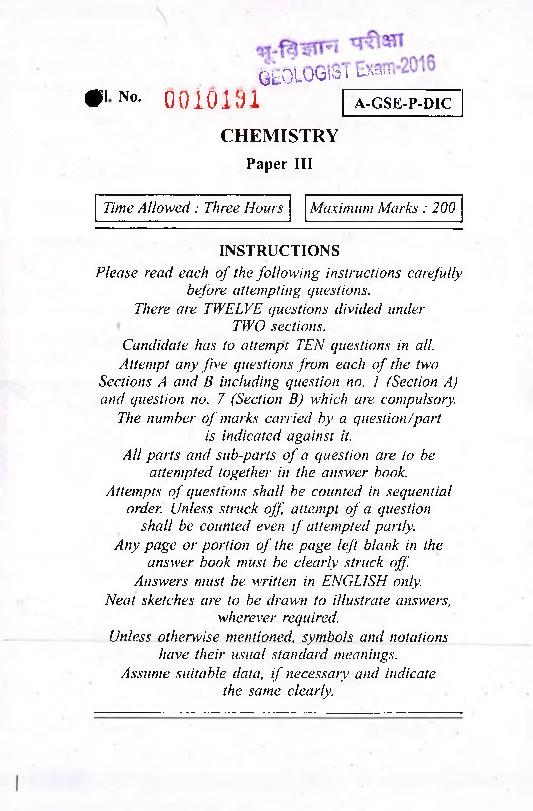
• 1No* 0 0 1 0 1 9 1 A-GSE-P-DIC
CHEMISTRY
Paper III
Time Allowed : Three Hours Maximum Marks : 200
INSTRUCTIONS
Please read each o f the follow ing instructions carefully
before attempting questions.
There are TWELVE questions divided under
TWO sections.
Candidate has to attempt TEN questions in all.
Attempt any five questions from each o f the two
Sections A and B including question no. 1 (Section A)
and question no. 7 (Section B) which are compulsory.
The number o f marks carried by a question /part
is indicated against it.
All parts and sub-parts o f a question are to be
attempted together in the answer book.
Attempts o f questions shall be counted in sequential
order. Unless struck o ff attempt o f a question
shall be counted even i f attempted partly.
Any page or portion o f the page left blank in the
answer book must be clearly struck o ff
Answers must be written in ENGLISH only.
Neat sketches are to be drawn to illustrate answers,
wherever required.
Unless otherwise mentioned, symbols and notations
have their usual standard meanings.
Assume suitable data, i f necessary and indicate
the same clearly.
Page 2
1. Answer all of the following questions : 4^10=40
(a) pH o f an aqueous solution at 400°C is 6-76.
What is the nature o f the solution ?
(acidic/basic/neutral) {Given K w at 400°C is
2-92><10-14}. Justify your answer.
(b) What are the alkaline error and the acid error
o f a glass membrane pH electrode ?
(c) What is solid phase extraction ? Write down
the main principle involved in it.
(d) Silver forms ccp lattice and X-ray studies of
its crystals show that the edge length o f its
unit cell is 408-6 pm. Calculate the density o f
silver (Atomic mass = 107-9U).
(e) State the purpose o f an auxiliary complexing
agent and taking an example, illustrate its use.
(f) 20 ml o f an aqueous solution o f 0-10 M butyric
acid was shaken with 10 ml ether. After the
layers were separated, it was determined by
titration that 0-5 mol o f butyric acid remained
in the aqueous layer. What is the distribution
ratio and the per cent extracted ?
A-GSE-P-DIC 2 (Contd.)
Page 3
steel sample. What volume of 1% wt o f DMG
(dimethyl glyoxime) in alcohol to be used
to provide a 50% excess of DMG for the
analysis. The density o f alcohol (0-79 g/ml).
FM : Ni(58-69); DM G(116-12).
(h) Write down the principles of High Perform
ance Liquid Chromatography (HPLC) and Gas
Liquid Chromatography (GLC).
(i) In atomic absorption spectroscopy (AAS) what
is the significance of background absorption
and background correction.
(j) Given,
AgBr(s) + e~ ^ Ag(s) + Br“; E+ = 0-071 V
Ag++ e~ ^ Ag(s) ; E° = 0-799 V
Compute the solubility product expressed as
AgBr(s) ^ Ag+ + Br~.
2. (a) 25-00 ml liquid bleach was diluted to 1000 ml
in a volumetric flask. An aliquot of 25 ml o f
this diluted sample was transferred to an
Erlenmeyer flask and treated with excess KI.
This gets oxidized to KI3 and the bleach OCl~
to Cl~. The liberated I2 in the form of KI3
required 8-96 ml of 0-09892 M Na2S20 3 to
titrate using starch as indicator. Find out the
% W/V NaOCl in the bleach sample. 5
(b) Lay down the procedure to separate and then
estimate the constituents Cu, Zn, Sn, Pb and
Fe o f the Brass alloy. 5
A-GSE-P-DIC 3 (Contd.)
Page 4
BaCl2-2H20 (F M : 244-26) and KC1 (FM : •
74-55). When the mixture is heated at 160°C
for lh, the water o f crystallization is driven
off. A sample originally weighing 1-783 g
weighed 1-5623 g after heating. Calculate the
weight % of Ba, K and Cl in the original
sample. 5
3 . (a) The amount of Fe in a 0-4891 g sample of
an ore was determined by a redox titration
with K2Cr20 7. The sample was dissolved in
HC1 and the iron brought in to +2 oxidation
state using Jones reductor. Titration using
diphenylamine sulfonic acid as indicator, the
end point required 36-92 ml o f 0-02153 M of
K2Cr20 7. Report the iron content of the ore as
%WAV Fe20 3. 5
(b) Fill in the blanks :
(i) When you double the frequency of
electromagnetic radiation, y o u ________
the energy.
(ii) When you double thewavelength, you
_________ the energy.
(iii) When you double the wave number, you
_________ the energy.
(iv) 10% transmittance equals _________
absorbance.
(v) When you double the path length, you
absorbance. 5
A-GSE-P-DIC 4 (Contd.)
Page 5
dissociation constants and [H+] for the highest
alpha value for each of the following :
(i) Tartrate
(ii) Acetate
(iii) Phosphate
(iv) Nitrilo acetic acid
(v) EDTA 5
4 . (a) Calculate the H30 + (hydronium ion) concen
tration for a buffer solution o f 2 M phosphonic
acid and 1-5 M potassium hydrogen phosphate
[ K a ^ - l l x l O - 3; Ka2= 6 -3 2 x l0 -8]. 5
(b) How many milligrams o f C 0 2 and H20 will be
produced from the combustion of 4-635 mg of
benzoic acid ? 5
(c) Define acid-base indicator. Suggest the
transition pH-range with colour changes in
methyl orange and phenolphthalein indicators.
5
5. (a) A solution o f carbon in face centered cubic
iron has a density o f 8-105 g cm-3 and a unit
cell edge o f 3-589 A. Are the carbon atoms
interstitial or do they substitute for iron atoms
in the lattice ? Calculate the weight % o f
carbon. 5
A-GSE-P-DIC 5 (Contd.)
Page 6
pyrolusite requires different tarif rates f o i ^
transport. As analyst, you performed a fusion
test o f the ore using Na 2C 03 -Na 202 . You
leached the mass once get cooled with
water. The leached colour would either be
brown-violet or green in colour. On acidifica
tion with cold dilute H2S 0 4, the colour
vanishes quickly or acquired a violet colour.
Based on the observations, can you identify
the brown ore. Explain the expected changes
in colour if the ore was for an iron or for a
manganese. 5
(c) Sketch photometric titration curves for the
following conditions :
(i) Gs = e P = 0 S - Substrate
Er > 0 p “ Product
T - Titrant
(ii) e T> e P>0
0 5
6. (a) In a UV-visible spectrum, if you observe a
negative absorbance, suggest the reasons that
can be responsible for this and possible
remedies. 5
(b) Plot a measured value o f pipet against the
percentage o f measurements in an experiment
to plot a histogram showing the distribution o f
say 50 results. Correlate this histogram with a
Gaussian Curve bearing same mean and
standard deviation.
[% in range : 6, 2, 14, 18, 26, 14, 10, 8, 2]
No. in range : 3, 1, 7, 9, 13, 7, 5, 4, 1]
5
A-GSE-P-DIC 6 (Contd.)
Page 7
^ made up to 500 ml in a standard measuring
flask. When 50 ml o f this solution was treated
with excess KI (2g) and a mineral acid
(10 ml of 0-5 M), IJ are produced. Find out the
moles o f I3. 5
Section - B
7. Answer all o f the following : 4x10=40
(a) Arrange the following compounds in the order
o f decreasing acidity. Explain your answer.
CH3- CH2 - N H 3 ; CH 3 - CH = NH 2 ;
CII3 - C = NH
(b) Predict the product of the following reaction
and write the mechanism involved.
NaOH
+ CHCl, -------------> ?
(c) Complete the following reaction and propose a
suitable mechanism for it.
O
O
(1) MeMgBr in ether (3 equiv.)
-------+------------------------->?
O (2) H30
A-GSE-P-DIC 7 (Contd.)
Page 8
has the greater dipole moment ? Explain.
(e) Complete the following reaction and propose a
suitable mechanism.
CHO
(f) Sketch the following FI-molecular orbitals
showing nodes :
(i) HOMO for 1, 3-butadiene
(ii) LUMO for allyl cation
(g) Explain why the compound A exists exclu
sively in the enol form and the compound B
exists exclusively in the keto form.
A-GSE-P-DIC 8 (Contd.)
Page 9
w reaction sequence.
0
Br, I OH H,SOs
_____ — -------- > ? — :— -> ?
(i) Arrange the compounds A, B and C in the
order decreasing stretching frequency of >=0
in the IR spectrum. Justify your arrangements.
O O O
A B C
(j) The mass spectrum of an unknown compound
has a molecular ion peak with a relative
intensity o f 43-27% and an M +l peak with a
relative intensity o f 3-81%. How many carbon
atoms are present in the compound ?
8. (a) Classify the following compounds into
aromatic, antiaromatic and non-aromatic.
Explain your answer.
H
A B C D
5
A-GSE-P-DIC 9 (Contd.)
Page 10
decreasing order of stability. Give reaso™ for
the order given by you.
©
0 0 0 0
A B C D 5
(c) Describe Heinsberg’s method o f separation of
amines. 5
9. Give the main product o f the following reactions
and give plausible mechanisms involved for its
formation.
3+
(a) PhCOMe + )— OH - - - >
O
(b) A* Base
p h 0
'v NaOH
(<=) H ^ r NHj — Rr. Bn,>
Me
A-GSE-P-DIC 10 (Contd.)
Page 11
R eactions. Suggest a suitable mechanism involved
in each case.
hv
----- > 9 5
. , NH; N aN O ,|H C l
(c) [ |T ------- ^ ----- > ? --------?
0 C A
COOH
5
11 . (a) The cyclic compound A exhibits enhanced
acidity when compared to acyclic compound B.
Rationalize the observation.
°YY°
o o O O
> r
A B
pKa= 7-42 pKa= 15-87
(b) What are ylides ? How the stabilized and
unstabilized phosphorus ylides yield different
products in the Wittig reaction with a cyclic
ketone. 5
A-GSE-P-DIC 11 (Contd.)
Page 12
yields if the aldehyde contains e lS r o n
donating or electron withdrawing groups.
Explain. 5
12. (a) Why do polar solvents shift the n - > n *
transition to a longer w avelength and n->Yl*
transition to a shorter wavelength. 5
(b) A non-polar organic compound with molecular
formula C4H60 does not show any significant
UV absorption and has IR absorption at
3300-2900 and 2200 c m 1. Its 'H -N M R spec
trum consists of three singlets at 8 3 0 (1H),
3-5 (3H) and 4-9 (2H). Elucidate the structure
o f the compound. 5
(c) An organic compound with molecular formula
C8H80 3 gives the following spectral data.
Assign a suitable structure to the compound.
IR(cm-1) : 2980(br), 1675(S), 1600(S), 1320(S),
1250(S), 1040(m), 940(br) and 835(S)T
'H-NMR(5) : 11-52 (1H, S), 6 - 8 - 8 (4H, m) and
3-85 (3H, S)
,3C -N M R (5): 172, 167-2, 131-1, 122-9, 114, 56.
5
A-GSE-P-DIC 12
Document Details
| Board / Org | UPSC |
| Exam | UPSC Combined Geo-Scientist |
| Type | Question Paper |
| Pages | 12 |
| Updated | 30 Apr 2026 |