UPSC CGGE 2016 Question Paper Geology Paper I
Finished viewing? Save it for later —
Download UPSC CGGE 2016 Question Paper Geology Paper I (PDF · 8 pages)About UPSC CGGE 2016 Question Paper Geology Paper I
UPSC CGGE 2016 Question Paper Geology Paper I is available here for free download. Published by UPSC for UPSC Combined Geo-Scientist, this question paper can be viewed online or downloaded as a PDF (8 pages). Candidates preparing for UPSC Combined Geo-Scientist can use UPSC CGGE 2016 Question Paper Geology Paper I to understand the exam pattern, the type of questions asked, and the overall difficulty level.
Frequently Asked Questions
How can I download UPSC CGGE 2016 Question Paper Geology Paper I?
Open this page and click the Download button to save UPSC CGGE 2016 Question Paper Geology Paper I as a PDF. It is completely free on AglaSem Docs.
Is UPSC CGGE 2016 Question Paper Geology Paper I free to download?
Yes. UPSC CGGE 2016 Question Paper Geology Paper I can be viewed online and downloaded as a PDF free of cost on AglaSem Docs.
How many pages does UPSC CGGE 2016 Question Paper Geology Paper I have?
UPSC CGGE 2016 Question Paper Geology Paper I contains 8 pages, which you can read online or download together as a single PDF.
Where can I find more UPSC Combined Geo-Scientist study material?
You can find more UPSC Combined Geo-Scientist question papers, sample papers, syllabus, and answer keys on AglaSem Docs.
UPSC CGGE 2016 Question Paper Geology Paper I – Text
Read the full text of this question paper below — useful to quickly search, copy and reference the content online without downloading the PDF.
📄 View text version (8 pages)
Page 1
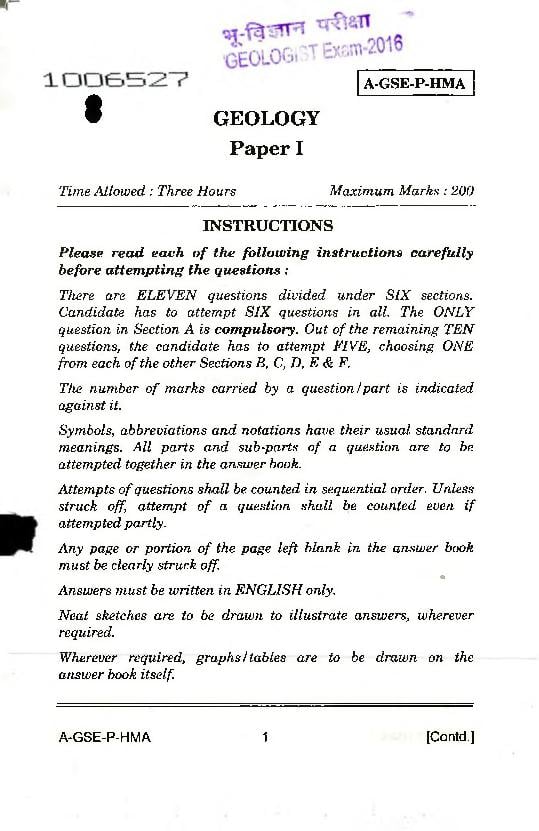
I GEOLOGY
Paper I
Time Allowed : Three Hours Maximum Marks : 200
INSTRUCTIONS
Please read each o f the following instructions carefully
before attempting the questions :
There are ELEVEN questions divided under SIX sections.
Candidate has to attempt SIX questions in all. The ONLY
question in Section A is compulsory. Out of the remaining TEN
questions, the candidate has to attempt FIVE, choosing ONE
from each of the other Sections B, C, D, E & F.
The number of marks carried by a question Ipart is indicated
against it.
Symbols, abbreviations and notations have their usual standard
meanings. All parts and sub-parts of a question are to be
attempted together in the answer book.
Attempts o f questions shall be counted in sequential order. Unless
struck off, attempt o f a question shall be counted even if
attempted partly.
Any page or portion o f the page left blank in the answer book
must be clearly struck off.
%
Answers must be written in ENGLISH only.
Neat sketches are to be drawn to illustrate answers, wherever
required.
Wherever required, graphs I tables are to be drawn on the
answer book itself.
A-GSE-P-HMA 1 [Contd.]
Page 2
(Compulsory Section) £
1. Describe the following in about 100 words each, with
brief sketches, wherever necessary : 10x5=50
(a) Levees and their role in flood control 5
(b) Differences between unsupervised and
supervised classification 5
(c) Mechanism of parasitic folds 5
(d) Conditions leading to progressive deformation 5
(e) Concept of geodesy and crustal movement 5
(f) Gravity anomaly of mid-oceanic ridges 5
(g) Sargur Schist Belt 5
(h) Concurrent Range Zone 5
(i) Rajahmundry Formation 5
(j) Derived fossils 5
A-GSE-P-HMA 2 [Contd.]
Page 3
^ (Attempt any ONE question)
2. (a) Compare the morphology of the landforms
produced by glaciers and rivers. 15
(b) Explain the term “Spectral reflectance” and
describe its significance. Also, give a detailed
account of the spectra of various rocks,
vegetation, soil and water. 15
3. (a) Explain Davis cycle of erosion and landscape
development. 10
(b) Explain the causes and effects of variation of
scale in aerial photographs. 10
(c) Give an account of the types of lineaments and
the role of remote sensing in mapping them. 10
A-GSE-P-HMA 3 [Contd.]
Page 4
(Attempt any ONE question) £
4. (a) Discuss the mechanism of stress and strain in
elastic and plastic deformation. 15
(b) Discuss in detail the time relationship between
crystallization and deformation of mineral
grains. 15
5. (a) What are joints ? Explain the mechanism of
joint formation and explain the type of joints
with neat sketches and their significance. 10
(b) Discuss the mechanism and significance of
mylonite and cataclastic deformation. 10
(c) What are the stereographic projections ?
Explain the use of cyclographic stereographic
projection to analyse stress and strain in rocks. 10
A-GSE-P-HMA 4 [Contd.]
Page 5
£ (Attempt any ONE question)
6. (a) Describe in detail the thickness of various
layers of the Earth’s interior, their composition
and physical properties with neat sketches. 15
(b) Explain the geological features and
accretionary wedges of the lithosphere and
asthenosphere with a neat sketch. 15
7. (a) Describe the seismic belts and seismic zones of
the Indian Subcontinent. 10
(b) Describe paleomagnetism and its application
for determining paleoposition of India. 10
(c) Discuss the theory and concept of plate
tectonics with neat sketches. 10
A-GSE-P-HMA 5 [Contd.]
Page 6
(Attempt any ONE question)
8. (a) “Late Cretaceous was a period of varied facies
in the Indian Subcontinent.” Discuss the
statement giving examples. 15
(b) In a stratigraphic sequence, evolutionary
lineage of species A, B and C (a) and ranges of
M, N and O (b) are shown. Divide the sequence
into biostratigraphic zones based on both (a)
and (b). Which of the zones should be preferred
for correlation and why ? 15
O
I I I I
B
N
M
(a) (b)
Evolutionary First occurrence Last occurrence
appearance
A-GSE-P-HMA 6 [Contd.]
Page 7
tabular form and mention the characteristic
•
(b)
fossils in each division.
Briefly describing the lithologic succession of
10
Bagh Beds, link the stratigraphic
sequence with the episodes of marine
transgression-regression. 10
(c) Name the areas in Peninsular India affected by
Permian marine transgression, briefly
describing the lithology and fossil content. 10
A-GSE-P-HMA 7 [Contd.]
Page 8
(Attempt any ONE question) £
10. (a) Discuss, with examples, how microfossils are
used as tracers of deep-sea currents. 15
(b) Discuss the evolutionary changes that took
place in facial sutures and glabella of trilobites. 15
11, (a) Describe the method of separation of
foraminifera from soft shale or mudstone. 10
(b) What is pallial sinus in a bivalve ? Discuss the
habitat of bivalves having pallial sinus. 10
(c) What is dimorphism in foraminifera ? Write the
morphological difference in the foraminiferal
forms which originate due to dimorphism. 10
A-GSE-P-HMA 8
Document Details
| Board / Org | UPSC |
| Exam | UPSC Combined Geo-Scientist |
| Type | Question Paper |
| Pages | 8 |
| Updated | 30 Apr 2026 |