TIFR GS 2023 Question Paper Mathematics
Finished viewing? Save it for later —
Download TIFR GS 2023 Question Paper Mathematics (PDF · 7 pages)About TIFR GS 2023 Question Paper Mathematics
TIFR GS 2023 Question Paper Mathematics is available here for free download. Published by TIFR for TIFR GS, this question paper can be viewed online or downloaded as a PDF (7 pages). Candidates preparing for TIFR GS can use TIFR GS 2023 Question Paper Mathematics to understand the exam pattern, the type of questions asked, and the overall difficulty level.
Frequently Asked Questions
How can I download TIFR GS 2023 Question Paper Mathematics?
Open this page and click the Download button to save TIFR GS 2023 Question Paper Mathematics as a PDF. It is completely free on AglaSem Docs.
Is TIFR GS 2023 Question Paper Mathematics free to download?
Yes. TIFR GS 2023 Question Paper Mathematics can be viewed online and downloaded as a PDF free of cost on AglaSem Docs.
How many pages does TIFR GS 2023 Question Paper Mathematics have?
TIFR GS 2023 Question Paper Mathematics contains 7 pages, which you can read online or download together as a single PDF.
Where can I find more TIFR GS study material?
You can find more TIFR GS question papers, sample papers, syllabus, and answer keys on AglaSem Docs.
TIFR GS 2023 Question Paper Mathematics – Text
Read the full text of this question paper below — useful to quickly search, copy and reference the content online without downloading the PDF.
📄 View text version (7 pages)
Page 1
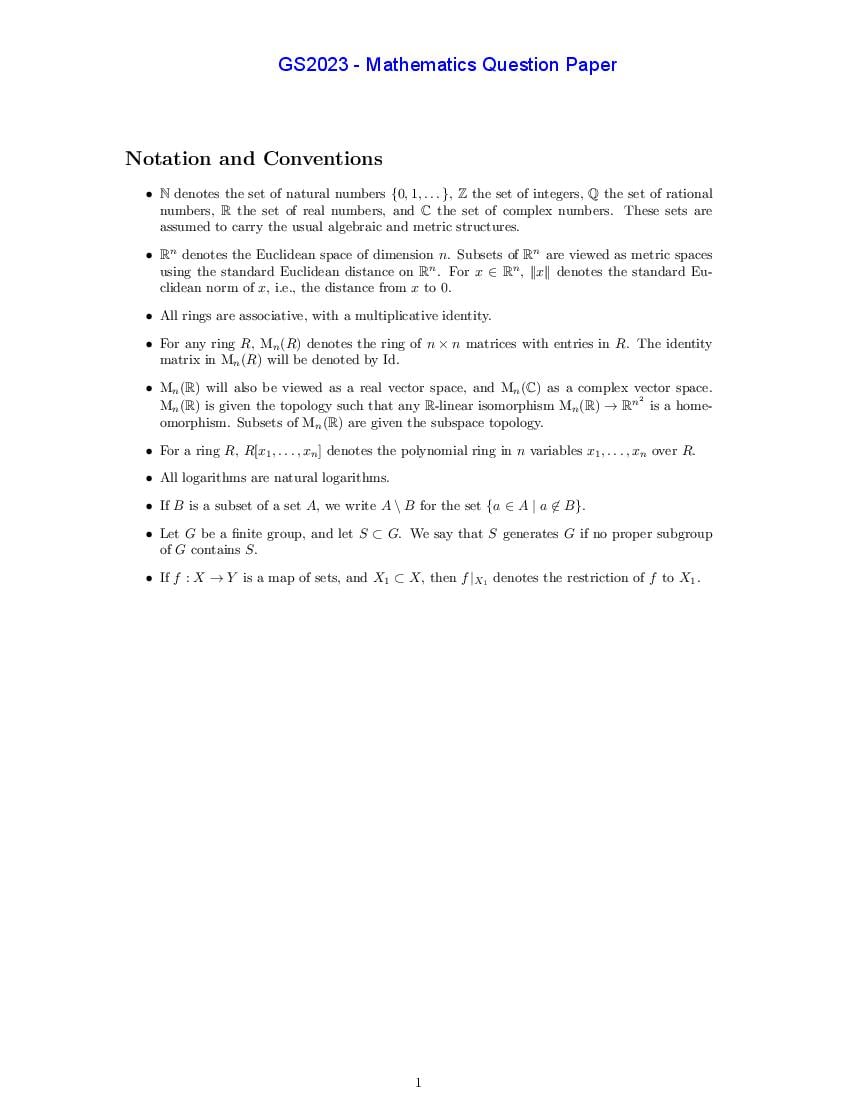
Notation and Conventions
N denotes the set of natural numbers {0, 1, . . . }, Z the set of integers, Q the set of rational
numbers, R the set of real numbers, and C the set of complex numbers. These sets are
assumed to carry the usual algebraic and metric structures.
Rn denotes the Euclidean space of dimension n. Subsets of Rn are viewed as metric spaces
using the standard Euclidean distance on Rn . For x ∈ Rn , kxk denotes the standard Eu-
clidean norm of x, i.e., the distance from x to 0.
All rings are associative, with a multiplicative identity.
For any ring R, Mn (R) denotes the ring of n × n matrices with entries in R. The identity
matrix in Mn (R) will be denoted by Id.
Mn (R) will also be viewed as a real vector space, and Mn (C) as a complex vector space.
2
Mn (R) is given the topology such that any R-linear isomorphism Mn (R) → Rn is a home-
omorphism. Subsets of Mn (R) are given the subspace topology.
For a ring R, R[x1 , . . . , xn ] denotes the polynomial ring in n variables x1 , . . . , xn over R.
All logarithms are natural logarithms.
If B is a subset of a set A, we write A \ B for the set {a ∈ A | a 6∈ B}.
Let G be a finite group, and let S ⊂ G. We say that S generates G if no proper subgroup
of G contains S.
If f : X → Y is a map of sets, and X1 ⊂ X, then f |X1 denotes the restriction of f to X1 .
1
Page 2
Answer the following multiple choice questions.
1. Define f : R → R by f (x) = (3x2 + 1)/(x2 + 3). Let f ◦1 = f , and let f ◦n = f ◦(n−1) ◦ f for
all integers n ≥ 2. Which of the following statements is correct?
(a) lim f ◦n (1/2) = 1, and lim f ◦n (2) = 1.
n→∞ n→∞
◦n
(b) lim f (1/2) = 1, but lim f ◦n (2) does not exist.
n→∞ n→∞
(c) lim f ◦n (1/2) does not exist, but lim f ◦n (2) = 1.
n→∞ n→∞
(d) Neither lim f ◦n (1/2) nor lim f ◦n (2) exists.
n→∞ n→∞
2. Consider the following properties of a sequence {an }n of real numbers.
(I) lim an = 0.
n→∞
P∞
(II) There exists a sequence {in }n of positive integers such that n=1 ain converges.
(a) (I) implies (II), and (II) implies (I).
(b) (I) implies (II), but (II) does not imply (I).
(c) (I) does not imply (II), but (II) implies (I).
(d) (I) does not imply (II), and (II) does not imply (I).
3. Consider sequences {xn }n of real numbers such that
lim (x2n−1 + x2n ) = 2 and lim (x2n + x2n+1 ) = 3.
n→∞ n→∞
x2n+1
(a) For every such sequence {xn }n , lim = 1.
n→∞ x2n
x2n+1
(b) For every such sequence {xn }n , lim = −1.
n→∞ x2n
x2n+1
(c) For every such sequence {xn }n , lim = 3/2.
n→∞ x2n
x2n+1
(d) There exists such a sequence {xn }n , for which lim does not exist.
n→∞ x2n
4. Consider the function f : (0, ∞) → (0, ∞) given by f (x) = xex . Let
L : (0, ∞) → (0, ∞) be its inverse function. Which of the following statements is correct?
L(x)
(a) lim = 1.
x→∞ log x
L(x)
(b) lim = 1.
x→∞ (log x)2
L(x)
(c) lim √ = 1.
x→∞ log x
(d) None of the remaining three options is correct.
5. Let {bn }n be a monotonically increasing sequence of positive real numbers such that lim bn =
n→∞
∞. Which of the following statements is true about
n
1 X bk
lim ?
n→∞ bn k2
k=1
2
Page 3
(b) The limit exists for all such sequences, and its value is always 0.
(c) The limit exists for all such sequences, and its value is always 1.
(d) None of the remaining three options is correct.
2 n
6. For every positive integer n, define fn : [0, 1] → R by fn (x) = sin(n 1+n
x)+cos(e x)
2 x2 . Then
Z 1−sin(1/n)
lim fn (x) dx
n→∞ 0
equals
(b) 0.
(c) ∞.
(d) 1/2.
7. Consider the functions f1 , f2 : (0, ∞) → R defined by
√ √
f1 (x) = x, and f2 (x) = x sin x.
(a) f1 and f2 are uniformly continuous.
(b) f1 is uniformly continuous, but f2 is not.
(c) f2 is uniformly continuous, but f1 is not.
(d) Neither f1 nor f2 is uniformly continuous.
8. Let x1 ∈ R2 \ {0} be fixed, and inductively define xn+1 = Axn for n ≥ 1, where A is the
2 × 2 real matrix given by √ !
3 1
A := 2 √2 .
3
− 21 2
(a) {xn }n is a convergent sequence.
(b) {xn }n is not a convergent sequence, but it has a convergent subsequence.
(c) lim kxn k = 0.
n→∞
(d) None of the remaining three options is correct.
1
9. Let T : M3 (R) → R3 be the linear map defined by T (A) = A 0 . Then the dimension
−1
of the kernel of T equals
(a) 2.
(b) 8.
(c) 1.
(d) None of the remaining three options.
10. Let V = {f (x) ∈ R[x] | f (0) = 0}, viewed as a real vector space. Consider the following
assertions:
3
Page 4
(II) V contains two linearly independent polynomials of degree 3.
(a) Both (I) and (II) are true.
(b) (I) is true, but (II) is false.
(c) (I) is false, but (II) is true.
(d) Neither (I) nor (II) is true.
11. Let C([−1, 1], R) denote the real vector space of continuous functions from [−1, 1] to R, and
consider the subspace
V = {f ∈ C([−1, 1], R) | f (−x) = f (x) for all x ∈ [−1, 1]}.
Define an inner product on C([−1, 1], R) by
Z 1
hf, gi = f (t)g(t) dt.
−1
What is the orthogonal complement of V in C([−1, 1], R)?
(a) {f ∈ C([−1, 1], R) | f (−x) = −f (x) for all x ∈ [−1, 1]}.
(b) {f ∈ C([−1, 1], R) | f (0) = 0}.
(c) V does not have an orthogonal complement in C([−1, 1], R).
(d) None of the remaining three options.
12. Consider pairs (X, d), where X is a set with 100 elements, and d : X × X → R is a function
such that d(x, y) = d(y, x) > 0 if x, y ∈ X are distinct, and d(x, x) = 0 for all x ∈ X. For
n < 100, let An be the statement:
For every such pair (X, d), there exists a subset X1 of X, with n elements,
such that (X1 , d|X1 ×X1 ) is a metric space.
(a) A2 is true, but A3 is not true.
(b) A3 is true, but A4 is not true.
(c) An is true for all n ≤ 10, but not for all n ≤ 25.
(d) An is true for all n ≤ 25.
13. Let {xn }n be a sequence in a metric space (X, d). Let f : X → R be defined by
f (x) = inf{d(x, xn ) | n ∈ N}.
(a) f is uniformly continuous on X.
(b) f is continuous on X, but not necessarily uniformly continuous.
(c) f is continuous on X if and only if X is compact.
(d) None of the remaining three options is correct.
14. The number of finite groups, up to isomorphism, with exactly two conjugacy classes, equals
4
Page 5
(c) Greater than 2, but finite.
(d) Infinite.
15. Consider the following assertions about a commutative ring R with identity and elements
a, b ∈ R:
(I) There exist p, q ∈ R such that ap + bq = 1.
(II) There exist p, q ∈ R such that a2 p + b2 q = 1.
Then:
(a) (I) implies (II), and (II) implies (I).
(b) (I) implies (II), but (II) does not imply (I).
(c) (I) does not imply (II), but (II) implies (I).
(d) (I) does not imply (II), and (II) does not imply (I).
16. The number of elements of finite order in the group
1 a b
0 1 c | a, b, c ∈ R
0 0 1
is
(b) Finite, but not 1.
(c) Countably infinite.
(d) Uncountably infinite.
17. The value of
[
max {x1 x2 . . . xk | x1 , . . . , xk ∈ N, and x1 + · · · + xk = 100}
k∈N
k≥1
equals
(a) 4 × 332 .
(b) 250 .
(c) 226 × 316 .
(d) None of the remaining three options.
18. Choose the option that completes the sentence correctly: There exists a 10 × 10 real sym-
metric matrix A, all of whose entries are nonnegative and all of whose diagonal entries are
positive, such that A10 has
(a) exactly 67 positive entries.
(b) exactly 68 positive entries.
(c) exactly 69 positive entries.
(d) exactly 70 positive entries.
19. The number of (nondegenerate Euclidean) triangles with sides of integer length and perimeter
8, up to congruence, is
5
Page 6
(c) 3.
(d) 4.
20. Let
A = {(α, β) ∈ Z2 | the roots r1 , r2 , r3 of the polynomial
p(x) = x3 − 2x2 + αx − β satisfy r13 + r23 + r33 = 0}.
(a) A is infinite.
(b) A is empty.
(c) A is singleton.
(d) A is finite, but neither empty nor singleton.
PART B
Answer whether the following statements are True or False.
1. Let α be a positive real number, and let f : (0, 1) → R be a function such that |f (x)−f (y)| ≤
True
|x − y|α for all x, y ∈ (0, 1). Then f can be extended to a continuous function [0, 1] → R.
2. Suppose f, g : R → R are continuous functions such that f 2 + g 2 is uniformly continuous.
False
Then at least one of the two functions f and g is uniformly continuous.
3. Let {fn }n be a sequence of (not necessarily continuous) functions from [0, 1] to R. Let
f : [0, 1] → R be such that for any x ∈ [0, 1] and any sequence {xn }n consisting of elements True
from [0, 1], if lim xn = x, then lim fn (xn ) = f (x). Then f is continuous.
n→∞ n→∞
4. Let A, B ∈ M2 (Z/2Z) be such that tr(A) = tr(B) and tr(A2 ) = tr(B 2 ). Then A and B have
False
the same eigenvalues.
5. Let v1 , v2 , w1 , w2 be nonzero vectors in R2 . Then there exists a 2 × 2 real matrix A such
False
that Av1 = v2 and Aw1 = w2 .
6. Let A = (aij ) ∈ Mn (R) be such that aij ≥ 0 for all 1 ≤ i, j ≤ n. Assume that lim Am
m→∞ False
exists, and denote it by B = (bij ). Then, for all 1 ≤ i, j ≤ n, we have bij ∈ {0, 1}.
7. Given any monic polynomial f (x) ∈ R[x] of degree n, there exists a matrix A ∈ Mn (R) such
True
that its characteristic polynomial equals f .
8. If A ∈ M4 (Q) is such that its characteristic polynomial equals x4 +1, then A is diagonalizable
True
in M4 (C).
9. If A ∈ Mn (R) is such that AB = BA for all invertible matrices B ∈ Mn (R), then A = λ · Id True
for some λ ∈ R.
10. There exists a homeomorphism f : R → R such that f (2x) = 3f (x) for all x ∈ R. True
11. There exists a continuous bijection from [0, 1] × [0, 1] to {(x, y) ∈ R2 | x2 + y 2 ≤ 1}, which
False
is not a homeomorphism.
6
Page 7
X = {z ∈ Cn | f (z) = 0}.
Then Cn \ X is path connected.
13. A connected metric space with at least two points is uncountable. True
14. If A and B are disjoint subsets of a metric space (X, d), then
False
inf{d(x, y) | x ∈ A, y ∈ B} 6= 0.
15. A countably infinite complete metric space has infinitely many isolated points (an element True
x of a metric space X is said to be an isolated point if {x} is an open subset of X).
16. Suppose G and H are two countably infinite abelian groups such that every nontrivial element
True
of G × H has order 7. Then G is isomorphic to H.
17. There exists a nonabelian group G of order 26 such that every proper subgroup of G is True
abelian.
18. Let G be a group generated by two elements x and y, each of order 2. Then G is finite. False
19. R[x]/(x4 + x2 + 2023) is an integral domain. False
20. Every finite group is isomorphic to a subgroup of a finite group generated by two elements. True
7
Document Details
| Board / Org | TIFR |
| Exam | TIFR GS |
| Type | Question Paper |
| Pages | 7 |
| Updated | 23 Oct 2026 |