CUSAT CAT 2025 Question Paper 3 Year LLB
Finished viewing? Save it for later —
Download CUSAT CAT 2025 Question Paper 3 Year LLB (PDF · 34 pages)About CUSAT CAT 2025 Question Paper 3 Year LLB
CUSAT CAT 2025 Question Paper 3 Year LLB is available here for free download. Published by Cochin University for CUSAT Common Admission Test, this question paper can be viewed online or downloaded as a PDF (34 pages). Candidates preparing for CUSAT Common Admission Test can use CUSAT CAT 2025 Question Paper 3 Year LLB to understand the exam pattern, the type of questions asked, and the overall difficulty level.
Frequently Asked Questions
How can I download CUSAT CAT 2025 Question Paper 3 Year LLB?
Open this page and click the Download button to save CUSAT CAT 2025 Question Paper 3 Year LLB as a PDF. It is completely free on AglaSem Docs.
Is CUSAT CAT 2025 Question Paper 3 Year LLB free to download?
Yes. CUSAT CAT 2025 Question Paper 3 Year LLB can be viewed online and downloaded as a PDF free of cost on AglaSem Docs.
How many pages does CUSAT CAT 2025 Question Paper 3 Year LLB have?
CUSAT CAT 2025 Question Paper 3 Year LLB contains 34 pages, which you can read online or download together as a single PDF.
Where can I find more CUSAT Common Admission Test study material?
You can find more CUSAT Common Admission Test question papers, sample papers, syllabus, and answer keys on AglaSem Docs.
CUSAT CAT 2025 Question Paper 3 Year LLB – Text
Read the full text of this question paper below — useful to quickly search, copy and reference the content online without downloading the PDF.
📄 View text version (34 pages)
Page 1
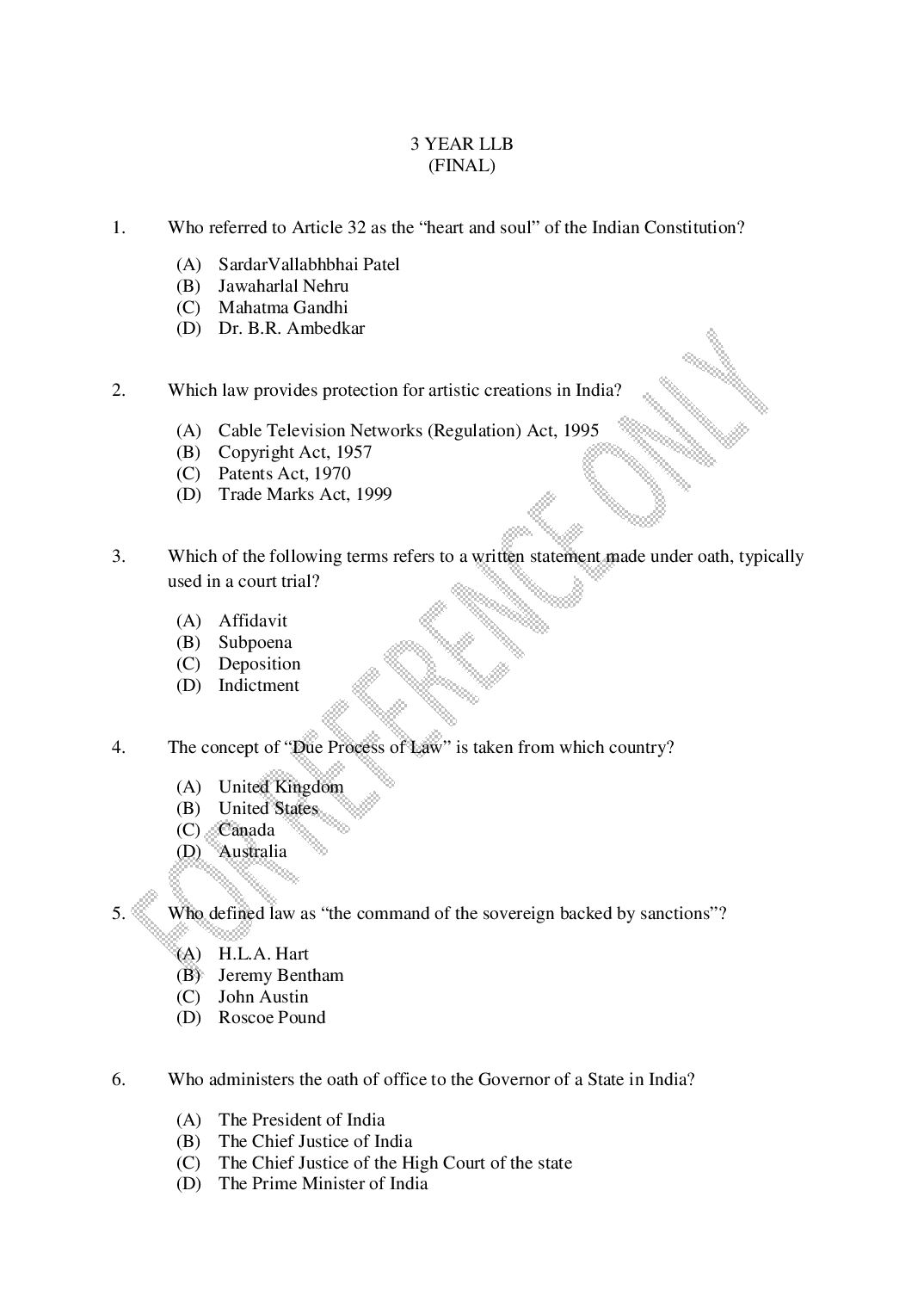
(FINAL)
1. Who referred to Article 32 as the “heart and soul” of the Indian Constitution?
(A) SardarVallabhbhai Patel
(B) Jawaharlal Nehru
(C) Mahatma Gandhi
(D) Dr. B.R. Ambedkar
2. Which law provides protection for artistic creations in India?
(A) Cable Television Networks (Regulation) Act, 1995
(B) Copyright Act, 1957
(C) Patents Act, 1970
(D) Trade Marks Act, 1999
3. Which of the following terms refers to a written statement made under oath, typically
used in a court trial?
(A) Affidavit
(B) Subpoena
(C) Deposition
(D) Indictment
4. The concept of “Due Process of Law” is taken from which country?
(A) United Kingdom
(B) United States
(C) Canada
(D) Australia
5. Who defined law as “the command of the sovereign backed by sanctions”?
(A) H.L.A. Hart
(B) Jeremy Bentham
(C) John Austin
(D) Roscoe Pound
6. Who administers the oath of office to the Governor of a State in India?
(A) The President of India
(B) The Chief Justice of India
(C) The Chief Justice of the High Court of the state
(D) The Prime Minister of India
Page 2
(A) 3 years
(B) 4 years
(C) 5 years
(D) 6 years
8. Which of the following examinations must Indian law students pass in order to
practice law?
(A) The National Law Entrance Exam (NLAT)
(B) The Common Law Admission Test (CLAT)
(C) All India Bar Examination (AIBE)
(D) The Judicial Services Exam
9. The Indian Constitution is described as a “Quasi-Federal” system because:
(A) It is purely federal in nature
(B) It combines elements of federalism with unitary features
(C) It provides for dual citizenship
(D) It grants autonomy to all Indian states
10. Select the correct chronological order of the following Chief Justices of India
(A) RanjanGogoi → NuthalapatiVenkataRamana →
DhananjayaYeshwantChandrachud → Sanjiv Khanna
(B) RanjanGogoi → DhananjayaYeshwantChandrachud →
NuthalapatiVenkataRamana → Sanjiv Khanna
(C) NuthalapatiVenkataRamana → RanjanGogoi →
DhananjayaYeshwantChandrachud → Sanjiv Khanna
(D) DhananjayaYeshwantChandrachud → RanjanGogoi →
NuthalapatiVenkataRamana → Sanjiv Khanna
11. Which of the following words is NOT included in the Preamble of the Indian
Constitution?
(A) Sovereign
(B) Socialist
(C) Secular
(D) Federal
Page 3
(A) To respect the National Anthem and National Flag
(B) To protect and improve the natural environment
(C) To vote in elections
(D) To promote harmony and the spirit of brotherhood
13. When was the Constitution of India adopted?
(A) 15th August 1947
(B) 26th January 1949
(C) 26th January 1950
(D) 26th November 1949
14. Read the given Assertion (A) and Reasoning (R) carefully and choose the correct
option
Assertion (A): The Directive Principles of State Policy (DPSP) can be enforced
by the courts.
Reasoning (R): The DPSP are guidelines for the governance of India, but they
cannot be enforced by the courts
(A) Both Assertion (A) and Reasoning (R) are true, and Reasoning (R) is the
correct explanation of Assertion (A)
(B) Both Assertion (A) and Reasoning (R) are true, but Reasoning (R) is not the
correct explanation of Assertion (A)
(C) Assertion (A) is true, but Reasoning (R) is false
(D) Assertion (A) is false, but Reasoning (R) is true
15. Read the given Assertion (A) and Reasoning (R) carefully and choose the correct
option
Assertion (A): A person can be arrested without a warrant for certain offences.
Reasoning (R): Section 35 of the BharatiyaNagarikSurakshaSanhita (BNSS),
2023 permits arrest without a warrant for cognisable offences
(A) Both Assertion (A) and Reason (R) are true, and Reason (R) is the correct
explanation of Assertion (A).
(B) Both Assertion (A) and Reason (R) are true, but Reason (R) is not the correct
explanation of Assertion (A)
(C) Assertion (A) is true, but Reason (R) is false
(D) Assertion (A) is false, but Reason (R) is true
Page 4
option
Assertion (A): The right to life and personal liberty is guaranteed under Article
32 of the Indian Constitution.
Reasoning (R): The right to life includes the right to live with human dignity,
which encompasses the right to a clean environment, health, and
livelihood.
(A) Both Assertion (A) and Reason (R) are true, and Reason (R) is the correct
explanation of Assertion (A)
(B) Both Assertion (A) and Reason (R) are true, but Reason (R) is not the correct
explanation of Assertion (A).
(C) Assertion (A) is true, but Reason (R) is false.
(D) Assertion (A) is false, but Reason (R) is true
17. The BharatiyaSakshyaAdhiniyam (BSA),2023, addresses which of the following
areas of law?
(A) Evidence laws
(B) Marriage and divorce
(C) Taxation laws
(D) Land reform laws
18. What is the main function of the judiciary in India?
(A) To make laws
(B) To enforce laws
(C) To interpret laws
(D) To implement laws
19. Which of the following is an example of a fiduciary relationship?
(A) Employer and employee
(B) Buyer and seller
(C) Landlord and tenant
(D) Doctor and patient
20. In India, who has the power to amend the Constitution?
(A) The President of India
(B) The Parliament
(C) The Supreme Court
(D) The Prime Minister
Page 5
detention?
(A) Habeas Corpus
(B) Certiorari
(C) Mandamus
(D) Prohibition
22. Which of the following legal principles is concerned with protecting the rights of
individuals accused of crimes?
(A) Principles of justice
(B) Principles of natural justice
(C) Principles of sovereignty
(D) Principles of parliamentary law
23. Which article of the Indian Constitution deals with the imposition of President’s Rule
in a state?
(A) Article 356
(B) Article 365
(C) Article 370
(D) Article 352
24. Who can issue a “Search Warrant” in India?
(A) A police officer
(B) A magistrate
(C) The President
(D) The Supreme Court
25. Which of the following is the primary purpose of the Consumer Protection Act, 1986?
(A) To empower women
(B) To establish small retail shops
(C) To protectcooperative societies
(D) To regulate business practices
26. Under Indian Majority Act, 1875, a minor is someone who is below the age of
(A) 18 years
(B) 21 years
(C) 16 years
(D) 14 years
Page 6
(A) Only the government
(B) Only a person directly affected by the issue
(C) Any person acting in public interest
(D) Only a legal representative
28. Which legal term is used for unlawful entry into a property?
(A) Trespass
(B) Defamation
(C) Fraud
(D) Libel
29. In a legal context, what is “Negligence”?
(A) Intentionally causing harm
(B) Failure to exercise reasonable care
(C) Criminal intent
(D) An act of omission
30. Who presides over the joint sitting of the Parliament?
(A) The Speaker
(B) The President
(C) The Vice President
(D) The Chief Justice
31. The Supreme Court of India started with a Chief Justice and ………………. in 1950.
(A) Seven Judges
(B) Twelve Judges
(C) Thirteen Judges
(D) Fifteen Judges
32. Indian Constitution can be amended under Article
(A) 352
(B) 360
(C) 368
(D) None of the above
Page 7
(A) Article 323
(B) Article 324
(C) Article 327
(D) Article 329
34. When the master is held liable for the act of servant, the liability is called?
(A) Strict Liability
(B) Absolute Liability
(C) Vicarious Liability
(D) None of the above
35. The offence which can be compromised between the parties are
(A) Compoundable offence
(B) Non -Compoundable offence
(C) Cognizable offence
(D) Non-Cognizable offence
36. A party who files the suit is called
(A) Plaintiff
(B) Defendant
(C) Respondent
(D) Litigant
37. Mensrea in Indian Penal Code means
(A) Guilty mind
(B) Good intention
(C) Bonafide intention
(D) None of the above
38. The Chief Justice of India is appointed by
(A) The Speaker
(B) The President
(C) The Prime Minister
(D) None of the above
Page 8
(A) Let the Seller be aware
(B) Let the Buyer be aware
(C) Let the Owner be aware
(D) Let the Purchaser be aware
40. Mandamus is a
(A) Public interest Litigation
(B) Writ
(C) Civil Suit
(D) Appeal
41. A child born out of legal wedlock is called
(A) Legitimate Child
(B) Illegitimate Child
(C) Legal Child
(D) Illegal Child
42. If a person marries for the second time without divorcing the first wife he has
committed an offence of
(A) Adultery
(B) Affray
(C) Bigamy
(D) Rape
43. The Preamble of Indian Constitution of India proclaims that “We the people of
India have established
(A) A Sovereign, Socialist,Democratic,Republic only
(B) A Sovereign, Secular,Democratic,Republic only
(C) A Secular, Socialist,Democratic,Republic only
(D) A Sovereign, Socialist, Secular,Democratic,Republic only
44. The expression Hindu include
(A) Jains
(B) Sikhs
(C) Buddhists
(D) All of the above
Page 9
(A) Body of Judges
(B) Group of Jurists
(C) Body of Law
(D) Knowledge of law
46. The Right of a Party to initiate an Action and be heard before a Court of Law
is called:
(A) Locus Standi
(B) Personam
(C) Fundamental Right
(D) Private Obligation
47. Indian Parliament is based on the Principle of
(A) Bicameralism
(B) Universal Adult Franchise
(C) Diarchy
(D) Federalism
48. Who is regarded as First Law officer of India?
(A) Chief Justice of India
(B) Soliciter General of India
(C) Attorney General of India
(D) Secretary, Ministry of Law and Justice
49. The Supreme Court formulated Basic Structure Doctrine in
(A) Golaknathvs Union of India
(B) KeshavanandaBharathivs Union of India
(C) Sajjan Singh vs Union of India
(D) S.P.Guptavs Union of India
50. Any invention to grant patent should involve
(A) Industrial Application
(B) Novelty
(C) No obviousness
(D) All of the above
Page 10
legal principle to the factual situation and select the most appropriate answer to the
question:
Legal Principle: A minor is not competent to enter into a contract and the law will
assume that the contract never happened and everything is returned to as it was
Factual Situation: A minor fraudulently misrepresenting her age, enters into a contract
with another of the purchase of a piano. After the piano has been delivered she
refused to pay price for the same contending the non existence of a legally binding
contract
(A) The contract is valid and binding against the minor as the minor has
misrepresented her age knowingly
(B) The contract is voidable at the option of the other party and thus the minor is
liable to pay if the other party wants to carry out the obligation
(C) The contract is void and the court can direct the minor to restore the piano to
the other party
(D) The contract is valid and the guardian of the minor will be liable to pay for the
piano
52. Direction: Given below are legal principle and a factual situation. Apply the given
legal principle to the factual situation and select the most appropriate answer to the
question:
Legal Principle: Theft occurs when a person dishonestly takes any movable property
out of the possession of any person without that person’s consent.
Factual Situation: Keshav finds Manu’s cattle roaming the streets and takes them
home to prevent them from being run over by vehicles. Manu does not find his cattle
and makes a complaint to the police reporting them to be missing
(A) Keshav is guilty of theft as he did not inform Manu as the whereabouts of his
cattle
(B) Keshav is not guilty of theft since the cattle were not in Manu’s possession
(C) Keshav is not guilty of theft since cattle are not property
(D) Keshav is not guilty of theft as there was no dishonest intention on his part
Page 11
given legal principles to the factual situation and select the most appropriate answer to
the question:
Legal Principle 1:A person is liable for negligence, if he fails to take care of his
neighbour’s interest
Legal Principle 2:A neighbour is anyone whose interests should have been
foreseeable by a reasonable man while carrying on his activities.
Facts:A cricket match was going on in a closed door stadium. A cricket fan who could
not get in to the stadium was watching the game by climbing up a nearby tree and
sitting there. The cricket ball in the course of the game went out of the stadium and hit
this person and injured him. He filed a suit against the organizers.
(A) The organizers are liable to compensate the injured person
(B) The organizers are not liable to compensate the injured person
(C) The organizers could not have foreseen somebody watching the game by
climbing up a tree and hence not liable
(D) None of the above
54. Fact:A who owns two cars, one Maruti and the other Santro, offers to sell B one car.
A intending it to be the Maruti car. B accepts the offer thinking that it is the Santro
Issue:Is A liable?
(A) A is not liable because there is no consensus and hence no contract.
(B) A is liable because once he had offered the contract is complete
(C) It is upto the court to decide the liability
(D) None of the above
55. Fact:S, intending to deceive Y, falsely represents that 500 maunds of indigo are made
annually at X’s factory and thereby induces Y to buy the factory
Issue: Is it a valid contract?
(A) It is a valid contract
(B) It is a contract voidable at the option of Y because he has been falsely
misrepresentated
(C) It is void abinitio
(D) None of the above
Page 12
will be killed unless you send us Rs 5,000.”
Issue:What offence, if any, has been committed?
(A) A is guilty of extortion
(B) A is not guilty of extortion
(C) A is guilty of robbery
(D) None of the above
57. Fact:A, a chain snatcher, forcibly pulled the ear rings from the ears of an old lady.
Both the ear lobes were torn and the old lady suffered pain and suffering for over
three weeks.
Issue:What offence, if any, has been committed?
(A) He is guilty of theft
(B) A is guilty of voluntarily causing ‘grievous hurt’. The case comes under clause
eighthly of Section 320 (‘any hurt which caused the sufferer to be during the
space of 20 days in severe bodily pain’)
(C) He is guilty of rash and negligent
(D) None of the above
58. Fact:A pulled B out of his classroom, gave blows on his ribs fracturing two of them
and kicked him causing rupture of B’s enlarged spleen. A was not aware of this
physical infirmity of B. These injuries cumulatively resulted in B’s death
Issue:What offence, if any, A has committed?
(A) A has committed offence of his murder as the severe blows on the ribs causing
fracture and rupture of spleen are sufficient to cause the death in ordinary
course of nature
(B) It is culpable homicide
(C) It is neither murder nor culpable homicide
(D) The facts of the case show that it is a matter of grievous hurt
Page 13
legal principle to the factual situation and select the most appropriate answer to the
question:
Legal Principle:A person who is usually of unsound mind, but occasionally of sound
mind, may make a contract when he is of sound mind
Factual Situation:Mr. Jamal is a patient in a lunatic asylum who experiences intervals
of sound mind. Jamal entered into a contract during such interval of sound mind. On
having suffered losses, he challenged the validity of the contract on the ground that he
not only was mentally unsound but also lived in lunatic asylum
(A) The contract is valid
(B) The contract is invalid
(C) The contract is voidable at the option of Mr. Jamal
(D) The contract is voidable at the option of the opposite party
60. Direction: Given below are legal principle and a factual situation. Apply the given
legal principle to the factual situation and select the most appropriate answer to the
question:
Legal Principle:All citizens shall have the right to freedom of speech and expression
under Article 19 of the Constitution of India and it is a Fundamental Right
Factual Situation:Mr. Sinha a famous English writer and orator criticized another
novelist, Mr. Rahul stating that: “The novel of Mr. Rahul is irrational and indecent,
his mind is impure, he is a loose character, he should write decent and good novel”.
Decide Can Mr. Rahul be sued for defamation?
(A) He is not liable because he has just expressed his personal views
(B) He is liable to be sued for defamation if his statement, was not true or said in
mala fide intention
(C) He cannot be liable because he has fundamental right to freedom of speech and
expression
(D) He cannot be sued, because both are writer and novelists and both can criticize
each other
61. Direction: Given below are legal principle and a factual situation. Apply the given
legal principle to the factual situation and select the most appropriate answer to the
question:
Legal Principle:Ignorance of fact is excused but ignorance of law is no excuse
Fact:X was a passenger from Zurich to Manila in a Swiss Plane. When the plane
landed at the Airport of Bombay on 28thNovember 1962 it was found on searching
that X carried 34 kg of Gold Bars on his person and that he had not declared it in the
‘Manifest for Transit’. On 26thNovember 1962 the Government of India had issued a
Page 14
must be declared in the “Manifest” of the aircraft.
(A) X cannot be prosecuted because he had actually no knowledge about the new
notification issued two days ago
(B) X cannot be prosecuted because ignorance of fact is excusable
(C) X can be prosecuted because ignorance of law is not excusable
(D) X’s liability would depend on the discretion of the court
62. If in a certain code, ‘123’ means ‘I am fine’ and ‘345’ means ‘He is fine’, what does
‘3’ stand for?
(A) I
(B) am
(C) fine
(D) is
63. Direction: From the below statement, find out the correct conclusion from the options
given
Statement: All students are intelligent. Some students are hardworking.
(A) All hardworking students are not intelligent
(B) All intelligent students are hardworking
(C) Some intelligent students are hardworking
(D) Some hardworking students are not intelligent
64. If A is older than B and B is older than C, which statement is correct?
(A) A is the youngest
(B) C is older than B
(C) B is the oldest
(D) C is the youngest
65. Find the missing term in the series:
2, 5, 10, 17, 26, ?
(A) 35
(B) 37
(C) 38
(D) 39
66. In a certain code language, ‘WATER’ is written as ‘YCVGT’. How is ‘SUPER’
written in that code?
Page 15
(B) WVXIT
(C) UWTHS
(D) VWTIU
67. A man walks 6 km East, then turns right and walks 4 km, and then again turns right
and walks 6 km. How far is he from the starting point?
(A) 2 km
(B) 4 km
(C) 10 km
(D) 12 km
68. In a class of 40 students, 20 students passed in Mathematics, 15 passed in English,
and 5 passed in both. How many students passed in at least one of the two subjects?
(A) 25
(B) 30
(C) 35
(D) 40
69. If a clock shows 8:00 PM, what is the angle between the hour hand and the minute
hand?
(A) 60°
(B) 90°
(C) 120°
(D) 150°
70. The barometer is to pressure as the altimeter is to
(A) Sound
(B) Altitude
(C) Speed
(D) Temperature
71. Here are some words translated from an artificial language:
larnvilop means “fruit basket”
vilopzen means “basket holder”
cartalarn means “apple pie”
Which word could mean “apple basket”?
Page 16
(B) cartavilop
(C) cartavilarn
(D) viloplarn
72. Look at the series: 3, 9, 27, 81, ...... What number should come next?
(A) 243
(B) 162
(C) 324
(D) 729
73. DLL, ENN, FPP, ……….., HTT
(A) GSS
(B) ISS
(C) WXX
(D) GRR
74. Direction: Fill in the blank with appropriate word
Africa: Giraffe : :Australia: …
(A) Horse
(B) Rabbit
(C) Kangaroo
(D) Rat
75. Which one will come next in the series?
Z, A, Y, B, X, C, …….
(A) W
(B) V
(C) D
(D) P
76. Fill in the blank space
The team is working hard ……………..the project.
(A) on
(B) in
Page 17
(D) at
77. Which sentence has incorrect word order?
(A) Only after the meeting ended did she realize the mistake
(B) Seldom I have seen such a beautiful performance
(C) Hardly had he finished his speech when the audience applauded
(D) No sooner had they arrived than the event started
78. Choose the sentence that correctly uses an idiomatic expression
(A) He bent over backwards to help his friend move into the new apartment
(B) She was the weather because of the good news
(C) They broke the cold by sitting in silence
(D) The manager was in water hot for successfully closing the deal
79. Choose the correct sentence
(A) She is the most smartest student in the class
(B) She is the smarter student in the class
(C) She is the most smarter student in the class
(D) She is the smartest student in the class
80. Choose the grammatically correct sentence
(A) She enjoys to swim in the lake
(B) She enjoys swimming in the lake
(C) She enjoys to swimming in the lake
(D) She enjoy swimming in the lake
81. Choose the sentence that best completes the following analogy
Dawn is to morning as twilight is to …………….
(A) Daylight
(B) Night
(C) Evening
(D) Noon
82. “That’s a nice apse” is a compliment that might be said about which of the following?
(A) A physically attractive person
(B) An iPhone
(C) A church
(D) A reptile
Page 18
(A) mischevous
(B) mischevious
(C) mischievious
(D) mischievous
84. Which of these is most likely to be described as scrummy?
(A) A used car
(B) A sports competition
(C) A delicious cake
(D) An underhanded person
85. Which is a synonym of tenacity?
(A) Respect
(B) Caring
(C) Persistence
(D) Interest
86. Which is NOT the synonym of abandon?
(A) Give up
(B) Leave
(C) Forsake
(D) Take
87. Which is the correct synonymous for accord?
(A) charge
(B) agree
(C) inform
(D) bold
88. Find the correctantonym for abundance?
(A) descend
(B) disperse
(C) dearth
(D) conform
Page 19
(A) fertile
(B) ugly
(C) bad
(D) rude
90. Choose the correct word which is not antonym to the word capacious
(A) Narrow
(B) Aggravate
(C) Small
(D) Cramped
91. Which of the following is not antonymous to begin?
(A) start
(B) finish
(C) end
(D) stop
Direction(Question No. 92 to 99) Substitute the one word for the statement
92. Substitute the one word for the statement.
Things to be corrected in a printed book
(A) Corrigendum
(B) Red –correction
(C) Black-Correction
(D) Rectification
93. Substitute the one word for the statement.
Having not beginning or end to its existence
(A) internal
(B) External
(C) Eternal
(D) Interior
Page 20
A person who has a long experience of any occupation
(A) Highly experienced
(B) Veteran
(C) Egoist
(D) Learned
95. Substitute the one word for the statement.
A disease that is found regularly in a particular place
(A) Fatal
(B) Epidemic
(C) Pandemic
(D) Endemic
96. Substitute the one word for the statement.
An event which happens once in four years
(A) Biannial
(B) Quadrennial
(C) Sexennial
(D) Septennial
97. Substitute the one word for the statement.
A company of performers playing musical instruments
(A) Orchestra
(B) Band
(C) Group
(D) Musician
98. Substitute the one word for the statement.
The act of killing one's brother
(A) Feminist
(B) Executor
(C) Fratricide
(D) Genocide
Page 21
A building in which soldiers live
(A) Bunker
(B) Barrack
(C) Palace
(D) Aquarium
100. Direction: Fill in the blanks with proper collective noun
A …….of swinewas creating bad noises in front of Ram Sunder’s house
(A) Cloud
(B) Herd
(C) faggot
(D) Convoy
Direction (101-105): Read the following passage and answer the questions below
In an increasingly interconnected world, the question of digital privacy has become a pressing
issue. While technological advancements have brought about numerous benefits in terms of
communication, commerce, and entertainment, they have also raised significant concerns
about the security of personal data. The digital age, characterised by the proliferation of
social media platforms, online banking, and smart devices, has given rise to unprecedented
amounts of data being collected on individuals without their explicit consent.
While some argue that the collection of this data is necessary for improving services and
targeting advertisements, others believe it infringes on fundamental privacy rights. A growing
movement advocates for stronger privacy regulations, calling for greater transparency in how
companies handle personal data and more control for individuals over their information.
However, striking a balance between innovation and privacy remains a contentious issue.
The tension between convenience and security is also apparent in the increasing reliance on
biometric data—fingerprints, facial recognition, and retinal scans—to secure personal devices
and online accounts. While such measures provide enhanced security, they also raise
questions about surveillance and the potential misuse of personal identifiers. Some fear that
this trend may eventually lead to a “Big Brother” scenario, where governments and
corporations have access to private data on an unprecedented scale.
As we navigate the complexities of the digital age, it is clear that ongoing debates,
technological innovations, and the evolving demands of society will shape the future of
digital privacy. The challenge lies in finding a balance that safeguards personal freedoms
while allowing technological progress to thrive.
Page 22
(A) The rapid pace of technological innovation
(B) The importance of social media in modern communication
(C) The challenges surrounding digital privacy and data security
(D) The role of biometric data in modern society
102. What is the argument made by those who support the collection of personal data?
(A) Data collection is necessary for improving services
(B) Data collection should be prohibited to protect personal privacy
(C) Data collection should be limited to prevent misuse
(D) Data collection is irrelevant to technological progress
103. What do advocates for stronger privacy regulations want?
(A) More control for companies over personal data
(B) Improved transparency in handling personal data
(C) To stop all data collection altogether
(D) To eliminate social media platforms
104. What concern is raised about the use of biometric data?
(A) It has the potential to render personal devices excessively secure
(B) It leads to surveillance and misuse of personal data identifiers
(C) It eliminates the need for passwords
(D) It will lead to improved biometric security for individuals
105. What is the “Big Brother” scenario mentioned in the passage?
(A) A future where personal devices are protected by multiple security measures
(B) A future where privacy rights are fully protected
(C) A system where biometric data is required for all forms of identification
(D) Governments and corporations have unmatched access to private data.
Direction (106-110): Read the following passage and answer the questions below
The concept of sustainable development has evolved considerably over the last few decades,
transitioning from a primarily environmental focus to an integrated approach that includes
economic, social, and cultural dimensions. Initially, discussions surrounding sustainability
were centred on the conservation of natural resources, biodiversity, and the protection of
ecosystems. However, the growing realisation that economic growth cannot be sustained
without considering social and cultural implications led to the development of a more
comprehensive framework for sustainability.
Page 23
goal of development. Rather than focusing solely on economic indicators such as Gross
Domestic Product (GDP), sustainability now incorporates indicators related to health,
education, equality, and overall quality of life. In this regard, sustainable development
involves ensuring that economic growth does not come at the expense of social equity or
environmental preservation.
One of the key challenges of sustainable development is the need for intergenerational equity,
meaning that the actions we take today must not compromise the ability of future generations
to meet their own needs. This concept places a moral responsibility on current societies to
balance immediate economic growth with long-term environmental stewardship and social
welfare. While technological innovations and policy interventions can play a significant role
in facilitating sustainable development, the underlying principle remains that sustainability is
not solely about managing resources efficiently, but also about fostering a more equitable and
just society for all.
The global shift towards sustainability is not without its challenges, particularly in balancing
the needs of developed and developing nations. While wealthier countries have the resources
and infrastructure to implement sustainability initiatives, poorer nations often face significant
barriers, such as lack of access to technology, financial constraints, and socio-political
instability. Despite these challenges, the recognition of sustainability as a global priority has
led to cooperative efforts among nations, aiming to address these issues through frameworks
such as the Paris Agreement on climate change.
106. What has been the primary shift in the concept of sustainable development over recent
decades?
(A) It has moved from a focus on economic growth to environmental protection
(B) It has evolved from an environmental focus to a broader approach
(C) It has focused primarily on economic growth without considering the
environment
(D) It has shifted from technological innovation to social well-being
107. What does sustainable development now focus on, apart from economic growth?
(A) Economic growth at the cost of environmental preservation
(B) Technological innovations to boost GDP
(C) Human well-being, reflected in health, education, equality, and quality of life
(D) Promoting only environmental conservation through strict policies
108. Which of the following is true about intergenerational equity as discussed in the
passage?
(A) It refers to the idea of economic growth being prioritized over environmental
concerns
(B) It focuses on the right of future generations to have equal access to
Page 24
(C) It suggests that economic resources should be distributed equally across all
nations
(D) It stresses that today’s actions must not hinder future generations’ needs
109. Which of the following is cited as a major obstacle for developing nations in
achieving sustainability?
(A) Overreliance on technological innovations
(B) Limited tech access, financial issues, and instability
(C) Excessive resources and infrastructure for sustainability initiatives
(D) The absence of global cooperation on climate change
110. What is the role of the Paris Agreement in relation to sustainable development?
(A) It is a global framework to address sustainability challenges
(B) It helps to implement technological advancements for sustainability
(C) It focuses solely on economic growth and ignores environmental issues
(D) It limits the resources allocated for sustainability projects in developing nations
Direction (111-115): Read the following passage and answer the questions below
The Indian legal system, entrenched in the convoluted synthesis of colonial precedents,
customary jurisprudence, and post-independence statutory enactments, is an intricate edifice.
The Constitution of India, a monumental document of both legislative audacity and
constitutional prudence, promulgates the framework within which the judiciary is obligated to
dispense justice. Its quintessence lies in the juxtaposition of individual liberty and the
collective good, an equilibrium that is often contested within the courts, given the pluralistic
nature of Indian society.
Despite its resplendent theoretical robustness, the Indian judiciary is beset with a myriad of
exigencies that stymie the efficacious delivery of justice. The protracted delay in adjudicating
cases, the onerous procedural labyrinth, and the inadequacy of legal infrastructure are merely
the surface manifestations of endemic systemic inefficiencies. Furthermore, the pervasive
entanglement of political interests with the judicial apparatus casts a shadow over the
supposed impartiality of the courts, thereby undermining the public’s trust in legal
adjudication.
Compounding the situation is the inherent tension between statutory law and personal laws-
religiously informed frameworks of governance that circumscribe familial, marital, and
inheritance rights. This dichotomy between secular and religious legal domains often
precipitates contradictions, wherein individuals find themselves ensnared within a patchwork
of legal entitlements that are governed by disparate sets of rules. Such a state of legal
pluralism raises poignant questions about the very essence of equality before the law, for the
Page 25
vicissitudes of religious affiliations.
Moreover, the rapid emergence of cybercrime and the globalisation of financial markets have
introduced new paradigms of legal transgressions, necessitating the swift adaptation of
India’s legal framework. However, the lag in legal reforms-manifested in the resistance to
recalibrate antiquated laws-further exacerbates the challenges. Technological advancements,
while promising efficiency, have introduced their own complex conundrums regarding
privacy and surveillance, engendering an ongoing debate about the extent to which the law
can regulate new-age realities without infringing upon fundamental freedoms.
111. The passage describes the Indian legal system as an ‘intricate edifice.’ Which of the
following best conveys the meaning of ‘intricate edifice’ in this context?
(A) A simple and easy-to-understand structure that is easily navigated by all
(B) A multi-layered framework based on historical, cultural, and legislative
influences
(C) A decentralised system with numerous conflicting laws that are rarely enforced
(D) A rigid and outdated system that has lost its relevance in the modern world
112. What does the phrase ‘the protracted delay in adjudicating cases’ in the passage refer
to?
(A) The rapid and efficient resolution of legal matters without hindrance
(B) The frequent success of legal cases being dismissed in a timely manner
(C) The legal system’s focus on quick decisions at the expense of thoroughness
(D) The extended periods required to resolve cases delay delivering justice
113. The term’ entanglement of political interests with the judicial apparatus’ implies:
(A) A harmonious collaboration between political leaders and the judiciary for the
public good
(B) Separation between the judiciary and political spheres, ensuring impartiality.
(C) Political influences on impartiality and integrity of the judiciary
(D) Absolute division between politics and the judiciary, with no interaction
whatsoever
114. What does the author suggest about the relationship between statutory law and
personal laws in India?
(A) The author highlights personal laws causing confusion and inconsistency
(B) The author presents personal laws and statutory laws as complementary and
harmonious with no conflicts
(C) The author views personal laws as superior to statutory laws in all legal matters
(D) The author dismisses personal laws as irrelevant, advocating for a completely
secular legal system
Page 26
(A) The dominance of secular laws over all other forms of law
(B) A legal system where different sets of laws, particularly religious and secular
laws, coexist and govern various aspects of life
(C) The uniform application of a single legal code across all jurisdictions
(D) The separation of criminal and civil laws into distinct systems with no overlap
Direction (116-120):Read the following passage carefully andfocus on the descriptions,
characters, and any specific information provided.After reading,please proceed to answer the
multiple-choice questions based on what you’ve read.Use information from the passage only,
and do not make assumptions beyond what is stated.Choose the best possible answer. Even if
two answers seem correct, pick the one that most closely matches the information in the
passage.
Anisha had always been drawn to the quiet corner of her grandmother’s backyard,
where a towering oak tree cast a cool shadow over a patch of wildflowers. One day, while
exploring the overgrown bushes near the tree, she discovered a small, hidden gate she had
never noticed before. It was rusty and covered in ivy, and at first glance, it looked as though
it hadn’t been opened in years. Intrigued, Anisha pushed it open, the hinges creaking in
protest.
On the other side of the gate, she found a garden unlike any she had ever seen. Flowers of
every colour imaginable bloomed in neat rows, and the air smelled sweet and fresh.
Butterflies fluttered around, their wings shimmering in the sunlight. In the centre of the
garden was a sparkling fountain, the water glistening as it danced in the breeze.
Anisha spent hours wandering through the garden, marvelling at its beauty. As she sat beside
the fountain, she noticed something even more curious—a small stone with an inscription
carved into it. It read, “Only those who seek the quiet will find the magic.”
From that day on, Anisha visited the garden whenever she needed peace or felt overwhelmed.
It became her secret place, where she could escape the chaos of the outside world and find
serenity in the beauty of nature.
116. Where did Anisha find the hidden gate?
(A) Near her house
(B) At the end of a street
(C) In her grandmother’s backyard
(D) In a public park
Page 27
(A) It was shiny and new
(B) It was rusty and covered in ivy
(C) It was painted bright green
(D) It was locked and could not be opened
118. What does the phrase “the hinges creaking in protest” suggest about the gate Anisha
pushed open?
(A) The gate was too small to open properly
(B) The gate was made of weak materials
(C) The gate was locked, and Anisha forced it open
(D) The gate was old and had not been used in a long time
119. What was written on the stone Anisha found in the garden?
(A) “The garden of wonders”
(B) “Only those who seek the quiet will find the magic”
(C) “This is a secret place”
(D) “Peace is found here”
120. Why did Anisha return to the garden frequently?
(A) To escape the chaos of the outside world
(B) To meet new people
(C) To plant more flowers
(D) To have a picnic
Directions (Q. No. 121 to 125): There is modicum of truth in the assertion that "a working
knowledge of ancient history is necessary to the intelligent interpretation of current events".
But the sage who uttered these words of wisdom might well have added something on the
benefits of studying, particularly, the famous battles of history for the lessons they contain for
those of us who lead or aspire to leadership. Such a study will reveal certain qualities and
attributes which enabled the winners to win and certain deficiencies which caused the losers
to lose. And the student will see that the same patterns recurs consistently, again and again,
throughout the centuries.
121. A person who aspires to lead could learn from the history of battles
(A) what led the previous leaders win a battle
(B) what made them lose a battle
(C) the qualities and deficiencies of commanders of these battles
(D) the strategies that they have evolved in course of these battles
Page 28
(A) rational explanation of events
(B) appropriate understanding of events
(C) intellectual outlook on events
(D) skillful interpretation of events
123. The expression "more than a modicum of truth" means
(A) some truth
(B) much truth
(C) more than a small amount of truth
(D) nothing but truth
124. According to the writer, a study of famous battles of history would
(A) be beneficial to wise men
(B) provide food to modern leaders for reflection
(C) be more useful than a general knowledge of ancient history
(D) help us understand the art of modern warfare
125. A knowledge of history is necessary to interpret current problems because
(A) they have roots in the past
(B) they can be contrasted with the past events
(C) they may be repetitions of past events
(D) only then they can be put in a proper context
126. Captain cool is the nickname of
(A) SouravGanguly
(B) ViratKohli
(C) Mahendra Singh Dhoni
(D) Sunil Gavaskar
127. In Water Polo the number of players will be
(A) 7
(B) 6
(C) 5
(D) 4
Page 29
(A) B
(B) C
(C) D
(D) A
129. Indian Air Force Day is celebrated on
(A) October 8
(B) October 9
(C) October 10
(D) October 11
130. Jumbo is the nick name for which cricket player?
(A) Ravi Shastri
(B) Anil Kumble
(C) Mohammad Azharuddin
(D) NayanMongia
131. Chandrakanta is written by
(A) DevakiNandan Khatri
(B) Kabirdas
(C) Tulsidas
(D) Surdas
132. What is the name of the AI-driven application, launched by the Government of India
that provides study materials in multiple regional languages?
(A) Bharat Gyan
(B) E-Pathshala
(C) Anuvadini
(D) DigiShiksha
133. Which country hosted the 2024 Summer Olympics?
(A) Japan
(B) France
(C) United States
(D) Australia
Page 30
(A) Providing telemedicine services in remote areas
(B) Offering online education to rural areas
(C) Delivering mental health support services via telecommunication
(D) Enhancing digital literacy in rural schools
135. In 1666, IsaacNewton settled a longstanding debate on whether ………..were an
inherent property of light or a result of external factors, using a combination of prisms
and lenses. Fill in the blank
(A) Colours
(B) Waves
(C) Shadows
(D) Sound
136. With reference to the COVID-19 virus, consider the following statements
(i) COVID-19 is caused by the H5N1 virus
(ii) Polymerase Chain Reaction (PCR) is one of the most accurate methods for
diagnosing COVID-19
(iii) COVID-19 primarily spreads through respiratory droplets
Which of the statements given above is/are correct?
(A) (i) and (ii) only
(B) (ii) and (iii) only
(C) (i) and (iii) only
(D) (i), (ii), and (iii)
137. Select the correct chronological order of the Presidents of India
(A) Dr. Rajendra Prasad → Dr. SarvepalliRadhakrishnan → Shri Ram NathKovind
→ Dr. A.P.J. Abdul Kalam
(B) Dr. Rajendra Prasad → Dr. SarvepalliRadhakrishnan → Dr. A.P.J. Abdul
Kalam → Shri Ram NathKovind
(C) Dr. Rajendra Prasad → Dr. A.P.J. Abdul Kalam → Dr.
SarvepalliRadhakrishnan → Shri Ram NathKovind
(D) Dr. SarvepalliRadhakrishnan → Dr. Rajendra Prasad → Shri Ram NathKovind
→ Dr. A.P.J. Abdul Kalam
138. Consider the following states
(i) Karnataka
(ii) Tamil Nadu
(iii) Andhra Pradesh
(iv) Goa
Page 31
(A) (i) only
(B) (i) and (ii) only
(C) (ii) and iv) only
(D) (i), (ii), and (iii) only
139. With reference to the United Nations, consider the following statements
(i) The United Nations (UN) was established in 1945 after the end of World War II.
(ii) The UN has 193 member states as of 2024
(iii) The Security Council is the main body responsible for international trade and
economic development
Which of the statements given above is/are correct?
(A) (i) and (ii) only
(B) (ii) and (iii)only
(C) (i) and (iii)only
(D) (i), (ii), and (iii)
140. Select the correct chronological order of the following events in the Indian
Independence movement
(A) Salt March → Champaran Satyagraha → Quit India Movement → Non-
Cooperation Movement
(B) Champaran Satyagraha → Non-Cooperation Movement → Salt March → Quit
India Movement
(C) Champaran Satyagraha → Salt March → Non-Cooperation Movement → Quit
India Movement
(D) Non-Cooperation Movement → Quit India Movement → Champaran
Satyagraha → Salt March
141. In December 2024, Syrian President Bashar al-Assad fled Syria and sought asylum in
which country?
(A) United States
(B) Russia
(C) Iran
(D) Turkey
142. What is the full form of BBC in BBC News Channel?
(A) British Broadcasting Corporation
(B) British Broadcasting Council
(C) British Bureau of Communication
(D) British Broadcasting Cooperation
Page 32
(A) United States
(B) India
(C) Brazil
(D) Saudi Arabia
144. Which legendary Malayalam author, screenwriter, and filmmaker, known for
iconic works like Nirmalyam, OruVadakkanVeeragadha, and Kadavu, passed
away on 25thDecember 2024?
(A) O. V. Vijayan
(B) M.T.Vasudevan Nair
(C) T. P. Rajeevan
(D) Kamala Das
145. Who among the following Indian Foreign Ministers had earlier served as the Foreign
Secretary?
(A) Pranab Mukherjee
(B) SushmaSwaraj
(C) Salman Khurshid
(D) Dr. S. Jaishankar
146. In 2024, which country enacted a pioneering law banning children under 16 from
using social media platforms?
(A) United States
(B) Australia
(C) Germany
(D) Canada
147. Which country won the 2024 ICC Men’s T20 World Cup?
(A) India
(B) Australia
(C) England
(D) New Zealand
148. Which of the following is NOT a product of Meta?
(A) Facebook
(B) Instagram
(C) WhatsApp
(D) TikTok
Page 33
LCD in mobile phones?
(A) Better battery performance
(B) Improved color accuracy and contrast
(C) Lower manufacturing cost
(D) Enhanced touch sensitivity
150. Which fruit is technically classified as a berry but is often mistaken for a vegetable?
(A) Strawberry
(B) Cucumber
(C) Tomato
(D) Bell Pepper
Page 34
Subject Name: 3 year LLB
SI No. Key SI No. Key SI No. Key SI No. Key SI No. Key
1 D 31 A 61 C 91 A 121 C
2 B 32 C 62 C 92 A 122 A
3 A 33 B 63 C 93 C 123 C
4 B 34 C 64 D 94 B 124 B
5 C 35 A 65 B 95 D 125 C
6 C 36 A 66 A 96 B 126 C
7 D 37 A 67 B 97 A 127 A
8 C 38 B 68 B 98 C 128 D
9 B 39 B 69 C 99 B 129 A
10 A 40 B 70 B 100 B 130 B
11 D 41 A 71 B 101 C 131 A
12 C 42 C 72 A 102 A 132 C
13 D 43 D 73 D 103 B 133 B
14 D 44 D 74 C 104 B 134 C
15 A 45 C 75 A 105 D 135 A
16 D 46 A 76 A 106 B 136 B
17 A 47 A 77 B 107 C 137 B
18 C 48 C 78 A 108 D 138 B
19 D 49 B 79 D 109 B 139 A
20 B 50 D 80 B 110 A 140 B
21 A 51 C 81 C 111 B 141 B
22 B 52 D 82 C 112 D 142 A
23 A 53 C 83 D 113 C 143 C
24 B 54 A 84 C 114 C 144 B
25 D 55 B 85 C 115 B 145 D
26 A 56 A 86 D 116 C 146 B
27 C 57 B 87 B 117 B 147 A
28 A 58 A 88 C 118 D 148 D
29 B 59 A 89 A 119 B 149 B
30 A 60 B 90 B 120 A 150 C
Document Details
| Board / Org | Cochin University |
| Exam | CUSAT Common Admission Test |
| Type | Question Paper |
| Pages | 34 |
| Updated | 24 Sep 2026 |