MBOSE Class 12 Question Paper 2020 for Music
Finished viewing? Save it for later —
Download MBOSE Class 12 Question Paper 2020 for Music (PDF · 8 pages)About MBOSE Class 12 Question Paper 2020 for Music
MBOSE Class 12 Question Paper 2020 for Music is available here for free download. Published by Meghalaya Board for Class 12, this question paper can be viewed online or downloaded as a PDF (8 pages). Candidates preparing for Class 12 can use MBOSE Class 12 Question Paper 2020 for Music to understand the exam pattern, the type of questions asked, and the overall difficulty level.
Frequently Asked Questions
How can I download MBOSE Class 12 Question Paper 2020 for Music?
Open this page and click the Download button to save MBOSE Class 12 Question Paper 2020 for Music as a PDF. It is completely free on AglaSem Docs.
Is MBOSE Class 12 Question Paper 2020 for Music free to download?
Yes. MBOSE Class 12 Question Paper 2020 for Music can be viewed online and downloaded as a PDF free of cost on AglaSem Docs.
How many pages does MBOSE Class 12 Question Paper 2020 for Music have?
MBOSE Class 12 Question Paper 2020 for Music contains 8 pages, which you can read online or download together as a single PDF.
Where can I find more Class 12 study material?
You can find more Class 12 question papers, sample papers, syllabus, and answer keys on AglaSem Docs.
MBOSE Class 12 Question Paper 2020 for Music – Text
Read the full text of this question paper below — useful to quickly search, copy and reference the content online without downloading the PDF.
📄 View text version (8 pages)
Page 1
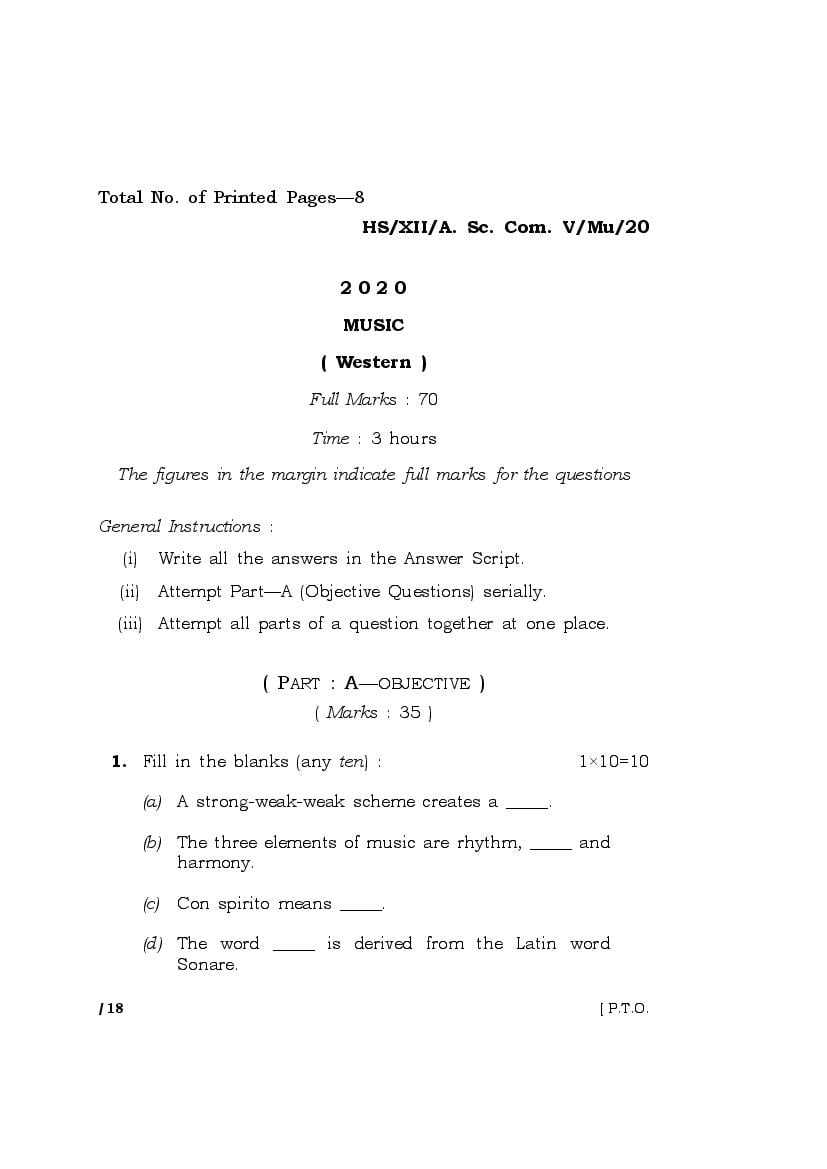
HS/XII/A. Sc. Com. V/Mu/20
2020
MUSIC
( Western )
Full Marks : 70
Time : 3 hours
The figures in the margin indicate full marks for the questions
General Instructions :
(i) Write all the answers in the Answer Script.
(ii) Attempt Part—A (Objective Questions) serially.
(iii) Attempt all parts of a question together at one place.
( PART : A—OBJECTIVE )
( Marks : 35 )
1. Fill in the blanks (any ten) : 1×10=10
(a) A strong-weak-weak scheme creates a _____.
(b) The three elements of music are rhythm, _____ and
harmony.
(c) Con spirito means _____.
(d) The word _____ is derived from the Latin word
Sonare.
/18 [ P.T.O.
Page 2
(e) Ternary form is not just applied to instrumental
music but also successfully utilized in _____ music.
(f) A _____ is a special notation based on the strings
and fret positions which was devised so that
performers could indicate fingerings as well as
pitches.
(g) Frederic Chopin was born in _____.
(h) The Classic period is marked from the year _____
to 1828.
(i) _____ form is exactly the opposite of strophic form.
(j) Rhythmic organization in northern Indian music
is provided by repeated patterns or cycles known
as _____.
(k) _____ music is transmitted orally rather than in
written or printed form as in art music.
(l) The _____ voice is the highest female range.
(m) ______ means the shifting from one key or tonal area
to another in a composition.
(n) _____ is the tone colour of a sound as measured by
the characteristic shape of a sound wave.
(o) _____ is a step that is smaller than the half-step of
Western tonality.
HS/XII/A. Sc. Com. V/Mu/20/18 [ Contd.
Page 3
2. State whether the following statements are True or
False (any ten) : 1×10=10
(a) The scalar pitch that is seven notes away is referred
to as the leading tone.
(b) Triads cannot be constructed on notes of any other
scale.
(c) The Renaissance can be considered the gateway to
the Medieval period.
(d) Popular music reaches a large audience but is
generally heard for only a brief span of time.
(e) The period of time spanned by the years 1600–1750
is called the Baroque Period.
(f) Franz Joseph Haydn was born in 1712.
(g) During the Romantic period, Opera flourished most
strongly in London.
(h) AABB is known as binary form.
(i) Recording, radio and television routinely disseminate
music of every culture throughout the world.
(j) A carillon consists of bells rung from a violin.
(k) The musical texture of monophony consists of a
single melodic line.
HS/XII/A. Sc. Com. V/Mu/20/18 [ P.T.O.
Page 4
(l) fff means as loud as possible.
(m) A series of measures organized in a repeated pattern
is called meter.
(n) Pentatonic scales are four note scales that are found
in traditional music throughout the world.
(o) A call and response is also known as responsorial
texture.
3. Choose the correct answer from the choices given
(any five) : 1×5=5
(a) The oboe is a/an
(i) percussion instrument
(ii) aerophone instrument
(iii) electrophone instrument
(iv) chordophone instrument
(b) One of the major composers during the Classic
period is
(i) Antonio Vivaldi
(ii) John Bull
(iii) Felix Mendelssohn
(iv) Wolfgang Amadeus Mozart
HS/XII/A. Sc. Com. V/Mu/20/18 [ Contd.
Page 5
(c) Rhythm is the ordered flow of music through time,
measured by
(i) meter and tempo
(ii) dynamics
(iii) key signatures
(iv) harmonic progression
(d) FAC is a/an
(i) minor triad
(ii) major triad
(iii) augmented triad
(iv) diminished triad
(e) Legato is an articulation term indicating
(i) a smooth connection between notes
(ii) a detached connection between notes
(iii) a parallel movement of notes
(iv) a single movement of notes
(f) A string quartet is a chamber ensemble of
(i) two violins
(ii) viola
(iii) cello
(iv) All of the above
HS/XII/A. Sc. Com. V/Mu/20/18 [ P.T.O.
Page 6
(g) When a melody moves along the scale line from one
member of a chord to another, the intervening non-
harmonic tones are known as
(i) anticipation
(ii) neighbouring tones
(iii) passing tones
(iv) turning tones
4. Answer the following questions (any five) : 2×5=10
(a) What do you understand by polyphony?
(b) Define the term ‘melody’.
(c) Write a short note on any stringed instrument.
(d) Construct a dominant chord (V) in the key of D
major in the treble clef.
(e) Write a short note on any one of the composers
during the Renaissance period.
(f) What is the meaning of the four Italian terms?
(i) Pianissimo
(ii) Andante
(iii) Grave
(iv) Largo
(g) What is metronomic marking?
(h) What do you understand by alto?
HS/XII/A. Sc. Com. V/Mu/20/18 [ Contd.
Page 7
( PART : B—DESCRIPTIVE )
( Marks : 35 )
Answer any one from each Unit
UNIT—1
5. (a) Using a treble clef write a 3 part diatonic secondary
triad of the following keys in crotchets : 3+3=6
(i) A major
(ii) F major
(b) Using semibreves draw the root position and 1st
inversion in the treble clef of the given keys :
2½+2½=5
(i) C major
(ii) E minor
6. (a) What do you understand by the term ‘chords’?
Write four differences between a tonic chord and
a dominant chord. 2+4=6
(b) Using semibreves, construct a V7 chord in the key of
A major scale in the bass clef. 5
HS/XII/A. Sc. Com. V/Mu/20/18 [ P.T.O.
Page 8
UNIT—2
7. (a) Name the four broad categories of vocal range. Using
semibreves, draw the voice ranges in relation to the
grand staff. 2+5=7
(b) Explain any seven performance techniques of the
violin family. 1×7=7
8. (a) Explain any two basic elements of music. 3½+3½=7
(b) Explain the characteristics of traditional music. 1×7=7
UNIT—3
9. (a) What is chamber music? Write a short note on the
sonata and the string quartet. 1+2+2=5
(b) Explain any two textural approaches of the music in
non-Western cultures. 2½+2½=5
10. (a) Explain any two musical instruments used in the
Renaissance period. 2½+2½=5
(b) Describe how pentatonic scales were used in the
African-American Music and the Asian Music.
2½+2½=5
HS/XII/A. Sc. Com. V/Mu/20/18 20K
Document Details
| Board / Org | Meghalaya Board |
| Exam | Class 12 |
| Type | Question Paper |
| Pages | 8 |
| Updated | 30 Apr 2026 |