ISC Class 12 Question Paper 2019 for Indian Music Hindustani Paper 1
Finished viewing? Save it for later —
Download ISC Class 12 Question Paper 2019 for Indian Music Hindustani Paper 1 (PDF · 4 pages)About ISC Class 12 Question Paper 2019 for Indian Music Hindustani Paper 1
ISC Class 12 Question Paper 2019 for Indian Music Hindustani Paper 1 is available here for free download. Published by CISCE for Class 12, this question paper can be viewed online or downloaded as a PDF (4 pages). Candidates preparing for Class 12 can use ISC Class 12 Question Paper 2019 for Indian Music Hindustani Paper 1 to understand the exam pattern, the type of questions asked, and the overall difficulty level.
Frequently Asked Questions
How can I download ISC Class 12 Question Paper 2019 for Indian Music Hindustani Paper 1?
Open this page and click the Download button to save ISC Class 12 Question Paper 2019 for Indian Music Hindustani Paper 1 as a PDF. It is completely free on AglaSem Docs.
Is ISC Class 12 Question Paper 2019 for Indian Music Hindustani Paper 1 free to download?
Yes. ISC Class 12 Question Paper 2019 for Indian Music Hindustani Paper 1 can be viewed online and downloaded as a PDF free of cost on AglaSem Docs.
How many pages does ISC Class 12 Question Paper 2019 for Indian Music Hindustani Paper 1 have?
ISC Class 12 Question Paper 2019 for Indian Music Hindustani Paper 1 contains 4 pages, which you can read online or download together as a single PDF.
Where can I find more Class 12 study material?
You can find more Class 12 question papers, sample papers, syllabus, and answer keys on AglaSem Docs.
ISC Class 12 Question Paper 2019 for Indian Music Hindustani Paper 1 – Text
Read the full text of this question paper below — useful to quickly search, copy and reference the content online without downloading the PDF.
📄 View text version (4 pages)
Page 1
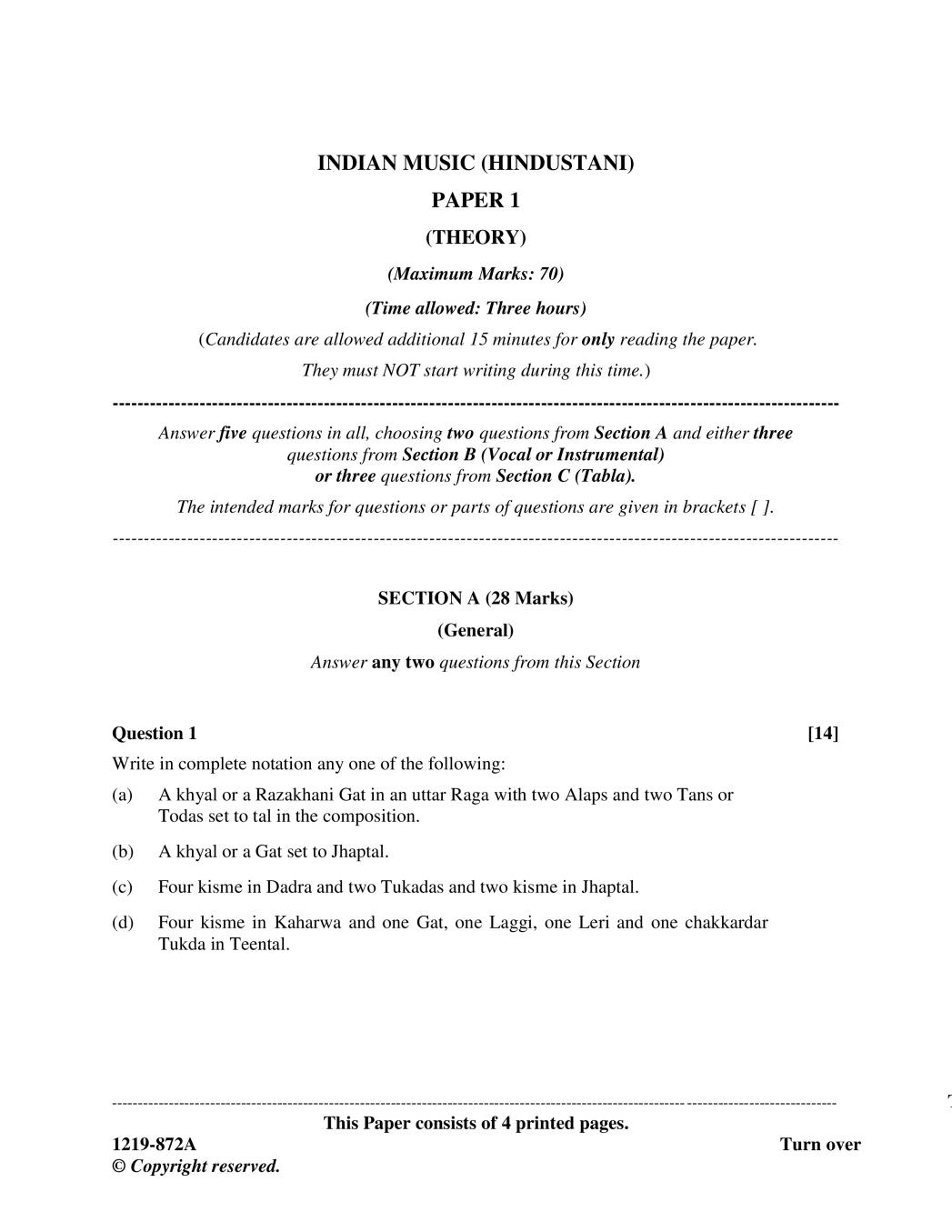
PAPER 1
(THEORY)
(Maximum Marks: 70)
(Time allowed: Three hours)
(Candidates are allowed additional 15 minutes for only reading the paper.
They must NOT start writing during this time.)
---------------------------------------------------------------------------------------------------------------------
Answer five questions in all, choosing two questions from Section A and either three
questions from Section B (Vocal or Instrumental)
or three questions from Section C (Tabla).
The intended marks for questions or parts of questions are given in brackets [ ].
---------------------------------------------------------------------------------------------------------------------
SECTION A (28 Marks)
(General)
Answer any two questions from this Section
Question 1 [14]
Write in complete notation any one of the following:
(a) A khyal or a Razakhani Gat in an uttar Raga with two Alaps and two Tans or
Todas set to tal in the composition.
(b) A khyal or a Gat set to Jhaptal.
(c) Four kisme in Dadra and two Tukadas and two kisme in Jhaptal.
(d) Four kisme in Kaharwa and one Gat, one Laggi, one Leri and one chakkardar
Tukda in Teental.
--------------------------------------------------------------------------------------------------------------- ----------------------------- T
This Paper consists of 4 printed pages.
1219-872A Turn over
© Copyright reserved.
Page 2
Write an essay (not exceeding 200 words) on any one of the following:
(a) The emotions evoked by Ragas.
(b) The kind of music you like the most.
(c) The role of younger generation in preserving the classical music tradition of
India.
Question 3 [14]
(a) Write the Theka of a taal with 16 matras and two more taals, whose matras
together make 16 matras.
(b) Write the Thaha, Dugun and Chaugun of two taals having the same number of
matras.
Question 4 [14]
(a) What makes Rag Bageshri different from its Ashray Rag?
(b) Describe why Rag Bhairavi and Rag Malkauns are Uttarangavadi Rags and not
Poorvangavadi.
Question 5 [14]
Give a brief description of the contributions made by the following to the history of
Indian Music. Also, mention the period to which they belonged.
(a) Bharata’s Natyashashtra
(b) Pandit Bhatkhande
(c) Tan Sen
Question 6 [14]
Explain what you understand by the terms Laya, Drut and Vilambit. What is the role of
each of these in Hindustani classical music in particular and in music in general?
SECTION B (42 Marks)
(For candidates offering Vocal/Instrumental Music excluding Tabla)
Question 7 [14]
(a) Explain how sound is produced, transmitted and received.
(b) With reference to sound, explain the role of Volume, Pitch and Timbre.
2
Page 3
Write a comparative study of Dhrupad, Dhamar and Khyal.
Question 9 [14]
(a) With the help of a labelled diagram, describe any stringed instrument used in
Hindustani classical music.
(b) Explain how the length of the wire of a stringed instrument changes its frequency.
(c) How does the tension in the strings change the sound produced by the
instrument?
Question 10 [14]
(a) Pakad
(b) Shuddha rag
(c) Sthayee
(d) Andolan
(e) Ansh
Question 11 [14]
Explain Vadi, Samvadi, Anuvadi and Vivadi. Give examples of each of them with the
help of two Ragas.
Question 12 [14]
Write ten alankaras with their aroha and avaroha.
Question 13 [14]
What Ragas do the following note compositions suggest? Write the aroha, avaroha and
pakad of each Raga that you have identified.
(i) DHA NI SA RE NI SA, MA MA GA GA RE SA.
• • •
(ii) DHA NI SA, NI SA, MA GA GA SA
• • •
• • • • •
(iii) MA PA DHA NI SA, RE GA RE SA, NI DHA PA
(iv) MA PA DHA GA, NI DHA
--------------------------------------------------------------------------------------------------------------------------------------------
3
1219-872A Turn over
Page 4
(Only for candidates offering Tabla)
Question 14 [14]
(a) What is the significance of Jati in Taal?
(b) Explain Jatis with examples.
Question 15 [14]
(a) Vibhag
(b) Sam
(c) Tali
(d) Khali
(e) Matra
Question 16 [14]
Choose any four Taals from your syllabus and answer the following questions:
(a) Write Bedum Tihaai in each of the four Taals.
(b) Write Dumdaar Tihaai in each of the four Taals.
Question 17 [14]
Draw the diagram of Tabla and Bayan. Label them. Explain the usage of each of the
parts.
Question 18 [14]
What is the difference between Kayada and Palta? Explain mentioning Bhari and
Khali. Write two Kayadas each in Teental and Jhaptal.
Question 19 [14]
What is meant by Wazan? Give examples of two Taals having same number of matras
but different wazans.
4
Document Details
| Board / Org | CISCE |
| Exam | Class 12 |
| Type | Question Paper |
| Pages | 4 |
| Updated | 30 Apr 2026 |