UPSC CGGE 2016 Question Paper Geology Paper II
Finished viewing? Save it for later —
Download UPSC CGGE 2016 Question Paper Geology Paper II (PDF · 8 pages)About UPSC CGGE 2016 Question Paper Geology Paper II
UPSC CGGE 2016 Question Paper Geology Paper II is available here for free download. Published by UPSC for UPSC Combined Geo-Scientist, this question paper can be viewed online or downloaded as a PDF (8 pages). Candidates preparing for UPSC Combined Geo-Scientist can use UPSC CGGE 2016 Question Paper Geology Paper II to understand the exam pattern, the type of questions asked, and the overall difficulty level.
Frequently Asked Questions
How can I download UPSC CGGE 2016 Question Paper Geology Paper II?
Open this page and click the Download button to save UPSC CGGE 2016 Question Paper Geology Paper II as a PDF. It is completely free on AglaSem Docs.
Is UPSC CGGE 2016 Question Paper Geology Paper II free to download?
Yes. UPSC CGGE 2016 Question Paper Geology Paper II can be viewed online and downloaded as a PDF free of cost on AglaSem Docs.
How many pages does UPSC CGGE 2016 Question Paper Geology Paper II have?
UPSC CGGE 2016 Question Paper Geology Paper II contains 8 pages, which you can read online or download together as a single PDF.
Where can I find more UPSC Combined Geo-Scientist study material?
You can find more UPSC Combined Geo-Scientist question papers, sample papers, syllabus, and answer keys on AglaSem Docs.
UPSC CGGE 2016 Question Paper Geology Paper II – Text
Read the full text of this question paper below — useful to quickly search, copy and reference the content online without downloading the PDF.
📄 View text version (7 pages)
Page 1
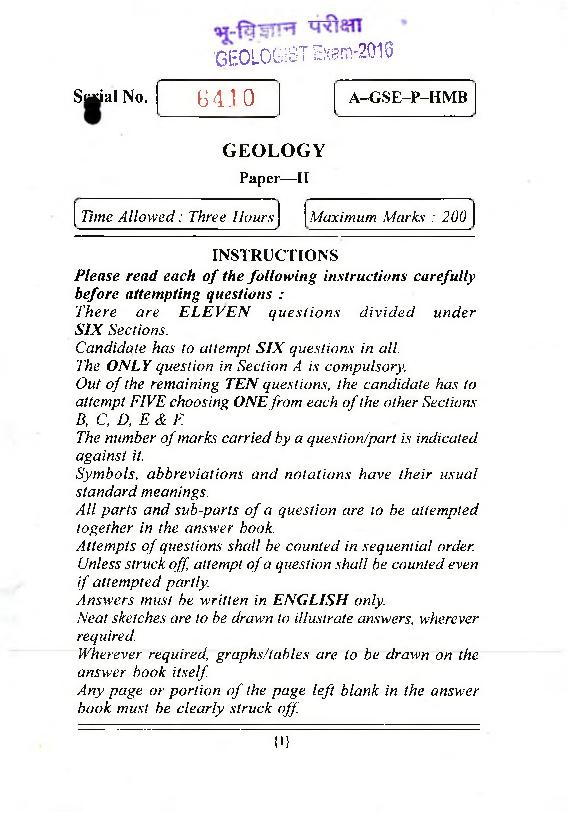
Sadal No. 6410 A-GSE-P-HM B
GEOLOGY
Paper—II
Time Allow ed: Three Hours Maximum Marks : 200
INSTRUCTIONS
Please read each o f the following instructions carefully
before attempting questions :
There are ELEVEN questions divided under
SIX Sections.
Candidate has to attempt SIX questions in all.
The ONLY question in Section A is compulsory.
Out o f the remaining TEN questions, the candidate has to
attempt FIVE choosing ONE from each o f the other Sections
B, C, D, E & F.
The number o f marks carried by a question/part is indicated
against it.
Symbols, abbreviations and notations have their usual
standard meanings.
All parts and sub-parts o f a question are to be attempted
together in the answer book.
Attempts o f questions shall be counted in sequential order.
Unless struck off, attempt o f a question shall be counted even
if attempted partly.
Answers must be written in ENGLISH only.
Neat sketches are to be drawn to illustrate answers, wherever
required.
Wherever required, graphs/tables are to be drawn on the
answer book itself.
Any page or portion o f the page left blank in the answer
book must be clearly struck off.
{1}
Page 2
(Compulsory Section) 5x10=^)
Write short notes on each of the following:
(a) Application of Powder X-ray diffraction method in the
study of silicates.
(b) Lanthanite contraction in REEs.
(c) Eutectic crystallization and related textural features.
(d) Tectono-magmatic setting for carbonatites.
(e) Distinguish between ACF and AKF diagrams.
(f) Explain paired metamorphic belts.
(g) Significance of cross bedding and current beddings.
(h) Distinguish between Arkose and Greywacke.
(i) Significance o f ‘PM 10’ and its impact on respiratory
system.
(j) Seismic zonation map of India.
{2} (Contd.)
Page 3
(Mineralogy, Geochemistry and Isotope Geology)
(a) Discuss the structure, composition, physical and optical
properties of garnet. 15
(b) Derive an equation used in the radiometric Rb-Sr age
determination of rocks. Comment upon Concordia and
Discordia. 15
(a) Discuss symmetry elements of the normal class of
Monoclinic System. Add a note on the crystallographic
notation. 10
(b) What do you understand by coordination number?
Discuss various types of silicate structures based on
coordination number. 10
(c) Discuss the geochemical classification of trace elements.
Give an account o f the role of L.I.L. (Large Ion
Lithophiles) in magmatic crystallization. 10
{3} (Contd.)
Page 4
(Igneous Petrology) ^
4. (a) Discuss crystallization of a ternary magma, citing an
example of Feldspar. 15
(b) What do you understand by modal and nonn? Discuss
IUGS classification of basic and ultrabasic rocks. Add
a note on TAS diagram. 15
5. (a) Discuss incongruent melting citing an example of
Forsterite-Silica system. Give an account on reaction
rim / corona structure. 10
(b) Discuss about open and closed systems of magmatic
crystallization. Add a note on the layered igneous
complexes. 10
(c) Discuss the age, duration and nature o f Deccan
Volcanism in India. Add a detailed note on the ‘aa’ and
‘pahoehoe’ type lava flows. 10
{4} (Contd.)
Page 5
(Metamorphic Petrology and Processes)
(a) What do you understand by porphyroblasts ? Explain
their significance in metamorphic terrains, citing an
example of garnet in the mica schist. 15
(b) Describe the characteristics and mineral assemblages
of Green Schist Facies of metamorphism. Add a note
on the mutual relationship between sub-facies and
conditions of metamorphism. 15
(a) Give a brief account of Blue Schist and Eclogite Facies
of metamorphism and their relationships to plate
tectonics. 10
(b) What is the principle of Gamet-Biotite Thermometry?
Discuss its limitations and applications to metamorphic
rocks. 10
(c ) Write a critique on “Facies concept of Metamorphism”
10
{5} (Contd.)
Page 6
(Sedimentology)
(a) What are the heavy minerals ? Discuss the application
of heavy minerals in the determination of provenance.
15
(b) How would you distinguish between Arkose and
Greywacke? Discuss their depositional environments.
15
(a) Discuss the physicochemical factors, which play an
important role in the sedimentation. What are the
products of sedimentation? 10
(b) Discuss in detail about the formation of clay minerals.
Give your remarks on their environment of formation.
10
(c) Describe the concept of sedimentary environment and
add a note on the parameters. 10
{6} (Contd.)
Page 7
(Environmental Geology' and Natural Hazards)
10. (a) What is coastal erosion? Discuss the causes and
mitigation of coastal erosion and add a note on such
incidences with reference to Indian context. 15
(b) Discuss the causes and impacts of an earthquake. Give
an account of the precautionary measures to be taken
against earthquake hazards. 15
11. (a) How are the satellite imageries useful in environmental
planning ? Give an account of the factors controlling
landslides. 10
(b) What do you understand by global warming and climate
change ? Discuss the effects of C 0 2on green-house
effect. 10
(c) What is Cryosphere? Discuss the effects of Ozone
depletion on ice sheets and sea level fluctuations. 10
{7}
Document Details
| Board / Org | UPSC |
| Exam | UPSC Combined Geo-Scientist |
| Type | Question Paper |
| Pages | 8 |
| Updated | 30 Apr 2026 |