ISC Class 12 Question Paper 2025 Political Science
Finished viewing? Save it for later —
Download ISC Class 12 Question Paper 2025 Political Science (PDF · 7 pages)About ISC Class 12 Question Paper 2025 Political Science
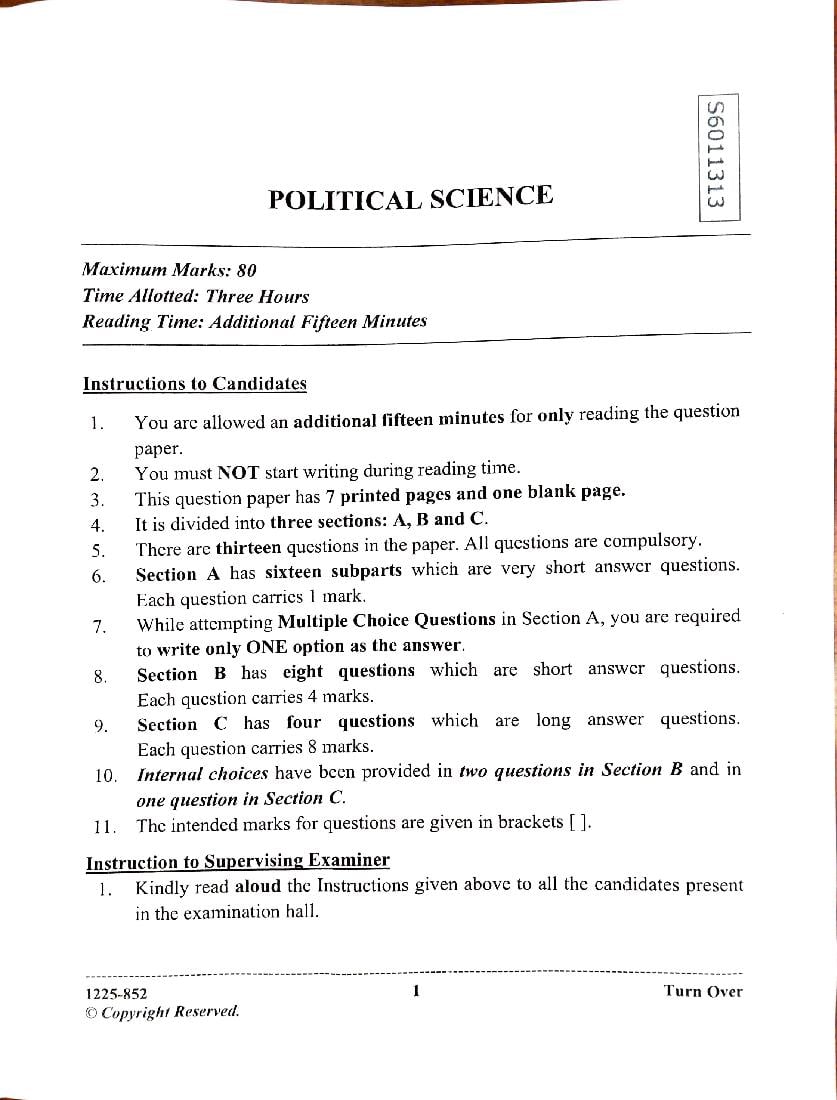
ISC Class 12 Question Paper 2025 Political Science is available here for free download. Published by CISCE for Class 12, this question paper can be viewed online or downloaded as a PDF (7 pages). Candidates preparing for Class 12 can use ISC Class 12 Question Paper 2025 Political Science to understand the exam pattern, the type of questions asked, and the overall difficulty level.
Frequently Asked Questions
How can I download ISC Class 12 Question Paper 2025 Political Science?
Open this page and click the Download button to save ISC Class 12 Question Paper 2025 Political Science as a PDF. It is completely free on AglaSem Docs.
Is ISC Class 12 Question Paper 2025 Political Science free to download?
Yes. ISC Class 12 Question Paper 2025 Political Science can be viewed online and downloaded as a PDF free of cost on AglaSem Docs.
How many pages does ISC Class 12 Question Paper 2025 Political Science have?
ISC Class 12 Question Paper 2025 Political Science contains 7 pages, which you can read online or download together as a single PDF.
Where can I find more Class 12 study material?
You can find more Class 12 question papers, sample papers, syllabus, and answer keys on AglaSem Docs.
ISC Class 12 Question Paper 2025 Political Science – Text
Read the full text of this question paper below — useful to quickly search, copy and reference the content online without downloading the PDF.
📄 View text version (6 pages)
Page 2
Question 1
(i) Indian states are large and conplex with varying economic problems. In some |1]
Cases, parts of a large state may feel neglected with their problems perceived as
not given adequate attention. This may lead to ademand focused on more
responsive governance, administrative accessibility and economic viability of
sub-regions.
which one of the following regional aspirations correctly represents the above?
(a) Sons-of-the-soil principle
(b) Demands for a new state
(c) Secessionist tendencies
(d) Language Agitations
(ii) Article 32 (1) in the Constitution of India states, The right to move the Supreme [1]
Court by appropriate proceedings for the enforcement of the rights conferred by
this Part is guaranteed.
The fundamental right being referred to here is:
(a) Right to Freedom
(b) Right to Life
(c) Right against Exploitation
(d) Right to Constitutional Remedies
(iii) Given below are two statements marked Assertion and Reason. Read the two |1|
statements carefully and choose the correct option.
Assertion: In a First-Past-the-Post system, a candidate can win an election without
winning a majority of the votes cast.
Reason: To win in this system, a candidate simply needs to get more votes than
other candidates.
.(a) Both Assertion and Reason are true and Reason is the correct explanation
for Assertion.
(b) Both Assertion and Reason are true but Reason is not the correct explanation
for Assertion.
(c) Assertion is true and Reason is false.
(d) Both Assertion and Reason are false.
1225-852 2
Page 3
two
statements marked Assertion and Reason. Read
statements carefully and choose the correct option.
ASsertion: A written constitution with a clear division of powers is essential tor a
federal state.
Reason: An unwritten constitution is easy to amend.
(a) Both Assertion and Reason are true and Reason is the correct explanation
for Assertion.
(b) Don ASSertion and Reason are true but Reason is not the correct explanation
for Assertion.
(c) Assertion is true and Reason is false.
(d) Both Assertion and Reason are false.
(v) In the United States, if the President does not sign a bill within ten days of its
passage by Congress, it automatically becomes a law. However,
if Congress adjourns within the ten-day period and the President does not sign the
bill, it dies. This is called the
1]
(vi) Observe the relation between the first two words / phrases and fill in the fourth
word /phrase.
Senate and the
The House of Representative and the Lok Sabha: Speaker :: The
Rajya Sabha:
can declare a [1]
(vii) According to Article 352 of the Constitution of India, the President
or
national emergency on the grounds of war, external aggression
refers to that part of the Executive which consists of civil [11
(vii) The
servants whoserve untilretirement.
False.
(ix) State whether the following are True or
with the [1|
(a) Under the U.S. Constitution, the power to declare war rests
President.
an
Though she is not a member of either House, the President of India is [1]
(b) Parliament.
integral part of the Union
States serve until they reach the [1]
(c) Judges of the Supreme Court of the United
age of sixty-five.
legally. Allother |1
(d) In a bi-party system, only two parties are allowed to exist
parties are banned.
Turn Over
1225-852
Page 4
(a) A list of twenty-nine subjects that has been delegated to local [1]
self-government institutions by the 73td Amendment to the Constitution of
India.
(b) The Fundamental Right added to the Constitution of India by the [1]
86" Amendment and designated as Article 21lA.
(c) The majority required in Congress to override a Presidential veto in the (1
United States.
(d) An electoral system that seeks to create a representative legislature that [1]
reflects the percentage of votes for each political party.
SECTION B - 32 MARKS
Question 2 [4]
A Liberal Democracy is not limited to one-person-one-vote and free and fair elections.
It has numerous other essential features. Briefly explain any two of them.
Question 3 14]
Explain any two differences between a Written constitution and an Unwritten constitution.
Question 4 (4]
Discuss the Appellate Jurisdiction of the Supreme Court of India in criminal and civil
Imatters.
Question 5 [4]
() State and explain any two ways in which the Lok Sabha exercises control over the
Councilof Ministers.
OR
(ii) Compare the relative positions of the Rajya Sabha and the Senate with respect to
money bills.
1225-852 4
Page 5
Briefly explain one Executive and one Legislative power of the President of India.
Question 7 14]
(i) State and briefly explain any wo kinds of Political Violence in India since
independence.
OR
(1) Briefly explain the following salient features of the Constitution of India:
(a) Detailed constitution drawn from many sources
(b) Federal in Structure and Unitary in spirit
Question 8 [4]
Discuss anywo reasons for the importance of the Preamble to the Constitution of India.
Question 9
Read the excerpt given below and answer the questions that follow.
"It is the intention of this Assembly that in future both the legislature and the executive
should not merely pay lip service to these (directive) principles enacted in this part, but
that they should be made the basis of all executive and legislative action that may be taken
hereafter in the matter of the governance of the country. I therefore submit that both the
words fundamental" and "directive" are necessary and should be retained."
(Source: Dr. Ambedkar, speaking in the Constituent Assembly on November 19, 1948)
() Why are Directive Principles fundamental to lawmaking? [2]
(ii) Comment on the significance of Directive Principles. (2]
1225-852 5 Turn Over
Page 6
Question 10 (8]
of India.
Apain any four key features of the 74th Amendment to the Constitution
(i)
OR
(ii) The Constitution of India has been described as partly rigid and partly tlexible.
Explain.
Question 11 [8|
Discuss any four rights conferred under the Right to Equality (Articles 14-18) in the
Constitution of India.
Question 12
[8]
Discuss two Legislative and two Executive powers of the President of the
How can the President influence legislation despite not being a part of United States.
the legislature?
Question 13
Read the passage given below and answer the questions that follow.
Chief Justice Marshall's masterful verdict in Marbury
versus Madison case has been
widely hailed. In the face of attacks on the
judiciary,...Marshall
statement to maintain the status of the Supreme needed to make a strong
Court as the head of a coequal branch of
government. By asserting the crucial power for Supreme Court (not mentioned in the
Constitution) Marshall claimed for the court a paramount position as
Constitution. interpreter of the
(Source: https:/www.britannica.com/event/Marbury-v-Madison)
() What power was asserted by the Chief Justice John
Marshall in the landmark case
of Marbury versus Madison? Briefly explain its meaning. [2]
1225-852 6
Page 7
(a) Ultra Vires (2)
(b) Severability |21
(m) How is the independence of the judiciary ensured in the Constitution of the United
States?
1225-852 7
Document Details
| Board / Org | CISCE |
| Exam | Class 12 |
| Type | Question Paper |
| Pages | 7 |
| Updated | 24 Sep 2026 |