UPSC CGGE 2016 Question Paper Geology Paper III
Finished viewing? Save it for later —
Download UPSC CGGE 2016 Question Paper Geology Paper III (PDF · 6 pages)About UPSC CGGE 2016 Question Paper Geology Paper III
UPSC CGGE 2016 Question Paper Geology Paper III is available here for free download. Published by UPSC for UPSC Combined Geo-Scientist, this question paper can be viewed online or downloaded as a PDF (6 pages). Candidates preparing for UPSC Combined Geo-Scientist can use UPSC CGGE 2016 Question Paper Geology Paper III to understand the exam pattern, the type of questions asked, and the overall difficulty level.
Frequently Asked Questions
How can I download UPSC CGGE 2016 Question Paper Geology Paper III?
Open this page and click the Download button to save UPSC CGGE 2016 Question Paper Geology Paper III as a PDF. It is completely free on AglaSem Docs.
Is UPSC CGGE 2016 Question Paper Geology Paper III free to download?
Yes. UPSC CGGE 2016 Question Paper Geology Paper III can be viewed online and downloaded as a PDF free of cost on AglaSem Docs.
How many pages does UPSC CGGE 2016 Question Paper Geology Paper III have?
UPSC CGGE 2016 Question Paper Geology Paper III contains 6 pages, which you can read online or download together as a single PDF.
Where can I find more UPSC Combined Geo-Scientist study material?
You can find more UPSC Combined Geo-Scientist question papers, sample papers, syllabus, and answer keys on AglaSem Docs.
UPSC CGGE 2016 Question Paper Geology Paper III – Text
Read the full text of this question paper below — useful to quickly search, copy and reference the content online without downloading the PDF.
📄 View text version (6 pages)
Page 1
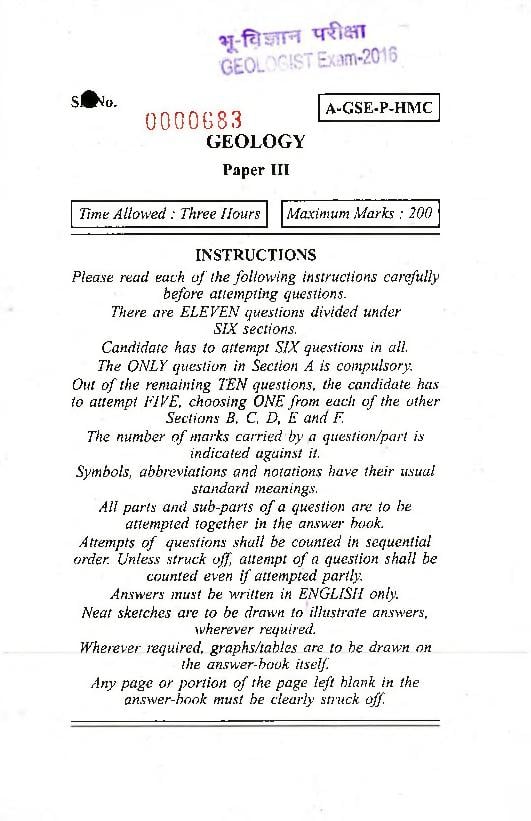
0000G83
GEOLOGY
Paper III
Time Allowed : Three Hours Maximum Marks : 200
INSTRUCTIONS
Please read each o f the follow ing instructions carefully
before attempting questions.
There are ELEVEN questions divided under
SIX sections.
Candidate has to attempt SIX questions in all.
The ONLY question in Section A is compulsory.
Out o f the remaining TEN questions, the candidate has
to attempt FIVE, choosing ONE from each o f the other
Sections B, C, D, E and F.
The number o f marks carried by a question/part is
indicated against it.
Symbols, abbreviations and notations have their usual
standard meanings.
All parts and sub-parts o f a question are to be
attempted together in the answer book.
Attempts o f questions shall be counted in sequential
order. Unless struck off, attempt o f a question shall be
counted even i f attempted partly.
Answers must be written in ENGLISH only.
Neat sketches are to be drawn to illustrate answers,
wherever required.
Wherever required, graphs/tables are to be drawn on
the answer-book itself
Any page or portion o f the page left blank in the
answer-book must be clearly struck o ff
Page 2
1. Write short answer for each o f the following with
sketches wherever necessary. 5x10=50
(a) Favourable conditions for the formation of
blanket type bauxite deposits.
(b) Grade o f iron ore from Singhbhum area.
(c) Association of REEs and Rare metals in
carbonatite.
(d) Time-distance relation for horizontal layers in
seismic refraction survey.
(e) Methods o f sampling o f porphyry copper
deposit.
(f) Biogeochemical and geobotanical surveys.
(g) Broad stratigraphic succession o f Jharia coal
field.
(h) Geology and hydrocarbon reservoirs of
Bombay High oil field.
(i) Investigation of foundation rocks in a dam site
using electrical resistivity method.
(j) Overbreak in tunnelling in relation to different
rock types.
A-GSE-P-HMC 2 (Contd.)
Page 3
2. (a) Compare the geological set up o f Khetri and
Malanjkhand copper deposits. 15
(b) With appropriate examples, write the genesis
o f gold deposit associated with the greenstone
belts in Dharwar craton of South India. 15
3. (a) What are the major economically useful rocks
belonging to ‘Vindhyan Supergroup’ ? 10
(b) What are prospecting licence and mining
leases for mineral investigation and
exploitation ? 10
(c) Explain the legal aspects o f seabed mining
with special reference to India. 10
Section - C
4. (a) How stratiform and podiform chromite
deposits differ in geological age, lithological
association, structure and tectonics? 15
(b) Describe with diagram the details o f profiling
and sounding methods o f resistivity survey.
Add a note on their applications. 12+3=15
A-GSE-P-HMC 3 (Contd.)
Page 4
data ? Describe the correction to be applied to
the gravity data. 2+8=10
(b) How ‘VM SD’ and ‘SEDEX’ type deposits
differ from each other ? 10
(c) How is fluid inclusion study helpful in
geothermometry? 10
Section - D
6. (a) Describe the different stages in mineral
exploration. 15
(b) Describe the estimation of ore reserves in
blanket type bauxite deposit using surface
trenching and pitting. 15
7 . (a) Write on the procedure of core logging in a
drilling site. 10
(b) Calculate ore reserve of a 5 m thick ore
blocked out between two levels, separated by
30 m, and ready for immediate extraction. The
length of the ore block is 40 m and the bulk
density o f the ore is 2-73 gm/cc. Assuming
0-63% average grade o f copper, how much
copper metal can be obtained from the block
with 90% recovery ? 5+5
(c) How geochemical soil survey is earned out ?
10
A-GSE-P-HMC 4 (Contd.)
Page 5
8 . (a) Describe the processes of migration and
accumulation o f hydrocarbon. 15
(b) Describe the major Tertiary coal deposits of
India. 15
9 . (a) Write on the occurrence and distribution of
major radioactive mineral deposits (U - Th) of
India. • 10
(b) Describe the proximate analysis of coal and its
industrial application. 10
(c) Give an account of the geology and
hydrocarbon occurrence in any one o f the
major producing oil fields of upper Assam
shelf. 10
Section - F
10. (a) Give an account o f the field procedures for the
estimation o f compressive and shear strengths
o f rocks used for stable foundation. 15
(b) What is grouting ? Describe the typical
grouting applications in tunnelling. 15
A-GSE-P-HMC 5 (Contd.)
Page 6
sub-continent and propose the features o f an
earthquake resistant dam in a high risk seismic
zone. 10
(b) Explain the various factors that influence the
life o f a reservoir. 10
(c) Describe the different types o f tunnel supports
and their usefulness in different rock types
while tunnelling. 10
A-GSE-P-HMC 6
Document Details
| Board / Org | UPSC |
| Exam | UPSC Combined Geo-Scientist |
| Type | Question Paper |
| Pages | 6 |
| Updated | 30 Apr 2026 |