UPSC CGGE 2016 Question Paper Geo-Physics Paper I
Finished viewing? Save it for later —
Download UPSC CGGE 2016 Question Paper Geo-Physics Paper I (PDF · 8 pages)About UPSC CGGE 2016 Question Paper Geo-Physics Paper I
UPSC CGGE 2016 Question Paper Geo-Physics Paper I is available here for free download. Published by UPSC for UPSC Combined Geo-Scientist, this question paper can be viewed online or downloaded as a PDF (8 pages). Candidates preparing for UPSC Combined Geo-Scientist can use UPSC CGGE 2016 Question Paper Geo-Physics Paper I to understand the exam pattern, the type of questions asked, and the overall difficulty level.
Frequently Asked Questions
How can I download UPSC CGGE 2016 Question Paper Geo-Physics Paper I?
Open this page and click the Download button to save UPSC CGGE 2016 Question Paper Geo-Physics Paper I as a PDF. It is completely free on AglaSem Docs.
Is UPSC CGGE 2016 Question Paper Geo-Physics Paper I free to download?
Yes. UPSC CGGE 2016 Question Paper Geo-Physics Paper I can be viewed online and downloaded as a PDF free of cost on AglaSem Docs.
How many pages does UPSC CGGE 2016 Question Paper Geo-Physics Paper I have?
UPSC CGGE 2016 Question Paper Geo-Physics Paper I contains 8 pages, which you can read online or download together as a single PDF.
Where can I find more UPSC Combined Geo-Scientist study material?
You can find more UPSC Combined Geo-Scientist question papers, sample papers, syllabus, and answer keys on AglaSem Docs.
UPSC CGGE 2016 Question Paper Geo-Physics Paper I – Text
Read the full text of this question paper below — useful to quickly search, copy and reference the content online without downloading the PDF.
📄 View text version (7 pages)
Page 1
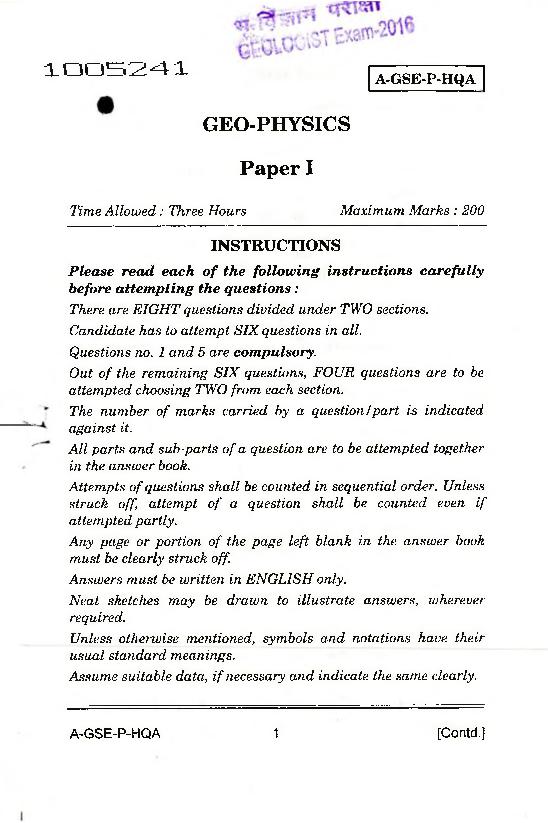
GEO-PHYSICS
Paper I
Time Allowed: Three Hours Maximum Marks: 200
INSTRUCTIONS
Please read each o f the following instructions carefully
before attempting the questions :
There are EIGHT questions divided under TWO sections.
Candidate has to attempt SIX questions in all.
Questions no. 1 and 5 are compulsory.
Out of the remaining SIX questions, FOUR questions are to be
attempted choosing TWO from each section.
The number of marks carried by a question /part is indicated
against it.
All parts and sub-parts of a question are to be attempted together
in the answer book.
Attempts of questions shall be counted in sequential order. Unless
struck off, attempt of a question shall be counted even if
attempted partly.
Any page or portion of the page left blank in the answer book
must be clearly struck off.
Answers must be written in ENGLISH only.
Neat sketches may be drawn to illustrate answers, wherever
required.
Unless otherwise mentioned, symbols and notations have their
usual standard meanings.
Assume suitable data, if necessary and indicate the same clearly.
A-GSE-P-HQA 1 [Contd.]
Page 2
1. Attempt all of the following : 9
(a) Discuss the magnetic elements of the Earth,
with the help of a neat sketch. Give the
relationships among these elements.
(b) What is fault plane solution of an earthquake ?
Using the ‘Beach Ball’ image show the fault
plane solutions for (i) Normal fault, (ii) Thrust
fault, (iii) Vertical strike-slip fault, and
(iv) Vertical dip-slip fault.
(c) Write down the expressions for gradient of a
scalar field, T, and divergence and curl of a
vector field, , in Cartesian coordinate
system.
(d) What is Singular Value Decomposition (SVD) of
a matrix ? How is it used to obtain the inverse
of a square matrix ?
2. (a) Write down the expressions of Laplace equation
in Cartesian, cylindrical and spherical
coordinate systems.
(b) Describe an iterative linear inversion method
for quasi-linear problems and discuss the
problem of trapping of the solution in local
minima.
(c) Discuss the magnetic field of the Earth in terms
of internal and external causes. Describe the
theory, with the help of a neat sketch, that
explains 90% of the observed magnetic field of
the Earth.
A-GSE-P-HQA 2
Page 3
underdetermined problem using Lagrange
^ multiplier. 10
(b) Show that the minimum time-path between
points A and B for the following ray geometry
gives the same result as Snell’s law : 10
(c) With the help of a neat sketch, describe how the
time of occurrence of an earthquake and the
distance travelled by the seismic wave be
determined, using Wadati diagram. 10
4. (a) What do you understand by ‘Monte Carlo’ and
‘Directed Monte Carlo’ methods ? Describe the
important steps of Monte Carlo method of
inversion. 10
(b) Discuss the mode of propagation of EM field for
low ( < 50 kHz) and high ( > 50 kHz)
frequencies. On the basis of it, define the
quasi-static approximation and quasi-static
region for low frequency EM field. 10
(c) Discuss the geophysical evidences of ‘Seafloor
spreading’. 10
A-GSE-P-HQA [Contd.]
I
Page 4
5. Attempt all of the following :
(a) Expand cosh z - cosh 6 in a Taylor series in
powers of (z - 6). What is the radius of
convergence of this power series ? 10
(b) Find the wavelength and propagation speed of
radio waves of 1 MHz in copper and compare
your answers with those in vacuum (given that
conductivity of copper is 6 x 10⁷ SI units,
£q = 8-85 x 10-12 SI units, ji0 = An x 1CT7 SI
units; also assumed a = eQ, jx ~ ^Q). 10
(c) 1 kg of water at 0°C is brought in contact with a
heat reservoir at 100°C.
(i) Calculate the change in entropy of water
when it attains the temperature of the
reservoir.
(ii) Obtain the entropy change of both the
reservoir and the universe. 5+5=10
(d) Draw a neat block diagram of a 3-layer model
for a satellite navigation system.
Discuss the working principle of the above
navigation system. 5+5=10
A-GSE-P-HQA 4 [Contd.]
Page 5
(a) A periodic function with a period of 2n is given
£ by
fix) = x2 for - n < x < n.
Find out the Fourier series expansion and use
your result to find the sum of the series
I
n=1
1 / n 2. 10
(b) Write down Maxwell’s equations for a plane
electromagnetic wave propagating in free space.
How do these equations differ from those in an
isotropic conducting medium ?
Show that the plane electromagnetic wave
E ( k, co) follows the equation
^ 2 —>
V2E + ^5- E = 0. 6+4=20
c
(c) What is the origin of day-time attenuation of
the high frequency (HF) radio waves ? Write a
brief note on this specific ionospheric layer. 2+8-10
7. (a) Write down Simpson’s rule for numerical
integration of
b
I
a
fix) dx.
Use the above rule for computing the value of
5
j1
i2 dx
by dividing the interval (1, 5) in four equal
parts. Compare the numerical value with the
exact result and give your comments. 10
A-GSE-P-HQA 5 [Contd.]
Page 6
(b) What is atmospheric plasma ? Define electron
and ion plasma frequencies in terms of tj^
material parameters. Show that the plasnra
effects on electromagnetic wave propagation in
the ionosphere is mainly due to the electrons. 10
(c) Using the relation
2n h v3
e (v, T) dv =
c2 e ^ - l ’
show that the energy radiated per unit area
and time in the range X and X + dX is
2 ^ h U h c / X _ j j - 1 dx = e(JL T ) ^
X5 ’
Here, X = c/v and e(v, T) is the black body
emissivity and h is Planck’s constant.
Using the variable x = (3hc/X, show that the
value of x for which e(X, T) is maximum is given
by
(5 - x) ex - 5 = 0. 10
8. (a) Define a group and show that the set of all
2 x 2 unitary matrices with determinant 1 is a
group. Find the number of independent real
parameters required to specify a group element
of SU(2). 5+5=10
(b) The first excited state of He-atom lies
19-82 eV above the ground state. If this excited
state is 3-fold degenerate while the ground
state is non-degenerate, find the relative
populations of the first excited state and the
ground state for He-gas in thermal equilibrium
at 1000 K. 10
A-GSE-P-HQA 6 [Contd.]
Page 7
ionospheric medium can be approximated as
with N as electron density and f is the linear
frequency in kHz.
What will happen, if the electron plasma
frequency is greater than the wave
frequency ? 7+3=10
A-GSE-P-HQA 7
Document Details
| Board / Org | UPSC |
| Exam | UPSC Combined Geo-Scientist |
| Type | Question Paper |
| Pages | 8 |
| Updated | 30 Apr 2026 |