MBOSE Class 12 Question Paper 2020 for Education
Finished viewing? Save it for later —
Download MBOSE Class 12 Question Paper 2020 for Education (PDF · 8 pages)About MBOSE Class 12 Question Paper 2020 for Education
MBOSE Class 12 Question Paper 2020 for Education is available here for free download. Published by Meghalaya Board for Class 12, this question paper can be viewed online or downloaded as a PDF (8 pages). Candidates preparing for Class 12 can use MBOSE Class 12 Question Paper 2020 for Education to understand the exam pattern, the type of questions asked, and the overall difficulty level.
Frequently Asked Questions
How can I download MBOSE Class 12 Question Paper 2020 for Education?
Open this page and click the Download button to save MBOSE Class 12 Question Paper 2020 for Education as a PDF. It is completely free on AglaSem Docs.
Is MBOSE Class 12 Question Paper 2020 for Education free to download?
Yes. MBOSE Class 12 Question Paper 2020 for Education can be viewed online and downloaded as a PDF free of cost on AglaSem Docs.
How many pages does MBOSE Class 12 Question Paper 2020 for Education have?
MBOSE Class 12 Question Paper 2020 for Education contains 8 pages, which you can read online or download together as a single PDF.
Where can I find more Class 12 study material?
You can find more Class 12 question papers, sample papers, syllabus, and answer keys on AglaSem Docs.
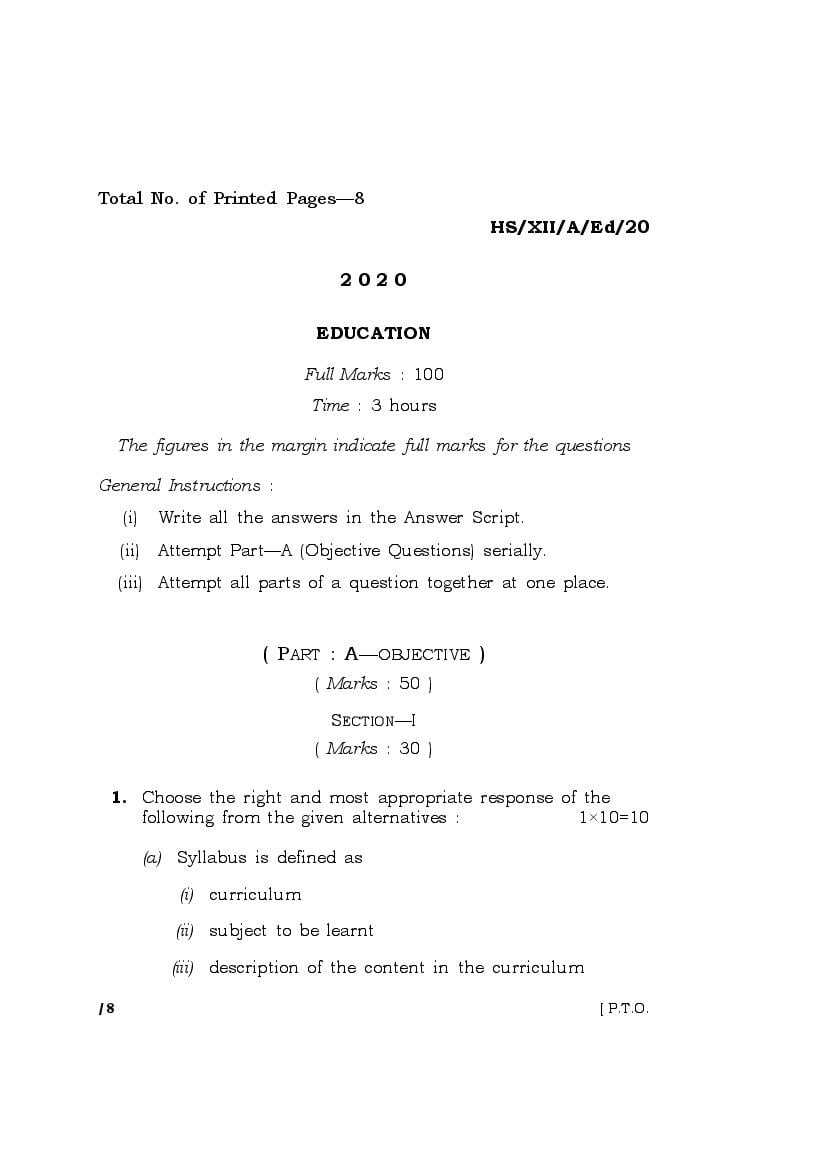
MBOSE Class 12 Question Paper 2020 for Education – Text
Read the full text of this question paper below — useful to quickly search, copy and reference the content online without downloading the PDF.
📄 View text version (8 pages)
Page 1
HS/XII/A/Ed/20
2020
EDUCATION
Full Marks : 100
Time : 3 hours
The figures in the margin indicate full marks for the questions
General Instructions :
(i) Write all the answers in the Answer Script.
(ii) Attempt Part—A (Objective Questions) serially.
(iii) Attempt all parts of a question together at one place.
( PART : A—OBJECTIVE )
( Marks : 50 )
SECTION—I
( Marks : 30 )
1. Choose the right and most appropriate response of the
following from the given alternatives : 1×10=10
(a) Syllabus is defined as
(i) curriculum
(ii) subject to be learnt
(iii) description of the content in the curriculum
/8 [ P.T.O.
Page 2
(b) The type of evaluation that evaluate the achievement
of students at the end of instruction is
(i) placement evaluation
(ii) summative evaluation
(iii) formative evaluation
(c) Autism is a developmental disability referring to
(i) a child’s emotional disturbances
(ii) hyperactivity
(iii) normal intelligence
(d) “Without Music and Fine Arts a nation lacks its
highest means of National Self-expression and the
people remain inarticulate.” It was stated by
(i) Pablo Picasso
(ii) Gandhiji
(iii) Tagore
(e) Educational Technology is the science of
(i) School Programmes
(ii) Techniques and Methods
(iii) Advancement of Knowledge
HS/XII/A/Ed/20/8 [ Contd.
Page 3
(f) The form of learning in which the gap between the
instructor and student is bridged through online
technologies is
(i) E-Learning
(ii) M-Learning
(iii) Blended Learning
(g) Individual differences demand that education
should be
(i) subject-centred
(ii) teacher-centred
(iii) child-centred
(h) The ability to select and process certain information
while simultaneously ignoring others is called
(i) Focussed attention
(ii) Sustained attention
(iii) Selective attention
(i) The oldest idea about forgetting is that it is simply
caused by
(i) interference
(ii) repression
(iii) decay
(j) The process that helps us to validate our argument
and reach conclusions is known as
(i) thinking
(ii) reasoning
(iii) understanding
HS/XII/A/Ed/20/8 [ P.T.O.
Page 4
2. Write whether the following statements are True
or False : 1×5=5
(a) Evaluation is not an integral part of the teaching-
learning process.
(b) The Superego is a part of personality that is
concerned with morality.
(c) Crow and Crow propounded the Two-Factor Theory.
(d) Distance education or distance learning aims to
deliver education to students who are not physically
‘on site’.
(e) Heredity plays a more important role than
environment in human development.
3. Match the word(s) in Column—A relating to the
appropriate word(s) in Column—B : 1×5=5
Column—A Column—B
(a) Pedagogy (i) Technology
(b) Telecommunication (ii) Performing Arts
(c) Binet and Simon (iii) Memory
(d) Drama and Music (iv) Intelligence
(e) Retention (v) Strategies and Styles
of teaching
HS/XII/A/Ed/20/8 [ Contd.
Page 5
4. Who stated the following : 1×5=5
(a) “All the learning which is planned and guided by the
school, whether it is carried on in groups or
individually, inside or outside the school.’’
(b) “Educational Technology is the application of
scientific method and techniques to Education.”
(c) “It’s not that I am so smart, it’s just that I stay with
problems longer.”
(d) The greatest gift you can give another is the purity
of your attention.
(e) When the mind is thinking, it is talking to itself.
5. Fill in the blanks : 1×5=5
(a) Aristotle the Greek philosopher introduced a system
of reasoning called _____.
(b) _____ is a feeling or emotion that causes to focus on
an object, event or a process.
(c) A/An _____ classroom is a means to bring children
with varied needs together.
(d) The human brain is a knot of _____ billion neurons
and support cells.
(e) Curriculum planning at the national level is done
by the _____.
HS/XII/A/Ed/20/8 [ P.T.O.
Page 6
SECTION—II
( Marks : 20 )
6. Answer briefly the following in 2 or 3 sentences
each : 2×10=20
(a) What is Evaluation?
(b) Mention four objectives of Educational Technology.
(c) Mention any four factors determining Personality.
(d) What is concept formation?
(e) What do you understand by Blended learning?
(f) Differentiate between overt and covert attention.
(g) Mention the Curriculum for drama at different
stages of school education as prescribed by NCERT.
(h) What is Mnemonics?
(i) State the basic steps used in reasoning.
(j) What are multiple disabilities?
HS/XII/A/Ed/20/8 [ Contd.
Page 7
( PART : B—DESCRIPTIVE )
( Marks : 50 )
Answer Question No. 7 and any two from the rest
7. Write short notes on any three of the following : 6×3=18
(a) Types of Attention
(b) Thinking critically
(c) Project-Based learning in Educational Technology
(d) Art Education Curriculum as prescribed by NCERT
for secondary stage
(e) Causes of forgetting
8. Define curriculum. Discuss the different types of
curriculum. 4+12=16
9. What is Art Education? Write briefly on the importance
of Art Education. 6+10=16
10. Discuss in detail the different aspects of Educational
Technology. 16
11. Define personality. Explain briefly the Allport’s
Trait Theory. 6+10=16
HS/XII/A/Ed/20/8 [ P.T.O.
Page 8
12. What is reasoning? How can thinking and reasoning
abilities be developed in children? 2+14=16
13. What is individual difference? Explain how heredity
and environment contribute to the differences in
intelligence. 4+12=16
HS/XII/A/Ed/20/8 20K
Document Details
| Board / Org | Meghalaya Board |
| Exam | Class 12 |
| Type | Question Paper |
| Pages | 8 |
| Updated | 30 Apr 2026 |