MBOSE Class 12 Question Paper 2020 for Philosophy
Finished viewing? Save it for later —
Download MBOSE Class 12 Question Paper 2020 for Philosophy (PDF · 8 pages)About MBOSE Class 12 Question Paper 2020 for Philosophy
MBOSE Class 12 Question Paper 2020 for Philosophy is available here for free download. Published by Meghalaya Board for Class 12, this question paper can be viewed online or downloaded as a PDF (8 pages). Candidates preparing for Class 12 can use MBOSE Class 12 Question Paper 2020 for Philosophy to understand the exam pattern, the type of questions asked, and the overall difficulty level.
Frequently Asked Questions
How can I download MBOSE Class 12 Question Paper 2020 for Philosophy?
Open this page and click the Download button to save MBOSE Class 12 Question Paper 2020 for Philosophy as a PDF. It is completely free on AglaSem Docs.
Is MBOSE Class 12 Question Paper 2020 for Philosophy free to download?
Yes. MBOSE Class 12 Question Paper 2020 for Philosophy can be viewed online and downloaded as a PDF free of cost on AglaSem Docs.
How many pages does MBOSE Class 12 Question Paper 2020 for Philosophy have?
MBOSE Class 12 Question Paper 2020 for Philosophy contains 8 pages, which you can read online or download together as a single PDF.
Where can I find more Class 12 study material?
You can find more Class 12 question papers, sample papers, syllabus, and answer keys on AglaSem Docs.
MBOSE Class 12 Question Paper 2020 for Philosophy – Text
Read the full text of this question paper below — useful to quickly search, copy and reference the content online without downloading the PDF.
📄 View text version (8 pages)
Page 1
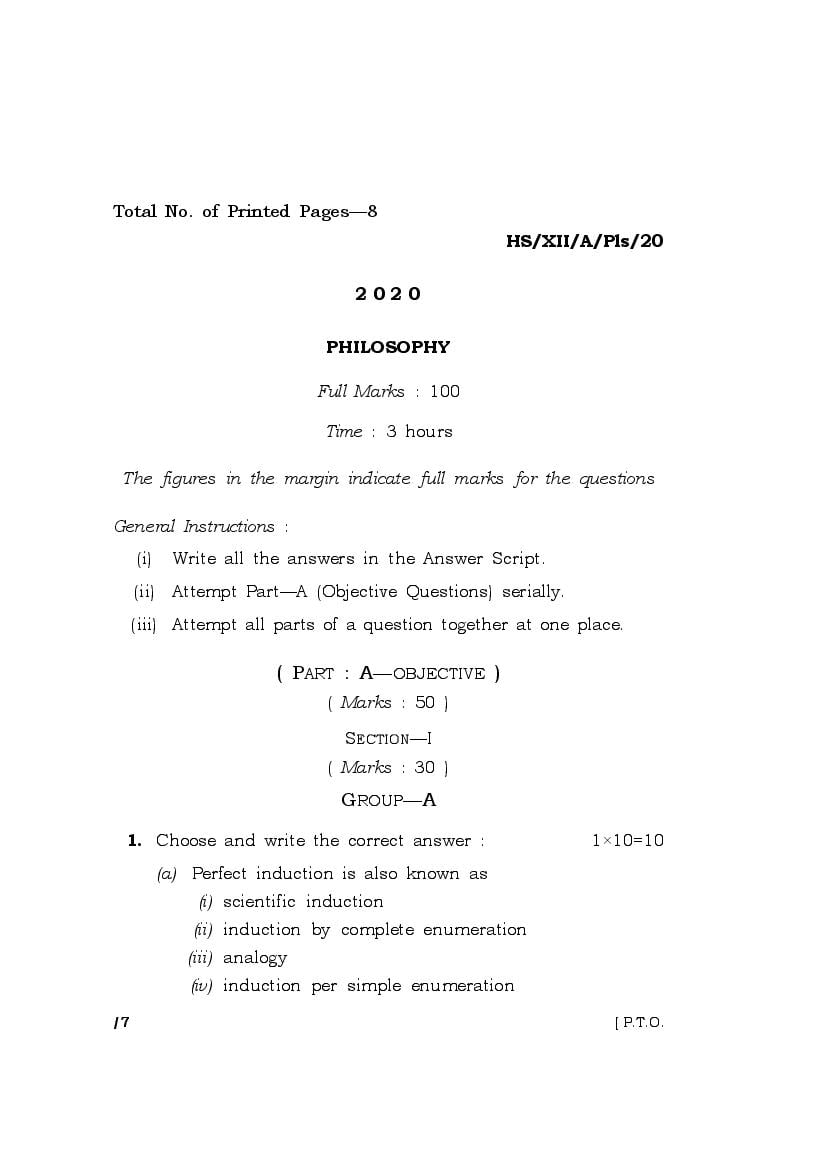
HS/XII/A/Pls/20
2020
PHILOSOPHY
Full Marks : 100
Time : 3 hours
The figures in the margin indicate full marks for the questions
General Instructions :
(i) Write all the answers in the Answer Script.
(ii) Attempt Part—A (Objective Questions) serially.
(iii) Attempt all parts of a question together at one place.
( PART : A—OBJECTIVE )
( Marks : 50 )
SECTION—I
( Marks : 30 )
GROUP—A
1. Choose and write the correct answer : 1×10=10
(a) Perfect induction is also known as
(i) scientific induction
(ii) induction by complete enumeration
(iii) analogy
(iv) induction per simple enumeration
/7 [ P.T.O.
Page 2
(b) The cause is
(i) an antecedent event
(ii) a consequent event
(iii) a concurrent event
(iv) a parallel event
(c) ‘Ex nihilo nihil fit’ means
(i) the same cause has the same effect
(ii) the same cause has different effects
(iii) out of nothing, nothing comes
(iv) cause is equal to the effect
(d) Mal-observation is a fallacy of
(i) petitio principi
(ii) wrong interpretation
(iii) overlooking
(iv) undistributed middle
(e) Mill formulates
(i) three experimental methods
(ii) four experimental methods
(iii) five experimental methods
(iv) six experimental methods
HS/XII/A/Pls/20/7 [ Contd.
Page 3
(f) The number of Nastika Schools in Indian philosophy
is
(i) 3
(ii) 6
(iii) 9
(iv) 12
(g) Darshana means
(i) love of knowledge
(ii) love of wisdom
(iii) love of argument
(iv) vision of truth
(h) A disjunction is defined by which symbol?
(i) (vel)
(ii) · (dot)
(iii) ~ (curl)
(iv) (horseshoe)
(i) In analogy, we proceed from
(i) particular to general
(ii) general to particular
(iii) particular to particular
(iv) general to general
HS/XII/A/Pls/20/7 [ P.T.O.
Page 4
(j) The method of agreement is pre-eminently a
(i) method of observation
(ii) method of experiment
(iii) method of concomitant variations
(iv) None of the above
GROUP—B
2. Write whether the following statements are True or
False: 1×10=10
(a) The law of causation states that every event must
have a cause.
(b) The term ‘colligation of facts’ was originally used by
Mill.
(c) The law of uniformity of nature is a postulate or
formal ground of induction.
(d) Quantitatively, the cause is not equal to the effect.
(e) Conditions are of three kinds.
(f) Observations and experiments are the formal
grounds of induction.
(g) The method of difference is essentially a method of
experiment.
(h) Locke is an empiricist philosopher.
(i) Analogy cannot be described as a stepping-stone to
scientific induction.
(j) Vedanta School belongs to the Orthodox group.
HS/XII/A/Pls/20/7 [ Contd.
Page 5
GROUP—C
3. Fill in the blanks : 1×10=10
(a) Induction is colligation but _____ is not necessarily
induction.
(b) According to Descartes, there are three types of
ideas. They are adventitious, factitious and _____.
(c) Analysis means breaking up a _____ into its
constituent factors.
(d) The principle of uniformity of nature is the result of
_____.
(e) The effect is nothing but the _____ transformed.
(f) The cause is the _____ total of positive and negative
conditions taken together.
(g) The term Observation literally means _____.
(h) The Orthodox school of Indian philosophy believes
in the _____ of the Vedas.
(i) The hypothesis when verified becomes a _____.
(j) The thing acted upon is said to be the _____.
HS/XII/A/Pls/20/7 [ P.T.O.
Page 6
SECTION—II
( Marks : 20 )
4. Answer the following questions in 2 or 3 sentences each
(any ten) : 2×10=20
(a) What is induction by parity of reasoning?
(b) What are the grounds of induction?
(c) What is the paradox of induction?
(d) Name three empiricist philosophers.
(e) What is meant by the plurality of causes?
(f) Distinguish between constant and variable.
(g) Define heteropathic intermixture of effects.
(h) Mention two advantages of observation over
experiment.
(i) Distinguish between Orthodox and Heterodox
Schools of Indian philosophy.
(j) Give the meaning of hypothesis according to Mill.
(k) Define the method of concomitant variations.
(l) Distinguish between Good and Bad analogy.
HS/XII/A/Pls/20/7 [ Contd.
Page 7
( PART : B—DESCRIPTIVE )
( Marks : 50 )
Answer Question No. 5 and any three from the rest.
5. (a) Symbolize any four of the following : 2½×4=10
(i) Alice and Betty will both not be elected.
(ii) It is not the case that neither Atlanta nor
Baltimore wins their Conference Championship.
(iii) The words of his mouth were smoother than
butter, but war was in his heart.
(iv) Amherst wins its first game if either Colgate
wins its first game or Dartmouth wins its first
game.
(v) Either Chicago or Dallas will fail to win the
superbowl.
(vi) Both Amherst and Colgate wins their first games
only if Dartmouth does not win its first game.
(b) Use truth tables to determine the validity or
invalidity of any two of the following argument
forms : 5×2=10
(i) P Q
Q P
(ii) P (Q R)
P Q
R
HS/XII/A/Pls/20/7 [ P.T.O.
Page 8
(iii) P · Q
P
(iv) (P Q) (P Q)
P Q
P Q
6. What is scientific induction? Is perfect induction an
induction at all? 3+7=10
7. What is a cause according to Carveth Read? Explain its
marks or characteristics. 2+8=10
8. “Observation and experiment do not differ in kind but
only in degree.” Discuss. 10
9. Explain Rationalism as a theory of knowledge. 10
10. Why is Indian philosophy called Darshana? What are
the distinctive features of Indian philosophy? 2+8=10
11. Explain the method of difference with example. 10
12. Write short notes on any two of the following : 5×2=10
(a) Law of uniformity of nature
(b) Empiricism
(c) Plurality of causes
(d) Forms of hypothesis
HS/XII/A/Pls/20/7 20K
Document Details
| Board / Org | Meghalaya Board |
| Exam | Class 12 |
| Type | Question Paper |
| Pages | 8 |
| Updated | 30 Apr 2026 |