MBOSE Class 12 Question Paper 2020 for History
Finished viewing? Save it for later —
Download MBOSE Class 12 Question Paper 2020 for History (PDF · 12 pages)About MBOSE Class 12 Question Paper 2020 for History
MBOSE Class 12 Question Paper 2020 for History is available here for free download. Published by Meghalaya Board for Class 12, this question paper can be viewed online or downloaded as a PDF (12 pages). Candidates preparing for Class 12 can use MBOSE Class 12 Question Paper 2020 for History to understand the exam pattern, the type of questions asked, and the overall difficulty level.
Frequently Asked Questions
How can I download MBOSE Class 12 Question Paper 2020 for History?
Open this page and click the Download button to save MBOSE Class 12 Question Paper 2020 for History as a PDF. It is completely free on AglaSem Docs.
Is MBOSE Class 12 Question Paper 2020 for History free to download?
Yes. MBOSE Class 12 Question Paper 2020 for History can be viewed online and downloaded as a PDF free of cost on AglaSem Docs.
How many pages does MBOSE Class 12 Question Paper 2020 for History have?
MBOSE Class 12 Question Paper 2020 for History contains 12 pages, which you can read online or download together as a single PDF.
Where can I find more Class 12 study material?
You can find more Class 12 question papers, sample papers, syllabus, and answer keys on AglaSem Docs.
MBOSE Class 12 Question Paper 2020 for History – Text
Read the full text of this question paper below — useful to quickly search, copy and reference the content online without downloading the PDF.
📄 View text version (12 pages)
Page 1
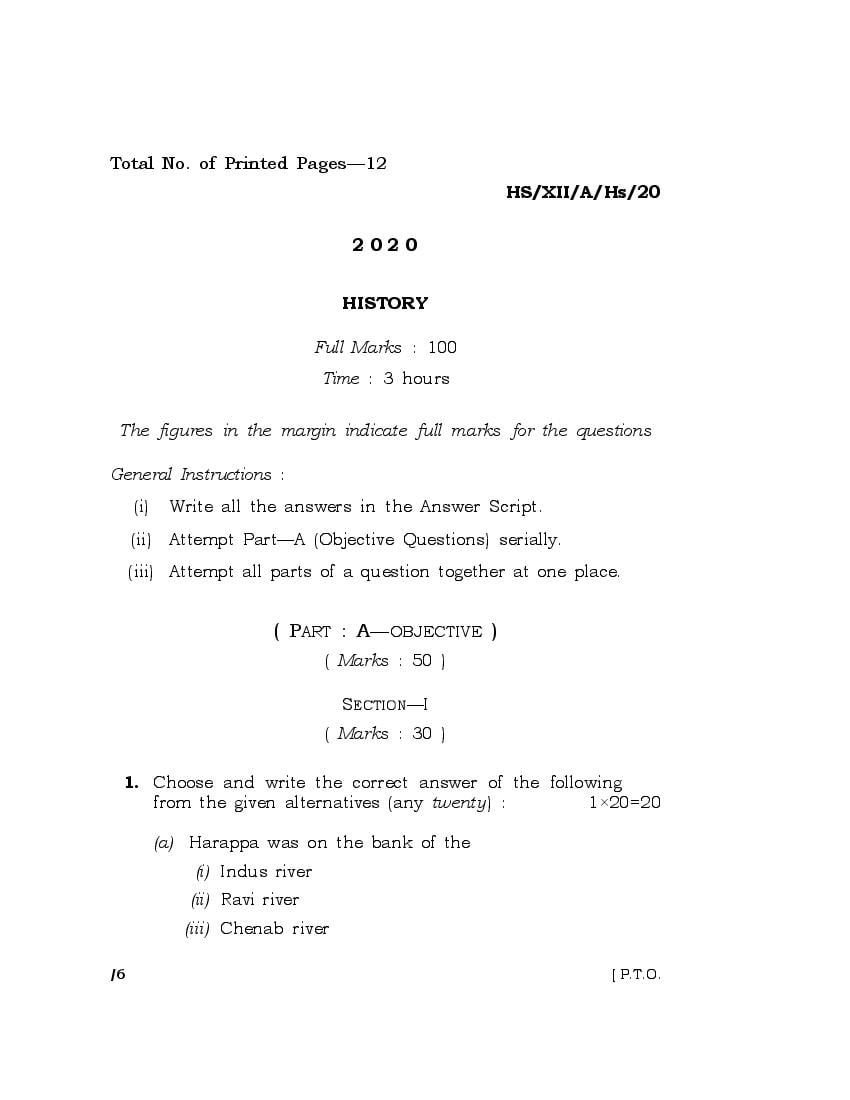
HS/XII/A/Hs/20
2020
HISTORY
Full Marks : 100
Time : 3 hours
The figures in the margin indicate full marks for the questions
General Instructions :
(i) Write all the answers in the Answer Script.
(ii) Attempt Part—A (Objective Questions) serially.
(iii) Attempt all parts of a question together at one place.
( PART : A—OBJECTIVE )
( Marks : 50 )
SECTION—I
( Marks : 30 )
1. Choose and write the correct answer of the following
from the given alternatives (any twenty ) : 1×20=20
(a) Harappa was on the bank of the
(i) Indus river
(ii) Ravi river
(iii) Chenab river
/6 [ P.T.O.
Page 2
(b) Archaeo-botanists are those who study and
specialise in
(i) ancient plant remains
(ii) ancient animal remains
(iii) ancient human remains
(c) Initially, Rajagriha also known as Girivraja was the
capital of
(i) Magadha
(ii) Kashi
(iii) Koshala
(d) Which of the following rulers assumed the title
Devaputra or Son of God?
(i) Guptas
(ii) Mauryas
(iii) Kushans
(e) Who authored the Mahabharata?
(i) Dvaipayana Vyasa
(ii) Ekalavya
(iii) Arjuna
HS/XII/A/Hs/20/6 [ Contd.
Page 3
(f) ‘Vanik’ is the Sanskrit term used for
(i) artisans
(ii) peasants
(iii) merchants
(g) The Sutta Pitaka consists of the teachings of
(i) Buddha
(ii) Mahavira
(iii) Guru Nanak
(h) The word ‘stupa’ is a/an
(i) Pali word
(ii) Sanskrit word
(iii) English word
(i) The Nagara style of architecture is prevalent in
which part of India?
(i) North
(ii) South
(iii) Deccan
HS/XII/A/Hs/20/6 [ P.T.O.
Page 4
(j) Badami was the original capital of the
(i) Chola Empire
(ii) Chalukya Empire
(iii) Vijayanagara Empire
(k) In the 16th and 17th centuries women were equally
active in
(i) hunting
(ii) craft production
(iii) steel production
(l) Who said “Gold and silver after circulating over every
part of the world is finally buried in India which is
the sink of gold and silver”?
(i) Ibn Battuta
(ii) Megasthenes
(iii) Bernier
(m) Tuzuk-i-Baburi or the Baburnamah was written in
which language?
(i) Sanskrit
(ii) Persian
(iii) Turkish
HS/XII/A/Hs/20/6 [ Contd.
Page 5
(n) The Buland Darwaza or the arched gateway
symbolized Akbar’s victory in
(i) Rajasthan
(ii) Gujarat
(iii) Delhi
(o) The tomb-shrine of a Shaikh was called
(i) Dargah
(ii) Khanqah
(iii) Langar
(p) Mirabai, the Rajput Princess, was a devotee of
(i) Lord Vishnu
(ii) Lord Shiva
(iii) Lord Krishna
(q) Al-Biruni travels in India for
(i) 10 years
(ii) 13 years
(iii) 15 years
HS/XII/A/Hs/20/6 [ P.T.O.
Page 6
(r) Ibn Battuta visited the equivalent of
(i) 44 modern countries
(ii) 45 modern countries
(iii) 43 modern countries
(s) A rich ryot, also a trader and moneylender was the
(i) Zamindar
(ii) Mandal
(iii) Jotedar
(t) The American Civil War broke out in the year
(i) 1860
(ii) 1861
(iii) 1862
(u) Which territory became the capital of the new
province of Eastern Bengal and Assam since 1905?
(i) Dacca
(ii) Shillong
(iii) Guwahati
HS/XII/A/Hs/20/6 [ Contd.
Page 7
(v) The first missionary to visit Mizoram was
(i) Nathan Brown
(ii) William Williams
(iii) Miles Bronson
(w) Which Mughal Emperor took part in the Revolt of
1857?
(i) Bahadur Shah
(ii) Shah Alam II
(iii) Aurangzeb
(x) The second major movement that Mahatma Gandhi
led against the British was the
(i) Khilafat Movement
(ii) Salt Satyagraha
(iii) Quit India Movement
(y) In September 1946, an interim cabinet was formed
by the Congress and headed by
(i) Mahatma Gandhi
(ii) Jawaharlal Nehru
(iii) Motilal Nehru
HS/XII/A/Hs/20/6 [ P.T.O.
Page 8
2. Write whether the following statements are True or False
(any ten ) : 1×10=10
(a) The Harappans practised agriculture alongside
hunting.
(b) The Ashokan inscription was first deciphered by
Max Müller.
(c) The Puranas were written to popularise the religion
of the Vedas.
(d) The orthodox Jain came to be known as
Digambaras.
(e) South Indian architecture is mainly the temple
architecture.
(f) Tobacco was also a new crop that came to be raised
in North India from the Fifteenth Century.
(g) Akbar was characterised as Insan-i-Kamil or the
‘Perfect Man’ of the age.
(h) Kabir, Guru Nanak and Mirabai supported the
existing caste order.
HS/XII/A/Hs/20/6 [ Contd.
Page 9
(i) Ibn Battuta was the foreign traveller who wrote
Travels in the Mughal Empire.
(j) Supa, a village in Poona District was the starting
point of Santhal Rebellion.
(k) Calcutta served as the capital of British Raj until
1912.
(l) The British formally annexed Upper Assam in
March, 1828.
(m) The chief organiser of the Revolt of 1857 in Bihar
was Kunwar Singh.
(n) The Rowlatt Act Satyagraha made Gandhiji a truly
National leader.
(o) Jawaharlal Nehru served as the Chairman of the
Drafting Committee of the Constitution.
SECTION—II
( Marks : 20 )
3. Answer any ten questions in 2 or 3 sentences each :
2×10=20
(a) What did the citadel contain?
(b) What were the punched-mark coins?
HS/XII/A/Hs/20/6 [ P.T.O.
Page 10
(c) Who were the Chandalas?
(d) What is hagiography?
(e) Specify the rituals associated with Pallava Temples.
(f) Who were the Zamindars in the Mughal Empire?
(g) What was the Kitabkhana?
(h) What was the Bhakti Movement?
(i) Who was Al-Biruni?
(j) What was the Deccan Riots Commission?
(k) Give the significance of Writers Building.
(l) Who was Thomas Jones?
(m) Who was Kunwar Singh?
(n) What were the Morley-Minto Reforms?
(o) Who was Dr. Rajendra Prasad?
HS/XII/A/Hs/20/6 [ Contd.
Page 11
( PART : B—DESCRIPTIVE )
( Marks : 50 )
4. Answer Question No. ( j) and any three from the rest :
(a) Was there a Ruling Authority in the Harappan
Civilisation? If so, of what kind? 2+10=12
(b) Describe the life and teachings of Mahavira. 6+6=12
(c) Discuss the distinguishing features of Vijayanagara
temple and architecture. 12
(d) Explain the role of women in the medieval agrarian
society. 12
(e) What was Mansabdary System? Note down the
composition and responsibilities of the Mughal
nobility. 4+8=12
(f) Explain in brief the major beliefs and practices of
Sufism. How did the Chishtis acquire popularity?
8+4=12
(g) In what way and to what extent were social relations
transformed in the new cities? 12
HS/XII/A/Hs/20/6 [ P.T.O.
Page 12
(h) Why and how did the Christian missionaries
promote local languages and Western education?
2+10=12
(i) Explain the main features of Non-Cooperation
Movement. Why did Gandhi call off the Movement?
8+4=12
(j) Write short notes on any two of the following : 7×2=14
(i) Limitations of Inscriptional evidence
(ii) Puranas
(iii) Babur
(iv) Francois Bernier
(v) Characteristics of new towns
(vi) Poorna Swaraj
(vii) The Government of India Act, 1935
HS/XII/A/Hs/20/6 20K
Document Details
| Board / Org | Meghalaya Board |
| Exam | Class 12 |
| Type | Question Paper |
| Pages | 12 |
| Updated | 01 May 2026 |