MBOSE Class 12 Question Paper 2020 for Political Science
Finished viewing? Save it for later —
Download MBOSE Class 12 Question Paper 2020 for Political Science (PDF · 11 pages)About MBOSE Class 12 Question Paper 2020 for Political Science
MBOSE Class 12 Question Paper 2020 for Political Science is available here for free download. Published by Meghalaya Board for Class 12, this question paper can be viewed online or downloaded as a PDF (11 pages). Candidates preparing for Class 12 can use MBOSE Class 12 Question Paper 2020 for Political Science to understand the exam pattern, the type of questions asked, and the overall difficulty level.
Frequently Asked Questions
How can I download MBOSE Class 12 Question Paper 2020 for Political Science?
Open this page and click the Download button to save MBOSE Class 12 Question Paper 2020 for Political Science as a PDF. It is completely free on AglaSem Docs.
Is MBOSE Class 12 Question Paper 2020 for Political Science free to download?
Yes. MBOSE Class 12 Question Paper 2020 for Political Science can be viewed online and downloaded as a PDF free of cost on AglaSem Docs.
How many pages does MBOSE Class 12 Question Paper 2020 for Political Science have?
MBOSE Class 12 Question Paper 2020 for Political Science contains 11 pages, which you can read online or download together as a single PDF.
Where can I find more Class 12 study material?
You can find more Class 12 question papers, sample papers, syllabus, and answer keys on AglaSem Docs.
MBOSE Class 12 Question Paper 2020 for Political Science – Text
Read the full text of this question paper below — useful to quickly search, copy and reference the content online without downloading the PDF.
📄 View text version (11 pages)
Page 1
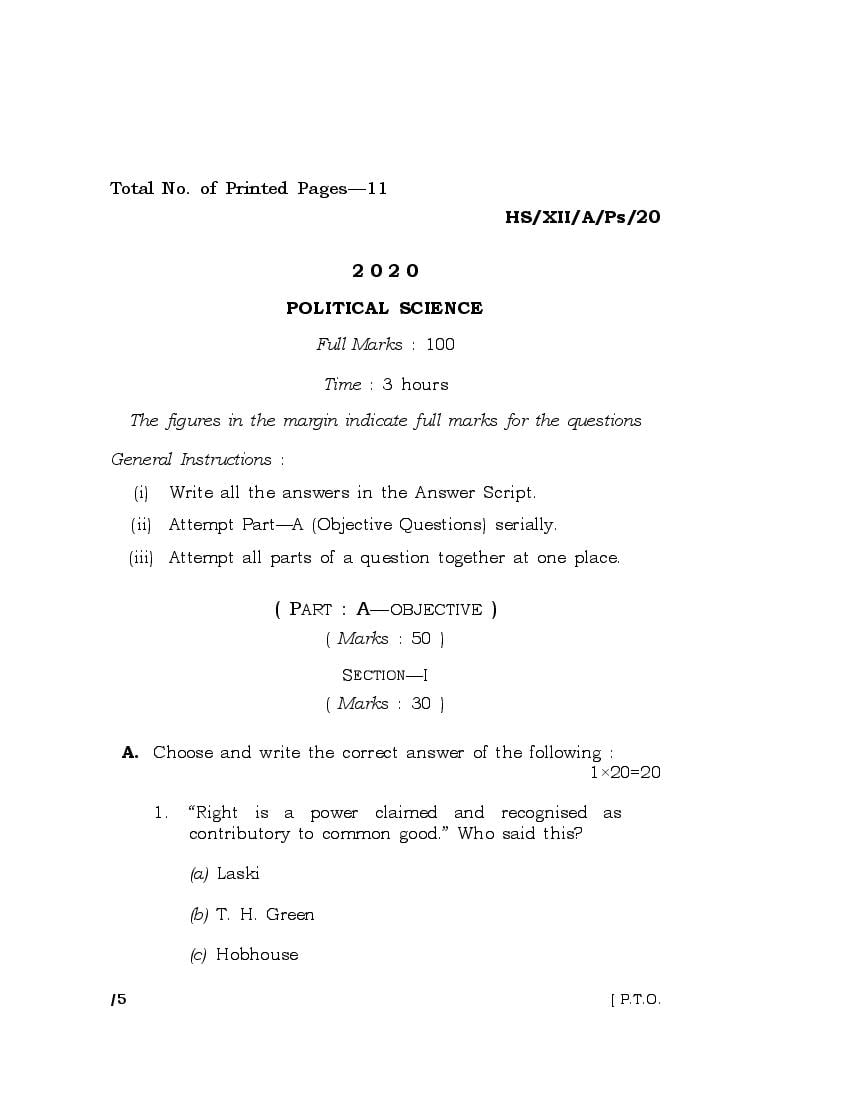
HS/XII/A/Ps/20
2020
POLITICAL SCIENCE
Full Marks : 100
Time : 3 hours
The figures in the margin indicate full marks for the questions
General Instructions :
(i) Write all the answers in the Answer Script.
(ii) Attempt Part—A (Objective Questions) serially.
(iii) Attempt all parts of a question together at one place.
( PART : A—OBJECTIVE )
( Marks : 50 )
SECTION—I
( Marks : 30 )
A. Choose and write the correct answer of the following :
1×20=20
1. “Right is a power claimed and recognised as
contributory to common good.” Who said this?
(a) Laski
(b) T. H. Green
(c) Hobhouse
/5 [ P.T.O.
Page 2
2. Which one of the following is regarded as the earliest
source of law?
(a) Legislature
(b) Equity
(c) Custom
3. According to whom justice consists in telling the
truth and repaying one’s debt?
(a) Aristotle
(b) Cephalus
(c) Plato
4. In any State
(a) all voters are citizens
(b) all citizens are voters
(c) some voters are citizens
5. Double citizenship is practised in
(a) Germany
(b) India
(c) USA
HS/XII/A/Ps/20/5 [ Contd.
Page 3
6. Women in England got the right to vote in the year
(a) 1917
(b) 1918
(c) 1919
7. The book, The Spirit of Laws was written by
(a) Montesquieu
(b) Rousseau
(c) Adam Smith
8. Who among the following is considered as the father
of Socialism?
(a) Jawaharlal Nehru
(b) Mahatma Gandhi
(c) Karl Marx
9. The judges of the International Court of Justice is
elected for a period of
(a) six years
(b) nine years
(c) five years
HS/XII/A/Ps/20/5 [ P.T.O.
Page 4
10. Which Article of the Constitution prohibits
employment of children below 14 years of age to
work in any factory or mine or any other hazardous
employment?
(a) Article 24
(b) Article 28
(c) Article 30
11. The Directive Principles of State Policy have been
enumerated in
(a) Articles 19 to 22
(b) Articles 25 to 28
(c) Articles 37 to 51
12. Which of the following Writs prevent a person from
continuing in an office which he occupies unjustly?
(a) Quo warranto
(b) Certiorari
(c) Prohibition
13. Who among the following stands at the apex of the
administrative structure of India?
(a) The Prime Minister
(b) The President
(c) The Cabinet Secretary
HS/XII/A/Ps/20/5 [ Contd.
Page 5
14. Who among the following are not involved in the
election of the Vice President of India?
(a) Members of the Lok Sabha
(b) Members of the Rajya Sabha
(c) Members of the Legislative Assembly
15. The portfolios among the members of the Council of
Ministers are distributed by the
(a) Prime Minister
(b) President
(c) Speaker of the Lok Sabha
16. No Bill can become an Act without the assent of the
(a) Speaker of the Rajya Sabha
(b) Vice President
(c) President
HS/XII/A/Ps/20/5 [ P.T.O.
Page 6
17. Which of the following is the defender of the
Constitution?
(a) The Parliament
(b) The Supreme Court
(c) The Comptroller and Auditor General of India
18. Which of the following countries is not a member of
NAM?
(a) India
(b) Pakistan
(c) USA
19. SAARC was established on
(a) 28th December, 1984
(b) 8th December, 1985
(c) 18th December, 1986
20. The National Human Rights Commission (NHRC)
was established on
(a) 12th October, 1991
(b) 12th October, 1992
(c) 12th October, 1993
HS/XII/A/Ps/20/5 [ Contd.
Page 7
B. Write whether the following statements are True or
False :
1×10=10
1. Equity may be regarded as a kind of Judge made
law.
2. Womanhood suffrage means only women have the
right to vote.
3. Social equality is the main feature of a classless
society.
4. The UNO came into existence on 24th October,
1945.
5. According to Marx, capital is the only factor that
creates value in a commodity.
6. The Directive Principles of State Policy are not
suspended during emergency.
7. The Chief Justice and other judges of the Supreme
Court are appointed by the Prime Minister of India.
8. All the Members of the Lok Sabha are elected
directly by the people.
HS/XII/A/Ps/20/5 [ P.T.O.
Page 8
9. Japan is a member of SAARC.
10. India conducted its first Nuclear Test in the year
1974.
SECTION—II
( Marks : 20 )
Answer the following questions in about 2 or 3 sentences
each : 2×10=20
1. Mention two similarities between citizens and aliens.
2. Mention any two demerits of Universal Adult
Franchise.
3. What is a Statute?
4. Mention any two aims of the UN.
5. What do you understand by negative equality?
HS/XII/A/Ps/20/5 [ Contd.
Page 9
6. What is habeas corpus?
7. What are the qualifications required to become the
Vice President of India?
8. Why is the Supreme Court called as the Court of
Records?
9. Mention any two principles of NAM.
10. Define Human Rights.
( PART : B—DESCRIPTIVE )
( Marks : 50 )
GROUP—A
( Political Theory )
Answer any three of the following questions : 10×3=30
1. What is liberty? Explain the various kinds of liberty.
2+8=10
2. What is citizenship? Explain the methods of
acquiring citizenship.
2+8=10
HS/XII/A/Ps/20/5 [ P.T.O.
Page 10
3. Define law. Explain the various sources of law.
2+8=10
4. Describe the principal features of liberalism. 10
5. Examine the merits and demerits of Universal Adult
Franchise. 5+5=10
6. Describe the composition, powers and functions of
the UN General Assembly. 10
7. Write short notes on any two of the following : 5×2=10
(a) Basic Principles of the United Nations
(b) Functional Representation
(c) Social Justice
(d) Dictatorship of the Proletariat
(e) Characteristics of Rights
GROUP—B
( The Indian Constitution and Political
System in Operation )
Answer any two of the following questions : 10×2=20
8. Describe the different types of Directive Principles
of State Policy as enumerated in the Constitution
of India. 10
HS/XII/A/Ps/20/5 [ Contd.
Page 11
9. Describe the powers and functions of the President
of India. 10
10. What is the composition of the Lok Sabha? Describe
its powers and functions. 2+8=10
11. What has been India’s role in the activities of
SAARC? 10
12. Write short notes on any two of the following :
5×2=10
(a) Right to Equality
(b) The Fundamental Duties
(c) Formation of the Union Council of Ministers
(d) Original Jurisdiction of the Supreme Court of
India
HS/XII/A/Ps/20/5 20K—
Document Details
| Board / Org | Meghalaya Board |
| Exam | Class 12 |
| Type | Question Paper |
| Pages | 11 |
| Updated | 30 Apr 2026 |