MAHA SET 2020 Syllabus Political Science
Finished viewing? Save it for later —
Download MAHA SET 2020 Syllabus Political Science (PDF · 6 pages)About MAHA SET 2020 Syllabus Political Science
MAHA SET 2020 Syllabus Political Science is available here for free download. Published by Maharashtra Exams for Maharashtra State Eligibility Test, this syllabus can be viewed online or downloaded as a PDF (6 pages). Candidates preparing for Maharashtra State Eligibility Test can use MAHA SET 2020 Syllabus Political Science to understand the exam pattern, the type of questions asked, and the overall difficulty level.
Frequently Asked Questions
How can I download MAHA SET 2020 Syllabus Political Science?
Open this page and click the Download button to save MAHA SET 2020 Syllabus Political Science as a PDF. It is completely free on AglaSem Docs.
Is MAHA SET 2020 Syllabus Political Science free to download?
Yes. MAHA SET 2020 Syllabus Political Science can be viewed online and downloaded as a PDF free of cost on AglaSem Docs.
How many pages does MAHA SET 2020 Syllabus Political Science have?
MAHA SET 2020 Syllabus Political Science contains 6 pages, which you can read online or download together as a single PDF.
Where can I find more Maharashtra State Eligibility Test study material?
You can find more Maharashtra State Eligibility Test question papers, sample papers, syllabus, and answer keys on AglaSem Docs.
MAHA SET 2020 Syllabus Political Science – Text
Read the full text of this syllabus below — useful to quickly search, copy and reference the content online without downloading the PDF.
📄 View text version (6 pages)
Page 1
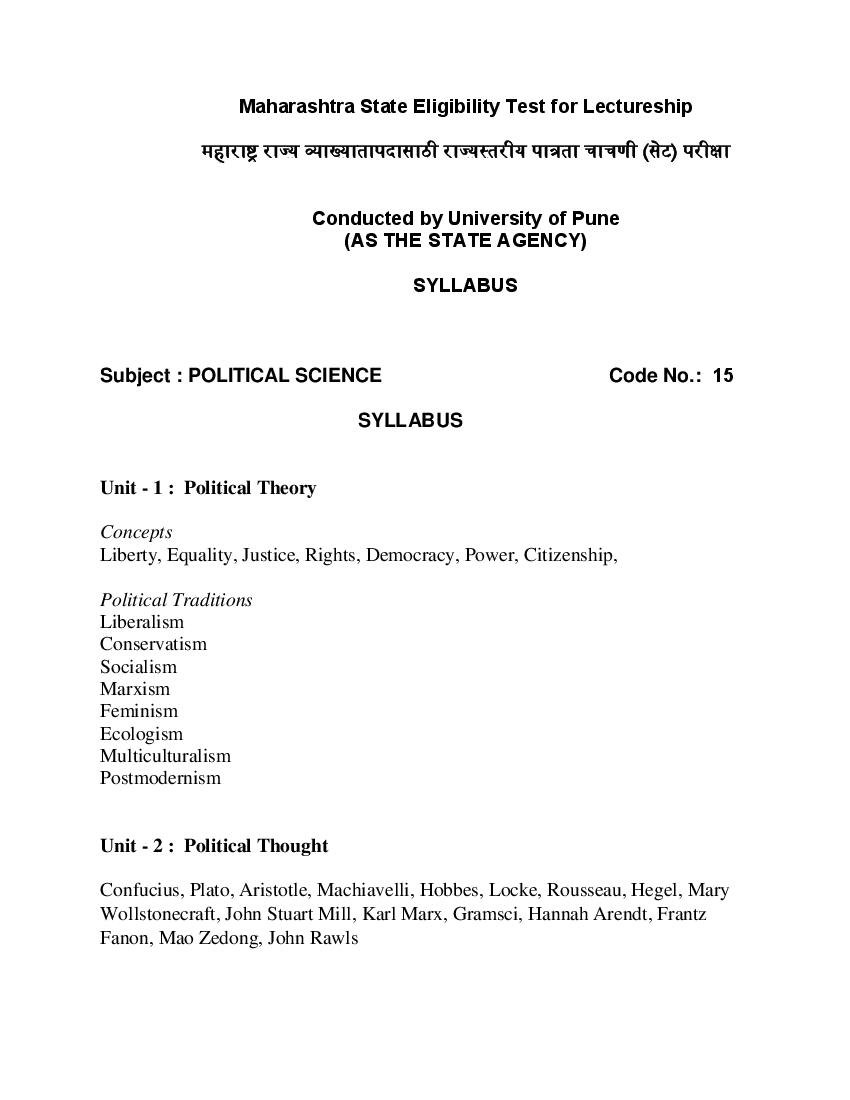
महारा� राज्य �ाख्यातापदासाठी राज्यस्तरीय पा�ता चाचणी (सेट) परीक्षा
Conducted by University of Pune
(AS THE STATE AGENCY)
SYLLABUS
Subject : POLITICAL SCIENCE Code No.: 15
SYLLABUS
Unit - 1 : Political Theory
Concepts
Liberty, Equality, Justice, Rights, Democracy, Power, Citizenship,
Political Traditions
Liberalism
Conservatism
Socialism
Marxism
Feminism
Ecologism
Multiculturalism
Postmodernism
Unit - 2 : Political Thought
Confucius, Plato, Aristotle, Machiavelli, Hobbes, Locke, Rousseau, Hegel, Mary
Wollstonecraft, John Stuart Mill, Karl Marx, Gramsci, Hannah Arendt, Frantz
Fanon, Mao Zedong, John Rawls
Page 2
Dharamshastra, Kautilya, Aggannasutta, Barani, Kabir, Pandita Ramabai, Bal
Gangadhar Tilak, Swami Vivekanand, Rabindranath Tagore, M.K Gandhi, Sri
Aurobindo, Periyar E. V. Ramasamy, Muhammad Iqbal, M.N.Roy, V D Savarkar,
Dr. B.R.Ambedkar, J L Nehru, Ram Manohar Lohia, Jaya Prakash Narayan,
Deendayal Upadhyaya
Unit - 4 : Comparative Political Analysis
Approaches: Institutional, Political Culture, Political Economy and New
Institutionalism; Comparative Methods
Colonialism and decolonization: forms of colonialism, anti-colonial struggles and
decolonization
Nationalism: European and non-European.
State theory: debate over the nature of state in capitalist and socialist societies;
post-colonial state; welfare state; globalization and nations-states
Political regimes: democratic (Electoral, Liberal, Majoritarian and Participatory)
and non-democratic regimes (Patrimonialism, Bureaucratic authoritarianism,
Military dictatorship, Totalitarianism, and fascist).
Constitutions and Constitutionalism: forms of constitutions, rule of law, judicial
independence and liberal constitutionalism; emergency powers and crisis of
constitutionalism.
Democratisation: democratic transition and consolidation.
Development: Underdevelopment, Dependency, Modernization, World Systems
Theory, development and democracy.
Structures of Power: ruling class, power elites, democratic elitism
Actor and Processes: Electoral Systems, Political Parties and Party System, Interest
groups, Social movements, new social movements, Non Governmental
Organisations (NGOs) and civil society campaigns; Revolutions.
Page 3
Approaches to the study of International relations: Idealism, Realism, Structural
Marxism, Neoliberalism, Neorealism, Social Constructivism, Critical International
Theory, Feminism, Postmodernism.
Concepts: State, state system and non-state actors, Power, Sovereignty, Security:
traditional and non- traditional.
Conflict and Peace: Changing Nature of Warfare; Weapons of mass destruction;
deterrence; conflict resolution, conflict transformation.
United Nations: Aims, Objectives, Structure and Evaluation of the Working of UN;
Peace and Development perspectives; Humanitarian intervention. International
law; International Criminal Court
Political Economy of IR; Globalisation; Global governance and Bretton Woods
system, North-South Dialogue, WTO, G-20, BRICS.
Regional Organisations: European Union, African Union, Shanghai Cooperation
Organisation, ASEAN.
Contemporary Challenges: International terrorism, Climate change and
Environmental Concerns, Human Rights, Migration and Refugees; Poverty and
Development; Role of Religion, Culture and Identity Politics.
Unit - 6 : India’s Foreign Policy
Perspectives on India’s Foreign Policy: India’s Identity as postcolonial,
development, rising power and as emerging political economy
Continuity and change in India’s Foreign Policy: Principles and determinants;
Non-Alignment movement: historical background and relevance of Non Aligned
Movement; India’s Nuclear Policy
India’s relations with major powers: USA, USSR/Russia, People’s Republic of
China
Page 4
BRICS, ASEAN, Shanghai Cooperation Organisation, African Union, Southern
African Development Community, Gulf Cooperation Council
India’s relations with neighbourhood: SAARC, Gujaral doctrine, Look Eas t/ Act
East, Look West.
India’s Negotiation Strategies in International Regimes: The United Nations,
World Trade Organisation, International Monetary Fund, Intergovernmental Panel
on Climate Change
Contemporary challenges: maritime security, energy security, environmental
security, migrants and refugees, water resources, international terrorism, cyber
security
Unit - 7 : Political Institutions in India
Making of the Indian Constitution: Colonialism heritage and the contribution
Indian National Movement to the making of the Indian Constitution
Constituent Assembly: Composition, Ideological Moorings, Constitutional Debates
Philosophy of the Constitution: Preamble, Fundamental Rights, Directive
Principles
Constitutionalism in India: Democracy, Social Change, National Unity, Checks
and Balances, Basic Structure Debate, Constitutional Amendments
Union Executive: President, Prime Minister and Council of Ministers
Union Parliament: Structure, Role and Functioning, Parliamentary Committees
Judiciary: Supreme Court, High Court, Judicial Review, Judicial Activism, Judicial
Reform.
Executive and Legislature in the States: Governor, Chief Minister, State
Legislature
Federalism in India: Strong Centre Framework, Asymmetrical Federal Provisions
and Adaption, Role of Intergovernmental Coordination Mechanisms, Inter-State
Council, Emerging Trends.
Page 5
Electoral Reforms.
Local Government Institutions: Functioning and reforms.
Constitutional and Statutory Bodies: Comptroller and Auditor General, National
Commission for Scheduled Castes, National Commission for Scheduled Tribes,
National Commission for Human Rights, National Commission for Women,
National Commission for Minorities.
Unit - 8 : Political Processes in India
State, Economy and Development: Nature of Indian State, Development Planning
model, New Economic Policy, Growth and Human Development.
Process of globalisation: social and economic implications.
Identity Politics: Religion, Tribe, Caste, Region, Language.
Social Movements: Dalit, Tribal, Women, Farmers, labour
Civil Society Groups: Non-Party Social Formations, Non-Governmental
Organisations, Social Action Groups.
Regionalisation of Indian Politics: Reorganisation of Indian States, States as
Political and Economic Units, Sub-State Regions, Regional disparities, Demand
for New States,
Gender and Politics in India: Issues of Equality and Representation.
Ideology and Social basis of Political Parties: National Parties, State Parties.
Electoral Politics: Participation, Contestation, Representation, Emerging trends.
Unit - 9 : Public Administration
Public Administration: meaning and evolution; public and private administration
Approaches: System Theory, Decision Making, Ecological Approach
Public administration theories and concepts: Scientific Management Theory,
Rational Choice theory, New Public Administration, Development Administration,
Page 6
Public Administration in the era of liberalisation and Globalisation
Theories and Principles of Organization: Scientific Management Theory,
Bureaucratic Theory, Human Relations Theory
Managing the organization: Theories of leadership and motivation.
Organisational Communication: Theories and Principles, Chester Bernard
Principles of Communication, Information Management in the organization
Managing Conflict in the Organization: Mary Parker Follett
Management by Objectives- Peter Drucker
Unit – 10 : Governance and Public Policy in India
Governance, good governance and democratic governance, role of state, civil
society and individuals.
Accountability and control: Institutional mechanism for checks and balances,
legislative control over executive, administrative and budgetary control, control
through parliamentary committees, judicial control over legislature and executive,
administrative culture, corruption and administrative reforms
Institutional mechanisms for good governance: Right to Information, Consumer
Protection Act, Citizen Charter; Grievance redress system: Ombudsman, Lokpal,
Lokayukta
Grassroots Governance: Panchayati Raj Institutions and their functioning
Planning and Development: Decentralised planning, planning for development,
sustainable development, participatory development, e-governance; NITI Aayog
Public policy as an instrument of socio-economic development: public policies
with special reference to housing, health, drinking water, food security, MNREGA,
NHRM, RTE
Monitoring and evaluation of public policy; mechanisms of making governance
process accountable: jansunwai, social audit.
Document Details
| Board / Org | Maharashtra Exams |
| Exam | Maharashtra State Eligibility Test |
| Type | Syllabus |
| Pages | 6 |
| Updated | 22 Jul 2026 |