AP DEECET 2020 Question Paper Social Studies (Tamil)
Finished viewing? Save it for later —
Download AP DEECET 2020 Question Paper Social Studies (Tamil) (PDF · 50 pages)About AP DEECET 2020 Question Paper Social Studies (Tamil)
AP DEECET 2020 Question Paper Social Studies (Tamil) is available here for free download. Published by APSCHE for Andhra Pradesh Diploma in Elementary Education Common Entrance Test, this question paper can be viewed online or downloaded as a PDF (50 pages). Candidates preparing for Andhra Pradesh Diploma in Elementary Education Common Entrance Test can use AP DEECET 2020 Question Paper Social Studies (Tamil) to understand the exam pattern, the type of questions asked, and the overall difficulty level.
Frequently Asked Questions
How can I download AP DEECET 2020 Question Paper Social Studies (Tamil)?
Open this page and click the Download button to save AP DEECET 2020 Question Paper Social Studies (Tamil) as a PDF. It is completely free on AglaSem Docs.
Is AP DEECET 2020 Question Paper Social Studies (Tamil) free to download?
Yes. AP DEECET 2020 Question Paper Social Studies (Tamil) can be viewed online and downloaded as a PDF free of cost on AglaSem Docs.
How many pages does AP DEECET 2020 Question Paper Social Studies (Tamil) have?
AP DEECET 2020 Question Paper Social Studies (Tamil) contains 50 pages, which you can read online or download together as a single PDF.
Where can I find more Andhra Pradesh Diploma in Elementary Education Common Entrance Test study material?
You can find more Andhra Pradesh Diploma in Elementary Education Common Entrance Test question papers, sample papers, syllabus, and answer keys on AglaSem Docs.
AP DEECET 2020 Question Paper Social Studies (Tamil) – Text
Read the full text of this question paper below — useful to quickly search, copy and reference the content online without downloading the PDF.
📄 View text version (50 pages)
Page 1
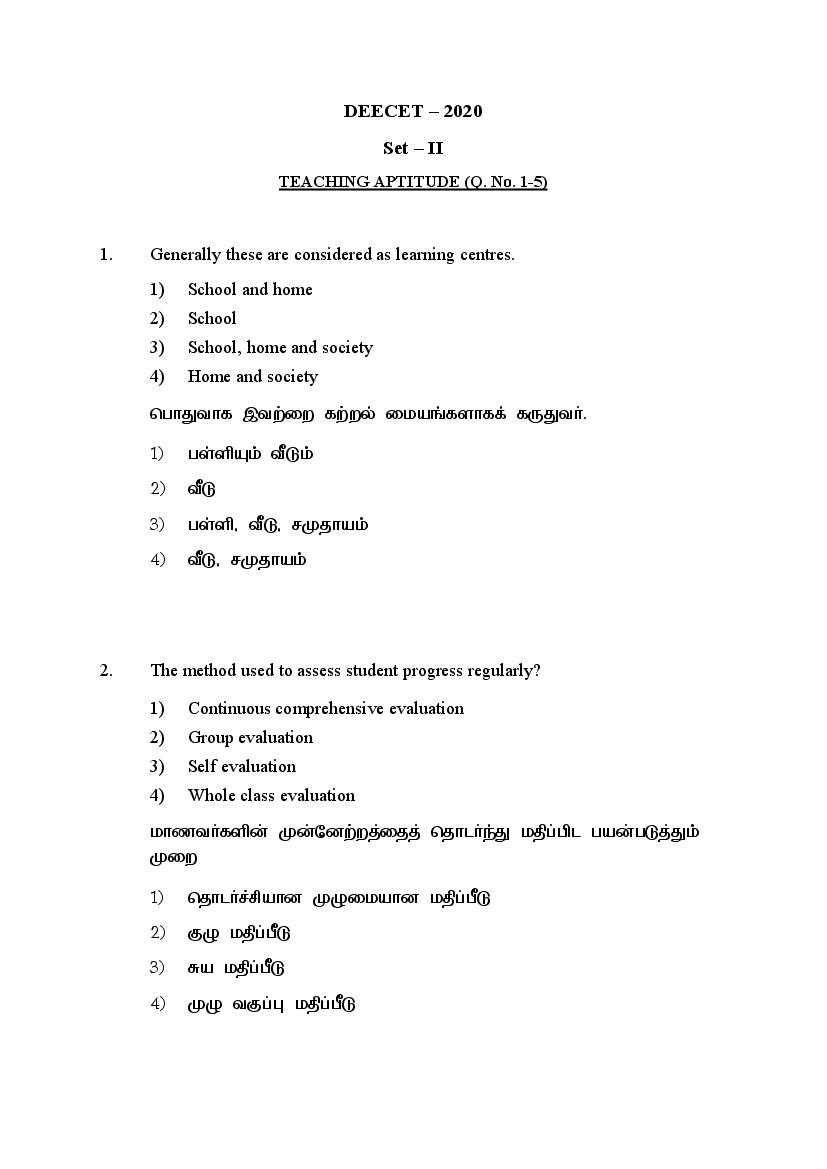
Set – II
TEACHING APTITUDE (Q. No. 1-5)
1. Generally these are considered as learning centres.
1) School and home
2) School
3) School, home and society
4) Home and society
ùΣôÕΞôΚ ΒΞσû[ Κσ[ο ûΤΥδΚΖôΚχ ΚÚÕΞν−
1) Σρ↓Ùλ ÅÓλ
2) ÅÓ
3) Σρ↓+ ÅÓ+ ΜØΘôΥλ
4) ÅÓ+ ΜØΘôΥλ
2. The method used to assess student progress regularly?
1) Continuous comprehensive evaluation
2) Group evaluation
3) Self evaluation
4) Whole class evaluation
ΤôΠΞνΚ↓τ Øτú∴σ[ιûΘι ùΘôΟνϕÕ Τƒκ♦Ο ΣΥτΣÓιÕλ
Øû[
1) ùΘôΟνε′Υô∴ ØÝûΤΥô∴ ΤƒκÀÓ
2) ÏÝ ΤƒκÀÓ
3) ÑΥ ΤƒκÀÓ
4) ØÝ ΞÏκ× ΤƒκÀÓ
Page 2
than in the classroom through
1) Internet and mass media
2) Television and movies
3) Whats APP and You Tube
4) Computer and C.Ds
ΘσΚôΩιƒο ΤôΠΞνΚÞχÏ ΞÏκΣû[♠ο ΚσΣûΘ↑Ο ΞÏκ♦σÏ
ùΞ↓úΥ ΒΞσ°τ Ξô♠ΩôΚ ΚσΣΘσÏ ♥Κε′[ϕΘ Ξôµκ×Κρ
∆ρΖ∴−
1) ΒûΠΥΘΖλ Τσßλ ΘΚΞο ùΘôΟν× ΕΟΚδΚρ
2) ùΘôûΩχΚôγ′ Τσßλ ƒûςκΣΟδΚρ
3) Ξôγυ≅κ Τσßλ ë γëκ
4) Κ∞± Τσßλ ÏßϕΘΚÓΚρ
4. The teacher has to encourage the bright students of the class preparing them for
1) Final examinations
2) Sports meet
3) Cultural competitions
4) Competitive tests
ΞÏκ♦ÛρΖ ÖηΠ°Ü♥χΚ ΤôΠΞνΚûΖ ΕχΚκΣÓιÕΞΘσÏ
Α′↔Υν ≅ΞνΚûΖ ΒΞσ°σΚôΚ ΑΥιΘκ ΣÓιΘúΞηÓλ
1) Β߃ι úΘνÜΚρ
2) ↑ûΖΥôγÓκ úΣôγ⁄Κρ
3) ΚΩôεΜôςκ úΣôγ⁄Κρ
4) úΣôγ⁄ι úΘνÜΚρ
Page 3
1) Test items
2) Curricular areas
3) Co-curricular areas
4) Play items
Σρ↓Κ↓ο Κσ♦χÏλ ↑ûΖΥôγÓΚρ+ ΣôΟοΚρ+ ΣΟλ ΞûςΘο
Α€ΥûΞ Βκ♦↔↑τ •θ ΞÚλ−
1) úΘνÜ ≅λΜδΚρ
2) ΚûΩιƒγΟκ ΣσΚρ
3) ÕûΠ ΚûΩιƒγΟκ ΣσΚρ
4) ↑ûΖΥôγÓ ≅λΜδΚρ
Page 4
6. Indian National Flage was designed by
1) DuggiralaGopalakrishniah
2) Pidamarri VenkataSubbarao
3) Pingali Venkayya
4) Damerlla Ramarao
ΒϕƒΥ úΘ′Υχ ùΚô⁄ûΥ Ξ⁄ΞûΤιΘΞν
1) Õχ€ςôΩ úΚôΣôΩ €ÚωΠµΥô
2) ûΣΟΤν↔ ùΞδΚΟ ÑκΣôςôπ
3) ♦δΚ↓ ùΞδΚµΥô
4) ΘôΤνΩ ςôΤôςôπ
7. 2019 world badminton championship winner
1) P.V. Sindhu
2) Saina Nehwal
3) Karolina Marin
4) Deepa Karmakar
2019 ∆ΩΚ Σôγ♥ηΟτ Μôλ♦Υτ ΣγΟιûΘ ùΞτ[Ξν
1) ♦−↑− ′ϕÕ
2) ûΜ∴ô ùΡξΞôο
3) Κúςô←∴ô Τô↔τ
4) Σô ΚνΤôΚν
Page 5
1) Pune
2) Bengaluru
3) Hyderabad
4) Mumbai
ΒϕƒΥô↑τ ‘♥τ∴Ô ΡΚςλ’ Φ∴ ≅ûΨχΚκΣÓλ ΡΚςλ
1) ×ú∴
2) ùΣδΚðÚ
3) ΗΘςôΣôι
4) ØλûΣ
9. Book written by Kodavatiganti Kutumbarao was
1) Chaduvu
2) Amruthamkurisinaratri
3) Maha Prastanam
4) Rajasekhara Charitram
ùΚôΟΞγ⁄ Κη⁄ ÏÓλΣςôπ ΦÝƒΥ èο
1) ΜÕÜ
2) ≅λÚΘλ Ï↔′∴ ςôιƒ↔
3) ΤΚô ♦ςυΘô∴λ
4) ςô⊥úΜΚς Μ↔ιƒςλ
Page 6
1) SHAR
2) ISRO
3) PSLV
4) SSRC
ΒϕƒΥ ↑ηùΞ↓ Αςôµε′ ûΤΥιûΘ ΒπΞôß ≅ûΨκΣν
1) SHAR
2) ISRO
3) PSLV
4) SSRC
Page 7
11. Ramaiah is a centenarian. His age is …………..
Choose the word / phrase to complete the sentence.
1. above hundred years
2. above one fifty years
3. below 50 years
4. below hundred years
12. Sujatha had arrived at the station …………….. the train came.
Choose the correct linker to complete the sentence.
1. after
2. before
3. but
4. whoever
13. Choose the compound sentence from the following.
1. She was unhappy or she was upset.
2. She was too unhappy to be upset.
3. If she was unhappy, she was upset.
4. She was unhappy when she was upset.
Page 8
1. hesitate
2. hesitated
3. hesitation
4. hesitates
15. The children liked him.
Choose the passive voice of the sentence above.
1. He likes the children.
2. He is liked by the children.
3. The children were liked by him.
4. He was liked by the children.
Page 9
16. ¿ì+~ y{ìýË d+jáTT¿±ï¿s£ +Á >·\ |< >·T]ï#+á &
1) eTç]
2) sÁ«
3) ¿±sÁ+
4) <T:K+
17. »»HûqT C²ÔásýÁ Ë mçsÁ >±E\T ¿=HqTµµ - y¿£«+ýË $XâwD
+
1) C²ÔásÁ
2) mçsÁ
3) >±E\T
4) ¿=HqT
18. »»dT$TçÔá V²Å£Ø\ ....................... eÖ{²¢&+~µµ - U²°ýË dÂsÕq |< |P]+#á+&
1) >·TsÁ+º
2) ýË
3) ýË|\
4) q+<T
19. »»¥ejáT« ç<bþÔáTH&Tµµ - y¿±«¿ì e«Ü¹s¿£ nsÁ+ #ûÌÛ y¿£«+
1) ¥ejáT« ç<bþÔ&T
2) ¥ejáT« ç<bþjáÖ&T
3) ¥ejáT« ç<bþe&+ ýñ<T
4) ¥ejáT« ç<bþ&T
Page 10
1) e
2) sÁ
3) q
4)
Page 11
21. ‘ΤΠèο’ Φ∴ ≅ûΨχΚκΣÓλ Κôκ♦Υλ−
1) ′ΩκΣƒΚôςλ
2) Τ∞úΤΚûΩ
3) ≠ΞΚ ′ϕΘôΤ∞
4) ΞûΖΥôΣƒ
22. Α[ôλ úΞσßûΤ ∆Ú×−
1) Αο
2) Βτ
3) Η
4) ≅Õ
23. ΚΟσΚûς♠ο ∆ÚΞôÏλ ΡΚςδΚûΖ ΒπΞôß ≅ûΨκΣν−
1) ΣôχΚλ
2) Σγ⁄∴λ
3) ÏκΣλ
4) ×ςλ
24. •θχΚôÔΣΞσßρ ΒûΞ ↑∴ô ΦÝιÕΚΖôÏλ−
1) Φ+ Υô+ Α+ ϑ+ Γ
2) Φ+ Γ+ Η+ Χ
3) ≅+ Β +∆
4) ≅+ Ι+ Φ
Page 12
1) ≅τ∴λ
2) ΦÚûΤ
3) Áτ
4) Τςλ
26. ‘ΞßΞο ƒτ[ôτ’ ΦτΣÕ ΒπΞûΚ ΑÏùΣΥςôÏλ
1) ΚôΩΞôÏ ùΣΥν
2) ùΘô→ΩôÏ ùΣΥν
3) ΒΟΞôÏ ùΣΥν
4) ΣηΣôÏ ùΣΥν
27. ‘Κο ∗ ′ûΩ < Κσ′ûΩ’ ΦτΣÕ ΒπΞûΚκ ×Πνε′ΥôÏλ−
1) ΒΥο×κ ×Πνε′
2) úΘôτ[ο ↑Κôςκ ×Πνε′
3) ƒ↔Θο ↑Κôςκ ×Πνε′
4) ùΚÓΘο ↑Κôςκ ×Πνε′
28. ≅⁄úΘôßλ ΡôτÏ ≠νΚûΖκ ùΣσß ΞÚΞÕ−
1) Ï[Ζ⁄
2) ′ϕΘ⁄
3) ≅ΖΞ⁄
4) ùΡ⁄Ω⁄
Page 13
1) ΒςÜ 1 Τ∞ ØΘο ΚôûΩ 5 Τ∞ Ξûς
2) ΒςÜ 0/ Τ∞ ØΘο ΒςÜ 1 Τ∞ Ξûς
3) ΤôûΩ 5 Τ∞ ØΘο ΒςÜ 0/ Τ∞ Ξûς
4) ♦σΣΚο 1 Τ∞ ØΘο 5 Τ∞ Ξûς
30. ÕκΣôνχÏι ÕκΣôΥ ÕκΣôχ€ι ÕκΣôνχÏι
ÕκΣôΥ çÜλ ΤûΨ− , ΒχÏ[γΣô↑ο ≅ûΤϕÕρΖ ≅∞−
1) ùΣôÚρ ♦τΞÚ ♣ûΩΥ∞
2) ùΜôσùΣôÚρ ♦τΞÚ ♣ûΩΥ∞
3) ùΜôο ♦τΞÚ ♣ûΩΥ∞
4) ♦°Õ ùΤô→ΘΩ∞
Page 14
31. Which of the following is irrational
1)
√
2)
√
3) √81
4) √11
•θχΚηΟΞσ°ο ↑€ΘØ[ô Φη
1)
√
2)
√
3) √81
4) √11
32. The degree of the polynomial (x3+8) (5-x2) is
1) 2
2) 3
3) 5
4) 6
(x3+8) (5-x2) Φàλ ΣοÛßκ×χ úΚôûΞ♠τ Σ⁄
1) 2
2) 3
3) 5
4) 6
Page 15
then the area of the triangle is (in sq.cm)
1) 30
2) 32.5
3) 60
4) 65
ΙÚ ØχúΚôΠιƒτ ΒςηÓ ΣχΚ ≅ΖÜΚρ 5 ùΜ−Á− Τσßλ
13 ùΜ−Á−+ úΤÛλ ≅Θτ Ñσ[ΖÜ 30 ùΜ−Á− Φ±ο ≅ϕΘ
ØχúΚôΠιƒτ ΣςκΣΖÜ (Μ−ùΜ−Á− ,ο )
1) 30
2) 32.5
3) 60
4) 65
34. The height of a cone whose base diameter 10 cm and slant height 13 cm
is (in cm)
1) 12
2) 13
3) √69
4) √194
≅⁄ ↑γΟλ 10 ùΜ−Á− Τσßλ ΜôµÜ ∆Υςλ 13 ùΜ−Á− ∆ûΟΥ
áλ♦τ ∆Υςλ (ùΜ−Á−,ο)
1) 12
2) 13
3) √69
4) √194
Page 16
ration 3:7:6:4 then ABCD is
1) rhombus
2) parallelogram
3) trapezium
4) kite
ΙÚ ΡôσΚςιƒο Ξ↔ûΜκΣ⁄ ≅ûΤϕΘ úΚôΠδΚρ A, B, C Τσßλ D
Α€ΥΞσ°τ ↑€Θλ 3:7:6:4 Φ±ο ABCD ΡôσΚςλ ΙÚ
1) ΜôµΜÕςλ
2) ΒûΠΚςλ
3) Μ↔ΞΚλ
4) ΣγΟλ
36. The mean of five numbers is 30 of one number is excluded, their mean
becomes 28 then the excluded number is
1) 28
2) 30
3) 35
4) 38
ΗϕÕ ΦηΚ↓τ áγΟ ΜςôΜ↔ 30. ≅πùΞηΚ↓ο ΙÚ ΦηûΠ
¿χ€Υ ♦[Ï ÁƒÙρΖ ΦηΚ↓τ áγÓΜςôΜ↔ 28 Φ±ο ¿χΚκΣγΟ
Φη
1) 28
2) 30
3) 35
4) 38
Page 17
1) -√3
2) 2
3) 4
4) 4- √3
x = 2 + √3 Φ±ο x + τ Τƒκ×
1) -√3
2) 2
3) 4
4) 4- √3
38. If sinθ – cosθ = 0 then the value of sin4θ + cos4 θ is
1)
2)
3)
4) 1
If sinθ – cosθ = 0 Φ±ο sin4θ + cos4 θ τ Τƒκ×
1)
2)
3)
4) 1
Page 18
discount percentage is
1) 4%
2) 5%
3) 10%
4) 95%
ΙÚ ùΣôÚ↓τ Ï°ιΘ ↑ûΩ ì.80 úΤÛλ ≅Θτ ↑σ[ ↑ûΩ
ì−76 Φ±ο ΘρÞΣ⁄ ΜΘÅΘλ
1) 4%
2) 5%
3) 10%
4) 95%
40. The lengths of the diagonals of a rhombus are 16cm and 12cm then the
length of the side of the rhombus is (in cm)
1) 8
2) 9
3) 10
4) 20
ΙÚ ΜôµΜÕςιƒτ êûΩ↑γΟδΚ↓τ ¿Ζλ 16ùΜ−Á− Τσßλ 12ùΜ−Á−
Φ±ο ≅εΜôµΜÕςιƒτ ΣχΚ¿Ζλ (ùΜ−Á−,ο)
1) 8
2) 9
3) 10
4) 20
Page 19
41. Natural magnet is
1) bar magnet
2) lode stone
3) disc magnet
4) ring magnet
•θχΚηΟΞσ°ο ΒΥσûΚ ΚôϕΘλ Φ∴κΣÓΞÕ
1) ΜγΟ ΚôϕΘλ
2) ΚôϕΘχΚο
3) ΞγÓ ΚôϕΘλ
4) ΞûΖΥ ΚôϕΘλ
42. It is a fixed joint
1) upper jaw
2) lower jaw
3) neck
4) knee
•θχΚηΟΞσ°ο ≅ûΜΥô êγÓ
1) úΤο ΘôûΟ
2) •θ ΘôûΟ
3) ΚÝιÕ
4) ØΨδΚôο
Page 20
1) 0ºC
2) 98ºC
3) 100ºC
4) 10ºC
¿↔τ ùΚôƒ♣ûΩκ ×ρ↓
1) 0ºC
2) 98ºC
3) 100ºC
4) 10ºC
44. Which is correct
a. Potato : New plants grow from eyes in the tuber
b. Sugarcane : Stem grows roots at the nodes
1) a only
2) b only
3) a and b
4) None of these
ΦÕ Μ↔Υô∴Õ>
a. ∆ÚûΖχ€ΨδÏ: €Ψδ€τ ΚηΚ↓←ÚϕÕ ×ƒΥ ΘôΞςδΚρ
úΘôτßλ
b. ΚÚλ× : Θη⁄τ ΒûΟχΚÔχΚ↓←ÚϕÕ ×ƒΥ ΘôΞςδΚρ
úΘôτßλ
1) a ΤγÓλ
2) b ΤγÓλ
3) a Τσßλ b
4) úΤσΚηΟ ΦÕÜ♥οûΩ
Ζ
Page 21
1) from 5.5 to 7.5
2) below pH7
3) above pH7
4) No pH
′[ϕΘ Τη∞σΚô∴ pH Τƒκ×
1) 5.5 ØΘο 7.5 Ξûς
2) pH7 Η ↑Ο Ïû[Ü
3) pH 7 Η ↑Ο ≅ƒΚλ
4) pH ΒÚκΣƒοûΩ
46. Father of white revolution
1) J.K. Kurion
2) Edward jenner
3) AlexandarFlemming
4) Jonas salk
ùΞηûΤκ ×ςγ′♠τ ΘϕûΘ Φ∴ ≅ûΨχΚκΣÓΣΞν
1) J.K. Ï↔Υτ
2) ΦγΞνγ ù⊥τ∴ν
3) ≅ùΩχΜôηΟν ?♦Ζ♥δ
4) ú⊥ô∴ôυ Μôχ
Page 22
1) ovule
2) Synergids
3) antipodals
4) male gamatonudei
ΤΚςϕΘχ ÏΨô♠ο ΚôΠκΣÓλ ùΜοΚρ
1) ØγûΟ
2) ÕûΠ ùΜοΚρ
3) Ατ⁄úΣôΟο ùΜοΚρ
4) Αη ∆γΚÚ
48. Water passing down through the soil particles is called
1) percolation
2) crystallization
3) distillation
4) sublimation
¿ν+ Τη ÕΚρΚ↓τ Ξ→ΥôΚ ΣΥ∞ιÕ ≅⁄ΤγΟιƒσÏ ≅ûΟΘûΩ
ΒπΞôß ≅ûΨκΣν
1) Κ′↑[χΚλ
2) Σ⁄ΚΤôΘο
3) Κôµε′ Ξ⁄ιΘο
4) ΣΘδΚΤôΘο
Page 23
Producer in food chain is
1) fox
2) carrot
3) rabbit
4) none of these
úΚςγgØΥο gΡ↔
úΤσΚηΟ ∆ΠÜεΜδ€←♠ο ∆σΣιƒΥôΖν
1) Ρ↔
2) úΚςγ
3) ØΥο
4) úΤσΚηΟ ΦÕÜ♥οûΩ
50. Example of Dicotyledons
1) maize
2) paddy
3) finger millets
4) groundnut
ΒÚ↑ιƒûΩι ΘôΞςδΚÞχÏ ∆ΘôςΠλ
1) úΜôΖλ
2) ùΡο
3) úΚθΞςÏ∋↑ςο ƒûΠ(
4) úΞνχΚΟûΩ
Page 24
51. Kautilya wrote the famous book Arthasastra, it explains about
1) how to conquer and rule kingdoms
2) how to read inscriptions
3) how to learn Sanskrit
4) how to perform rituals
ùΚΖ⁄οΥν ‘≅νιΘΜôυƒςλ’ Φτàλ ×Κθ♥χΚ èûΩ ΒΥσ°∴ôν−
≅Õ ΒûΘκΣσ° ↑ΖχÏ€[Õ
1) Βςôϖ≥ΥδΚûΖ ΦπΞôß ûΚκΣσßΞÕ Τσßλ ΑρΞÕ
2) ΚοùΞγÓΚûΖ ΦπΞôß Σ⁄κΣÕ
3) ΜΤυ€ÚΘ ùΤô→ûΥ ΦπΞôß ΚσΣÕ
4) ΜΟδÏΚûΖ ΦπΞôß ùΜµΞÕ
Page 25
hunter-gatherers living near Sri Kalahasti.The name of the book is
1) Shilappadikaram
2) Periyapuranam
3) Sivapuranam
4) Mani Mekhalai
12 Αλ èσ[ôηûΟε úΜνϕΘ ΙÚ Θ♥θ èΩô∴Õ+ βΚôΖυƒ
≅Ú€ο ΞôθϕÕ ΞϕΘ úΞγûΟΥô⁄ ∆ΠÜ úΜΚ↔κΣΞνΚ↓τ ΤΘ
ΡûΟØû[ΚûΖκ Σσ° ↑Ξ↔χ€[Õ− ≅ϕΘ è←τ ùΣΥν
1) ′ΩκΣƒΚôςλ
2) ùΣ↔Υ ×ςôΠλ
3) ′Ξ×ςôΠλ
4) Τ∞úΤΚûΩ
53. Rivers like the Krishna and the Godavari start from the
1) eastern Ghats
2) Western Ghats
3) Indo Gangetic plains
4) Himalayas
€ÚωΠô+ úΚôΘôΞ↔ ΡƒΚρ Βδ€ÚϕÕ ùΘôΟδÏ€τ[∴
1) €ΨχÏ ùΘôΟνε′ ΤûΩΚρ
2) úΤσÏ ùΘôΟνε′ ΤûΩΚρ
3) ′ϕÕ ΚδûΚε ΜΤùΞ↓Κρ
4) ΒΤΥ ΤûΩΚρ
Page 26
1) ruling family
2) learned Brahmins
3) soldiers
4) religious priests
ΚοùΞγÓΚ↓τ ØΘο ΣôΚδΚΖô∴ ‘♦ςΜυƒ’ ΚûΖ ΦÝÕΣΞνΚρ
1) ΑÞλ ÏÓλΣλ
2) Κσ[°ϕΘ ♦ςôΤΠνΚρ
3) ΣûΟ ÅςνΚρ
4) ΤΘ ÏÚχΚρ
55. The Earth rotates around an imaginary line which joins the North Pole
and the South Pole. This line is called as
1) Longitude
2) orbit
3) Axis
4) hemisphere
é♥Υô∴Õ ΞΟ+ ùΘτÕÚΞδΚûΖ ΒûΠχÏλ ΙÚ ΚσΣû∴
úΚôγ⁄τ ÁÕ Ñσ߀[Õ− ΒχúΚôγ⁄û∴ ΒπΞôß ≅ûΨκΣν
1) νχΚ úςûΚ
2) ΞγΟκΣôûΘ
3) ≅εÑ
4) ≅ûςχúΚôΖλ
Page 27
……..district of AP
1) Ananthapuram
2) Kurnool
3) Kadapa
4) Nellore
∆Ω€úΩúΥ ♥ΚκùΣ↔Υ Σûς≈υ Κ∞κùΣôÚρ Σ⁄ÜΚρ Αϕƒς
Τô♣Ωιƒτ ΒϕΘ ΤôΞγΟιƒο €ûΟχ€[Õ
1) ≅∴ϕΘ×ςλ
2) Κνèο
3) ΚΟκΣô
4) ùΡοíν
57. Laurasia and Gondwana blocks were separated by a long and shallow
Inland Sea
1) Black sea
2) Tethys sea
3) Red sea
4) yellow sea
Ωôς′Υô Τσßλ úΚôηγΞô∴ô ♣ΩκΣσΚûΖ úΞßΣÓιÕλ
¿ΖΤô∴ ΑΨΤσ[ ∆ρΡôγÓχ ΚΟο
1) ΚÚδΚΟο
2) ùΟƒυ ΚΟο
3) ùΜδΚΟο
4) ΤφΜρ ΚΟο
Page 28
1) Oceans
2) continents
3) valleys
4) plateaus
•θχΚηΟΞσ°ο êτ[ôλ ♣ûΩ ♣ΩΞ⁄ΞιûΘχ ΚηΟ°ΥÜλ
1) ùΣÚδΚΟοΚρ
2) ΚηΟδΚρ
3) ΣρΖιΘôχÏΚρ
4) ÀΟé♥Κρ
59. Tungabhadra river water shared by the states
1) Andhra Pradesh,Tamilnadu,Telangana
2) Andhra Pradesh,Karnataka,Telangana
3) Tamilanadu,Telangana
4) Karnataka,Telangana
ÕδΚΣιƒςô Ρƒ¿ûςκ Σ€νϕÕùΚôρÞλ Τô♣ΩδΚρ
1) Αϕƒςκ ♦ςúΘΜλ+ Θ♥θΡôÓ+ ùΘΩδΚô∴ô
2) Αϕƒςκ ♦ςúΘΜλ , Κν∴ôΟΚλ+ ùΘΩδΚô∴ô
3) Θ♥θΡôÓ , ùΘΩδΚô∴ô
4) Κν∴ôΟΚλ , ùΘΩδΚô∴ô
Page 29
1) 1906
2) 1927
3) 1920
4) 1909
‘Øυ←λ Äχ’ ∆ÚΞôχΚκΣγΟ ΑηÓ
1) 1906
2) 1927
3) 1920
4) 1909
Page 30
SOCIAL STUDIES
Set – II
HISTORY (61 – 74)
61. Who wrote the book “Indica”?
1) Fahien
2) Hiuentsang
3) Alberuini
4) Megasthanes.
‘Βη⁄Κô’ Φτàλ èûΩ ΒΥσ°ΥΞν
1) Σô∝Υôτ
2) ÙΞôτ ÑΞôδ
3) ≅ο♦Ú±
4) ùΤΚυΘÉυ
62. “Ziggurat” means
1) School
2) College
3) Office
4) Temple
‘≥Ïςôι’ ΦτΣΘτ ùΣôÚρ
1) Σρ↓
2) Κοí↔
3) ≅ÛΞΩΚλ
4) úΚô↑ο
Page 31
1) Ambhi
2) Bimbisara
3) Udayana
4) Shishunaga
ΤΚΘιƒτ ØΘΩôΞÕ Øχ€Υ ≅ςΜτ
1) ≅λ♦
2) ♦λ♦Μôςν
3) ∆ΘΥΠτ
4) ′ÑΡôΚτ
64. Chenghis Khan belongs to which country?
1) Chaina
2) Japan
3) Tibet
4) Managolia
ùΜδ€υΚôτ ΦϕΘ ΡôγÓΟτ ùΘôΟν×ûΟΥΞν>
1) ≠∴ô
2) ⊥κΣôτ
3) ƒùΣι
4) ΤδúΚô←Υô
Page 32
1) War with Greeks
2) War with Nandakings
3) Kalinga war
4) War with Romans
≅úΜôΚ↔τ Αγ′♠ο ♥Κ Øχ€Υ ♣ΚθÜ
1) €úςχΚνΚÞΟτ úΣôν
2) ΡϕΘ ≅ςΜνΚÞΟτ úΣôν
3) Κ←δΚκ úΣôν
4) úςôΤô±ΥνΚÞΟτ úΣôν
66. The Author of the book “The Prince” ?
1) Cicero
2) Julius Caesar
3) Machiavelli
4) Plato
“The Prince” Φτàλ è←τ Α′↔Υν
1) ′′úςô
2) ⊥ø←Υυ ≠Μν
3) Τχ€ΥôΞο←
4) ♦úΖγúΟô
Page 33
1) Akbar
2) Babur
3) Aurangzeb
4) Humayun
τ ` Β ` ΒΩô∝ûΥι úΘôσß↑ιΘΞν
1) ≅χΣν
2) ΣôΣν
3) ΙΖςδΚ≠κ
4) øΤôëτ
68. Who painted the “Mona Lisa” and the “Last Supper”?
1) Donatello
2) Michelangelo
3) Leonardo da vinci
4) Andreas Vesalies
‘úΤô∴ô←Μô’+ ‘ƒ Ωôυγ ΜκΣν’ úΣôτ[ ϑ↑ΥδΚûΖ ΞûςϕΘΞν
1) ùΟô∴ôùΟοúΩô
2) ûΤχúΚο ΓφΜúΩô
3) ←úΥô∴ôνúΟô Οô↑τ′
4) Αη⁄↔Υôυ ùΞΜôÄυ
Page 34
1) Sankaracharya
2) Ramanujacharya
3) Madhavacharya
4) Vallabhacharya
≅ιÕûΞΘ ùΚôρûΚûΥ úΣôƒιΘΞν
1) ΜδΚςôεΜô↔Υôν
2) ΒςôΤôà⊥ôεΜô↔Υôν
3) ΤιΞôεΜô↔Υôν
4) ΞοΩΣôεΜô↔Υôν
70. The secret organization founded by “Joseph Mazzini” is?
1) Young Germany
2) Young Italy
3) Young France
4) Young England
ú⊥ôΜκ Τô≥±Υôο ùΘôΟδΚκΣγΟ ΒςΚ′Υ ≅ûΤκ×
1) ΒûΖΥ ù⊥νΤ±
2) ΒûΖΥ ΒιΘô←
3) ΒûΖΥ ♦ςôτÑ
4) ΒûΖΥ Βδ€ΩôϕÕ
Page 35
1) Surdas
2) Kabir
3) Tulsidas
4) Chaitanya Maha Prabhu
ΒςôΤ Μ↔Θ Τô∴û] ΒΥσ°ΥΞν Υôν>
1) ãς ΘôΜν
2) ΚÀν
3) ÕΖ′ ΘôΜν
4) ûΜΘτΥ ΤΚôκ♦ς×
72. The year of United Nations emerged?
1) 1945
2) 1944
3) 1946
4) 1947
Ηχ€Υ ΡôÓΚρ ♣ßΞ∴λ úΘôτ°Υ ΑηÓ
1) 1945
2) 1944
3) 1946
4) 1947
Page 36
1) Ganapati Deva
2) Mahadeva
3) Rudramadevi
4) Prataparudra - II
Βû[ΥôηûΤ ùΚôηΟ ΚôΚΥ Αγ′ΥôΖνΚ↓ο ΚûΟ′ ≅ςΜν Υôν>
1) ΚΠΣƒ úΘΞν
2) ΤΚô úΘΞν
3) ÚιƒςΤ úΘ↑
4) ΒςηΟôλ ♦ςΘôΣ Úιƒςτ
74. The principles of the “Non Alignment Movement” (NAM) are called as
1) PANCHASHEEL
2) Constitution
3) Agenda
4) Atlantic charter
≅∞úΜςô ΒΥχΚιƒτ ùΚôρûΚΚûΖ ΦπΞôß ≅ûΨκΣν>
1) ΣφΜ≠Ωλ
2) ≅ς′ΥΩûΤκ×
3) ♣Κθε′ ♣ςο
4) ≅γΩôη⁄χ ΜôΜ∴λ
Page 37
75. “Micro Economics” was popularized by
1) Marshall
2) Robbins
3) Jacob Viner
4) A. Samuelson
Öη∞Υο ùΣôÚΖôΘôςιûΘ ♦ςΣΩκΣÓιƒΥΞν
1) Τôν_ο
2) ςô♦τυ
3) ú⊥χΚκ ûΞ∴ν
4) Γ− ΜôØúΞοΜτ
76. Who defined “Economic development is simply an increase in economic
welfare”?
1) Kindle
2) Colin Clark
3) G. M. Mayor
4) To-daro
‘ùΣôÚΖôΘôς ΞΖνε′ ΦτΣÕ ùΣôÚΖôΘôς ΡΩιƒτ ≅ƒΚ↔κ×’
Φτß ↑ΖχΚΤ↓ιΘΞν Υôν>
1) €η⁄ο
2) Κô↓τ €Ζôνχ
3) ≥− Φλ− úΤΥν
4) ùΘôΟôúςô
Page 38
1) Essential commodities
2) Drinks
3) Inferior Goods
4) Prestigious Goods
“ùΞκΩτ ↑ûΖÜ” ΦΘàΟτ ùΘôΟν×ûΟΥÕ>
1) ≅ιƒΥôΞ′Υκ ùΣôÚγΚρ
2) Σô∴δΚρ
3) Ïû[ϕΘςΚκ ùΣôÚγΚρ
4) Τƒκ×♥χΚκ ùΣôÚγΚρ
78. “Sarvashiksha Abhiyan” was established during?
1) 2005-2006
2) 2003-2004
3) 2001-2002
4) 2004-2005
ΜνΞ′χ_ô ≅♦Υôτ ∋≅û∴ΞÚχÏλ Κο↑ ƒγΟλ( ùΘôΟδΚκΣγΟ
ΚôΩλ
1) 2005-2006
2) 2003-2004
3) 2001-2002
4) 2004-2005
Page 39
by
1) Marshall
2) J. B. Clark
3) Benham
4) Boulding
Σ€νΘ←τ Β߃♣ûΩ ∆σΣιƒι ƒ[τ úΚôγΣôγ⁄û∴ ΙÝδΚô∴
Øû[♠ο ΤƒκÀÓ ùΜµΘΞν
1) Τôν_ο
2) ú⊥−♦−€Ζôνχ
3) ùΣτôλ
4) ùΣΖο⁄δ
80. India stands first in the world, in the production of
1) Sugar cane
2) Groundnut
3) Cotton
4) Jute
∆ΩΚ ≅Ζ↑ο ΒϕƒΥô ΒΘτ ∆σΣιƒ♠ο ØΘ←Ολ Ξ€χ€[Õ
1) ΚÚλ×
2) úΞνΚΟûΩ
3) ΣÚιƒ
4) ΜΠο
Page 40
1) M. S. Swaminathan
2) B. F. John
3) S. Lakshman
4) Norman Borlaug
ΣÑûΤκ ×ςγ′♠τ ΘϕûΘ
1) Φλ− Φυ− ÑΞô♥ΡôΘτ
2) ♦− Φ?κ− ⊥ôτ
3) Φυ− ΩγÑΤη
4) ΡôνΤτ úΣôνΩôχ
82. The current market value of all final goods and services produced in a country
during a year is called as
1) Gross Domestic Product at market prices (GDP)
2) Gross National Product at market prices (GNP)
3) Net National Product at market prices (NNP)
4) Personal Income (PI)
ϑςôηÓ ΚôΩιƒο ΙÚ Ρôγ⁄ο ∆σΣιƒ ùΜµΥκΣγΟ ≅û∴ιÕ
Ø⁄Üκ ùΣôÚγΚρ Τσßλ úΜûΞΚ↓τ ΘσúΣôûΘΥ ΜϕûΘ
Τƒκ♦τ ùΤôιΘιûΘ ΦπΞôß ≅ûΨκΣν>
1) ΜϕûΘ ↑ûΩΚ↓ο ùΤôιΘ ∆ρΡôγÓ ∆σΣιƒ (GDP)
2) ΜϕûΘ ↑ûΩΚ↓ο ùΤôιΘ úΘ′Υ ∆σΣιƒ (GNP)
3) ΜϕûΘ ↑ûΩΚ↓ο ♣Κς úΘ′Υ ∆σΣιƒ (NNP)
4) Θ±Τ±Θ±τ ΞÚΤô∴λ (PI)
Page 41
1) Political Constitution
2) Civil Constitution
3) Constitution of the country
4) Economic Constitution
1956 ΒϕƒΥ ùΘô→σΜôûΩχ ùΚôρûΚι νΤô∴ιûΘ ΒπΞôß
ΞÚ∞κΣν−
1) ≅ς′Υο ≅ς′ΥΩûΤκ× ΜγΟλ
2) ′↑ο ≅ς′ΥΩûΤκ× ΜγΟλ
3) Ρôγ⁄τ ≅ς′ΥΩûΤκ× ΜγΟλ
4) ùΣôÚΖôΘôς ≅ς′ΥΩûΤκ× ΜγΟλ
84. The annual statement showing the estimated receipts and expenditure of the
Government
1) Agenda
2) Account
3) Resolution
4) Budget
≅ςΜôδΚιƒτ Κ∞χΚκΣγΟ ΞÚΞôµ Τσßλ ùΜΩÜΚûΖχ ΚôγÓλ
ΑηÓ ≅°χûΚûΥι ùΘ↔↑κΣÕ
1) ♣Κθε′ ♣ςο
2) ΚΠχÏ
3) νΤô∴λ
4) ΞςÜùΜΩÜ ƒγΟλ
Page 42
1) R.B.I.
2) NITI AYOG
3) LIC
4) National Development Council
ƒγΟχ ÏÝ↑σÏ ΣƒΩôΚ ΓσΣÓιΘκΣγΟ ≅ûΤκ×
1) ΒϕƒΥ ΒÚκ× Ξδ€
2) ¿ƒ ΑúΥôχ
3) ΒϕƒΥ ΑÙρ ΚôκÀγÓ ♣ßΞ∴λ
4) úΘ′Υ ΞΖνε′χ ÏÝ
86. Example for Near - Money
1) Machinery
2) Buildings
3) Treasury bills
4) Land
ùΡÚχΚΤô∴ ΣΠιƒσÏ ΦÓιÕχΚôγÓ
1) ΒΥϕƒςδΚρ
2) Κγ⁄ΟδΚρ
3) ΚÚîΩ ∆η⁄ΥοΚρ
4) ♣Ωλ
Page 43
1) New York
2) London
3) Delhi
4) Geneva
∆ΩΚ Ξ∞Κ ♣ßΞ∴ιƒτ ΘûΩûΤε ùΜΥΩΚλ
1) ♣ëΥôνχ
2) ΩηΟτ
3) ⁄ο←
4) ù⊥ÉΞô
Page 44
88. Who observed that “Man is Social Animal”?
1) Plato
2) Aristotle
3) Machiavelli
4) Socrates
»»Τ±Θτ ΜØΘôΥ ↑Ωδϵµ Φτß Ξν∞ιΘΞν Υôν>
1) ♦úΖγúΟô
2) ≅↔υΟôγ⁄ο
3) Τχ€ΥôΞο←
4) Μôχς≈υ
89. The Chief architect of the theory of separation of power
1) Rousseau
2) Bodin
3) Montesquieu
4) J.S. Mill
≅ƒΚôςιûΘκ ♦↔ιΘο úΚôγΣôγûΟ ∆ÚΞôχ€ΥΞν
1) ìúΜô
2) úΣô⁄τ
3) ΤôτùΟυχÙ
4) ú⊥− Φυ− ♥ο
Page 45
1) Baliram Bhagath
2) Sardar Hukum Singh
3) G.V. Mavalankar
4) G.S. Dhillon
úΩôχΜûΣ♠τ ØΘο ΜΣôΡôΥΚν
1) Σ←ςôλ ΣΚι
2) ΜνΘôν ÷Ïλ′δ
3) ≥−↑−ùΤΖΩôδΚν
4) ≥−Φυ−ƒοΩôτ
91. Who mentioned 6 sources of Law?
1) Machiavelli
2) Holland
3) Woodrow wilson
4) Solmand
ΜγΟιƒτ 5 ΑΘôςδΚûΖχ Ï°κ♦γΟΞν Υôν>
1) Τχ€ΥôΞο←
2) ôΩϕÕ
3) ∆γúςô ↑οΜτ
4) ΜôοΤηγ
Page 46
1) 30
2) 22
3) 15
4) 20
ùΣôÕχ ΚΠχÏχ ÏÝ↑ο ∆ρΖ ∆ßκ♦∴νΚ↓τ Φη∞χûΚ
1) 30
2) 22
3) 15
4) 20
93. Mandamus Means ______
1) We command
2) to forbid
3) to be certified
4) None
ΤôηΟΤυ ΦτΣΘκ ùΣôÚρ
1) ΡôδΚρ ΑûΠ♠Ó€ú[ôλ
2) ΘÓιΘο
3) Μôτ[↓ιΘο
4) ΦÕÜ♥οûΩ
Page 47
1) Rousseau
2) H.J. Laski
3) John Locke
4) J.S. Mill
ΒΥσûΚ ∆↔ûΤΚρ úΚôγΣôγûΟ ØτùΤô→ϕΘΞν Υôν>
1) ìúΜô
2) ùε−ú⊥−Ωôυ€
3) ⊥ôτ Ωôχ
4) ú⊥− Φυ− ♥ο
95. Who is the leader of state legislative Assembly?
1) Governor
2) Chief Minister
3) Speaker
4) President of India
Τô♣Ω ΜγΟΤτ[ιƒτ ΘûΩΞν Υôν>
1) ΑÞΡν
2) ØΘΩûΤεΜν
3) ΜΣôΡôΥΚν
4) ΒϕƒΥ Ï⁄ΥςÑι ΘûΩΞν
Page 48
legislative Assembly.
1) 117
2) 175
3) 295
4) 120
Τô♣Ωκ ♦↔↑û∴χÏκ ♦τ Αϕƒςκ♦ςúΘΜ Τô♣Ω ΜγΟΤτ[
∆ßκ♦∴νΚ↓τ ùΤôιΘ Φη∞χûΚ
1) 117
2) 175
3) 295
4) 120
97. Who is the father of Political Science?
1) Plato
2) Socrates
3) Aristotle
4) Machiavelli
≅ς′Υο ≅°↑Υ←τ ΘϕûΘ Υôν>
1) ♦úΖγúΟô
2) Μôχς≈υ
3) ≅↔υΟôγ⁄ο
4) Τχ€ΥôΞο←
Page 49
for the people”
1) A.V. Dicey
2) J.S. Mill
3) Lord Bryce
4) Abraham Lincoln
ΤχΚΖôγ′ ΦτΣÕ ΤχΚΖôο+ ΤχΚÞχΚôΚ+ ΤχΚúΖ ΡΟιÕλ Αγ′
Φτß á°ΥΞν Υôν>
1) Γ−↑− ûΟ′
2) ú⊥−Φυ− ♥ο
3) Ωôνγ ♦ûςυ
4) Α♦ςΚôλ ←δΚτ
99. The soul of the constitution is __________
1) Fundamental duties
2) Directive Principles
3) Preamble
4) Citizenship
≅ς′ΥΩûΤκ×ε ΜγΟιƒτ ΑιΤô Φ∴κΣÓΞÕ
1) ≅⁄κΣûΟχ ΚΟûΤΚρ
2) Ξ→ΚôγÓλ ùΡ°Øû[Κρ
3) ØΚκ×ûς
4) Ï⁄Ù↔ûΤ
Page 50
1) Zilla Parishad Chairman
2) District Collector
3) Joint Collector
4) None
ΤôΞγΟιƒο ΤχΚρùΘôûΚχ ΚΠχùΚÓκ× ≅ƒΚô↔ΥôΚ ùΜΥοΣÓΣΞν
Υôν>
1) ≥οΩô Σ↔_ι úΜνΤτ
2) ΤôΞγΟ Αγ′Υν
3) ÕûΠ Αγ′Υν
4) ΥôÚ♥οûΩ
Document Details
| Board / Org | APSCHE |
| Exam | Andhra Pradesh Diploma in Elementary Education Common Entrance Test |
| Type | Question Paper |
| Pages | 50 |
| Updated | 22 Jul 2026 |