MBOSE Class 12 Question Paper 2020 for Economics New Course
Finished viewing? Save it for later —
Download MBOSE Class 12 Question Paper 2020 for Economics New Course (PDF · 8 pages)About MBOSE Class 12 Question Paper 2020 for Economics New Course
MBOSE Class 12 Question Paper 2020 for Economics New Course is available here for free download. Published by Meghalaya Board for Class 12, this question paper can be viewed online or downloaded as a PDF (8 pages). Candidates preparing for Class 12 can use MBOSE Class 12 Question Paper 2020 for Economics New Course to understand the exam pattern, the type of questions asked, and the overall difficulty level.
Frequently Asked Questions
How can I download MBOSE Class 12 Question Paper 2020 for Economics New Course?
Open this page and click the Download button to save MBOSE Class 12 Question Paper 2020 for Economics New Course as a PDF. It is completely free on AglaSem Docs.
Is MBOSE Class 12 Question Paper 2020 for Economics New Course free to download?
Yes. MBOSE Class 12 Question Paper 2020 for Economics New Course can be viewed online and downloaded as a PDF free of cost on AglaSem Docs.
How many pages does MBOSE Class 12 Question Paper 2020 for Economics New Course have?
MBOSE Class 12 Question Paper 2020 for Economics New Course contains 8 pages, which you can read online or download together as a single PDF.
Where can I find more Class 12 study material?
You can find more Class 12 question papers, sample papers, syllabus, and answer keys on AglaSem Docs.
MBOSE Class 12 Question Paper 2020 for Economics New Course – Text
Read the full text of this question paper below — useful to quickly search, copy and reference the content online without downloading the PDF.
📄 View text version (8 pages)
Page 1
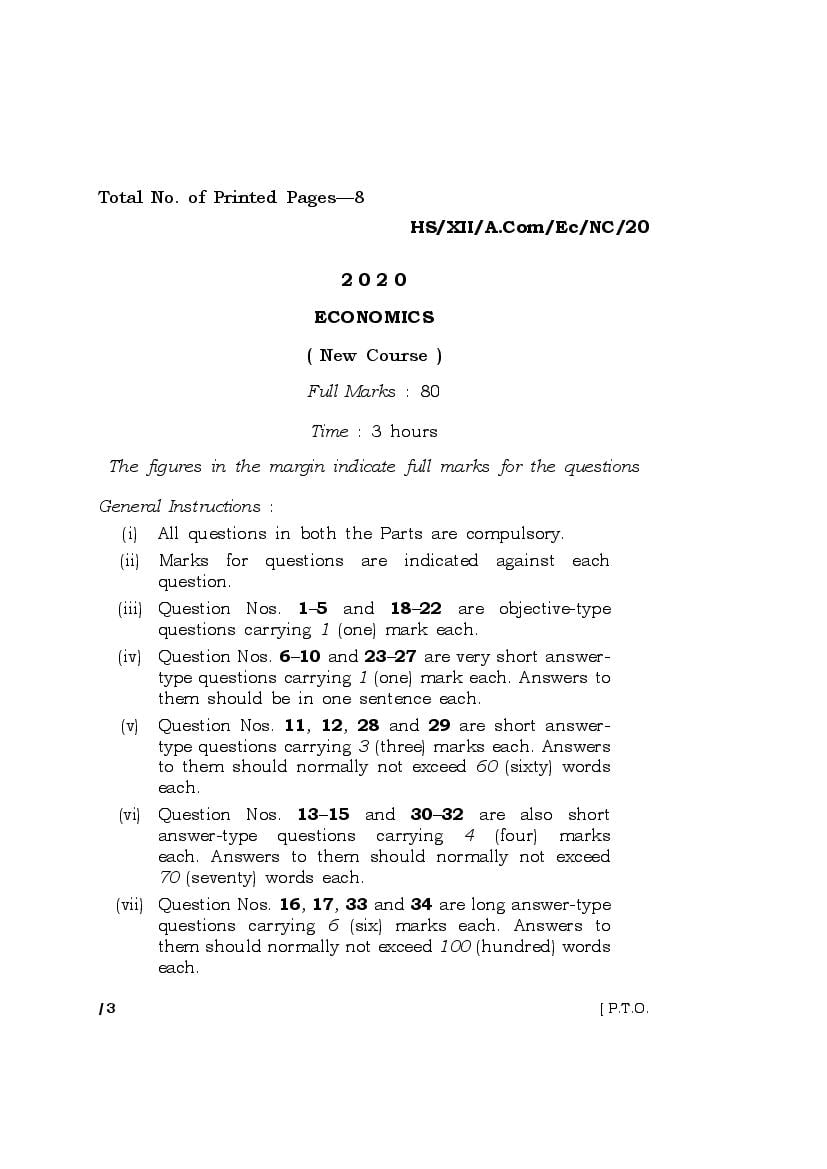
HS/XII/A.Com/Ec/NC/20
2020
ECONOMICS
( New Course )
Full Marks : 80
Time : 3 hours
The figures in the margin indicate full marks for the questions
General Instructions :
(i) All questions in both the Parts are compulsory.
(ii) Marks for questions are indicated against each
question.
(iii) Question Nos. 1–5 and 18–22 are objective-type
questions carrying 1 (one) mark each.
(iv) Question Nos. 6–10 and 23–27 are very short answer-
type questions carrying 1 (one) mark each. Answers to
them should be in one sentence each.
(v) Question Nos. 11, 12, 28 and 29 are short answer-
type questions carrying 3 (three) marks each. Answers
to them should normally not exceed 60 (sixty) words
each.
(vi) Question Nos. 13–15 and 30–32 are also short
answer-type questions carrying 4 (four) marks
each. Answers to them should normally not exceed
70 (seventy) words each.
(vii) Question Nos. 16, 17, 33 and 34 are long answer-type
questions carrying 6 (six) marks each. Answers to
them should normally not exceed 100 (hundred) words
each.
/3 [ P.T.O.
Page 2
PART—A
( Introductory Macroeconomics )
( Marks : 40 )
1. The wear and tear of capital is called
(a) net investment
(b) gross investment
(c) depreciation
(d) All of the above 1
2. The number of times a unit of money changes hands
during the unit period is called
(a) velocity of circulation of money
(b) high-powered money
(c) legal tender money
(d) money multiplier 1
3. Ex-ante investment means
(a) the value of planned consumption
(b) the value of planned investment
(c) the method of calculating national income
(d) None of the above 1
HS/XII/A.Com/Ec/NC/20/3 [ Contd.
Page 3
4. Revenue deficit is referred to the excess of
(a) revenue expenditure over revenue receipt
(b) gross fiscal deficit over net interest liabilities
(c) total expenditure over total receipt
(d) revenue receipt over revenue expenditure 1
5. When imports exceed exports, there is a
(a) trade surplus
(b) trade deficit
(c) trade balance
(d) All of the above 1
6. What is a flexible exchange rate? 1
7. Mention the components of a budget. 1
8. What is marginal propensity to consume? 1
9. Define money. 1
Or
Calculate the value of money mulitplier if cash reserve
ratio (CRR) is 20%.
HS/XII/A.Com/Ec/NC/20/3 [ P.T.O.
Page 4
10. What is high-powered money? 1
11. Distinguish between stocks and flows with examples. 3
Or
Find nominal GDP if real GDP = R 240 and price
index = 120.
12. What are the measures of money supply? 3
13. What is meant by full employment? Distinguish between
voluntary unemployment and involuntary unemployment.
1+3=4
Or
Calculate autonomous consumption expenditure from
the following data when the economy is in equilibrum :
National income (Y ) = R 1,200 crore
Marginal propensity to consume (MPC) = 0·8
Investment expenditure (I ) = R 100 crore
14. Distinguish between : 4
(a) Revenue expenditure and Capital expenditure
(b) Revenue receipt and Capital receipt
15. Distinguish between : 4
(a) Balance of trade and Balance of payments
(b) Devaluation and Depreciation of currency
16. Explain the expenditure method of calculating national
income. 6
HS/XII/A.Com/Ec/NC/20/3 [ Contd.
Page 5
17. What is meant by propensity to consume? Explain the
concept with the help of a suitable diagram. 1+5=6
Or
Explain the working of the investment multiplier with the
help of a table. 6
PART—B
( Indian Economic Development )
( Marks : 40 )
18. Adoption of new technology is called
(a) modernization
(b) liberalization
(c) privatization
(d) globalization 1
19. Integrating the domestic economy with the economies of
other countries is known as
(a) liberalization
(b) globalization
(c) privatization
(d) None of the above 1
HS/XII/A.Com/Ec/NC/20/3 [ P.T.O.
Page 6
20. The data on poverty is made available to the public by
(a) Planning Commission
(b) National Commission
(c) State Commission
(d) District Commission 1
21. The ratio which is used for analyzing the employment
situation in the country is derived from
(a) world-population ratio
(b) worker-population ratio
(c) cash-reserve ratio
(d) statutory-liquidity ratio 1
22. The Great Leap Forward (GLF) campaign initiated in
1958 aimed at _____ the country. 1
(a) industrializing
(b) privatizing
(c) globalizing
(d) All of the above
23. Mention the three elements of the New Economic
Policy, 1991. 1
HS/XII/A.Com/Ec/NC/20/3 [ Contd.
Page 7
24. Define poverty line. 1
25. Mention the two major sources of human capital in a
country. 1
26. What is infrastructure? 1
27. What is Human Development Index? 1
Or
What is infant mortality rate?
28. Explain three problems of Indian agriculture. 3
Or
Give three merits of GST.
29. Explain the effects of economic development on the
environment. 3
30. What are the benefits of organic farming? 4
31. What measures would you suggest to solve the problem
of unemployment in India? 4
Or
Explain how human capital can promote economic
development.
HS/XII/A.Com/Ec/NC/20/3 [ P.T.O.
Page 8
32. Bring out a comparison between India and China on the
basis of—
(a) GDP growth;
(b) human development indicators. 2+2=4
33. Distinguish between absolute poverty and relative
poverty. Briefly explain any four poverty elleviation
programmes adopted in the country. 2+4=6
34. What are the main goals of Five-Year Plans? Explain. 6
Or
Define small-scale industry. Explain how they help in
promoting rural development. 1+5=6
HS/XII/A.Com/Ec/NC/20/3 20K
Document Details
| Board / Org | Meghalaya Board |
| Exam | Class 12 |
| Type | Question Paper |
| Pages | 8 |
| Updated | 30 Apr 2026 |