MAHA SET 2020 Syllabus Earth Atmospheric Ocean and Planetary Science
Finished viewing? Save it for later —
Download MAHA SET 2020 Syllabus Earth Atmospheric Ocean and Planetary Science (PDF · 11 pages)About MAHA SET 2020 Syllabus Earth Atmospheric Ocean and Planetary Science
MAHA SET 2020 Syllabus Earth Atmospheric Ocean and Planetary Science is available here for free download. Published by Maharashtra Exams for Maharashtra State Eligibility Test, this syllabus can be viewed online or downloaded as a PDF (11 pages). Candidates preparing for Maharashtra State Eligibility Test can use MAHA SET 2020 Syllabus Earth Atmospheric Ocean and Planetary Science to understand the exam pattern, the type of questions asked, and the overall difficulty level.
Frequently Asked Questions
How can I download MAHA SET 2020 Syllabus Earth Atmospheric Ocean and Planetary Science?
Open this page and click the Download button to save MAHA SET 2020 Syllabus Earth Atmospheric Ocean and Planetary Science as a PDF. It is completely free on AglaSem Docs.
Is MAHA SET 2020 Syllabus Earth Atmospheric Ocean and Planetary Science free to download?
Yes. MAHA SET 2020 Syllabus Earth Atmospheric Ocean and Planetary Science can be viewed online and downloaded as a PDF free of cost on AglaSem Docs.
How many pages does MAHA SET 2020 Syllabus Earth Atmospheric Ocean and Planetary Science have?
MAHA SET 2020 Syllabus Earth Atmospheric Ocean and Planetary Science contains 11 pages, which you can read online or download together as a single PDF.
Where can I find more Maharashtra State Eligibility Test study material?
You can find more Maharashtra State Eligibility Test question papers, sample papers, syllabus, and answer keys on AglaSem Docs.
MAHA SET 2020 Syllabus Earth Atmospheric Ocean and Planetary Science – Text
Read the full text of this syllabus below — useful to quickly search, copy and reference the content online without downloading the PDF.
📄 View text version (11 pages)
Page 1
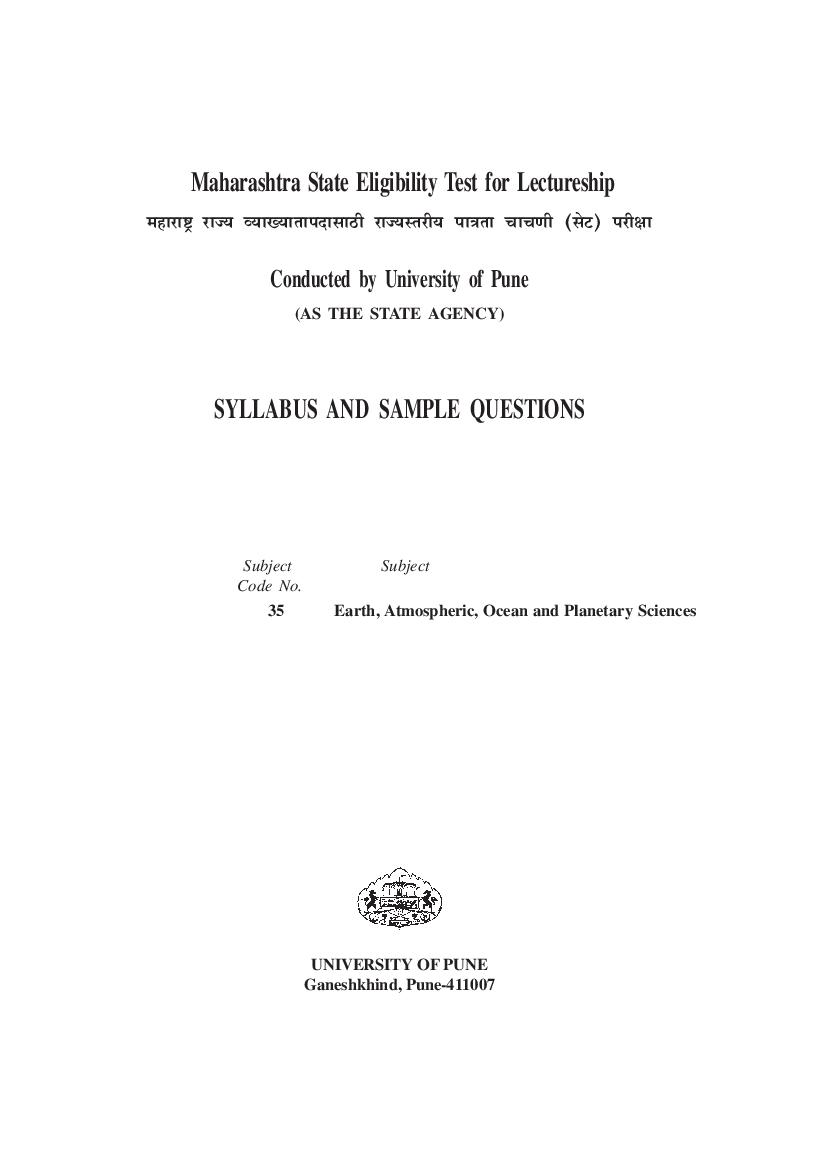
_hmamï´> amÁ` ì`m»`mVmnXmgmR>r amÁ`ñVar` nmÌVm MmMUr (goQ>) narjm
Conducted by University of Pune
(AS THE STATE AGENCY)
SYLLABUS AND SAMPLE QUESTIONS
Subject Subject
Code No.
35 Earth, Atmospheric, Ocean and Planetary Sciences
UNIVERSITY OF PUNE
Ganeshkhind, Pune-411007
Page 2
[35] : EARTH, ATMOSPHERIC, OCEAN AND PLANETARY SCIENCES
SYLLABUS
PAPER II
1. About the Earth : The earth and the solar system; important physical parameters and properties
of the planet earth; abundance of elements in the earth; primary differentiation of the earth and
composition of its various zones; composition of meteorites and the solar photosphere; shape
and internal structure of the earth. Uniformitarianism; geological time scale; use of fossils and
nuclear clocks in the subdivision of geological time.
2. Materials of the Earth : Gross composition and physical properties of important rocks and
minerals; properties and process responsible for mineral concentrations; nature and distribution
of rocks and minerals in different units of the earth; deformations of rocks; folds and faults
and their surface expressions.
3. Surface Features and Processes : Physiography of the earth; landscape and seafloor;
weathering, erosion, transportation and deposition of earth’s material; formation of soil,
sediments and sedimentary rocks; energy balance of the earth’s surface processes.
4. Internal Features and Processes : Elastic waves and fine structure of the earth; crust, mantle
and core; thermal, gravitational and magnetic fields of the earth; origin of the main geomagnetic
field; mantle convection and plate tectonics; earthquakes and valcanoes; Isostasy.
5. The Atmosphere : Composition of the atmosphere and its internal structure; prevailing and
adiabatic lapse rates; instability of dry and moist air; geopotential; cloud classification;
condensation nuclei; artificial precipitation. Fundamental forces in the atmosphere; Coriolis
force and the geostrophic wind; basic structure and mechanism of atmospheric general
circulation; monsoon systems; cyclones, anticyclones and tornadoes; jet streams; climate and
climatic changes; natural and human induced factors.
6. The Hydrosphere : The hydrological cycle; inter-relationship of surface and ground water;
seafloor spreading and hydrothermal vents; marine sediments, their composition and uses;
distribution of temperature and salinity in the ocean; surface circulation, causes of ocean
currents and important current systems; deep circulation. Water masses-their formation and
characteristics; convergence and upwelling of ocean waters; sealevel changes; waves and
tides; chemistry of sea water, biological controls on the composition of the oceans; oceanic
modulation of climatic changes estuary, bay and marine pollution.
7. Geology and Geography of India : Land, biotic and mineral resources and their role in
development; salient aspects of plant zoogeography; geologic setting; location and approximate
reserves of minerals, fuel and water resources of the Indian territory. Important geological
features of the Precambrian shield, the Gondwanas, the Deccan Trap, Indo-Gangetic Plains,
the Himalaya - their physiography, landforms, drainage systems. Soils : their characteristics
and distribution; climate and population; location of important natural resources and renewable
sources of energy in relation to industrial centres.
Page 3
8. Man and Environment : Ecology, ecosystem and biotic communities; carbon and nutrient
cycling and food-chain; human impact on air, land, soil, water, climate and forest resources;
conservation of resources; coping with natural hazards; problems of pollution and waste;
application of engineering geology to development without destruction; optimum use of energy
alternatives.
SYLLABUS
PAPER III
1. GEOLOGY
( i ) Geomorphology : Landforms-their types and development; weathering, transport and
erosion; landforms in relation to rock type, structure and tectonics. Soils-their development
and types. Geomorphic processes and their impact on various landforms and associated
dynamics-slope, channel, coastline, glacial and aeolian; evolution of major
geomorphological features of the Indian sub-continent; geomorphometric analysis and
modelling.
( ii) Sedimentology : Classification of sedimentary rocks; petrography of rocks of clastic,
chemical and biochemical origin. Sedimentary textures and structures. Diagenesis; marine,
non-marine and mixed depositional environments. Facies association, sedimentation and
tectonics; basin analysis; Reconstruction of palaeoenvironments using radioactive and
stable isotopes.
(iii) Palaentology : Origin and evolution of life; fossils and their uses; species concept;
functional morphology, classification and evolution of important invertebrate, vertebrate
and plant fossils; biomineralisation and trace fossils; types of microfossils and their
applications; palaeobiogeography and palaeoecology; evolution of man. Oxygen and carbon
isotopic studies on fossils; analysis of palaentological record for tracing plate tectonics
processes.
(iv) Stratigraphy : Recent developments in stratigraphic classification : Litho bio and chrono
stratigraphic units and their interrelationships; modern methods of stratigraphic correlation;
steps in stratigraphic studies; approaches to palaeogeography; Earth’s climatic history.
Rocks of Phanerozoic Eon in India-their intercontinental correlation with special reference
to type localities; boundary problems in stratigraphy; geodynamic evolution of the Indian
subcontinent through the Phanerozoic.
( v) Structural Geology and Geotectonics : Concepts of stress and strain; strain analysis
using deformed objects; geometric classification of folds; mechanics of folding; folding
in shear zones; geometry of superposed folding; structural analysis in terrains with multiple
deformation; foliation and lineation; geometry and mechanics of shear zones; brittle-
ductile and ductile structures in shear zones; geometry of thrust sheets. Classification of
unconformities; map patterns and their uses in the determination of large-scale structures.
Isostasy; seismicity; sea-floor spreading and plate tectonics; orogenesis; orogenic belts of
India; evolution of the Himalaya and Himalayan tectonics.
Page 4
(vi) Mineralogy : Concept of symmetry, point group lattice and space group; principles of
crystal chemistry; principles of optical and X-ray mineralogy. Structural classification of
minerals; structure and its interrelation with physical and chemical properties of minerals
important phase diagrams of major rockforming minerals and ore minerals; principles of
geothermo-barometry.
(vii) Geochemistry : Abundances of elements; structure and atomic properties of elements;
the Periodic Table; geochemical classification and distribution of elements in the earth;
principles of geochemical cycling; principles of ionic substitution in minerals; laws of
thermodynamics; concepts of free energy, activity, fugacity and equilibrium constant;
thermodynamics of ideal, nonideal and dilute solutions; element partitioning in mineral/
rocks formation and concept of distribution coefficients; concept of P-T-X. Eh-pH diagrams
and mineral stabilities; radioactive decay schemes, growth of daughter isotopes and
radiometric dating; stable isotopes and their fractionation. Mineral/Mineral assemblages
as ‘sensors’ of ambient environments.
(viii) Petrology : Phase equilibria studies of single, binary, temary and quartermary silicate
systems with reference to petrogenesis; magmas, their generation in the crust and mantle,
their emplacement and their relation to plate tectonics; magmatic crystallization,
differentiation and assimilation; classification of igneous rocks; major and trace elements
and isotopic composition of igneous rocks in the context of petrogenesis; petrogenesis of
important types of igneous rocks; volatile components in petrogenesis. Physical and
rheological properties of silicate melts-Bingham liquid; partial melting and fractional
crystallization in closed and open system models.
Role of T.P. and fluids in metamorphism; metamorphic facies; mineral assemblages and
important reactions in different facies; types of metamorphism and metamorphic-belts;
relationship among metamorphism, anatexis and grantization.
Petrogenetic aspects of important rocks of India such as the Deccan Trap. the Layered
intrusions, charnockites, khondalities and ‘gondites’.
(ix) Ore Geology : Physico-chemical controls of deposition and of post-depositional changes
in ores; geological processes of formation of economic mineral deposits; global metallogeny
as related to crustal evolution; metallogenesis in space and time. Elements of ore petrology;
mineral assemblages and fluid inclusions as ‘sensors’ of ore-forming environments; Live
ore-forming systems. Geological setting, characteristics features and genesis of ferrous
and non-ferrous ore deposits of India. Metallogenic history of India.
(x) Marine Geology : Morphological and tectonic domains of the ocean floor; midocean
ridge systems; seawater-basalt interaction and hydrothermal vents; models and rates of
ocean circulation and of sedimentation in the oceans; diagenetic changes in oxic and
anoxic environments; mobility of redox metals; major components of marine sediments
and processes regulating sediment composition; geochronology of marine sediments from
radioactivity measurements; sedimentary markers of palaeoenvironmental conditions;
mineral resources of the oceans and factors controlling their distribution.
Page 5
Ocean margins; nature of deep sea sediments, their chronology and correlation; tectonic
history of the oceans.
(xi) Petroleum and Coal Geology : Origin, migration and entrapment of petroleum; properties
of source and reservoir rocks; structural, stratigraphic and combinations traps. Techniques
of exploration. Petroliferous basins of India.
Origin of peat, lignite, bitumen and anthracite. Classification, rank and grading of coal;
coal petrography, coal measures of India.
(xii) Precambrian Geology and Crustal Evolution : Evolution of the early crust, early
Precambrian life, lithological, geochemical and stratigraphic characteristics of granite-
greenstone and granulite belts. Stratigraphy and geochronology of the Precambrian terrains
of India.
(xiii) Applied Geology :
(a) Photogeology and Remote Sensing : Elements of photogrammetry; elements of
photo interpretation; electromagnetic spectrum emission range, film and imagery;
multispexctral sensors; geological interpretation of air-photos and imagery.
(b) Engineering Geology : Mechanical properties of rocks; geological investigations
for the construction of dams, bridges, highways and tunnels.
(c) Mineral Exploration : Geological and geophisical methods of surface and subsurface
exploration on different scales, sampling, assaying and evaluation of mineral deposits;
geochemical and geobotanical surveys in exploration.
(d) Hydrogeology : Ground water, Darcy’s law; hydrological characteristics of aquifers;
hydrological cycle; precipitation, evapotranspiration and infiltration processes;
hydrological classification of water-bearing formations; fresh and salt water
relationship in coastal and inland areas; ground water exploration and management,
water polution, ground water regimes in India.
2. PHYSICAL GEOGRAPHY
( i ) Geomorphology : Land forms-their types and developments; weathering, transport and
crosion; landforms in relation to rock type, structure and tectonics. Soils-their development
and types. Geomorphic processes and their impact on various landforms and associated
dynamics-slope, channel coastline, glacial and aeolian; evolution of major geomorphological
features of the Indian subcontinent. Geomorphometric analysis and modelling.
( ii) Climatology : Fundamental principles of climatology; Earth-sun relationship; earth’s
radiation balance, latitudinal and seasonal variation of insolation, temperature humidity,
wind and precipitation. Indian climatology with special reference to seasonal distribution
and variations of temperature, humidity, wind and precipitation; air masses notably
monsons, and jet streams, tropical cyclones and cloud formation, classification of climates;
Koppen’s and Thornthwaite’s scheme as applicable to India. Climate zones of India.
Hydrological cycle and water balance. Climate change; green house warming, stratospheric
ozone depletion. Palaeoclimatology.
Page 6
(iii) Geohydrology : Ground water as part of the hydrological cycle; precipitation and
evapotranspiration and infiltration processes; rainfall-run off analysis; stream flow, stage-
discharge relationship; hydrograph and flood frequency analysis. Hydrological classification
of a water-bearing formations, fresh and salt water relationship in coastal and inland
areas; ground water regimes in India.
Principles of management of water resources; concept of safe yield; water balance studies
and conjunctive use of surface and ground water; ground water problems and their
management in India.
(iv) Biogeography : Elements of biogeography with special reference to India; environment,
habitat and plant-animal association; zoogeography of India; distribution of major animal
groupings; elements of plant geography, distribution of forests and major plant communities.
National forest policy, conservation of forests; afforestation, social forestry; ecology and
man in India. Ecological balance, environmental pollution and deterioration.
( v) Oceangraphy : Submarine relief, continental shelf, continental slope, ocean deeps;
temperature of ocean water; salinity in the coastal open and enclosed seas; movement of
ocean waters; waves, tides, currents; island arcs and coral reefs and atolls; oceanic deposits.
3. GEOPHYSICS
( i ) Geophysical Fields : Concept of fieds; scalar, vector and tensor; conservation laws;
mass, momentum, energy and charge, constitutive relations and dynamical equations;
elastic viscous, electro-magnetic and thermal; Laws of thermodynamics and entropy;
Partial differential equations of physics; wave, diffusion, potential and schrodinger;
analytical (Green’s functions and integral transforms) and numerical (Spectral, finite
difference and finite element) methods for solving initial value and boundary value problems
of geophysics.
Linear instability theory and onset of convection; Benard Cells; Elements of nonlinear
instability in fluids; Theory of Attractors; phase space, critical points, limit cycles and
bifucation of nonlinear systems.
( ii) Signal Processing : Continuous and discrete signals; Fourier analysis linear time-invariant
systems with deterministic and random inputs; bandlimited signals and sampling theorem;
Z-transform, discrete and Fast Fourier transforms; filter discreate and continuous, recursive
and non-recursive, optimal, inverse filters, deconvolution. Estimation of signal parameters
system identification. Hypothesis testing.
(iii) Solid Earth : Gravity and figure of the Earth : Spheroid and geoid mass inhomogenetics
and associated gravity anomalies; geoidal undulations and deflection of the vertical;
isostasy; local and regional compensation mechanisms. Seismology; causes and space
distribution of earthquakes; theory of seismic waves; (body and surface waves), free
oscillations, application for estimating earth structure and earthquake source parameters;
earthquake hazard assessment. Geomagnetism; main field, its secular variation and
reversals; remanent magnetization, palaeomagnetism and lithospheric movements;
Page 7
geodynamo theory and hydromagnetic waves; magnetosphere and geomagnetic stroms.
Electrical structure of the earth; geomagnetic and magnetotelluric depth sounding. Plate
tectonics theory; kinematics, dynamics and evolution of plates; types of boundaries,
processes and corresponding geophysical and geological signatures. Heat flow thermal
and mechanical structure of continental and oceanic lithosphere; role of fluids in crustal
processes; mantle convection. Mineral physics; constraints on earth structure from
seismological and petrological investigations.
(iv) Geophysical Exploration : Basic principles; various methods, their distinctive features,
scope, limitations and prospects of conjuctive use. Geophysical exploration from the air
on the ground in bore holes, across drill holes in underground mines and in the oceans.
Instruments used : theory, behaviour and precision of spring-mass systems, magnetomeres
(suspended magnet type, nuclear procession, nuclear resonance, flux gate and
superconducting), Gravimeters (land, shipborne, spaceborne and borehole), wide band
seismograph and geophone skystems. Electrical systems, (resistivity, IP, MT, EM, TEM),
Well logging units (caliper, electrical, radiation, acoustic, dipmeter, televiewer, induction,
nuclear magnetism log) and seismic sources.
Principles of measuring complex signals; measurements in time and frequency domain.
Pseudorandom sources for electrical and seismic exploration.
Signal Analysis : Gravity (free air, Bouguer, terrain drift and Eotovos correction) and
magnetic (diurnal) and latitude (corrections) data reduction; regional and residual separation;
derivatives, continuation and reduction to pole of potential field data. Electrical/EM data
processing, Seismic (velocity analysis, signal enhancement, deconvolution, migration and
time to depth conversion), Shear wave, VSP, 2-D/3-D multifold and marine data processing.
Numerical experiments for computer aided design of high resolution field measurements;
sensivity analysis of various control parameters for maximum information/uncertainty
ratio.
( v) Geophysical Inversion and Interpretation : Distinction between well-posed and ill-
posed problems. Generalized inversion techniques; error analysis and the study of resolution
and uniqueness in geophysical interpretation; Backus-Gilbert inversion method; linear
and non-linear programming methods; Joint inversion of geophysical data and effective
strategies for integrated geophysical exploration from a systems view point. Interpretation
for average value of physical properties of rocks and minerals and their structure; direct
detection of hydrocarbons (fluid content); lithostratigraphy, ground water, ore deposit,
engineering sites, environmental parameters.
4. OCEANOGRAPHY
( i ) Physical Oceanography : Equation of State of sea water, current system including under
current, their formation and theories, oceanic fronts.
Subtropical current system-Western and Eastern boundary currents; Somali current;
thermohaline and abyssal circulation; formation of water masses mixing and double
diffusion.
Page 8
TSV diagrams computation of divergence and estimation of vertical velocity; acoustics and
optics.
( ii) Dynamical Oceanography : Equation of motion of frictionless ocean current scalae
analysis; barottropic and baroclinic approximation; geostrophic currents in a stratified
ocean, the 2-layer approximation and White-Margules equation; gradient current and
mass stratification; relative currents and slope currents; Ekman’s theory, Sverdrup, Stommel
and Munk’s theories; Upwelling and sinking with special reference to the Indian ocean.
(iii) Ocean Waves and Tides : Small amplitude ocean waves; wave celerity; wave energy and
group velocity. Finite amplitude waves, long waves and internal wave, wind waves, their
origin, growth, propagation and decay; significant wave height and period. Wave spectrum,
Principles of wave forcasting SMB and PNJ methods; tides their causes, variation and
types; tidal currents; harmonic analysis, finite difference method and prediction of tides.
(iv) Air-Sea Interaction : Laminar and turbulent flows, Reynolds stresses; Richardson’s
crierion for turbulence; principle of Prandtl’s mixing length theory; Taylor’s statistical
theory and Kolmogoroffs similarity theory, Air-sea interaction at various scales; planetary
and laminar boundary layer, surface layer and spiral layer; Sea surface as a lower boundary
of air-flow and its geometry; wind field in the first few meters of the sea surface, wind
structure in the maritime frictional layer; transfer of heat and water vapour, determination
of air-sea fluxes; energy exchange and global heat and water budgets, convection and its
role in tropical circulations, effects of upwelling and sinking on the ocean-atmosphere
system.
(v) Coastal and Estuarine Oceanography : Factors influencing coastal processes;
transformation of waves in shallow water; effects of stratification; effect of bottom friction,
phenomena of wave reflection, refraction and diffraction; breakers and surflitoral currents;
wave action on sediments-movement to beach material; rip currents; beach stability ocean
beach nourishment; harbour resonance; seiches; Tsunamis; Interaction of waves and
structure. Sea Walls, groynes, revetments etc.
Estuaries : Classification and nomenclature; tides in estuaries; estuarine circulation and
mixing, depth-averged and breadth-averaged models; sedimentation in estuaries; salinity
intrusion in estuaries; Effect of stratification; coastal pollution; mixing and diffusion
dispersal of pollutants in estuaries and nearshore areas; standing concentration; coastal
zone management.
(vi) Chemical Oceangraphy : Major and minor constituents of sea-water and their residence
times; processes controlling the composition of sea-water, Dissolved gases in sea-water,
their sources and sinks. Carbondioxide system, distribution of alkalinity; Physical chemistry
of sea-water; dynamic equilibrium in chemical composition of the ocean including trace
metals, organic materials. Biogeochemical cycling and its effect on atmospheric composition
and climate. Inter-relationship between ocean circulation, primary productivity and chemical
composition of the atmosphere and ocean.
Page 9
Stable and radioactive isotopes; chemistry of interstital waters and transfer of solutes
across the sediment-water interface; marine pollution, pathways of transfer of various
pollutants (petroleum hydrocarbons, pesticides, trace metals etc.) and their fates in the sea.
Chemistry of marine natural products; biomedical potential of marine biota; remote sensing of
the oceans.
(vii) Marine Geology : Morphological and tectonic domains of the ocean floor. Mid-oceanic ridge
systems, hydrothermal vents and sea-water basalt interaction; modes and rates of sedimentation
in the oceans; diagenetic changes in oxic and anoxic environments, mobility of redoxmetals;
nature of deep sea sediments and processes and regulating sedimentary composition;
geochronology of marine sediments, sedimentary markers (biological and chemical) of
paleoenvironmental conditions. Mineral resources of the ocean - phosphorites, manganes and
other deposits and the factors controlling their distribution.
(viii) Marine Biology : Sea as a biological environment; divisions of the marine environment and
their characteristics fauna and flora and their adaptations. Marine ecosystems; rocky shores,
sandy shores, estuarine, mangroves and coral reefs; description of communities, community
structure and function; plankton, nekton and benthos; primary, secondary and tertiary production;
food web and trophic structure; living resources of the Indian seas; mariculture; culture of
molluses, crustacean, fishes and seaweeds.
5. METEOROLOGY
( i ) Climatology : Fundamental principles of climatology; Earth-sun relationship; earth’s radiation
balance, latitudinal and seasonal variation of insolation, temperature, humidity, wind and
precipitation. Indian climatology with special reference to seasonal distribution and variations of
temperature, humidity, wind and precipitation; air masses notably monsoons, and jet streams,
tropical cyclones, and cloud formation, classification of climates; Koppen’s and Thornthwaite’s
schemes as applicable to India. Climatic zones of India. Hydrological cycle and water balance.
Climate change; green house warming, stratospheric ozone depletion. Palaeoclimatology.
( ii) Physical Meteorology : Layered structure of the atmosphere and its composition. Radiation;
basic Laws - Raleigh and Mie scattering, multiple scattering, radiation from the sun, solar
constant, effect of clouds, surface and planetary albedo. Emission and absorption of terrestrial
radiation, radiation windoes, radiative transfer. Greenhouse effect, net radiation budget; Derivation
of radiance parameters from satellite observations. Thermodynamics of dry and moist air;
specific gas constant, Adiabatic and Non adiabatic processes, entropy and enthalphy, Moisture
variables, virtual Temperature; Clausius - Clapeyron equation, adiabatic process of a moist air;
thermodynamic diagram; Emagram, tephigram, skew T-log p and Stuve diagrams. Hydrostatic
equilibrium; Hydrostatic equation, variation of pressure with height, geopotential, standard
atmosphere, altimetry. Vertical stability of the atmosphere; Dry and moist air parcel and slice
methods, Entrainment, Bubble theory, Diurnal variation of lapse rate, convection in the atmosphere.
Page 10
(iii) Atmospheric Electricity : fair weather electric field in the atmosphere and potential gradients,
ionisation in the atmosphere, conduction currents, air-earth currents, point discharge currents.
Electrical fields in thunderstorms, theories of thunderstorm electrification, lightning discharges.
(iv) Cloud Physics : Cloud classification, condensation nucleii, growth of cloud drops and ice-
crystals, precipitation mechanisms; Bergeron, Findeisen process, coalescence process-Precipitation
of warm and mixed clouds, artificial precipitation, hail supression, fog and cloud-dissipation,
radar observation of clouds and precipitation, radar equation, rain-drop spectra, radar echoes
of hail and tornadoes, radar observation of hurricanes, measurements of rainfall by radar.
( v) Dynamical Meteorology : Basic equations and fundamental forces; Pressure gravity, centripetal
and coriolis forces, continuity equation in Cartesian and isobaric coordinates. Momentum equations
in rotating, cartesian, and spherical coordinates; scale analysis, Inertial flow, Geostrophic and
gradient winds, thermal wind. Divergence and vertical motion, Rossby, Richardson, Reynolds
and Froude numbers. Circulation vorticity and divergence; Bjerknese circulation theorem and
applications, Vorticity and divergence equations, Scale analysis, Potential vorticity, Stream function,
velocity potential. Atmospheric turbulence; Mixing length theory, planetary boundary layer
equations, surface layer, Ekmann layer eddy transport of heat, water vapour and momentum,
Richardson criterion. Linear perturbation theory; Internal and external gravity waves, Inertia
waves, gravity waves, Rossby waves; wave motion in the tropics, barotropic and baroclinic
instabilities; Taylor - Goldstein instability; theorems of Mines, Fjortozt, Howard and Pedlosky.
Atmospheric energetics; Kinetic, potentiai and internal energies - Conversion of potential and
internal energies into Kinetic energy, available potential energy.
(vi) Numerical Weather Prediction : Computational instability, filtering of sound and gravity
waves, filtered forecast equations, barotropic and equivalent barotropic models, two parameter
baroclinic model relaxaation method, two layer primitive equatier, model, short, mediun and long
range weather prediction models; objective analysis; Initialisation of the data for use in weather
prediction models; data assimilation techniques.
(vii) General Circulation and Climate Modelling : Observed zonally symmetric circulations,
meridional circulation models, mean meridional and eddy transport of momentum and energy,
angular momentum and energy budgets; zonally asymmetric features of general circulation;
standing eddies; east-west circulation in tropics; climate variability and forcings; feedback
processes, low frequency variability, ENSO, QBO and sunspot cycles. basic principles of
general circulation modelling; Grid-point and spectral GCMs; role of the ocean in climate
modelling; interannual variability of ocean fields (SST, winds, circulation, etc.) and its relationship
with monsoon, concepts of ocean - atmosphere coupled models.
(viii) Synoptic Meteorology : Synoptic charts, Weather observations, and transmission. Analysis of
surface, upper aiar and other derivative charts; Stream lines, isotachs and countour analysis; tilt
and slope of pressure/weather systems with height. Synoptic weather forecasting, Prediction of
Weather elements such as rain, maximum and minimum temperature and fog; hazardous weather
Page 11
elements like thunderstorms, duststorms, tornadoes, dates of onset, and withdrawal of monsoons,
break monsoon; formation and movement of western distrurbances,depressions and tropical
cyclones; intensification, weakening, deepening and filling of surface pressure systems. Air
masses and fronts; Sources, origin and classification of air masses; classification of fronts,
frontogenesis and frontolysis; structure of cold and warm fronts; Weather systems associated
with fronts. Extra-tropical synoptic scale features; jet streams, extratropical cyclones; anticyclones
and blockings. Tropical synoptic meteorology; Trade wind inversion; ITCZ; monsoon trough;
Tropical cyclones, their structure and development theory; Monsoon depressions; tropical easterly
jet stream; Somali Jet; Waves in easterlies; western distrurbances; SW and NE Monsoons;
synoptic features associated with onset, withdrawal, break, active and weak monsoons.
(ix) Aviation Meteorology : Meteorological hazards to aviation; take-off, landing, inflight-
icing, turbulence, visibility, fog, clouds, rain, gusts, wind shear and thunderstorms.
( x) Satellite Meteorology : Meteorological satellites : Polar orbitting and geostationary
satellites, Visible and infrared radiometers, multiscanner ratiometers; identification of
synoptic systems, fog and sandstorms, detection of cyclones, estimation of SST and cloud
top temperatures, winds, and rainfall; temperature and humidity soundings.
————
Document Details
| Board / Org | Maharashtra Exams |
| Exam | Maharashtra State Eligibility Test |
| Type | Syllabus |
| Pages | 11 |
| Updated | 30 Apr 2026 |