ISC Class 12 Question Paper 2025 Sociology
Finished viewing? Save it for later —
Download ISC Class 12 Question Paper 2025 Sociology (PDF · 7 pages)About ISC Class 12 Question Paper 2025 Sociology
ISC Class 12 Question Paper 2025 Sociology is available here for free download. Published by CISCE for Class 12, this question paper can be viewed online or downloaded as a PDF (7 pages). Candidates preparing for Class 12 can use ISC Class 12 Question Paper 2025 Sociology to understand the exam pattern, the type of questions asked, and the overall difficulty level.
Frequently Asked Questions
How can I download ISC Class 12 Question Paper 2025 Sociology?
Open this page and click the Download button to save ISC Class 12 Question Paper 2025 Sociology as a PDF. It is completely free on AglaSem Docs.
Is ISC Class 12 Question Paper 2025 Sociology free to download?
Yes. ISC Class 12 Question Paper 2025 Sociology can be viewed online and downloaded as a PDF free of cost on AglaSem Docs.
How many pages does ISC Class 12 Question Paper 2025 Sociology have?
ISC Class 12 Question Paper 2025 Sociology contains 7 pages, which you can read online or download together as a single PDF.
Where can I find more Class 12 study material?
You can find more Class 12 question papers, sample papers, syllabus, and answer keys on AglaSem Docs.
ISC Class 12 Question Paper 2025 Sociology – Text
Read the full text of this question paper below — useful to quickly search, copy and reference the content online without downloading the PDF.
📄 View text version (7 pages)
Page 1
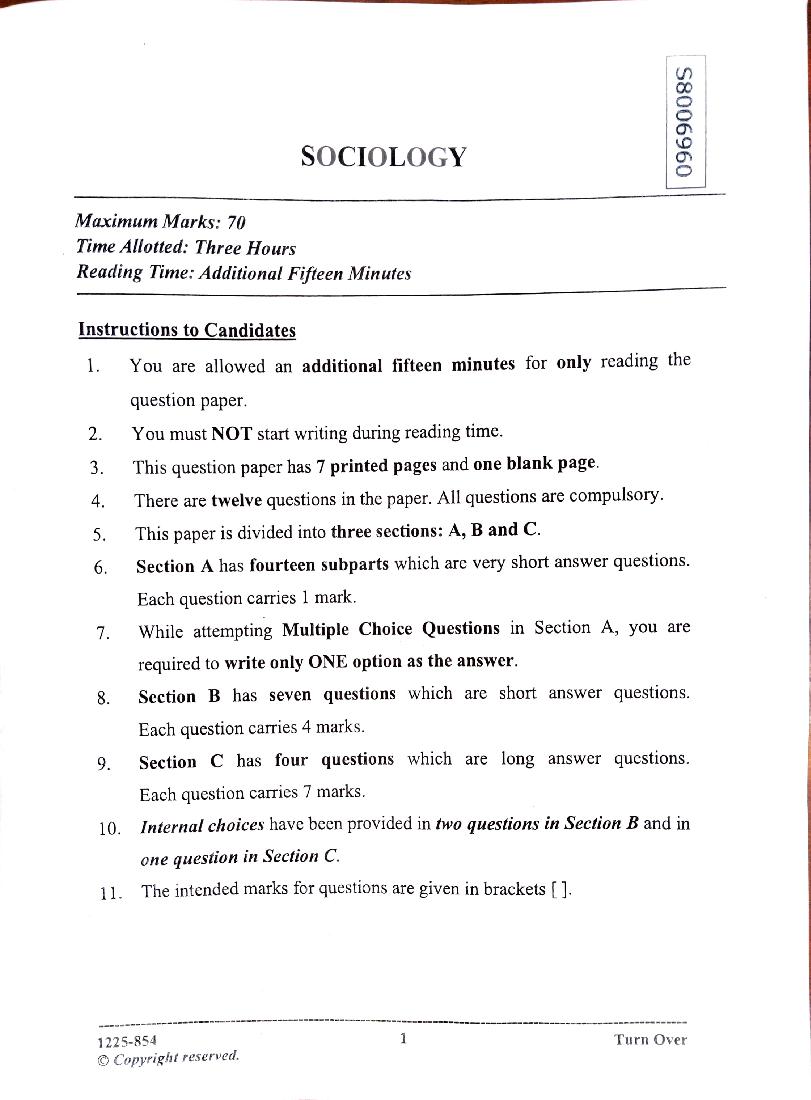
SOCIOLOGY
Maximum Marks: 70
Time Allotted: Three Hours
Reading Time: Additional Fifteen Minutes
Instructions to Candidates
1. You are allowed an additional fifteen minutes for only reading the
question paper.
2. You must NOT start writing during reading time.
3. This question paper has 7 printed pages and one blank page.
4. There are twelve questions in the paper. Allquestions are compulsory.
5. This paper is divided into threesections: A, B and C.
6. Section Ahas fourteen subparts which are very short answer questions.
Each question carries 1 mark.
7. While attempting Multiple Choice Questions in Section A, you are
required to write only ONE option as the answer.
8. Section B has seven questions which are short answer questions.
Each question carries 4 marks.
9. Section C has four questions which are long answer questions.
Each question carries 7 marks.
10. Internalchoices have been provided in two questions in Section B and in
one question in Section C.
11. The intended marks for questions are given in brackets [ ].
1225-854 1 Turn Over
© Copyright reserved.
Page 2
candidates
I. Kindly read aloud the Instructions given on page 1 to all the
present in the examination hall.
1225-854 2
Page 3
Questionl
() Samira lived in a remote village and was married to Darshan. As a customary
practice, she was also married to Darshan's younger brother.
Which form of marriage was practised in the above case?
(a) Polyandry
(b) Polygyny
(c) Parallel cousin marriage
(d) Monogamy
(ii) Under colonial influence, a certain section of Indians discarded traditional [1]|
Indian clothes in favour of formal English attire as they considered it to be a
mark of upward social mobility.
Which process of upward social mobility was followed here?
(a) Brahminisation
(b) Globalisation
(c) Westernisation
(d) Sanskritisation
(iii) Given below are two statements marked Assertion and Reason. Read the two (1]
statements carefully and choose the correct option.
Assertion: Incertain communities, the husband stays with his wife throughout
the entire period of pregnancy and observes certain restrictions.
Reason: This practice reinforces paternity and strengthens the institution of
marriage.
(a) Both Assertion and Reason are true and Reason is the correct explanation
for Assertion.
(b) Both Assertion and Reason are true but Reason is not the correct
explanation for Assertion.
Assertion is true and Reason is false.
(c)
(d) Both Assertion and Reason are false.
(iv) Given below are two statements marked Assertion and Reason. Read the two [1]
statements carefully and choose the correct option.
ASsertion: Members of lower castes in India were restricted to performing
menial jobs.
Reason: The caste system was governed by strict rules of marriage.
(a) Both Assertion and Reason are true and Reason is the correct explanation
for Assertion.
(b) Both Assertion and Reason are true but Reason is not the correct
explanation for Assertion.
(c) Assertion is true and Reason is false.
(d) Both Assertion and Reason are false.
1225-854 3 Turn Over
Page 4
following statements describes the relationship of owners with tenants and
sharecroppers?
(a) Owners manage the land while tenants and sharecroppers collectively
own the land.
(b) Owners cultivate the land themselves while tenants pay a fixed fee for
land use and sharecroppers own the land they work on.
(c) Tenants manage the land and pay a portion of the produce to owners
while sharecroppers lease the land and pay rent to the owners.
(d) Owners lease the land to tenants who pay rent to them while
sharecroppers work on the land and share the produce with the owner.
(i) Avuncupotestal is aform of authority in which all decisions and responsibilities [1]
concerning the nephews and nieces are taken by the maternal uncle.
Which one of the following scenarios indicates an Avuncupotestal form of
authority?
(a) Rakshit lives with his father's brother who is responsible for his
upbringing and wellbeing.
(b) Ananya lives with her mother's sister who has been given the
responsibility of finding agroom for Ananya.
(c) Suresh and his siblings live in their mother's brother's home. Their
mother's brother looks after them and allocates duties and
responsibilities to each one.
(d) Lekha lives with her father's mother who is unwell and needs to be
looked after.
(vi) Identify the degree of kinship between ego and her father's sister's son. [1]
(a) Tertiary kin
(b) Secondary kin
(c) Affinal kin
(d) Primary kin
(vii) Every moming Ravi hangs abunch of green chillies and lemons at the entrance [11
of his house to ward off evil spirits.
Which concept of religion does Ravi practise?
(ix) In Shyam's community, the same term is used to refer to many kin members. I11
Which type of kinship term is used in Shyam's community?
1225-854 4
Page 5
(Source: www.pinterest.com)
(xi) The movie Thappad (2020) shows a happily married woman, Amrita filing for [1]
divorce after her husband slaps her one night.
Which gender issue is Amrita a victim of?
(xii) In a village in India, the government introduces latest farming techniques to [1)
improve agricultural productivity. Training sessions are conducted for the
farmers on using innovative farming methods and technology.
Which aspect of development is being referred to here?
(xiii) State any one feature of tribes. [1]
(xiv) Marriage in some societies is governed by certain preferential rules. [1]
In this context,mention any one feature of cousin marriage.
SECTION B 28 MARKS
Question 2 [4]
Which theory of religion is the symbol shown below associated with?
Discuss any three features of this theory.
(Source: www.crafingagreenworld.com)
1225-854 5 Turn Over
Page 6
On 28" August 2011, thousands of people turned up to join the nationwide
anti-corruption drive led by its chief crusader, Anna Hazare. This collective effort is
considered to be a turning point in Indian history.
What is this collective effort aimed at bringing about social change known as?
Explore the role of such efforts in society.
Question 4 14]
Explain any four functions of the dormitories in tribal communities.
Question5 [4]
Discuss any four differences between Class and Caste.
Question 6 [4]
Caste as a system of social stratification is a divisive force. Justify the statement by
highlighting any four negative impacts of caste on society.
Question 7 14]
(i) A mining company attempted to encroach on tribal land to establish mines.
This agitated the tribals who felt that it would destroy the ecosystem and their
means of livelihood.
Justify the reaction of tribals by referring to any four of their economic
activities.
OR
(ii) The Parliament of India implemented a social welfare measure in 2005,
which
aimed at ensuring the livelihood and economic security of rural households
across the country. It guaranteed at least hundred days of wage employment to
families in rural areas.
Name the programme of rural employment being referred to above.
Comment on any three of its implications.
Question 8
14)
() Explain any four features of the Joint family system.
OR
(ii) Explain any two features each of Amitate and Teknonymy as kinship usages.
1225-854
Page 7
Question9
Discuss any seven differences between the Consanguineous family and tne
Conjugal family.
OR
(ii) Discuss any seven features of Social Institutions.
Question 10 (7]
eDU
REC
Image: 1 Image: 2
(Source (edited): htp:/pinterest. com) (Source (edited): http:/%ikipedia.org
Identify the two aspects of development shown above. Which one of these supports
conservation of resources for the future generation?
Justify your answer with the help of any five arguments.
Question 11 (7]
Expiain the concept of taboo in religion.
Question 12
Iam a ten-year-old girl who lives in a village called Banipur. In our village, selected
children between the age group of ten to fifteen years are members of a council that
meets once every week. I, too, am a member of this council that comprises only
children.
Few months ago, the rampant use of polythene bags led to the death of stray cattle in
our village. They had been feeding on these bags which were casually dumped by the
villagers. This incident urged us to launch a campaign against the use of polythene
bags. We were also supported by the elders of our village in this initiative. Gradually,
the awareness on creating a plastic free environment spread toother villages too.
(i) Which council is being referred to by the narrator? [1]
E
(i) Elaborate on the role of the council, identified in subpart (1), in the lives of the [6]
children in rural areas.
1225-854
Document Details
| Board / Org | CISCE |
| Exam | Class 12 |
| Type | Question Paper |
| Pages | 7 |
| Updated | 24 Sep 2026 |