HP Board Class 9 Syllabus 2024 English
Finished viewing? Save it for later —
Download HP Board Class 9 Syllabus 2024 English (PDF · 4 pages)About HP Board Class 9 Syllabus 2024 English
HP Board Class 9 Syllabus 2024 English is available here for free download. Published by Himachal Pradesh Board for Class 9, this syllabus can be viewed online or downloaded as a PDF (4 pages). Candidates preparing for Class 9 can use HP Board Class 9 Syllabus 2024 English to understand the exam pattern, the type of questions asked, and the overall difficulty level.
Frequently Asked Questions
How can I download HP Board Class 9 Syllabus 2024 English?
Open this page and click the Download button to save HP Board Class 9 Syllabus 2024 English as a PDF. It is completely free on AglaSem Docs.
Is HP Board Class 9 Syllabus 2024 English free to download?
Yes. HP Board Class 9 Syllabus 2024 English can be viewed online and downloaded as a PDF free of cost on AglaSem Docs.
How many pages does HP Board Class 9 Syllabus 2024 English have?
HP Board Class 9 Syllabus 2024 English contains 4 pages, which you can read online or download together as a single PDF.
Where can I find more Class 9 study material?
You can find more Class 9 question papers, sample papers, syllabus, and answer keys on AglaSem Docs.
HP Board Class 9 Syllabus 2024 English – Text
Read the full text of this syllabus below — useful to quickly search, copy and reference the content online without downloading the PDF.
📄 View text version (4 pages)
Page 1
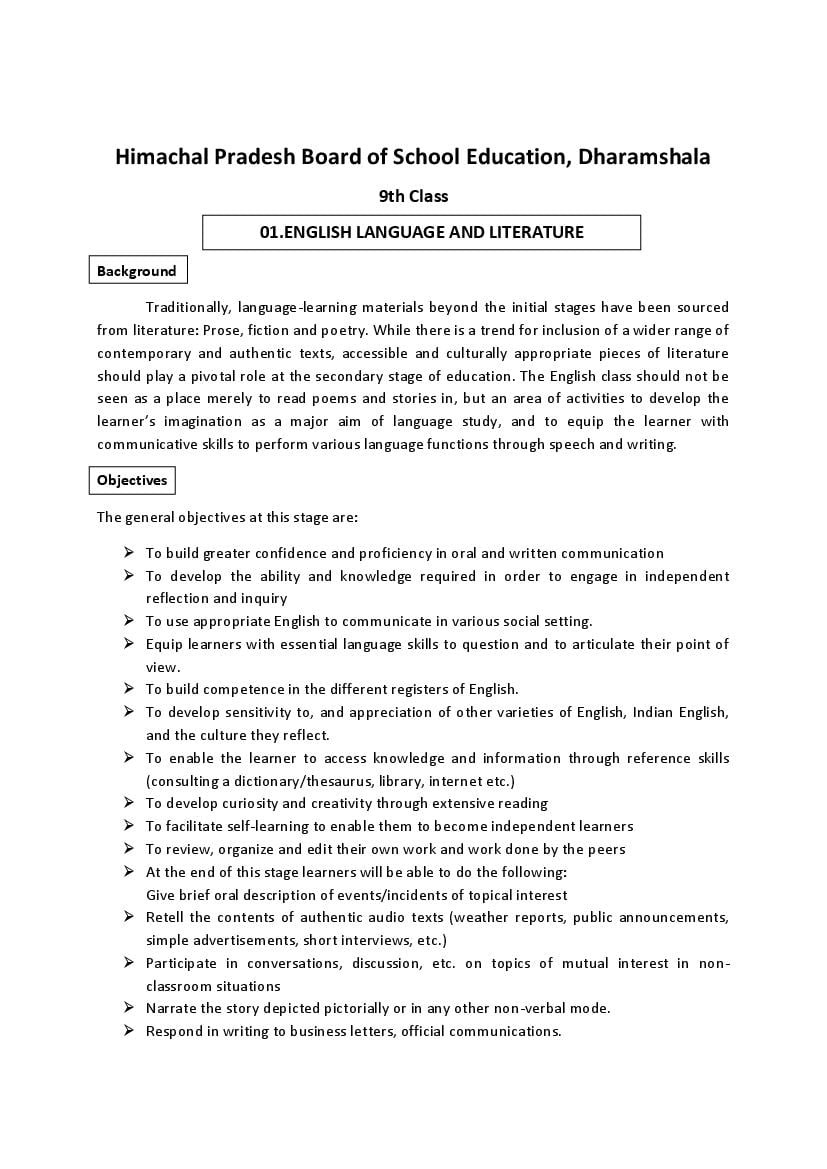
9th Class
01.ENGLISH LANGUAGE AND LITERATURE
Background
Traditionally, language-learning materials beyond the initial stages have been sourced
from literature: Prose, fiction and poetry. While there is a trend for inclusion of a wider range of
contemporary and authentic texts, accessible and culturally appropriate pieces of literature
should play a pivotal role at the secondary stage of education. The English class should not be
seen as a place merely to read poems and stories in, but an area of activities to develop the
learner’s imagination as a major aim of language study, and to equip the learner with
communicative skills to perform various language functions through speech and writing.
Objectives
The general objectives at this stage are:
To build greater confidence and proficiency in oral and written communication
To develop the ability and knowledge required in order to engage in independent
reflection and inquiry
To use appropriate English to communicate in various social setting.
Equip learners with essential language skills to question and to articulate their point of
view.
To build competence in the different registers of English.
To develop sensitivity to, and appreciation of other varieties of English, Indian English,
and the culture they reflect.
To enable the learner to access knowledge and information through reference skills
(consulting a dictionary/thesaurus, library, internet etc.)
To develop curiosity and creativity through extensive reading
To facilitate self-learning to enable them to become independent learners
To review, organize and edit their own work and work done by the peers
At the end of this stage learners will be able to do the following:
Give brief oral description of events/incidents of topical interest
Retell the contents of authentic audio texts (weather reports, public announcements,
simple advertisements, short interviews, etc.)
Participate in conversations, discussion, etc. on topics of mutual interest in non-
classroom situations
Narrate the story depicted pictorially or in any other non-verbal mode.
Respond in writing to business letters, official communications.
Page 2
interviews, discussions, debates etc.
Write without prior preparation on a given topic and be able to defend or explain the
position taken view expressed.
Write an assessment of different points of view expressed in a discussion/debate.
Read poems effectively (With proper rhythm and information)
To transcode information from a graph/chart to a description/report
Language Items
In addition to consolidating the grammatical items practiced earlier, the courses at
secondary level will seek to reinforce the following explicitly:
Sequence of tenses.
Reported speech in extended texts
Modal auxiliaries (those not covered at upper primary)
Non-finites (infinitives, gerunds, participles)
Conditional clauses
Complex and compound sentences
Phrasal verbs and prepositional phrases
Cohesive devices.
Punctuation (semicolon, colon, dash, hyphen, parenthesis or use of brackets and
exclamation mark)
Methods and Techniques
The methodology will be based on a multi-skill, activity based, learner centered
approach. Care would be taken to fulfill the functional (communicative), literary (aesthetic) and
cultural (sociological) needs of the learner. In this situation the teacher is the facilitator of
learning, she/he presents language items, contrives situations which motivates the child to use
English for the purposes of communication and expression. Aural-oral teaching and testing is an
integral feature of the teaching-learning process. The electronic and print media could be used
extensively. The evaluation procedure should be continuous and comprehensive. A few
suggested activities are:
Role playing
Simulating real-to-life situations
Dramatizing and miming.
Problem solving and decision making.
Interpreting information given in tabular form and schedule.
Using newspaper clippings
Page 3
disciplines
Using language games, riddles, puzzles and jokes.
Interpreting pictures/sketches/cartoons.
Debating and discussing.
Narrating and discussing stories, anecdotes, etc.
Reciting poems
Working in pairs and groups.
Using media inputs-computer, television, video cassettes, tapes, software packages.
Structure of Question Paper/Section Wise Distribution of Marks
One Paper 3 Hours Marks : 80
Section-A : Reading 16 Marks
1 Unseen Passage: Variety of questions including vocabulary. Factual and Literacy
Six MCQ 10 Marks
2 Unseen Passage: Questions including vocabulary, factual and literacy question.
Four MCQ 06 Marks
Section-B : Writing 16 Marks
3. Letter writing-one letter based on provided verbal stimulus and context.
Types of letter:
Informal: Personal such as to family and friends (7 Marks)
Formal: Letter of complaint, enquiry, request, application, etc.
4. Writing a paragraph on a given outline/topic. (5 Marks)
5. A short writing task based on a verbal visual stimulus
(Diagram, picture, graph, map, chart, table, flowchart etc.) (4 Marks)
Section-C: Grammar 15 Marks
(Including Four marks MCQ based questions)
Question No. 6-10
A variety of short questions involving the use of particular structures within a context.
Text type include cloze, gap-filling, sentence Completion, sentence- reordering, dialogue
Completion and sentence-transformation Combining sentences.
The grammar syllabus will include the following areas
1. Tense
2. Modals : can, could, may, must. might, shall, should, need ought to, will, would
3. Active ; Passive Voice
4. Direct- Indirect Narration.
5. Sentence Connectors ; Since, while, because, and, yet until
6. Determination
7. Prepositions.
Page 4
Q. 11 One extract from different prose lessons included in the text book
(Approximately 100 words)
This extract will be literary or discursive in nature. The extract will have five Questions
(3 questions one mark and 2 question MCQ one mark each) used for testing local and global
comprehension beside a question on interpretation and vocabulary.
( 5 Marks)
Q. 12 One extract from a poem (Reader) followed by three questions to test the local and
global comprehension of the text. ( 3 Marks)
Q.13 One out of two questions extrapolative in nature based on any one of the prose lessons
(Reader) to be answered in about 80 to 100 words. ( 5 Marks)
Q.14 Two out of three short answer type questions in interpretation of them and ideas
contained in the poems (Reader) to be answered is 30-40 words each. (4 Marks)
Q.15 One out of two questions (Reader) to interpret, evaluates and analyze character, plot or
situation occurring in the text. ( 8 Marks)
Q.16 One out of two questions to interpret, evaluate and analyze character, plot or situation
occurring in the text. ( 4 Marks)
Q.17 One out of two questions to interpret plot or situation from the text. ( 4 Marks)
PRESCRIBED BOOKS
1. First Flight Published by H.P Board of School Education
2. Footprints without Feet Published by H.P Board of School Education
Document Details
| Board / Org | Himachal Pradesh Board |
| Exam | Class 9 |
| Type | Syllabus |
| Pages | 4 |
| Updated | 22 Jul 2026 |