MBOSE Class 12 Question Paper 2023 for Anthropology
Finished viewing? Save it for later —
Download MBOSE Class 12 Question Paper 2023 for Anthropology (PDF · 8 pages)About MBOSE Class 12 Question Paper 2023 for Anthropology
MBOSE Class 12 Question Paper 2023 for Anthropology is available here for free download. Published by Meghalaya Board for Class 12, this question paper can be viewed online or downloaded as a PDF (8 pages). Candidates preparing for Class 12 can use MBOSE Class 12 Question Paper 2023 for Anthropology to understand the exam pattern, the type of questions asked, and the overall difficulty level.
Frequently Asked Questions
How can I download MBOSE Class 12 Question Paper 2023 for Anthropology?
Open this page and click the Download button to save MBOSE Class 12 Question Paper 2023 for Anthropology as a PDF. It is completely free on AglaSem Docs.
Is MBOSE Class 12 Question Paper 2023 for Anthropology free to download?
Yes. MBOSE Class 12 Question Paper 2023 for Anthropology can be viewed online and downloaded as a PDF free of cost on AglaSem Docs.
How many pages does MBOSE Class 12 Question Paper 2023 for Anthropology have?
MBOSE Class 12 Question Paper 2023 for Anthropology contains 8 pages, which you can read online or download together as a single PDF.
Where can I find more Class 12 study material?
You can find more Class 12 question papers, sample papers, syllabus, and answer keys on AglaSem Docs.
MBOSE Class 12 Question Paper 2023 for Anthropology – Text
Read the full text of this question paper below — useful to quickly search, copy and reference the content online without downloading the PDF.
📄 View text version (8 pages)
Page 1
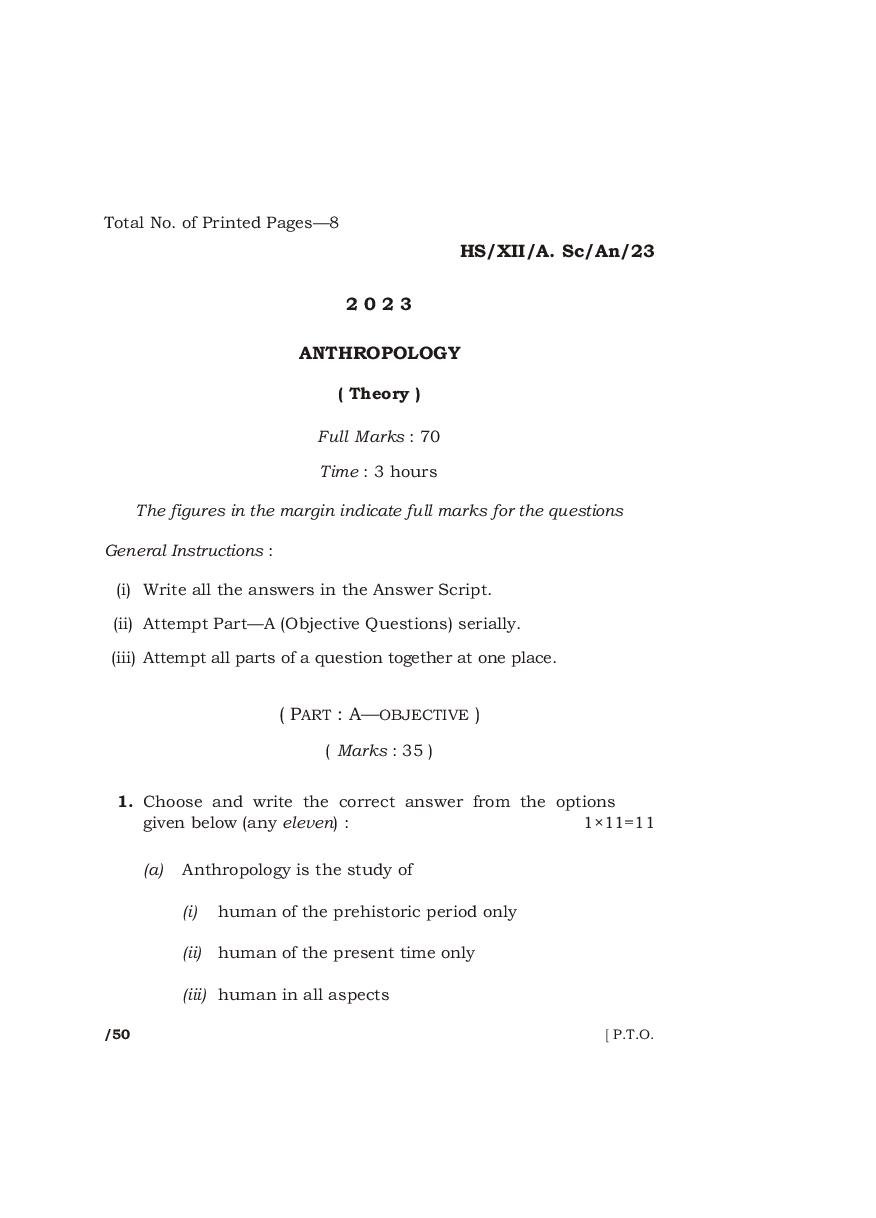
HS/XII/A. Sc/An/23
2023
ANTHROPOLOGY
( Theory )
Full Marks : 70
Time : 3 hours
The figures in the margin indicate full marks for the questions
General Instructions :
(i) Write all the answers in the Answer Script.
(ii) Attempt Part—A (Objective Questions) serially.
(iii) Attempt all parts of a question together at one place.
( PART : A—OBJECTIVE )
( Marks : 35 )
1. Choose and write the correct answer from the options
given below (any eleven) : 1×11=11
(a) Anthropology is the study of
(i) human of the prehistoric period only
(ii) human of the present time only
(iii) human in all aspects
/50 [ P.T.O.
Page 2
(b) Man can regulate his internal body temperature
around
(i) 36 °C
(ii) 37 °C
(iii) 38 °C
(c) The process which gives definite shape to different
parts of the body is called
(i) morphogenesis
(ii) growth spurt
(iii) orthogenesis
(d) The first Backward Class Commission was appointed
on
(i) 26th November, 1949
(ii) 29th January, 1953
(iii) 31st March, 1955
(e) Bone tool belongs to
(i) Mesolithic culture
(ii) Middle Palaeolithic culture
(iii) Upper Palaeolithic culture
HS/XII/A. Sc/An/23/50 [ Contd.
Page 3
(f) Hierarchy is one of the characteristics of the Indian
(i) tribe
(ii) caste
(iii) OBC
(g) The Pleistocene is an epoch of
(i) man
(ii) fish
(iii) mammals
(h) The word ‘taboo’ means
(i) acceptance
(ii) rejection
(iii) prohibition
(i) The process of determining the guilt or innocence by
submitting the accused to a dangerous or harmful
test under supernatural control is
(i) oath
(ii) ordeal
(iii) trial
HS/XII/A. Sc/An/23/50 [ P.T.O.
Page 4
(j) The human ovum at conception is about
(i) 0·1 mm
(ii) 0·5 mm
(iii) 0·8 mm
(k) The first discovery of primitive art was from a large
cave named
(i) Altamira
(ii) Bhimbetka
(iii) Lascaux
(l) The Negrito racial element was classified by
(i) H. H. Risley
(ii) B. S. Guha
(iii) S. S. Sarkar
(m) ——— is a sudden change in a particular gene
producing a new form of the old character.
(i) Hybridization
(ii) Natural selection
(iii) Mutation
HS/XII/A. Sc/An/23/50 [ Contd.
Page 5
(n) Narrow nose is advantageous to the people living in
(i) hot climate
(ii) cold climate
(iii) moist climate
(o) Cleavers are found in
(i) Palaeolithic stage
(ii) Mesolithic stage
(iii) Neolithic stage
2. Write True or False against each statement (any ten) :
1×10=10
(a) The first fossil remains of Homo erectus was
discovered in the year 1891.
(b) Growth and development are the same.
(c) When the face does not show any protrusion, it is
called prognathism.
(d) Hormones are organic substances produced by the
body that affect physiological activity.
(e) Large and plumb individuals are best adapted to hot
climatic conditions.
(f) Microliths are the characteristic tools of the
Mesolithic period.
HS/XII/A. Sc/An/23/50 [ P.T.O.
Page 6
(g) Customary laws are also known as unwritten laws
of society.
(h) Race is a biological concept.
(i) Mousterian culture was found to be associated with
the Neanderthal race.
(j) The Indo-Aryan was classified by B. S. Guha.
(k) Man has developed a high-level precision in striking
objects with the help of eye-hand coordination.
(l) Loess is topographic platforms, benches or steps in
the river valley.
(m) Levalloisian is the first flake tool culture.
(n) Australopithecine occupies the third stage of
hominid evolution.
(o) M. C. Burkitt classified the Palaeolithic art tradition
in Europe.
3. Answer briefly on any seven of the following questions :
2×7=14
(a) Mention the first-two stages of hominid evolution.
(b) Define tribe.
(c) What are handaxes?
HS/XII/A. Sc/An/23/50 [ Contd.
Page 7
(d) List in order the glacial period of Europe.
(e) How does black skin help in adaptation?
(f) What is hybridization?
(g) What is ‘cave art’?
(h) Name any two factors affecting human growth.
(i) Mention any two characteristic features used for
racial criteria.
(j) Who are the Scheduled Castes?
(k) What is an oath?
(l) Name any two Palaeolithic tools.
(m) Define adaptation.
(n) What is gender?
(o) Name the four environmental situations of human
adaptation.
HS/XII/A. Sc/An/23/50 [ P.T.O.
Page 8
( PART : B—DESCRIPTIVE )
( Marks : 35 )
Answer Question No. 4 and any two from the rest
4. Write short notes on any three of the following : 5×3=15
(a) High mountain adaptation
(b) Grinding and polishing technique
(c) Sanctions
(d) Major tribal problems
(e) Moraine
(f) Sanskritization
5. Define race. Give the characteristic features of any two
major races of the world. 2+8=10
6. What is prehistory? Describe any two methods of
toolmaking in Palaeolithic period. 2+(4+4)=10
7. Define growth. Enumerate the post-natal stages of human
growth. 2+8=10
8. Highlight the status of women in North-East India with
reference to matrilineal society. 10
9. Write an essay on justice and punishment in tribal
societies. 10
10. Define caste. Describe the important characteristics of
caste system in India. 2+8=10
11. Define evolution. Describe any two biocultural
mechanisms behind human evolution. 2+8=10
12. Describe the main features of Neolithic cultures. 10
HHH
HS/XII/A. Sc/An/23/50 K23—260
Document Details
| Board / Org | Meghalaya Board |
| Exam | Class 12 |
| Type | Question Paper |
| Pages | 8 |
| Updated | 22 Jul 2026 |