Karnataka 1st PUC Model Question Paper 2027 for Physics (Paper 1)
Finished viewing? Save it for later —
Download Karnataka 1st PUC Model Question Paper 2027 for Physics (Paper 1) (PDF · 4 pages)About Karnataka 1st PUC Model Question Paper 2027 for Physics (Paper 1)
Karnataka 1st PUC Model Question Paper 2027 for Physics (Paper 1) is available here for free download. Published by Karnataka Board for Class 11, this sample paper can be viewed online or downloaded as a PDF (4 pages). Candidates preparing for Class 11 can use Karnataka 1st PUC Model Question Paper 2027 for Physics (Paper 1) to understand the exam pattern, the type of questions asked, and the overall difficulty level.
Frequently Asked Questions
How can I download Karnataka 1st PUC Model Question Paper 2027 for Physics (Paper 1)?
Open this page and click the Download button to save Karnataka 1st PUC Model Question Paper 2027 for Physics (Paper 1) as a PDF. It is completely free on AglaSem Docs.
Is Karnataka 1st PUC Model Question Paper 2027 for Physics (Paper 1) free to download?
Yes. Karnataka 1st PUC Model Question Paper 2027 for Physics (Paper 1) can be viewed online and downloaded as a PDF free of cost on AglaSem Docs.
How many pages does Karnataka 1st PUC Model Question Paper 2027 for Physics (Paper 1) have?
Karnataka 1st PUC Model Question Paper 2027 for Physics (Paper 1) contains 4 pages, which you can read online or download together as a single PDF.
Where can I find more Class 11 study material?
You can find more Class 11 question papers, sample papers, syllabus, and answer keys on AglaSem Docs.
Karnataka 1st PUC Model Question Paper 2027 for Physics (Paper 1) – Text
Read the full text of this sample paper below — useful to quickly search, copy and reference the content online without downloading the PDF.
📄 View text version (5 pages)
Page 1
Karnataka 1st PUC
Model Question Paper
2027 for Physics
(Paper 1)
EXAM YEAR TYPE SUBJECT
Karnataka Class 11 2027 Sample Paper Physics
Notes · Sample Papers · Previous Year Papers · Mock Tests
Page 2
m .co
c. o
e m
em l a s
s a g
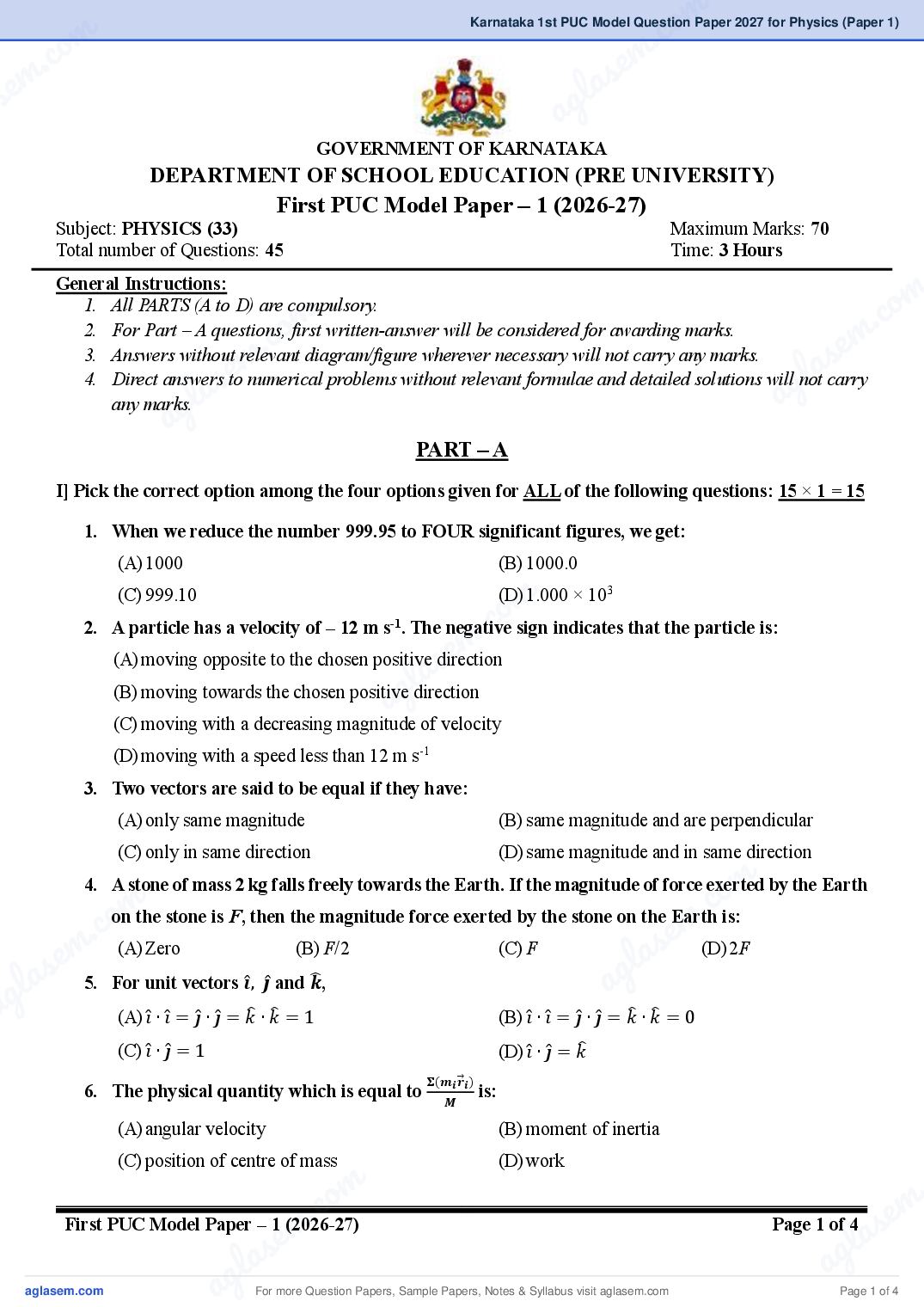
GOVERNMENT OF KARNATAKA
DEPARTMENT OF SCHOOL EDUCATION (PRE UNIVERSITY)
First PUC Model Paper – 1 (2026-27)
Subject: PHYSICS (33) Maximum Marks: 70
Total number of Questions: 45 Time: 3 Hours
m
c. o
General Instructions:
m
co
1. All PARTS (A to D) are compulsory.
. e m
s
2. For Part – A questions, first written-answer will be considered for awarding marks.
em la
s
3. Answers without relevant diagram/figure wherever necessary will not carry any marks.
l a
4. Direct answers to numerical problems without relevant formulae and detailed solutions will not carry
a g
ag
any marks.
PART – A
I] Pick the correct option among the four options given for ALL of the following questions: 15 × 1 = 15
1. When we reduce the number 999.95 to FOUR significant figures, we get:
(A) 1000 (B) 1000.0
m
co
(C) 999.10 (D) 1.000 × 10³
.
em
2. A particle has a velocity of – 12 m s-1. The negative sign indicates that the particle is:
la s
(A) moving opposite to the chosen positive direction
(B) moving towards the chosen positivegdirection
a
(C) moving with a decreasing magnitude of velocity
(D) moving with a speed less than 12 m s-1
3. Two vectors are said to be equal if they have:
(A) only same magnitude (B) same magnitude and are perpendicular
(C) only in same direction (D) same magnitude and in same direction
o m
m c
. is:
4. A stone of mass 2 kg falls freely towards the Earth. If the magnitude of force exerted by the Earth
c. oon(A)theZerostone is F, then the magnitude force exerted by the stone on the Earth
s
m
e (D) 2F
em l a
s g
(B) F/2 (C) F
l a a
ag
5. For unit vectors 𝒊̂ , 𝒋̂ and ̂,
𝒌
(A) 𝑖̂ ∙ 𝑖̂ = 𝑗̂ ∙ 𝑗̂ = 𝑘̂ ∙ 𝑘̂ = 1 (B) 𝑖̂ ∙ 𝑖̂ = 𝑗̂ ∙ 𝑗̂ = 𝑘̂ ∙ 𝑘̂ = 0
(C) 𝑖̂ ∙ 𝑗̂ = 1 (D) 𝑖̂ ∙ 𝑗̂ = 𝑘̂
⃗ 𝒊)
𝚺(𝒎𝒊 𝒓
6. The physical quantity which is equal to is:
𝑴
(A) angular velocity (B) moment of inertia
m .
(C) position of centre of mass (D) work
.c o e m
e m l as
s
First PUC Model Paper – 1 (2026-27) Page 1 of 4
l a a g
a g For more Question Papers, Sample Papers, Notes & Syllabus visit Page 1 of 4
Page 3
escape speeds is:
(A) 2 : 1 (B) 1 : 2 (C) 4 : 1 (D) 1 : 1
8. Which one of the following sentences is WRONG?
(A) The stretching of a coil is determined by its shear modulus.
(B) The Young’s modulus of rubber is greater than that of steel.
(C) When a spring is stretched by applying a load to one of its free ends, both longitudinal and shear
strains are produced in the spring.
(D) Poisson’s ratio is the ratio of lateral strain to the longitudinal strain.
9. If θ is the angle of contact between a liquid drop and a solid surface, then:
(A) the liquid wets the surface if θ > 90°.
(B) the liquid wets the surface if θ = 90°.
(C) the liquid wets the surface if θ < 90°.
(D) the liquid doesn’t wet the surface if θ < 90°.
10. A student cools a sample of water from 10 °C to 0 °C. Which of the following is correct?
(A) The density of water increases throughout the cooling process.
(B) The density of water decreases throughout the cooling process.
(C) The density of water first increases and then decreases.
(D) The density of water remains constant throughout the cooling process.
11. Match the following:
Process Work done per mole
(A) (a) – (i), (b) – (ii), (c) – (iii)
(a) an isothermal process (i) 𝑹(𝑻𝟐 − 𝑻𝟏 )
(B) (a) – (ii), (b) – (iii), (c) – (i)
𝑽
(C) (a) – (iii), (b) – (ii), (c) – (i) (b) an adiabatic process (ii) 𝑹𝑻 𝒍𝒐𝒈𝒆 (𝑽𝟐 )
𝟏
(D) (a) – (i), (b) – (iii), (c) – (ii) (c) an isobaric process
𝑹
(iii) 𝜸−𝟏 (𝑻𝟐 − 𝑻𝟏 )
12. A gas behaves as an ideal gas:
(A) at high temperature and low pressure. (B) at low temperature and high pressure.
(C) at normal temperature and pressure. (D) at low temperature and low pressure.
13. A particle executes SHM. At the extreme position, its:
(A) speed is maximum. (B) acceleration is zero.
(C) kinetic energy is zero. (D) momentum is maximum.
14. The following statements are related to periodic motion:
Statement I: Every oscillatory motion is periodic.
Statement II: Every periodic motion is oscillatory.
Between the two statements:
(A) Statement I is true, but statement II is false (B) Both statements I and II are true
(C) Statement II is true, but statement I is false (D) Both statements I and II are false
15. Phase difference between two particles in a wave separated by a distance of λ/2 is:
(A) π (B) π/2 (C) 2π (D) π/4
First PUC Model Paper – 1 (2026-27) Page 2 of 4
For more Question Papers, Sample Papers, Notes & Syllabus visit Page 2 of 4
Page 4
m .co
c. II]o Fill in the blanks by choosing appropriate answer given in the bracket
e for ALL of the followingm
m la s
se questions. a g
5×1=5
(maximum, temperature, hydraulic lift, moment of inertia, heat, zero)
16. The rotational analogue of mass in linear motion is _________.
17. A _________ works on the principle of Pascal’s law.
18. Calorimeter is a device that is used for the measurement of _________.
19. Zeroth law of thermodynamics defines the concept of _________.
m
c. o
20. Nodes are points where amplitude of standing waves is ________.
m
.co e m
PART – B
e m s 10
5 X 2a=
l
a s
III] Answer ANY FIVE of the following questions:
l limitations of dimensional analysis. ag
21. Give any g
a two
⃗ in terms of their
22. Write the expression for the magnitude of the resultant of two vectors 𝐴 and 𝐵
magnitudes. Explain each term.
23. Mention any two methods of reducing friction.
24. Two workers lift identical sacks of cement to the roof of a building. Both do the same amount of work,
m
co
but the first worker takes half the time taken by the other. Which worker delivers greater power? Justify
.
em
your answer.
25. Define stress. What is its SI unit?
l a s
a g
26. When a steel ball is dropped through a vertical tube containing castor oil, its velocity becomes constant
after some time. Why?
27. The time period of a simple pendulum is 2 seconds. Calculate the length of the pendulum.
Take g = 9.8 m s-2.
28. Why did Laplace consider the propagation of sound in air to be an adiabatic process instead of an
m
co
isothermal process?
o m PART – C
m .
c
. ANY FIVE of the following questions: se
em
IV] Answer
l a
5 × 3 = 15
l as a g
ag
29. Obtain an expression for centripetal acceleration.
30. A 1000 kg car is moving on a banked circular road of radius 50 m. The angle of banking is 30° and the
coefficient of static friction between the tyres and the road is 0.5. Determine whether the car can
negotiate the curve safely at a speed of 25 m s-1. Take g = 10 m s-2.
31. Define (i) elastic collision (ii) inelastic collision and (iii) completely inelastic collision.
m
32. Explain the principle of moments for a lever.
c o m .
m . s e
se
First PUC Model Paper – 1 (2026-27)
l
Page 3 of 4
g a
g l a a
a For more Question Papers, Sample Papers, Notes & Syllabus visit Page 3 of 4
Page 5
1
34. For an ideal gas at constant pressure, derive 𝛼𝑉 = where the symbols have their usual meaning.
𝑇
35. Mention the factors on which the mean free path of a gas molecule depends.
36. Show that the acceleration of a particle executing SHM is 𝑎 = −𝜔2 𝑥 by assuming the equation of
displacement of SHM.
PART – D
V] Answer ANY THREE of the following questions 3 × 5 = 15
37. What is a v-t graph? Draw a v-t graph for a body moving with uniform acceleration ‘a’ and initial
1
velocity ‘vo’ and hence derive the expression 𝑥 = 𝑣𝑜 𝑡 + 2 𝑎𝑡 2 .
38. State Newton’s second law of motion. Derive 𝐹 = 𝑚𝑎, where symbols have their usual meaning.
39. Define torque. Show that torque is equal to the rate of change of angular momentum of a particle.
40. Derive an expression for acceleration due to gravity at a point below the surface of the earth.
41. Explain the different stages of Carnot’s cycle with P-V diagram.
VI] Answer ANY TWO of the following questions. 2 × 5 = 10
42. A football player kicks a ball at an angle of 30° to the horizontal with an initial speed of 20 m s-1.
Calculate (a) maximum height and (b) horizontal range reached by the ball. For which other angle of
projection at 20 m s-1 does the ball have the same horizontal range? Take g = 9.8 m s-2.
43. A rain drop of mass 1 g falling from a height 1 km hits the ground at a speed of 50 m s-1. Calculate the
(a) work done by the gravitational force and (b) work done by the unknown resistive force.
Given: g = 9.8 m s-2.
44. 0.2 kg of copper heated to 100 °C is dropped into 0.1 kg of water at 30 °C contained in copper
calorimeter of mass 0.2 kg. If the specific heat of copper is 385 J kg-1 K-1 and that of water is
4200 J kg-1 K-1, find the maximum temperature attained by the water.
45. A wave travelling along a string is described by y (x, t) = 0.005 sin (80x – 3t) m in which the numerical
constants are in SI units. Calculate (a) amplitude (b) the wavelength (c) the period and frequency of
wave (d) displacement y of the wave at a distance x = 30 cm and t = 2 s.
**************
First PUC Model Paper – 1 (2026-27) Page 4 of 4
For more Question Papers, Sample Papers, Notes & Syllabus visit Page 4 of 4
Document Details
| Board / Org | Karnataka Board |
| Exam | Class 11 |
| Type | Sample Paper |
| Pages | 4 |
| Updated | 13 Nov 2026 |