RUHS CUET 2027 Sample Paper PCB
Finished viewing? Save it for later —
Download RUHS CUET 2027 Sample Paper PCB (PDF · 19 pages)About RUHS CUET 2027 Sample Paper PCB
RUHS CUET 2027 Sample Paper PCB is available here for free download. Published by RUHS for RUHS CUET, this sample paper can be viewed online or downloaded as a PDF (19 pages). Candidates preparing for RUHS CUET can use RUHS CUET 2027 Sample Paper PCB to understand the exam pattern, the type of questions asked, and the overall difficulty level.
Frequently Asked Questions
How can I download RUHS CUET 2027 Sample Paper PCB?
Open this page and click the Download button to save RUHS CUET 2027 Sample Paper PCB as a PDF. It is completely free on AglaSem Docs.
Is RUHS CUET 2027 Sample Paper PCB free to download?
Yes. RUHS CUET 2027 Sample Paper PCB can be viewed online and downloaded as a PDF free of cost on AglaSem Docs.
How many pages does RUHS CUET 2027 Sample Paper PCB have?
RUHS CUET 2027 Sample Paper PCB contains 19 pages, which you can read online or download together as a single PDF.
Where can I find more RUHS CUET study material?
You can find more RUHS CUET question papers, sample papers, syllabus, and answer keys on AglaSem Docs.
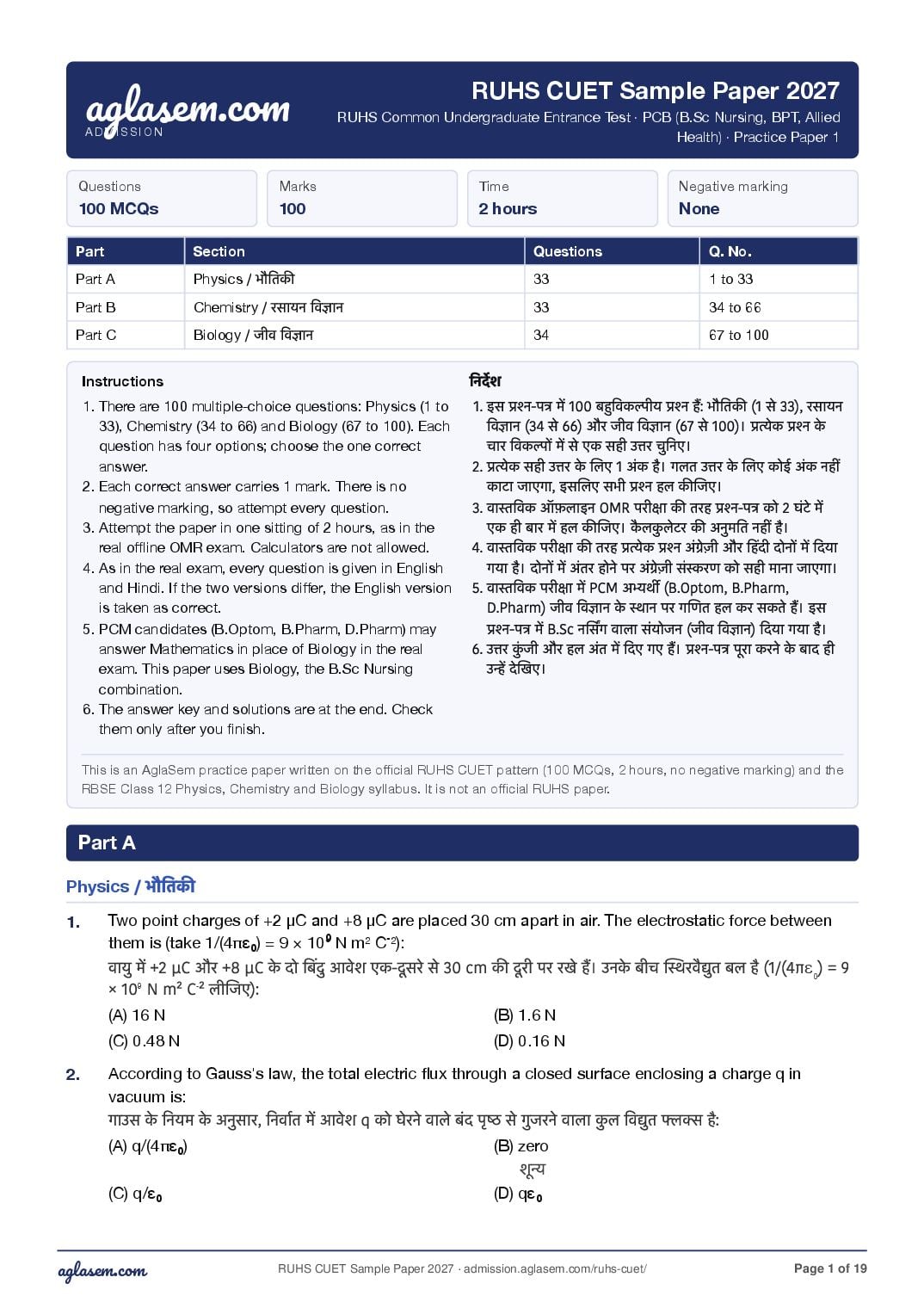
RUHS CUET 2027 Sample Paper PCB – Text
Read the full text of this sample paper below — useful to quickly search, copy and reference the content online without downloading the PDF.
📄 View text version (19 pages)
Page 1
RUHS Common Undergraduate Entrance Test · PCB (B.Sc Nursing, BPT, Allied
ADMISSION
Health) · Practice Paper 1
Questions Marks Time Negative marking
100 MCQs 100 2 hours None
Part Section Questions Q. No.
Part A Physics / भौतिकी 33 1 to 33
Part B Chemistry / रसायन विज्ञान 33 34 to 66
Part C Biology / जीव विज्ञान 34 67 to 100
Instructions निर्देश
1. There are 100 multiple-choice questions: Physics (1 to 1. इस प्रश्न-पत्र में 100 बहुविकल्पीय प्रश्न हैं: भौतिकी (1 से 33), रसायन
33), Chemistry (34 to 66) and Biology (67 to 100). Each विज्ञान (34 से 66) और जीव विज्ञान (67 से 100)। प्रत्येक प्रश्न के
question has four options; choose the one correct चार विकल्पों में से एक सही उत्तर चुनिए।
answer. 2. प्रत्येक सही उत्तर के लिए 1 अंक है। गलत उत्तर के लिए कोई अंक नहीं
2. Each correct answer carries 1 mark. There is no काटा जाएगा, इसलिए सभी प्रश्न हल कीजिए।
negative marking, so attempt every question. 3. वास्तविक ऑफ़लाइन OMR परीक्षा की तरह प्रश्न-पत्र को 2 घंटे में
3. Attempt the paper in one sitting of 2 hours, as in the एक ही बार में हल कीजिए। कै लकु लेटर की अनुमति नहीं है।
real offline OMR exam. Calculators are not allowed. 4. वास्तविक परीक्षा की तरह प्रत्येक प्रश्न अंग्रेज़ी और हिं दी दोनों में दिया
4. As in the real exam, every question is given in English गया है। दोनों में अंतर होने पर अंग्रेज़ी संस्करण को सही माना जाएगा।
and Hindi. If the two versions differ, the English version 5. वास्तविक परीक्षा में PCM अभ्यर्थी (B.Optom, B.Pharm,
is taken as correct. D.Pharm) जीव विज्ञान के स्थान पर गणित हल कर सकते हैं। इस
5. PCM candidates (B.Optom, B.Pharm, D.Pharm) may प्रश्न-पत्र में B.Sc नर्सिं ग वाला संयोजन (जीव विज्ञान) दिया गया है।
answer Mathematics in place of Biology in the real 6. उत्तर कुं जी और हल अंत में दिए गए हैं। प्रश्न-पत्र पूरा करने के बाद ही
exam. This paper uses Biology, the B.Sc Nursing उन्हें देखिए।
combination.
6. The answer key and solutions are at the end. Check
them only after you finish.
This is an AglaSem practice paper written on the official RUHS CUET pattern (100 MCQs, 2 hours, no negative marking) and the
RBSE Class 12 Physics, Chemistry and Biology syllabus. It is not an official RUHS paper.
Part A
Physics / भौतिकी
1. Two point charges of +2 µC and +8 µC are placed 30 cm apart in air. The electrostatic force between
them is (take 1/(4πε₀) = 9 × 10⁹ N m² C⁻²):
वायु में +2 µC और +8 µC के दो बिं दु आवेश एक-दू सरे से 30 cm की दू री पर रखे हैं। उनके बीच स्थिरवैद्युत बल है (1/(4πε₀) = 9
× 10⁹ N m² C⁻² लीजिए):
(A) 16 N (B) 1.6 N
(C) 0.48 N (D) 0.16 N
2. According to Gauss's law, the total electric flux through a closed surface enclosing a charge q in
vacuum is:
गाउस के नियम के अनुसार, निर्वात में आवेश q को घेरने वाले बंद पृष्ठ से गुजरने वाला कु ल विद्युत फ्लक्स है:
(A) q/(4πε₀) (B) zero
शून्य
(C) q/ε₀ (D) qε₀
RUHS CUET Sample Paper 2027 · admission./ruhs-cuet/ Page 1 of 19
Page 2
एकसमान आवेशित पतले गोलीय कोश के अंदर किसी बिं दु पर विद्युत क्षेत्र होता है:
(A) proportional to the distance r
दू री r के अनुक्रमानुपाती
(B) same as on the surface
पृष्ठ पर विद्युत क्षेत्र के बराबर
(C) zero everywhere inside
अंदर हर जगह शून्य
(D) maximum at the centre
कें द्र पर अधिकतम
4. A capacitor of capacitance 4 µF is charged to 50 V. The energy stored in it is:
4 µF धारिता के एक संधारित्र को 50 V तक आवेशित किया गया है। उसमें संचित ऊर्जा है:
(A) 2 × 10⁻⁴ J (B) 2.5 × 10⁻³ J
(C) 1 × 10⁻² J (D) 5 × 10⁻³ J
5. A parallel-plate capacitor of capacitance C is completely filled with a dielectric of dielectric constant K =
5. Its new capacitance is:
धारिता C वाले एक समांतर पट्टिका संधारित्र को परावैद्युतांक K = 5 वाले परावैद्युत से पूरी तरह भर दिया जाता है। उसकी नई धारिता
होगी:
(A) C/5 (B) 25C
(C) C (D) 5C
6. A wire of resistance R is stretched uniformly to twice its original length. Its new resistance is:
प्रतिरोध R वाले एक तार को एकसमान रूप से खींचकर उसकी मूल लंबाई का दोगुना कर दिया जाता है। उसका नया प्रतिरोध होगा:
(A) R/4 (B) 2R
(C) 4R (D) 16R
7. Kirchhoff's junction rule is based on the conservation of:
किरखोफ़ का संधि नियम किसके संरक्षण पर आधारित है?
(A) charge (B) mass
आवेश द्रव्यमान
(C) energy (D) momentum
ऊर्जा संवेग
8. A cell of emf 12 V and internal resistance 1 Ω is connected to an external resistance of 5 Ω. The terminal
potential difference of the cell is:
12 V विद्युत वाहक बल और 1 Ω आं तरिक प्रतिरोध वाले एक सेल को 5 Ω के बाह्य प्रतिरोध से जोड़ा गया है। सेल का टर्मि नल
विभवांतर है:
(A) 8 V (B) 2 V
(C) 10 V (D) 12 V
9. In a balanced Wheatstone bridge, P = 10 Ω, Q = 20 Ω and R = 15 Ω. The fourth resistance S is:
एक संतुलित व्हीटस्टोन सेतु में P = 10 Ω, Q = 20 Ω और R = 15 Ω है। चौथा प्रतिरोध S है:
(A) 7.5 Ω (B) 30 Ω
(C) 45 Ω (D) 15 Ω
10. A circular coil of 50 turns and radius 10 cm carries a current of 2 A. The magnetic field at its centre is (μ₀
= 4π × 10⁻⁷ T m A⁻¹):
50 फे रों और 10 cm त्रिज्या वाली एक वृत्ताकार कुं डली में 2 A धारा प्रवाहित हो रही है। उसके कें द्र पर चुंबकीय क्षेत्र है (μ₀ = 4π ×
10⁻⁷ T m A⁻¹):
(A) 6.28 × 10⁻⁴ T (B) 1.26 × 10⁻³ T
(C) 3.14 × 10⁻⁴ T (D) 6.28 × 10⁻⁵ T
RUHS CUET Sample Paper 2027 · admission./ruhs-cuet/ Page 2 of 19
Page 3
एक आवेशित कण एकसमान चुंबकीय क्षेत्र में क्षेत्र के लंबवत वेग से प्रवेश करता है। उसका पथ होगा:
(A) a straight line (B) a circle
सरल रेखा वृत्त
(C) a helix (D) a parabola
कुं डलिनी (हेलिक्स) परवलय
12. Two long parallel wires carry currents in the same direction. The force between them is:
दो लंबे समांतर तारों में एक ही दिशा में धारा प्रवाहित हो रही है। उनके बीच बल होता है:
(A) attractive (B) repulsive
आकर्षण बल प्रतिकर्षण बल
(C) parallel to the wires (D) zero
तारों के समांतर शून्य
13. Which of the following substances has a small negative magnetic susceptibility?
निम्नलिखित में से किस पदार्थ की चुंबकीय प्रवृत्ति (सुग्राहिता) कम और ऋणात्मक होती है?
(A) Aluminium (B) Nickel
ऐलुमिनियम निके ल
(C) Iron (D) Bismuth
लोहा बिस्मथ
14. Lenz's law is a consequence of the law of conservation of:
लेंज़ का नियम किसके संरक्षण के नियम का परिणाम है?
(A) energy (B) linear momentum
ऊर्जा रैखिक संवेग
(C) angular momentum (D) charge
कोणीय संवेग आवेश
15. The current in a coil of self-inductance 0.5 H falls from 5 A to 1 A in 0.2 s. The magnitude of the induced
emf is:
0.5 H स्वप्रेरकत्व वाली एक कुं डली में धारा 0.2 s में 5 A से घटकर 1 A हो जाती है। प्रेरित विद्युत वाहक बल का परिमाण है:
(A) 20 V (B) 2 V
(C) 10 V (D) 5 V
16. In a purely inductive AC circuit, the current:
एक शुद्ध प्रेरकीय AC परिपथ में धारा:
(A) leads the voltage by π/2
वोल्टता से π/2 आगे रहती है
(B) lags the voltage by π/2
वोल्टता से π/2 पीछे रहती है
(C) lags the voltage by π
वोल्टता से π पीछे रहती है
(D) is in phase with the voltage
वोल्टता के साथ समान कला में रहती है
17. In a series LCR circuit, L = 0.2 H and C = 5 µF. The angular frequency at resonance is:
एक श्रेणी LCR परिपथ में L = 0.2 H और C = 5 µF है। अनुनाद पर कोणीय आवृत्ति है:
(A) 1000 rad/s (B) 100 rad/s
(C) 10⁴ rad/s (D) 500 rad/s
RUHS CUET Sample Paper 2027 · admission./ruhs-cuet/ Page 3 of 19
Page 4
निम्नलिखित विद्युतचुंबकीय तरंगों में से किसकी तरंगदैर्ध्य सबसे कम होती है?
(A) γ-rays (B) Ultraviolet rays
गामा किरणें पराबैंगनी किरणें
(C) Microwaves (D) X-rays
सूक्ष्म तरंगें X-किरणें
19. Which electromagnetic radiation is used in water purifiers to kill germs?
जल शोधकों में कीटाणुओं को नष्ट करने के लिए किस विद्युतचुंबकीय विकिरण का उपयोग होता है?
(A) Radio waves (B) Infrared radiation
रेडियो तरंगें अवरक्त विकिरण
(C) Microwaves (D) Ultraviolet rays
सूक्ष्म तरंगें पराबैंगनी किरणें
20. An object is placed 30 cm in front of a convex lens of focal length 20 cm. The image is formed:
20 cm फोकस दू री वाले उत्तल लेंस के सामने 30 cm की दू री पर एक वस्तु रखी है। प्रतिबिं ब बनेगा:
(A) 30 cm on the other side (B) 12 cm on the same side
दू सरी ओर 30 cm पर उसी ओर 12 cm पर
(C) 60 cm on the other side (D) 40 cm on the same side
दू सरी ओर 60 cm पर उसी ओर 40 cm पर
21. The power of a concave lens of focal length 25 cm is:
25 cm फोकस दू री वाले अवतल लेंस की क्षमता है:
(A) +25 D (B) −0.25 D
(C) +4 D (D) −4 D
22. The critical angle for light going from a medium of refractive index √2 into air is:
√2 अपवर्तनांक वाले माध्यम से वायु में जाते प्रकाश के लिए क्रांतिक कोण है:
(A) 45° (B) 60°
(C) 90° (D) 30°
23. In Young's double-slit experiment, λ = 600 nm, slit separation d = 0.2 mm and screen distance D = 1 m.
The fringe width is:
यंग के द्वि-झिरी प्रयोग में λ = 600 nm, झिरियों के बीच दू री d = 0.2 mm और पर्दे की दू री D = 1 m है। फ्रिं ज चौड़ाई है:
(A) 3 mm (B) 6 mm
(C) 0.3 mm (D) 1.5 mm
24. Which phenomenon shows that light waves are transverse?
कौन-सी परिघटना दर्शाती है कि प्रकाश तरंगें अनुप्रस्थ होती हैं?
(A) Interference (B) Polarisation
व्यतिकरण ध्रुवण
(C) Diffraction (D) Reflection
विवर्तन परावर्तन
25. Photons of energy 3.5 eV fall on a metal of work function 2.0 eV. The stopping potential is:
3.5 eV ऊर्जा वाले फ़ोटॉन 2.0 eV कार्यफलन वाली धातु पर आपतित होते हैं। निरोधी विभव है:
(A) 3.5 V (B) 1.5 V
(C) 5.5 V (D) 2.0 V
26. The de Broglie wavelength of an electron accelerated through a potential difference of 100 V is about:
100 V विभवांतर से त्वरित एक इलेक्ट्रॉन की दे ब्रॉग्ली तरंगदैर्ध्य लगभग है:
(A) 12.3 nm (B) 1.23 nm
(C) 0.0123 nm (D) 0.123 nm
RUHS CUET Sample Paper 2027 · admission./ruhs-cuet/ Page 4 of 19
Page 5
प्रकाश-इलेक्ट्रॉनों की अधिकतम गतिज ऊर्जा किस पर निर्भर करती है?
(A) intensity of incident light (B) frequency of incident light
आपतित प्रकाश की तीव्रता आपतित प्रकाश की आवृत्ति
(C) time of exposure to light (D) area of the emitting surface
प्रकाश में रखने का समय उत्सर्जक पृष्ठ का क्षेत्रफल
28. The energy of the electron in the n = 2 orbit of a hydrogen atom is:
हाइड्रोजन परमाणु की n = 2 कक्षा में इलेक्ट्रॉन की ऊर्जा है:
(A) −6.8 eV (B) −1.51 eV
(C) −3.4 eV (D) −13.6 eV
29. The half-life of a radioactive sample is 10 days. The fraction of the sample left undecayed after 30 days
is:
एक रेडियोऐक्टिव नमूने की अर्धायु 10 दिन है। 30 दिन बाद नमूने का कितना भाग अविघटित बचेगा?
(A) 1/6 (B) 1/3
(C) 1/16 (D) 1/8
30. Nuclear forces are:
नाभिकीय बल होते हैं:
(A) long-range and charge-dependent
दीर्घ परास वाले और आवेश पर निर्भर
(B) long-range and purely repulsive
दीर्घ परास वाले और के वल प्रतिकर्षी
(C) short-range and purely electrostatic
लघु परास वाले और के वल स्थिरवैद्युत
(D) short-range and charge-independent
लघु परास वाले और आवेश पर निर्भर नहीं
31. To make n-type silicon, pure silicon is doped with:
n-प्रकार का सिलिकॉन बनाने के लिए शुद्ध सिलिकॉन में किसका अपमिश्रण किया जाता है?
(A) gallium (B) aluminium
गैलियम ऐलुमिनियम
(C) boron (D) arsenic
बोरॉन आर्सेनिक
32. A full-wave rectifier is fed with 50 Hz AC. The fundamental frequency of the ripple in the output is:
एक पूर्ण-तरंग दिष्टकारी को 50 Hz की AC दी जाती है। निर्गत में ऊर्मि का (रिपल) की मूल आवृत्ति है:
(A) 25 Hz (B) 200 Hz
(C) 50 Hz (D) 100 Hz
33. When a p-n junction diode is forward biased, the width of its depletion layer:
जब p-n संधि डायोड अग्र अभिनत होता है, तो उसकी अवक्षय परत की चौड़ाई:
(A) does not change
नहीं बदलती
(B) decreases
घटती है
(C) increases
बढ़ती है
(D) first increases, then decreases
पहले बढ़ती है, फिर घटती है
RUHS CUET Sample Paper 2027 · admission./ruhs-cuet/ Page 5 of 19
Page 6
Chemistry / रसायन विज्ञान
34. 4 g of NaOH is dissolved in 500 g of water. The molality of the solution is (molar mass of NaOH = 40 g
mol⁻¹):
4 g NaOH को 500 g जल में घोला गया है। विलयन की मोललता है (NaOH का मोलर द्रव्यमान = 40 g mol⁻¹):
(A) 0.2 mol kg⁻¹ (B) 0.1 mol kg⁻¹
(C) 0.4 mol kg⁻¹ (D) 2 mol kg⁻¹
35. Which of the following is a colligative property?
निम्नलिखित में से कौन-सा अणुसंख्य गुणधर्म है?
(A) Viscosity (B) Osmotic pressure
श्यानता परासरण दाब
(C) Surface tension (D) Optical rotation
पृष्ठ तनाव ध्रुवण घूर्णन
36. The van 't Hoff factor (i) for K₂SO₄, assuming complete dissociation in water, is:
जल में पूर्ण वियोजन मानते हुए K₂SO₄ के लिए वान्ट हॉफ़ गुणक (i) है:
(A) 4 (B) 3
(C) 2 (D) 1
37. Which pair of liquids forms a solution showing positive deviation from Raoult's law?
द्रवों का कौन-सा युग्म राउल्ट के नियम से धनात्मक विचलन दर्शाने वाला विलयन बनाता है?
(A) Nitric acid and water (B) Ethanol and acetone
नाइट्रिक अम्ल और जल एथेनॉल और ऐसीटोन
(C) Chloroform and acetone (D) Benzene and toluene
क्लोरोफ़ॉर्म और ऐसीटोन बेंज़ीन और टॉलूईन
38. For the Daniell cell, E°(Zn²⁺/Zn) = −0.76 V and E°(Cu²⁺/Cu) = +0.34 V. The standard emf of the cell is:
डेनियल सेल के लिए E°(Zn²⁺/Zn) = −0.76 V और E°(Cu²⁺/Cu) = +0.34 V है। सेल का मानक विद्युत वाहक बल है:
(A) 0.42 V (B) −1.10 V
(C) 1.10 V (D) 0.76 V
39. The quantity of electricity needed to deposit 1 mol of aluminium from Al³⁺ ions is:
Al³⁺ आयनों से 1 mol ऐलुमिनियम निक्षेपित करने के लिए आवश्यक विद्युत की मात्रा है:
(A) 6 F (B) 3 F
(C) 2 F (D) 1 F
40. On dilution, the molar conductivity of a strong electrolyte:
तनुकरण पर प्रबल विद्युत-अपघट्य की मोलर चालकता:
(A) increases slightly (B) falls to zero
थोड़ी बढ़ती है शून्य हो जाती है
(C) decreases sharply (D) remains exactly constant
तेज़ी से घटती है बिल्कु ल स्थिर रहती है
41. The standard Gibbs energy change of a cell reaction is related to its standard emf by:
सेल अभिक्रिया का मानक गिब्ज़ ऊर्जा परिवर्तन उसके मानक विद्युत वाहक बल से किस प्रकार संबंधित है?
(A) ΔG° = −nFE°cell (B) ΔG° = nFE°cell
(C) ΔG° = −FE°cell/n (D) ΔG° = −nE°cell/F
RUHS CUET Sample Paper 2027 · admission./ruhs-cuet/ Page 6 of 19
Page 7
एक प्रथम कोटि की अभिक्रिया का वेग स्थिरांक 0.0693 min⁻¹ है। उसकी अर्धायु है:
(A) 100 min (B) 10 min
(C) 6.93 min (D) 1 min
43. The unit of the rate constant of a zero-order reaction is:
शून्य कोटि की अभिक्रिया के वेग स्थिरांक की इकाई है:
(A) L² mol⁻² s⁻¹ (B) L mol⁻¹ s⁻¹
(C) mol L⁻¹ s⁻¹ (D) s⁻¹
44. For a reaction with rate = k[A]²[B], if the concentrations of both A and B are doubled, the rate becomes:
वेग = k[A]²[B] वाली अभिक्रिया में यदि A और B दोनों की सांद्रता दोगुनी कर दी जाए, तो वेग हो जाएगा:
(A) 2 times (B) 4 times
2 गुना 4 गुना
(C) 6 times (D) 8 times
6 गुना 8 गुना
45. A catalyst increases the rate of a reaction because it:
उत्प्रेरक अभिक्रिया का वेग बढ़ाता है, क्योंकि वह:
(A) raises the activation energy
सक्रियण ऊर्जा बढ़ा देता है
(B) lowers the activation energy
सक्रियण ऊर्जा घटा देता है
(C) shifts the equilibrium position
साम्य की स्थिति खिसका देता है
(D) changes ΔH of the reaction
अभिक्रिया का ΔH बदल देता है
46. Zirconium (Zr) and hafnium (Hf) have almost identical atomic radii because of:
ज़र्कोनियम (Zr) और हैफ़्नियम (Hf) की परमाणु त्रिज्याएँ लगभग समान होती हैं, इसका कारण है:
(A) lanthanoid contraction (B) a diagonal relationship
लैंथेनॉयड आकुं चन विकर्ण संबंध
(C) the inert pair effect (D) actinoid contraction
अक्रिय युग्म प्रभाव ऐक्टिनॉयड आकुं चन
47. The spin-only magnetic moment of Mn²⁺ (atomic number of Mn = 25) is about:
Mn²⁺ (Mn का परमाणु क्रमांक = 25) का के वल-प्रचक्रण चुंबकीय आघूर्ण लगभग है:
(A) 1.73 BM (B) 4.90 BM
(C) 5.92 BM (D) 3.87 BM
48. The oxidation state of manganese in KMnO₄ is:
KMnO₄ में मैंगनीज़ की ऑक्सीकरण अवस्था है:
(A) +6 (B) +5
(C) +4 (D) +7
49. The IUPAC name of [Co(NH₃)₆]Cl₃ is:
[Co(NH₃)₆]Cl₃ का IUPAC नाम है:
(A) triamminecobalt(III) chloride
(B) hexaamminecobalt(III) chloride
(C) hexaamminecobaltate(III) chloride
(D) hexaamminecobalt(II) chloride
RUHS CUET Sample Paper 2027 · admission./ruhs-cuet/ Page 7 of 19
Page 8
K₄[Fe(CN)₆] में आयरन की उपसहसंयोजन संख्या और ऑक्सीकरण अवस्था हैं:
(A) 6 and +2 (B) 6 and +3
6 और +2 6 और +3
(C) 6 and +4 (D) 4 and +2
6 और +4 4 और +2
51. EDTA⁴⁻ (ethylenediaminetetraacetate) is a:
EDTA⁴⁻ (एथिलीनडाइऐमीनटेट्राऐसीटेट) है एक:
(A) tridentate ligand (B) monodentate ligand
त्रिदंतुर लिगन्ड एकदंतुर लिगन्ड
(C) bidentate ligand (D) hexadentate ligand
द्विदंतुर लिगन्ड षड् दंतुर लिगन्ड
52. An SN2 reaction at a chiral carbon proceeds with:
किरैल कार्बन पर SN2 अभिक्रिया में होता है:
(A) formation of a carbocation (B) inversion of configuration
कार्बधनायन का बनना विन्यास का प्रतिलोमन
(C) retention of configuration (D) complete racemisation
विन्यास का धारण पूर्ण रेसिमीकरण
53. Which alkyl halide reacts fastest by the SN1 mechanism?
कौन-सा ऐल्किल हैलाइड SN1 क्रियाविधि द्वारा सबसे तेज़ अभिक्रिया करता है?
(A) CH₃CH₂Br (B) (CH₃)₂CHBr
(C) CH₃Br (D) (CH₃)₃CBr
54. Chlorobenzene is much less reactive than chloroethane towards nucleophilic substitution because:
नाभिकरागी प्रतिस्थापन के प्रति क्लोरोबेंज़ीन, क्लोरोएथेन की तुलना में बहुत कम क्रियाशील है, क्योंकि:
(A) the C–Cl bond has partial double-bond character
C–Cl आबंध में आं शिक द्विआबंध लक्षण होता है
(B) chlorobenzene exists as an ionic compound
क्लोरोबेंज़ीन एक आयनिक यौगिक के रूप में होता है
(C) the benzene ring contains no delocalised π electrons
बेंज़ीन वलय में कोई विस्थानीकृ त π इलेक्ट्रॉन नहीं होते
(D) chlorine atom is far less electronegative than carbon
क्लोरीन परमाणु कार्बन से बहुत कम विद्युतऋणी है
55. Phenol is more acidic than ethanol because:
फ़ीनॉल, एथेनॉल से अधिक अम्लीय है, क्योंकि:
(A) phenol has more hydrogen atoms than ethanol
फ़ीनॉल में एथेनॉल से अधिक हाइड्रोजन परमाणु होते हैं
(B) ethanol forms no hydrogen bonds with water
एथेनॉल जल के साथ हाइड्रोजन आबंध नहीं बनाता
(C) the ethoxide ion is stabilised by resonance
एथॉक्साइड आयन अनुनाद द्वारा स्थायी होता है
(D) the phenoxide ion is stabilised by resonance
फ़ीनॉक्साइड आयन अनुनाद द्वारा स्थायी होता है
RUHS CUET Sample Paper 2027 · admission./ruhs-cuet/ Page 8 of 19
Page 9
प्राथमिक, द्वितीयक और तृतीयक ऐल्कोहॉलों में अंतर करने वाला लूकास अभिकर्मक है:
(A) iodine in aqueous NaOH
जलीय NaOH में आयोडीन
(B) acidified K₂Cr₂O₇ with conc. H₂SO₄
सांद्र H₂SO₄ युक्त अम्लीय K₂Cr₂O₇
(C) conc. HCl and anhydrous ZnCl₂
सांद्र HCl और निर्जल ZnCl₂
(D) ammoniacal silver nitrate solution
अमोनियामय सिल्वर नाइट्रेट विलयन
57. Williamson synthesis is used to prepare:
विलियमसन संश्लेषण का उपयोग किसे बनाने में होता है?
(A) alkenes (B) ketones
ऐल्कीन कीटोन
(C) esters (D) ethers
एस्टर ईथर
58. Which of the following undergoes the Cannizzaro reaction?
निम्नलिखित में से कौन कै निज़ारो अभिक्रिया देता है?
(A) Propanal (B) Acetaldehyde
प्रोपेनैल ऐसीटैल्डिहाइड
(C) Benzaldehyde (D) Acetone
बेंज़ैल्डिहाइड ऐसीटोन
59. Which compound gives a silver mirror with Tollens' reagent?
कौन-सा यौगिक टॉलेन अभिकर्मक के साथ रजत दर्पण बनाता है?
(A) Ethanol (B) Ethanoic acid
एथेनॉल एथेनॉइक अम्ल
(C) Propanone (D) Ethanal
प्रोपेनोन एथेनैल
60. Which of the following is the strongest acid?
निम्नलिखित में से सबसे प्रबल अम्ल कौन-सा है?
(A) ClCH₂COOH (B) CCl₃COOH
(C) HCOOH (D) CH₃COOH
61. The carbylamine (isocyanide) test is given by:
कार्बि लऐमीन (आइसोसायनाइड) परीक्षण कौन देती हैं?
(A) all types of amines (B) secondary amines only
सभी प्रकार की ऐमीन के वल द्वितीयक ऐमीन
(C) tertiary amines only (D) primary amines only
के वल तृतीयक ऐमीन के वल प्राथमिक ऐमीन
RUHS CUET Sample Paper 2027 · admission./ruhs-cuet/ Page 9 of 19
Page 10
ऐनिलीन, मेथिलऐमीन से दुर्बल क्षारक है, क्योंकि:
(A) the methyl group withdraws electrons from nitrogen
मेथिल समूह नाइट्रोजन से इलेक्ट्रॉन खींचता है
(B) aniline has two nitrogen atoms in each molecule
ऐनिलीन के प्रत्येक अणु में दो नाइट्रोजन परमाणु होते हैं
(C) aniline is completely ionised in water
ऐनिलीन जल में पूर्णतः आयनित होती है
(D) the N lone pair is delocalised into the ring
N का एकाकी युग्म वलय में विस्थानीकृ त होता है
63. Aniline reacts with NaNO₂ and HCl at 273–278 K to form:
ऐनिलीन 273–278 K पर NaNO₂ और HCl से अभिक्रिया करके बनाती है:
(A) phenol and nitrogen gas (B) benzenediazonium chloride
फ़ीनॉल और नाइट्रोजन गैस बेंज़ीनडाइऐज़ोनियम क्लोराइड
(C) nitrobenzene and water (D) p-chloroaniline hydrochloride
नाइट्रोबेंज़ीन और जल p-क्लोरोऐनिलीन हाइड्रोक्लोराइड
64. Which of the following is a non-reducing sugar?
निम्नलिखित में से कौन-सी अनपचायी शर्क रा है?
(A) Lactose (B) Glucose
लैक्टोस ग्लूकोस
(C) Sucrose (D) Maltose
सुक्रोस माल्टोस
65. Which of the following vitamins is water-soluble?
निम्नलिखित में से कौन-सा विटामिन जल में विलेय है?
(A) Vitamin C (B) Vitamin A
विटामिन C विटामिन A
(C) Vitamin K (D) Vitamin D
विटामिन K विटामिन D
66. The α-helix (secondary structure) of a protein is stabilised mainly by:
प्रोटीन की α-हेलिक्स (द्वितीयक संरचना) मुख्यतः किसके द्वारा स्थायी होती है?
(A) phosphodiester bonds (B) hydrogen bonds
फ़ॉस्फ़ोडाइएस्टर आबंध हाइड्रोजन आबंध
(C) glycosidic bonds (D) ionic bonds
ग्लाइकोसाइडी आबंध आयनिक आबंध
Part C
Biology / जीव विज्ञान
67. In angiosperms, the endosperm is generally:
आवृतबीजियों में भ्रूणपोष सामान्यतः होता है:
(A) triploid (B) haploid
त्रिगुणित अगुणित
(C) tetraploid (D) diploid
चतुर्गुणित द्विगुणित
RUHS CUET Sample Paper 2027 · admission./ruhs-cuet/ Page 10 of 19
Page 11
100 परागकण बनाने के लिए कितने अर्धसूत्री विभाजन आवश्यक हैं?
(A) 100 (B) 25
(C) 50 (D) 75
69. The water of a tender coconut is an example of:
कच्चे (हरे) नारियल का पानी किसका उदाहरण है?
(A) persistent nucellus (perisperm)
स्थायी बीजांडकाय (परिभ्रूणपोष)
(B) cellular endosperm
कोशिकीय भ्रूणपोष
(C) free-nuclear endosperm
मुक्त-कें द्रकी भ्रूणपोष
(D) the fused antipodal cells
संलयित प्रतिमुख कोशिकाएँ
70. In humans, fertilisation normally takes place in the:
मनुष्य में निषेचन सामान्यतः कहाँ होता है?
(A) cervical canal
ग्रीवा नाल में
(B) cavity of the uterus
गर्भाशय की गुहा में
(C) ampulla of the fallopian tube
अंडवाहिनी के तुंबिका भाग में
(D) isthmus of the fallopian tube
अंडवाहिनी के संकीर्ण भाग (इस्थमस) में
71. Home pregnancy test kits detect which hormone in urine?
घरेलू गर्भावस्था परीक्षण किट मूत्र में किस हॉर्मोन का पता लगाती है?
(A) Prolactin (B) FSH
प्रोलैक्टिन
(C) hCG (D) Oxytocin
ऑक्सीटोसिन
72. In the human testis, androgens are secreted by the:
मानव वृषण में एं ड्रोजन किनके द्वारा स्रावित होते हैं?
(A) Leydig cells (B) spermatogonia
लीडिग कोशिकाएँ शुक्राणुजन (स्पर्मेटोगोनिया)
(C) spermatids (D) Sertoli cells
शुक्राणुप्रसू (स्पर्मेटिड) सर्टोली कोशिकाएँ
73. Which of the following is a copper-releasing IUD?
निम्नलिखित में से कौन-सा कॉपर मोचक IUD है?
(A) Progestasert (B) LNG-20
(C) Multiload 375 (D) Lippes loop
74. Medical termination of pregnancy (MTP) is considered relatively safe during the:
चिकित्सीय सगर्भता समापन (MTP) किस अवधि में अपेक्षाकृ त सुरक्षित माना जाता है?
(A) third trimester (B) second trimester
तीसरी तिमाही दू सरी तिमाही
(C) last month (D) first trimester
अंतिम महीना पहली तिमाही
RUHS CUET Sample Paper 2027 · admission./ruhs-cuet/ Page 11 of 19
Page 12
मेंडल के द्विसंकर संकरण की F₂ पीढ़ी में लक्षणप्ररूपी अनुपात है:
(A) 3 : 1 (B) 1 : 1 : 1 : 1
(C) 9 : 3 : 3 : 1 (D) 1 : 2 : 1
76. The AB blood group in humans is an example of:
मनुष्य में AB रुधिर वर्ग किसका उदाहरण है?
(A) codominance (B) incomplete dominance
सहप्रभाविता अपूर्ण प्रभाविता
(C) polygenic inheritance (D) pleiotropy
बहुजीनी वंशागति बहुप्रभाविता
77. A woman who is a carrier of haemophilia marries a normal man. What proportion of their sons are likely
to be haemophilic?
हीमोफ़ीलिया की वाहक एक स्त्री का विवाह एक सामान्य पुरुष से होता है। उनके पुत्रों में से कितने प्रतिशत के हीमोफ़ीलिया-ग्रस्त होने
की संभावना है?
(A) 25% (B) 0%
(C) 100% (D) 50%
78. Down's syndrome is caused by:
डाउन सिं ड्रोम का कारण है:
(A) trisomy of chromosome 21
गुणसूत्र 21 की त्रिसूत्रता
(B) an extra X chromosome in males
पुरुषों में एक अतिरिक्त X गुणसूत्र
(C) trisomy of chromosome 13
गुणसूत्र 13 की त्रिसूत्रता
(D) monosomy of the X chromosome
X गुणसूत्र की एकसूत्रता
79. A double-stranded DNA sample contains 20% adenine. The percentage of cytosine in it is:
एक द्विरज्जुकी DNA नमूने में 20% ऐडेनीन है। इसमें साइटोसीन का प्रतिशत है:
(A) 60% (B) 40%
(C) 30% (D) 20%
80. Meselson and Stahl's experiment using ¹⁵N showed that DNA replication is:
¹⁵N का उपयोग करते हुए मेसेल्सन और स्टाल के प्रयोग ने दर्शाया कि DNA प्रतिकृ ति होती है:
(A) conservative (B) semi-conservative
संरक्षी अर्धसंरक्षी
(C) discontinuous on both strands (D) dispersive
दोनों रज्जुकों पर असतत परिक्षेपी
81. Which of the following is a stop (termination) codon?
निम्नलिखित में से कौन-सा समापन (रोध) प्रकू ट (कोडॉन) है?
(A) AUG (B) UUU
(C) GGG (D) UAG
82. In the lac operon of E. coli, the inducer is:
E. coli के lac ओपेरॉन में प्रेरक है:
(A) lactose (B) RNA polymerase
लैक्टोस RNA पॉलीमरेज़
(C) the repressor protein (D) glucose
दमनकारी (रिप्रेसर) प्रोटीन ग्लूकोस
RUHS CUET Sample Paper 2027 · admission./ruhs-cuet/ Page 12 of 19
Page 13
तितली के पंख और पक्षी के पंख हैं:
(A) homologous organs (B) rudimentary organs
समजात अंग अल्पविकसित अंग
(C) analogous organs (D) vestigial organs
समवृत्ति अंग अवशेषी अंग
84. Industrial melanism in the peppered moth in England is an example of:
इं ग्लैंड में चित्तीदार (पेप्पर्ड) शलभ में औद्योगिक मेलेनिनता किसका उदाहरण है?
(A) natural selection
प्राकृ तिक वरण
(B) genetic drift
आनुवंशिक विचलन
(C) inheritance of acquired characters
उपार्जि त लक्षणों की वंशागति
(D) founder effect
संस्थापक प्रभाव
85. In a population in Hardy–Weinberg equilibrium, the frequency of a recessive allele is 0.3. The frequency
of heterozygotes is:
हार्डी-वीनबर्ग साम्य वाली एक समष्टि में एक अप्रभावी युग्मविकल्पी की आवृत्ति 0.3 है। विषमयुग्मजों की आवृत्ति है:
(A) 0.42 (B) 0.49
(C) 0.09 (D) 0.21
86. The infective stage of Plasmodium that enters the human body through the bite of a female Anopheles
mosquito is the:
मादा ऐनोफ़िलीज़ मच्छर के काटने से मानव शरीर में प्रवेश करने वाली प्लाज़्मोडियम की संक्रामक अवस्था है:
(A) sporozoite (B) trophozoite
स्पोरोज़ॉइट ट्रोफ़ोज़ॉइट
(C) merozoite (D) gametocyte
मीरोज़ॉइट युग्मकजनक (गैमीटोसाइट)
87. Each antibody molecule is made of:
प्रत्येक प्रतिरक्षी (ऐंटीबॉडी) अणु बना होता है:
(A) two heavy and two light chains
दो भारी और दो हल्की शृंखलाओं से
(B) four heavy polypeptide chains
चार भारी पॉलीपेप्टाइड शृंखलाओं से
(C) two heavy chains only
के वल दो भारी शृंखलाओं से
(D) one heavy and three light chains
एक भारी और तीन हल्की शृंखलाओं से
88. Typhoid fever is confirmed by the:
टाइफ़ॉइड ज्वर की पुष्टि किस परीक्षण से होती है?
(A) Tine test (B) Widal test
टाइन परीक्षण विडाल परीक्षण
(C) Mantoux test (D) Benedict's test
मैंटू परीक्षण बेनेडिक्ट परीक्षण
RUHS CUET Sample Paper 2027 · admission./ruhs-cuet/ Page 13 of 19
Page 14
बायोगैस संयंत्र में मेथेनोबैक्टीरियम जैसे मेथेनोजन मुख्यतः क्या बनाते हैं?
(A) ammonia (B) hydrogen sulphide
अमोनिया हाइड्रोजन सल्फ़ाइड
(C) carbon dioxide (D) methane
कार्बन डाइऑक्साइड मेथेन
90. Statins, used to lower blood cholesterol, are obtained from:
रक्त कोलेस्टेरॉल कम करने वाले स्टैटिन किससे प्राप्त होते हैं?
(A) Saccharomyces cerevisiae (B) Monascus purpureus
(C) Streptococcus pyogenes (D) Trichoderma polysporum
91. Restriction endonucleases cut DNA at:
प्रतिबंधन एं डोन्यूक्लिएज़ DNA को कहाँ काटते हैं?
(A) only the free ends of DNA (B) only single-stranded regions
के वल DNA के मुक्त सिरों पर के वल एकल-रज्जुक भागों में
(C) specific palindromic sites (D) random sites along the DNA
विशिष्ट पैलिं ड्रोमिक स्थलों पर DNA पर यादृच्छिक स्थलों पर
92. DNA fragments are separated according to their size by:
DNA खंडों को उनके आकार के अनुसार किस तकनीक से पृथक किया जाता है?
(A) polymerase chain reaction (B) microinjection
पॉलीमरेज़ शृंखला अभिक्रिया सूक्ष्म अंतःक्षेपण
(C) ultracentrifugation (D) gel electrophoresis
अतिअपकें द्रण जेल वैद्युतकणसंचलन
93. Taq polymerase is used in PCR because it is:
PCR में Taq पॉलीमरेज़ का उपयोग किया जाता है, क्योंकि यह:
(A) able to cut DNA (B) active only at 4 °C
DNA काटने में सक्षम है के वल 4 °C पर सक्रिय है
(C) made of RNA (D) thermostable
RNA से बना है तापस्थायी है
94. Bt cotton resists bollworms because it carries a gene from:
Bt कपास बॉलवर्म का प्रतिरोध करती है, क्योंकि उसमें किसका जीन होता है?
(A) Escherichia coli (B) Agrobacterium tumefaciens
(C) Bacillus thuringiensis (D) Thermus aquaticus
95. In genetically engineered human insulin, chains A and B are joined by:
आनुवंशिक इं जीनियरी द्वारा बने मानव इं सुलिन में शृंखला A और B किसके द्वारा जुड़ी होती हैं?
(A) glycosidic bonds (B) peptide bonds
ग्लाइकोसाइडी आबंध पेप्टाइड आबंध
(C) disulphide bridges (D) phosphodiester bonds
डाइसल्फ़ाइड आबंध (सेतु) फ़ॉस्फ़ोडाइएस्टर आबंध
96. An interaction in which one species benefits and the other is neither harmed nor benefited is:
वह पारस्परिक क्रिया जिसमें एक जाति को लाभ होता है और दू सरी को न हानि होती है न लाभ, कहलाती है:
(A) mutualism (B) interspecific competition
सहोपकारिता अंतरजातीय स्पर्धा
(C) commensalism (D) amensalism
सहभोजिता असहभोजिता
RUHS CUET Sample Paper 2027 · admission./ruhs-cuet/ Page 14 of 19
Page 15
संसाधन सीमित होने पर समष्टि वृद्धि लॉजिस्टिक मॉडल का पालन करती है, जिससे बनता है:
(A) straight line (B) S-shaped curve
सरल रेखा S-आकार का वक्र
(C) U-shaped curve (D) J-shaped curve
U-आकार का वक्र J-आकार का वक्र
98. If producers in a food chain fix 10,000 J of energy, about how much energy reaches the tertiary
consumers (10% law)?
यदि किसी खाद्य शृंखला में उत्पादक 10,000 J ऊर्जा स्थिर करते हैं, तो 10% नियम के अनुसार तृतीयक उपभोक्ताओं तक लगभग
कितनी ऊर्जा पहुँचेगी?
(A) 1 J (B) 100 J
(C) 10 J (D) 1000 J
99. The pyramid of biomass is inverted in a:
जीवभार का पिरामिड किसमें उल्टा होता है?
(A) grassland ecosystem (B) marine ecosystem
घास स्थल पारितंत्र समुद्री पारितंत्र
(C) desert ecosystem (D) forest ecosystem
मरुस्थल पारितंत्र वन पारितंत्र
100. Which of the following is an example of in situ conservation?
निम्नलिखित में से कौन-सा स्वस्थाने (इन-सीटू ) संरक्षण का उदाहरण है?
(A) National park (B) Botanical garden
राष्ट्रीय उद्यान वानस्पतिक उद्यान
(C) Zoological park (D) Seed bank
प्राणि उद्यान बीज बैंक
RUHS CUET Sample Paper 2027 · admission./ruhs-cuet/ Page 15 of 19
Page 16
1 B 2 C 3 C 4 D 5 D 6 C 7 A 8 C 9 B 10 A
11 B 12 A 13 D 14 A 15 C 16 B 17 A 18 A 19 D 20 C
21 D 22 A 23 A 24 B 25 B 26 D 27 B 28 C 29 D 30 D
31 D 32 D 33 B 34 A 35 B 36 B 37 B 38 C 39 B 40 A
41 A 42 B 43 C 44 D 45 B 46 A 47 C 48 D 49 B 50 A
51 D 52 B 53 D 54 A 55 D 56 C 57 D 58 C 59 D 60 B
61 D 62 D 63 B 64 C 65 A 66 B 67 A 68 B 69 C 70 C
71 C 72 A 73 C 74 D 75 C 76 A 77 D 78 A 79 C 80 B
81 D 82 A 83 C 84 A 85 A 86 A 87 A 88 B 89 D 90 B
91 C 92 D 93 D 94 C 95 C 96 C 97 B 98 C 99 B 100 A
Solutions
Physics / भौतिकी
1. (B) F = 9 × 10⁹ × (2 × 10⁻⁶)(8 × 10⁻⁶)/(0.3)² = 0.144/0.09 = 1.6 N.
2. (C) Gauss's law: total flux through a closed surface = (charge enclosed)/ε₀ = q/ε₀.
3. (C) A Gaussian sphere drawn inside the shell encloses no charge, so E = 0 everywhere inside.
4. (D) U = ½CV² = ½ × 4 × 10⁻⁶ × 2500 = 5 × 10⁻³ J.
5. (D) Filling the gap with a dielectric multiplies the capacitance by K: C' = KC = 5C.
6. (C) Volume stays the same, so doubling the length halves the area. R = ρl/A becomes ρ(2l)/(A/2) = 4R.
7. (A) Charge does not pile up at a junction, so the current entering equals the current leaving: conservation of charge.
8. (C) I = E/(R + r) = 12/6 = 2 A. Terminal voltage V = IR = 2 × 5 = 10 V (or E − Ir = 12 − 2).
9. (B) Balance condition P/Q = R/S gives S = RQ/P = 15 × 20/10 = 30 Ω.
10. (A) B = μ₀NI/(2R) = 4π × 10⁻⁷ × 50 × 2/(2 × 0.1) = 2π × 10⁻⁴ ≈ 6.28 × 10⁻⁴ T.
11. (B) The magnetic force qvB is always perpendicular to the velocity, so it acts as a centripetal force and the path is
a circle.
12. (A) Parallel currents in the same direction attract each other; opposite currents repel.
13. (D) Bismuth is diamagnetic (small negative χ). Aluminium is paramagnetic; iron and nickel are ferromagnetic.
14. (A) The induced current opposes the change that causes it, so work must be done to produce it. This is
conservation of energy.
15. (C) |e| = L ΔI/Δt = 0.5 × (5 − 1)/0.2 = 10 V.
16. (B) In a pure inductor the current lags the applied voltage by 90° (π/2).
17. (A) ω₀ = 1/√(LC) = 1/√(0.2 × 5 × 10⁻⁶) = 1/√(10⁻⁶) = 1000 rad/s.
18. (A) In the electromagnetic spectrum γ-rays have the shortest wavelength (highest frequency).
19. (D) UV lamps are used in water purifiers because ultraviolet radiation kills germs.
20. (C) 1/v − 1/u = 1/f with u = −30 cm, f = +20 cm: 1/v = 1/20 − 1/30 = 1/60, so v = +60 cm (real image on the other
side).
21. (D) P = 1/f (in metres) = 1/(−0.25) = −4 D. A concave lens has negative power.
22. (A) sin C = 1/n = 1/√2, so C = 45°.
23. (A) β = λD/d = (600 × 10⁻⁹ × 1)/(0.2 × 10⁻³) = 3 × 10⁻³ m = 3 mm.
24. (B) Only transverse waves can be polarised. Interference and diffraction happen with longitudinal waves too.
25. (B) K_max = hν − φ = 3.5 − 2.0 = 1.5 eV, so the stopping potential V₀ = 1.5 V.
RUHS CUET Sample Paper 2027 · admission./ruhs-cuet/ Page 16 of 19
Page 17
27. (B) K_max = hν − φ depends only on frequency (for a given metal). Intensity changes only the number of
photoelectrons.
ₙ
28. (C) E = −13.6/n² eV = −13.6/4 = −3.4 eV.
29. (D) 30 days = 3 half-lives, so the fraction left = (1/2)³ = 1/8.
30. (D) Nuclear forces act only over a few femtometres and are nearly the same for p–p, n–n and n–p pairs, so they are
short-range and charge-independent.
31. (D) Arsenic is pentavalent (group 15) and donates a free electron, giving an n-type semiconductor. B, Al and Ga are
trivalent and give p-type.
32. (D) A full-wave rectifier gives one output pulse for each half-cycle, so the ripple frequency is 2 × 50 = 100 Hz.
33. (B) In forward bias the applied voltage opposes the barrier potential, so the depletion layer becomes narrower.
Chemistry / रसायन विज्ञान
34. (A) Moles of NaOH = 4/40 = 0.1 mol. Molality = 0.1 mol/0.5 kg = 0.2 mol kg⁻¹.
35. (B) Colligative properties depend only on the number of solute particles: relative lowering of vapour pressure,
boiling point elevation, freezing point depression and osmotic pressure.
36. (B) K₂SO₄ → 2K⁺ + SO₄²⁻ gives 3 ions per formula unit, so i = 3.
37. (B) Acetone breaks some hydrogen bonds of ethanol, so attractions in the mixture are weaker and the vapour
pressure is higher (positive deviation). The next two show negative deviation; benzene + toluene is nearly ideal.
38. (C) E°cell = E°cathode − E°anode = 0.34 − (−0.76) = 1.10 V.
39. (B) Al³⁺ + 3e⁻ → Al, so 1 mol of Al needs 3 mol of electrons = 3 F (about 2.9 × 10⁵ C).
40. (A) For a strong electrolyte Λm = Λ°m − A√c, so Λm rises slowly as the concentration falls.
41. (A) ΔG° = −nFE°cell; a positive E°cell gives a negative ΔG°, so the reaction is spontaneous.
42. (B) t½ = 0.693/k = 0.693/0.0693 = 10 min.
43. (C) For zero order, rate = k, so k has the unit of rate: mol L⁻¹ s⁻¹. (s⁻¹ is first order; L mol⁻¹ s⁻¹ is second order.)
44. (D) New rate = k(2[A])²(2[B]) = 8k[A]²[B], that is 8 times.
45. (B) A catalyst gives an alternative path of lower activation energy. It does not change ΔH or the equilibrium
constant.
46. (A) The steady decrease in size across the lanthanoids (lanthanoid contraction) cancels the expected increase from
Zr (4d) to Hf (5d).
47. (C) Mn²⁺ is 3d⁵ with 5 unpaired electrons. μ = √(n(n + 2)) = √35 ≈ 5.92 BM.
48. (D) (+1) + x + 4(−2) = 0 gives x = +7.
49. (B) Six NH₃ ligands (hexaammine); three Cl⁻ outside, so cobalt is +3. The complex is a cation, so the metal name
has no '-ate'.
50. (A) Six CN⁻ ligands give coordination number 6. 4(+1) + x + 6(−1) = 0 gives x = +2.
51. (D) EDTA⁴⁻ binds through two N atoms and four O atoms, so it is hexadentate.
52. (B) In SN2 the nucleophile attacks from the side opposite the leaving group in one step, so the configuration is
inverted (Walden inversion).
53. (D) SN1 goes through a carbocation. The tertiary carbocation from (CH₃)₃CBr is the most stable, so it reacts
fastest.
54. (A) The lone pair on Cl is delocalised into the ring by resonance, giving the C–Cl bond partial double-bond
character, so it is hard to break.
55. (D) The negative charge of the phenoxide ion is delocalised over the benzene ring. The ethoxide ion has no such
resonance, so ethanol is less acidic.
56. (C) Lucas reagent is concentrated HCl with anhydrous ZnCl₂. Tertiary alcohols turn it turbid at once, secondary in a
few minutes, primary not at room temperature.
57. (D) An alkyl halide reacts with a sodium alkoxide (R–X + R'ONa → R–O–R' + NaX) to give an ether.
RUHS CUET Sample Paper 2027 · admission./ruhs-cuet/ Page 17 of 19
Page 18
59. (D) Aldehydes reduce Tollens' reagent to metallic silver. Ethanal is an aldehyde; propanone (a ketone), ethanol and
ethanoic acid do not.
60. (B) Three electron-withdrawing Cl atoms (−I effect) stabilise the carboxylate ion most, so trichloroethanoic acid is
the strongest.
61. (D) Only primary amines, heated with chloroform and alcoholic KOH, give foul-smelling isocyanides.
62. (D) In aniline the lone pair on nitrogen is in resonance with the benzene ring, so it is less available to accept a
proton. The methyl group (+I) makes methylamine more basic.
63. (B) This is diazotisation: C₆H₅NH₂ + NaNO₂ + 2HCl → C₆H₅N₂⁺Cl⁻ + NaCl + 2H₂O. The diazonium salt is stable only
in the cold.
64. (C) In sucrose the reducing groups of glucose (C1) and fructose (C2) are both used in the glycosidic bond, so it is
non-reducing.
65. (A) Vitamins B-group and C are water-soluble; A, D, E and K are fat-soluble.
66. (B) In the α-helix, each N–H group forms a hydrogen bond with the C=O group four residues away.
Biology / जीव विज्ञान
67. (A) The primary endosperm nucleus forms by triple fusion of a male gamete (n) with two polar nuclei (n + n), so it is
3n.
68. (B) Each microspore mother cell gives a tetrad of 4 microspores by one meiosis. 100/4 = 25 meiotic divisions.
69. (C) Tender coconut water is free-nuclear endosperm (thousands of free nuclei); the white kernel around it is cellular
endosperm.
70. (C) The sperm meets the ovum in the ampullary region of the fallopian tube (oviduct).
71. (C) Human chorionic gonadotropin (hCG) is made by the placenta in pregnancy and appears in urine.
72. (A) Leydig (interstitial) cells between the seminiferous tubules secrete androgens such as testosterone. Sertoli cells
nourish germ cells.
73. (C) CuT, Cu7 and Multiload 375 release copper. LNG-20 and Progestasert release hormones; the Lippes loop is
non-medicated.
74. (D) MTP is relatively safe in the first trimester, that is up to 12 weeks of pregnancy.
75. (C) Independent assortment of two gene pairs gives 9 : 3 : 3 : 1 in F₂. (1 : 1 : 1 : 1 is the dihybrid test cross.)
76. (A) Alleles Iᴬ and Iᴮ are both fully expressed in an AB person, which is codominance.
77. (D) Sons get their X from the mother. Half her X chromosomes carry the allele, so 50% of sons are likely to be
affected.
78. (A) Down's syndrome is trisomy 21 (47 chromosomes). XO is Turner's syndrome and XXY is Klinefelter's syndrome.
79. (C) A = T = 20%, so G + C = 60% and C = 30% (Chargaff's rule).
80. (B) After one generation in ¹⁴N all DNA was of hybrid density, showing that each new DNA keeps one parental
strand.
81. (D) UAA, UAG and UGA are stop codons. AUG is the start codon (methionine).
82. (A) Lactose (as allolactose) binds the repressor and inactivates it, so the structural genes are transcribed.
83. (C) They do the same job (flight) but have different structure and origin, so they are analogous organs (convergent
evolution).
84. (A) Soot-darkened tree trunks hid the dark moths from birds, so the dark form increased: natural selection.
85. (A) q = 0.3, p = 0.7. Heterozygotes = 2pq = 2 × 0.7 × 0.3 = 0.42.
86. (A) The mosquito injects sporozoites, which first multiply in liver cells.
87. (A) An antibody (H₂L₂) has four polypeptide chains: two heavy and two light.
88. (B) The Widal test detects antibodies against Salmonella typhi. Mantoux and Tine tests are for tuberculosis;
Benedict's test detects reducing sugar.
RUHS CUET Sample Paper 2027 · admission./ruhs-cuet/ Page 18 of 19
Page 19
component of biogas.
90. (B) Statins come from the yeast Monascus purpureus. Trichoderma polysporum gives cyclosporin A;
Saccharomyces is baker's yeast.
91. (C) Each restriction enzyme recognises a specific palindromic base sequence (e.g. GAATTC for EcoRI) and cuts
within it.
92. (D) Negatively charged DNA moves through the agarose gel towards the anode; smaller fragments move farther.
93. (D) Taq polymerase from Thermus aquaticus stays active at the high temperature used to denature DNA in each
PCR cycle.
94. (C) The cry genes of Bacillus thuringiensis code for a protein that becomes toxic in the insect gut.
95. (C) Chains A and B are made separately and then linked by disulphide bridges to form mature insulin.
96. (C) Commensalism is +/0, for example an orchid growing on a mango branch.
97. (B) Logistic (Verhulst-Pearl) growth levels off at the carrying capacity K, giving a sigmoid or S-shaped curve.
98. (C) 10,000 J → primary 1000 J → secondary 100 J → tertiary 10 J.
99. (B) In the sea the small standing crop of phytoplankton supports a larger biomass of consumers, so the pyramid is
inverted.
100. (A) In situ conservation protects species in their natural habitat: national parks, sanctuaries, biosphere reserves.
The rest are ex situ.
RUHS CUET Sample Paper 2027 · admission./ruhs-cuet/ Page 19 of 19
Document Details
| Board / Org | RUHS |
| Exam | RUHS CUET |
| Type | Sample Paper |
| Pages | 19 |
| Language | english |
| Updated | 27 Oct 2026 |