CUSAT CAT 2025 Question Paper Chemistry
Finished viewing? Save it for later —
Download CUSAT CAT 2025 Question Paper Chemistry (PDF · 42 pages)About CUSAT CAT 2025 Question Paper Chemistry
CUSAT CAT 2025 Question Paper Chemistry is available here for free download. Published by Cochin University for CUSAT Common Admission Test, this question paper can be viewed online or downloaded as a PDF (42 pages). Candidates preparing for CUSAT Common Admission Test can use CUSAT CAT 2025 Question Paper Chemistry to understand the exam pattern, the type of questions asked, and the overall difficulty level.
Frequently Asked Questions
How can I download CUSAT CAT 2025 Question Paper Chemistry?
Open this page and click the Download button to save CUSAT CAT 2025 Question Paper Chemistry as a PDF. It is completely free on AglaSem Docs.
Is CUSAT CAT 2025 Question Paper Chemistry free to download?
Yes. CUSAT CAT 2025 Question Paper Chemistry can be viewed online and downloaded as a PDF free of cost on AglaSem Docs.
How many pages does CUSAT CAT 2025 Question Paper Chemistry have?
CUSAT CAT 2025 Question Paper Chemistry contains 42 pages, which you can read online or download together as a single PDF.
Where can I find more CUSAT Common Admission Test study material?
You can find more CUSAT Common Admission Test question papers, sample papers, syllabus, and answer keys on AglaSem Docs.
CUSAT CAT 2025 Question Paper Chemistry – Text
Read the full text of this question paper below — useful to quickly search, copy and reference the content online without downloading the PDF.
📄 View text version (42 pages)
Page 1
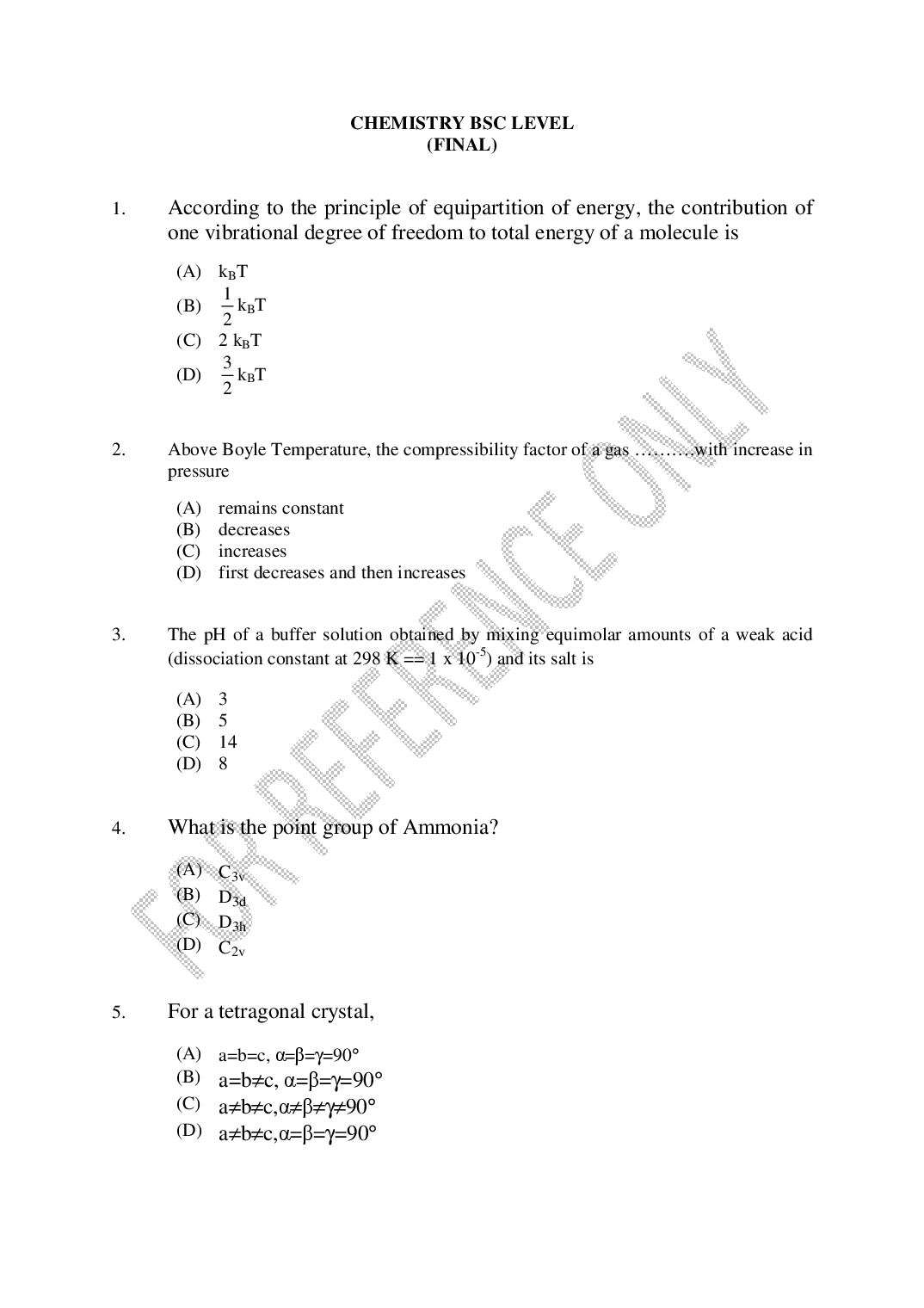
(FINAL)
1. According to the principle of equipartition of energy, the contribution of
one vibrational degree of freedom to total energy of a molecule is
(A) kBT
1
(B) kB T
2
(C) 2 kBT
3
(D) k BT
2
2. Above Boyle Temperature, the compressibility factor of a gas ……….with increase in
pressure
(A) remains constant
(B) decreases
(C) increases
(D) first decreases and then increases
3. The pH of a buffer solution obtained by mixing equimolar amounts of a weak acid
(dissociation constant at 298 K == 1 x 10⁻⁵) and its salt is
(A) 3
(B) 5
(C) 14
(D) 8
4. What is the point group of Ammonia?
(A) C3v
(B) D3d
(C) D3h
(D) C2v
5. For a tetragonal crystal,
(A) a=b=c, α=β=γ=90°
(B) a=b≠c, α=β=γ=90°
(C) a≠b≠c,α≠β≠γ≠90°
(D) a≠b≠c,α=β=γ=90°
Page 2
axes are
(A) 6 43
(B) 2 -3 4
(C) 234
(D) 462
7. When an ideal gas expands isothermally against vacuum,
(A) work done is positive
(B) internal energy change is positive
(C) heat exchanged is negative
(D) work done is zero
8. Which thermodynamic parameter is known as Time’s arrow?
(A) internal energy
(B) enthalpy
(C) entropy
(D) Gibbs free energy
9. Residual entropy is not observed in
(A) Ice
(B) Nitric oxide
(C) Nitrous oxide
(D) Oxygen
10. On expansion, a gas gets………. above Joule Thomson inversion
temperature
(A) cooled
(B) Heated
(C) liquefied
(D) solidified
Page 3
11. As per Maxwell’s relations, is equal to
∂V s
(A) ∂S
∂P v
(B) ∂P
∂T v
(C) ∂P
−
∂S v
(D) ∂P
∂S v
12. Which spectroscopic technique is particularly useful for studying
electronic transitions in molecules?
(A) IR spectroscopy
(B) Mass spectrometry
(C) UV-Vis spectroscopy
(D) NMR spectroscopy
13. Identify the molecule which is microwave active
(A) CO2
(B) H2O
(C) C6H6
(D) O2
14. Mutual exclusion principle in spectroscopy is applicable for molecules
(A) having a plane of symmetry
(B) lacking a centre of symmetry
(C) having a centre of symmetry
(D) lacking a plane of symmetry
Page 4
(A) 400 cm-1−10 cm-1
(B) 4000 cm-1– 400 cm-1
(C) 12500 cm-1– 4000 cm-1
(D) 10 cm-1 – 1 cm-1
16. “Einstein” is a unit of
(A) Electricity
(B) Viscosity
(C) Energy
(D) Mechanical strength
17. The light produced by fire fly is an example of
(A) Thermoluminescence
(B) Photoluminescence
(C) Electroluminescence
(D) Chemiluminescence
18. According to Lindemann theory,the unimolecular reactions at low
pressuresare of
(A) second order
(B) zero order
(C) first order
(D) third order
19. A species that is preferably adsorbed on the surface from the solution
(A) increases the surface tension of liquid
(B) decreases the surface tension of liquid
(C) does not change the vapour pressure of the liquid
(D) does not change the surface tension of liquid
Page 5
(A) involves weak forces
(B) spontaneous in nature
(C) reversible process
(D) irreversible process
21. Among the following, choose the wrong statement about Langmuir
adsorptionmodel
(A) It is monolayer adsorption process
(B) The heat of adsorption is independent of the number of adsorption
sites
(C) Adsorbed molecules interact with each other
(D) Each active site can adsorb only one molecule
Page 6
(A) ex
(B) x2
(C) sin x
(D) tan x
23. Degeneracy of the first excited state of a particle in a cubical box having energy
6h 2
is
8ml 2
(A) 1
(B) 3
(C) 2
(D) 4
24. Energy levels in harmonic oscillators have a spacing of
(A) 3 hν
(B) 2 hν
(C) hν
1
(D) hν
2
25. For the precipitation of a solute, the solubility product should be
(A) smaller than the ionic product
(B) larger than the ionic product
(C) equal to the ionic product
(D) zero
26. In a conductance cell, the resistance of a given salt solution is 300 ohm. If
the specific conductance of the solution is 1.5 × 10⁻² ohm−1cm−1, the cell
constant is
(A) 0.0
(B) 4.5
(C) 450
(D) 2.25
Page 7
the equivalent conductance of it at infinite dilution is 390.7 ohm-1 cm2 eq-
1
, the degree of dissociation of the electrolyte is
(A) 20%
(B) 90%
(C) 10%
(D) 1%
28. If Eo(Cd2+, Cd) and Eo(Cu2+, Cu) are -0.40 V and 0.36 V respectively, the
standard EMF of the cell CdCd2+║Cu2+Cu is
(A) 0.06 V
(B) -0.06 V
(C) 0.76 V
(D) -0.74 V
29. Fora redox reaction to occur spontaneously, the EMF of the cell should
be
(A) Negative
(B) positive
(C) zero
(D) None of the above
30. The rate constant increases by a factor of 10 upon increasing the
temperature from 300 K to 320 K. The activation energy of the reaction
in kJ.mol−1 is
(A) 22
(B) 44
(C) 66
(D) 88
Page 8
represented below
The order of the reaction is
(A) 0
(B) 1
(C) 2
(D) 3
32. Which of the following is true regarding adsorption?
(A) Adsorption is accompanied by an increase in entropy (∆S> 0)
(B) Adsorption is accompanied by a decrease in entropy (∆S< 0)
(C) Adsorption does not affect the entropy
(D) Adsorption is always accompanied by a significant increase in
enthalpy (∆H> 0)
33. In which region of the electromagnetic spectrum is nuclear magnetic
resonance (NMR) studied?
(A) Radio frequency
(B) Microwave
(C) UV – Visible
(D) X-ray
34. At a given temperature, the molar solubility of PbBr2 is 2.17 × 10⁻³ M.
Ksp for PbBr2 is
(A) 3.4 × 10⁻⁶
(B) 6.4 × 10⁻⁷
(C) 4.1 × 10⁻⁸
(D) 3.4 × 10⁻⁹
Page 9
change with temperature?
(A) The conductivity of metals increases with temperature, while that
of semiconductors decreases
(B) The conductivity of metals decreases with temperature, while that
of semiconductors increases
(C) The conductivity of both metals and semiconductors increases with
temperature
(D) The conductivity of both metals and semiconductors decreases with
temperature
36. If 58.5 grams of NaCl are dissolved in 1 liter of water, what will be
the boiling point of the resulting solution? (Assume complete
dissociation of NaCl and Kb for water = 0.512 °C·kg/mol)
(A) 102.00 °C
(B) 101.52 °C
(C) 101.02 °C
(D) 100.51 °C
37. How long (in hours) must a current of 5.0 amperes be maintained to
electroplate 60 g of calcium from molten CaCl2?
(A) 8.05
(B) 16.1
(C) 24.15
(D) 32.2
38. What is the electrode potential (E) for the following half-reaction?
MnO4−(0.010M) + 8H+ (0.20M) +5e− → Mn2+ (0.020M) + 4H2O
Given that the standard electrode potential E0 is +1.51V
(A) 1.44 V
(B) 1.51 V
(C) 1.86 V
(D) 2.04 V
Page 10
maximum wavelength of radiation that can dissociate the molecule is
(A) 499 nm
(B) 399 nm
(C) 299 nm
(D) 199 nm
40. A microscope using suitable photons is employed to locate an electron
in an atom within a distance of 0.1 Å. The uncertainty involved in the
measurement of its velocity is ………… (Given: Mass of electron =
9.1 × 10⁻³¹ kg)
(A) 5.790 × 10⁷ m s-1
(B) 0.579 × 10⁷ m s-1
(C) 5.790 × 10⁻⁷ m s-1
(D) 0.579 × 10⁻⁷ m s-1
41. de Broglie wavelength of an electron moving with a velocity of 1.20×10⁵ m s-1
is ……………. (Given: Mass of electron = 9.1 × 10⁻³¹ kg)
(A) 6.068 × 10⁻⁶ m
(B) 6.068 × 10⁻⁷ m
(C) 6.068 × 10⁻⁸ m
(D) 6.068 × 10⁻⁹ m
42. The efficiency of a heat engine is maximum when the
(A) source temperature is less than the sink temperature
(B) source temperature is equal to the sink temperature
(C) temperature difference between source and sink is maximum
(D) temperature difference between source and sink is minimum
43. The molar heat of vaporisation of a liquid expressed in joules divided by
the normal boiling point of the liquid on absolute scale is approximately
equal to 88. This is known as
(A) Raoult’s law
Page 11
(C) Vant Hoff’s law
(D) Trouton’s law
Page 12
…………
(Given: ∆Hf for ice is equal to 334.72 J g−1).
(A) 1.226 J K−1 kg−1
(B) 12.26 J K−1 g−1
(C) 1226 J K−1 kg−1
(D) 1226 J K−1 g−1
45. The cooling of a gas during Joule-Thomson effect is due to the
(A) decrease in the kinetic energy of the gaseous molecules
(B) increase in the kinetic energy of the gaseous molecules
(C) formation of van der Walls force of attraction between the gaseous
molecules
(D) formation of covalent bonds between the gaseous molecules
46. Find out the correct statement
(A) Spontaneous adsorption is endothermic
(B) The solid that takes up a species is called adsorbate, while the
species held to the surface of the solid is called adsorbent
(C) The uniform distribution of a species (gas or solute) throughout the
body of a solid is called adsorption
(D) Adsorption is a phenomenon of accumulation of higher
concentration of any species (gas or solute) at the surface of a solid
47. At absolute zero temperature, the entropy of every substance may become
zero and it does become zero in the case of a perfectly crystalline solid.
This is the statement of
(A) First Law of thermodynamics
(B) Second Law of thermodynamics
(C) Third Law of thermodynamics
(D) Zeroth Law of thermodynamics
48. The dissociation constant of aniline (as a base) at 25oC is 5.93 × 10⁻¹⁰. If
the ionic product of water at 25oC is 1.008 × 10⁻¹⁴, then the percentage
hydrolysis of aniline hydrochloride in 0.1 M solution at 25oC is
Page 13
(B) 1.83
(C) 2.13
(D) 2.73
Page 14
are respectively
(A) 3, 3, 2
(B) 3, 2, 4
(C) 3, 3, 3
(D) 3, 4, 2
50. The mole fraction of Schottky defect in NaCl crystal at 1000 K is ………
(Given: The energy of formation for this defect is 2eV, 1eV = 1.602×10⁻¹⁹
J, k = 1.38×10⁻²³ J K-1)
(A) 9.17×10⁻⁶
(B) 8.27×10⁻⁸
(C) 1.60×10⁻⁹
(D) 1.38×10⁻³
51. Which among the following can be detected by flame photometry?
(A) Ge
(B) Se
(C) Ca
(D) Br
52. The electronegativity of hydrogen is nearly similar to ……………… and
therefore, the bond between them is considered …………..
(A) Carbon, Covalent
(B) Alkali metals, Covalent
(C) Alkali metals, Ionic
(D) Chlorine, Covalent
53. The molecule X2 has 10 electrons in bonding molecular orbitals and 12
electrons in antibonding molecular orbitals. Which of the following is
true for X2?
(A) X2 has a bond order of 1
(B) X-X bond is ionic
(C) X-X bond is coordinate covalent
(D) The molecule doesn’t exist
Page 15
is refined by this?
(A) Vapor phase refining and Silicon
(B) Vapor phase refining and Nickel
(C) Zone refining and Silicon
(D) Zone refining and Nickel
55. The name of the metal extraction process whose oxides are not easily
reduced by carbon is
(A) Roasting
(B) Smelting
(C) Alumino-thermic process
(D) Calcination
56. Which one of the following ionic compounds has highest melting point?
(A) MgCl2
(B) CaCl2
(C) SrCl2
(D) BaCl2
57. Which molecule has two lone pair of electrons on the central atom as per
VSEPR theory?
(A) SF4
(B) SF6
(C) ICl4−
(D) XeO2F2
58. The highest occupied molecular orbital in N2+ and O2+ are (Consider the
z-axis as the internuclear axis)
(A) σ2pz and π*2px
(B) σ2pz and π2py
(C) π2pxand π*2px
(D) π2pxand σ*2pz
Page 16
of voids present in 54 g of Aluminium will be: [Given, atomic mass of
Aluminium: 27 u]
(A) 6 NA
(B) 4 NA
(C) 3 NA
(D) 2 NA
Page 17
(A) SeO2
(B) P2O3
(C) Na2O
(D) CaO
61. Which among the following is true for diborane, B2H6?
(A) Diborane is electron sufficient
(B) Diborane has a structure similar to ethane
(C) In diborane, the bond connecting boron and terminal hydrogen is
strong in comparison to boron and bridging hydrogen
(D) In diborane, the bond connecting boron and terminal hydrogen is
weak in comparison to boron and bridging hydrogen
62. Which of these acids form strong conjugate bases?
(A) HClO
(B) HClO2
(C) HClO3
(D) HClO4
63. Muller-Rochow process is used for the manufacturing of
(A) (PNCl2)3
(B) R2SiCl2
(C) (R2SiO)n
(D) SiH4
64. The structure of triphosphonitrilic chloride involves
(A) pπ-pπ bonding
(B) dπ-dπ bonding
(C) pπ-dπ bonding
(D) No π-bonding
65. The geometry of [Ni(CN)4]2− and [NiCl4]2− are
(A) Square planar
Page 18
(C) Square planar and Tetrahedral respectively
(D) Tetrahedral and Square planar respectively
66. A blue colored compound has been formed when a transition metal ion
M2+ is combined with ligand. If 0.04 moles of metal ions react with
excess ligand, how much blue colored compound will be formed? [The
compound has a molar mass of 280 g/mol].
(A) 5.6 g
(B) 11.2 g
(C) 1.12 g
(D) 0.56 g
67. The magnetic moment of an octahedral metal ion M2+ is 5.0 BM. Which
combination of metal ion and electronic configuration suit the above
statement?
(A) Fe2+, t2g4 eg2
(B) Co2+, t2g5 eg2
(C) Co2+, t2g6 eg1
(D) Fe3+, t2g5 eg0
68. The complexes [Rh(NH3)4Cl2]Br2 and [Rh(NH3)4Br2]Cl2 are examples of
(A) Linkage isomerism
(B) Geometric isomerism
(C) Ionization isomerism
(D) Solvate isomerism
69. trans-[CoCl2(CO)(PPh3)]− + Cl−→ ?
(A) [CoCl3 (PPh3)]−2
(B) [CoCl3(CO)]−2
(C) [CoCl2(CO)(PPh3)]−
(D) [CoCl3(CO)(PPh3)]−2
70. Which metallocene has strong metal-carbon bond?
(A) Fe(η5-Cp)2
(B) Co(η5-Cp)2
Page 19
(D) Rh(η5-Cp)2
Page 20
number and the oxidation number of the metal atom by two. The reaction
is
(A) Reductive elimination
(B) Dissociation
(C) Oxidative addition
(D) Sigma bond metathesis
72. Oxyhaemoglobin’s red color is due to
(A) Charge transfer
(B) Spin allowed and Laporte forbidden d-d transition
(C) Spin and Laporte allowed d-d transition
(D) π- π* transition within the ligand
73. The metal ions involved in the dioxygen transport in biological systems
are of
(A) Fe and Co
(B) Fe and Zn
(C) Fe and Mg
(D) Fe and Cu
74. The hydrogen bond in water has a dissociation energy of
(A) 432 kJ/mol
(B) 180 kJ/mol
(C) 23 kJ/mol
(D) 8 kJ/mol
75. Which isotope is produced when 216Po decays by emitting an alpha
particle followed by two beta particles?
212
(A) Po
212
(B) Pb
214
(C) Bi
214
(D) Po
Page 21
charge for a metal carbonyl complex [M(CO)x]y− that satisfies the 18-
electron rule is
(A) M = Mo, x = 5, y = 1
(B) M = Co, x = 4, y = 2
(C) M = V, x = 6, y = 1
(D) M = Ti, x = 6, y = 1
77. How many significant numbers are there in 1.006500?
(A) 5
(B) 7
(C) 3
(D) 6
78. The wave numbers correspond to the wavelength 4.0 µm is
(A) 3500 cm−1
(B) 2000 cm−1
(C) 5000 cm−1
(D) 2500 cm−1
79. Which of the following basic molecular structure shows three different
values of bond angles?
(A) Trigonalbipyramidal
(B) Tetrahedral
(C) Octahedral
(D) Icosahedral
80. G-, L2- and M3- are isotonic and isoelectronic species. The correct order
of their atomic masses is
(A) G<L<M
(B) M<G<L
(C) G=L=M
(D) M<L<G
Page 22
(i) similar size and charge of lanthanide ions
(ii) slightdifferences in solubilities
(iii) increasedstabilityoffered by ligand fieldstabilizationenergy
The CORRECT statement/s is/are
(A) (i) only
(B) (i) and (ii)
(C) (iii) only
(D) (ii) and (iii)
Page 23
(A) larger size of S2- than O2-
(B) decreased covalent character for S2-
(C) similar charge on Fe2+ andO2-
(D) less polarizability of S2- than O2-
83. The most acidic oxide is
(A) CO
(B) N2O5
(C) V2O5
(D) Ag2O
84. The trend of first ionization energy going from lower to higher is
CORRECT in
(A) Ar< Na < P < Ne
(B) Na < P <Ar< Ne
(C) Ar< Ne < Na < P
(D) Ne <Ar< Na < P
85. The effective atomic number for the complex [C2H4Fe(CO)3] is
(A) 34
(B) 35
(C) 36
(D) 37
86. The complex with highest ∆o value is
(A) [Co(H2O)6]3+
(B) [Co(H2O)6]2+
(C) [Co(NH3)6]3+
(D) [Co(NH3)6]2+
87. The pair of complex ions with correct order of crystal field splitting is
(A) [CrF6]3– > [Cr(CN)6]3–
(B) [Fe(OH2)6]2+ > [Cr(OH2)6]3+
Page 24
(D) [Ru(NH3)6]3+ > [Fe(NH3)6]3+
Page 25
(A) CO
(B) O2
(C) CN
(D) NO
89. The statement that appropriately describes the diamagnetic nature of
oxyhemoglobin is
(A) Low-spin Fe2+ binds to singlet oxygen
(B) Low-spin Fe3+ binds to the superoxide ion
(C) Low-spin Fe4+ binds to the peroxide ion
(D) Low spin Fe3+ binds to dioxygen
90. The molecular geometries of ClF3 and SO3 are respectively
(A) Trigonal planar, trigonal planar
(B) Pyramidal, T-shaped
(C) T-shaped, trigonal planar
(D) Trigonal planar, pyramidal
91. Addition of a trace amount of arsenic to pure germanium will give
(A) n-type semiconductor
(B) p-type semiconductor
(C) germanium arsenide
(D) a superconducting alloy
92. The set in which all central atoms in the given molecular species are in
sp2 hybridization
(A) NO3−, CO32−, ClO3−
(B) ClO3−, SO3, CO32−
(C) SO3, ClO3−, NO3−
(D) SO3, NO3−, CO32−
93. In an interhalogen compound of the type PQn, P will not be
(A) F
Page 26
(C) Br
(D) I
Page 27
(A) H2SnO3
(B) H2SnO2
(C) Sn(NO3)2
(D) Sn(NO3)4
95. The correct order of increasing bond strength in the following compounds
is
(A) [Mn(CO)6]+> [Ni(CO)4] > [Co(CO)4]-> [Fe(CO)4]2-
(B) [Fe(CO)4]2-> [Ni(CO)4] > [Co(CO)4]-> [Mn(CO)6]+
(C) [Co(CO)4]-> [Fe(CO)4]2-> [Ni(CO)4] > [Mn(CO)6]+
(D) [Ni(CO)4]> [Fe(CO)4]2->[Co(CO)4]-> [Mn(CO)6]+
96. The molecule that exhibits different electron domain geometry and
molecular geometry is
(A) XeO4
(B) XeF2
(C) [XeO6]4−
(D) ClF7
97. Select the one which is not a source for UV-Visible spectroscopy
(A) Deuterium lamps
(B) Gunn diodes
(C) Tunsten-halogen lamps
(D) Light emitting diode
98. To analyze for phosphorous content in soil, which analytical method is
adopted?
(A) Combustion
(B) Extraction using acid solutions
(C) Extraction using alkaline solutions
(D) Extraction using water
99. The reaction of borax (Na₂[B₄O₅(OH)₄]) with 2 moles of acid will give
Page 28
(B) 2 moles of [B(OH)4]¯
(C) 2 moles each of B(OH)3 and [B(OH)4]¯
(D) 1 mole each of B(OH)3 and [B(OH)4]¯
100. The oxide of xenon that is known to react explosively with cellulose in
dry condition is
(A) XeO4
(B) XeO2F2
(C) XeOF2
(D) XeO3
101. Among 11B, 32S, 19F and 31P, the NMR inactive nuclei is
19
(A) F
11
(B) B
32
(C) S
31
(D) P
102. The product formed when methylmagnesium bromide reacts with carbon
dioxide is
(A) acetaldehyde
(B) acetic acid
(C) acetone
(D) formic acid
103. Number of signals in 1HNMR spectrum of CH3CH=CH2 is (ignore
splitting)
(A) 3
(B) 2
(C) 6
(D) 4
104. Indole is treated with tin and conc. HCl. The product formed has
(A) 1 Double bond reduced
(B) All double bonds reduced
Page 29
(D) No reaction
105. Which among the following is not a test for proteins?
(A) Biuret test
(B) Ninhydrin test
(C) Millon’s test
(D) Salkowski test
Page 30
(A) Buna-S
(B) PAN
(C) Teflon
(D) Cellulose
107. Which among these is not an azo dye?
(A) Congo red
(B) Alizarin
(C) Methyl red
(D) Methyl orange
108. Which of the following terms is not directly associated with α-amino
acids?
(A) Denaturation
(B) Isoelectric point
(C) Electrophoresis
(D) Zwitterions
109. Highest bond energy among the following bonds is for
(A) C-O
(B) C-C
(C) C-H
(D) C-Cl
110. Major product formed when pyrrole is treated with chloroform and
aqueous KOH at 340 K is
(A) pyrrole-2-carbaldehyde
(B) pyrrole-3-carbaldehyde
(C) 2-chloropyridine
(D) 3-chloropyridine
111. Glucose and mannose constitute a pair of
(A) anomers
Page 31
(C) conformers
(D) tautomers
112. Specific rotation of α- and β-D-glucose in water are +112 and +19
degrees respectively. However, equilibrium value of specific rotation of α
and β (D) glucose in water is 52.7 degrees. This is taken to mean that:
(A) at equilibrium, both anomers of glucose are present in a 1:1 ratio
(B) at equilibrium, the two anomers of glucose are present in a 527:473
ratio
(C) at equilibrium, α- and β-D-glucose are present in a 64:36 (α:β)
ratio
(D) in water, β-D-glucose is more stable than α-D-glucose
113. In a 1H NMR spectrum, a highly deshielded peak at δ> 13 probably
indicates a proton of group
(A) COOH
(B) CHO
(C) Enol stabilized by H-bonding
(D) Terminal alkyne
114. D2O exchange is used in proton NMR to ascertain the presence of
(A) OH protons only
(B) NH protons only
(C) SH protons only
(D) OH, NH and SH protons
115. Though lower hydrocarbons themselves are odorless, characteristic odor
of domestic LPG is due to the presence of added
(A) (CH2)2(SH)2
(B) CH3CH2SH
(C) CH3SH
(D) H2S
116. Which of the following produces deep blue colour with iodine?
Page 32
(B) Amylopectin
(C) Amylose
(D) All of the above
117. The deficiency of which of the following vitamins directly causes
anemia?
(A) Vitamin A
(B) Vitamin B1
(C) Vitamin B12
(D) Vitamin K
118. The most stable conformer of all cis-2-bromo-4-methylcyclohexanol has
the OH and Me groups in which positions?
(A) OH ax, Me eq
(B) OH and Me eq
(C) OH eq, Me ax
(D) OH and Me ax
119. A 3.20 g sample of an alkaloid ([α]D = -132o) was dissolved in 10.0 mL
of acetic acid ([α]D = 0). If it is put into a sample tube with a path length
of 2.00 cm, what would be its observed rotation (α)?
(A) -8.45°
(B) +84.5°
(C) -84.5°
(D) +8.25°
120. Which of the following asymmetric molecule pairs is most difficult to be
resolved to pure enantiomers?
(A) Phosphines
(B) Sulfoxides
(C) Tertiary amines
(D) α-amino acids (C3 and above)
121. Arrange the following in order of acidity
Page 33
(ii) m-hydroxybenzoic acid
(iii) p-hydroxybenzoic acid
(A) i>ii>iii
(B) iii>ii>i
(C) ii>i>iii
(D) ii>iii>i
122. Arrangein order of basicity
(i) triethyl amine
(ii) pyridine
(iii) CH3CN
(A) i>ii>iii
(B) ii>iii>i
(C) iii>ii>i
(D) i=ii>iii
Page 34
O O
(A) 4
(B) 3
(C) 2
(D) 1
124. From among the following, pick the best catalyst for Knoevenagel
reaction between benzaldehyde and diethyl malonate
(A) Raney nickel
(B) Pyrrolidine
(C) Pd on Carbon
(D) Carbon nanotubes
125. Conversion of benzaldehyde to ethyl cinnamate through Wittig reaction
in minimum number of steps is achieved by using
(A) Acetic acid
(B) Ethyl bromoacetate
(C) Ethyl acetate
(D) 2-bromoethyl acetate
126. The product formed when 2 moles of benzaldehyde react with 1 mole of
acetone in presence of base is
(A) Benzalacetone
(B) Dibenzylideneacetone
(C) β,β-dimethylstyrene
(D) Benzil
Page 35
its probable structure from the following:
(A) OH
O
(B)
H
(C)
OH
O
(D)
128. Index of H-deficiency of C5H6O is
(A) 1
(B) 2
(C) 3
(D) 4
129. Which among the following class of polymers is used to make foams?
(A) Polyurethane
(B) PVC
(C) PMMA
(D) Melamine
130. Indole-3-carboxaldehyde on nitration yields which among the following
as the major product/products?
7 H
6
N
5
4
CHO
(A) 2-nitroindole-3-carboxaldehyde
(B) 5-nitroindole-3-carboxaldehyde
(C) a mixture of 5- and 7-nitroindole-3-carboxaldehyde
(D) a mixture of 4- and 6-nitroindole-3-carboxaldehyde
Page 36
(A) Tyrosine
(B) Tryptophan
(C) Histidine
(D) Threonine
132. Which among the following is not a prominent factor in stabilizing the
tertiary structure of chymotrypsin?
(A) H bonding
(B) π-stacking
(C) disulfide covalent bonding
(D) hydrophobic interactions
133. RNA is devoid of:
(A) Adenine
(B) Guanine
(C) Uracil
(D) Thymine
134. Which of the following can be detected using electron spin resonance
spectroscopy?
(A) Carbocation
(B) Carbanion
(C) Free-radical
(D) Singlet carbene
135. Neoprene contains which of the following groups?
(A) -CN
(B) -OAc
(C) -Cl
(D) -CO2CH3
Page 37
monochloride (Br-Cl, an interhalogen compound) under kinetically
controlled conditions is
(A) 1-bromonaphthalene
(B) 2-bromonaphthalene
(C) 1-chloronaphthalene
(D) 2-chloronaphthalene
137. At which position does electrophilic substitution on indole occur
most readily?
(A) 6
(B) 5
(C) 3
(D) 2
138. Identify the odd one.
(A) Progesterone
(B) Cholesterol
(C) Estrone
(D) prostaglandin
139. Among solvents listed below, the most suitable solvent to prepare
Grignard reagent is
(A) Methanol
(B) DMF
(C) THF
(D) Toluene
140. Ebola is caused due to
(A) Fungus
(B) Virus
(C) Bacteria
(D) Parasite
141. The chemical name of laughing gas is
Page 38
(B) Nitric oxide
(C) Nitrous oxide
(D) Trichlorobenzene
142. 1% (w/w) aqueous solution of which among the following saccharides
will freeze at the highest temperature?
(A) Glucose
(B) Galactose
(C) Maltose
(D) Altrose
Page 39
(A) peracid
(B) O3, Me2S
(C) peracid, NaOH
(D) OsO4, NaOH
144. Ester can be reduced to alcohol using
(A) NaBH4
(B) Na, EtOH
(C) H2, Pd-C-BaSO4
(D) LiAlH4
145. Transition metal used most widely for C-C coupling reactions is
(A) Pd
(B) Cr
(C) Mn
(D) V
146. Among the following, lowest stretching frequency in FTIR spectroscopy
is for the carbonyl group of
(A) benzamide
(B) methyl benzoate
(C) acetophenone
(D) benzaldehyde
147. Species produced by reaction of benzophenone with sodium is
(A) free-radical
(B) radical anion
(C) radical cation
(D) carbocation
148. Among the following, the one which gives positive Fehling’s test most
readily is
(A) Benzaldehyde
Page 40
(C) sucrose
(D) propanal
Page 41
is
(A) sublimation
(B) steam distillation
(C) adsorption chromatography over silica gel
(D) fractional crystallization
150. Chemical process happening during adhesion using M-seal is
(A) Hydrolysis
(B) Esterification
(C) Reduction
(D) Curing
Page 42
Subject Name: CHEMISTRY PG
SI No. Key SI No. Key SI No. Key SI No. Key SI No. Key
1 A 31 C 61 C 91 A 121 A
2 C 32 B 62 A 92 D 122 A
3 B 33 A 63 B 93 A 123 C
4 A 34 C 64 C 94 A 124 B
5 B 35 B 65 C 95 A 125 B
6 A 36 C 66 B 96 B 126 B
7 D 37 B 67 A 97 B 127 A
8 C 38 A 68 C 98 B 128 C
9 D 39 D 69 B 99 D 129 A
10 B 40 B 70 A 100 D 130 D
11 C 41 D 71 C 101 C 131 B
12 C 42 C 72 D 102 B 132 B
13 B 43 D 73 D 103 D 133 D
14 C 44 C 74 C 104 A 134 C
15 B 45 A 75 A 105 D 135 C
16 C 46 D 76 C 106 A 136 A
17 D 47 C 77 B 107 B 137 C
18 A 48 A 78 D 108 A 138 D
19 B 49 C 79 A 109 C 139 C
20 D 50 A 80 D 110 A 140 B
21 C 51 C 81 B 111 B 141 C
22 C 52 A 82 A 112 D 142 C
23 B 53 D 83 B 113 C 143 D
24 C 54 B 84 B 114 D 144 D
25 A 55 C 85 A 115 B 145 A
26 B 56 D 86 C 116 C 146 A
27 C 57 C 87 D 117 C 147 B
28 C 58 A 88 B 118 A 148 D
29 B 59 A 89 B 119 A 149 C
30 D 60 C 90 C 120 C 150 D
Document Details
| Board / Org | Cochin University |
| Exam | CUSAT Common Admission Test |
| Type | Question Paper |
| Pages | 42 |
| Updated | 24 Sep 2026 |