CUSAT CAT 2025 Question Paper Fisheries
Finished viewing? Save it for later —
Download CUSAT CAT 2025 Question Paper Fisheries (PDF · 29 pages)About CUSAT CAT 2025 Question Paper Fisheries
CUSAT CAT 2025 Question Paper Fisheries is available here for free download. Published by Cochin University for CUSAT Common Admission Test, this question paper can be viewed online or downloaded as a PDF (29 pages). Candidates preparing for CUSAT Common Admission Test can use CUSAT CAT 2025 Question Paper Fisheries to understand the exam pattern, the type of questions asked, and the overall difficulty level.
Frequently Asked Questions
How can I download CUSAT CAT 2025 Question Paper Fisheries?
Open this page and click the Download button to save CUSAT CAT 2025 Question Paper Fisheries as a PDF. It is completely free on AglaSem Docs.
Is CUSAT CAT 2025 Question Paper Fisheries free to download?
Yes. CUSAT CAT 2025 Question Paper Fisheries can be viewed online and downloaded as a PDF free of cost on AglaSem Docs.
How many pages does CUSAT CAT 2025 Question Paper Fisheries have?
CUSAT CAT 2025 Question Paper Fisheries contains 29 pages, which you can read online or download together as a single PDF.
Where can I find more CUSAT Common Admission Test study material?
You can find more CUSAT Common Admission Test question papers, sample papers, syllabus, and answer keys on AglaSem Docs.
CUSAT CAT 2025 Question Paper Fisheries – Text
Read the full text of this question paper below — useful to quickly search, copy and reference the content online without downloading the PDF.
📄 View text version (29 pages)
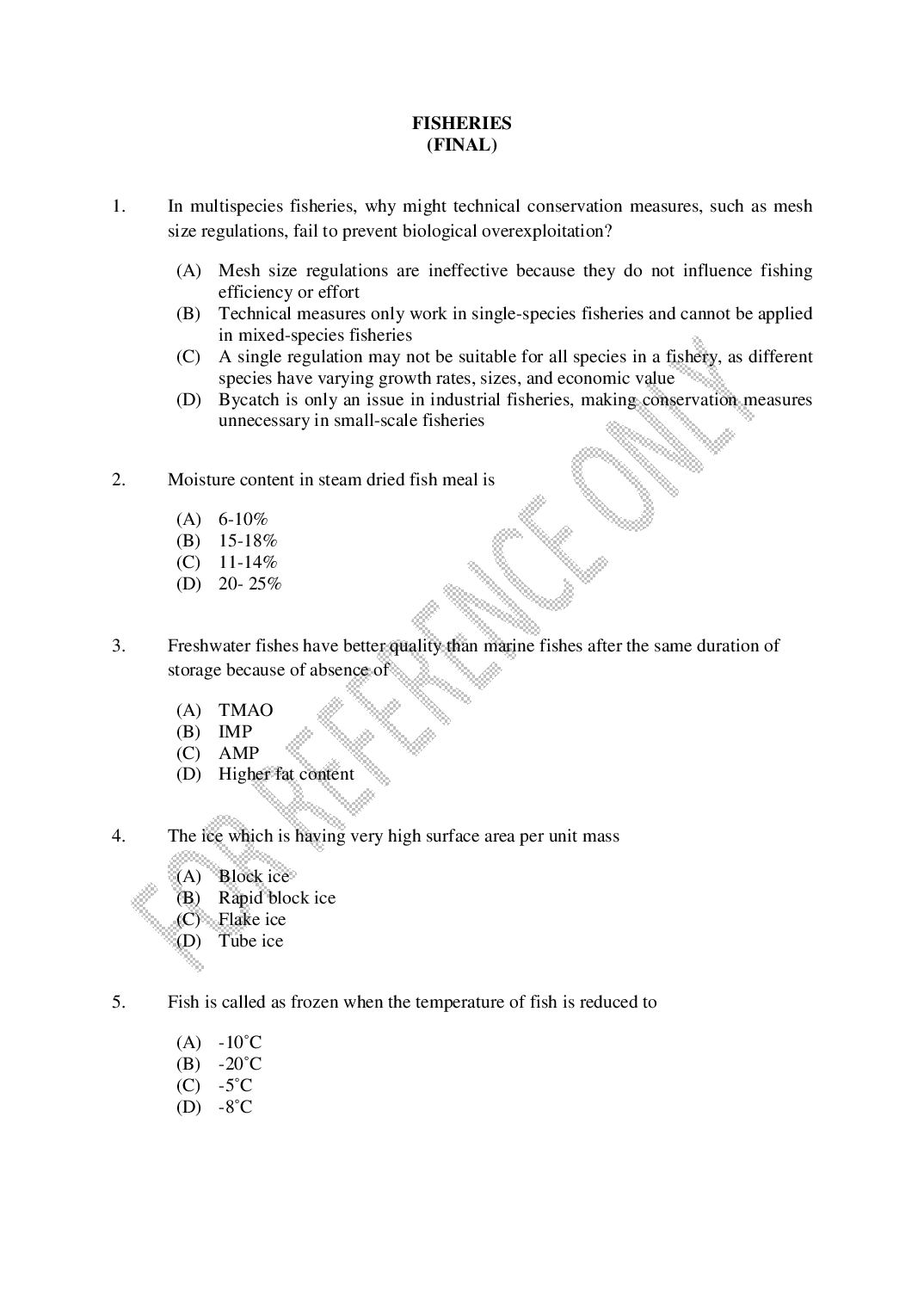
Page 1
(FINAL)
1. In multispecies fisheries, why might technical conservation measures, such as mesh
size regulations, fail to prevent biological overexploitation?
(A) Mesh size regulations are ineffective because they do not influence fishing
efficiency or effort
(B) Technical measures only work in single-species fisheries and cannot be applied
in mixed-species fisheries
(C) A single regulation may not be suitable for all species in a fishery, as different
species have varying growth rates, sizes, and economic value
(D) Bycatch is only an issue in industrial fisheries, making conservation measures
unnecessary in small-scale fisheries
2. Moisture content in steam dried fish meal is
(A) 6-10%
(B) 15-18%
(C) 11-14%
(D) 20- 25%
3. Freshwater fishes have better quality than marine fishes after the same duration of
storage because of absence of
(A) TMAO
(B) IMP
(C) AMP
(D) Higher fat content
4. The ice which is having very high surface area per unit mass
(A) Block ice
(B) Rapid block ice
(C) Flake ice
(D) Tube ice
5. Fish is called as frozen when the temperature of fish is reduced to
(A) -10˚C
(B) -20˚C
(C) -5˚C
(D) -8˚C
Page 2
(A) Hyperplasia
(B) Hypertrophy
(C) Metaplasia
(D) Neoplasia
7. The frozen fish is
(A) as good as dried fish
(B) as good as fresh fish
(C) near to smoked fish
(D) superior to fresh fish
8. Larvae of Brittle star is called as
(A) Ophiopluteus
(B) Echinopluteus
(C) Vitellaria
(D) Auricularia
9. The most commonly used sanitizer in fish processing plant
(A) Sodium hypochlorite
(B) Iodophores
(C) Dettol
(D) QUATs
10. The White Spot Syndrome Virus (WSSV) genome is composed of
(A) RNA
(B) Double – Stranded DNA (dsDNA)
(C) Small Interfering RNA (SiRNA)
(D) None of the above
11. The significance of correlation coefficient between length and weight in fishes is done
by the test
(A) Normal
(B) t
(C) F
(D) Chi-square
Page 3
(A) Carcharodon
(B) Pandaka
(C) Mystichthys
(D) Squaliolus
13. Which of the following species has a larval stage known as "elver"?
(A) Scomber spp.
(B) Anguilla spp.
(C) Mugil spp.
(D) Chimaera spp.
14. The number of degrees (oF or oC) required for the TDT curve to pass through one log
cycle is known as
(A) D value
(B) Fo value
(C) Z value
(D) F value
15. What fibrous structures do green mussels utilize to securely attach themselves to
rocks in their marine environment?
(A) Tentacles
(B) Siphon
(C) Byssus threads
(D) Shell ridges
16. The Amino acid that is absent in vegetable protein, but present in fish is
(A) Arginine
(B) Lysine
(C) Glutamic acid
(D) Methionine
17. Which of the following is involved in blood clotting mechanism?
(A) Vitamin K
(B) Biotin
(C) Vitamin E
(D) Niacin
Page 4
(A) 1950
(B) 1952
(C) 1960
(D) 1958
19. The Indian commercial Mackerel fishery is composed of the size group
(A) 18-24cm
(B) 25-32 cm
(C) 5-10cm
(D) 10-12cm
20. Which of the following biological source serves for the extraction of the Pearl
essence?
(A) Molluscan shells
(B) Sea weed
(C) Fish scales
(D) Freshwater pearls
21. Scientific name of Grey mullet is
(A) Liza parsia
(B) Mugil macrolepis
(C) Mugil cephalus
(D) Velamugil seheli
22. The ideal stocking density of carps (polyculture) in grow out pond is (in terms of
fingerlings)
(A) 50000/ha
(B) 10000/ha
(C) 100000/ha
(D) 1 million/ha
23. The National Bureau of Fish Genetic Resources (NBFGR) head quarters is located at
(A) Mumbai
(B) Lucknow
(C) Cochin
(D) Bhubaneswar
Page 5
(A) Histology
(B) Cytology
(C) Virology
(D) Urology
25. Which of the following genera includes the largest fish species known to exist,
renowned for its massive size and filter-feeding behavior?
(A) Megalodon
(B) Rhincodon
(C) Balaenoptera
(D) Leedsichthys
26. What is the function of swim bladders in fish?
(A) Food digestion
(B) Maintaining buoyancy
(C) Breathing air
(D) Absorbing nutrients
27. The area of Indian EEZ is (million Sq. Kms.)
(A) 2.02 million Sq. Kms.
(B) 2.20 million Sq. Kms.
(C) 2.15 million Sq. Kms.
(D) 0.53 million Sq. Kms.
28. Blue-green algae, also known as cyanobacteria, can sometimes produce toxins. Which
of the following organisms, belonging to this group, is known for its toxic varieties?
(A) Spirogyra
(B) Chlamydomonas
(C) Microcystis aeruginosa
(D) Euglena
29. Antibodies are generally
(A) Glycoproteins
(B) Glycolipids
(C) Nucleoproteins
(D) Polysaccharides
Page 6
commercially important fauna?
(A) Ganga and Yamuna
(B) Godavari and Krishna
(C) Narmada and Tapti
(D) Brahmaputra and Mahanadi
31. In which fishing method is the term "backing down" commonly used?
(A) Gillnetting
(B) Trawling
(C) Purse seining
(D) Traps
32. The causative agent of EMS in shrimp (P. vannamei) is
(A) V. parahaemolyticus
(B) TSV
(C) Laeme – singh virus
(D) A. hyrophila
33. A scientist is researching advanced fish preservation techniques. Which of the
following is a non-thermal preservation method?
(A) Curing
(B) Vacuum drying
(C) High-pressure processing
(D) Brining
34. Clarius batrachus is commonly called
(A) Singhi
(B) Magur
(C) Butter cat fish
(D) Freshwater shark
35. Which of the following methods can be used to correct the porosity of the pond
bottom?
(A) Inorganic fertilizers
(B) KMnO₄ (Potassium permanganate)
(C) Organic matter
(D) None of the above
Page 7
(A) Protein
(B) Carbohydrates
(C) Fats
(D) Minerals
37. The gland that helps in induced breeding of fishes is
(A) Adrenal
(B) Thyroid
(C) Thymus
(D) Pituitary
38. The primary cause of algal blooms in aquaculture ponds is
(A) High oxygen levelsz
(B) Excess nutrient input
(C) Increased fish density
(D) Low water temperature
39. Which process is used to produce fishmeal for aqua feed?
(A) Fermentation
(B) Freeze-drying
(C) Rendering
(D) Canning
40. The hormone used in fish for feminization
(A) Testosterone
(B) HCG
(C) PMS
(D) 17- β- estradiol
41. Which of the following is primarily the phytoplankton feeder?
(A) Silver carp
(B) Big head carp
(C) Grass carp
(D) Common carp
Page 8
(A) Fish skin
(B) Fish sperm
(C) Fish roe
(D) Fish liver
43. Who is credited with the development of tin plate technology for food preservation?
(A) Ganole
(B) Peter Durand
(C) Nicholas Appert
(D) Olson
44. Squid jigging employs the principle of
(A) Color
(B) Smell
(C) Light
(D) Electric current
45. Botulism is caused by which of the following bacteria?
(A) Clostridium botulinum
(B) Clostridium perfringens
(C) Clostridium tetani
(D) All Clostridium species
46. Low acid foods have a pH of
(A) >4.6
(B) 3.7- 4.6
(C) < 3.7
(D) 2.5- 3.7
47. Synthesis of cDNA from RNA is termed as
(A) Transformation
(B) Transduction
(C) Translation
(D) Transcription
Page 9
(A) Androgenesis
(B) Gynogenesis
(C) Oogenesis
(D) Parthenogenesis
49. The sous-vide technique of preparing fish primarily involves
(A) Cooking in a precisely controlled, low-temperature water bath
(B) Preservation and flavoring through smoke exposure
(C) Preservation by removing moisture content
(D) Cooking at extremely high temperatures for a very short time
50. Which of the following is the scientific name of the ornate spiny lobster widely
cultured in Southeast Asia?
(A) Scyllarides latus
(B) Panulirus ornatus
(C) Homarus americanus
(D) Panulirus argus
51. The most commonly cited bacterial species responsible for a significant increase in
histamine levels in improperly refrigerated tuna samples is
(A) Pseudomonas
(B) Hafnia alvei
(C) Klebsiella pneumoniae
(D) Clostridium
52. Which of the following is not an active fishing gear?
(A) Seines
(B) Dredges
(C) Electrifying gear
(D) Traps
53. Which phase of bacterial growth is extended by lowering the temperature?
(A) Log
(B) Lag
(C) Declining
(D) Stationary
Page 10
salt concentrations?
(A) Xerophilic
(B) Halophilic
(C) Osmophilic
(D) Acidophilic
55. Regions with the same wind speed are often mapped to analyze wind patterns. What
is this called?
(A) Isobar
(B) Isotach
(C) Heat Equator
(D) Isogonic Line
56. 'Fugu' is a delicacy in Japan prepared from which of the following?
(A) Puffers
(B) Pomfrets
(C) Mackerel
(D) Sharks
57. Which of the following is called 'Paddle Fish'?
(A) Polyodon
(B) Palaeoniscus
(C) Pangasius
(D) Polypterus
58. Hill stream loaches belong to the family
(A) Homalopteridae
(B) Cobitidae
(C) Gobidae
(D) Amblycipitidae
59. ‘Shagreen’ is derived from which language?
(A) Russian
(B) French
(C) German
(D) Japanese
Page 11
(A) Salmon
(B) Anguilla
(C) Catostomous
(D) Gasterosteus
61. Osphronemus is the
(A) Betta
(B) Kissing gourami
(C) Giant gourami
(D) Dwarf gourami
62. ‘Asphyxiation’ is a term related with
(A) Harvesting
(B) Preservation
(C) Breathing
(D) Eating
63. TCBS is selective differential medium used for isolation of
(A) Escherichia
(B) Salmonella
(C) Shigella
(D) Vibrios
64. ‘Gono
podium’ is the characteristic of
(A) Poecilia
(B) Cynopoecilus
(C) Pterolebias
(D) Tilapia
65. As the acidity of food decreases the severity of thermal process
(A) Increases
(B) Decreases
(C) Remain unchanged
(D) None of the above
Page 12
(A) Struvite crystals
(B) Blue discoloration in crab
(C) Honey combing
(D) Sulphide blackening in crab
67. Which of the following statements is true regarding 'Surimi'?
(A) It refers to a traditional Japanese fish soup
(B) It is a type of deboned fish product
(C) It is a type of net specifically designed for catching tuna
(D) It is a type of bony fish known for its delicate flavor
68. The following selective medium used for isolation of Staphylococcus aureus from
seafood is
(A) BPA
(B) BSA
(C) TCBS
(D) EMB
69. In which year was the Marine Products Export Development Authority (MPEDA)
established in Kochi, Kerala?
(A) 1952
(B) 1972
(C) 1962
(D) 1982
70. Which of the following cellular organelles is primarily responsible for translating
mRNA into polypeptide chains during protein synthesis?
(A) Lysosomes
(B) Endoplasmic reticulum
(C) Ribosomes
(D) Centrioles
71. Glucosamine Hydrochloride is prepared from
(A) Chitin
(B) Cuttle bone
(C) Clam shell
(D) Fish skin
Page 13
of
(A) Lobster
(B) Crab
(C) Shrimp
(D) Squid
73. In which year was the Maritime Zones of India (Regulation of Fishing by Foreign
Vessels) Act enacted?
(A) 1976
(B) 1981
(C) 1985
(D) 1983
74. In a seafood processing plant, which factor is most crucial for maintaining the final
product's freshness?
(A) Proper cold chain management
(B) Use of natural preservatives
(C) Packaging color and design
(D) Processing automation level
75. Which feeding category includes fish that filter plankton from water using specialized
gill rakers?
(A) Predators
(B) Grazers
(C) Strainers
(D) Suckers
76. Which statement correctly describes the structure of braided netting yarn?
(A) It consists of a single continuous yarn without interwoven strands
(B) It is produced by twisting multiple strands in the S-direction to form folded
yarns
(C) It is formed by interlaying strands diagonally, creating a tubular structure
(D) It is made by further twisting already twisted yarns into a compact form
77. What is a key advantage of using low water activity (aw) in fish preservation?
(A) Prevents protein denaturation
(B) Inhibits microbial growth
Page 14
(D) Enhances enzymatic activity
78. The target water activity for safe storage of dried fish is generally below
(A) 0.50
(B) 0.65
(C) 0.80
(D) 0.95
79. How do straddling stocks differ from transboundary stocks?
(A) Straddling stocks stay in the high seas, while transboundary stocks remain
within EEZs
(B) Straddling stocks exist in both EEZs and high seas; transboundary stocks occur
in EEZs of multiple countries
(C) Transboundary stocks are highly migratory, while straddling stocks stay
localized
(D) Straddling stocks need no international management, unlike transboundary
stocks
80. Which structural adaptation is most useful in identifying the feeding behaviour of a
fish?
(A) Gill structure and presence of swim bladder
(B) Mouth position, shape, and presence of teeth
(C) Body shape and fin size
(D) Scales and lateral line system
81. The primary reason for using probiotics in fish farming is
(A) Enhancing coloration
(B) Improving gut health and digestion
(C) Increasing oxygen uptake
(D) All of the above
82. What is the main function of a biofilter in recirculating aquaculture systems?
(A) Remove solid waste
(B) Convert ammonia to less toxic forms
(C) Enhance fish immunity
(D) Increase water salinity
83. Which fish species is known for being anadromous, migrating from saltwater to
freshwater for spawning?
(A) Tuna
(B) Salmon
Page 15
(D) Tilapia
84. How does the direct numbering system differ from the indirect system in yarn
measurement?
(A) Direct system keeps length constant while weight varies, whereas the indirect
system keeps weight constant while length varies
(B) The indirect system specifies weight in grams per 1000m, while the direct
system uses hanks per pound
(C) Direct system applies only to synthetic fibers, while the indirect system applies
only to natural fibers
(D) None of the above
85. Which of the following is a common method for assessing fish population abundance
in marine environments?
(A) Trawling surveys
(B) Hydroacoustic surveys
(C) Mark-recapture methods
(D) All of the above
86. A major environmental concern associated with intensive fish farming is
(A) Increased biodiversity
(B) Waste accumulation and eutrophication
(C) Reduction in fish disease outbreaks
(D) Improved water quality
87. What is the term for a system where exclusive rights to fish within a specific territory
are granted to individuals, communities, or organizations, allowing them to manage
and benefit from the resource?
(A) Common-pool resource exploitation
(B) Open-access fishing
(C) Territorial Use Rights
(D) Individual Transferable Quotas
88. What is the term for a model that incorporates random variables to account for
unexplained effects and uncertainty in predictions?
(A) Deterministic model
(B) Stochastic model
(C) Empirical model
(D) Conceptual model
Page 16
facilities?
(A) Enhancing fish coloration
(B) Preventing disease outbreaks
(C) Increasing stocking density
(D) Reducing oxygen consumption
90. Which factor is most critical in ensuring the sustainability of fisheries?
(A) Unregulated fishing
(B) Habitat conservation
(C) Increased fishing quotas
(D) Decreasing biodiversity
91. Which of the following fish groups lack pyloric caeca?
(A) Flatfishes (Pleuronectiformes)
(B) Mackerels (Scombridae)
(C) Catfishes (Ictaluridae)
(D) Salmons (Salmonidae)
92. What is a major environmental impact of shrimp farming?
(A) Deforestation
(B) Ocean acidification
(C) Mangrove destruction
(D) Coral bleaching
93. The "tragedy of the commons" is a well-known issue in fisheries management, where
individual fishers prioritize short-term gains over long-term resource sustainability.
What is the fundamental reason this phenomenon occurs in open-access fisheries?
(A) Fishers lack the technological capability to control their catches, leading to
uncontrolled exploitation
(B) Since fish stocks are a shared resource, individuals have little incentive to
conserve them
(C) Regulations are always ineffective in controlling fishing effort, making
overexploitation inevitable
(D) All of the above reasons
94. Which of the following is a PRIMARY advantage of using Recirculating Aquaculture
Systems (RAS) compared to traditional aquaculture methods?
(A) Lower initial investment costs
(B) Significant reduction in water usage
(C) Increased reliance on natural weather patterns
(D) Higher susceptibility to external diseases
Page 17
(A) Higher operational costs
(B) Greater disease transmission risk
(C) Limited fish growth
(D) Poor water circulation
96. Which government policy is designed to promote sustainable fisheries management?
(A) Marine Protected Areas (MPAs)
(B) Increased fishing quotas
(C) Subsidies for commercial fishing
(D) Deep-sea mining incentives
97. Which of the following fins in perch contains only soft, unossified fin rays?
(A) Anterior dorsal fin
(B) Caudal fin
(C) First two rays of the anal fin
(D) Pectoral fin
98. Which is a common method for measuring fish population dynamics?
(A) Tagging and recapture studies
(B) Sonar mapping
(C) Genetic barcoding
(D) All of the above
99. The primary goal of fisheries stock assessment is
(A) Maximizing short-term profits
(B) Ensuring long-term sustainability
(C) Increasing global seafood trade
(D) Promoting wild capture fisheries
100. Which sampling method is best suited for obtaining deep, undisturbed sediment cores
of over 20 meters?
(A) Gravity corer
(B) Grab sampler
(C) Piston corer
(D) Dredge
Page 18
environment?
(A) Beverton-Holt model
(B) Lotka-Volterra model
(C) Schaefer model
(D) Hardy-Weinberg equilibrium
102. What is the primary advantage of using genomic tools in fisheries management?
(A) Identification of cryptic species
(B) Enhancement of artificial breeding programs
(C) Increasing wild fish population
(D) Eliminating genetic variations
103. In the context of ecosystem-based fisheries management, what is the role of trophic
cascades?
(A) Regulating predator-prey relationships
(B) Directly increasing fishery yields
(C) Eliminating invasive species
(D) Reducing fish recruitment variability
104. Which statistical method is most appropriate for assessing multi-species interactions
in an ecosystem?
(A) Principal Component Analysis (PCA)
(B) Bayesian hierarchical models
(C) Pearson correlation
(D) All of the above
105. Which ecological principle explains the stability of marine food webs in response to
fishing pressures?
(A) Trophic redundancy
(B) Niche differentiation
(C) Competitive exclusion principle
(D) Island biogeography theory
106. What is the most common impact of overfishing on age structure within a fish
population?
(A) Increased proportion of older individuals
(B) Shift towards smaller, younger fish
(C) Enhanced reproductive success
(D) Uniform growth across all age classes
Page 19
an Exclusive Economic Zone (EEZ)?
(A) Foreign military and research vessels require permission from the coastal state
to enter the EEZ
(B) Foreign vessels have freedom of navigation and overflight but must respect the
right of coastal state over resource management
(C) Foreign commercial vessels can extract resources freely as long as they do not
exceed sustainable limits
(D) The coastal state has the right to regulate all foreign vessel movements, just as
in its territorial waters
108. Which environmental parameter is crucial for larval fish survival in marine
ecosystems?
(A) Dissolved inorganic nitrogen levels
(B) Turbidity
(C) Chlorophyll-a concentration
(D) Light penetration and prey availability
109. What is the primary use of Individual Transferable Quotas (ITQs) in fisheries
management?
(A) Allocating catch limits to individual fishers
(B) Reducing competition in global seafood markets
(C) Increasing vessel efficiency
(D) Enhancing aquaculture production
110. How does using electronic tagging technologies improve fisheries research?
(A) Helps track migration patterns and habitat use
(B) Increases fish survival rates
(C) Reduces genetic diversity
(D) Improved IUU fishing
111. What is a key consequence of high fishing pressure on high trophic level species on
predator-prey dynamics?
(A) Increased prey population stability
(B) Reduced predator populations thus altering ecosystem balance
(C) Strengthening of top-down control
(D) All of the above
Page 20
conservation efforts, many populations are declining. Which of the following factors
most significantly increases the risk of extinction for dugongs?
(A) Their ability to migrate long distances
(B) Their reliance on seagrass habitats
(C) Their rapid reproductive cycle
(D) Their ability to adapt to various marine habitats
113. Which hormone shift triggers germinal vesicle breakdown (GVBD) and final oocyte
maturation?
(A) Estradiol (E2) → steroids (MIS) like 17α, 20β-diOH progesterone
(B) Progesterone → Estradiol (E2)
(C) GtH inhibition → Prostaglandin (PG)
(D) GVBD occurs independently of hormonal regulation
114. Which category of benthic organisms includes those with a size range between 60 µm
and 500 µm?
(A) Macrobenthos
(B) Microbenthos
(C) Meiobenthos
(D) Nanobenthos
115. A polymer sample is subjected to a flame test, and the following observations are
made regarding its residue: Hard, blackish, crumbly, irregular substance and no bead
formation. Based on this residue characteristic, which of the following polymers is
most likely the tested material?
(A) PA 6.6
(B) PP
(C) PVC
(D) Saran
116. Tubifex worms are a commonly used live food in aquariums, but their use requires
caution. Based on the information provided, what is the primary concern when
feeding Tubifex worms to fish?
(A) They live in polluted stretches of rivers and streams, and thus potential carriers
of disease-causing organisms
(B) They are difficult to culture successfully
(C) They should be rinsed gently in cold running tap water for several hours before
feeding to fish
(D) They should only be used as a staple diet for adult breeding fish to maintain
their health
Page 21
genetic analysis. What is its primary function?
(A) Mass production of antibiotics for pharmaceutical applications
(B) Enhancement of bacterial transformation efficiency in recombinant DNA
technology
(C) Facilitation of rapid protein synthesis in cellular processes
(D) Amplification of specific DNA sequences, enabling genetic studies and
diagnostics
118. What is the navigation method called where a ship's position is estimated based on
previously known positions, course, and speed, without considering external factors
like wind and current?
(A) Celestial Navigation
(B) GPS Navigation
(C) Dead Reckoning
(D) Visual Piloting
119. Why is urea applied to shrimp ponds before stocking, and what is the recommended
application rate?
(A) Urea helps increase the salinity of the water, making the pond environment
more suitable for shrimp growth, and should be applied at 10-20 kg/ha
(B) Urea is used to disinfect the pond water before stocking shrimp and should be
applied at 200-300 kg/ha
(C) Urea is used to facilitate the growth of diatoms, which serve as food for shrimp
post-larvae, and should be applied at 50-100 kg/ha
(D) Urea is added to stabilize the pond's pH and should be applied at 500-600
kg/ha
120. What is the scientific study of chemical processes involving metabolites, focusing on
the unique chemical fingerprints left by cellular activities?
(A) Proteomics
(B) Metagenomics
(C) Metabolomics
(D) Transcriptomics
Page 22
maturation. However, the practice has multiple physiological consequences. Based on
the information, which of the following is an unintended negative effect of eyestalk
ablation?
(A) It increases the number of eggs per spawning, significantly improving
reproductive success
(B) It shortens the moult cycle but increases mortality rates by up to three times
(C) It enhances egg quality by ensuring more robust and disease-resistant offspring
(D) It permanently impairs vision and prevents eyestalk regeneration in all shrimp
species
122. What is the name of the first genetically engineered fish sold commercially,
introduced to the U.S. market in 2003?
(A) AquAdvantage Salmon
(B) Glofish
(C) Biolume Fish
(D) Luminous Guppy
123. Which of the following statements correctly describes a characteristic of
mitochondrial DNA (mtDNA) in fish?
(A) It contains introns and repetitive sequences like nuclear DNA
(B) It is inherited maternally in almost all animals, with few exceptions
(C) It undergoes meiosis before replication, ensuring genetic recombination
(D) It contains only protein-coding genes and lacks ribosomal or transfer RNA
genes
124. Who developed the Polymerase Chain Reaction (PCR) technique in the 1980s,
revolutionizing DNA cloning?
(A) Frederick Sanger
(B) Kary Mullis
(C) James Watson
(D) Rosalind Franklin
125. What is the term for the spiral pattern formed by ocean currents due to the Coriolis
effect, where each deeper layer moves more slowly and at an angle to the one above?
(A) Pycnocline effect
(B) Coriolis Drift
(C) Thermohaline Circulation
(D) Ekman Spiral
Page 23
which category based on their structural design and method of capture?
(A) Entangling nets like gillnets
(B) A variant of trammel nets
(C) Enclosures designed to trap fish
(D) A circular net with large meshes
127. In maritime navigation, the term "Port side" refers to which of the following?
(A) The side of the ship that is always exposed to the dock when berthed
(B) The right-hand side of the vessel when facing forward, opposite to the
starboard side
(C) The left-hand side of the vessel when facing forward, opposite to the starboard
side
(D) The section of the hull that intersects with the waterline at the stern
128. After death, ATP depletion leads to rigor mortis in fish. What biochemical process
drives this change?
(A) Anaerobic glycogen breakdown produces lactic acid, lowering pH and
depleting ATP
(B) Aerobic respiration continues postmortem, delaying rigor mortis until glycogen
is fully depleted.
(C) Fat oxidation sustains ATP production, preventing rigor mortis
(D) Carbon dioxide buildup postmortem hydrolyzes ATP, stopping rigor mortis
129. In the context of the FAO Code of Conduct, Total Allowable Catch (TAC) is a critical
tool for sustainable fisheries management. Given that an indigenous fishing
community traditionally relies on a stock with a Maximum Sustainable Yield (MSY)
of 25,000 metric tons per year, and scientific assessments show a 20% decline in
stock biomass due to overfishing, what would be the most appropriate TAC
recommendation to align with the Code’s sustainability principles?
(A) Maintain TAC at 25,000 metric tons to support indigenous food security and
livelihoods
(B) Reduce TAC proportionally to 20,000 metric tons to allow for stock recovery
while sustaining local fisheries
(C) Impose a temporary moratorium on all fishing activities until stock biomass
recovers to historical MSY levels
(D) Allow unrestricted fishing for indigenous fishers while restricting commercial
fishing to compensate for biomass loss
Page 24
Agreement (PSMA) when one of its vessels is reported for suspected IUU fishing?
(A) The flag state must immediately impose sanctions on the vessel
(B) The flag state must notify all regional fisheries management organizations
(RFMOs)
(C) The flag state must investigate the report and take appropriate enforcement
action if there is sufficient evidence
(D) The flag state must allow the vessel to operate until a court finds it guilty of
IUU fishing
131. In the context of port state inspections of fishing vessels, why the use of vessel
monitoring systems (VMS) is considered an essential component?
(A) VMS helps determine if a vessel has complied with port entry regulations
before arrival
(B) VMS replaces the need for onboard inspections by port state authorities
(C) VMS is used primarily for tax and customs verification of fishery products
(D) VMS data provides historical tracking but is not admissible as legal evidence
in fisheries enforcement
132. Transshipment of tuna and tuna-like species is strictly regulated under IOTC
guidelines. What key requirement must be met before transshipment is approved in an
RFMO-regulated area?
(A) The transshipment must be conducted exclusively in high-seas zones to avoid
jurisdictional disputes
(B) The vessel must notify the IOTC Secretariat, provide documentation, and be
monitored by an authorized observer
(C) The vessel must be on the IUU vessel list to qualify for transshipment
(D) Only vessels registered under non-coastal states are permitted to transship in
IOTC waters
133. Which caudal fin type is LEAST likely to be found in a species that relies on rapid
acceleration and short bursts of speed?
(A) Heterocercal
(B) Homocercal
(C) Diphycercal
(D) Hypocercal
Page 25
buoyancy regulation?
(A) Otolithes
(B) Protopterus
(C) Clarias batrachus
(D) Mola mola
135. A fish species found in deep-sea environments has an elongated body, reduced or
absent pelvic fins, and a caudal fin adapted for slow and energy-efficient swimming.
Based on these characteristics, what type of caudal fin is this fish MOST LIKELY to
possess?
(A) Gephyroceral
(B) Heterocercal
(C) Isocercal
(D) Hypocercal
136. Which of the following is a mandatory requirement for vessels operating under the
IOTC Compliance framework?
(A) Obtaining a special permit only when targeting high-value tuna species
(B) Carrying an operational Vessel Monitoring System (VMS) that transmits
location data at specified intervals
(C) Reporting catch data voluntarily, with no requirement for independent
verification
(D) Using onboard observers only when fishing in territorial waters
137. In environments where environmental conditions fluctuate frequently—such as
temperature, water levels, and oxygen content—which of the following reproductive
strategies is most likely to provide a fish species with an adaptive advantage in terms
of reproductive efficiency and the ability to cope with such environmental instability?
(A) Egg scatterers
(B) Egg buriers
(C) Bubble nest builders
(D) Egg depositors
138. Freshwater species display a higher growth rate when fed Moina rather than Daphnia.
What is the most likely explanation for this observation?
(A) Moina has a softer exoskeleton and higher digestibility, making it more
suitable for small-mouthed fish larvae
(B) Daphnia has a higher protein content but lacks essential fatty acids required for
optimal larval development
(C) Moina exhibits erratic swimming behaviour, which stimulates active predation
and enhances feeding efficiency in larval fish
(D) Daphnia is more resistant to gut enzymatic digestion, leading to lower
assimilation efficiency compared to Moina
Page 26
hatchery aiming to optimize larval survival and growth?
(A) Providing a diet rich in Artemia nauplii supplemented with Diatoms to enhance
larval nutrition
(B) Feeding Rotifers and Copepods in early larval stages, followed by a transition
to Artemia for post-larvae
(C) Relying exclusively on Daphnia as the primary feed, given its high protein
content and freshwater origin
(D) Using Isochrysis as the first feed and gradually introducing Artemia to mimic
wild feeding conditions
140. Which of the following bacteria are associated with gastric ulcers?
(A) Proteus
(B) Helicobacter pylori
(C) Schewanella putrefasciens
(D) Hafnia alvei
141. A seafood processing facility using high-salt brining observes microbial
contamination despite salt concentrations exceeding 15%. Which of the following
organisms is most likely responsible for the contamination?
(A) Achromobacter
(B) Clostridium botulinum
(C) Halobacterium
(D) Pseudomonas
142. Canned fish can showed bloating and gas formation after extended storage, despite
being heat-processed. Which of the following microorganisms is the most likely cause
of this spoilage?
(A) Pseudomonas
(B) Clostridium butyricum
(C) Streptococcus
(D) Listeria
143. Different freezing techniques are used to minimize ice crystal formation in high-value
seafood. Which of the following methods would be most effective for achieving rapid
freezing while maintaining product texture?
(A) Tunnel freezing at -18 to -34°C
(B) IQF (Individually Quick Frozen) at -40°C
(C) Super chilling at 0 to -4°C
(D) Cold store at -18°C
Page 27
(A) J L S Smith
(B) Jones S and M Kumaran
(C) Ian Stafford Ross Munro
(D) Vishwa Gopal Jhingran
145. Which country has the largest market for ornamental fish?
(A) Singapore
(B) Japan
(C) USA
(D) Malaysia
146. In the transportation of fresh fish over long distances without active refrigeration,
eutectic crates are often used to maintain optimal temperature stability. Which of the
following best explains how these crates achieve this?
(A) They utilize phase change materials that absorb and release latent heat at a
fixed eutectic point
(B) They rely on continuous air circulation with ice packets within the crate to
prevent temperature fluctuations
(C) They use vacuum insulation to completely block heat transfer from the
surroundings
(D) They are designed with built-in cooling fans powered by onboard batteries
147. What biochemical change is most associated with the loss of fresh fish flavor and the
onset of spoilage?
(A) Rise in IMP levels, indicating fish is in an advanced stage of spoilage
(B) Accumulation of inosine, enhancing the fresh taste of fish
(C) Increase in hypoxanthine, contributing to bitter off-Flavors
(D) Reduction in K-value, signaling deterioration in fish quality
148. Depensation in fish populations can lead to severe consequences for stock recovery.
Which of the following best explains why depensation is a critical concern in fisheries
management?
(A) At low population sizes, individual fish produce more offspring to compensate
for declining numbers, preventing stock collapse
(B) When population density decreases below a certain threshold, factors such as
reduced mating encounters, increased predation, and Allee effects lead to
further declines in recruitment, increasing the risk of extinction
(C) Depensation occurs when recruitment remains constant regardless of
population size, meaning fish stocks are resilient to overfishing
(D) Depensation enhances genetic diversity in fish populations by selecting for
individuals with higher reproductive success, improving long-term stock
stability
Page 28
the estimated global annual discard volume in marine and estuarine capture fisheries?
(A) 5.2 million tonnes
(B) 9.1 million tonnes
(C) 15.4 million tonnes
(D) 20.8 million tonnes
150. Based on estimates of ecosystem effects for different fishing methods, which of the
following has the most damaging overall impact on the ecosystem, as indicated by the
lowest ecosystem effect index?
(A) Purse seine
(B) Pelagic trawl
(C) Handlining
(D) Trammel net
Page 29
Subject Name: FISHERIES
SI No. Key SI No. Key SI No. Key SI No. Key SI No. Key
1 C 31 C 61 C 91 C 121 B
2 A 32 A 62 C 92 C 122 B
3 A 33 C 63 D 93 B 123 B
4 C 34 B 64 A 94 B 124 B
5 B 35 C 65 A 95 B 125 D
6 A 36 C 66 A 96 A 126 C
7 B 37 D 67 B 97 B 127 C
8 A 38 B 68 A 98 D 128 A
9 A 39 C 69 B 99 B 129 B
10 B 40 D 70 C 100 C 130 C
11 B 41 A 71 A 101 C 131 A
12 D 42 C 72 B 102 A 132 B
13 B 43 B 73 B 103 A 133 C
14 C 44 C 74 A 104 B 134 D
15 C 45 A 75 C 105 A 135 C
16 B 46 A 76 C 106 B 136 B
17 A 47 D 77 B 107 B 137 A
18 D 48 B 78 B 108 D 138 A
19 A 49 A 79 B 109 A 139 C
20 C 50 B 80 B 110 A 140 B
21 C 51 B 81 B 111 B 141 C
22 A 52 D 82 B 112 B 142 B
23 B 53 B 83 B 113 A 143 B
24 C 54 B 84 A 114 C 144 B
25 B 55 B 85 D 115 C 145 C
26 B 56 A 86 B 116 A 146 A
27 A 57 A 87 C 117 D 147 C
28 C 58 A 88 B 118 C 148 B
29 A 59 B 89 B 119 C 149 B
30 C 60 B 90 B 120 C 150 D
Document Details
| Board / Org | Cochin University |
| Exam | CUSAT Common Admission Test |
| Type | Question Paper |
| Pages | 29 |
| Updated | 24 Sep 2026 |