MBOSE Class 12 Question Paper 2019 for Bio Botany
Finished viewing? Save it for later —
Download MBOSE Class 12 Question Paper 2019 for Bio Botany (PDF · 4 pages)About MBOSE Class 12 Question Paper 2019 for Bio Botany
MBOSE Class 12 Question Paper 2019 for Bio Botany is available here for free download. Published by Meghalaya Board for Class 12, this question paper can be viewed online or downloaded as a PDF (4 pages). Candidates preparing for Class 12 can use MBOSE Class 12 Question Paper 2019 for Bio Botany to understand the exam pattern, the type of questions asked, and the overall difficulty level.
Frequently Asked Questions
How can I download MBOSE Class 12 Question Paper 2019 for Bio Botany?
Open this page and click the Download button to save MBOSE Class 12 Question Paper 2019 for Bio Botany as a PDF. It is completely free on AglaSem Docs.
Is MBOSE Class 12 Question Paper 2019 for Bio Botany free to download?
Yes. MBOSE Class 12 Question Paper 2019 for Bio Botany can be viewed online and downloaded as a PDF free of cost on AglaSem Docs.
How many pages does MBOSE Class 12 Question Paper 2019 for Bio Botany have?
MBOSE Class 12 Question Paper 2019 for Bio Botany contains 4 pages, which you can read online or download together as a single PDF.
Where can I find more Class 12 study material?
You can find more Class 12 question papers, sample papers, syllabus, and answer keys on AglaSem Docs.
MBOSE Class 12 Question Paper 2019 for Bio Botany – Text
Read the full text of this question paper below — useful to quickly search, copy and reference the content online without downloading the PDF.
📄 View text version (4 pages)
Page 1
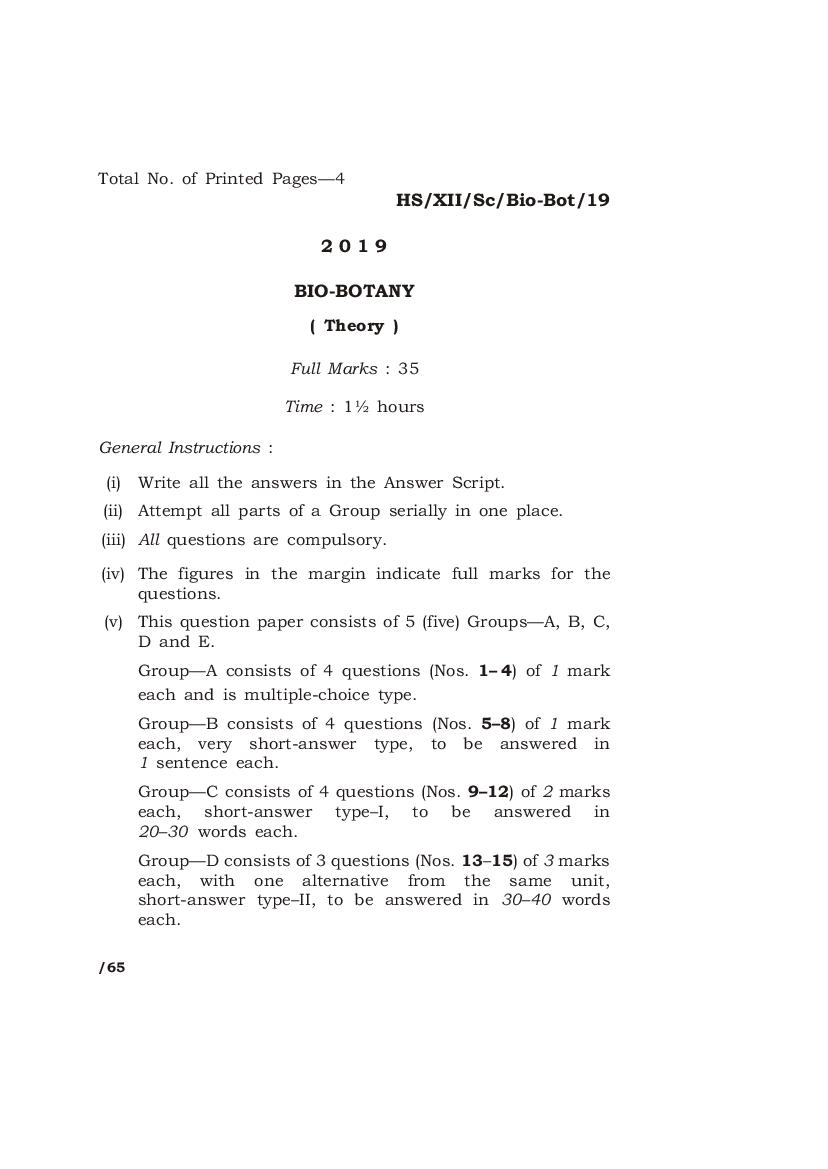
HS/XII/Sc/Bio-Bot/19
2019
BIO-BOTANY
( Theory )
Full Marks : 35
Time : 1½ hours
General Instructions :
(i) Write all the answers in the Answer Script.
(ii) Attempt all parts of a Group serially in one place.
(iii) All questions are compulsory.
(iv) The figures in the margin indicate full marks for the
questions.
(v) This question paper consists of 5 (five) Groups—A, B, C,
D and E.
Group—A consists of 4 questions (Nos. 1– 4) of 1 mark
each and is multiple-choice type.
Group—B consists of 4 questions (Nos. 5–8) of 1 mark
each, very short-answer type, to be answered in
1 sentence each.
Group—C consists of 4 questions (Nos. 9–12) of 2 marks
each, short-answer type–I, to be answered in
20–30 words each.
Group—D consists of 3 questions (Nos. 13–15) of 3 marks
each, with one alternative from the same unit,
short-answer type–II, to be answered in 30–40 words
each.
/65
Page 2
Group—E consists of 2 questions (Nos. 16 and 17) of
5 marks each, with one alternative for each question,
long-answer type, to be answered in 70–80 words each.
GROUP—A
Choose and write the correct answer for the following :
1×4=4
1. Sporopollenin occurs in the wall of
(a) egg cell
(b) pollen grain
(c) synergids
(d) antipodal cells
2. Which of the following is required as inducer for the
expression of lac operon?
(a) Lactose
(b) Galactose
(c) Glucose
(d) Lactose and galactose
3. Emasculation is the process of removal of
(a) stigma
(b) stamen
(c) carpel
(d) petals
Page 3
4. A grazing food chain cannot begin in the absence of
(a) carnivores
(b) herbivores
(c) producers
(d) decomposers
GROUP—B
5. Write two important characteristics of anemophilous
flowers. ½×2=1
6. Define heterosis. 1
7. Define totipotency. 1
8. What are mutagens? 1
GROUP—C
9. What are transgenic plants? Give two examples. 1+1=2
10. What is biogas? Name the principal organism
involved in its production. 1+1=2
11. Define symbiosis. Give two examples. 1+1=2
12. Name the bacterium responsible for the large holes
seen in ‘Swiss cheese’. What are those holes due to?
1+1=2
Page 4
GROUP—D
13. Draw a well-labelled diagram of an angiospermic
ovule showing porogamous type of pollen
germination. 3
14. What are complementary genes? Explain with the
help of an example. 1+2=3
15. Give an account of the production of human insulin
in transgenic organism. 3
Or
Write the technique of plant tissue culture. 3
GROUP—E
16. Define transcription. Explain the process of
transcription in bacteria with suitable diagram.
1+3+1=5
Or
Explain the chromosomal theory of inheritance. 5
17. Briefly explain the biotic components of an
ecosystem. 5
Or
What are ecological pyramids? Describe briefly
different types of ecological pyramids with suitable
diagrams. 1+3+1=5
HHH
HS/XII/Sc/Bio-Bot/19/65 K9—5220
Document Details
| Board / Org | Meghalaya Board |
| Exam | Class 12 |
| Type | Question Paper |
| Pages | 4 |
| Updated | 15 Jul 2026 |