KUET 2025 Question Paper Zoology
Finished viewing? Save it for later —
Download KUET 2025 Question Paper Zoology (PDF · 15 pages)About KUET 2025 Question Paper Zoology
KUET 2025 Question Paper Zoology is available here for free download. Published by University of Kashmir for KUET, this question paper can be viewed online or downloaded as a PDF (15 pages). Candidates preparing for KUET can use KUET 2025 Question Paper Zoology to understand the exam pattern, the type of questions asked, and the overall difficulty level.
Frequently Asked Questions
How can I download KUET 2025 Question Paper Zoology?
Open this page and click the Download button to save KUET 2025 Question Paper Zoology as a PDF. It is completely free on AglaSem Docs.
Is KUET 2025 Question Paper Zoology free to download?
Yes. KUET 2025 Question Paper Zoology can be viewed online and downloaded as a PDF free of cost on AglaSem Docs.
How many pages does KUET 2025 Question Paper Zoology have?
KUET 2025 Question Paper Zoology contains 15 pages, which you can read online or download together as a single PDF.
Where can I find more KUET study material?
You can find more KUET question papers, sample papers, syllabus, and answer keys on AglaSem Docs.
KUET 2025 Question Paper Zoology – Text
Read the full text of this question paper below — useful to quickly search, copy and reference the content online without downloading the PDF.
📄 View text version (16 pages)
Page 1
KUET 2025 Question
Paper Zoology
EXAM YEAR TYPE
KUET 2025 Question Paper
Notes · Sample Papers · Previous Year Papers · Mock Tests
Page 2
m .co
c. o
e m
em l a s
s a g
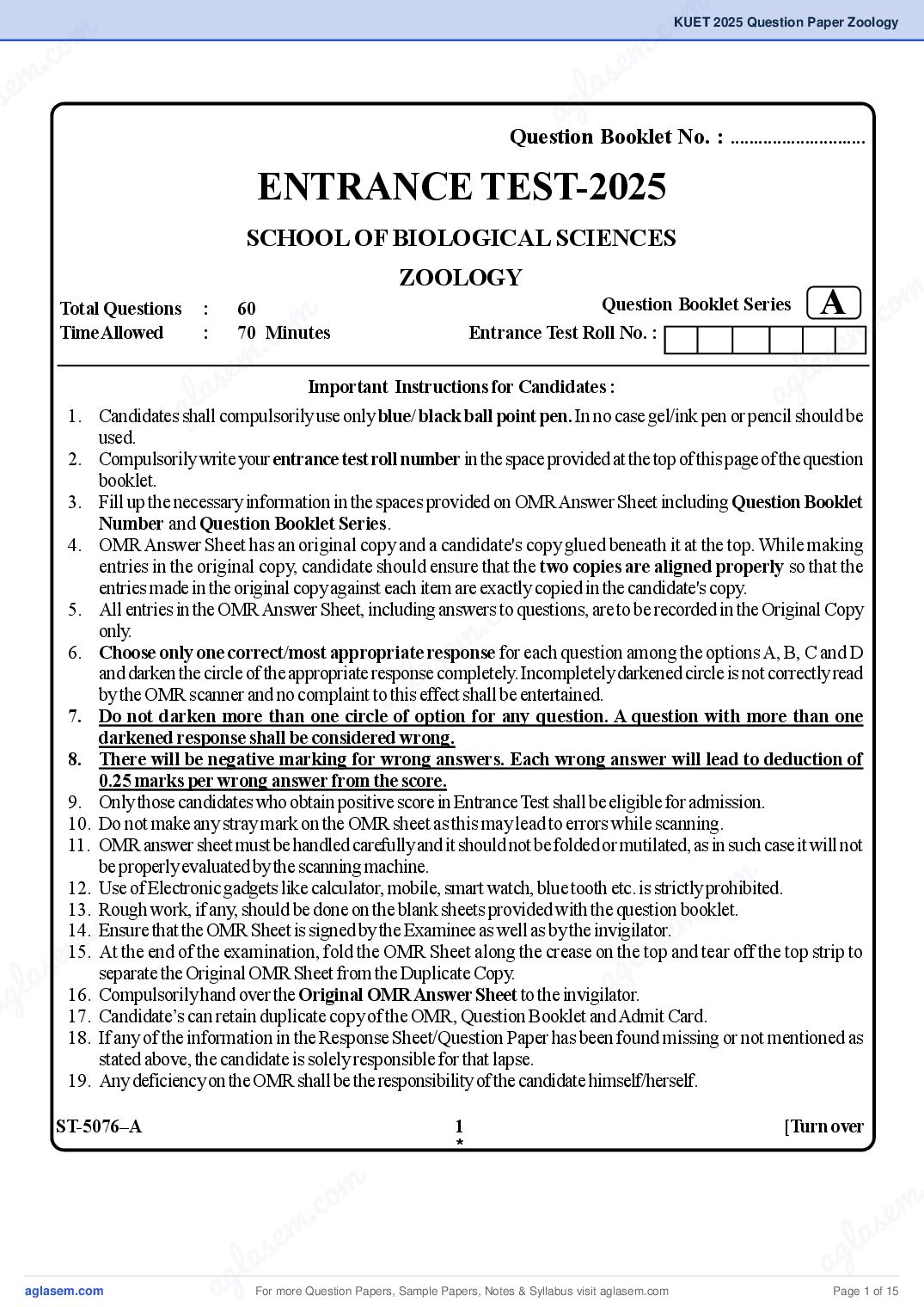
Question Booklet No. : .............................
ENTRANCE TEST-2025
SCHOOL OF BIOLOGICAL SCIENCES
A .com
ZOOLOGY
m
co
Total Questions : 60 Question Booklet Series
. e m
as
Time Allowed : 70 Minutes Entrance Test Roll No. :
e m l
a s g
l compulsorily use only blue/ black ball point pen. In no case gel/ink pen or pencila should be
g
Important Instructions for Candidates :
used.
a
1. Candidates shall
2. Compulsorily write your entrance test roll number in the space provided at the top of this page of the question
booklet.
3. Fill up the necessary information in the spaces provided on OMR Answer Sheet including Question Booklet
Number and Question Booklet Series.
4. OMR Answer Sheet has an original copy and a candidate's copy glued beneath it at the top. While making
entries in the original copy, candidate should ensure that the two copies are aligned properly so that the
m
co
entries made in the original copy against each item are exactly copied in the candidate's copy.
.
5. All entries in the OMR Answer Sheet, including answers to questions, are to be recorded in the Original Copy
em
only.
a s
6. Choose only one correct/most appropriate response for each question among the options A, B, C and D
l
g
and darken the circle of the appropriate response completely. Incompletely darkened circle is not correctly read
a
by the OMR scanner and no complaint to this effect shall be entertained.
7. Do not darken more than one circle of option for any question. A question with more than one
darkened response shall be considered wrong.
8. There will be negative marking for wrong answers. Each wrong answer will lead to deduction of
0.25 marks per wrong answer from the score.
9. Only those candidates who obtain positive score in Entrance Test shall be eligible for admission.
10. Do not make any stray mark on the OMR sheet as this may lead to errors while scanning.
11. OMR answer sheet must be handled carefully and it should not be folded or mutilated, as in such case it will not
m
co
be properly evaluated by the scanning machine.
m .
12. Use of Electronic gadgets like calculator, mobile, smart watch, blue tooth etc. is strictly prohibited.
c. o se
m
13. Rough work, if any, should be done on the blank sheets provided with the question booklet.
em la
14. Ensure that the OMR Sheet is signed by the Examinee as well as by the invigilator.
las g
15. At the end of the examination, fold the OMR Sheet along the crease on the top and tear off the top strip to
g
separate the Original OMR Sheet from the Duplicate Copy.
a
a 16. Compulsorily hand over the Original OMR Answer Sheet to the invigilator.
17. Candidate’s can retain duplicate copy of the OMR, Question Booklet and Admit Card.
18. If any of the information in the Response Sheet/Question Paper has been found missing or not mentioned as
stated above, the candidate is solely responsible for that lapse.
19. Any deficiency on the OMR shall be the responsibility of the candidate himself/herself.
ST-5076–A 1 [Turn over
*
m .
.co s e m
e m l a
l a s a g
ag For more Question Papers, Sample Papers, Notes & Syllabus visit Page 1 of 15
Page 3
(A) Coelom (A) Housefly
(B) Pseudocoelom (B) Grasshopper
(C) Both (A) and (B) (C) Mayfly
(D) None of the above (D) Silverfish
2. How many proglottids are found in adult Taenia 8. Which of the following is not a characteristic feature
solium ? of Echinoderms ?
(A) 1000 (A) Cephalization
(B) 1000-2000 (B) Water vascular system
(C) 2000 (C) Enterocoelous coelom with mesodermal derived
(D) 2000-3000 archenteron
3. Which of the following protozoans perform (D) Poorly developed circulatory system
locomotion through ciliary movements ? 9. Which of the following statement is true about
(A) Balantidium, Paramecium, Vorticella Elasmobranchs ?
(B) Euglena, Lophomonas, Entamoeba (A) Skeleton is made up of cartilage
(C) Amoeba, Paramecium, Euglena (B) Five to seven gill openings on each side
(D) Trichonympha, Vorticella, Lophomonas (C) Placoid scales are present
4. Which cells are involved in food reserve and nutrient (D) All of the above
storage in sponges among the following ? 10. Which of the following belongs to Cephalochordata ?
(A) Choanocytes (A) Herdmania
(B) Amoebocytes (B) Jellyfish
(C) Collencytes (C) Amphioxus
(D) Thesocytes (D) Sea urchin
5. Which one of the following is not a characteristic of 11. The excretion of salt is carried out by osmoregulators
phylum Arthropoda? through:
(A) Haemocoelom (A) Gills
(B) Ventral nerve cord (B) Bladder
(C) Metameric segmentation (C) Fins
(D) Closed circulatory system (D) Scales
6. True coelom, segmentation and closed circulatory 12. A tunicate, marine invertebrate belongs to the sub-
system are characteristic of phylum: phylum:
(A) Arthropoda (A) Hemichordata
(B) Annelida (B) Urochordata
(C) Mollusca (C) Cephalochordata
(D) Echinodermata (D) Protochordata
ST-5076–A 2
*
For more Question Papers, Sample Papers, Notes & Syllabus visit Page 2 of 15
Page 4
m .co
c. o
e m
em l a s
s a g
13. The thoracic and abdominal cavity are separated by 19. In man, the sour taste receptors are found on:
a muscular diaphragm in: (A) Tip of the tongue
(A) Fishes (B) Tip and sides of the tongue
(B) Lizards (C) Along the lateral edges of the tongue
(C) Crocodiles (D) At the base of the tongue
(D) Birds
m
20. The place for collection of venous blood in primitive
c. o
14. Which of the following structural modification adds
m
vertebrate heart is:
co m
to the length of the forearm in birds ?
. e
(A) Atrium
(A) Humerus
em la s
s g
(B) Sinus venosus
l a a
(B) Radius
ag
(C) Ventricle
(C) Ulna
(D) None of the above
(D) Carpometacarpus
21. The erythrocytes are nucleated in:
15. In some insects, the filter chamber is a modification
(A) Mammals
to:
(A) Conserve water (B) Man
(B) Remove excess fluid (C) Camel
(C) Digest proteins (D) None of the above
o m
c
22. “The tube within a tube” body organization is found
16. Among poisonous snakes superior labial or parotid .
(D) Digest fats
em (A) Arthropoda
in:
glands are modified into:
la s
(A) Poison glands
(B) Poison ducts a g (B) Annelida
(C) Porifera
(C) Fangs (D) Mollusca
(D) Poison muscles 23. Approximately, how many nerve cells are present in
17. The hairs in mammals are the derivatives of: a human brain:
(A) Epidermis (A) 1 million
m
(B) Endodermis (B) 10 million
m
(C) Dermis (C) 10 billion
.c o
co m
18. .The organs of respiration in prawn are: e ecosystem contains:
(D) Mesodermis (D) 100 billion
em (A) Gills a s
s (A) Sharks gl
24. The upper part of an aquatic
gla (B) Trachea a
a (C) Lungs
(B) Plankton
(C) Benthos
(D) Book lungs (D) Both (A) and (B)
ST-5076–A 3 [Turn over
*
m .
.co s e m
e m l a
l a s a g
ag For more Question Papers, Sample Papers, Notes & Syllabus visit Page 3 of 15
Page 5
in about: (A) Ammonia
(A) 24 hours
(B) Urea
(B) Two days
(C) Uric acid
(C) Seven days
(D) All of the above
(D) 3 weeks
32. The most common vertebrate respiratory pigment is:
26. When the yolk particles are present in little amount
and are fairly evenly distributed throughout the (A) Haemoglobin
cytoplasm, the egg is known as: (B) Haemocyanin
(A) Oligolecithal (C) Pinnaglobin
(B) Telolecithal (D) Vanadium
(C) Centrolecithal 33. A muscle unable to undergo a sustained contraction
(D) Macrolecithal is:
27. Which of the following contains diploid number of (A) Cardiac muscle
chromosomes ?
(B) Skeletal muscle
(A) Primary spermatocyte
(C) Visceral muscle
(B) Secondary spermatocyte
(C) Spermatid (D) None of the above
(D) Spermatozoan 34. Which of the following has receptors for hearing ?
28. Which of the following type of placenta is found in (A) Ampulla
human beings ? (B) Vestibule
(A) Epitheliochorial (C) Macula
(B) Endotheliochorial (D) Organ of corti
(C) Haemochorial 35. During vision, a bundle of nerve fibres carrying
(D) All of the above electrical impulses from the retina to the brain is called:
29. Which of the following is odd one ?
(A) Optic nerve
(A) Lipase
(B) Choroid
(B) Maltase
(C) Ciliary body
(C) Lactase
(D) None of the above
(D) Sucrase
30. Trypsin has highest activity of protein digestion at pH 36. What effect does high concentrations of carbon
of: dioxide have on haemoglobin and blood ?
(A) pH 6 (A) An increase in blood pH
(B) pH 8 (B) A decrease in blood pH
(C) pH 10 (C) Haemoglobin picking up more oxygen
(D) pH 12 (D) No effect on haemoglobin
ST-5076–A 4
*
For more Question Papers, Sample Papers, Notes & Syllabus visit Page 4 of 15
Page 6
m .co
c. o
e m
em l a s
s a g
37. When one or more pairs of spiracles totally disappear 43. Which of the following taxonomic characters cannot
from the usual 10 pairs in insects, the arrangement is be studied in preserved material ?
termed as: (A) DNA
(A) Apneustic (B) Protein
(B) Holopneustic (C) Egg structure
(C) Hemipneustic (D) Behavior
m
c. o
(D) Hypopneustic 44. The end product of Ornithine cycle is:
m
co m
38. The pineal gland is located in: (A) Ammonia
m . (B) Urea
s e
la
(A) On kidney
s e g
a
(C) Uric acid
a
(B) Beneath the thymus gland
l
ag
(C) Beneath the thyroid gland (D) Carbon dioxide
(D) In the brain 45. The tendency of linked genes to remain together during
the process of inheritance is called:
39. Deficiency of vasopressin hormone causes:
(A) Linkage
(A) Diabetes insipidus
(B) Synapses
(B) Diabetes mellitus
(C) Crossing over
(C) Gestational diabetes
(D) Terminalization
(D) Addison’s disease
m
46. The process of transferring and immobilizing DNA
co
40. A distinct group of organisms which can be assigned
.
onto a membrane after restriction enzyme digestion
em
to a definite category at any level of a hierarchic
and electrophoresis is called:
a s
classification is called:
l
(A) W-blotting
a g
(A) Phenon
(B) N-blotting
(B) Category
(C) S-blotting
(C) Taxon
(D) All of the above
(D) All of the above 47. Which of the following is the most familiar sex-linked
41. The main source of ATP in a cell is: character ?
(A) Glycolysis (A) Haemophilia
(B) Krebs cycle (B) Red-green colour blindness
m
co
(C) Electron Transport System (ETS) (C) Congenital night blindness
m .
c. o m
(D) Pyruvate oxidation (D) All of the above
em la se
42. The presence of peroxide-producing enzymes is the 48. The enzyme used in making cDNA Library is known
s
la (A) Lysosomes
characteristic feature of: as:
a g
ag (B) Peroxisomes
(A) Taq polymerase
(B) Reverse transcriptase
(C) Spherosomes (C) DNA polymerase
(D) All of the above (D) RNA polymerase
ST-5076–A 5 [Turn over
*
m .
.co s e m
e m l a
l a s a g
ag For more Question Papers, Sample Papers, Notes & Syllabus visit Page 5 of 15
Page 7
mutation is: (A) Self-immune system
(A) Cistron (B) Specific immunity
(B) Mutan (C) Auto-immunity
(C) Recon (D) None of the above
(D) None of the above 56. A unit of evolutionary morphological change equal to
one standard deviation per generation is called:
50. DNA replication in most prokaryotic cells is:
(A) Darwin
(A) Unidirectional
(B) Haeckel
(B) Bidirectional
(C) Von Baer
(C) Conservative
(D) Haldane
(D) All of the above
57. Who finalized the biological species concept ?
51. Which gene is commonly used in the study of DNA
(A) Carolus Linnaeus
barcoding and phylogeny of animal phyla ?
(B) Aristotle
(A) Mitochondrial gene
(C) Theophrastus
(B) Nuclear gene (D) Ernst Mayr
(C) Ribosomal gene 58. Morphologically similar and reproductively isolated
(D) Mutant gene species are termed as:
52. The temperature-dependant sex determination is found (A) Sympatric species
in : (B) Sibling species
(A) Reptiles and teleost fish (C) Allopatric species
(B) Fishes and amphibians (D) Parapatric species
(C) Both (A) and (B) 59. Which of the following is the most important factor
(D) None of the above for splitting up of the species and establishing a new
species ?
53. Animals defend their territory against:
(A) Adaptation
(A) Predator
(B) Climate
(B) Any intruder
(C) Heredity
(C) Intruder of another species
(D) Isolation
(D) Intruder of same species
60. What was the largest of the known mass extinctions
54. Archaeopteryx is a connecting link between: of life on earth ?
(A) Amphibians and Reptiles (A) Ordovician-Silurian
(B) Reptiles and Mammals (B) Devonian
(C) Reptiles and Birds (C) Permian-Triassic
(D) Birds and Mammals (D) Triassic-Jurassic
ST-5076–A 6
*
For more Question Papers, Sample Papers, Notes & Syllabus visit Page 6 of 15
Page 8
m .co
c. o
e m
em l a s
s ROUGH WORK a g
m
m c. o
.co s e m
em la
l a s a g
ag
m
. co
s em
g l a
a
m
m .co
c. o se
m
s em g la
gla a
a
ST-5076–A 7
*
m .
.co s e m
e m l a
l a s a g
ag For more Question Papers, Sample Papers, Notes & Syllabus visit Page 7 of 15
Page 9
ST-5076–A 8 275
*
For more Question Papers, Sample Papers, Notes & Syllabus visit Page 8 of 15
Page 10
c. o se
m
em la
as a g
m
co
m m .co
m . s e
se l a
l a ag
ag
m
. co
s em
g l a
a
m
m c. o
c. o s e m
s em la
gla ag
a
m . c
.co s e m
e m l a
as
For more Question Papers, Sample Papers, Notes & Syllabus visit
a g Page 9 of 15
Page 11
Page 12
. co se
m
em la
as a g
m
om . co
.c e m
e m l a s
l a s a g
ag
m
. co
s em
g l a
a
m
m c. o
c. o s e m
s em la
gla ag
a
m . c
c. o s e m
sem g l a
a
For more Question Papers, Sample Papers, Notes & Syllabus visit Page 11 of 15
Page 13
Page 14
c. o s e m
em
l a
as a g
m
co
m m.co
m . s e
se la
l a ag
ag
m
. co
s em
g l a
a
m
m c. o
c. o s e m
s em l a
gla ag
a
m . c
c. o s e m
sem g l a
a
For more Question Papers, Sample Papers, Notes & Syllabus visit
aPage 13 of 15
Page 15
Page 16
c. o se
m
em
as g la
a
m
co
m m .co
m . s e
s e la
la ag
ag
m
. co
s em
g l a
a
m
m c. o
c. o s e m
s em l a
gla ag
a
m . c
c. o s e m
sem la
la
For more Question Papers, Sample Papers, Notes & Syllabus visit
ag
Page 15 of 15
Document Details
| Board / Org | University of Kashmir |
| Exam | KUET |
| Type | Question Paper |
| Pages | 15 |
| Updated | 29 Oct 2026 |