MBOSE Class 12 Question Paper 2019 for Chemistry
Finished viewing? Save it for later —
Download MBOSE Class 12 Question Paper 2019 for Chemistry (PDF · 12 pages)About MBOSE Class 12 Question Paper 2019 for Chemistry
MBOSE Class 12 Question Paper 2019 for Chemistry is available here for free download. Published by Meghalaya Board for Class 12, this question paper can be viewed online or downloaded as a PDF (12 pages). Candidates preparing for Class 12 can use MBOSE Class 12 Question Paper 2019 for Chemistry to understand the exam pattern, the type of questions asked, and the overall difficulty level.
Frequently Asked Questions
How can I download MBOSE Class 12 Question Paper 2019 for Chemistry?
Open this page and click the Download button to save MBOSE Class 12 Question Paper 2019 for Chemistry as a PDF. It is completely free on AglaSem Docs.
Is MBOSE Class 12 Question Paper 2019 for Chemistry free to download?
Yes. MBOSE Class 12 Question Paper 2019 for Chemistry can be viewed online and downloaded as a PDF free of cost on AglaSem Docs.
How many pages does MBOSE Class 12 Question Paper 2019 for Chemistry have?
MBOSE Class 12 Question Paper 2019 for Chemistry contains 12 pages, which you can read online or download together as a single PDF.
Where can I find more Class 12 study material?
You can find more Class 12 question papers, sample papers, syllabus, and answer keys on AglaSem Docs.
MBOSE Class 12 Question Paper 2019 for Chemistry – Text
Read the full text of this question paper below — useful to quickly search, copy and reference the content online without downloading the PDF.
📄 View text version (12 pages)
Page 1
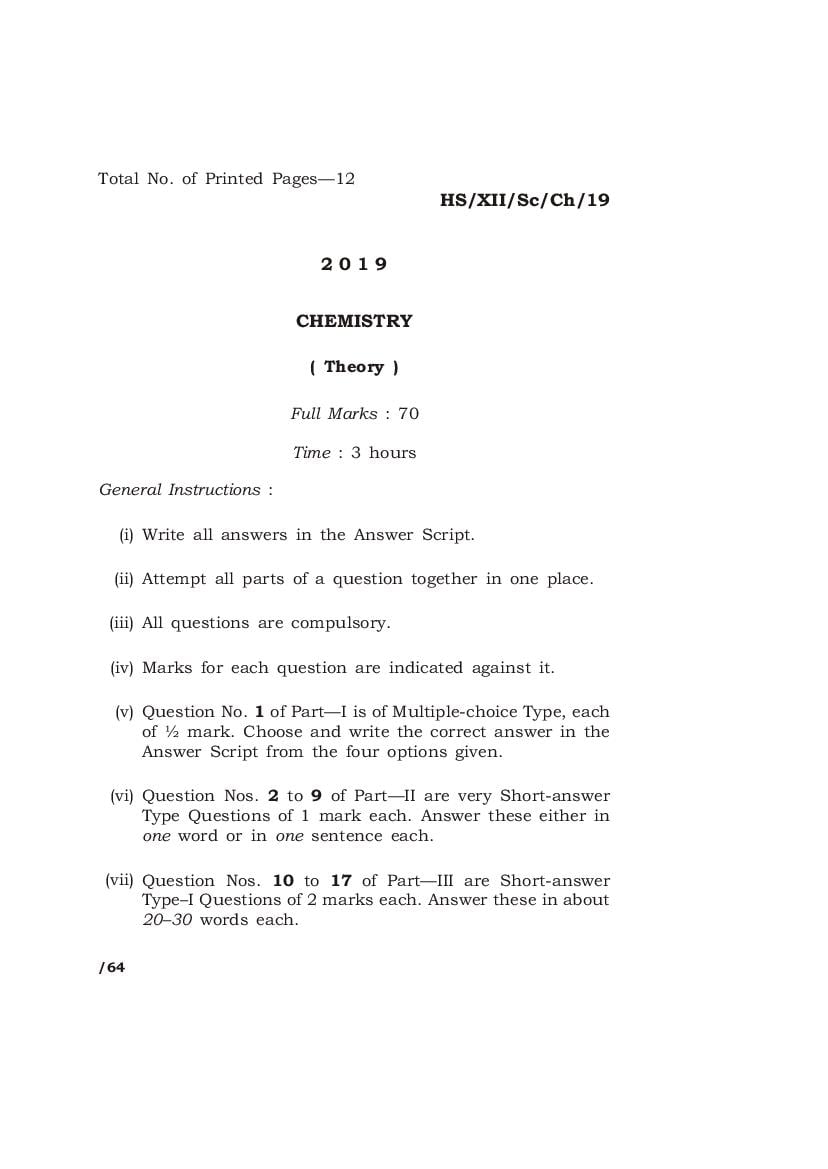
HS/XII/Sc/Ch/19
2019
CHEMISTRY
( Theory )
Full Marks : 70
Time : 3 hours
General Instructions :
(i) Write all answers in the Answer Script.
(ii) Attempt all parts of a question together in one place.
(iii) All questions are compulsory.
(iv) Marks for each question are indicated against it.
(v) Question No. 1 of Part—I is of Multiple-choice Type, each
of ½ mark. Choose and write the correct answer in the
Answer Script from the four options given.
(vi) Question Nos. 2 to 9 of Part—II are very Short-answer
Type Questions of 1 mark each. Answer these either in
one word or in one sentence each.
(vii) Question Nos. 10 to 17 of Part—III are Short-answer
Type–I Questions of 2 marks each. Answer these in about
20–30 words each.
/64
Page 2
(viii) Question Nos. 18 to 26 of Part—IV are Short-answer
Type–II Questions of 3 marks each. Answer these in
about 40–50 words each.
(ix) Question Nos. 27 to 29 of Part—V are Long-answer Type
Questions of 5 marks each. Answer these in about
70–80 words each.
(x) Use of non-programmable ordinary Scientific Calculators
and Log Tables is allowed.
(xi) Mobile phones and Pagers are not allowed inside the
Examination Hall.
PART—I
1. Choose and write the correct answers for the
following in the Answer Script : ½×8=4
(a) In which pair is the most efficient packing
present?
(i) hcp and bcc
(ii) bcc and ccp
(iii) hcp and ccp
(iv) bcc and simple cubic
(b) The fraction of the total volume occupied by the
atoms present in a simple cubic is
p
(i)
4
p
(ii)
6
p
(iii)
3 2
p
(iv)
4 2
Page 3
(c) Increasing the temperature of an aqueous
solution will cause
(i) decrease in molality
(ii) decrease in molarity
(iii) decrease in mole fraction
(iv) decrease in mass percent
(d) Colligative properties are those properties which
depend on
(i) shapes of the particles
(ii) nature of the particles only
(iii) nature of the solvent only
(iv) number of particles only
(e) The most suitable reagent for the conversion of
R — CH2 — OH ® RCHO is
(i) KMnO4
(ii) K 2Cr2O 7
(iii) LiAlH4
(iv) PCC
(f) The strongest acid among the following
compounds is
(i) o-nitrophenol
(ii) p-chlorophenol
(iii) m-nitrophenol
(iv) p-nitrophenol
Page 4
(g) Which of the following acids is a vitamin?
(i) Aspartic acid
(ii) Adipic acid
(iii) Ascorbic acid
(iv) Saccharic acid
(h) The reason for the double helical structure of
DNA is due to the presence of
(i) van der Waals’ forces
(ii) dipole-dipole interactions
(iii) hydrogen bonding
(iv) London forces
PART—II
2. What is Kraft temperature? 1
3. What are ambidentate ligands? 1
4. Arrange the following in order of decreasing SN1
reactivity : 1
(CH 3 )3 C Cl , CH 3Cl , (CH 3 )2 CHCl , CH 3CH2Cl
5. Write the IUPAC name of
O
CH3 1
6. Identify the products A and B formed in the following
reaction : ½+½=1
CH 3 — CH2 — CH = CH — CH 3 + HCl ¾¾® A + B
Page 5
7. Give one reaction that can be used as a test for
primary amines. 1
8. Identify A and B in the following reaction : ½+½=1
O
Cl H2/Pd
KCN
A B
9. How does antiferromagnetism differ from
ferromagnetism in terms of magnetic domains? 1
PART—III
10. An element has bcc structure with cell edge of
288 pm. The density of the element is 7·2 g cm -3 .
How many atoms are present in 208 g of the
element? 2
11. Either
(a) What will happen to the boiling point of a
solution on mixing two miscible liquids showing
negative deviation from Raoult’s law? 1
(b) Give two conditions necessary for a solution to
be ideal. 1
Or
(c) Derive a relation between relative lowering of
vapour pressure and mole fraction of the solute. 2
Page 6
12. The boiling point of benzene is 353·23 K. When
1·80 g of a nonvolatile solute was dissolved in 90 g of
benzene, the boiling point is raised to 354·11 K.
Calculate the molar mass of the solute. (K b for
benzene is 2·53 K kg mol -1) 2
13. (a) When does the average rate of a reaction become
equal to instantaneous rate? 1
(b) Write any one condition under which a
bimolecular reaction may be kinetically of first
order. 1
14. (a) Calculate the magnetic moment of a divalent ion
in aqueous solution if its atomic number is 25. 1
(b) Predict which of the following will be coloured in
aqueous solution : 1
Sc 3 + , Fe 3 + , Ti4 + , V 3 +
(Atomic nos. of Sc, Fe, Ti and V are 21, 26, 22
and 23 respectively)
15. Either
(a) Write the IUPAC name of the following complex : 1
Pt [Cl2 (en)2 ](NO 3 )2
(b) Name the type of isomerism exhibited by the
following pairs of complexes : ½×2=1
(i) [Co (NH 3 )6 ][Cr (CN)6 ] and
[Cr (NH 3 )6 ][Co (CN)6 ]
(ii) [Co (NH 3 )5 SO4 ]Br and [Co (NH 3 )5 Br ]SO4
Page 7
Or
(c) Is the complex [Ni (CO)4 ] a low-spin or a
high-spin complex? Explain on the basis of VBT. 2
16. Write the products of the following reaction. Which
one is the major product and why? 2
Alc. KOH
CH3—CH—CH2—CH3 A+B
D
Br
17. (a) Arrange the following substances in increasing
order of their basic strength in water : 1
C 6H 5NH2 , (C2H 5 )2 NH , (C2H 5 )3 N , C2H 5NH2
(b) Out of ethylamine and ethyl alcohol, which has
higher boiling point and why? 1
PART—IV
18. Either
(a) Half-life period of a reaction increases with
increase in initial concentration. Predict the
order of the reaction. 1
(b) Decomposition of a compound follows first-order
kinetics. If it takes 15 minutes for 20% of
original substance to decay, calculate—
(i) rate constant;
(ii) the time at which 10% of the reactant
remains undecayed. 1+1=2
Page 8
Or
(c) Define activation energy. 1
(d) The rate of a particular reaction doubles when
temperature changes from 27 ºC to 37 ºC.
Calculate the value of activation energy.
(R = 8·314 J K -1 mol -1) 2
19. (a) Distinguish between Physical adsorption and
Chemical adsorption. 1
(b) What do you mean by selectivity of a catalyst? 1
(c) State Hardy-Schulze rule. 1
20. Either
(a) What are the two requirements for vapour phase
refining? Write the chemical reactions which
occur during Mond’s process for the refining of
nickel. 3
Or
(b) What is the role of cryolite in the metallurgy of
aluminium? 1
(c) Name the depressant used for the separation of
ZnS ore from PbS ore during froth floatation
process. 1
(d) How would you convert pig iron into cast iron? 1
Page 9
21. Give reason for the following : 1+2=3
(a) O 3 acts as a powerful oxidizing agent.
(b) O2 is a gas but sulphur is a solid.
22. (a) Write the reaction of KMnO4 with Fe(II) ions in
acidic medium. 1
(b) Define lanthanoid contraction. Write two
consequences of lanthanoid contraction. 1+1=2
23. (a) How would you convert propene to propan-1-ol? 1
(b) Complete the following reactions : 1×2=2
OC2H5
(i) + HBr ?
OH
340 K
(ii) + CHCl3 + NaOH ?
24. Either
(a) Name the vitamins whose deficiency is
responsible for—
(i) night blindness;
(ii) poor coagulation of blood. ½+½=1
(b) What are essential and nonessential amino
acids? Give one example of each type. 1+1=2
Page 10
Or
(c) What is the difference between amylose and
amylopectin? 1
(d) What is a glycosidic linkage? 1
(e) Name the base that is found in RNA only. 1
25. (a) What is a biodegradable polymer? 1
(b) Classify the following into addition and
condensation polymers : 2
Terylene, Bakelite, Polyvinyl chloride, Polythene
26. (a) What are tranquilizers? 1
(b) What are broad-spectrum antibiotics? 1
(c) Name a substance that can be used as an
antiseptic as well as disinfectant. 1
PART—V
27. Either
(a) Why does the conductivity of a solution decrease
with dilution? 1
(b) Write two conditions necessary for the corrosion
to occur. 1
Page 11
(c) State Kohlrausch’s law. Calculate the molar
conductivity of an aqueous solution at infinite
dilution for BaCl2 , when ionic conductances of
Ba 2+ and Cl - ions are 127·30 S cm2 mol -1 and
76·34 S cm2 mol -1 respectively. 1+2=3
Or
(d) What are fuel cells? 1
(e) Write all reactions taking place during
recharging of lead storage cell. 2
(f) Calculate the standard Gibbs’ energy change for
the reaction
Zn (s) + Cu2 + (aq) ® Zn2 + (aq) + Cu (s)
(Given, E º º
= -0·76 V, E Cu = +0·34 V)
Zn 2 + /Zn 2+
/Cu 2
28. Either
(a) How does ammonia react with a solution of
Cu2+ ions? 1
(b) Draw the structure of cyclometaphosphoric acid. 1
(c) Write the principle and conditions involved
giving stepwise reaction for the manufacture of
H2SO4 by contact process. 3
Or
(d) HCl reacts with powdered Fe to give FeCl2 and
not FeCl 3 . Why? 1
Page 12
(e) When NaBr is heated with conc. H2SO4 , Br2 is
produced. But when NaCl is heated with
conc. H2SO4 , HCl is produced. Explain with
chemical equations. 2
(f) Complete the following reactions : 1×2=2
(i) Cu + HNO 3 (dilute) ¾¾® ?
(ii) XeF4 + O2F2 ¾¾® ?
29. (a) Arrange the following in increasing order of
acidic strength : 1
ClCH2COOH , CF3COOH , HCOOH , CCl 3COOH
(b) Identify the products A, B, C and D in the given
reactions : 1×2=2
COOH
SOCl2 H2-Pd/BaSO4
(i) A B
CH3
KMnO4 H3O+
(ii) C D
KOH, D
(c) How will you bring about the following
conversions? 1×2=2
(i) Ethyl cyanide to 1-phenyl propanone
(ii) Ethanal to 2-aminoethanoic acid
HHH
HS/XII/Sc/Ch/19/64 K9—5450
Document Details
| Board / Org | Meghalaya Board |
| Exam | Class 12 |
| Type | Question Paper |
| Pages | 12 |
| Updated | 15 Jul 2026 |