Kerala Plus One Plus Two Syllabus
Finished viewing? Save it for later —
Download Kerala Plus One Plus Two Syllabus (PDF · 153 pages)About Kerala Plus One Plus Two Syllabus
Kerala Plus One Plus Two Syllabus is available here for free download. Published by Kerala Board for Class 12, this syllabus can be viewed online or downloaded as a PDF (153 pages). Candidates preparing for Class 12 can use Kerala Plus One Plus Two Syllabus to understand the exam pattern, the type of questions asked, and the overall difficulty level.
Frequently Asked Questions
How can I download Kerala Plus One Plus Two Syllabus?
Open this page and click the Download button to save Kerala Plus One Plus Two Syllabus as a PDF. It is completely free on AglaSem Docs.
Is Kerala Plus One Plus Two Syllabus free to download?
Yes. Kerala Plus One Plus Two Syllabus can be viewed online and downloaded as a PDF free of cost on AglaSem Docs.
How many pages does Kerala Plus One Plus Two Syllabus have?
Kerala Plus One Plus Two Syllabus contains 153 pages, which you can read online or download together as a single PDF.
Where can I find more Class 12 study material?
You can find more Class 12 question papers, sample papers, syllabus, and answer keys on AglaSem Docs.
Kerala Plus One Plus Two Syllabus – Text
Read the full text of this syllabus below — useful to quickly search, copy and reference the content online without downloading the PDF.
📄 View text version (144 pages)
Page 1
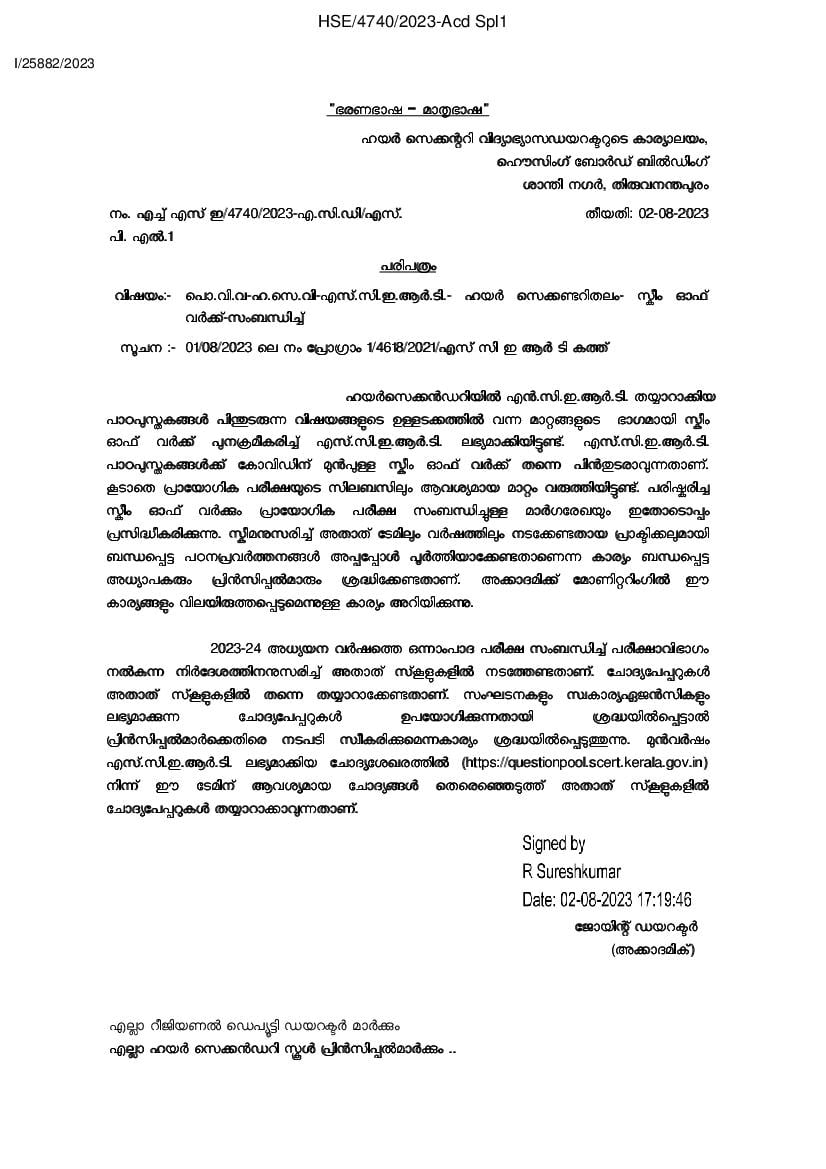
I/25882/2023
"ഭരണഭാഷ – മാ ഭാഷ"
ഹയർ െസ റി വിദ ാഭ ാസഡയറ െട കാര ാലയം,
െഹൗസിംഗ് േബാർഡ് ബിൽഡിംഗ്
ശാ ി നഗർ, തി വന രം
നം. എ ് എസ് ഇ/4740/2023-എ.സി.ഡി/എസ്. തീയതി: 02-08-2023
പി. എൽ.1
പരിപ ം
വിഷയം:- െപാ.വി.വ-ഹ.െസ.വി-എസ്.സി.ഇ.ആർ.ടി.- ഹയർ െസ റിതലം- ീം ഓഫ്
വർ ്-സംബ ി ്
ചന :- 01/08/2023 െല നം േ ാ ാം 1/4618/2021/എസ് സി ഇ ആർ ടി ക ്
ഹയർെസ ൻഡറിയിൽ എൻ.സി.ഇ.ആർ.ടി. ത ാറാ ിയ
പാഠ ക ൾ പി ട വിഷയ െട ഉ ട ിൽ വ മാ െട ഭാഗമായി ീം
ഓഫ് വർ ് ന മീകരി ് എസ്.സി.ഇ.ആർ.ടി. ലഭ മാ ിയി ്. എസ്.സി.ഇ.ആർ.ടി.
പാഠ ക ൾ ് േകാവിഡിന് ൻ ീം ഓഫ് വർ ് തെ പിൻ ടരാ താണ്.
ടാെത ാേയാഗിക പരീ െട സിലബസി ം ആവശ മായ മാ ം വ ിയി ്. പരി രി
ീം ഓഫ് വർ ം ാേയാഗിക പരീ സംബ ി മാർഗേരഖ ം ഇേതാെടാ ം
സി ീകരി . ീമ സരി ് അതാത് േടമി ം വർഷ ി ം നടേ തായ ാ ി മായി
ബ െ പഠന വർ ന ൾ അ േ ാൾ ർ ിയാേ താെണ കാര ം ബ െ
അധ ാപക ം ിൻസി ൽമാ ം ിേ താണ്. അ ാദമി ് േമാണി റിംഗിൽ ഈ
കാര ം വിലയി െ െമ കാര ം അറിയി .
2023-24 അധ യന വർഷെ ഒ ാംപാദ പരീ സംബ ി ് പരീ ാവിഭാഗം
നൽ നിർേദശ ിന സരി ് അതാത് സ് കളിൽ നടേ താണ്. േചാദ േപ കൾ
അതാത് സ് കളിൽ തെ ത ാറാേ താണ്. സംഘടനക ം സ കാര ഏജൻസിക ം
ലഭ മാ േചാദ േപ കൾ ഉപേയാഗി തായി യിൽെ ാൽ
ിൻസി ൽമാർെ തിെര നടപടി സ ീകരി െമ കാര ം യിൽെ . ൻവർഷം
എസ്.സി.ഇ.ആർ.ടി. ലഭ മാ ിയ േചാദ േശഖര ിൽ (https://questionpool.scert.kerala.gov.in)
നി ് ഈ േടമിന് ആവശ മായ േചാദ ൾ െതെരെ ് അതാത് സ് കളിൽ
േചാദ േപ കൾ ത ാറാ ാ താണ്.
േജായി ് ഡയറ ർ
(അ ാദമിക്)
എ ാ റീജിയണൽ െഡപ ി ഡയറ ർ മാർ ം
എ ാ ഹയർ െസ ൻഡറി ൾ ിൻസി ൽമാർ ം ..
Page 2
I/25882/2023
Page 5
MATHEMATICS (SCIENCE)
TE
No of Lab weighta
Chapters Term & Month Name Periods Periods ge
1 Term I Sets 12 4
2 Relations and functions 17 4
3 JUNE, JULY, Trigonometric functions 18 20 5
4 AUGUST Complex numbers and Quadratic equations 9 3
5 Linear Inequalities 9 3
6 Permutations and Combinations 15 5
Term II
7 Binomial Theorem 8 3
8 Sequences and series 10 5
9 SEPTEMBER, Straight Lines 13 30 5
OCTOBER,
10 Conic Sections 16 5
NOVEMBER,
11 DECEMBER Introduction to Three Dimesional Geometry 8 3
12 Limits and Derivatives 18 6
13 Term III Statistics 12 5
JANUARY, 10
15 4
14 FEBRUARY Probability, Revision
Total 180 60 60
Total working Periods: 240
FIRST YEAR HSS SCHEME OF WORK
MATHEMATICS (COMMERCE)
TE
No of Lab weighta
Chapters Term & Month Name Periods Periods ge
1 Term I Sets 12 4
2 Relations and functions 17 4
3 JUNE, JULY, Trigonometric functions 18 20 4
4 AUGUST Complex numbers and Quadratic equations 9 3
5 Linear Inequalities 9 3
6 Permutations and Combinations 15 5
Term II
7 Binomial Theorem 8 3
8 Sequences and series 10 5
9 SEPTEMBER, Straight Lines 13 30 5
OCTOBER,
10 Conic Sections 16 5
NOVEMBER,
11 DECEMBER Introduction to Three Dimesional Geometry 8 3
12 Limits and Derivatives 18 5
13 Term III Statistics 12 7
JANUARY, 10
15 4
14 FEBRUARY Probability, Revision
Total 180 60 60
Total working Periods: 240
Page 6
MATHEMATICS (SCIENCE)
TE
No of Lab weighta
Chapters Term & Month Name Periods Periods ge
1 Relations and Functions 12 5
Term I
2 Inverse Trigonometric Functions 12 3
3 Matrices 14 25 5
JUNE, JULY,
4 Determinants 16 5
AUGUST
5 Continuity and Differentiability 18 6
6 Term II Application of Derivatives 18 4
7 Integrals 20 6
8 SEPTEMBER, Application of Integrals 10 3
OCTOBER, 25
9 Differential Equations 14 4
NOVEMBER,
10 DECEMBER Vector Algebra 12 5
11 Three Dimensional Geometry 8 4
12 Term III Linear Programming 8 5
JANUARY, 10
18 5
13 FEBRUARY Probability, Revision
Total 180 60 60
Total working Periods: 240
SECOND YEAR HSS SCHEME OF WORK
MATHEMATICS (COMMERCE)
TE
No of Lab weighta
Chapters Term & Month Name Periods Periods ge
1 Relations and Functions 12 4
Term I
2 Inverse Trigonometric Functions 12 3
3 Matrices 14 25 6
JUNE, JULY,
4 Determinants 16 6
AUGUST
5 Continuity and Differentiability 18 5
6 Term II Application of Derivatives 18 5
7 Integrals 20 5
8 SEPTEMBER, Application of Integrals 10 3
OCTOBER, 25
9 Differential Equations 14 3
NOVEMBER,
10 DECEMBER Vector Algebra 12 5
11 Three Dimensional Geometry 8 4
12 Term III Linear Programming 8 5
JANUARY, 10
18 6
13 FEBRUARY Probability, Revision
Total 180 60 60
Total working Periods: 240
Page 7
Scheme of Work and Unit Wise Score Weight
Sl. Term Unit No. of Score
No. (Month) Periods
1 I Some basic concepts in Chemistry 18 6
(June,
2 July, Structure of atom 24 7
Aug.)
3 Classification of elements and periodicity 12 6
in properties
4 Chemical bonding and molecular 22 7
II structure
(Sept.,
5 Oct., Thermodynamics 24 6
Nov.,
6 Dec.) Equilibrium 28 7
7 Redox reactions 8 5
8 III Organic chemistry – some basic 22 8
(Jan., principles and techniques
Feb.)
9 Hydrocarbons 22 8
Total (Theory) 180 60
For Practicals 60 -
Total 240 60
Page 8
Scheme of Work and Unit Wise Score Weight (Theory)
Sl. Term Unit No. of Score
No. (Month) Periods
1 I Solutions 18 6
(June,
2 July, Electrochemistry 21 7
Aug.)
3 Chemical kinetics 18 6
4 The d- and f-Block elements 21 6
5 Coordination compounds 18 7
II
6 (Sept., Haloalkanes and haloarenes 18 6
Oct.,
7 Nov., Alcohols, phenols and ethers 18 6
Dec.)
8 Aldehydes, ketones and carboxylic acids 18 7
8 III Amines 15 5
(Jan.,
9 Feb.) Biomolecules 15 4
Total (Theory) 180 60
For Practicals 60 40
Total 240 100
Page 10
SCHEME OF WORK- PLUS ONE
BIOLOGY
BOTANY
Unit Chapter Month Number Score
of Weight
Period
Term-1
I 1. Biological Classification June- July 7 3
I 2. Plant Kingdom July 9 2
II 3. Morphology of flowering Plants August 5
(Up to 5.4 The Inflorescence)
Term- 2 3
II 3. Morphology of flowering Plants August- September 5
(Contd........)
II 4. Anatomy of flowering Plants September 10 3
III 5. Cell- The unit of Life October 12 3
III 6. Cell Cycle and Cell Division October- November 9 3
IV 7. Photosynthesis November- December 13 5
Term- 3
IV 8. Respiration in plants January- February 11 4
IV 9. Plant growth and development February 9 4
Total 90 30
Page 11
SCHEME OF WORK
ZOOLOGY
Unit Chapter Month Number Score
of Period Weight
TERM 1
I 1. The Living World June 4 1
I 2. Animal Kingdom June- July 17 6
II 3. Structural Organisation in Animals July- 8 2
August
TERM 2
III 4. Biomolecules August- 10 3
September
V 5. Breathing and exchange of gases October 10 3
V 6. Body fluids and circulation November 10 3
V 7. Excretory products and their Elimination November- 8 3
December
V 8. Locomotion and movement December 6
(Up to 17.2.2Mechanism of Muscle contraction) 3
TERM 3
V 9. Locomotion and movement January 2
(Contd.........)
V 10. Neural control and Co ordination January 8 3
V 11. Chemical Coordination and Integration February 7 3
Total 90 30
Page 12
SCHEME OF WORK – PLUS TWO
BOTANY
No. of Score
Unit Chapter Month
Period weight
TERM- 1
1. Sexual Reproduction in Flowering
VI 20 06 June- July
Plants
2. Biotechnology: Principles and
Processes (Upto 11.2.3 competent
IX 10 06 August
Host) (for transformation with
recombinant DNA)
TERM-2
2. Biotechnology: Principles and
Processes (11.3 process of
IX 10 September
recombinant DNA technology)
(Contd….)
IX 3. Biotechnology and its applications 15 06 September- October
X 4. Organisms and Populations 20 06 November- December
TERM- 3
X 5. Ecosystem 15 06 January- February
TOTAL 90 30
Page 16
Geography
TB 1-Fundamentals of Physical Geography
TB 2- India Physical Environment
Sl Month Chapter
Name of the Chapters
No
June 1 • Geography as a
2 Discipline
1
• The Origin and
Evolution of the Earth
July 3 • Interior of the Earth
4 • Distribution of Oceans
and Continents
2 5 • Geomorphic Processes
• Landforms and their
6 Evolution
August 6 • Landforms and their
Evolution
3 1 • India – Location
2 • India- Structure and
Physiography
September 3 • India- Drainage System
4 7 • Composition and
Structure of Atmosphere
October 8 • Solar Radiation , Heat
Balance and
9 Temperature
5
• Atmospheric Circulation
10 and Weather Systems
• Water in the Atmosphere
November 11 • World Climate and
Climate Change
6 4 • India- Climate
5 • India- Natural
Vegetation
7 December 12 • Water ( Oceans)
January 13 • Movements of Ocean
Water
8 14 • Biodiversity and
Conservation
February 6 • Natural Hazards and
9
Disasters
Page 17
Geography
TB 1-Fundamentals of Human Geography
TB 2- India People and Economy
Sl Month Chapter
Name of the Chapters
No
June 1 • Human Geography
Nature and Scope(TB1)
2 • The World Population
Distribution Density and
1
Growth(TB1)
1 • Population Distribution
Density Growth and
Composition(TB2)
July 3 • Human
Development(TB1)
2 2 • Human Settlement (TB2)
4 • Primary Activities (TB1)
August 4 • Primary Activities (TB1)
3 3 • Land Resources and
Agriculture(TB2)
September 4 • Water Resources(TB2)
5 • Secondary
4
Activities(TB1)
October 5
• Minerals and Energy
Resources (TB2)
5 6
• Tertiary and Quaternary
Activity (TB1)
November 7 • Transport and
Communication(TB1)
6
7 • Transport and
Communication(TB2)
December 8 • International Trade(TB1)
7 8 • International Trade(TB2)
January 6 • Planning and Sustainable
Development in Indian
Context (TB2)
8 9 • Geographical Perspective
on Selected Issues and
Problems(TB2)
Page 19
Geography
Fundamentals of Physical Geography
Chapter
Sl No Name of the Chapters wise
weightage
1 Geography as a Discipline 1
2 The Origin and Evolution of the Earth 2
3 Interior of the Earth 6
4 Distribution of Oceans and Continents 6
5 Geomorphic Processes 4
6 Landforms and their Evolution 4
7 Composition and Structure of Atmosphere 2
8 Solar Radiation , Heat Balance and Temperature 4
9 Atmospheric Circulation and Weather Systems 4
10 Water in the Atmosphere 2
11 World Climate and Climate Change 2
12 Water ( Oceans) 2
13 Movements of Ocean Water 4
14 Biodiversity and Conservation 1
TOTAL 44
India Physical Environment
Chapter
Sl No Name of the Chapters wise
weightage
1 India - Location 2
2 Structure and Physiography 4
3 Drainage System 3
4 Climate 3
5 Natural Vegetation 2
6 Natural Hazards and Disasters 2
TOTAL 16
GRAND TORAL 60 SCORES
Page 20
Goegraphy
Fundamentals of Human Geography
Sl No Chapters Weightage
1 Human Geography Nature and Scope 2
2 The World Population Distribution Density and Growth 7
3 Human Development 4
4 Primary Activities 7
5 Secondary Activities 4
6 Tertiary and Quaternary Activity 2
7 Transport and Communication 5
8 International Trade 3
TOTAL 34
India People and Economy
SL
No Chapters Weightage
1 Population Distribution Density Growth and
Composition 4
2 Human Settlement 4
3 Land Resources and Agriculture 4
4 Water Resources 2
5 Mineral and Energy Resources 4
6 Planning and Sustainable Development in Indian
Context 2
7 Transport and Communication 2
8 International Trade 2
9 Geographical Perspective on Selected Issues and
Problems 2
TOTAL 26
GRAND TOTAL 60 SCORES
Page 21
ECONOMICS
Term SCERT
Number Weightage
and Units NCERT Name of Chapter Additional
of period to chapter
Month Text
*ST1 Introduction to Statistics 8 2
Term 1 ST 2 Collection of Data 18 7
(June, ST 3 Organisation of Data 14 4
July, Indian Economy on the Eve of
August) **IE 1 Independence 11 3
IE 2 Indian Economy 1950-1990 11 4
ST 4 Presentation of Data 22 8
ST 5 Measures of Central Tendency 26 8
Term 2
(Sept, IE 3 Liberalisation, Privatisation,Globalisation 18 6
Oct, IE 4 Poverty 20 6
Nov, IE 5 Human Capital Formation in India 11 4
Dec) IE 6 Rural Development 13 5
Employment,Growth,Informalisation and
IE 7 other Issues 8 3
ST 7 Index Numbers 12 4
ST 6 Correlation 15 5
Term 3 ST 8 Use of Statistical Tools 5 2
(Jan, Environment and sustainable
Feb) IE 8 Development 17 6
Comparative Development Experience of
IE 9 India and its neighbours 11 3
Total 240 80
* ST - Statics for economics ** IE - Indian Economic Development
Page 22
ECONOMICS
Term and Number of Weightage
Month Units Name of Chapter period to chapter
Term 1 *MI 1 Introduction(Microeconomics) 13 4
(June,July, MI 2 Theory of Consumer Behaviour 32 12
August)
MI 3 Production and Cost 29 8
The Theory of a Firm under Perfect
MI 4 Competition 29 10
Term 2 MI 5 Market Equilibrium 17 6
(Sept,Oct, **MA 1 Introduction (Macroeconomics) 8 3
Nov,Dec) MA 2 National Income Accounting 29 12
MA 3 Money and Banking 19 6
MA 4 Income Determination 24 7
The Government Budget and the
Term 3(Jan) MA 5 Economy 21 6
MA 6 Open Economy Macroeconomics 19 6
Total 240 80
* MI - Micro Economics , **MA - Macro Economics
Page 23
Textbook I - Politics in India since Independence
Number of periods Weightage to Unit
Term and Addi- Addi-
Units Name of Chapter NCERT NCERT
Month tional Total tional Total
Text Text
Text Text
1 Challenges of Nation Building 16 16 6 6
2 Era of One Party Dominance 13 13 4 4
(June, July, August)
3 Politics of Planned Development 6 6 12 2 3 5
First Term
4 India’s External Relations 14 14 5 5
Challenges to and Restoration of
5 13 13 5 5
the Congress System
6 The Crisis of Democratic Order 12 4 16 5 1 6
7 Rise of Popular Movements 0 10 10 0 3 3
Second Term
8 Regional Aspirations 15 15 5 5
Recent Developments in Indian
9 14 14 4 4
Politics
TOTAL 103 20 123 36 7 43
Page 24
Textbook II- Contemporary World Politics
Number of periods Weightage to Unit
Term and Addi- Addi-
Units Name of Chapter NCERT NCERT
Month tional Total tional Total
Text Text
Text Text
(September, October, November,
1 The Era of Cold War 0 9 9 0 3 3
2 The End of Bipolarity 15 15 5 5
Second Term
December)
3 The US Hegemony 0 11 11 0 4 4
Contemporary Centres of
4 16 16 6 6
Power
5 Contemporary South Asia 15 15 4 4
6 International Organisations 13 13 5 5
Security in the Contemporary
7 12 12 3 3
World
Third Term
February)
(January,
Environment and Natural
8 14 14 4 4
Resources
9 Globalisation 13 13 3 3
TOTAL 98 20 118 30 7 37
Page 25
Textbook I - Indian Constitution at Work
Number of periods Weightage to Unit
Term and Addi- Addi-
Units Name of Chapter NCERT NCERT
Month tional Total tional Total
Text Text
Text Text
1 Constitution: Why And How? 17 17 5 5
(June, July,
First Term
August)
Rights in the Indian
2 18 18 6 6
Constitution
3 Election and Representation 18 18 5 5
4 Executive 16 16 5 5
(Septembe, October, November, December)
5 Legislature 17 17 5 5
6 Judiciary 16 16 5 5
Second Term
7 Federalism 18 18 5 5
8 Local Governments 14 14 5 5
Constitution as a Living
9 10 10 4 4
Document
The Philosophy of the
10 12 12 3 3
Constitution
TOTAL 156 156 48 48
Page 26
Textbook II- Political Theory
Number of periods Weightage to Unit
Term and Addi- Addi-
Units Name of Chapter NCERT NCERT
Month tional Total tional Total
Text Text
Text Text
Political Theory : An
1 8 8 3 3
Introduction
2 Freedom 8 8 3 3
Second Term
3 Equality 10 10 5 5
4 Social Justice 10 10 3 3
5 Rights 8 8 3 3
6 Citizenship 8 8 3 3
(January, February)
7 Nationalism 8 8 3 3
Third Term
8 Secularism 12 12 5 5
9 Peace 0 6 6 0 2 2
10 Development 0 6 6 0 2 2
TOTAL 72 12 84 28 4 32
Page 29
XI -BUSINESS STUDIES
Serial Unit weight
Units Periods
Number in scores
Term I - June, July, August
1 Business, Trade and Commerce 23 6
2 Forms of Business Organisations 29 12
3 Private, Public and Global Enterprises 20 6
Term 2- September, October, November, December
4 Business Services 29 10
5 Emerging Modes of Business 16 5
6 Social Responsibilities of Business and Business 21 6
Ethics
7 Formation of a Company 23 8
8 Sources of Business Finance 25 8
Term 3 – January, February
9 MSME and Business Entrepreneurship 14 4
10 Internal Trade 23 10
11 International Business 17 5
Total 240 80
Page 30
XII -BUSINESS STUDIES
Serial Unit weight
Units Periods
Number in scores
Term I - June, July, August
1 Nature and Purpose of Management 21 6
2 Principles of Management 21 7
3 Business Environment 15 4
4 Planning 16 6
5 Organising 20 7
Term 2- September, October, November, December
6 Staffing 24 9
7 Directing 28 11
8 Controlling 14 4
9 Financial Management 28 10
Term 3 – January, February
10 Marketing Management 39 12
11 Consumer Protection Act 14 4
Total 240 80
Page 31
XII -ACCOUNTANCY WITH COMPUTERISED ACCOUNTING
Part 1- Accountancy
Serial Unit weight
Units Periods
Number in scores
Term I - June, July, August
1 Accounting for Partnership: Basic Concepts 21 8
2 Reconstitution of a Partnership Firm – Admission of
a Partner (Up to treatment of goodwill)
Term 2- September, October, November,
December 32 13
3 Reconstitution of a Partnership Firm – Admission of
a Partner (From Adjustment for Accumulated profits
and losses)
4 Reconstitution of a Partnership Firm – 21 8
Retirement/Death of a Partner
Term 3 – January, February
5 Dissolution of Partnership Firm 26 11
Part -III Computerised Accounting
Term 1 - June, July, August
1 Overview of Computerised Accounting System 8 3
2 Spread sheet 22 5
Term 2- September, October, November, December
3 Use of spread sheet in Business 12 2
Applications
4 Graph and Chart for Business 8 3
5 Accounting software package- GNUKhata 16 5
Term 3 – January, February
6 Data Base Management System 14 2
Sub Total 180 60
Practicals 60 40
Total 240 100
Page 32
STATEMENTS
Part 1- Accountancy
Unit
Serial
Units Periods weight in
Number
scores
Term 1 -June, July, August
1 Accounting for Partnership : Basic Concepts 24 8
2 Reconstitution of a Partnership Firm –
Admission of a Partner (Up to treatment of
goodwill)
Term 2- September, October, November, December 38 13
3 Reconstitution of a Partnership Firm –
Admission of a Partner (From Adjustment for
Accumulated profits and losses)
4 Reconstitution of a Partnership Firm – 26 8
Retirement/Death of a Partner
Term 3 – January, February
5 Dissolution of Partnership Firm 32 11
PART II - ANALYSIS OF FINANCIAL STATEMENTS
Term 1 - June, July, August
1 Accounting for Share capital 36 12
2 Issue and Redemption of Debentures 16 6
Term 2- September, October, November, December
3 Financial Statements of a Company 10 3
4 Analysis of Financial Statements 16 6
5 Accounting Ratios 24 8
Term 3 – January, February
6 Cash flow Statement 18 5
Total 240 80
Page 33
XI -ACCOUNTANCY
Serial Unit weight in Scores
Units Periods
Number CA AFS
Term I - June, July, August
1 Introduction to Accounting 20 6 8
2 Theory Base of Accounting 20 6 8
3 Recording of Transactions - I 32 6 10
Term 2 - September, October, November, December
4 Recording of Transactions - II 40 9 10
5 Bank Reconciliation Statement 22 6 8
6 Trial Balance and Rectification of Errors 22 6 8
7 Depreciation, Provisions and Reserves 22 6 8
Term 3 – January, February
8 Financial Statements - I 24 5 6
9 Financial Statements - II 38 10 14
240 60 80
Page 34
SCHEME OF WORK AND UNIT WISE SCORE WEIGHT
TERM CHAPTER NAME PERIODS SCORE
Chapter 1 30 12
Term 1 Variations in Psychological Attributes
(June,July,August) Chapter 2 30 10
Self and Personality
Chapter 3 30 11
Meeting Life Challenges
Chapter 4 30 9
Term 2 Psychological Disorders
(September,October, Chapter 5 24 7
November,December) Therapeutic Approaches
Chapter 6 18 5
Attitude and Social Cognition
Term 3 Chapter 7 18 6
(January) Social Influence and Group Processes
Total 180 60
Practical Periods 60
Total 240
Page 35
SCHEME OF WORK AND UNIT WISE SCORE WEIGHT
Term Chapter Name No. of Score
Periods
Chapter 1 25 10
TERM 1 What is Psychology?
(June,July,August) Chapter 2 25 6
Methods of Enquiry in
Psychology
Chapter 3 25 9
Human Development
TERM 2 Chapter 4 20 6
(September,October,November,December) Sensory, Attentional
and Perceptual
Processes
Chapter 5 25 8
Learning
Chapter 6 20 9
Human Memory
Chapter 7 20 5
TERM 3 Thinking
(January, February) Chapter 8 20 7
Motivation and
Emotion
TOTAL 180 60
60
PRACTICAL PERIODS
TOTAL 240
Page 36
12345678901234567890123456789012123456789012345678901234567890121234567890123456789012345678901212345678901234567890123456789012123456789012345678901234567
12345678901234567890123456789012123456789012345678901234567890121234567890123456789012345678901212345678901234567890123456789012123456789012345678901234567
12345678901234567890123456789012123456789012345678901234567890121234567890123456789012345678901212345678901234567890123456789012123456789012345678901234567
123456789012345678901234567890121234567890123456789012345678901212345678901234
12345678901234567890123456789012123456789012345678901234567890121234567890123456789012345678901212345678901234567890123456789012123456789012345678901234567
12345678901234567890123456789012123456789012345678901234567890121234567890123456789012345678901212345678901234567890123456789012123456789012345678901234567
123456789012345678901234567890121234567890123456789012345678901212345678901234
12345678901234567890123456789012123456789012345678901234567890121234567890123456789012345678901212345678901234567890123456789012123456789012345678901234567
12345678901234567890123456789012123456789012345678901234567890121234567890123456789012345678901212345678901234567890123456789012123456789012345678901234567
123456789012345678901234567890121234567890123456789012345678901212345678901234
12345678901234567890123456789012123456789012345678901234567890121234567890123456789012345678901212345678901234567890123456789012123456789012345678901234567
12345678901234567890123456789012123456789012345678901234567890121234567890123456789012345678901212345678901234567890123456789012123456789012345678901234567
123456789012345678901234567890121234567890123456789012345678901212345678901234
12345678901234567890123456789012123456789012345678901234567890121234567890123456789012345678901212345678901234567890123456789012123456789012345678901234567
12345678901234567890123456789012123456789012345678901234567890121234567890123456789012345678901212345678901234567890123456789012123456789012345678901234567
123456789012345678901234567890121234567890123456789012345678901212345678901234
12345678901234567890123456789012123456789012345678901234567890121234567890123456789012345678901212345678901234567890123456789012123456789012345678901234567
12345678901234567890123456789012123456789012345678901234567890121234567890123456789012345678901212345678901234567890123456789012123456789012345678901234567
123456789012345678901234567890121234567890123456789012345678901212345678901234
12345678901234567890123456789012123456789012345678901234567890121234567890123456789012345678901212345678901234567890123456789012123456789012345678901234567
12345678901234567890123456789012123456789012345678901234567890121234567890123456789012345678901212345678901234567890123456789012123456789012345678901234567
123456789012345678901234567890121234567890123456789012345678901212345678901234
12345678901234567890123456789012123456789012345678901234567890121234567890123456789012345678901212345678901234567890123456789012123456789012345678901234567
12345678901234567890123456789012123456789012345678901234567890121234567890123456789012345678901212345678901234567890123456789012123456789012345678901234567
12345678901234567890123456789012123456789012345678901234567890121234567890123456789012345678901212345678901234567890123456789012123456789012345678901234567
12345678901234567890123456789012123456789012345678901234567890121234567890123456789012345678901212345678901234567890123456789012123456789012345678901234567
12345678901234567890123456789012123456789012345678901234567890121234567890123456789012345678901212345678901234567890123456789012123456789012345678901234567
12345678901234567890123456789012123456789012345678901234567890121234567890123456789012345678901212345678901234567890123456789012123456789012345678901234567
12345678901234567890123456789012123456789012345678901234567890121234567890123456789012345678901212345678901234567890123456789012123456789012345678901234567
12345678901234567890123456789012123456789012345678901234567890121234567890123456789012345678901212345678901234567890123456789012123456789012345678901234567
12345678901234567890123456789012123456789012345678901234567890121234567890123456789012345678901212345678901234567890123456789012123456789012345678901234567
12345678901234567890123456789012123456789012345678901234567890121234567890123456789012345678901212345678901234567890123456789012123456789012345678901234567
12345678901234567890123456789012123456789012345678901234567890121234567890123456789012345678901212345678901234567890123456789012123456789012345678901234567
12345678901234567890123456789012123456789012345678901234567890121234567890123456789012345678901212345678901234567890123456789012123456789012345678901234567
12345678901234567890123456789012123456789012345678901234567890121234567890123456789012345678901212345678901234567890123456789012123456789012345678901234567
12345678901234567890123456789012123456789012345678901234567890121234567890123456789012345678901212345678901234567890123456789012123456789012345678901234567
12345678901234567890123456789012123456789012345678901234567890121234567890123456789012345678901212345678901234567890123456789012123456789012345678901234567
12345678901234567890123456789012123456789012345678901234567890121234567890123456789012345678901212345678901234567890123456789012123456789012345678901234567
12345678901234567890123456789012123456789012345678901234567890121234567890123456789012345678901212345678901234567890123456789012123456789012345678901234567
12345678901234567890123456789012123456789012345678901234567890121234567890123456789012345678901212345678901234567890123456789012123456789012345678901234567
12345678901234567890123456789012123456789012345678901234567890121234567890123456789012345678901212345678901234567890123456789012123456789012345678901234567
12345678901234567890123456789012123456789012345678901234567890121234567890123456789012345678901212345678901234567890123456789012123456789012345678901234567
12345678901234567890123456789012123456789012345678901234567890121234567890123456789012345678901212345678901234567890123456789012123456789012345678901234567
12345678901234567890123456789012123456789012345678901234567890121234567890123456789012345678901212345678901234567890123456789012123456789012345678901234567
12345678901234567890123456789012123456789012345678901234567890121234567890123456789012345678901212345678901234567890123456789012123456789012345678901234567
12345678901234567890123456789012123456789012345678901234567890121234567890123456789012345678901212345678901234567890123456789012123456789012345678901234567
12345678901234567890123456789012123456789012345678901234567890121234567890123456789012345678901212345678901234567890123456789012123456789012345678901234567
12345678901234567890123456789012123456789012345678901234567890121234567890123456789012345678901212345678901234567890123456789012123456789012345678901234567
12345678901234567890123456789012123456789012345678901234567890121234567890123456789012345678901212345678901234567890123456789012123456789012345678901234567
12345678901234567890123456789012123456789012345678901234567890121234567890123456789012345678901212345678901234567890123456789012123456789012345678901234567
12345678901234567890123456789012123456789012345678901234567890121234567890123456789012345678901212345678901234567890123456789012123456789012345678901234567
12345678901234567890123456789012123456789012345678901234567890121234567890123456789012345678901212345678901234567890123456789012123456789012345678901234567
12345678901234567890123456789012123456789012345678901234567890121234567890123456789012345678901212345678901234567890123456789012123456789012345678901234567
12345678901234567890123456789012123456789012345678901234567890121234567890123456789012345678901212345678901234567890123456789012123456789012345678901234567
12345678901234567890123456789012123456789012345678901234567890121234567890123456789012345678901212345678901234567890123456789012123456789012345678901234567
12345678901234567890123456789012123456789012345678901234567890121234567890123456789012345678901212345678901234567890123456789012123456789012345678901234567
12345678901234567890123456789012123456789012345678901234567890121234567890123456789012345678901212345678901234567890123456789012123456789012345678901234567
12345678901234567890123456789012123456789012345678901234567890121234567890123456789012345678901212345678901234567890123456789012123456789012345678901234567
12345678901234567890123456789012123456789012345678901234567890121234567890123456789012345678901212345678901234567890123456789012123456789012345678901234567
12345678901234567890123456789012123456789012345678901234567890121234567890123456789012345678901212345678901234567890123456789012123456789012345678901234567
12345678901234567890123456789012123456789012345678901234567890121234567890123456789012345678901212345678901234567890123456789012123456789012345678901234567
12345678901234567890123456789012123456789012345678901234567890121234567890123456789012345678901212345678901234567890123456789012123456789012345678901234567
12345678901234567890123456789012123456789012345678901234567890121234567890123456789012345678901212345678901234567890123456789012123456789012345678901234567
12345678901234567890123456789012123456789012345678901234567890121234567890123456789012345678901212345678901234567890123456789012123456789012345678901234567
12345678901234567890123456789012123456789012345678901234567890121234567890123456789012345678901212345678901234567890123456789012123456789012345678901234567
12345678901234567890123456789012123456789012345678901234567890121234567890123456789012345678901212345678901234567890123456789012123456789012345678901234567
12345678901234567890123456789012123456789012345678901234567890121234567890123456789012345678901212345678901234567890123456789012123456789012345678901234567
12345678901234567890123456789012123456789012345678901234567890121234567890123456789012345678901212345678901234567890123456789012123456789012345678901234567
12345678901234567890123456789012123456789012345678901234567890121234567890123456789012345678901212345678901234567890123456789012123456789012345678901234567
12345678901234567890123456789012123456789012345678901234567890121234567890123456789012345678901212345678901234567890123456789012123456789012345678901234567
12345678901234567890123456789012123456789012345678901234567890121234567890123456789012345678901212345678901234567890123456789012123456789012345678901234567
12345678901234567890123456789012123456789012345678901234567890121234567890123456789012345678901212345678901234567890123456789012123456789012345678901234567
12345678901234567890123456789012123456789012345678901234567890121234567890123456789012345678901212345678901234567890123456789012123456789012345678901234567
12345678901234567890123456789012123456789012345678901234567890121234567890123456789012345678901212345678901234567890123456789012123456789012345678901234567
12345678901234567890123456789012123456789012345678901234567890121234567890123456789012345678901212345678901234567890123456789012123456789012345678901234567
12345678901234567890123456789012123456789012345678901234567890121234567890123456789012345678901212345678901234567890123456789012123456789012345678901234567
12345678901234567890123456789012123456789012345678901234567890121234567890123456789012345678901212345678901234567890123456789012123456789012345678901234567
12345678901234567890123456789012123456789012345678901234567890121234567890123456789012345678901212345678901234567890123456789012123456789012345678901234567
12345678901234567890123456789012123456789012345678901234567890121234567890123456789012345678901212345678901234567890123456789012123456789012345678901234567
12345678901234567890123456789012123456789012345678901234567890121234567890123456789012345678901212345678901234567890123456789012123456789012345678901234567
12345678901234567890123456789012123456789012345678901234567890121234567890123456789012345678901212345678901234567890123456789012123456789012345678901234567
12345678901234567890123456789012123456789012345678901234567890121234567890123456789012345678901212345678901234567890123456789012123456789012345678901234567
12345678901234567890123456789012123456789012345678901234567890121234567890123456789012345678901212345678901234567890123456789012123456789012345678901234567
12345678901234567890123456789012123456789012345678901234567890121234567890123456789012345678901212345678901234567890123456789012123456789012345678901234567
12345678901234567890123456789012123456789012345678901234567890121234567890123456789012345678901212345678901234567890123456789012123456789012345678901234567
12345678901234567890123456789012123456789012345678901234567890121234567890123456789012345678901212345678901234567890123456789012123456789012345678901234567
12345678901234567890123456789012123456789012345678901234567890121234567890123456789012345678901212345678901234567890123456789012123456789012345678901234567
12345678901234567890123456789012123456789012345678901234567890121234567890123456789012345678901212345678901234567890123456789012123456789012345678901234567
12345678901234567890123456789012123456789012345678901234567890121234567890123456789012345678901212345678901234567890123456789012123456789012345678901234567
12345678901234567890123456789012123456789012345678901234567890121234567890123456789012345678901212345678901234567890123456789012123456789012345678901234567
12345678901234567890123456789012123456789012345678901234567890121234567890123456789012345678901212345678901234567890123456789012123456789012345678901234567
12345678901234567890123456789012123456789012345678901234567890121234567890123456789012345678901212345678901234567890123456789012123456789012345678901234567
12345678901234567890123456789012123456789012345678901234567890121234567890123456789012345678901212345678901234567890123456789012123456789012345678901234567
12345678901234567890123456789012123456789012345678901234567890121234567890123456789012345678901212345678901234567890123456789012123456789012345678901234567
12345678901234567890123456789012123456789012345678901234567890121234567890123456789012345678901212345678901234567890123456789012123456789012345678901234567
12345678901234567890123456789012123456789012345678901234567890121234567890123456789012345678901212345678901234567890123456789012123456789012345678901234567
12345678901234567890123456789012123456789012345678901234567890121234567890123456789012345678901212345678901234567890123456789012123456789012345678901234567
12345678901234567890123456789012123456789012345678901234567890121234567890123456789012345678901212345678901234567890123456789012123456789012345678901234567
12345678901234567890123456789012123456789012345678901234567890121234567890123456789012345678901212345678901234567890123456789012123456789012345678901234567
12345678901234567890123456789012123456789012345678901234567890121234567890123456789012345678901212345678901234567890123456789012123456789012345678901234567
12345678901234567890123456789012123456789012345678901234567890121234567890123456789012345678901212345678901234567890123456789012123456789012345678901234567
12345678901234567890123456789012123456789012345678901234567890121234567890123456789012345678901212345678901234567890123456789012123456789012345678901234567
12345678901234567890123456789012123456789012345678901234567890121234567890123456789012345678901212345678901234567890123456789012123456789012345678901234567
12345678901234567890123456789012123456789012345678901234567890121234567890123456789012345678901212345678901234567890123456789012123456789012345678901234567
12345678901234567890123456789012123456789012345678901234567890121234567890123456789012345678901212345678901234567890123456789012123456789012345678901234567
12345678901234567890123456789012123456789012345678901234567890121234567890123456789012345678901212345678901234567890123456789012123456789012345678901234567
12345678901234567890123456789012123456789012345678901234567890121234567890123456789012345678901212345678901234567890123456789012123456789012345678901234567
Guidelines for Higher Secondary
12345678901234567890123456789012123456789012345678901234567890121234567890123456789012345678901212345678901234567890123456789012123456789012345678901234567
12345678901234567890123456789012123456789012345678901234567890121234567890123456789012345678901212345678901234567890123456789012123456789012345678901234567
12345678901234567890123456789012123456789012345678901234567890121234567890123456789012345678901212345678901234567890123456789012123456789012345678901234567
12345678901234567890123456789012123456789012345678901234567890121234567890123456789012345678901212345678901234567890123456789012123456789012345678901234567
12345678901234567890123456789012123456789012345678901234567890121234567890123456789012345678901212345678901234567890123456789012123456789012345678901234567
12345678901234567890123456789012123456789012345678901234567890121234567890123456789012345678901212345678901234567890123456789012123456789012345678901234567
PRACTICAL EVALUATION 2023-2024
12345678901234567890123456789012123456789012345678901234567890121234567890123456789012345678901212345678901234567890123456789012123456789012345678901234567
12345678901234567890123456789012123456789012345678901234567890121234567890123456789012345678901212345678901234567890123456789012123456789012345678901234567
12345678901234567890123456789012123456789012345678901234567890121234567890123456789012345678901212345678901234567890123456789012123456789012345678901234567
12345678901234567890123456789012123456789012345678901234567890121234567890123456789012345678901212345678901234567890123456789012123456789012345678901234567
12345678901234567890123456789012123456789012345678901234567890121234567890123456789012345678901212345678901234567890123456789012123456789012345678901234567
12345678901234567890123456789012123456789012345678901234567890121234567890123456789012345678901212345678901234567890123456789012123456789012345678901234567
12345678901234567890123456789012123456789012345678901234567890121234567890123456789012345678901212345678901234567890123456789012123456789012345678901234567
12345678901234567890123456789012123456789012345678901234567890121234567890123456789012345678901212345678901234567890123456789012123456789012345678901234567
12345678901234567890123456789012123456789012345678901234567890121234567890123456789012345678901212345678901234567890123456789012123456789012345678901234567
12345678901234567890123456789012123456789012345678901234567890121234567890123456789012345678901212345678901234567890123456789012123456789012345678901234567
12345678901234567890123456789012123456789012345678901234567890121234567890123456789012345678901212345678901234567890123456789012123456789012345678901234567
12345678901234567890123456789012123456789012345678901234567890121234567890123456789012345678901212345678901234567890123456789012123456789012345678901234567
12345678901234567890123456789012123456789012345678901234567890121234567890123456789012345678901212345678901234567890123456789012123456789012345678901234567
12345678901234567890123456789012123456789012345678901234567890121234567890123456789012345678901212345678901234567890123456789012123456789012345678901234567
12345678901234567890123456789012123456789012345678901234567890121234567890123456789012345678901212345678901234567890123456789012123456789012345678901234567
12345678901234567890123456789012123456789012345678901234567890121234567890123456789012345678901212345678901234567890123456789012123456789012345678901234567
12345678901234567890123456789012123456789012345678901234567890121234567890123456789012345678901212345678901234567890123456789012123456789012345678901234567
12345678901234567890123456789012123456789012345678901234567890121234567890123456789012345678901212345678901234567890123456789012123456789012345678901234567
12345678901234567890123456789012123456789012345678901234567890121234567890123456789012345678901212345678901234567890123456789012123456789012345678901234567
12345678901234567890123456789012123456789012345678901234567890121234567890123456789012345678901212345678901234567890123456789012123456789012345678901234567
12345678901234567890123456789012123456789012345678901234567890121234567890123456789012345678901212345678901234567890123456789012123456789012345678901234567
12345678901234567890123456789012123456789012345678901234567890121234567890123456789012345678901212345678901234567890123456789012123456789012345678901234567
12345678901234567890123456789012123456789012345678901234567890121234567890123456789012345678901212345678901234567890123456789012123456789012345678901234567
12345678901234567890123456789012123456789012345678901234567890121234567890123456789012345678901212345678901234567890123456789012123456789012345678901234567
12345678901234567890123456789012123456789012345678901234567890121234567890123456789012345678901212345678901234567890123456789012123456789012345678901234567
12345678901234567890123456789012123456789012345678901234567890121234567890123456789012345678901212345678901234567890123456789012123456789012345678901234567
12345678901234567890123456789012123456789012345678901234567890121234567890123456789012345678901212345678901234567890123456789012123456789012345678901234567
12345678901234567890123456789012123456789012345678901234567890121234567890123456789012345678901212345678901234567890123456789012123456789012345678901234567
12345678901234567890123456789012123456789012345678901234567890121234567890123456789012345678901212345678901234567890123456789012123456789012345678901234567
12345678901234567890123456789012123456789012345678901234567890121234567890123456789012345678901212345678901234567890123456789012123456789012345678901234567
12345678901234567890123456789012123456789012345678901234567890121234567890123456789012345678901212345678901234567890123456789012123456789012345678901234567
12345678901234567890123456789012123456789012345678901234567890121234567890123456789012345678901212345678901234567890123456789012123456789012345678901234567
12345678901234567890123456789012123456789012345678901234567890121234567890123456789012345678901212345678901234567890123456789012123456789012345678901234567
12345678901234567890123456789012123456789012345678901234567890121234567890123456789012345678901212345678901234567890123456789012123456789012345678901234567
12345678901234567890123456789012123456789012345678901234567890121234567890123456789012345678901212345678901234567890123456789012123456789012345678901234567
12345678901234567890123456789012123456789012345678901234567890121234567890123456789012345678901212345678901234567890123456789012123456789012345678901234567
12345678901234567890123456789012123456789012345678901234567890121234567890123456789012345678901212345678901234567890123456789012123456789012345678901234567
12345678901234567890123456789012123456789012345678901234567890121234567890123456789012345678901212345678901234567890123456789012123456789012345678901234567
12345678901234567890123456789012123456789012345678901234567890121234567890123456789012345678901212345678901234567890123456789012123456789012345678901234567
12345678901234567890123456789012123456789012345678901234567890121234567890123456789012345678901212345678901234567890123456789012123456789012345678901234567
12345678901234567890123456789012123456789012345678901234567890121234567890123456789012345678901212345678901234567890123456789012123456789012345678901234567
12345678901234567890123456789012123456789012345678901234567890121234567890123456789012345678901212345678901234567890123456789012123456789012345678901234567
12345678901234567890123456789012123456789012345678901234567890121234567890123456789012345678901212345678901234567890123456789012123456789012345678901234567
12345678901234567890123456789012123456789012345678901234567890121234567890123456789012345678901212345678901234567890123456789012123456789012345678901234567
12345678901234567890123456789012123456789012345678901234567890121234567890123456789012345678901212345678901234567890123456789012123456789012345678901234567
12345678901234567890123456789012123456789012345678901234567890121234567890123456789012345678901212345678901234567890123456789012123456789012345678901234567
12345678901234567890123456789012123456789012345678901234567890121234567890123456789012345678901212345678901234567890123456789012123456789012345678901234567
12345678901234567890123456789012123456789012345678901234567890121234567890123456789012345678901212345678901234567890123456789012123456789012345678901234567
12345678901234567890123456789012123456789012345678901234567890121234567890123456789012345678901212345678901234567890123456789012123456789012345678901234567
12345678901234567890123456789012123456789012345678901234567890121234567890123456789012345678901212345678901234567890123456789012123456789012345678901234567
12345678901234567890123456789012123456789012345678901234567890121234567890123456789012345678901212345678901234567890123456789012123456789012345678901234567
12345678901234567890123456789012123456789012345678901234567890121234567890123456789012345678901212345678901234567890123456789012123456789012345678901234567
12345678901234567890123456789012123456789012345678901234567890121234567890123456789012345678901212345678901234567890123456789012123456789012345678901234567
12345678901234567890123456789012123456789012345678901234567890121234567890123456789012345678901212345678901234567890123456789012123456789012345678901234567
12345678901234567890123456789012123456789012345678901234567890121234567890123456789012345678901212345678901234567890123456789012123456789012345678901234567
12345678901234567890123456789012123456789012345678901234567890121234567890123456789012345678901212345678901234567890123456789012123456789012345678901234567
12345678901234567890123456789012123456789012345678901234567890121234567890123456789012345678901212345678901234567890123456789012123456789012345678901234567
12345678901234567890123456789012123456789012345678901234567890121234567890123456789012345678901212345678901234567890123456789012123456789012345678901234567
12345678901234567890123456789012123456789012345678901234567890121234567890123456789012345678901212345678901234567890123456789012123456789012345678901234567
12345678901234567890123456789012123456789012345678901234567890121234567890123456789012345678901212345678901234567890123456789012123456789012345678901234567
12345678901234567890123456789012123456789012345678901234567890121234567890123456789012345678901212345678901234567890123456789012123456789012345678901234567
12345678901234567890123456789012123456789012345678901234567890121234567890123456789012345678901212345678901234567890123456789012123456789012345678901234567
12345678901234567890123456789012123456789012345678901234567890121234567890123456789012345678901212345678901234567890123456789012123456789012345678901234567
12345678901234567890123456789012123456789012345678901234567890121234567890123456789012345678901212345678901234567890123456789012123456789012345678901234567
12345678901234567890123456789012123456789012345678901234567890121234567890123456789012345678901212345678901234567890123456789012123456789012345678901234567
12345678901234567890123456789012123456789012345678901234567890121234567890123456789012345678901212345678901234567890123456789012123456789012345678901234567
12345678901234567890123456789012123456789012345678901234567890121234567890123456789012345678901212345678901234567890123456789012123456789012345678901234567
12345678901234567890123456789012123456789012345678901234567890121234567890123456789012345678901212345678901234567890123456789012123456789012345678901234567
12345678901234567890123456789012123456789012345678901234567890121234567890123456789012345678901212345678901234567890123456789012123456789012345678901234567
12345678901234567890123456789012123456789012345678901234567890121234567890123456789012345678901212345678901234567890123456789012123456789012345678901234567
12345678901234567890123456789012123456789012345678901234567890121234567890123456789012345678901212345678901234567890123456789012123456789012345678901234567
12345678901234567890123456789012123456789012345678901234567890121234567890123456789012345678901212345678901234567890123456789012123456789012345678901234567
12345678901234567890123456789012123456789012345678901234567890121234567890123456789012345678901212345678901234567890123456789012123456789012345678901234567
12345678901234567890123456789012123456789012345678901234567890121234567890123456789012345678901212345678901234567890123456789012123456789012345678901234567
12345678901234567890123456789012123456789012345678901234567890121234567890123456789012345678901212345678901234567890123456789012123456789012345678901234567
12345678901234567890123456789012123456789012345678901234567890121234567890123456789012345678901212345678901234567890123456789012123456789012345678901234567
12345678901234567890123456789012123456789012345678901234567890121234567890123456789012345678901212345678901234567890123456789012123456789012345678901234567
12345678901234567890123456789012123456789012345678901234567890121234567890123456789012345678901212345678901234567890123456789012123456789012345678901234567
12345678901234567890123456789012123456789012345678901234567890121234567890123456789012345678901212345678901234567890123456789012123456789012345678901234567
kwÿm\ hnZym-`ymk Kth-jW ]cn-io-e\ kanXn (SCERT)
12345678901234567890123456789012123456789012345678901234567890121234567890123456789012345678901212345678901234567890123456789012123456789012345678901234567
12345678901234567890123456789012123456789012345678901234567890121234567890123456789012345678901212345678901234567890123456789012123456789012345678901234567
12345678901234567890123456789012123456789012345678901234567890121234567890123456789012345678901212345678901234567890123456789012123456789012345678901234567
12345678901234567890123456789012123456789012345678901234567890121234567890123456789012345678901212345678901234567890123456789012123456789012345678901234567
12345678901234567890123456789012123456789012345678901234567890121234567890123456789012345678901212345678901234567890123456789012123456789012345678901234567
hnZym-`h≥, ]qP-∏p-c, Xncp-h-\-¥-]pcw 695 012
12345678901234567890123456789012123456789012345678901234567890121234567890123456789012345678901212345678901234567890123456789012123456789012345678901234567
12345678901234567890123456789012123456789012345678901234567890121234567890123456789012345678901212345678901234567890123456789012123456789012345678901234567
Phone: 0471 - 2341883, 2340323, e-mail: [email protected]
12345678901234567890123456789012123456789012345678901234567890121234567890123456789012345678901212345678901234567890123456789012123456789012345678901234567
12345678901234567890123456789012123456789012345678901234567890121234567890123456789012345678901212345678901234567890123456789012123456789012345678901234567
12345678901234567890123456789012123456789012345678901234567890121234567890123456789012345678901212345678901234567890123456789012123456789012345678901234567
12345678901234567890123456789012123456789012345678901234567890121234567890123456789012345678901212345678901234567890123456789012123456789012345678901234567
12345678901234567890123456789012123456789012345678901234567890121234567890123456789012345678901212345678901234567890123456789012123456789012345678901234567
12345678901234567890123456789012123456789012345678901234567890121234567890123456789012345678901212345678901234567890123456789012123456789012345678901234567
12345678901234567890123456789012123456789012345678901234567890121234567890123456789012345678901212345678901234567890123456789012123456789012345678901234567
123456789012345678901234567890121234567890123456789012345678901212345678901234
12345678901234567890123456789012123456789012345678901234567890121234567890123456789012345678901212345678901234567890123456789012123456789012345678901234567
12345678901234567890123456789012123456789012345678901234567890121234567890123456789012345678901212345678901234567890123456789012123456789012345678901234567
123456789012345678901234567890121234567890123456789012345678901212345678901234
12345678901234567890123456789012123456789012345678901234567890121234567890123456789012345678901212345678901234567890123456789012123456789012345678901234567
12345678901234567890123456789012123456789012345678901234567890121234567890123456789012345678901212345678901234567890123456789012123456789012345678901234567
123456789012345678901234567890121234567890123456789012345678901212345678901234
12345678901234567890123456789012123456789012345678901234567890121234567890123456789012345678901212345678901234567890123456789012123456789012345678901234567
12345678901234567890123456789012123456789012345678901234567890121234567890123456789012345678901212345678901234567890123456789012123456789012345678901234567
123456789012345678901234567890121234567890123456789012345678901212345678901234
12345678901234567890123456789012123456789012345678901234567890121234567890123456789012345678901212345678901234567890123456789012123456789012345678901234567
12345678901234567890123456789012123456789012345678901234567890121234567890123456789012345678901212345678901234567890123456789012123456789012345678901234567
123456789012345678901234567890121234567890123456789012345678901212345678901234
12345678901234567890123456789012123456789012345678901234567890121234567890123456789012345678901212345678901234567890123456789012123456789012345678901234567
12345678901234567890123456789012123456789012345678901234567890121234567890123456789012345678901212345678901234567890123456789012123456789012345678901234567
123456789012345678901234567890121234567890123456789012345678901212345678901234
12345678901234567890123456789012123456789012345678901234567890121234567890123456789012345678901212345678901234567890123456789012123456789012345678901234567
12345678901234567890123456789012123456789012345678901234567890121234567890123456789012345678901212345678901234567890123456789012123456789012345678901234567
123456789012345678901234567890121234567890123456789012345678901212345678901234
12345678901234567890123456789012123456789012345678901234567890121234567890123456789012345678901212345678901234567890123456789012123456789012345678901234567
12345678901234567890123456789012123456789012345678901234567890121234567890123456789012345678901212345678901234567890123456789012123456789012345678901234567
12345678901234567890123456789012123456789012345678901234567890121234567890123456789012345678901212345678901234567890123456789012123456789012345678901234567
12345678901234567890123456789012123456789012345678901234567890121234567890123456789012345678901212345678901234567890123456789012123456789012345678901234567
12345678901234567890123456789012123456789012345678901234567890121234567890123456789012345678901212345678901234567890123456789012123456789012345678901234567
12345678901234567890123456789012123456789012345678901234567890121234567890123456789012345678901212345678901234567890123456789012123456789012345678901234567
12345678901234567890123456789012123456789012345678901234567890121234567890123456789012345678901212345678901234567890123456789012123456789012345678901234567
12345678901234567890123456789012123456789012345678901234567890121234567890123456789012345678901212345678901234567890123456789012123456789012345678901234567
Page 37
F≥.-kn.-C.-B¿.Sn {]kn-≤o-I-cn-®n-´p≈ lb¿ sk°‚dn ¢mkp-I-fnse
]mT-]p-kvX-I-ß-fn¬ dmjWssetkjs‚ `mKambn Nne ]mT`mKßfn¬
am‰ßƒ hcpØnbn´p≠v . AØcw am‰w em_v {]h¿Ø\ßfpsS
D≈S°Ønepw hcptØ≠Xp≠v. Cu kmlNcyØn¬ Cu A[yb\
h¿jw (2023˛2024) {]mtbmKnI ]co£bv°v sNtø≠ {]h¿Ø\ßfpsS
hniZmwiw CtXmsSm∏w tN¿°p∂p. {]kvXpX em_v{]h¿Ø\߃
kab_‘nXambn ]q¿Ønbm°p∂-Xn\v F√m-t]cpw {i≤n-°p-a-t√m.
tUm. Pb-{]-Imiv B¿.sI
UbdŒ¿
Fkv.-kn.-C.-B¿.Sn tIcfw
Page 38
PHYSICS
Physics is an experimental science. A clear understanding of its principles can be made by
doing the experiments by one’s own hands. Hence experimental Physics is highly significant in
the higher secondary level. In the Physics laboratory a systematic study of a phenomenon or a
principle is conducted through scientific method.
A minimum of 14 experiments must be performed by each student with at least 7 experiments
from each section A and B (First year and Second year)
Students must be provided ample opportunities to be familiar with the maximum number of apparatus
and scientific principles through practical physics.
Performing experiments using the same apparatus / principle and recording them as different
experiments should be avoided. Eg. (i) Find the volume of a given sphere using Vernier Calipers and (ii)
Determine the density of a rectangular block using Vernier Calipers cannot be recorded as two separate
experiments.
Physics Practical Log Book
The experiments performed by the student must be recorded in the log book. The student should be
encouraged to draw the tabular column and write the aim and principle of the experiment before
performing the experiment in the lab and the certified logbook should be submitted for practical
examination. A single logbook should be used for first and second year. A minimum of 14 experiments
should be recorded in the practical log book.
Scheme of Work
Year Sub Section Units as per Minimum Total periods Minimum
NCERT number of required number of
textbook experiments experiments to
to be be performed
performed in the year
XI (Section 1 1,2,3 2 30 7
A)
2 4,5,6 2
3 7,8,9,10 1
Page 39
5 14,15 1
XII (Section 1 1,2,3 2 30 7
B)
2 4,5,6 1
3 7.8,9,10 3
4 11,12,13,14 1
Higher Secondary Practical Examination
An External practical examination should be conducted at the end of HSE Second year for a maximum
of 40 scores. Certified log book should be submitted for the practical examination also. Duration of the
examination is 3 h.
Score Distribution
Sl No. Item Score
1. Principle and theory 5
2 Setting up of apparatus 2
3 Performance of the experiment 6
4 Result in SI units/ conclusion 4
5 Viva-Ascertaining the awareness of concepts 1
6 Total score for one experiment 18
7 Total marks for two experiments 36
8 Record 4
9 Total Score 40
Two experiments should be done at the time of practical board examination, One experiment from XI
(Section A) and the other from XII (Section B). The total marks for practical board examination is 40.
Page 40
EXPERIMENTS (Section A)
1. Find the volume of the given cylinder/rectangular block. Given Vernier Calipers.
2. A sphere of known mass is given along with Vernier calipers. Determine the diameter and
hence volume of the sphere.
3. Determine internal volume of the given calorimeter. You are supplied with Vernier
calipers.
4. A screw gauge and a meter scale are supplied. Determine the diameter of the wire and
hence find its volume.
5. Using a screw gauge, determine the thickness of the glass plate and find its volume. Graph
paper supplied.
6. Determine the volume of the given lead shot using a screw gauge.
7. Using a spherometer find the thickness of the glass plate and hence find its volume with
the use of a graph paper.
8. Using a spherometer, find the radius of curvature of the spherical surface
(concave/convex).
9. Using common balance determine the mass of the given body by sensibility method.
10. Using the principle of moments determine the mass of the given body.
11. Find the mass of the meter scale using the principle of moments.
12. Using the moment bar, find the relative density of the given body.
13. Find the relative density of the given body using parallelogram law.
14. Find the mass of the given body using parallelogram law apparatus.
15. Using a capillary tube and microscope, find the surface tension by measuring capillary rise.
16. Draw the load-extension graph of a helical spring for at least four different loads and
determine the spring constant from the graph.
17. Tabulate load extension for helical spring for at least four different loads and find spring
constant by calculation.
18. Using a helical spring, measure the period of oscillation with four different known masses
and determine spring constant by calculation.
19. Draw M-T2 graph for a helical spring with four readings. Determine spring constant from
the graph.
Page 41
oil in a jar.
21. Find the specific heat of a solid or liquid by the method of mixtures.
22. Using the law of friction, find the coefficient of friction between a block and a horizontal
surface.
23. Determine the period of oscillation for lengths, 70, 75, 85, 90 and 95 cm of a Simple
pendulum .Plot L-T2 graph, find acceleration due to gravity using graph.
24. Find the period of oscillation of a simple pendulum lengths, 65, 70, 75, 85 and 90 cm.
Using these values calculate the acceleration due to gravity at the place.
25. Using resonance column apparatus, measure the resonating lengths for at least three tuning
forks hence find velocity of sound at room temperature.
26. Compare the frequencies of two tuning forks using resonance column apparatus.
27. Using a sonometer, determine the unknown frequency of the given tuning fork. Three
tuning forks of known frequencies are supplied.
28. Using a Sonometer study the relation between length of a given wire and tension for
constant frequency.
29. Study the rate of cooling by drawing a time-temperature graph. You are provided with a
Calorimeter, water, stopwatch, thermometer etc.
Standard XI
EXPERIMENTS (Section B)
1. To find the resistivity of a material of wire using Ohm's Law.
2. To find the resistance of a material of wire using Ohm's Law by plotting V – I graph.
3. To find the change in resistance of a given material with length using ohm’s Law.
4. To determine resistance of a galvanometer by half-deflection method and to find its figure
of merit.
5. To convert the given galvanometer (of known resistance and of figure of merit) into an
ammeter of desired range and to verify the same.
6. To convert the given galvanometer into a voltmeter of desired range and to verify the
same.
7. To find the frequency of the ac mains with a sonometer.
Page 42
focal length.
9. To find the focal length of a convex mirror, using a convex lens.
10. To find the focal length of a concave mirror by drawing a uv graph and to verify the result
by normal reflection method.
11. To find the focal length of a convex lens by plotting a graph between u and v .
12. To find the focal length of a convex lens by plotting a graph between 1/u and 1/v.
13. To find the focal length of a concave lens, using a convex lens in contact with it.
14. To determine angle of minimum deviation for a given prism by plotting a graph between
the angle of incidence and the angle of deviation.
15. To calculate the refractive index of the material of the prism using the id curve.
16. To determine the refractive index of a glass slab using a travelling microscope.
17. To find the refractive index of a liquid by using (i) concave mirror, (ii) convex lens and
plane mirror.
18. To find the focal length of a liquid lens.
19. To draw the I-V characteristics of a p-n junction in forward bias.
20. To draw the I-V characteristics of a p-n junction in reverse bias.
Page 43
2023-2024
Class XII
Subject: Chemistry
Laboratory work plays a crucial role in the proper assimilation of concepts in science. Along
with term-end evaluation at the end of the academic year, practical evaluation (PE) is also to
be conducted. The skill in performing qualitative and quantitative analysis is to be assessed
through PE. The following are the guidelines to be followed while conducting PE during the
academic year 2023-2024:
• Sufficient number of apparatus is to be provided to the students.
• The apparatus should be of good quality brands.
• Sufficient number (at least 30) of standardised and calibrated apparatus should be
kept aside for conducting PE.
• A minimum of 8 salts (those soluble in water) for systematic analysis of anion &
cation should be given to the students.
• A minimum of 6 single titrations (Acidimetry -2, Alkalimetry – 2, Permanganometry -
2) should be given for volumetric analysis.
• The Practical Record should contain all the necessary recordings related to the
first-year and second-year practical syllabi collectively.
[Minimum requirements in the Practical Record: Basic laboratory techniques, reactions
of anions and cations, salt analysis of 8 salts (anion & cation), 6 single titrations,
physical chemistry experiments (minimum 2), reactions of organic compounds
(Aldehydes, Ketones, Phenol, Aniline, Carboxylic Acids), identification of functional
groups (minimum 5)].
• Required facilities should be arranged in the laboratory for students demanding
special attention because of deformities.
• The score distribution (detailed split up appended) should be as follows:
1
Page 44
o Quantitative Analysis (Single Titration Only) – 15 scores
o For writing principle & procedure
for Quantitative Analysis – 3 scores 40 scores
o Practical Record – 4 scores
o Viva voce – 2 scores
• The viva voce should be done to ascertain the awareness of concepts related to the
practical. Awareness of students on organic reactions and functional groups should also
be assessed. The viva should not create tension for the students. It should be a casual
interaction with the students through simple questions to check whether he/she has
conceptual clarity in qualitative and quantitative analysis, and in the organic reactions
specified in the scheme of practical work.
2
Page 45
Class – XII
CHEMISTRY
Detailed split up of scores
1 Practical Record Book Score
Basic laboratory techniques ½
Physical chemistry experiments (Two) ½
Reactions of anions and cations ½
Salt analysis (8 salts) ½
Reactions of organic compounds (Carboxylic acid, Phenol, Aniline, ½
Aldehyde and Ketone)
Volumetric analysis (Acidimetry-2, Alkalimetry-2, Permanganometry-2) 1½
2 Viva voce (Ascertaining the awareness of concepts related to the practical 2
through simple questions informally)
3 Qualitative analysis
Anion
Identification of anion (One test) 4
Confirmatory test (One test) 4
Cation
Identification of group (One test) 2
Identification of cation (One test) 3
Confirmatory test (One test) 3
4 Quantitative analysis (Single titration)
Tabulation and recording 4
Calculation
Normality of standard solution 1½
Normality of solution to be estimated 1½
Correct equivalent masses 2
Correct calculation of the result with unit 2
Correct reading of the result
Error within 1% (Full score) 4
Error up to 2% 3
Error above 2% 2
5 For writing the principle and procedure for quantitative analysis
For writing balanced chemical equation 1
Procedure
Solution in pipette ½
Solution in burette ½
Indicator used ½
Colour change ½
3
Page 46
i. The procedure for qualitative analysis should be obtained in detail.
ii. The student need not weigh the substance. The standard solution for
estimation should be provided by the examiner.
iii. The student has to make up the solution for estimation.
iv. Systematic analysis should be followed in inorganic and organic analysis.
v. Normality may be used as the concentration for volumetric analysis.
4
Page 47
HIGHER SECONDARY PRACTICAL EXAMINATION
Subject: CHEMISTRY
Maximum Score: 40 Time: 3 Hours
1. Estimate the mass of KMnO4 in the whole of the given solution. You are provided
with a standard solution of Oxalic acid containing 6.3g/L. (Score: 15)
2. Briefly write the principle and procedure for the above estimation within the first
5 minutes. (Score: 3)
3. Analyse the given salt and identify and confirm systematically the anion and cation
present in it. (Score: 16)
4. Viva voce (Informal simple Questions to know awareness on practical). (Score: 2)
5. Practical Record (Score: 4)
5
Page 48
PRACTICAL EVALUATION
GUIDELINES FOR LAB WORK AND PRACTICAL EVALUATION OF
MATHEMATICS 2023 - 2024
I. INTRODUCTION:
Numerical skills and other Maths related skills are inherent in a child. These skills
can be nourished by activity based learning and learning by doing. This system is practised in
schools of Kerala with regard to learning of Mathematics. Learners are also getting the opportunity
to learn Maths using free software like GeoGebra up to standard X. In Higher Secondary level, the
abstract thinking can be boosted by extending the scope of IT enabled Mathematics learning.
Considering this, SCERT has prepared guidelines for introducing the concept of 'Maths IT Lab' at
Higher Secondary level. This guideline was approved by the 50th State Curriculum committee. The
Director Higher Secondary Education requested SCERT to initiate steps to implement the IT Maths
Lab.
As per G. O (Rt) No. 522/2019/Gen. Edn. Dept, Trivandrum, dt. 08/02/2019 Govt.
of Kerala has decided to implement IT Maths Lab from the academic year 2019-20 onwards. As per
this government order the existing IT labs in Schools are to be utilised for the functioning of IT
Maths Lab. Separate IT Maths Lab is not essential. For enriching the Labs and to function the IT
Maths Labs funds such as High-tech School Programme, Plan fund, MP, MLA, Local body, etc can
be utilised. The free software such as GeoGebra, Python, LibreOffice Calc,... will be provided by
KITE.
Details of IT Maths Lab:
● For the proper functioning of the IT Maths Lab a detailed Maths Lab Manual has been
prepared.
● The Lab activities are prepared based on Textual content areas of Higher Secondary Maths –
Class 11, Class 12.
● For the first year, there are 16 Lab tasks based on Class 11 syllabus.
● For the second year, there are 27 Lab tasks based on Class 12 syllabus.
● Each Lab consists of 2 or 3 activities and some additional activities.
II. SYLLABUS FOR PRACTICAL:
Learning outcomes associated with some of the topics in Higher Secondary Maths syllabus
are better transacted if discussed in Lab. So IT Maths Lab is conceived as a transaction method.
Hence the Lab meant for each year should be discussed in the same year itself. The additional
activities in each Lab are meant for exceptional students and are not compulsory in regular Lab
classes. NCERT rationalised the content in Mathematics textbooks of Plus One and Plus Two. So it
is decided to modify the list of IT Maths Labs for this academic year (2023-24). For the IT Maths
Lab Practical Examination in February / March 2024, the following labs with the corresponding
activities are to be completed. Lab 0 - Basic concepts is compulsory. It is mandatory to do at least
7 labs form Plus one ( including Lab – 0 ) and 9 labs from Plus two.
Lab 0 Basic concepts (Compulsory)
Page 49
Lab 0 Basic concepts (Compulsory)
1. Lab 1 Value of functions
2. Lab 2 Shifting of graphs
3. Lab 3 Domain and range
• In Activity 3.1, problems i,iii,vii,viii,xi,xii,xiii,xiv,xvi and xvii
• In Activity 3.3 problems 1,2,5,6 and the figure (a)
4. Lab 4 Trigonometric functions
• Activity 4.1
• Activity 4.2
• In Activity 4.3, table excluded
5. Lab 9 Conic sections
• Activity 9.3
• Activity 9.4
• Activity 9.5
6. Lab 10 Circles and parabola
7. Lab 11 Ellipse and hyperbola
8. Lab 12 Basics of 3D
• Activity 12.1
• Activity 12.3
9. Lab 13 Limits
• Activity 13.1
• Activity 13.3
Plus Two
1. Lab 18 Functions
• Activity 18.1
• Activity 18.2
• Activity 18.3
2. Lab 19 Invertible functions
• Activity 19.1
• Activity 19.2
• Activity 19.3
3. Lab 20 Inverse trigonometric functions
• Activity 20.1
• Activity 20.3
• Activity 20.4
4. Lab 25 Continuity
5. Lab 27 Increasing and decreasing functions
6. Lab 30 Maxima and Minima
7. Lab 31 Maxima and Minima,visualisation of problems
• Activity 31.1
• Activity 31.2
8. Lab 34 Application of integrals
• Activity 34.1
• Activity 34.2
9. Lab 36 Differential Equations
• Activity 36.1
• Activity 36.3
10. Lab 37 Vectors
11. Lab 38 Vectors 2
• Activity 38.1
Page 50
12. Lab 39 Line in space
• Activity 39.2
• Activity 39.3
13. Lab 42 Linear Programming Problems
• Activity 42.1
• Activity 42.2
• Activity 42.3
14. Lab 43 Probability
III. EVALUATION AT HIGHER SECONDARY LEVEL:
The evaluation pattern of Mathematics at the Higher Secondary Level is as follows:
YEAR TE CE PE TOTAL
FIRST 60 20 80
SECOND 60 20 40 120
For the Continuous Evaluation, the activities of IT Maths Lab may also be considered along with
other items prescribed for CE from the first year itself. The Details of Practical Evaluation is
explained below.
IV. PRACTICAL EVALUATION (PE)
● The questions should be strictly based on the syllabus prescribed for practical work in each
year.
● The examination is of 3 hours duration and maximum score is 40.
● Practical examination should be conducted in batches. The maximum number of students in
each batch may be limited to 20.
● Students should attend the PE with the Practical Observation Book (POB). It should contain
observations of atleast 16 Labs, duly singed by the concerned teacher. The same should be
verified and counter signed by the external examiner at the time of PE.
● The questions should be taken from the question pool finalised by DHSE.
● For the practical examination, 6 questions will be given to each student out of which he/she
has to answer only 4, selecting at least 1 from each year. Each question carries a maximum
score of 8. Hence the students can get a maximum score of 32 from 4 questions. The
questions will be randomly selected by the external examiner.
The scoring indicators for a question of PE is as follows:
8 score (each question)
Indicators Score
Analysing the problems 2
Choosing the appropriate method 2
Recording the procedure 1
Problem solving skill 2
Generating output 1
● The Practical Observation Book will be evaluated by the external examiner. The maximum
score is 4.
● A Viva voce will be conducted for each student based on the questions answered in practical
exam. It should be a casual interaction with the student during the evaluation to check
Page 51
Students can get a maximum score of 4.
Scoring indicators for Viva-voce are as follows
Viva voce (4 score)
Indicators Score
Content knowledge 1
Clarity of concept 1
Logical sequencing of idea 1
Communication skill 1
The score sheet should be filled in by the external examiner. The format of score sheet is given
below.
Sample Score Sheet
Sl No. Register Question Question Question Question POB Viva Voce Total
Number No. 1 No. 2 No. 3 No. 4 Score (4) Score(4) Score (40)
Score (8) Score (8) Score (8) Score (8)
1
2
3
• Name and Designation of external Examiner:
……………………………………………………………………………………………….
……………………………………………………………………………………………….
Date of Exam:……………………………
Signature:………………………………..
The final score sheet should be send to DHSE as per instructions given by the Directorate.
Page 52
BOTANY
(Total Periods 30)
1. A. Dicot stem, Monocot stem, Dicot root, Monocot root
Preparation-2, Diagram -1, Labelling- 1Ú2 (at least two main parts), Identification- 1Ú2,
Reasons-2( two features for stem/root and other two for dicot/monocot).
2. B. Microscopic slides (Oscillatoria, Rhizopus, Spirogyra, Moss-protonema, Fern-
prothallus) Macroscopic specimens (Agaricus, Sargassum, Funaria-gametophyte with
sporophyte, Nephrolepissporophyte, Pinus male cone and Female cone), Any three
microscopic and macroscopic specimen should be provided. Name of specimen and its
specified part - 1Ú2 any one reason for its identification- 1Ú2.
C. Photograph of Bioreactor, Bt cotton ,Cloning vector(identification-1Ú2, any one reason
for its identification- 1Ú2).
3. D. Identification of any one stage of mitosis from the permanent slide mounting (use
pointer eye piece) (Identification of given stage 1Ú2 any one reason for its identification-
1Ú2).
4. E. Physiological experiments (Study of plant pigments by paper chromatography,
Hydrilla experiment, Study of distribution stomata on lower and upper surfaces of leaves,
Study of Yeast fermentation and production of alcohol). (At least two experiments should
be provided) Aim of experiment- 1Ú2,, diagram-1Ú2, labelling- 1Ú2.
5. F. Single flower of family Solanaceae should be provided to describe any one of it’s floral
whorl (Separate whorl to different batches). - 11/2
6. G. Lichen, Cuscuta/Loranthus, Epiphyte( identification of interaction-1 description-1).
7. H. Anther should be provided to take C.S.Section- 1, diagram-2( diagramatic sketch of
four lobed anther C.S/cellular diagram of a single lobe) (label any three parts).
8. Ask simple questions informally related to the physiological experiments done-1.
9. Practical diary-2.
* Issue individual materials for Q. no.1A and 7H
* Give separate answer sheet for answering spot at sight ,the material B,C and D (mitosis)
and collect the answer sheet immediately after answering.
1
Page 53
HIGHER SECONDARY PRACTICAL EXAMINATION
BOTANY
HSE-II Time: 1½Hrs
Total score: 20
1. Prepare a T.S of the given specimen A and identify giving reasons. Draw the ground plan
and label the parts. Leave the preparation for valuation. Score 6
Preparation - 2
Labelled diagram - 1½
Identification - ½
Reason – 2
2. Identify the material B and C at sight by giving reasons. Score 2
Identification - ½ x 2 = 1
Reason - ½ x 2 = 1
3. Identify the given stage D of mitosis and give reasons. Score 1
Identification - ½
Reason - ½
4. Write the aim of the experiment E. Draw and label the parts. Score 1½
Aim -½
Labelled diagram – 1
5. Observe the given flower ,F. Describe it’s floral whorl, calyx/corolla/ gynoecium
(Any one) using technical terms. (Any three) Score 1½
Three technical terms- 1½
7. Write down the ecological interaction of the specimen G Score 2
Name of interaction- 1
Description -1
8. Prepare a C.S. of the given specimen H. Draw diagram and Score 3
label any two parts. Leave the preparation for valuation.
Section - 1
Labelled diagram – 2
9. Ascertaining the awareness of concepts related to the experiment Score 1
10. Practical diary Score 2
2
Page 54
HIGHER SECONDARY EDUCATION FOR THE SUBJECT
ZOOLOGY 2023-2024
Outcome focused assessment approach is followed at Higher Secondary level.
Here we give importance to continuous evaluation (CE), term evaluation (TE)
and practical evaluation (PE).For the subject Zoology, practical internal
evaluation is compulsory. Following are the general guidelines to be followed
while conducting the practical evaluation.
GENERAL GUIDELINES
The practical and theory classes should be conducted simultaneously as a
part of teaching learning process.
Only internal practical evaluation will be conducted in class XI.
A proper record of the experiment done and practical work carried out
should be maintained at “practical log” (The book which is used by the
learner from first year onwards in the lab for entering observations and
calculations regularly)
The “practical log” should be submitted at the time of internal practical
evaluation.
The “practical log” should be signed by the concerned teacher in a regular
manner.
There should be a clear cut separation of the entries for the XI and XII class of
the practical records in a single “practical log”.
Rough “practical log” not needed. Only one fair “practical log” is enough for
recording class XI and XII.
Diagrams are to be drawn to substantiate the lab work.
At the end of the first year, the internal evaluation of the practical work of
Zoology will be conducted.
The internal evaluation scores given by the teacher will be entered as
practical evaluation of CCE (Continuous & Comprehensive Evaluation).
2
Page 55
academic year.
External evaluation of the practical work will be done at the end of second
year.
External evaluation of the practical work at the end of second year will
include the practical works of first year also.
No dissection of live animals. The student has to draw the diagram of the
system that is displayed or projected.
The time allotment of practical work for class XII is 1 and ½ hours
The teacher may check the content knowledge of the learner through oral
question (viva-voce)limited to the particular PE examination.
For Class XII, practical as per question paper = 17 Scores. Viva - 1 Score,
Practical Log - 2 Score. Total - 20 Score.
Students must attend the PE with “practical log”. It should contain all the
necessary recording related to the first year practical syllabus.
Splitted score should be entered in main answer.
Scheme of examination and mode of evaluation shall be prescribed along
with the practical syllabus which shall be strictly followed.
3
Page 56
CLASS XI & XII
LIST OF PRACTICALS FOR CLASS XI
1. Invertebrate Animals -
• Identification of an invertebrate animal through chart/ model
[Hydra, LiverF1uke, Ascaris, Leech, Earthworm, Prawn, Si1kworm,
Honeybee, Snail, Starfish]
2. Vertebrate Animals
• Identification of a vertebrate animal through chart/ model.
[Shark, Rohu, Frog, Calotes, Pigeon, Rabbit]
3. Morphology& Anatomy
Draw the diagram of the system is displayed or projected
• Digestive System of cockroach
• Viscera of frog
4. Physiology
• Identification of models
[Heart, Lung, Kidney, Brain, Eye, Ear, Urinary system]
5. Histology
• Identification of different types of muscles through permanent slides
[Striated muscle, Non-striated muscle, Cardiac muscle]
6. Osteology
• Identification of joints
[Types and Peculiarities]
• Ball & Socket Joint, Hinge Joint, Pivot Joint, Gliding Joint
7. Biochemical Experiment
• Demonstration of digestion of starch by salivary amylase.
[At room temperature, On heating]
• Identification of presence of starch, glucose, protein, fat. [Detect them in
suitable plant and animal material]
• Identification of presence of sugar, albumin.
4
Page 57
• Preparation of temporary stained slides
[Human Cheek Epithelium, Human Blood Smear]
LIST OF PRACTICALS FOR CLASS XII
9. Embryology
• Identification of embryological slides
[T.S of ovary, T.S of testes & T.S of blastula through
permanent slides]
10. Genetics
• Study of Mendelian inheritance using seeds of different colors.
• Study prepared pedigree charts of any one of the genetic traits such as
rolling of tongue, blood groups, ear lobes, widow's peak and color
blindness.
ll. Evolution
• Study analogous and homologous organs in
various animals [Using Charts]
12. Common Human Diseases
• To identify common human disease causing organisms like Ascaris,
Entamoeba, Plasmodium & Ringworm.
[Using slide or diagram]
5
Page 58
HSE II ZOOLOGY
TIME:1½ HOURS
TOTAL SCORE: 20
Instruction
• All the items are compulsory.
• The materials needed will be provided in the Centre.
• Preparation time - 10 minutes.
1. Identify the given invertebrate animal. [SCORE-1]
Write one identifying character/ one economic importance/ one adaptation.
Identification - ½ Score
One Value Point - ½ Score
Time - 4 minutes.
2. Identify the given vertebrate animal. [SCORE-1]
Write one identifying character/ one economic importance/one
adaptation
Identification - ½Score
One Value Point - ½ Score
Time - 4 minutes.
3. Identify the slide of given tissue. Sketch and label two parts. [SCORE-1]
Identification - l score
Sketch and Labeling - ½ + ½ = 1 Score
Time - 7 minutes
4. Identify the given model or Name the marked part. Write one physiological
function. [SCORE-1]
Identification - ½ Score
Function - 4 Score
Time - 4 minutes
6
Page 59
Identification - ½ Score
One Value Point - ½ Score
Time - 4 minutes
6. Draw the digestive system of cockroach. Label four parts. [SCORE-3]
OR
Draw the Viscera of frog. Label four parts.
Diagram - 1 Score
Label four parts - ½ × 4 = 2 Score
Time - 15 minutes.
OR
Identify one analogous and one homologous organ from the given chart and
write one peculiarity. (Vertebrate heart and vertebrate brain/fore limbs of whale
and fore limbs of cheetah and wings of butter fly and wings of birds)
Identification - 2 score
Peculiarity - 1 score
7. Two samples A & B are given. Identify the samples with glucose /protein
/starch.
OR
Two urine samples A & B are given. Identify the presents of albumin in the
sample using the reagent provided.
Two urine samples A & B are given. Identify the urine of diabetic patient from
the samples. [SCORE-2]
Experiment – l score
Procedure - ½ Score
Result - ½ Score
Time - 15 minutes
8. Prepare a stained slide of your cheek epithelium. Draw and label one part of
a single cell.
OR
Prepare a thin film of your blood smear on a slide. Identify one cell. Draw and
label. [SCORE-2]
7
Page 60
Diagram (RBC & one WBC) - 1 Score
Time - 15 minutes
9. Identify the pathogen, name the disease caused by it and write one
symptom
Identification - ½ Score
Disease - ½ Score
Symptom - 1 Score
Time - 4 minutes
10. Identify the given embryology slide. Sketch and label one part. (T.S of Testis/
Ovary/ Blastula of human) [SCORE-2]
Identification - ½ Score
Sketch and Labelling - 1 + 1/2 = 1 1/2 Score
Time - 7 minutes
11. Viva-Voce [SCORE-1]
Time – 1 minute
12. Practical Log [SCORE-2]
8
Page 61
GEOGRAPHY
Outcome focused assessment approach is followed at higher secondary
level. The curriculum and assessment procedure for Higher Secondary level
has been revised by giving importance to learner centered, process oriented
activity based and value oriented. Both comprehensive and continuous
assessment has been implemented to assess the proficiency of the learnersat
cognitive and socio emotional areas. In the area of practical evaluation in
geography, the scheme of evaluation, mode of evaluation and the
weightage is revised without altering the syllabus. The general guidance
given below are to be followed while conducting the evaluation of
geography practical work.
1. The practical and theory classes should be conducted simultaneously
as the part of teaching learning process with maximum integration.
2. Geography practical evaluation is restructured. The scheme of
evaluation mode of evaluation and the weight of scores in geography
practical is restructured but the syllabus must be followed without
any change.
3. Geography scheme of practical evaluation is restructured in four
different methods such as: - on the spot, drawing, calculation and
computer aided
4. A proper record of all the practical work carried out in class XI and
XII should be maintained and it will be assessed only in the calss
XII practical examination.
5. A field work should be conducted based on the cases given in the
chapter 5 of part II Geography practical textbook.
6. The total score for the PE is distributed as -
practical examination - 32 scores
field survey report - 2 scores
1
Page 62
Viva - 2 scores
Total - 40 scores
7. External evaluation of practical work will be done at the end of second
year.
8. The practical assessment should be conducted in batches, which
should not exceed 15 students.
9. Students must attend the practical evaluation with 'Practical Record'
and Field Survey Report'. Practical record should contain all necessary
recordings related to first and second year syllabus.
10. The practical record should be duly signed by the after the completion
of each practical work.
11. Practical work of class XII should commence only after completing
Part I and should be recorded accordingly in the record book.
12. At the end of class XI, an internal evaluation of practical work in
geography will be conducted.
13. The score for internal practical evaluation for class XI is limited to
20. The time allotment of practical work for one batch is 1 ½ hour.
This score will not be considered for final PE, it is only a part of
internal evaluation.
14. The total score for external practical evaluation for class XII is 40
and the time alloted for one batch is 3 hours.
15. Scheme of evaluation, mode of evaluation and weightage of scores
is given along with the syllabus which should be strictly followed.
16. Each school must have a Geography Laboratory with ample room for
exhibiting the equipments for conducting practicals and to
accommodate the students for practical sessions. The size
specification of geography laboratory and the equipments required
therein is appended.
2
Page 63
XI
Ter Month Chapter Name of Chapters
m s
I July 1 Introduction to Maps
2 Map Scale
August 3 Latitude, Longitude and Time
4 Map Projections
September 4 Map Projections (continued ...)
October 4 Map Projections (continued ...)
II November 5 Topographical Maps
December 6 Topographical Maps
Topographical Maps
January 6
Introduction to Remote
III February 7
Sensing
8 Weather Instruments, Maps and Charts
Class XII
Ter Month Chapter Name of Chapters
m s
I June 1 Data - Its Source and
2 CompilationData Processing
July 5 Graphical Representation of Data
II
Aug - 3
Sep
Oct - Dec 4 Geographical representation of Data
III Jan 6 Spatial Information Technology
3
Page 64
Class XI &XII
Modes of geography practical evaluation
• On the spot.
• Drawing.
• Calculations.
• Computer aided.
Note : The modes of evaluation is identified according to the nature
of unit of each class.
4
Page 65
Unit I - Introduction to Maps
On the spot.
• Classifies types of maps - Physical Maps, Cultural
Maps, Large Scale Maps, small scale maps, etc.
• Use of Magnetic compass to orient the map.
Drawing.
• Cardinal points or important directions.
Calculations.
• Measurement of distance.
• Measurement of area.
Unit II - Map Scale
On the spot.
• Measuring the length of curved features such as rivers, roads,
etc. by using thread and rotameter.
• Methods of representing scale.
Drawing.
• Graphical scale using RF/statement of scale.
Calculations.
• Scale conversions. (Statement of scale into RF and RF
intostatement of scale.)
Unit III - Latitude, Longitude and Time.
On the spot
• Identifying the latitude and longitude of given place with the
help of atlas, wall maps or globe.
Drawing.
• Important latitudes and longitudes.
• Drawing specific latitude with given angular measurements.
Calculations.
• Time calculations.
5
Page 66
On the spot.
• Identifying the projections based on developable surface.
Drawing.
• Conical map projections
Calculations.
• Calculation of reduced earth radius.
• Calculation of length of equator.
Unit V - Topographical Maps.
On the spot.
• Identifying the conventional signs and symbols.
• Write the marginal information from the toposheet.
• Interpretation of toposheet.
Drawing.
• Conventional signs and symbols.
• Contour cross section.
• Layout plan.
Calculations.
• Toposheet - 6 point grid reference.
Unit VII - Introduction to Remote Sensing.
On the spot.
• Identify and use the instrument - GPS (Global
PositioningSystem)
• Identify the geostationary satellites and sun synchronous
satellites from the pictures.
• Identifying satellite imageries.
• Identifying various features from the imageries.
• GPS Survey
Drawing.
• Position of geostationary satellites and sun synchronous
satellites.
Unit VIII - Weather Instruments, Maps and Charts.
On the spot.
• Identifying weather instruments.
6
Page 67
• Interpretation of weather charts.
Drawing.
• Weather symbols.
• Weather instruments.
• Construction of weather charts.
7
Page 68
UNIT - I - DATA-ITS SOURCEAMD COMPILATION
Drawing
• Frequency polygon
• Ogives.
Calculation
• Preparation of frequency distribution table
Computer aided
• Frequency polygon
• Ogives. (Less than & More than Ogives)
UNIT - II - DATAPROCESSEING
Drawing
• Correlation graph
Calculator
• Mean, median, mode
Computer aided
• Correlation Graphs
• Calculation of Mean using statistical function
UNIT - III - GRAPHICALREPRESENTATION OF DATA
Drawing
• Construction of Wind rose & Star diagrams.
• Flow Chart(Traffic)
• Thematic maps
1. Dot Map
2. Choropleth map
3. Isopleth map
Computer aided
• Excel / Ubandu based line, bar, polygraph, multiple Bar,
pie diagram.
UNIT - VI - SPATIALINFORMATION TECNOLOGY
On the spot
• Identify the Raster entities, Vector entities & Real world entities
Computer aided
• Layering
• Overlay operations
• Buffer Operations
8
Page 69
Unit I - Introduction to Maps
1. Globe
2. Physical Maps
(a) Relief Maps
(b) Geological Maps
(c) Climatic Maps
(d) Soil Maps
3. Cultural Maps
(a) Political Maps
(b) Population Maps
(c) Economic Map
(d) Transportation Maps
4. Large-scale Maps
(a) Cadastral maps
(b) Topographical maps
5. Small-scale Maps
(a) Wall Maps
(b) Atlas Maps
6. Magnetic Compass
Unit II - Map Scale
1. Meter Tape
2. Instrument Boxes
9
Page 70
1. Charts
a) Latitudes & Longitudes
b) Major Time Zones of the World
Unit IV - Map Projections
1. Transparent Globe
2. Chart - Map Projections
3. Instrument Boxes
Unit V - Topographical Maps
1. Reference Map of Topographical Sheets 2. Charts -
a) Conventional Signs and Symbols.
b) Contours and their cross sections
3. Relief Models -
a) Gentle Slope
b) Steep Slope
c) Concave Slope
d) Convex Slope
e) Conical Hill
f) Plateau
g) 'V'-shaped Valley
h) 'U' - shaped Valley
i) Gorge
j) Spur
k) CLIFF
l) Waterfall and Rapids
4. Toposheets
10
Page 71
1. Aerial Photographs (Stereopaire)
2. Stereoscope (Pocket /Mirror)
Unit VII - Introduction to Remote Sensing
1. Charts -
a) Stages in remote sensing
b) Electromagnetic spectrum
c) Orbit of sun synchronous satellites
d) Geostationary satellites
2. Satellite Imageries
Unit. VIII - Weather Instruments, Maps and Charts
1. Weather Instruments
a. Thermometer
b. Maximum & Minimum Thermometer
c. Wet Bulb & Dry Bulb Thermometer
d. Barometer (Mercury Barometer & Aneroid )
e. Wind Vane
f. Cup Anemometer
g. Rain Gauge
h. Hygrometer
i. Sun Shine Recorder
2. Weather Maps
3. Weather Charts
4. Charts - Weather Symbols
11
Page 72
Unit I - Data - Its Source and Compilation
1. Graph Paper
2. Instrument Boxes
Unit II - Data Processing
1. Calculator
2. Graph Paper
3. Instrument Boxes
Unit III - Graphical Representation of Data
1. Graph Paper
2. Calculator
3. Instrument Boxes
Unit VI - Use of Computer in Data Processing and Mapping
1. Computer
2, Chart - parts of computer
Unit V - Field Surveys
1. Camera
2. Measuring tape
3. Instruments as required for the topic
Unit VI - Spatial Information Technology
1. G.I.S Software
2. Computer
3. Tracing Table
Geography Lab
Geography laboratory room should have ample space to display weather
instruments, working and still models in geography, place for tracing tables
and computers, map stand, should easily accommodate 60 students to do
geography practical work without much congestion.
12
Page 73
Total Score : 40
Time : 3 hours
On the spot
Answer Any Four
(4x2 = 8)
1. Identify the types of map displayed.
2. Mention the direction of the given object with reference to your
position using magnetic compass.
3. Identify the features from the given satellite imageries.
4. Find out the precise location of the given object using GPS.
5. Identify any two settlements of the areas depicted in the given
toposheets.
6. Identify the latitude and longitude of the given place with the help of
an atlas or a wall map or a globe
7. Write the marginal information of the given toposheet.
Drawing
Answer Any Four
(4x3 = 12)
1. Draw a graphical scale for the RF 1: 50000.
2. Construct the graticules of conical map projection with one standard
parallel for a map scale 1: 20,000,000 with the projection interval
150 extending from 900 W to 900E of the northern hemisphere.
3. Draw the contour cross section and profile for the photograph of the
landforms.
a. Waterfall
b. 'V' shaped valley.
13
Page 74
scale.
a. An area with 1500m length and 1000m width.
b. A perennial river flowing from north to south direction.
c. A paddy fields spread over the SW corner.
d. A metalled road running W to E, crossing the river at the centre of
the region.
e. Broad gauge railway line running parallel to the metalled road.
f. A perennial pond located close to the bridge and to the south of
metalled road.
5. Prepare a weather chart byusing the followingdata. (outlinemap of India
will be provided)
a. Overcast sky prevails along the west coast near Kerala.
b. Clear sky prevails over the western Rajasthan.
c. A low pressure centre with 998mb over the Punjab plain.
d. High pressure system with barometric value of 1025mb south of
Lakshadweep.
6. Draw a choropleth /Isopleth /Dot map with the given data. (Outline map
will be provided)
7. Draw a windrose diagram with the provided data.
Calculation
Answer Any Four
(4x2 = 8)
1. Convert the given scale as directed.
a. RF to Statement.
i. RF 1: 100000.
ii. RF 1: 126720.
b. Statement to RF.
i. 4cm represents 1 km.
ii. 1 inch represents 1 mile.
14
Page 75
on 20th June 2015.
a. London (00)
b. New Orleans (900W)
3. Calculate the mean, median and mode for the following data.
4. Calculate the actual road distance between the given places from the
toposheet provided.
Computer aided.
Answer Any One
(1x4 = 4)
1. Calculate the mean of the given data.
2. Prepare frequency polygon/ Ogives for the given data using computers.
Viva 2
Field visit report 2
Practical record 4
15
Page 76
OF COMPUTER SCIENCE
2014 – 15 Admission onwards
(Modified for the academic year 2023 onwards)
We follow outcome focussed assessment approach in the evaluation process in the
Kerala School Curriculum 2013. Term-end Evaluation is an important aspect of
assessment. Along with Term-end Evaluation at the end of an academic year,
Practical Evaluation (PE) is to be conducted. PE is the term-end assessment of the lab
work done in the academic year. Lab work is an integral part of the Continuous and
Comprehensive Evaluation (CCE). Hence, it should be considered for the process
assessment and portfolio assessment which are the components of Continuous
Evaluation (CE) score. In view of Covid-19 pandemic, the syllabus for practical in
Computer Science and guidelines for PE have been modified during the period 2020
– 2023. Since the academic activities are turned into its normal mode, the practical
curriculum has been reinstated with the following specifications.
A. Syllabus for Practical
The practical should begin in Class XI itself and it should go on with the respective
theoretical aspects. Areas to be covered for the lab work and the minimum number
of problems are given below:
1. Programming in C++ (10 problems)
if - else statement (1 problem)
switch statement (1 problem)
Looping statements (3 problems)
Array manipulation (2 problems)
Functions (1 problem)
Structures (1 problem)
Pointers (1 problem)
2. Developing HTML documents (6 problems)
Basic tags, <IMG> tag (1 problem)
Lists (1 problem)
Hyper-linking (1 problem)
Table (1 problem)
Form (1 problem)
Embedding JavaScript (1 problem)
3. Database queries using MySQL (4 problems)
Four tables should be identified and queries should be designed in such a
way that all clauses, operators and aggregate functions are covered.
Page 77
A minimum of 20 problems, as specified above, are to be solved through the lab
work. Sample questions from each area are given below.
Programming in C++
1. Input the three coefficients of a quadratic equation and find the roots.
2. Input a digit and display the same in word. (Zero for 0, One for 1, …., Nine for 9)
3. Find the sum of the squares of the first N natural numbers without using
formula.
4. Input an integer number and check whether it is palindrome or not.
5. Input an integer number and check whether it is a prime or not.
6. Create an array to store the heights of some students and sort the values.
7. Find the length of a string without using strlen() function.
8. Define a function to find the factorial of a number. Using this function find the
value of nCr.
9. Create a structure to represent admission number, name and marks given for
CE, PE and TE of a subject. Input the details of a student and display admission
number, name and total marks obtained.
10. Input two numbers and swap them by defining a function with pointer
arguments.
Developing HTML documents
11. Design a simple and attractive web page for Kerala Tourism. It should contain
features like background colour/image, headings, text formatting and font tags,
images, etc.
12. Design a simple webpage about your school. Create another webpage named
address.htm containing the school address. Give links from school page to
address.htm and reverse.
13. Design an attractive web page showing the following list.
Leading Institutions in Kerala for Higher Education
Indian Institute of Technology, Palakkad
National Institute of Technology, Calicut
Indian Institute of Science Education and Research, Tvpm.
National University of Advanced Legal Studies, Kochi
Indian Institute of Space Science and Technology
Page 78
Terrestrial Planets (Source: NASA)
Planet Day Length Year Length
(In Earth hours) (In Earth days)
Mercury 1408 88
Venus 5832 224.7
Earth 24 365.26
15. Design a simple web page as shown below.
Client Login
Enter User Name
Enter your Password
Submit Clear
16. A web page should contain one text box for entering a text. There should be two
buttons labelled “To Upper Case” and “To Lower Case”. On clicking each
button, the content in the text box should be converted to upper case or lower
case accordingly. Write the required JavaScript for these operations.
Database queries using MySQL
17. Create a table Student with the following fields and insert at least 5 records into
the table except for the column Total.
Roll_Number Integer Primary key
Name Varchar (25)
Batch Varchar (15)
Mark1 Integer
Mark2 Integer
Mark3 Integer
Total Integer
a. Update the column Total with the sum of Mark1, Mark2 and Mark3.
b. List the details of students in Commerce batch.
c. Display the name and total marks of students who are failed (Total < 90).
d. Display the name of students in alphabetical order and in batch based.
18. Create a table Employee with the following fields and insert at least 5 records
into the table except the column Gross_pay and DA.
Emp_code Integer Primary key
Emp_name Varchar (20)
Designation Varchar (25)
Department Varchar (25)
Basic Decimal (10,2)
DA Decimal (10,2)
Gross_pay Decimal (10,2)
Page 79
b. Display the details of employees in Purchase, Sales and HR departments.
c. Update the Gross_pay with the sum of Basic and DA.
d. Display the details of employee with gross pay below 10000.
19. Create a table Stock, which stores daily sales of items in a shop, with the
following fields and insert at least 5 records into the table.
Item_code Integer Primary key
Item_name Varchar (20)
Manufacturer_Code Varchar (5)
Qty Integer
Unit_Price Decimal (10,2)
a. Display the item names with stock zero.
b. Display the number of items manufactured by the same manufacturer.
c. Display the highest price and lowest quantity in the stock.
d. Increase the unit price of all items by 10%.
20. Create a table Book with the following fields and insert at least 5 records into the
table.
Book_ID Integer Primary key
Book_Name Varchar (20)
Author_Name Varchar (25)
Pub_Name Varchar (25)
Price Decimal (10,2)
a. Display the details of books with price 100 or more.
b. Display the Name of all books published by SCERT.
c. Increase the price of the books by 10% which are published by SCERT.
d. List the details of books with the title containing the word "Programming" at
the end.
C. Practical Evaluation (PE)
The following are the guidelines to be followed while conducting PE.
• The questions should strictly be from the prescribed syllabus.
• Examination will be of 3 hours duration and maximum score will be 40.
• Practical evaluation will be conducted in batches. The maximum number of
students in each batch is limited to 20.
• Students must attend the PE with Practical Log Book. It should contain a
minimum of 20 programs covering the practical syllabus as described earlier.
Practical Log Book should be certified at the end of Class XI as well as Class XII
by the teacher-in-charge. The same should be verified and signed by the external
examiner.
• The question paper for PE will be provided by the DHSE.
• There will be three parts in the question paper. Part A contains questions from
Programming in C++. Part B contains questions for web applications from the
Page 80
candidate has to attend two questions – one from Part A and the other from
either Part B or C whichever is assigned.
• One question paper will be selected by the student at random from a set of 20
Question papers. Appropriate strategy may be adopted by the examiner to
ensure the fair conduct of examination.
The score distribution for each question in C++ should be as follows:
• Logic of the solution (Program coding) – 10 score
• Debugging skills (Error correction and execution) – 6 score
The score distribution for each question in web application should be as follows:
• Proper tags and attributes – 10 score
• Debugging skills (Error correction and execution) – 6 score
The score distribution for each question in SQL should be as follows:
• Proper commands, clauses, operators, etc. – 10 score
• Debugging skills (Error correction and execution) – 6 score
Total score for 2 questions – 32 score
Practical Log Book – 4 score
Viva voce – 4 score
Total – 40 score
• Viva voce should not create sense of fear among the students. It should be a
casual interaction with the students during the evaluation to check whether
he/she has conceptual/process clarity in the given two questions only. The
examiner may ask 4 to 6 questions to award the scores for viva voce.
Page 81
OF COMPUTER APPLICATIONS (COMMERCE)
2014 – 15 Admission onwards
(Modified for the academic year 2023 onwards)
We follow outcome focussed assessment approach in the evaluation process in the
Kerala School Curriculum 2013. Term-end Evaluation is an important aspect of
assessment. Along with Term-end Evaluation at the end of an academic year,
Practical Evaluation (PE) is to be conducted. PE is the term-end assessment of the lab
work done in the academic year. Lab work is an integral part of the Continuous and
Comprehensive Evaluation (CCE). Hence, it should be considered for the process
assessment and portfolio assessment which are the components of Continuous
Evaluation (CE) score. In view of Covid-19 pandemic, the syllabus for practical in
Computer Applications (Commerce) and guidelines for PE have been modified
during the period 2020 – 2023. Since the academic activities are turned into its
normal mode, the practical curriculum has been reinstated with the following
specifications.
A. Syllabus for Practical
The practical should begin in Class XI itself and it should go on with the respective
theoretical aspects. Areas to be covered for the lab work and the minimum number
of problems are given below:
1. Programming in C++ (10 problems)
if - else statement (2 problems)
switch statement (1 problem)
Looping statements (3 problems)
Array manipulation (2 problems)
Functions (2 problem)
2. Developing HTML documents (6 problems)
Basic tags, <IMG> tag (1 problem)
Hyper-linking (1 problem)
Lists (2 problems)
Table (1 problem)
Form (1 problem)
3. Database queries using MySQL (4 problems)
Four tables should be identified and queries should be designed in such a
way that all clauses, operators and aggregate functions are to be covered.
Page 82
A minimum of 20 problems, as specified above, are to be solved through the lab
work. Sample questions from each area are given below.
Programming in C++
1. Input three numbers and find the largest.
2. Input the principal amount, type of account (C for current a/c or S for SB a/c)
and number of years, and display the amount of interest. Rate of interest for
current a/c is 8.5% and that of SB a/c is 6.5%.
3. Input a digit and display the same in word. (Zero for 0, One for 1, …., Nine for 9)
4. Find the sum of the first N natural numbers without using formula.
5. Input an integer number and check whether it is palindrome or not.
6. Display the multiplication table of a number having 12 rows.
7. Create an array to store the heights of 10 students and find the largest value.
8. Find the length of a string without using strlen() function.
9. Find the factorial of a number with the help of a user-defined function.
10. Input two numbers and swap them with the help of a user defined function.
Developing HTML documents
11. Design a simple and attractive web page for Kerala Tourism. It should contain
features like background colour/image, headings, text formatting and font tags,
images, etc.
12. Design a simple webpage about your school. Create another webpage named
address.htm containing the school address. Give links from school page to
address.htm and reverse.
13. Design a webpage as shown below using appropriate list tags.
Permanent members in UN Security Council
Russia
China
USA
UK
France
14. Design a webpage as shown below using appropriate list tag.
Wild life Sanctuaries in Kerala
1. Eravikulam
2. Periyar
3. Chinnar
4. Wayanad
Page 83
Speed Limits in Kerala
Vehicles Near School Within Corporation/ State Highway
(In Km/hour) Municipality (In Km/hour)
(In Km/hour)
Motor Cycle 30 50 50
Motor Car 30 50 80
Light motor vehicles 30 50 80
Heavy motor vehicles 30 40 65
16. Design a simple web page as shown below.
Client Login
Enter User Name
Enter your Password
Submit Clear
Database queries using MySQL
17. Create a table Student with the following fields and insert at least 5 records into
the table except for the column Total.
Roll_Number Integer Primary key
Name Varchar (25)
Batch Varchar (15)
Mark1 Integer
Mark2 Integer
Mark3 Integer
Total Integer
a. Update the column Total with the sum of Mark1, Mark2 and Mark3.
b. List the details of students in Commerce batch.
c. Display the name and total marks of students who are failed (Total < 90).
d. Display the name of students in alphabetical order and in batch based.
18. Create a table Employee with the following fields and insert at least 5 records
into the table except the column Gross_pay and DA.
Emp_code Integer Primary key
Emp_name Varchar (20)
Designation Varchar (25)
Department Varchar (25)
Basic Decimal (10,2)
DA Decimal (10,2)
Gross_pay Decimal (10,2)
Page 84
b. Display the details of employees in Purchase, Sales and HR departments.
c. Update the Gross_pay with the sum of Basic and DA.
d. Display the details of employee with gross pay below 10000.
19. Create a table Stock, which stores daily sales of items in a shop, with the
following fields and insert at least 5 records into the table.
Item_code Integer Primary key
Item_name Varchar (20)
Manufacturer_Code Varchar (5)
Qty Integer
Unit_Price Decimal (10,2)
c. Display the item names with stock zero.
d. Display the number of items manufactured by the same manufacturer.
c. Display the highest price and lowest quantity in the stock.
d. Increase the unit price of all items by 10%.
20. Create a table Bank with the following fields and insert at least 5 records into the
table.
Acc_No Integer Primary key
Acc_Name Varchar (20)
Branch_Name Varchar (25)
Acc_ Type Varchar (10)
Amount Decimal (10,2)
a. Display the account details of "Savings Account" in Kodungallur branch.
b. Change the branch name "Trivandrum" to "Thiruvananthapuram".
c. Display the details of customers in Thiruvananthapuram, Ernakulam and
Kozhikode.
d. List the details of customers in Thrissur branch having a minimum balance of
Rs. 5000.
C. Practical Evaluation (PE)
The following are the guidelines to be followed while conducting PE:
• The questions should strictly be from the prescribed syllabus.
• Examination will be of 3 hours duration and maximum score will be 40.
• Practical evaluation will be conducted in batches. The maximum number of
students in each batch is limited to 20.
• Students must attend the PE with Practical Log Book. It should contain a
minimum of 20 programs covering the practical syllabus as described earlier.
Practical Log Book should be certified at the end of Class XI as well as Class XII
by the teacher-in-charge. The same should be verified and signed by the external
examiner.
Page 85
• There will be three parts in the question paper. Part A contains questions from
Programming in C++. Part B contains questions for web applications from the
respective syllabus and Part C includes questions for database queries. A
candidate has to attend two questions – one from Part A and the other from
either Part B or C whichever is assigned.
• One question paper will be selected by the student at random from a set of 20
Question papers. Appropriate strategy may be adopted by the examiner to
ensure the fair conduct of examination.
The score distribution for each question in C++ should be as follows:
• Logic of the solution (Program coding) – 10 score
• Debugging skills (Error correction and execution) – 6 score
The score distribution for each question in web application should be as follows:
• Proper tags and attributes – 10 score
• Debugging skills (Error correction and execution) – 6 score
The score distribution for each question in SQL should be as follows:
• Proper commands, clauses, operators, etc. – 10 score
• Debugging skills (Error correction and execution) – 6 score
Total score for 2 questions – 32 score
Practical Log Book – 4 score
Viva voce – 4 score
Total – 40 score
• Viva voce should not create sense of fear among the students. It should be a
casual interaction with the students during the evaluation to check whether
he/she has conceptual/process clarity in the given two questions only. The
examiner may ask 4 to 6 questions to award the scores for viva voce.
Page 86
OF COMPUTER APPLICATIONS (HUMANITIES)
2014 – 15 Admission onwards
(Modified for the academic year 2023 onwards)
We follow outcome focussed assessment approach in the evaluation process in the
Kerala School Curriculum 2013. Term-end Evaluation is an important aspect of
assessment. Along with Term-end Evaluation at the end of an academic year,
Practical Evaluation (PE) is to be conducted. PE is the term-end assessment of the lab
work done in the academic year. Lab work is an integral part of the Continuous and
Comprehensive Evaluation (CCE). Hence, it should be considered for the process
assessment and portfolio assessment which are the components of Continuous
Evaluation (CE) score. In view of Covid-19 pandemic, the syllabus for practical in
Computer Applications (Commerce) and guidelines for PE have been modified
during the period 2020 – 2023. Since the academic activities are turned into its
normal mode, the practical curriculum has been reinstated with the following
specifications.
A. Syllabus for Practical
The practical should begin in Class XI itself and it should go on with the respective
theoretical aspects. Areas to be covered for the lab work and the minimum number
of problems are given below:
1. Office packages (10 problems)
• Word processing including table,
mail merge, indexing, table of contents (4 problems)
• Spread sheet (2 problems)
• Presentation software (2 problems)
• Image editing (2 problems)
2. Web applications (6 problems)
• Basic tags in HTML (1 problem)
• Hyper linking (1 problem)
• Lists (2 problems)
• Table (1 problem)
• CSS (1 problem)
3. Database queries using MySQL (4 problems)
• Four tables should be identified and queries should be designed in such a
way that all clauses, operators and aggregate functions are to be covered.
Page 87
A minimum of 20 problems, as specified above, are to be solved through the lab
work. Sample questions from each area are given below.
Office Packages
1. Using the word processor (LibreOffice Writer), create a leave letter addressed to
your class teacher, requesting for one day leave. Perform the following activities
also in the same document.
a. Save the file as ‘Leave.odt’.
b. Bold face the ‘From’ and ‘To’ addresses appearing in the document.
c. Change the font size of above addresses to 12.
d. Make the body of the letter justify within left and right margins.
e. Change the line spacing of the body of the letter to double and font size 11.
f. Right align the name and signature at the end of the document.
g. Save the file again.
2. Open a new document in Writer. Type the following matter and do the given
tasks.
MICROCOMPUTERS
The Microcomputer has the lowest level capacity. The machine has memories
that are generally made of semiconductors fabricated on silicon chips. Large-
scale production of silicon chips began in 1971 and this has been of great use in
the production of microcomputers. The microcomputer is a digital computer
system that is controlled by a stored program that uses a microprocessor, a
programmable ROM and a RAM. The ROM defines the instructions to be
executed by the computer while RAM is the functional equivalent of computer
memory.
a. Save the file with name „COMPUTER‟.
b. Centralise the heading „MICROCOMPUTER‟.
c. Change the font face of the paragraph to „Ubuntu‟ and font size to 14.
d. Bold face and underline the paragraph heading.
e. Change the colour of the heading text to Green and paragraph text to Blue.
f. Copy the first sentence of the paragraph and place it at the end.
g. Change the line spacing of the paragraph to double spacing and justify the
paragraph.
h. Save the document.
i. Save the file with name „COMPUTER‟.
j. Centralise the heading „MICROCOMPUTER‟.
k. Change the font face of the paragraph to „Ubuntu‟ and font size to 14.
l. Bold face and underline the paragraph heading.
m. Change the colour of the heading text to Green and paragraph text to Blue.
n. Copy the first sentence of the paragraph and place it at the end.
o. Change the line spacing of the paragraph to double spacing and justify the
paragraph.
p. Save the document
Page 88
form using the word processor.
ClassNo, Name, Sub1, Sub2, Sub3, Total
1, Aneesh, 50, 45, 55, 150
2, Parvathi, 50, 40, 50, 140
3, Sreedev, 40, 30, 50, 120
4, Sreedhar, 40, 40, 30, 110
5, Rahul, 50, 50, 40, 140
Hint. The text separator is comma (,)
a. Save the file as “MARKLIST.ODT”.
b. Insert a new row in between 3rd and 4th row and enter a sample record.
c. Format the table using an attractive pre-defined format.
d. Remove the last column of the table.
e. Remove the 4 th row of the table.
4. Prepare the following table using Writer.
a. Save the file as ‘Staff.odt’.
b. Format the table using an attractive pre-defined format.
c. Insert a row immediately after the header row and store the details of LP
section.
5. Prepare an Examination Time Table using Spreadsheet software as given below.
a. Save the file with name 'EXAM'.
b. Bold face all column titles.
Page 89
d. Change the row height to1.2
e. Increase the column width of the table to fit the contents of the cells in a
single line.
f. Insert a new column with column title 'Sl.No.' as the first column.
g. Save the worksheet again
6. Create a worksheet containing the details of 5 employees in a company with the
following fields:
Employee Name, Designation, Basic salary, DA, HRA, Gross Salary, PF, Net
Salary
a. Save the file with name ‘Employ’.
b. Calculate DA, HRA, Gross Salary, PF and Net Salary for all employees.
c. Find the total salary paid to all employees by the company in a separate cell.
d. Save the file.
Calculations:
DA is 60% of Basic salary, HRA is 5% of Basic salary and PF is 10%.
Gross salary = Basic salary + DA+ HRA
Net salary = Gross salary – PF
7. Create a new presentation file and perform the following tasks.
a. Insert the following content in the first slide
b. Change the background colour of the slide
c. Insert a new slide and insert an image of Kerala state.
d. Insert a note to the slide as God’s Own Country.
e. Save the file.
8. Open a new presentation file and perform the following activities
a. In the first slide type the matter “PROTECT OUR ENVIRONMENT”.
b. Bold face the matter and change size to 16.
c. Insert a picture (provided) as the back ground.
d. Duplicate the slide.
e. Change the content to “PLANT MORE TREES”.
f. Insert a video file (provided).
g. Save the file.
9. Open a file in GIMP. Create the picture of Indian national flag. Save the file with
name „INDIA.XCF‟. Export it to „jpg‟ format.
Page 90
perform the following operations:
a. Rotate the picture to 40 degrees.
b. Flip the picture
c. Shear the picture
d. Save the picture after each activity with different names.
Developing HTML documents
11. Design a simple and attractive web page for Kerala Tourism. It should contain
features like background colour/image, headings, text formatting and font tags,
images, etc.
12. Design a simple webpage about your school. Create another webpage named
address.htm containing the school address. Give links from school page to
address.htm and reverse.
13. Design a webpage as shown below using appropriate list tags.
Permanent members in UN Security Council
Russia
China
USA
UK
France
14. Design a webpage as shown below using appropriate list tag.
Wild life Sanctuaries in Kerala
1. Eravikulam
2. Periyar
3. Chinnar
4. Wayanad
15. Design a web page containing a table as shown below.
Speed Limits in Kerala
Vehicles Near School Within Corporation/ State Highway
(In Km/hour) Municipality (In Km/hour)
(In Km/hour)
Motor Cycle 30 50 50
Motor Car 30 50 80
Light motor vehicles 30 50 80
Heavy motor vehicles 30 40 65
16. Design a web page that promotes cleanliness in public places. The web pages
should contain a description for cleanliness, images and a set of instructions for
keeping public places clean. The CSS style rules should be specified as internal
style sheet using class selectors. Following are the style rules to be followed.
Page 91
Paragraphs: font-Garamond, size-12, colour-blue.
Lists: font-Arial, size-12, colour-brown, italics, line height should be 1.5 lines.
The paragraphs should have a margin of 30 pixels and background colour
yellow.
Database queries using MySQL
17. Create a table Student with the following fields and insert at least 5 records into
the table except for the column Total.
Roll_Number Integer Primary key
Name Varchar (25)
Batch Varchar (15)
Mark1 Integer
Mark2 Integer
Mark3 Integer
Total Integer
a. Update the column Total with the sum of Mark1, Mark2 and Mark3.
b. List the details of students in Commerce batch.
c. Display the name and total marks of students who are failed (Total < 90).
d. Display the name of students in alphabetical order and in batch based.
18. Create a table Employee with the following fields and insert at least 5 records
into the table except the column Gross_pay and DA.
Emp_code Integer Primary key
Emp_name Varchar (20)
Designation Varchar (25)
Department Varchar (25)
Basic Decimal (10,2)
DA Decimal (10,2)
Gross_pay Decimal (10,2)
a. Update DA with 75% of Basic.
b. Display the details of employees in Purchase, Sales and HR departments.
c. Update the Gross_pay with the sum of Basic and DA.
d. Display the details of employee with gross pay below 10000.
19. Create a table Stock, which stores daily sales of items in a shop, with the
following fields and insert at least 5 records into the table.
Item_code Integer Primary key
Item_name Varchar (20)
Manufacturer_Code Varchar (5)
Qty Integer
Unit_Price Decimal (10,2)
a. Display the item names with stock zero.
b. Display the number of items manufactured by the same manufacturer.
Page 92
d. Increase the unit price of all items by 10%.
20. Create a table Book with the following fields and insert at least 5 records into the
table.
Book_ID Integer Primary key
Book_Name Varchar (20)
Author_Name Varchar (25)
Pub_Name Varchar (25)
Price Decimal (10,2)
a. Display the details of books with price 100 or more.
b. Display the Name of all books published by SCERT.
c. Increase the price of the books by 10% which are published by SCERT.
d. List the details of books with the title containing the word "Programming" at
the end.
C. Practical Evaluation (PE)
The following are the guidelines to be followed while conducting PE:
• The questions should strictly be from the prescribed syllabus.
• Examination will be of 3 hours duration and maximum score will be 40.
• Practical evaluation will be conducted in batches. The maximum number of
students in each batch is limited to 20.
• Students must attend the PE with Practical Log Book. It should contain a
minimum of 20 programs covering the practical syllabus as described earlier.
Practical Log Book should be certified at the end of Class XI as well as Class XII
by the teacher-in-charge. The same should be verified and signed by the external
examiner.
• The question paper for PE will be provided by the DHSE.
• There will be three parts in the question paper. Part A contains questions from
Programming in C++. Part B contains questions for web applications from the
respective syllabus and Part C includes questions for database queries. A
candidate has to attend two questions – one from Part A and the other from
either Part B or C whichever is assigned.
• One question paper will be selected by the student at random from a set of 20
Question papers. Appropriate strategy may be adopted by the examiner to
ensure the fair conduct of examination.
The score distribution for each question in Office packages should be as follows:
Procedure/Formula/Menus & Commands/Tools – 10 score
Creativity and formatting ability – 6 score
Page 93
• Proper tags and attributes – 10 score
• Debugging skills (Error correction and execution) – 6 score
The score distribution for each question in SQL should be as follows:
• Proper commands, clauses, operators, etc. – 10 score
• Debugging skills (Error correction and execution) – 6 score
Total score for 2 questions – 32 score
Practical Log Book – 4 score
Viva voce – 4 score
Total – 40 score
• Viva voce should not create sense of fear among the students. It should be a
casual interaction with the students during the evaluation to check whether
he/she has conceptual/process clarity in the given two questions only. The
examiner may ask 4 to 6 questions to award the scores for viva voce.
Page 94
Directorate of Higher Secondary Education
Guidelines for Lab Work and Practical Evaluation
Accountancy with Computerised Accounting
.
A. Syllabus for Practical
Accountancy for Class XII Commerce consists Part III Optional Computerised
Accounting System. The text book covers various aspects regarding the of the use and
application of accounting packages and database applications in accounting realities.
Learning of theoretical and practical aspects of these contents are equally important and
can be ensured only through the lab work. Not only for the effective transaction of
contents in the syllabus, but also for attaining the learning outcomes associated with the
concepts/content, practical lab work is necessary.
Areas to be covered for the practical work.
Part III Optional Computerised Accounting System is divided in to six units, and the
first unit is purely theoretical, for which no lab work is necessary. The second, third and
fourth units deal with electronics spreadsheet and its diverse applications in business,
while the fifth unit establishes the underlying features of accounting
software (GNUKhata). The sixth and last unit deals with practical aspects of managing
database for accounting. Accordingly the practical areas can be broadly grouped in to
three as follows:
Sl_No Area Unit No.of Programs
1 Spreadsheet II, III & IV 12
2 GNUKhata V 4
3 DBMS VI 4
Total 20
Table 1
Page 95
Area
Total
Table 2.
B. Lab Work
Lab work is considered essential in promoting students’ learning of Accountancy
with the use of accounting software and its familiarization. Student's class room
observations and various concept and ideas acquired etc can be practically implemented
in the lab which will strengthen conceptual clarity and operational skills and enhance
overall academic success. More over lab work in computerised accounting enables
students to cope with challenges in practical accounting situations in the industry, business
and other professional areas.
Every student has to practice a minimum of 20 problems, from various units as
mentioned above through the lab work. Sample questions from each area, are given in
Appendix-1 of this document. While selecting the minimum required questions, care
should be taken to include questions in satisfactory proportion as shown in Table 1 and
Table II above from all the three broad groups. A list of sample questions from these areas,
based on the previously mentioned criteria, are given as Appendix-1.
Page 96
All the activities related to lab work are recorded in Practical Log Book (PLB). The
Practical Log Book should contain a minimum of 20 works as specified in the practical
syllabus. The format of recording in Practical Log Book may be as follows :
Table 3
The teacher should verify the correctness of each work and sign on the bottom of
the page where output is noted along with date and remarks, if any.
Procedure
The lab work should be carried out strictly under the guidance and supervision of
the teacher. During the whole process of lab work, a student has to go through three
phases, and they are listed below:.
1) Preparatory Phase: Every student is supposed to possess adequate knowledge
regarding problem to be tried out in the lab and familiarise himself/herself the steps
for doing the work. Basic knowledge of the software to be used, loading the
software to work with etc are presupposed. Every student should personally
possess Practical Log Book while attending the lab work and the Log book should
as far as possible be prepared in tune with the directions and format as shown in
Table 3 above
2) Tryout: It is in this phase that the problem is actually tried to test correctness in the
lab. In the case of spreadsheet, various formulas and functions may be used in the
preparation of charts, management of assets or payroll preparation, which are
tested to get the desired results. During the actual execution, if there is any
correction or change or modification in the functions and formula statements, then
such changes are to be noted down in the Practical Log Book. In Accounting
software and DBMS , which are more internally controlled software, there can be
some variation in steps, paths, account types, entity and attribute names, data
types etc, then such changes made are also to be noted in Practical Log Book.
3) Reporting: When the problem is successfully executed in the lab, it will produce
definite output /results either in the form of figures or statements. The Practical
Log Book has to be updated with the final results . Students can use print out or
photocopy of output and paste it in the left hand side of the Practical Log Book.
After the completion of each lab work, the Practical Log Book should be submitted
to the concerned teacher and get the work duly signed, before the next lab period.
All remarks should be noted in the teachers diary by the teacher which may serve
useful for assessing the students as a part of CE.
Page 97
Log Book covering all the areas suggested for practical evaluation. The prescribed
proportion among the three groups should strictly be followed in the selection of questions.
C. Practical Evaluation (PE)
Practical Evaluation(PE) is designed to measure or assess problem solving skills,
and the competency in using spreadsheets in solving business and accounting problems,
competency and skill in using accounting software package and database management
application for accounting.
Guidelines to be followed while conducting PE:
1) The PE questions should cover the prescribed syllabus
2) The maximum score for PE will be 40
3) PE test shall be of three hours duration
4) PE will be conducted in batches consisting of 15 students per batch
5) PE will be conducted in the Computer Lab of the school where exam center is
allowed.
6) Every student should attend the PE with Practical Log Book duly certified by the
teacher in charge
7) Practical Log Book should be verified and certified by the External Examiner and
Internal Examiner at the time PE is done in the Lab.
8) Practical Log Book should contain not less than 20 problems in proportion to the
weight of area.
9) PE should be conducted using necessary sets of questions finalized from the pool
of questions approved by the DHSE or questions issued by the DHSE.
10) The PE question paper may contain four parts(Part A,B,C and D). The examiner,
to ensure the fair conduct of examination, may adopt appropriate strategy.
11)
a. THREE sets of question papers has to be prepared and for a group of 15
students five copies of each set (5 X 3 =15 ) should be made available for selection
at a random basis. In each question paper, part A consists of three questions from
SPREADSHEET, and the student has to attempt any two. Similarly part B contains
three questions from USE OF SPREADSHEET IN BUSINESS APPLICATIONS
and GRAPHS AND CHART FOR BUSINESS DATA and the student has to attempt
any two. Part C and Part D contain one question each, from ACCOUNTING
SOFTWARE PACKAGE and DATABASE MANAGEMENT SYSTEM FOR
ACCOUNTING respectively , for which no internal choice is allowed.
OR
b. A single question paper may be prepared, in which Part A contains 9 questions
from SPREADSHEET and the student has to attempt any two. Similarly, Part B
contains 9 questions from USE OF SPREADSHEET IN BUSINESS
APPLICATIONS and GRAPHS AND CHART FOR BUSINESS DATA and the
student has to attempt any two. Part C and Part D contain 3 questions each from
ACCOUNTING SOFTWARE PACKAGE and DATABASE MANAGEMENT
SYSTEM FOR ACCOUNTING respectively and students have to attempt only one
from each section. If only a single question paper is prepared for the practical
evaluation, the external examiner should exercise the right to choose questions to
be attempted,by putting tick mark in each part of the question paper.
12) It should be ensured that the computer used by a candidate does not contain
previously done lab works and that all lab works are deleted before another
candidate is allotted the same system. The students are not allowed to use the
help files of the software.
13) During the conduct of practical examination, each student has to attend a viva
Page 98
attained conceptual clarity with the practical aspects of computerised accounting.
Viva voce should not create sense of fear among the students. It should not be
formal in the form of an interview, but as far as possible it should be casual
interaction.
14) The pattern, structure and split up score of questions are given as follows.
GNUKhata
Question paper with 3 sets
Each set of question paper consist of:
Part A Total question THREE, attempt any TWO 2x 6 = 12
Part B Total question THREE, attempt any TWO 2x4 = 8
Part C Total questions ONE, attempt ONE 1x 6 = 6
Part DTotal Question ONE, attempt ONE 1x 6 = 6
Total 32
Maximum score for Practical Log Book 4
Maximum Score for Viva 4
Total Score for PE 40
Page 99
Single question paper
Part A Total question NINE, attempt any TWO 2x 6 = 12
Part B Total question NINE, attempt any TWO 2x4 = 8
Part C Total questions THREE, attempt ONE 1x 6 = 6
Part D Total Question THREE, attempt ONE 1x 6 = 6
Total 32
Maximum score for Practical Log Book 4
Maximum Score for Viva 4
Total Score for PE 40
(External should choose the required number of questions by putting tick mark in
respective sections of question paper.)
15) The time allotted is three hours and the maximum score is 40.
16) The general instructions to be given in the top of question paper is given.
Instructions to the candidates
1. Write the procedures and show the output of each questions.
2. Questions should be circled or tick marked in each sections.
3. Viva voce will be conducted based on the given practical questions.
4. The mark division consist of :
Part A 12
Part B 8
Part C 6
Part D 6
Practical log book 4
Viva voce 4
Page 100
Part A
(Attempt any TWO questions, 2x6=12 )
QUESTION NO. 1
Given below is a table showing the Name, Designation and Monthly Salary
paid for different employees in Royal Traders for March 2017
Employee Name Designation Monthly Salary ₹
Kumar CEO 80000
Anil AO 50000
Jithesh FM 40000
Alex FM 15000
Arshad MM 45000
Angel FM 30000
Find out the following:
a) The total monthly salary by Naming the concerned range as
TOTAL_SALARY.
b) The total monthly salary paid to the Finance Manager (FM) in the firm.
c) The Name of employee with monthly salary of ₹40,000 by using LOOKUP
Function
QUESTION NO2
Binu obtained the following Scores out of 100 in his Higher Secondary
Examination, March 2017.
Subjects Scores
ENGLISH 85
MALAYALAM 96
BUSINESS STUDIES 76
ACCOUNTANCY 67
ECONOMICS 29
COMPUTER APPLICATION 45
Convert the above Scores into Grades for each subject based on the following
criteria, by using IF function.
Page 101
90100 A+
8089 A
7079 B+
6069 B
5059 C+
4049 C
3039 D+
2029 D
Below 20 E
QUESTION NO.3
Consider the following table.
A B C D E F G H I J
1 390 651 856 765 STOCK 192 CASH 1032
2 342 9899 658 456 765 398 155T DRS CRS INVESTMENT
Answer the following questions using appropriate functions:
a) How many cells contain Numbers only.
b) Count the Number of cells contain any value.
c) Count the Number of cells containing the value exceeding 1000.
QUESTION NO.4
From the following information create a Pivot Table to give country wise
sales of the products
Sl No Products Sales Volume ₹ Country
1 SQUID 25000 CHINA
2 PRAWN 20000 AMERICA
3 CLOVE 30000 ENGLAND
4 SQUID 50000 CHINA
5 PRAWN 40000 AMERICA
6 CLOVE 15000 ENGLAND
Page 102
Following table gives the details of some products.
Sl No Products Code Name of Product Name of Supplier Quantity
1 E234 PUMP SETS ARON PVT LTD. 23
2 E546 WATER HEATER ALPHA TRADERS 16
3 E678 AIR CONDITIONER AIR COOL LINKS 25
4 E789 VACUUM CLEANER READY CLEAN CO. 17
Enter the details into a text file (Notepad/Text Editor) and import the same
to a spreadsheet.
QUESTION NO.6
Ms. Sajeev intends to apply for Civil Service examination this year. But the
upper age limit is 32 as on 01/08/2016. Determine whether he is eligible to apply
or not. Based on the cut off age. His date of birth is 06/09/1982 using appropriate
spreadsheeet functions.
QUESTION NO.7
A) Following are the scores obtained by some students in a competitive
examination. Find out the HIGHEST, LOWEST and AVERAGE scores using
appropriate function in spreadsheet.
A B C D E F G H
1 Name ARUN BIBIN CINI DENNY EBIN FABIN GEO
2 Scores 150 180 410 480 260 161 515
B) From the data given below Fill the Address in F2 using CONCATENATE
Function.
A B C D E
1 Name House Name Place Post PIN
2 JAYA DEEPAM NEWSTREET KOZHIKODE 680534
Page 103
A) From the following Table, find out the BASIC PAY of Mr. Ajith using
VLOOKUP Function using EMPCODE 1846
EMPCODE NAME BASIC PAY
1512 VINU 7000
3475 AKHIL 11500
1846 AJITH 8500
5432 SONU 6000
B) From the following details, Find out the actual profit for QUARTER II
using HLOOKUP Function
QUARTER I QUARTER II QUARTER III QUARTER IV
TOTAL SALES 20,000 30,000 45000 50000
TOTAL COST 15,000 18000 43000 37000
PROFIT 5000 12000 2000 13000
QUESTION NO.9
The XYZ Company Ltd. Furnishes you the list of their employees and their
taxable income.
NAME SEX TAXABLE INCOME TAX
SHIBU Male 239000
SULAIMAN Male 475000
SASI Male 525000
AJITHA Female 425000
HUSAIN Male 600000
Compute tax based on the following criteria by using appropriate function in
spreadsheet.
a) If Taxable Income is below 250,000 Tax is NIL
b) If Taxable income is 250,000 to 500,000 Tax rate is 10%
c) If Taxable Income is above 500,000 Tax rate is 20%
Page 104
Assume that your School have only Commerce and Science batches. You are
required to enter the following list of students after creating the data validation.
Data validation Rules are
a) Age should be between 15 and 20.
b) The Batch must limit to Commerce and Science.
Admission No Name Batch Age
1231 AYYOOB COMMERCE 16
1232 ARSHAD SCIENCE 15
1233 DONA COMMERCE 17
1234 FIDHA COMMERCE 16
1235 FADWA SCIENCE 15
QUESTION NO.11
List of Debtors and the amount dues from them are given below. Apply
Conditional formatting to high light receivables with date that have expired on
31/01/2016. Also highlight the receivables more than ₹35000 with red colour.
Sl No Name Amount of 31/01/2016
receivables
1 JIBY 25000 28/01/2016
2 JINU 30000 15/01/2016
3 GRACE 45000 15/01/2016
4 LUCY 37000 31/03/2016
5 BABU 32000 18/01/2016
QUESTION NO.12
A company proposes to invest 10,00,000 by installing a plant and machinery
with expected cash inflow of ₹ 4,00,000, ₹ 3,50,000, ₹ 2,75,000 and ₹ 2,25,000
respectively for 4 years of its life. Find out the Net Present Value of the project
using appropriate spreadsheet Function. The Normal rate of return of business is
20%.
Page 105
Consider the following information
• Loan amount – ₹300,000
• No. of Payments – 48 months
• Annual Rate of interest – 10%
• Prepare a one variable table showing the repayment of the above loan
in different number of payment such as 12 months, 24 months, 36
months, 48 months, 60 months and 72 months. Use PMT Function.
Question 14
Mr. ShyamLal took a loan of ₹200,000 from State Bank Of India, Cherukara
and No. of Instalments is 84 months. Calculate the rate assuming payments ₹3300
per month using appropriate spreadsheet Function.
Part B
(Attempt any TWO questions, 2x4=8)
Question 15
The total commission earned by Mr.Vinod and Mr. Thomas for the year 2013
– 2017 are given below:
Year Mr. Vinod Mr. Thomas
2013 8910 6880
2014 14000 9800
2015 12000 14880
2016 15150 14300
2017 15950 13890
a) Present the data in a column chart
b) Change the chart type to line chart
Question 16
Draw a pie chart for the following data on vehicles registered in the motor
vehicles department during 2016 – 2017 in a city.
Vehicle Bus Truck Auto car Two Heavy
Type rickshaw wheeler Vehicle
Number of 575 5889 12345 9765 23456 65
vehicles
Page 106
Draw a column chart for the following data a give a title Marks Scored by
Students.
Marks 020 2140 4160 6180 81100 Total
No. of 113 180 350 232 125 1000
Students
Question 18
Below are the details of various assets in a firm. Calculate depreciation under
straight line method using spreadsheet software.
Asset Cost of Installatio Transporta Pre Salvage Life in
Purchase n charges tion operating value years
charges expenses
Machinery 20000 2000 4600 1200 2000 10
Furniture 40000 3500 1500 500 3000 8
Question 19
ABC Ltd. purchased a machine on 01012017 for Rs. 200000 and spend Rs.
10000 for the installation. The machinery was installed on 10012017. The
expected salvage value is Rs. 8000, at the end of its useful life of 10 years. Calculate
annual depreciation under SLN method using spreadsheet.
Question 20
A machinery was purchased on 1st April 2013 for Rs. 200000. Its estimated
life is 10 years with salvage value of Rs. 20000. Accounting year is 1 st April to 31st
March every year. Using builtin function (Spreadsheet) calculate depreciation
under the Diminishing Balance Value method for 5 years.
Question 21
The following are the details of a plant and machinery under WDV method
using spreadsheet.
Name of Asset Plant& Machinery
Date of purchase 10/07/2010
Date of installation 20/07/2010
Cost of Plant & Machinery 300000
Installation Cost 50000
Preoperating cost 10000
Salvage Value 30000
Expected Life of Asset 8 years
1st year end date 31032011
Period 1
Page 107
Prepare payroll of the following employees
Name Basic Pay PF Loan
Sindhu 39500 11100
Ashly 41500 11800
Unni 41500 11300
Ranjith 54000 0
Bindu 48000 11700
Ambily 48000 11850
James 41500 12000
Thara 62000 0
Arun 33500 12000
Rahim 38000 5500
Additional Information
1. DA – 36% of Basic Pay
2. HRA – Rs.1750 for employees Basic Pay greater than Rs. 52000, for others
Rs.1500.
3. TA – 400 per Employee
4. PF subscription – 10% for Gross Pay.
5. TDS – 20% for Gross Pay greater than Rs. 60000, otherwise 10%
Question 23
Mr. Binu has taken a loan of Rs. 500000 from a bank, interest @ 10% per
annum . The loan is repayable over a period of 10 years in monthly installments .
Prepare a loan repayment schedule by showing outstanding balances for the first
year ( Hint: Use PMT function )
Page 108
(Attempt ONE question, 1x6=6)
Question 24
The various transactions relating to Zion Chemicals for the month of January
2016 is given below. Ascertain cash balance for the month using an accounting
software.
Jan 1. Started business with cash Rs. 50000
Jan 1 : Purchased office furniture Rs. 4500
Jan 1 : Cash purchases Rs.25000
Jan 1 : Credit sales to Anand Rs 43000
Jan 2 : Salary to staff Rs. 12000
Jan 2 : Received from Anand Rs 17500
Question 25
Enter the following transactions using appropriate accounting vouchers and
show the purchase and sales Ledgers of Karuna Traders Ernakulam.
01/01/2016 Started business with cash Rs. 150000
01/01/2016 Deposited in to SBI Rs 40000
01/01/2016 Purchased goods from Aruna Traders Rs. 25000
02/01/2016 Purchased goods Rs. 5000
02/01/2016 Sold goods Rs. 4000
02/01/2016 Purchased goods for Rs. 10000 and paid by cheque
02/01/2016 Sold goods on credit to Aneesh for Rs. 15000
Question 26
Enter the following transactions by using suitable accounting vouchers and
display the profit and loss accout and balance sheet.
01/06/2016Commenced business with cash Rs. 17000
01/06/2016Purchased machinery Rs. 10000
01/06/2016Payed Rent of building Rs. 7500
01/06/2016Cash deposited with Canera bank Rs. 20000
01/06/2016Purchased goods for Rs. 8400
02/06/2016 Sold goods for cash Rs. 3260
02/06/2016Sold goods on credit to Mr. Rajesh Rs. 2800
Page 109
Enter the following transactions in appropriate accounting vouchers and
prepare the BRS as on 31/01/2017 for m/s Royal Stores
01/01/2017 Commenced business with cash Rs. 100000
01/01/2017Open the bank Account with pnb Rs. 50000
02/01/2017Purchased goods by check (No. 10051 Rs. 12000)
02/01/2017Received check (No. 20101 from Alvin traders Rs. 15000
02/01/2017Issued a check (No. 10052 to bibin and Co. Rs. 4000)
02/01/2017Withdraw from bank for office use Rs. 16000
On comparison of cash book with the passbook the following details were
obtained
a) Check No. 10051 was cashed on 02/01/2017.
b) Check No. 10052 was cashed on 02/02/2017.
c) Check received from Alvin Traders (Check No. 20101 was collected on
02/02/2017)
Question 28
Create the following ledgers in an accounting software and display the
balance sheet as on 01/04/2017.
Items Amount
Capital 250000
Loose tools 50000
Crediters 50000
Bank Loan 75000
Land and Buildings 1000000
Plan and Machinery 1000000
Motor vehicle 75000
Debtors 50000
Outstanding salary 3000
Cash in hand 30000
Page 110
(Attempt ONE question,1x6=6)
Question 29
Enter the following in a database table with the file name Emp_details.
EMP_ID EMP_NAME EMP_SEX EMP_BASICPAY
100 ARUN M 30000
101 NISHA F 60000
102 ANIL M 40000
103 ROOPA F 80000
a) Display the name of employees drawing BASICPAY greater than or
equal to 60000.
b) Display the name of employees begin with 'A'.
Question 30
A) Prepare a payroll of employees with the gross pay on the basis of the
following database table.
EMP_ID EMP_NAME EMP_BASICPA DA HRA
Y
201 SUBHASH 40000 250
202 GEETHA 41500 250
203 SAJNA 48000 250
204 AKHIL 54000 250
(DA 20% of BASICPAY)
B) Display the salary details of the employees whose names ending with 'A'.
Question 31
Create a database table named TABLE_EMPLOYEE and enter the following
details using a form.
EMP_ID EMP_NAME BP HRA
1001 MAJEED 10000 1500
1002 ABHILASH 20000 1500
1003 SUNIL 30000 1500
Also create a query to display EMP_NAME and BP.
Page 111
From the following details calculate Total cost and profit/lost of each quarter
for the year 20162017 by using appropriate query.
QUARTER SALES COST ADM_EXP SELLING_EXP TOTAL_COST PROFIT_LOS
S
Q1 80000 45000 5000 2000
Q2 60000 35000 5000 3000
Q3 50000 30000 6000 4000
Q4 40000 30000 7000 5000
Question 33
Create database tables named EMPLOYEE and PAY_DETAILS with the
following field names.
Table name Fields
EMPLOYEE EMP_ID, EMP_NAME, EMP_SEX
PAY_DETAILS EMP_ID, BP, DA, HRA
Create relationship between these two tables.
Question 34
Create STUDENT table in database with the following fields.
Field name Data type Field width
STUD_NO Text 5
STUD_NAME Text 25
SEX Text 1
PLACE Text 20
CLASS Text 10
(Hint: Classes are Science, Commerce and Humanities)
a) Enter six records with imaginary details.
b) Prepare of report of students from commerce class.
Page 112
PRACTICALS
ASSESSING SPEAKING AND LISTENING SKILLS
(Suggested Activities)
Scheme of Examination
Teaching speaking is a very important part of second language learning.
The revised Communicative English text book for the higher secondary
classes lays stress on developing listening and speaking skills providing a
rich environment with collaborative activities, authentic materials and
challenging tasks. So the practical exam should focus on assessing the
four skills (LSRW) associated with language learning.
LISTENING ( 5 + 5 = 10 Score)
The students will be assessed on:
a) To play an audio text (short episodes / passages / stories / news
bulletin / speeches by famous personalities (not exceeding 5 min.)
The Students listen to this play-back and answer questions in a sheet
of paper (containing 5 questions). Auditory Comprehension (5 score).
Time for this exercise for the response of the students will be
approximately 10 minutes.
b) To play a face - to - face conversation (not exceeding 5 minutes)
through a video or audio system and the students listen to this
conversation with full attention and answer 5 questions in a sheet of
paper. Fill in the blanks type of questions may also be given to assess
the Listening skills of the students. Time to be taken by the students
for this exercise will be approximately 10 minutes. (5 score).
READING ALOUD (5 Score)
a) Each student reads a passage aloud. While reading, the students
will be assessed based on their performance in pronunciation,
articulation, intonation, punctuation, pauses etc… The examiner
should have to keep as many passages / exercises as required,
proportionate to the number of batches. The passages / exercises
should be the same for all the students of a particular batch. But it
should not be repeated for other batches, there should be different
passages / exercises for different batches. (5 score)
Page 113
a) Introducing oneself / Introducing others (5 score).
b) Short speech on simple topics on simpler themes for about 2 minutes
(5 score).
(NOTE: The topics identified in the syllabus for Presentation (Speaking
skills) have to be written individually one by one in separate papers
or in separate cards. The students may be allowed to choose a topic
through lot system. They are expected to speak on the topic chosen
by them for at least 2 minutes. The selection of the topics is left to the
discretion of the examiner.)
c) Assessing the performance of the students on any of the topics
given in the syllabus (5 score).
Group discussion/role play/presentation /reporting events/describing
situations etc
Portfolio and Class Blog (10 Score)
Portfolio
(1) One written product from each unit. (5 score)
(2) Any one Project report posted on blog. (Class Blog/Personal Blog)-
(5 score)
Or
Facebook/Twitter/Social media posts relevant to the topics of
Communicative English textbook.
Or
Presentations (ppt or impress)
Page 114
ELECTRONICS
We follow outcome focussed assessment approach in the evaluation
process in the Kerala School Curriculum 2013. Term end evaluation
is an important aspect of assessment. Along with term end evaluation
at the end of the academic year, practical evaluation (PE) is to be
conducted. A list of 13 experiments each are given below which are
suitable for plus one and plus two classes. A minimum of 6
experiments each from the list are to be performed during both the
years. Those performed by the students with a minimum of 12
experiments are to be considered for the final practical examination
which will be conducted at the end of the second year of the course.
Practical evaluation will be conducted in batches. The maximum
number of students in each batch is limited to 20.
• Final practical examination will be of three hours and the
maximum score will be 40.
• Any one question selected at random may be given to each
student.
• Only 20 students will be permitted to attend the practical
examination at a time.
• Students must attend the practical examination with a
practical log book.
• Neatness in connecting equipment as per the circuit
diagram, ability in observing the output , accuracy in
measurement an ability in recording the data should be
assessed.
• Calculation of data, sketching graph and recording final
results should be assessed.
• The score distribution will be as follows.
1. Theory and principle : 9
2. Circuit diagram : 7
3. Setting up of circuit : 7
1
Page 115
5. Measurement and recording : 6
6. Result : 2
7. Ascertaining the awareness relating to the particular
experiment : 4
LIST OF PRACTICAL EXPERIMENTS
First year
1. The study of the characteristic of a PN junction- forward
and reverse.(use silicon and germanium)
2. The study of forward and reverse characteristics of Zener
diode (repeat the experiment for two or three diodes of
different break down voltages.)
3. The input and output VI characteristics of CE configuration.
4. Study of transistor switch- switch a LED on and OFF using
transistor switch.
5. Study of the characteristic of LDR – resistance variation with
intensity of light.
6. Study of VI characteristic of LED
7. Light detection using photodiode and phototransistors.
8. Study of half wave rectifier- measurement of ripple factor.
9. Study of centre tap full wave rectifier- measurement of ripple
factor.
10. Study of bridge type full wave rectifier- measurement of
ripple factor.
11. Reduction of ripple at the output of a rectifier using simple
capacitor filter- repeat experiment for different value of
capacitor.
12. Voltage gain measurement of a CE amplifier.
13. Study of frequency response of CE amplifier.
2
Page 116
14. Generation of sine wave using a RC phase shift oscillator.
15. Generation of square wave using astable multivibrator.
16. Setting up of OR, AND and NOT gates and verification of
truth table.
17. Familiarization of logic gate ICs.
18. Setting up of an Ex-OR gate using basic gates and
verification of truth table.
19. Implementation of half adder and full adder using logic
gates.
20. Design and set up of an op-amp inverting and non inverting
amplifier.
21. Study of clipping circuits- simple clipper and biased
clipper- positive and negative
22. Study of clamper circuits- simple clamper and biased
clamper- positive and negative.
23. Study of integrator and differentiator circuits.
24. Study of zener diode voltage regulation.
25. Familiarization of voltage regulator ICs.
26. Setting up of LPF and HPF using circuits and study of their
frequency response.
3
Page 117
DETAILS OF PRACTICAL EVALUATION
GUIDELINES FOR PRACTICAL EVALUATION
1. The practical evaluation shall be for 3 hours duration out of 40
scores.
2. The experiments conducted during first year and second year
will be evaluated together at the end of second year.
3. Any note book can be used as a practical log with index.
4. The students should submit the practical log at the time of
practical evaluation.
5. All the experiments assigned for the first year should be
conducted in the first year itself.
6. All the experiments should be conducted and it should be
recorded in the practical log.
7. The same practical log can be used to record the experiments
conducted during the second year.
8. The practical log should be evaluated and can be considered
for CE.
9. The practical log may include the corrections of the teacher and
remarks.
10. Viva voce should be conducted and questions related to the
experiments only should be asked.
11. All the experiments conducted should have an aim, procedure
and result.
12. For the preparation of value scale primary colours only should
be used.
1
Page 118
13. The students should bring only red, yellow, blue, black, white
colours for practical evaluation.
14. Water colour /poster colour alone should be used.
15. The students should draw the value scale and it should be
coloured.
16. The prang colour wheel should be in a circle and should be
done with primary colours only.
17. The designs for colour schemes should be drawn by the
students.
18. The colour schemes should be done only with primary colours.
19. Dish selected for preparation should be very simple,made from
locally available and low cost food materials.
20. To calculate the nutritive of the prepared dish, use standard
nutritive value tables.
Higher Secondary Practical syllabus
HSE(I)
1. Prepare a prang colour wheel using primary colours.
2. Prepare a value scale.
3. Illustrate monochromatic colour scheme.
4. Illustrate analogous colour scheme.
5. Illustrate complimentary colour scheme.
6. Illustrate split complimentary colour scheme
7. Illustrate double complimentary colour scheme
8. Illustrate triad colour scheme
9. Detect the adulterant present in the following food stuff
a) Milk b) Channa dal c) Tea leaves
2
Page 119
SCHEME OF WORK
Term Month Chapter Practicals No. of
Planned period
I term Nil
II term Nil
III term January 11. Colour 1. Prepare a prang colour Theory 18
wheel using primary colours. Practical-4
2. Prepare a value scale.
3. Illustrate monochromatic
colour scheme.
4. Illustrate analogous colour
scheme.
5. Illustrate complimentary colour
scheme.
6. Illustrate split complimentary
colour scheme
7. Illustrate double complimentary
colour scheme
8. Illustrate triad colour scheme
III term February 12.Consumer Detect the adulterant present in the Theory 19
Education following food stuff Practical-1
a)Milk b)Channa dal c)Tea leaves
Higher Secondary Practical Syllabus
HSE (II)
1. Plan and prepare a dish each for the following nutrients and
calculate the nutritive value of the prepared dish
• Carbohydrates
• Protein
• Iron
• Calcium
• Vitamin A
• Vitamin C
3
Page 120
2. Prepare separate dishes involving the following
• Germination
• Fermentation
• Combination
3. Plan a day’s menu for the following categories, prepare a dish
from the planned meal and calculate the nutritive value
(carbohydrate,protein and iron) of the prepared dish.
• A pregnant woman( Sedentary)
• Lactating mother ( sedentary 0-6 months)
• Adolescent Boy/Girl(16-18 years)
4. Plan a day’s menu for the following disease conditions, prepare
a dish from the planned menu and calculate the nutritive
value(carbohydrate ,protein and iron) of the prepared dish.
• Diarrhoea
• Fever
• Anaemia
• Obesity
5. Qualitative analysis of nutrient.(glucose/fructose/lactose/
protein/iron/calcium)
6. Quantitative analysis of nutrients(Estimation of vitamin C in
lime juice/lactose in milk)
7. Identification of fibres-cotton, silk, wool and nylon (visual
inspection, burning test and microscopic test)
8. Collection of samples, identification and preparation (using
coloured papers) of basic weaves(plain, twill and satin)
9. Collection and identification of knitted fabrics, felt fabrics and
bonded fabrics
10. Preparation of samples –tie and dye, batik printing
11. Preparation of samples-block printing using vegetables
12. Prepare a poster on a given theme.(Theme should be based on
Home science plus 1 and plus II syllabus)
4
Page 121
SCHEME OF WORK
Term Month Chapter Practicals No. of
Planned period
I Term June 1.Basic 1. Plan and prepare a dish each Theory:21
Nutrition for the following nutrients and Practical:4
calculate the nutritive value of
the prepared dish
• Carbohydrates
• Protein
• Iron
• Calcium
• Vitamin A
• Vitamin C
2. Qualitative analysis of nutrient.
(glucose/fructose/lactose/
protein/iron/calcium)
3. Quantitative analysis of nutrients
(Estimation of vitamin C in lime
juice/lactose in milk)
I Term June 2. A Guide Prepare separate dishes involving Theory:6
to Healthy the following Practcal:2
Living • Germination
• Fermentation
• Combination
I Term July 3. Nutrition Plan a day's menu for the following Theory:14
for self & categories, prepare a dish from Practical:2
family the planned meal and calculate the
nutritive value (carbohydrate,
protein and iron) of the prepared dish.
• A pregnant woman (Sedentary)
• Lactating mother (sedentary
0-6 months)
• Adolescent Boy/Girl
(16-18 years)
5
Page 122
I Term July - 4. Diet Plan a day's menu for the following Thory:17
August therapy disease conditions, prepare a dish Practical:2
from the planned menu and calculate
the nutritive value (carbohydrate,
protein and iron) of the prepared dish.
• Diarrhoea
• Fever
• Anaemia
• Obesity
II Term August- 6.Introduction Identification of fibres-cotton, silk, Thory:18
Septem to fibre wool and nylon (visual inspection Practical:2
ber science burning test and microsopic test)
II Term October- 8. Fabric 1. Collection of samples, Thory:17
November construction identification and preparation Practical:6
(using coloured papers) of basic
weaves(plain, twill and satin)
2. Collection and identification of
knitted fabrics, felt fabrics and
bonded fabrics
II Term November 10.Finishing 1) Preparation of samples -tie and Theory:19
with colour: dye, batik printing Practcal:6
Dyeing and 2) Preparation of samples-block
Printing printing using vegetables
III Term December 12 Commun- Prepare a poster on a given theme. Theory:14
ication in (Theme should be based on Home Practical:2
HomeScience science plus 1 and plus II syllabus)
Extension.
6
Page 123
SCHEME FOR PRACTICAL EVALUATION
Time :3 Hrs
Score:40
PART-A
Answer any two questions from part-A (8x2=16)
1. Prepare a prang colour wheel using primary colours.
2. Plan and prepare a dish and calculate the nutritive value of
the prepared dish Carbohydrates/Protein/Iron/Calcium/
Vitamin A/Vitamin C.
3. Plan a day’s menu for a pregnant woman( Sedentary)/
Lactating mother ( sedentary 0-6 months) /Adolescent Boy/
Girl(16-18 years) and prepare a dish from the planned meal
and calculate the nutritive value (carbohydrate/protein / iron)
of the prepared dish.
4. Plan a day’s menu for diarrhoea/fever/anaemia/obesity and
prepare a dish from the planned menu and calculate the
nutritive value(carbohydrate /protein / iron) of the prepared
dish.
5. Identify the given weave and prepare a sample of it. (using
coloured papers )
6. Estimate vitamin C in lime juice/lactose in milk.
7
Page 124
PART -B
Answer any two questions from part-B (5x2=10)
1. Prepare a poster on a given theme.
2. Prepare a sample of tie and dye/vegetable block printing/batik
printing.
3. Prepare a value scale.
4. Prepare a dish involving germination/fermentation/
combination.
5. Illustrate monochromatic/analogous/complimentory/split/
double/triad colour harmonies.
PART-C
Answer any two questions from part - C (3x2=6)
1. Identify the weave of the given sample.
2. Identify the given fibre
3. Detect the adulterant present in the given sample.
4. Identify the nutrient in the given sample.
PART- D
Practical Record
(8)
Total 40
(Note:Scheme for practical evaluation should not be changed at any
circumstances)
8
Page 125
The practical evaluation at class XI& XII is meant for evaluating the ability
of the learner to identify various mineral and rock specimens. Through this
evaluation, the learner is expected to examine and identify:
1) Mineral specimens with the help of their salient physical properties.
2) Rock specimens based on their texture and mineralogy.
3) Metallic and non-metallic mineral specimens with the help of their chief
diagnostic properties.
I. Content areas for PE at class XII
Unit: 1 (Mineralogy-Rock forming minerals)
Megascopic identification of the following mineral specimens
1. Talc 2. Biotite (Mica)
3. Muscovite (Mica) 4. Calcite
5. Fluorite 6. Apatite
7. Feldspar 8. Quartz
9. Garnet 10. Corundum
Unit: 2 (Petrology)
Megascopic identification of the following rock specimens
A. Igneous rocks
1. Granite 2. Pegmatite
3. Basalt 4. Dolerite
5. Gabbro 6. Basalt
B. Sedimentary rocks
1. Sandstone 2. Conglomerate
3. Shale 4. Limestone
Page 126
1. Slate 2. Schist
3. Gneiss 4. Charnockite
Unit: 3 (Economic Geology)
A. Megascopic identification of the following ore/metallic minerals
1. Hematite 2. Magnetite
3. Chalcoprite 4. Bauxite
5. Pyrolusite 6. Galena
B. Megascopic identification of the following non-metallic/ industrial minerals
1. Asbestos 2. Gypsum
3. Graphite 4. Baryte
5. Magnesite 6. Clay
II. Practical evaluation (PE)-guide lines
1. The practical evaluation is conducted at the end of the first year course as an
internal examination.
2. Practical evaluation at the end of the second year of the course shall also be
conducted by an external examiner.
3. The learner shall keep with him/her a single entry practical log book containing
his/her observations and the teacher's comments.
4. The evaluation done by the teacher is recorded in practical log book.
4. The first year log book can be used for recording practical works done in the
second year also.
5. The practical log book will be evaluated by the external examiner during the PE
conducted at the end of the second year
Page 127
the items given for practical work while the examination is going on.
III. Scheme of work for PE
Maximum scores for PE are 40 (both first year & second year)
Total time is 3 hours
The distribution pattern of mineral specimens, intended to be given for practical
evaluation is provided herewith.
i). Four specimens from Unit I (mineralogy),
The specimens of rock forming minerals specified in the content area shall be
provided.
Scores assigned to each item is 4.
Total = 16 scores (4x4 = 16 scores).
ii). Three specimens from Unit II (Petrology)
The three rock specimens, each from igneous, sedimentary and metamorphic
groups of rocks shall be provided from Petrology.
Score assigned to each item is 4.
Total =12 scores from this unit (4x3 = 12 scores).
iii). Two specimens from Unit III (Economic Geology) shall be given.
The two specimens, each from metallic (ore) and non-metallic (industrial)
minerals can be given from this unit.
Score assigned to each item is 4.
Total = 8 scores from the unit 3 (4x2 = 8 scores).
iv). A maximum of 4 scores for the single entry practical log book and viva voce.
IV. Scoring key for PE
Identification of mineral specimens
Page 128
scores each
The scores are distributed as follows:
i). Identification of chief diagnostic properties of a specimen- 2 scores each
ii). Ability to diagnose all other physical properties-1 score each
iii). Identification and nomenclature-1 score each
Identification of rock specimens
i). Identification of textures/ structures of a rock specimen- 1scores each
ii). Description of mineralogy- 2 scores each
iii). Identification and nomenclature- 1 score each shall be given.
Page 129
PSYCHOLOGY (Class XII)
Psychology being a vibrant science has immense scope for application in every
fields of human endeavour. At higher secondary level, students are familiarised with the
basic concepts and theories of psychology. In almost every units in Psychology practicals
and activities can be integrated for meaningful assimilation of Psychological concepts
and theories. Teacher can administer as many as practicals as possible from the slot for
practical work.
Experiments plays a crucial role in the proper assimilation of concepts in Psychology.
Along with the term end evaluation at the end of the academic year, practical evaluation
(PE) is also to be conducted. The skill in performing experiments is to be assessed
through PE. The following guidelines are to be followed while conducting PE during the
academic year 2022-23.
Sufficient number of schedules, inventories or tests in printed form must be
provided to students individually to conduct practical work.
Practical log book should contain all the necessary recordings related to the
experiment done.
A minimum of Two practical works from first year have to be carried out from the
following list.
Memory Span
Distraction of attention
Levels of aspiration
Knowledge of results
Problem solving
A minimum of Four practical works from second year have to be carried out from
the following list.
Intelligence Test
Aptitude Test
Personality Test
Self-concept Test
Adjustment Scale
Anxiety Scale
Page 130
Standard XI
Unit
Unit Name Practical
No
1 What is Psychology Observation
Interview
2 Methods of enquiry in Psychology Survey
Case study
4 Human development Suggestibility
5 Sensory, Attentional and Perceptual Span of Attention
Processes Distraction of Attention
6 Learning Maze Learning
Bilateral Transfer
Knowledge of Result on
Performance
7 Human Memory Memory Span
8 Thinking Problem Solving
Concept Formation
9 Motivation and Emotion Level of Aspiration
Standard XII
Unit
Unit Name Practical
No
1 Variations in Psychological attributes Intelligence Test
Aptitude Test
Vocational Interest Inventory
2 Self and Personality Personality Test
3 Meeting life challenges Adjustment Scale
4 Psychological disorders Anxiety Scale
6 Attitude and social cognition Attitude Scale
Page 131
First Year 10 Score
Second Year 30 Score
Total 40 Score
Detailed Score Distribution for Practical Evaluation
Experiment from Class XI topics 10 Scores
Writing Introduction, Procedure, Result, Discussion, 12 Scores
Conclusion etc.
Administration of Test 8 Scores
Practical Log Book 4 Scores
Viva voce 6 Scores
Total 40 Scores
The viva voce should be done for ascertaining the awareness of concepts related to
practical. It should not create tension to the students. It should be a casual
interaction with the students through simple questions related to practicals only to
check whether he/she has clarity in the given work.
Page 132
Social Work Lab
The scientific and professional characteristics of social work make
it imperative to have 'practical' a dynamic component of its learning
strategy. The theoretical inputs regarding social dynamism, various
social work methods, therapeutic strategies, etc. will be exposed to
the learner in live situations. Due weightages are given in the
distribution of scores while evaluating the learner.
Guidelines
• Social awareness and community sensitization must be part of
practical learning.
• Organization and agencies chosen for exposure visit and study
must be socially acceptable and 50% of it must be professionally
managed.
• Due care must be given to familiarize various methods of social
work through the selection of such agencies.
• Action or extension programme chosen must provide room for
learners to plan, organize and implement the activities.
• The staff guide must facilitate the conduct of the exposure visits
concurrently or together as a block.
• Except the exposure visits, any one of the component of the field
work should be done during the first year.
• The learners must be oriented in writing practical records, case
study reports, and other relevant end products.
• Resource mobilization and budgeting for the practical projects
must be in consultation with the class PTA on a democratic basis.
1
Page 133
• An exposure visit itinerancy must be prepared involving the
learners and this must be given to the parents. The consent of
the parents must be obtained in writing. Agencies of visit, place
of stay etc. must be mentioned in the consent letter.
• The presence of lady teachers must be ensured while taking the
students for exposure visit. Mother PTA representatives can also
be included in the absence of lady teachers.
• Students in groups should be involved in planning,
organizing,implementing and evaluating the field exposure
programme.
• End products like field visit records, action programme report,
resource map, case study report, photographs etc. must be made
for each corresponding programme and this must be made
available for evaluation.
Components of Social Work Lab
A. Exposure Visit
A minimum of four exposure visits should be conducted. This visits
can be to social welfare agencies, communities, correctional
institutions, social action centres,etc. Of these four visits, two must
be centres where professionally qualified social workers are
employed. The learners should be facilitated to gain inputs on the
history, objectives, programmes, organizational structure, methods
of social work used and challenges of the agencies.
The end product of this practical component will be a record of the
report of each corresponding visits. Each report should contain a
minimum of four pages and should not exceed seven pages. The
score for exposure visits is 20.
b. Micro Research or Case Study
Learners in convenient groups should be facilitated to undertake a
small research work or a case study. This must be on any socially
relevant issues like alcoholism, use of tobacco, mobile misuse,
erroneous, study habits etc. Through this practical component, the
students should be familiarized on the various essential steps of
2
Page 134
scientific research methodology and sensitized on a socially relevant
issue which demands social work intervention.
The product of this practical component will be a study report not
exceeding ten pages compressing the title, subjective, methodology,
data analysis and interpretation. The case study report must contain
the profile of the case, problems, diagnosis and suggestions. It should
not exceed seven pages. The score for micro research or case study
is 5.
c. Extension or Action Programme
Extension, today is recognized as the third dimension of education.
In social work education, extension provides ample opportunities
to the learner to relate with the immediate community and intervene
in socially relevant issues. The students can organize any action
programme or extension activity like prominent day observations
(environment day, geriatric day, poverty day, population day,
human rights day, etc.) or organize community linked programme
of issues like environment protection, water literacy, hygiene,
organic farming, self-help groups etc. the students should be helped
to given experience in planning, organizing, implementing and
evaluating the programme.
The product of the component will be a report on the process and
programme. It should not exceed five pages. The score is 5.
d. Social Group work
The students are facilitated to form various groups to fulfil certain
developmental needs of the school/class. (Eg. Organise a career
exhibition, health programme, waste management, etc.). The teacher
facilitates the learner to identify suitable issues, help them to form
group according to their interest, plan, organize and evaluate
activities. Through this the learners are helped to observe the stages
of group formation and the dynamics involved in its functioning.
The product of this component is a report containing the process
and dynamics of group formation and programme implementation.
The report should not exceed five pages. The score is 5.
3
Page 135
Evaluation of Practical Work
Viva voce and rapid appraisal tests are the tools for practical
evaluation. This will be conducted by an external examiner with
the support of the staff guide. Each learner will be personally
interviewed by the external examiner. The learner should be
facilitated to express his/her understanding on the scientific
knowledge base of social work and the experience gained through
other practical components.
The rapid appraisal test will help the external examiner to assess
the knowledge, experience and skill gained by the learner. Besides,
short objective type questions, the external examiner can assess the
experience and skill gained by the learner through various other
strategies . The learners can be asked to prepare resource maps,
developmental projects, venn diagrams, problem trees, etc.
Though viva voce and rapid appraisal tests are practical evaluation
tools, the range in individual performance levels (clarity,
assertiveness, communication, …) should be measured providing
a maximum score of 5.
4
Page 136
The subject statistics has a wide range of practical application in all walks of life.Use of proper
data and its analysis are very importance.In the present scenario of outcome based approach, the
learning activities should go hand in hand with the related practical situations. Now a day’s almost
all data analysis can be successfully done using computers.
The guidelines for conducting practical examination for higher secondary STATISTICS are given
below in detail.
There will be Practical Evaluation only for second year students ,but the portions from first year
also included in examination .Teachers can conduct lab works in first year itself (if needed),but the
final assessment will be done only at the end of second year.
Maximum Score : 40
Maximum time allowed: 3 hrs.
Topics for PE
Simple Bar diagram, Multiple bar diagram, Sub
divided bar diagram, Percentage bar diagram, pie
1. Diagrams and graphs
diagram, Histogram, Scatter diagram, Control charts
using line charts(SQC).
Construction of frequency table, Mean, median,
mode, quartiles, skewness, kurtosis. Normal
2. Descriptive statistics
probability,Poisson probability , binomial probability
Karl Pearson’s coefficient of correlation, Regression
equations, Forecasting using Regression equations,
3. Correlation and Regression Trend line fitting (straight line), Estimation of trend
values, moving averages.
Z test - two sample for means, Ftest – ANOVA one
4 Testing of Hypothesis variable, Chi square test for independence.
198
Page 137
The question paper contains four sections related to the topics given above which will be supplied
by DHSE to the external examiner. Each section carries 4 questions. External examiner can prepare
question paperconsists of four questions. External examiner should ensure that there is one
question from each section. Change of question paper may be allowed with a penalty of 2 scores
for each change.
Each question carries 8 scores. 8x4 = 32 scores
Record work. 4 scores
Content awareness/Viva voce 4 scores
Total 40 scores
Score distribution for each question:
1. Identifying the questions ………………………………………….. 1
2. Data entry ………………………………………….. 2
3. Selecting appropriate statistical tool ………………………………………….. 2
4. Processing the data ………………………………………….. 2
5. Interpretation of the result/conclusion ………………………………………….. 1
Total Scores ………………………………………….. 8
*** All the problems should be done using computer
For practical examination
x Computerized procedure
x Output of the problem
x Inference
199
Page 138
*Different types of problems from the PE topics cited above.
1 Diagrams and graphs
Simple Bar diagram - one problem
Multiple bar diagram - one problem
Sub divided bar diagram - one problem
Percentage bar diagram - one problem
Pie diagram - one problem
Histogram - one problem
Scatter diagram - one problem
Control charts - one problem
8 problems
2 Descriptive statistics
Construction of frequency table - one problem
Mean, median, mode, quartiles, skewness, kurtosis. - one problem
Normal probability - one problem
Poisson probability - one problem
Binomial probability - one problem
5 problems
3 Correlation and Regression
Karl Pearson’s coefficient of correlation - one problem
Regression equations - Two problems ( Yon X and XonY)
Forecasting using Regression equations - one problem
Trend line fitting (straight line) - one problem
Estimation of trend values - one problem
Moving averages - two problems (odd,even cases)
8 problems
200
Page 139
Z test - two samples for means - two problems
(Population SD known & unknown)
F test – ANOVA one variable - two problems (Row and Column)
Chi square test for independence - one problem
5 problems
Total 26 problems
Structure of Record:
x Aim : The objective of the problem.
x Principle : Theory of the problem.
x Computational procedure : The PATH for solving the problem using computer.
x Data analysis : Computer printout or manual write up.
x Inference : Interpretation / conclusion.
Reference
Statistics made simple do it yourself on PC, by K.V.S.Sarma, Prentice- Hall of India Pvt. Ltd.
Any book related to these areas.
201
Page 140
Guidelines for Practicals
Based on the directions from the new curriculum revision committee, from this
year onwards, a new systematic approach has been adopted for practical in Gandhian
Studies. According to this scheme, there are two options and teachers have the
right to choose any one:
Option 1 - Any 7 crafts from the listed 6 categories + Field visit
or
Option 2 - Any 10 crafts from the listed 6 categories
The crafts can be selected only from the listed items. No other crafts are allowed.
From the given 6 categories one item from each category is compulsory. The
additional crafts can be selected from any given category. If field visit is not included,
additional 3 crafts are compulsory.
The 6 categories are
Category 1
• Screen printing
• Textile printing
• Vegetable printing
• Glass painting
• Fabric painting
Category 2
• Food processing (on the spot cooking)
• Bio-pesticide
• Mushroom cultivation
• Fresh flower arrangement
• Flower bouquet
Category 3
• Products using natural fibers ( bag, mat etc.)
• Coir products
• Bamboo products
• Badminton /volley ball net making
• Coconut shell products
Category 4
• Metal engraving/wood carving
• Pot designing
• Embroidery
• Plaster of Paris products
Page 141
Category 5
• Agarbathy making
• Soap making (toilet or washing)
• Chalk making
• Candle making
• Umbrella making
Category 6
• Book binding (calico binding/stitch binding)
• Folding file+ Office file+ Plain cover/ office file + writing board
• Paper bag (two types)
• Beads work or Ornaments (set of ornaments)
• Interior decoration items (wall hangers, bunch of flowers, flower vases etc.)
All the works should be recorded systematically in the record book. Submit the
duly signed record book for external evaluation.
Format of record book
Page 1 - Certificate
Page 2 - Index
Page 3 – Recording of craft (one by one)
Craft 1
Date
Name of the craft with category number
Aims and objectives
Materials required
Procedure
Time required
Cost of production
Skills achieved
Utility of the product
Marketing strategy
Signature of teacher
Craft 2
………..
Craft 3
………..
2
Page 142
………..
Craft 5
………..
Craft 6
………..
Craft 7
………..
Field visit report or Craft 8, 9 & 10 –
Field visit report format
Certificate from the Institution visited with date
Report - Name of the Institution
Introduction
History & background of the institution
Aims & objectives of the institution
Area of operation and funding
Administrative structure
Activities of the institution
Analysis of activities in the light of Gandhian ideas
Observation and conclusion
Procedure of certain craft items
1. Screen printing
Screen printing is the method of printing designs on plastic, cloth, pen, paper,
metal, ceramic and glass.
Materials required: - Frame with a screen, exposing frame, squeegee, exposing
box, table, vessels, enamel tray, palette knife, stove, old newspaper, bleaching
powder, waste, soap, paint (various colours) and DTP.
Method: Fix mesh on the frame. Mesh is widely available in numbers from 8 to 16.
Accurate screen will only be available on the cloth with equivalent strand. Then
take DTP of the required matter on butter paper. The printer and the 5 star film
should be laid together. Then put the exposing frame on it. Print should bring on
the film by exposing it on the sunlight. Wash the film in the liquid consisting of
hydrogen peroxide and hot water with a ratio of 1:3. Again wash it in fresh water
and affix it on the frame. Put the frame on the intended surface meant for printing.
Pull it with the squeegee filled with ink.
3
Page 143
Materials required: Fabric paints, brush (No-3), vegetables (potato, onions, ladies
finger, carrot etc), cloth (minimum ½ meter)
Method: - Cut the vegetables in suitable shapes. Apply paint upon the sliced
vegetables by using brush. Apply it on the cloth in desirable pattern. Allow it for
drying.
3. Glass painting
Materials required: Glass piece, Glass paints, White glue (fevicol tube), buds,
designs
Method :- Design of the picture meant for adorning the glass should be laid down
below the glass. Then draw the outline by using white glue. After drying apply the
black colour on it. Colour the inner part using desirable colours. Let it for drying.
After this we can frame it.
4. Fabric painting
Materials required: fabric paint, medium cloth (50 cm), brush 0 to 6, frame,
paint tray, glass, water, waste cloth, oil paper, carbon paper (yellow) and designs.
Method:- Draw the design on the cloth by using carbon paper. Put the cloth on the
frame. Apply the suitable fabric paints by using brush on the framed cloth. If you
paint the outlines only, then use brush no 6. Let it dry.
5. Coconut shell products
Materials required: Coconut shell, fevicol, axo blade, varnish, sandpaper.
Methods: We can make various items like cups, flower vase, spatula etc. by using
coconut shell.
Clean the shell neatly and polish it with a sand paper. Cut the shell using axo blade
into required shapes. Use fevicol for fixing various pieces into the required shapes.
Put varnish on it and allow for drying.
6. Pot designing
Materials required: Clay pot, enamel paint-black, sand paper, varnish, clay, white
glue, fabric paints, brush, emulsion paints etc.
Method: Polish the pot by using sand paper. Apply the emulsion paint on it. Again
polish it with sand paper and apply the enamel paint. (It can be done without
applying the paint). Make different shapes (flowers, stem and leafs, fruits, etc) by
using clay. Fix it on the pot by using glue. Let it dry. Apply desirable colours on the
shapes. Allow to dry. Apply varnish on it.
4
Page 144
Materials required: Plaster of paris, fevicol, mould etc.
Method: Mix plaster of paris and fevicol in the appropriate way. Put it over the
mould. Allow to dry. Remove it from the mould. Apply suitable colours for better
finishing.
8. Agarbathi making
Materials required: Charcoal dust-8kg, Wood carving powder- 38kg, kulamav
powder – 8kg, perfume, agarbathi stick, sieve, water.
Method: Filter the powders using a sieve. Mix the powders well. Pour some water
and perfume into the mixture and knead it like chappathi mavu. Fix the mix over
the stick. Allow to dry.
9. Chalk making
Materials required: plaster of paris, water, lubricant oil, mould.
Method: Mix plaster of Paris with water. After applying oil on the mould, pour the
prepared mixture into the mould. After setting, remove it from the mould and dry
it in sunlight.
10. Candle making
Materials required: Wax, stove, vessel, cup, thread, mould, knife, oil, water and
a large vessel.
Method: Light the stove and put an aluminum vessel on it. Put wax into the vessel
and allow it to melt. Open the mould and apply oil on it. Then put the thread on it.
Close the mould. Pour the melted wax on it. Dip the mould into the water in a large
vessel. Allow to cool completely. Take the mould from the water and remove the
candles with the help of a knife.
11. Umbrella making
Materials required: Parts of an umbrella- umbrella stick, umbrella cloth, metal
bars, cap, washer, handle, thread and needle, metal thread (winding wire).
Method: Assemble the metal bar and stick together. Stitch the umbrella cloth on
it. Fix the washer and cap on the top. Put the handle. Stitch the strap to hold
together the umbrella cloth.
12. Book binding 200 pages
Materials required: paper , calico, card board (bind), fancy paper, binding paste
or gum , thread, needle, knife, scale
Method: Cut the paper according to the double size of the type of book preferred.
Divide them into 4 equal parts. Fold each part and press strongly. Set the folded
5
Page 145
from both edges. Put another mark on the middle. Make a small hole on each
marking. Using thread and needle to stitch the bundle together strongly. Cut the
bind into the required size. Fix this over the stitched book with the help of calico
and paper. Graft fancy paper over the bind. Put some gum over the inner side and
fix the first page on the bind.
13. Folding file / Office file
Materials required: chart paper, brown paper, string, eyelet, punch, tag, scale,
etc.
Method: - folding file - Fold the chart paper in the order 1" 2" and affix it. The
inner part should be folded as the ½ manner. Then fix the 2 eyelets on the middle
part with 4 or 5 inch distance and put a tag on it.
Office file
Materials required: card board, calico, gum, brown paper, white cotton ribbon,
knife.
Method: The cardboard should be cut with proper length and width in the shape
of a rectangle. Cut the calico into the required size and graft it on the side of the
board. Fix the ribbon at the middle edges. Graft the middle part with brown paper
and mark as the covered part comes on the front. Then make a folding with brown
paper and calico and tie the ribbon on it.
14. Plain cover
Materials required: brown paper, gum, scale, pencil, paper cutter.
Method: Take a brown paper of 12" length and 9" width and blend it together.
Then fold it. Do not make any folders in the frontal area. Then fold as marking ½
on the lower part. Cut away the piece inside and graft it. Again fold the upper part
by marking it as 1". Cut away the portion inside and shape the side.
15. Writing board
Materials required: solid card board, calico, colour paper, gum, knife, scale, etc.
Method:- Cut the cardboard with 1meter length and 1 meter width.( you can
increase or decrease the size of board according to your choice). The side should
be affixed with calico and colour paper should be affixed on the upper and lower
areas.
16. Paper bag
Materials required: paper, gum, knife, scale, tag, eyelet and punch, iron hammer
etc.
Method:- Measurements – 24" x 18" and 10" x 8".
Take a paper with the measurement of 24" length and 18" width and affix the
lengthy portions each other. Fold as the affixed side comes in the front. Fold 1"
mark from both sides. Then fold as the folded inside part should come in the outer
6
Page 146
angle folded. Again mark the upper portion as 1" and fold it. Put the tag by fixing
eyelet.
17. Beads works / ornament making
Materials required: beads, needle, knife, thread, cutter, player etc.
Method:- You can make bangles, ear rings and necklaces according to your
imagination.
18. Fresh flower arrangement
Material required: different type of flowers, stems and leafs, flower arranging
bases, scissors, thread, cello tape etc.
Method:- We can make bouquets with fresh flowers according to our imagination.
Flowers can be arranged on vehicles, auditoriums, halls, and stages according to
the needs.
19. Embroidery
Materials required:- cloth, thread, scissors, ribbon, needle, frame etc.
Method:- This is the method of stitching beautiful designs by hand. You can take
any cloth of your choice. But be cautions while stitching the thread, it should
match with cloth meant for stitching. It is better to use a thread which may not
make any damage in the colour. After drawing the design put the cloth on a frame
and you can do your embroidery work on it.
There are various types of stitches in the hand embroidery. 1. Running stitch – it
is mainly used for stitching the outline of the leaves and flowers and also the stem
of the plants. 2. Back stitch – same as the above. 3. Stem stitch – it is meant for
stitching the stem of a plant. 4. Bullion stitch – meant for stitching rose flower. 5.
Chain stitch – can be used in any type of design. 6. Satin stitch – meant for stitching
the petals and leaves of the flowers.
20. Food products – Jam making
Material required: pineapple, induction stove, citric acid, sugar, permitted food
colour, essence, spoon, mixer, measuring jar etc.
Method:- After peeling, the pineapple should be juiced in the mixer. Heat it by
adding the same amount of sugar and stir it well. Then pour some citric acid till it
boils well. When it reaches the stage of leaving off from the vessel, add colour and
essence with it and stir it well. After cooling pack it in bottles.
21. Bio-pesticides
A. Tobacco decoction
Materials required: tobacco, water, ordinary bar soap.
7
Page 147
hours. Dissolve 120 gm of ordinary bar soap separately in 0.5 litre of water. Add
the soap solution to the tobacco extract and stir vigorously. Add 5 litres of water
to this stock solution and spray.
B. Neem oil & Garlic emulsion
Materials required: Neem oil 200ml, Garlic 200gm, ordinary bar soap 50gm.
Method of preparation: Slice the bar soap and dissolve in 500ml lukewarm water.
Grind the garlic pearls. Mix it with 300 ml water and strain to prepare garlic extract.
Pour 500 ml soap solution into 200 ml neem oil slowly and stir vigorously to get a
good emulsion. Mix the garlic extract in the emulsion. Dilute this 1 litre stock
solution by adding 9 litres of water to get 10 litres of 2% emulsion.
22. Toilet soap making
Materials required: Coconut oil 500ml, caustic soda, stone/talcum powder, colour,
perfume, water, measuring jar, 2 plastic bowls, spoon, small jar.
Method of preparation: Dissolve caustic soda in 300 ml water and keep it for six
hours. Put the colour in to the small jar and mix it in 10 ml oil. Pour the remaining
oil into the plastic bowl and add the stone/talcum powder. Stir well till the powder
dissolves completely. Add colour and stir well. Then pour caustic soda solution
and perfume. Stir well till the mixture becomes thick. Grease the mould and transfer
the mixture to the mould. Let it for setting. After 24 hours remove the soap from
the mould.
23. Mushroom cultivation / Oyster mushroom
Materials required: Seed, polythene cover, hay etc.
Method: While we hear about mushroom, the image into our mind is, about the
mushroom that are grown with various colours and shapes in our premises on
decayed tree stumps in our compound. Since time immemorial human beings have
been using mushrooms as a food product. Now mushroom cultivation has developed
into a state of getting mushrooms at any time and place compared to its availability
only during the rainy seasons in the earlier days. As a result of the relentless
perseverance of scientists and the farmers, mushroom cultivation has become easy
and profitable.
Oyster mushroom cultivation is the most appropriate one for Kerala as compared
to the other ones. It is suitable for any type of weather and is now available in
Kerala. Mushroom cultivation will be a positive remedy to the unemployment and
malnutrition in our society.
Agriculture method of oyster mushroom is very simple and less expensive. But
training and experience is a minimum requirement for the successful cultivation.
8
Page 148
and equipment. The seeds should be brought only from trusted sources or it should
be made yourself.
Cultivating mushrooms in polythene cover is the suitable way. Usually hay is used
as the medium for cultivation. It can also be done in the saw-dust of rubber wood.
Approximately 150-200 gage polythene covers should be used for cultivation. Cover
will be ready for the cultivation if you put 10 or 12 holes somewhere in the cover
with a perimeter of 30 cm and a length of 60 cm.
Hay making – Hay can be used either by slicing it into small pieces (5 to 10 cm) or
scrolls like wisp with an approximately 30 cm diameter and weight 500 grm. The
hay should sink in the water for getting soaked up to 16-18 hours. After pouring
out the water the wet hay should be boiled in water 30-45 minutes. The boiled hay
after getting cool is ripe enough for sowing the seed.
Likewise the saw-dust of rubber wood can also be prepared. Put the saw dust in a
gunny bag made of jute fiber into the water for getting soaked, it will be easy to
heap it up. The saw dust should be left for soaking up to 18-20 hours.
Sowing method – The hay prepared as mentioned above, should put into covers
which are already prepared by filling it layer by layer and then sow the seed. It is
enough to sow the seed through the side of the inner part while layering each hay
seed. 3-5 layers can be filled in each bed (approximately 1kg hay). The upper portion
of the filled cover should be tied together. The covers should be placed in a dark
room with lesser air movement. The mushroom strings will grow better in the hay
layers inside the cover when it reaches 12-15 days. Then the cover should place
somewhere, where we could get enough air, cooling and light.
Watering – The bed after cutting the cover should be made wet in the morning and
evening after one day according to the need. It will be better to give the heat of a
tube light upto 2or 3 days. The mushrooms will be sprout within 2 or 3 days and
the sprouted mushrooms will be ripe enough to pluck within this period.
Harvesting – Ripened mushroom should be plucked without causing any damage
to the bed. Mushrooms should be plucked without letting its roots to remain in the
bed. Clean the plucked mushrooms immediately. Fill the cleaned mushrooms in
poly proppellin covers( approximately 200 grms) and seal it. If the sealed mushroom
packets are kept in a cool environment it will remain without any damage up to 8-
10 days.
The beds which have once undergone the harvest should keep dry for a day and
continue the watering accordingly. The second crop will be ready for harvest within
6-7 days. If you nurture the bed with the same care, it will automatically get ready
for the third harvest. Once the harvesting is over you can change the bed into
fertilizers.
9
Page 149
affect the growth of the mushrooms. Bees belonging to various creeds destroy the
mushroom - medium and the mushroom itself. Bees get into the holes inside and
lay eggs on the plastic cover which is wrapped in the bed. Attacks from the bees
increase the growth of the bacteria and consequently lead to the decay of the bed.
Insects control – Mix 10 ml gingelly oil with 1 liter water and spray on the bed. It is
better to spray after 4 o’clock. Here we can save water by avoiding spraying in the
evening. Likewise continue the same for 3 days. If the bodintre has gone 30%
decayed, spray the sodium carbonite on the areas having green marks. It need not
to be watered up to 48 hours. If it has gone 70%, the bed should be destroyed.
Bury the cover after sowing sodium carbonite where the green colours are seen on
the opened cover. If there is any bad smell on the span run directions, then destroy
the bed immediately itself.
After each harvesting, the bed should be dissolved into 2 grms of bleaching powder
and 10 liters of water and spray it in the morning and evening. It will help to kill
the insects.
Plan and construction of mushroom hall – The length and width of the mushroom
hall can be changed according to the need. The hut should be constructed in the
east-west direction to maintain the heat inside by avoiding sunlight. There should
be less light and more air movement in the mushroom hall. It is better to prefer leaf
thatched hut on the plain regions and asbestos huts in the higher region where
there is comparatively lower heat.
The roof can have approximately 4 meters height. It is easy to maintain heat by
constructing a fake roof of 2.5 meter height from the ground. The hut should be
covered around and it should have a door and a window. You can put net on the
window to avoid the attack from insects and other beings. Hanging gunny bag
made of jute fiber inside the hut and watering the ground and sides 2 times a day
will help to maintain moisture inside the hut.
Precautions –
• Fix net on each window and door for preventing the insects and bees
• The workers engaged in the mushroom cultivation should wash their hands
and legs with dettol.
• The beds once used for cultivation should not be left inattentively around the
mushroom hall.
• Destroy the small bushes around the mushroom hut.
10
Page 150
JOURNALISM
The practical evaluation in the subject Journalism is done at the last term of
second year higher secondary course. However out of forty marks twenty marks
is given for first year syllabus and the remaining twenty is given for the second
year.
The following are the core areas and topics for practical evaluation.
First Year
News Reporting
• Analysis of Five Ws and one H in a news story.
• Lead writing based on Five Ws and H (for example monsoon havoc)
• A hard news story writing.
• A soft news story writing
• Cover a major cultural function on the campus. (praveshanotsvam,club
inaguration.youth festival etc.)
• Cover a sports event on the campus or outside. (for example school sports
meet)
• Cover a development news related to campus life of your locality.
• Report an environmental problem in your locality.Write a news based on it.
News Editing
• Headline writing
• Electronic editing of a story
• Rewriting a story
• Design of different types of headlines
• Electronic layout of a newspaper page-modular layout
Photo Editing
• Scaling on a software
• Cropping on a software
1
Page 151
Production work
• Campus newspaper/magazine
Scrap book or Practical Record
Scrap book should include all the items mentioned in the first year text book. It
should also reflect student's understanding of various concepts in Journalism.
Second Year
Production work
• Magazine
• Radio programme
• TV Documentary
• Blog
• User manual
• Corporate communication tool
Photographs
• Taking photographs of various shots
Anchoring or Compering
• Presentation of a radio news bulletin
• Compering a radio programme
• Presentation of a live report
Creative writing
• Feature
• Film review
• Ad copy
Scrap book or Practical Record
Scrap book should include all the items mentioned in the second year text book.
It should also reflect student's understanding of various concepts in journalism.
2
Page 152
PRACTICAL MUSIC
UNIT I
PRELIMINARY LESSONS I
(a) Sapta Svaras
(b) Varisas :- Sarali Varisas, Mandra-Madhya-Tara Sthayi varisas, Janta varisas
(5 Nos), Dhattu varisa (1 No) in three degrees of speed
UNIT II
PRELIMINARY LESSONS II
Alankaras
Sapta tala Alankaras in the following ragas
(a) Mayamalavagaula
(b) Sankarabharanam
UNIT III
MUSICAL FORMS - 1
Gita in the following ragas
1. Malahari
2. Mohanam
3. Kalyani
Page 153
PRACTICAL MUSIC
UNIT VIII
MUSICAL FORMS-1
1. Any one Jatisvaram
(a) Sankarabharanam
(b) Mohanam
2. Svarajati - Bilahari
UNIT IX
MUSICAL FORMS-2
Varnam in the following ragas
1. Mohanam
2. Hamsadvani
UNIT X
SIMPLE KRITIS
Any two Kritis in the following ragas
1. Chakravakam
2. Kalyani
3. Bagesri
Document Details
| Board / Org | Kerala Board |
| Exam | Class 12 |
| Type | Syllabus |
| Pages | 153 |
| Updated | 09 Jun 2026 |