AP DEECET 2020 Question Paper Social Studies (Telugu)
Finished viewing? Save it for later —
Download AP DEECET 2020 Question Paper Social Studies (Telugu) (PDF · 49 pages)About AP DEECET 2020 Question Paper Social Studies (Telugu)
AP DEECET 2020 Question Paper Social Studies (Telugu) is available here for free download. Published by APSCHE for Andhra Pradesh Diploma in Elementary Education Common Entrance Test, this question paper can be viewed online or downloaded as a PDF (49 pages). Candidates preparing for Andhra Pradesh Diploma in Elementary Education Common Entrance Test can use AP DEECET 2020 Question Paper Social Studies (Telugu) to understand the exam pattern, the type of questions asked, and the overall difficulty level.
Frequently Asked Questions
How can I download AP DEECET 2020 Question Paper Social Studies (Telugu)?
Open this page and click the Download button to save AP DEECET 2020 Question Paper Social Studies (Telugu) as a PDF. It is completely free on AglaSem Docs.
Is AP DEECET 2020 Question Paper Social Studies (Telugu) free to download?
Yes. AP DEECET 2020 Question Paper Social Studies (Telugu) can be viewed online and downloaded as a PDF free of cost on AglaSem Docs.
How many pages does AP DEECET 2020 Question Paper Social Studies (Telugu) have?
AP DEECET 2020 Question Paper Social Studies (Telugu) contains 49 pages, which you can read online or download together as a single PDF.
Where can I find more Andhra Pradesh Diploma in Elementary Education Common Entrance Test study material?
You can find more Andhra Pradesh Diploma in Elementary Education Common Entrance Test question papers, sample papers, syllabus, and answer keys on AglaSem Docs.
AP DEECET 2020 Question Paper Social Studies (Telugu) – Text
Read the full text of this question paper below — useful to quickly search, copy and reference the content online without downloading the PDF.
📄 View text version (49 pages)
Page 1
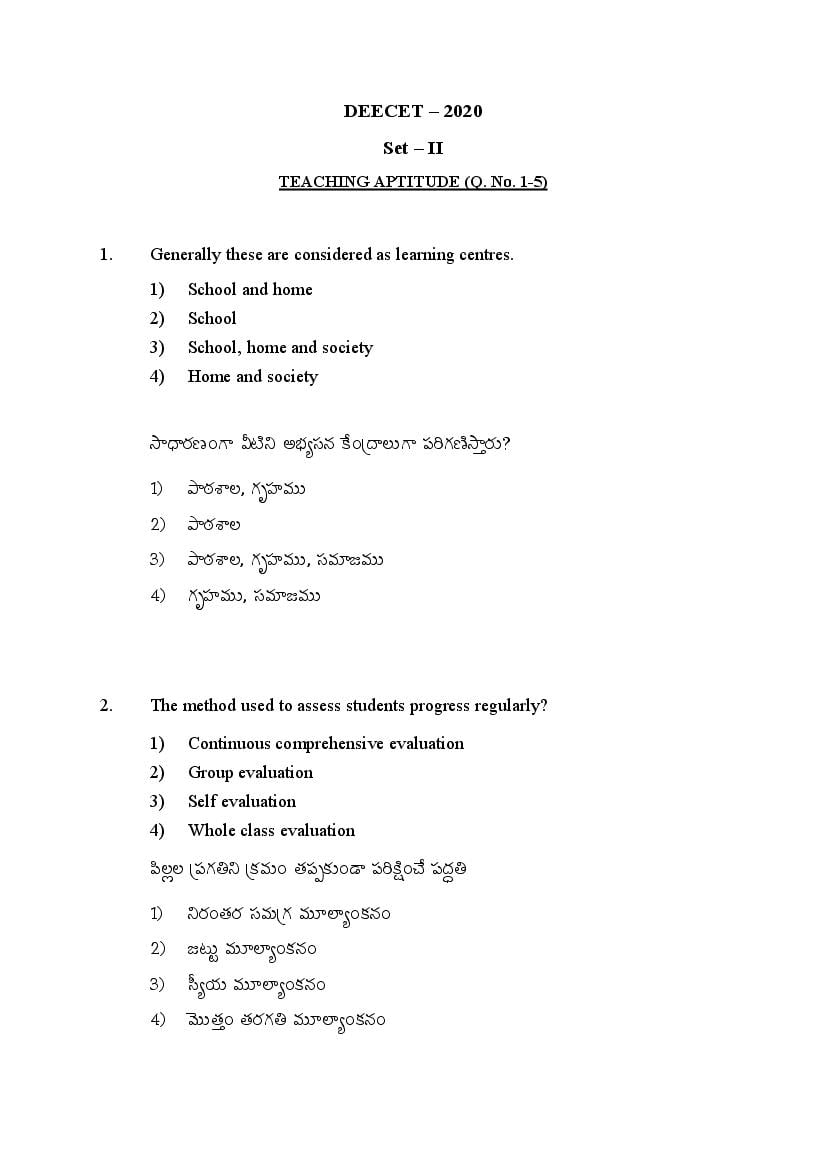
Set – II
TEACHING APTITUDE (Q. No. 1-5)
1. Generally these are considered as learning centres.
1) School and home
2) School
3) School, home and society
4) Home and society
kÍ<ósÁD+>± M{ì nuó« dq ¿¹ +ç<\T>± |]>·Dkì ÍïsTÁ ?
1) bÍsÄXÁ æ\, >·V²eTT
2) bÍsÄÁXæ\
3) bÍsÄÁXæ\, >·V²eTT, deÖÈeTT
4) >·V²eTT, deÖÈeTT
2. The method used to assess students progress regularly?
1) Continuous comprehensive evaluation
2) Group evaluation
3) Self evaluation
4) Whole class evaluation
|¾\\¢ ç|>Ü
· ç¿£eT+ Ôá|Πţ+& |]¿ì+ #û |<Ü
Æ
1) sÁ+ÔásÁ deTç>· eTÖý²«+¿£q+
2) ȳT¼ eTÖý²«+¿£q+
3) dÓ«jáT eTÖý²«+¿£q+
4) yîTTÔá+ï Ôás>Á Ü
· eTÖý²«+¿£q+
Page 2
than in the classroom through
1) Internet and mass media
2) Television and movies
3) Whats APP and You Tube
4) Computer and C.Ds
sÃE\ýË $<«sÁT\Æ Å£ Ôás>Á Ü
· ýË ¿£+fñ Ôás>Á Ü
·
jáT³ M{ì <Çs HûsÁTÌ¿Ãe&¿ì mHÃ ne¿±Xæ\T
HsTT.
1) n+Ôás¨\+, ç|kÍsÁeÖ<ó« eÖ\T
2) fÉ*$ÈH, #á\qºçÔ\T/d¾eÖ\T
3) y³à|t, jáTT³Ö«uÙ
4) ¿£+|P«³sY, d¾&\ T
4. The teacher has to encourage the bright students of the class by preparing them
for
1) Final examinations
2) Sports meet
3) Cultural competitions
4) Competitive tests
Ôás>Á Ü
· ýË ç|Üuó >·\ $<«sÁT\Æ qT çbþÔáàV¾²+#áT³Å£
bÍ<ó«jáTT&T y] M{ì ¿Ãd+ d¾<|Æ s #Á *
1) n+Ôá« |¯¿£\Å£
2) ç¿¡& bþ{¡\Å£
3) kÍ+dØÜ¿£ bþ{¡\Å£
4) bþ{¡ |¯¿£\Å£
Page 3
1) Test items
2) Curricular areas
3) Co-curricular areas
4) Play items
bÍsÄXÁ æ\ýË Hûs¹ Î ³\T, bͳ\T, u¤eT\T ^jáT&+ yîTT<ýqÕÉ $ $uó²>·+
¿ì+~¿ì ekÍïsTT.
1) |¯¿±+Xæ\T
2) bÍsÄ«+Xæ\T
3) dV²bÍsÄ«+Xæ\T
4) ç¿¡&+Xæ\T
Page 4
6. Indian National Flag was designed by
1) Duggirala Gopalakrishnaiah
2) Paidamarri Venkata Subbarao
3) Pingali Venkayya
4) Damerla Ramarao
uó²sÁÔá C²rjáT |Ô¿£ sÁÖ|¿s£ ïÁ
1) <TÐZs\ >ÃbÍ\¿£wjáT«
2) |Õ&eTç] yî+¿£³dTu²ÒseÚ
3) |¾+>·[ yî+¿£jáT«
4) <yîTsÁ¢ seÖseÚ
7. 2019 world badminton championship winner
1) P.V. Sindhu
2) Saina Nehwal
3) Karolina Marin
4) Deepa Karmakar
2019 ç||+ #á u²&+³H #+|¾jTá H w¾|t $CñÔá
1) |¾.$. d¾+<óT
2) dÕH HîVäÇýÙ
3) ¿£sÃ*H eÖ]H
4) BbÍ¿£s¿£sY
Page 5
1) Pune
2) Bengaluru
3) Hyderabad
4) Mumbai
+&jÖá ýË m\翱¼¿ù q>·s+Á >± |s= +~q q>·s+Á
1) |PDÉ
2) uÉ+>·TÞøSsY
3) VÕ²<su²<
4) eTT+sTT
9. Book written by Kodavatiganti Kutumbarao was
1) Chaduvu
2) Amrutham kurisina ratri
3) Maha Prastanam
4) Rajasekhara Charitram
¿= &e{ì >·+{ì Å£³T+seÚ sÁº+ºq |Úd¿ï +£
1) #á<T eÚ
2) neTÔá+ Å£]d¾q sçÜ
3) eTVäç|kÍÆq+
4) sÈXâKsÁ #á]çÔáeTT
Page 6
1) SHAR
2) ISRO
3) PSLV
4) SSRC
uó²sÁÔá n+Ôá]¿£ |]XË<óH d+dÆ qT ý² |¾\TkÍïsTÁ
1) SHAR
2) ISRO
3) PSLV
4) SSRC
Page 7
11. Ramaiah is a centenarian. His age is …………..
Choose the word / phrase to complete the sentence.
1. above hundred years
2. above one fifty years
3. below 50 years
4. below hundred years
12. Sujatha had arrived at the station …………….. the train came.
Choose the correct linker to complete the sentence.
1. after
2. before
3. but
4. whoever
13. Choose the compound sentence from the following.
1. She was unhappy or she was upset.
2. She was too unhappy to be upset.
3. If she was unhappy, she was upset.
4. She was unhappy when she was upset.
Page 8
1. hesitate
2. hesitated
3. hesitation
4. hesitates
15. The children liked him.
Choose the passive voice of the sentence above.
1. He likes the children.
2. He is liked by the children.
3. The children were liked by him.
4. He was liked by the children.
Page 9
16. ¿ì+~ y{ìýË d+jáTT¿±ï¿s£ +Á >·\ |< >·T]ï#+á &
1) eTç]
2) sÁ«
3) ¿±sÁ+
4) <T:K+
17. »»HûqT C²ÔásýÁ Ë mçsÁ >±E\T ¿=HqTµµ - y¿£«+ýË $XâwD
+
1) C²ÔásÁ
2) mçsÁ
3) >±E\T
4) ¿=HqT
18. »»dT$TçÔá V²Å£Ø\ ....................... eÖ{²¢&+ ~µµ - U²°ýË ds qÕ |< |P]+#á+&
1) >·T]+º
2) ýË
3) ýË|\
4) q+<T
19. »»¥ejáT« ç<bþÔáTH&Tµµ - y¿±«¿ì e«Ü¹s¿£ nsÁ+ #ûÌÛ y¿£«+
1) ¥ejáT« ç<bþÔ&T
2) ¥ejáT« ç<bþjáÖ&T
3) ¥ejáT« ç<bþe&+ ýñ<T
4) ¥ejáT« ç<bþ&T
Page 10
1) e
2) sÁ
3) q
4)
Page 11
21. »»Ôá$µµ - nsÁ+
1) Xø¯sÁ+
2) yûTqT
3) Ôá|¾ï
4) ÔÃ&T
22. »»¿£$çV², uój
Tá ¿£$ $TçÔáT&Tµµ nHû _sÁT<T\ >·\ ¿£$
1) <îÝq
2) d¾+>·q
3) qqjáT
4) Ü¿£Øq
23. »»Ð¯Xæµµ - |<¿ì >·TsÁT\|T TeÚ\qT >·T]ï+#á+&
1) UUU
2) IUU
3) UII
4) IIU
24. »»CËd|t ¹s|Ú $ÈjáTy& yîÞ²ï&Tµµ - y¿£«ýË ¿±\+
1) uó$w«ÔY ¿±\+
2) uóÖÔ῱\+
3) esÁïeÖq ¿±\+
4) Ôá<ÆósÁ ¿±\+
Page 12
1) MqT\ $+<T
2) #î$\T¢ ¿£³T¼¿=bþsÁT
3) #î${ìy eTT+<T Xø+KeTÖ~q³T¢
4) |&#î$q|³T¼
26. »»¿£qT|]ï \¿£ eTµµ >±] ¿£\+ |sÁT
1) \ý²¢ <û$
2) ©ý²eÜ
3) nÈ+Ô
4) mýË¢s
27. »»yûT~µµ - |<¿ì |s«jáT|<\T
1) uóÖ $T, n¿±Xø+
2) ¿±Xø+, n+sÁ+
3) uóÖ$T, eXø<ó
4) n+T<+, yûT|T +
28. »»dyîT®K«µµ - |< $&BjáT>± eºÌq sÁÖ|+
1) deTG@¿£
2) dyTî G® @¿£«
3) dyîT®G׿£«
4) deTG׿£«
Page 13
1) $<ÇH $XøÇ+
2) d¾. HsjáTDÂs&¦
3) seP] uósÁ<ÇÈ
4) |Ú*¿£+{ì ¿£cÍs &¦
30. »»ncͼ<Xø Xø¿ìï |ÓsÄ\Tµµ - deÖd |<¿ì $ç>·V² y¿£«+
1) m$T~ d+K« >·\ Xø¿ïì |ÓsÄ \T
2) mquóÕÉ d+K« >·\ Xø¿ïì |ÓsÄ\T
3) |<Ýî $T~ d+K«>·\ Xø¿ïì |ÓsÄ \T
4) qÖ³ m$T~ d+K« >·\ Xø¿ïì |ÓsÄ \T
Page 14
31. Which of the following is irrational
1)
√
2)
√
3) √81
4) √11
¿ì+~ yýË ¿£sÁD¡jáT d+K«
1)
√
2)
√
3) √81
4) √11
32. The degree of the polynomial (x3+8) (5-x2) is
1) 2
2) 3
3) 5
4) 6
(x3+8) (5-x2) VQ|~ |]eÖD+
1) 2
2) 3
3) 5
4) 6
Page 15
then the area of the triangle is (in sq.cm)
1) 30
2) 32.5
3) 60
4) 65
ÿ¿£ çÜuóT È+ jîTT¿£Ø s +&T uóT C²\T 5 d+.MT eT]jáTT 13 d+.MT eT]jáTT <
#áT³T¼¿=\Ôá 30 d+.MT nsTTq çÜuóT È yîXÕ æ\«+ (#áööd+.MT ýË)
1) 30
2) 32.5
3) 60
4) 65
34. The height of a cone whose diameter 10 cm and slant height 13 cm is
(in cm)
1) 12
2) 13
3) √69
4) √194
uóÖ y«d+ 10d+.MT eT]jáTT @³y\T mÔáTï 13 d+.MT >·\ Xø+KTeÚ mÔáTï
(d+.MT ýË)
1) 12
2) 13
3) √69
4) √194
Page 16
ration 3:7:6:4 then ABCD is
1) rhombus
2) parallelogram
3) trapezium
4) kite
ÿ¿£ #áÔTá sÁTÒÛÈ+ýË ç¿£eT+ýË rdT¿= q ¿ÃD²\T A, B, C eT]jáTT D \ wÎÜï
3:7:6:4 nsTTq ABCD #áÔTá sÁTÒÛÈeTT ÿ¿£
1) deT#áÔTá sÁTÒÛÈ+
2) deÖ+ÔásÁ #áÔáTsÁTÒÛÈ+
3) deT\+ #áÔTá sÁTÒÛÈ+
4) >±*|³+
36. The mean of five numbers is 30 if one number is excluded, their mean
becomes 28 then the excluded number is
1) 28
2) 30
3) 35
4) 38
×<T d+K«\ n+¿£ eT<ó« eTeTT 30. n+<TýË ÿ¿£ d+K«qT $TqVäsTT+#á>± $TÐ*q
d+K«\ n+¿£eT<ó« eT+ 28 nsTTq $TqVäsTT+ºq d+K«
1) 28
2) 30
3) 35
4) 38
Page 17
1) -2 3
2) 2
3) 4
4) 4- √3
x = 2 + √3 nsTTq x + $\Te
1) -2 3
2) 2
3) 4
4) 4- √3
38. If sinθ – cosθ = 0 then the value of sin4θ + cos4 θ is
A)
B)
C)
D) 1
If sinθ – cosθ = 0 nsTTq sin4θ + cos4 θ $\Te
A)
B)
C)
D) 1
Page 18
discount percentage is
1) 4%
2) 5%
3) 10%
4) 95%
ÿ¿£ edTeï Ú ç|¿{
£ Ô
ì á yî\ sÁÖ.80 eT]jáTT < n$Tq yî\ sÁÖ. 76 nsTTq sÁTdTeTT
XæÔá+
1) 4%
2) 5%
3) 10%
4) 95%
40. The lengths of the diagonals of a rhombus are 16cm and 12cm then the
length of the side of the rhombus is (in cm)
1) 8
2) 9
3) 10
4) 20
s+dt jîTT¿£Ø ¿£s\T 16 d+.MT eT]jáTT 12 d+.MT nsTTq < uóT È+
(d+.MT\ ýË)
1) 8
2) 9
3) 10
4) 20
Page 19
41. Natural magnet is
1) bar magnet
2) lode stone
3) disc magnet
4) ring magnet
~ dV² È njáTkÍØ+Ôá+
1) u²sY eÖ>·{Ù
2) ýË& kþ¼H
3) &dtØ eÖ>·{Ù
4) ]+>´ eÖ>·{Ù
42. It is a fixed joint
1) upper jaw
2) lower jaw
3) neck
4) knee
~ ¿£<\ ¿¡\T
1) |Õ <e&
2) ¿ì+~ <e&
3) yîT&
4) yîÖ¿±\T
Page 20
1) 0ºC
2) 98ºC
3) 100ºC
4) 10ºC
ú{ì uó²wÓÎuóeq cþç>·Ôá
1) 0ºC
2) 98ºC
3) 100ºC
4) 10ºC
44. Which is correct
a. Potato : New plants grow from eyes in the tuber
b. Sugarcane : Stem grows roots at the nodes
1) a only
2) b only
3) a and b
4) None of these
@~ ds qÕ ~
a. +>±Þø<T +| : <T+||Õ ¿£qT\ uó²>±\ qT+& ¿=Ôáï yîTT¿£Ø\T ekÍïsTT
b. #îsÅÁ £ : ¿±+&+ ¿£DT|Ú\ qT+& ¿=Ôáy
ï Tî T¿£Ø\T ekÍïsTT
1) a eÖçÔáyTû
2) b eÖçÔáyTû
3) a eT]jáTT b
4) |Õ yûM¿±<T
Page 21
1) from 5.5 to 7.5
2) below pH 7
3) above pH 7
4) No pH
eT+º dÇuó²e+ >·\ Hû\ pH
1) 5.5 qT& 7.5 esÁÅ£
2) pH 7 ¿£H ÔáÅ£Øe
3) pH 7 ¿£H mÅ£Øe
4) pH +&<T
46. Father of white revolution
1) J.K. Kurion
2) Edward Jenner
3) Alexandar Flemming
4) Jonas salk
XâÇÔá$|e¢ |¾ÔeTVQ&T
1) J.K. Å£]jáTH
2) m&ÇsY¦ CÉqsY
3) nýÉ>±¨+&sY |$¢ T+>´
4) CËHdt kÍ¿ù
Page 22
1) ovule
2) Synergids
3) anti podals
4) male gamete nuclei
|s>· HÞø+ýË ¿£D²\T
1) n+&+
2) dVä jáT ¿£D²\T
3) ç|ÜbÍ<¿£ ¿£D²\T
4) |ÚsÁTw;È ¿¹ +ç<¿±\T
48. Water passing down through the soil particles is called
1) percolation
2) crystallization
3) distillation
4) sublimation
úsÁT eT{ì¼ nDTeÚ\ >·T+& ç|jáÖDì+º ¿ì+~¿ì #ûsÁ&
1) |s= ØýñwH
2) ç¿ìd¼ýÉÕCñwH
3) &d¾¼ýñwH
4) d_¢yûTwH
Page 23
Producer in food chain is
1) fox
2) carrot
3) rabbit
4) none of these
¿±«Âs{Ù g Å£+<û\T g q¿£Ø
VäsÁ|Ú >=\TdTýË ÔáÎÜï <sÁT
1) q¿£Ø
2) ¿±«sÁ{Ù
3) Å£+<û\T
4) |Õy$û ¿±<T
50. Example of Dicotyledons
1) maize
2) paddy
3) finger millets
4) groundnut
~Ç<Þø ;C²\Å£ <V²sÁD
1) C¤q
2) e]
3) s>·T\T
4) yûsÁTXøq>·
Page 24
51. Kautilya wrote the famous book Ardhasastra, it explains about
1) how to conquer and rule kingdoms
2) how to read inscriptions
3) how to learn Sanskrit
4) how to perform rituals
¿{ì\T«&T sÁº+ºq nsÁX æd+ï nHû ç|d~¾ Ý #î+~q |Úd¿ï +£ B >·T]+º $e]dT+ï ~
1) sC²«\qT ÈsTT+#áT³ eT]jáTT |]bÍ*+#áT³
2) XædH\qT #á<e &+
3) d+dØÔá+ HûsTÁ Ì¿=qT³
4) ¿£sÁ ¿±+&\T sÁÇV¾²+#áT³
52. A 12th century book in Tamil, describes the religious practices of
hunter-gatherers living near Sri Kalahasti. The name of the book is
1) Shilappadikaram
2) Periyapuranam
3) Sivapuranam
4) Mani Mekhalai
12e XøÔu²Ý¿ì #î+~q ÿ¿£ Ôá$TÞø |Úd¿ï +£ , l¿±ÞøV² d¾¿ï ì dMT|+ýË ed¾dT qï yû³
d¿£sD
Á <sÁT\ eTÔá $XæÇkÍ\qT >·T]+º $e]dT+ï ~. < |sÁT
1) ¥\bÍÎ~¿±sÁ+
2) |]jáT |ÚsD+
3) ¥e|ÚsD+
4) eTDìyTû KýÉÕ
Page 25
1) Eastern Ghats
2) Western Ghats
3) Indo Gangetic plains
4) Himalayas
¿£cÍ, >Ã<e] e+{ì q<T\T .......... qT+º çbÍsÁ+uóe TeÚÔsTT
1) ÔáÖsÁTÎ ¿£qTeT\T
2) |¥ÌeT ¿£qTeT\T
3) >·+>± - d¾+<óÖ yîT<® q+
4) V¾²eÖ\jáÖ\T
54. The invocation part of inscriptions, ‘Prashastis’ were composed by
1) ruling family
2) learned Brahmins
3) soldiers
4) religious priests
XædH\ýË yîTT<{ì uó²>±ýÉqÕ ç|Xdø ï¾ ......... sdysÁT
1) sÈÅ£³T+eTT
2) çu²V²D |+&ÔTá \T
3) dÕÅ£\T
4) eTÔá |<\Ý T
Page 26
and the South Pole. This line is called as
1) Longitude
2) orbit
3) Axis
4) hemisphere
uóÖ $T Ôásï Á <¿D
ì <ó y\ ¿£*| ÿ¿£ }VäÈÔá s¹ K MT< ÜsÁT>·TÔáT+~.
s¹ K ý² |¾\TkÍïeTT.
1) s¹ U²+XøeTT
2) ¿£¿«£
3) n¿£e TT
4) nsÁeÆ Ôáeï TT
56. The largest reserves of barytes mineral in the world, is available in
……..district of AP
1) Ananthapuram
2) Kurnool
3) Kadapa
4) Nellore
ç||+ #á+ýËHû nÜ mÅ£Øe uÉs {
Õ d¡ t \Ç\T +ç<óç |<Xû ýÙ Ë .........................ý²¢ýËHû
\uó« eTeÚÔáTHsTT
1) nq+Ôá|ÚsÁ+
2) ¿£sÁÖýÙ
3) ¿£&|
4) Hî\Ö¢sÁT
Page 27
Inland sea, named
1) Black sea
2) Tethys sea
3) Red sea
4) yellow sea
ý²ÂsüjTá eT]jáTT >= +&ÇH K+&\qT yûsTÁ #ûjTá T#áTq bõ&yqÕî , ýËÔîqÕ deTTç<eTT
1) q\¢ deTTç<eTT
2) fÉ~dó t deTTç<eTT
3) mçsÁ deTTç<eTT
4) |dT |Ú deTTç<eTT
58. Identify the ‘Third order landform’ from the following
1) Oceans
2) continents
3) valleys
4) plateaus
ç¿ì+~ yýË »»eTÖ&e çXâDì uóÖ dÇsÁÖ|+µµ >·T]ï+#á+&
1) eTVädeTTç<\T
2) K+&\T
3) ýËjáT\T
4) |ÓsuÁÄ Öó eTT\T
Page 28
1) Andhra Pradesh, Tamilnadu, Telangana
2) Andhra Pradesh, Karnataka, Telangana
3) Tamilanadu, Telangana
4) Karnataka, Telangana
ÔáT+>·uçó < qB Èý²\qT |+#áTÅ£+³Tq scͼ\T
1) +ç<óç |<Xû ,Ù Ôá$TÞøH&T, Ôî\+>±D²
2) +ç<óç |<Xû ,Ù ¿£s³¿£, Ôî\+>±D²
3) Ôá$TÞøH&T, Ôî\+>±D²
4) ¿£s³¿£, Ôî\+>±D²
60. Muslim league was formed in the year
1) 1906
2) 1927
3) 1920
4) 1909
eTTd¾+¢ ©>´ kÍ|+¾ #á&q d+eÔáàsÁ+
1) 1906
2) 1927
3) 1920
4) 1909
Page 29
SOCIAL STUDIES
Set – II
HISTORY (61 – 74)
61. Who wrote the book “Indica”?
1) Fa-Hien
2) Hiuen Tsang
3) Alberuni
4) Megasthenes.
»»+&¿±µµ ç>·+<¸ sÁ#ásTTÔá mesÁT?
1) bÍV¾²jáÖH
2) VQjáÖHÔà+>´
3) ýÙuÉsÁÖú
4) yîT>·dïúdt
62. “Ziggurat” means
1) School
2) College
3) Office
4) Temple
»»>·ÖsÔYµµ n+fñ
1) bÍsÄÁXæ\
2) ¿£Þ²Xæ\
3) ¿±s«\jáT+
4) <ûy\jáT+
Page 30
1) Ambhi
2) Bimbisara
3) Udayana
4) Shishunaga
eT>·<óqT bÍ*+ºq yîTT<{ì ç|eTTKsE
1) n+_ó
2) _+_kÍsÁT&T
3) <jáTqT&T
4) ¥XøH>·T&T
64. Chenghis Khan belongs to which country?
1) China
2) Japan
3) Tibet
4) Mongolia
#á+|ÓTdt U²H @ <ûXæ¿ì d+u+~ó+ºq e«¿ìï?
1) #îÕH
2) ÈbÍH
3) {ìu{É Ù
4) eT+>Ã*jáÖ
Page 31
1) War with Greeks
2) War with Nanda kings
3) Kalinga war
4) War with Romans
nXËÅ£& bÍ\qýË nÜ eTTK«yîT®q d+|T³q
1) ç^Å£\ÔÃ jáTT<Æ+
2) q+<sE\ÔÃ jáTT<Æ+
3) ¿£[+>·jáTT<Æ+
4) sÃeTH\ÔÃ jáTT<Æ+
66. “The Prince” written by
1) Cicero
2) Julius Caesar
3) Machia - Velli
4) Plato
»»~ ç|¾H൵ ç>·+<¸ sÁ#ásTTÔá
1) d¾d¾sÃ
2) p*jáTdt dÓÈsY
3) eÖ¿ìjáTyî*¢
4) |{¢ Ë
Page 32
1) Akbar
2) Babur
3) Aurangzeb
4) Humayun
»»BH ` ` ý²V¾²µµ kÍÆ|+¾ ºq~.
1) n¿£ÒsY
2) u²sY
3) WsÁ+>·CñuÙ
4) VQeTjáTÖH
68. Who painted the “Mona Lisa” and the “Last Supper”?
1) Donatello
2) Michelangelo
3) Leonardo da vinci
4) Andreas Vesalius
»»yîTTH*d, ~ ý²dt¼ d|ÎsYµµ yûd¾q ºçÔ῱sÁT&T mesÁT?
1) &= HfÉýË¢
2) yîT®UñýÉ+ýË
3) *jîÖHsæ &$úà
4) +ç&jáTdt yîkÍ*dt
Page 33
1) Sankaracharya
2) Ramanujacharya
3) Madhavacharya
4) Vallabhacharya
n<îÕÇÔá d¾<Æ+Ôá+ uË~ó+ºq~ mesÁT?
1) Xø+¿£s#sÁT«\T
2) seÖqTC²#sÁT«\T
3) eT<óÇ#sÁT«\T
4) e\¢uó²#sÁT«\T
70. The secret organization founded by “Joseph Mazzini” is?
1) Young Germany
2) Young Italy
3) Young France
4) Young England
»»CËd|t eÖµµ #ûÔá çbÍsÁ+_ó+#á&q sÁV²d« d+dÆ?
1) jáT+>´ ÈsÁú
2) jáT+>´ ³©
3) jáT+>´ çbÍHà
4) jáT+>´ +>±¢&
Page 34
1) Surdas
2) Kabir
3) Tulasidas
4) Chaitanya Maha Prabhu
»»seT #á]Ôá eÖqdtµµ sÁº+ºq~ mesÁT?
1) dÖsY <dt
2) ¿£;sY
3) ÔáT\dÓ<dt
4) #îÕÔáq« eTVäç|uóT
72. The United Nations emerged in the year?
1) 1945
2) 1944
3) 1946
4) 1947
׿£«sÈ«d$TÜ $sÁÒÛ$+ºq d+eÔáàsÁ+
1) 1945
2) 1944
3) 1946
4) 1947
Page 35
1) Ganapati Deva
2) Mahadeva
3) Rudramadevi
4) Prataparudra - II
dÇÔá+çÔá ¿±¿£rjáTsEýË¢ ºe] sE mesÁT?
1) >·D|Ü <ûeÚ&T
2) eTVä<ûeÚ&T
3) sÁTç<eT<û$
4) Âs+&e ç|Ô|sÁTç<T&T
74. The principles of the “Non Alignment Movement” (NAM) are called as
1) Panchasheel
2) Constitution
3) Agenda
4) Atlantic charter
n©HÃ<«eT eTTK« <ûÝXæ\qT @eT |¾\TkÍïsÁT?
1) |+#áo\
2) sC²«+>·eTT
3) mCÉ+&
4) n{²¢+{ì¿ù #ósÁ¼sY
Page 36
75. “Micro Economics” was popularized by
1) Marshall
2) Robbins
3) Jacob Viner
4) A. Samuelson
»»dÖ¿£ nsÁXækÍïµµ y«|¾ïýË¿ì ÔîºÌq~?
1) eÖsÁüýÙ
2) s_Hà
3) C²¿£uÙ yîÕqsY
4) m. kÍeTÖ«ýÙdH
76. Who defined “Economic development is simply an increase in economic
welfare”?
1) Kindle
2) Colin Clark
3) G. M. Mayor
4) To-daro
]¿±_óe~Æ Å£¢|ï+>± #îbÍÎ\+fñ »»]¿£ çXâjáTdTàýË |sÁT>·<\µµ n sÁǺ+ºq~
mesÁT?
1) ¿ì+&ýÙ
2) ¿±*H ¿±¢sØY
3) . jáT+. yûTjáTsY
4) Ô= &sÃ
Page 37
1) Essential commodities
2) Drinks
3) Inferior Goods
4) Prestigious Goods
»»yîuÉ¢H ç|uó²e+µµ <û¿ì d++~ó+ºq~?
1) Ô«eds\T
2) bÍjáÖ\T
3) ÔáÅ£ØesÁ¿£+ edTïeÚ\T
4) >sÁedÖº¿£ edTïeÚ\T
78. “Sarvashiksha Abhiyan” was established during?
1) 2005-2006
2) 2003-2004
3) 2001-2002
4) 2004-2005
»»dsÁÇ¥¿± n_ójáÖHµµ kÍ|q
1) 2005-2006
2) 2003-2004
3) 2001-2002
4) 2004-2005
Page 38
by
1) Marshall
2) J. B. Clark
3) Benham
4) Boulding
bÍ+Ôá ÔÎ<¿Ô
£ á |+|¾D¡ d¾<Æ+Ô ç¿£eT |<Ü
Æ ýË n_óe~Æ |sºÁ q~ mesÁT?
1) eÖsÁüýÙ
2) CÉ._.¿±¢sYØ
3) uÉq½yT
4) u *¦+>´
80. India stands first in the world, in the production of
1) Sugar cane
2) Groundnut
3) Cotton
4) Jute
ç||+ #ákÍsTTýË uó²sÁÔ<á Xû +ø , M{ì ÔáÎÜïýË ç|<e¸ T kÍq+ýË +~
1) #îsTÁ Å£
2) yûsÁTXèq>·\T
3) ç|Üï
4) ÈqTeTT
Page 39
1) M. S. Swamynathan
2) B. F. John
3) S. Lakshman
4) Norman Borlog
V²]Ôá $|e¢ |¾ÔeTVQ&T
1) myT. mdt. kÍÇ$TH<¸H
2) _. m|t. C²H
3) mdt. \¿£DY
4) HsÁH uËsâ>´
82. The current market value of all final goods and services produced in a country
during a year is called as
1) Gross Domestic Product at market prices (GDP)
2) Gross National Product at market prices (GNP)
3) Net National Product at market prices (NNP)
4) Personal Income (PI)
ÿ¿£ d+eÔáàsÁ ¿±\+ýË ÿ¿£ <ûX+ø ýË ÔáÎÜï #ûdq¾ n+ÜeT edTï de\ ç|dT Ô
ï á eÖÂsØ{Ù
$\Te yîTTÔï @eT |¾\TkÍïsTÁ
1) eÖÂsØ{Ù <ósÁ\ýË dÖ\ <ûojîÖÔáÎÜï (GDP)
2) eÖÂsØ{Ù <ósÁ\ýË dÖ\ C²rjîÖÔáÎÜï (GNP)
3) eÖÂsØ{Ù <ósÁ\ýË ¿£sÁ C²rjîÖÔáÎÜï (NNP)
4) e«w¾÷ <jáT+ (PI)
Page 40
1) Political Constitution
2) Civil Constitution
3) Constitution of the country
4) Economic Constitution
uó²sÁÔá bÍ]çXæ$T¿£ rsqeTT 1956qT @eT e]kÍïsÁT?
1) sÈ¿¡jáT sC²«+>·+
2) båsÁ sC²«+>·+
3) <ûXø sC²«+>·+
4) ]¿£ sC²«+>·+
84. The annual statement showing the estimated receipts and expenditure of the
Government
1) Agenda
2) Account
3) Resolution
4) Budget
ÿ¿£ d+eÔáàs¿ì ç|uóT ÔáÇ+ jîTT¿£Ø n+#áH <jáÖ\qT n+#áH s&
Ôî*jáTCñd~
1) mCÉ+&
2) n¿+{Ù
3) rsq+
4) &î̈{Ù
Page 41
1) R.B.I.
2) NITI Aayog
3) LIC
4) National Development Council
bÍ¢+>´ ¿£MTwH kÍq+ýË @sÎfÉq® d+d
1) ]ÈsÁTÇ u²«+¿ù
2) úÜ jîÖ>´
3) uó²sÁÔá J$Ôá ;óeÖ d+d
4) C²rjáT n_óe~Æ eT+&*
86. Example for Near - Money
1) Machinery
2) Buildings
3) Treasury bills
4) Land
dMT| ç<y«¿ì <V²sÁD
1) jáT+çÔ\T
2) uóeH\T
3) çfÉȯ _\T¢\T
4) uóÖ$T
Page 42
1) New york
2) London
3) Delhi
4) Geneva
ç||+ #á yDìÈ« e«ed eTTK«¿±s«\jáT+
1) qÖ«jáÖsYØ
2) \+&H
3) &ó©¢
4) CÉúy
Page 43
88. Who observed that “Man is a Social Animal”?
1) Plato
2) Aristotle
3) Machiavelli
4) Socrates
»»eÖqeÚ&T d+|TJ$µµ e]+ºq~ mesÁT?
1) |{¢ Ë
2) n]kͼ{ìýÙ
3) eÖ¿¡jáTyî*¢
4) kþç¿£{¡dt
89. The chief architect of the theory of separation of power
1) Rousseau
2) Bodin
3) Montesquieu
4) J.S. Mill
n~ó¿±sÁ yûsγTy< d¾<Æ+Ô¿ì eTÖ\|ÚsÁTw§&T
1) sÁÖkþ
2) uË&H
3) eÖHfÉdÖ Ø«
4) CÉ. mdt. $TýÙ
Page 44
1) Baliram Bhagath
2) Sardar Hukum Singh
3) G.V. Mavalankar
4) G.S. Dhillon
yîTT<{ì ýË¿ùduó dÓο£sY mesÁT?
1) *s+uó>·ÔY
2) dsÝsY VQÅ£+d¾+>´
3) .$. eTòý²+¿£sY
4) .jáTdt. ~óý²¢H
91. Who mentioned 6 sources of Law?
1) Machiavelli
2) Holland
3) Woodrow Wilson
4) Solmand
#á{²¼¿ì 6 eTÖý²<ós\qT |s= Øqy&T mesÁT?
1) eÖ¿¡jáTyî*¢
2) Vä\+&
3) ç&Ã$\àH
4) kÍ\+&
Page 45
1) 30
2) 22
3) 15
4) 20
ç|uóTÔáÇU²Ô\ d+|T+ýË m+Ôá eT+~ duóT«\T +{²sÁT?
1) 30
2) 22
3) 15
4) 20
93. Mandamus Means ______
1) We command
2) to forbid
3) to be certified
4) None
eÖ+&eTdt nq>±
1) yûTeTT C²ã|¾dTïH+
2) w~ó+#áT³
3) <óM¿£]+#áT³
4) @B¿±<T
Page 46
1) Rousseau
2) H.J. Laski
3) John Locke
4) J.S. Mill
dV²È V²Å£Ø\ d¾<Æ+Ôá+qT ç|ÜbÍ~+ºq~ mesÁT?
1) sÁÖkþ
2) V²#Y.CÉ. ý²dÓØ
3) C²H ý²¿ù
4) CÉ.jáTdt. $TýÙ
95. Who is the leader of state legislative Assembly?
1) Governor
2) Chief Minister
3) Speaker
4) President of India
sçw¼ $<óqduó HjáTÅ£&T mesÁT?
1) >·esÁsY
2) eTTK«eT+çÜ
3) dÓο£sY
4) sçw¼|Ü
Page 47
legislative Assembly.
1) 117
2) 175
3) 295
4) 120
sçw¼$uóÈq ÔásÇÔá ç|dTïÔá+ +ç<óç|<ûXÙ $<óqduó yîTTÔáï+ duóT«\ d+K« m+Ôá?
1) 117
2) 175
3) 295
4) 120
97. Who is the father of Political Science?
1) Plato
2) Socrates
3) Aristotle
4) Machiavelli
sÈúÜXæçdï |¾ÔeTVQ&T mesÁT?
1) |{¢ Ë
2) kþç¿£{¡dt
3) n]kͼ{ìýÙ
4) eÖ¿¡jáTyî*¢
Page 48
for the people”
1) A.V. Dicey
2) J.S. Mill
3) Lord Bryce
4) Abraham Lincoln
ç|C²kÍÇeT«+ nq>± »»ç|È\ jîTT¿£Ø ç|È\ #ûÔá ç|È\ ¿=sÁÅ£ sÁÇV¾²+#á&û ç|uóTÔáÇ+µµ `
n nq~ mesÁT?
1) m.$. &îÕdÓ
2) CÉ.jáTdt. $TýÙ
3) ý²sY¦ çuÉÕdt
4) nçVä+ *+¿£H
99. The soul of the constitution is __________
1) Fundamental duties
2) Directive Principles
3) Preamble
4) Citizenship
sC²«+>±¿ì Ôáe+{ì~ @~?
1) çbÍ<¸$T¿£ $<óT\T
2) <ûXø dÖçÔ\T
3) |Ó]Ä¿£
4) båsÁdÔáÇ+
Page 49
1) Zilla Parishad Chairman
2) District Collector
3) Joint Collector
4) District Development officer
ý²¢ýË ÈHuó² ýÉ¿£Ø\ eTTK« n~ó¿±]>± mesÁT e«eV²]kÍïsÁT?
1) ý²¢|]wÔY #îÕsÁH
2) ý²¢ ¿£ýÉ¿£¼sY
3) C²sTT+{Ù ¿£ýÉ¿£¼sY
4) ý²¢ n_óe~Æ n~ó¿±]
Document Details
| Board / Org | APSCHE |
| Exam | Andhra Pradesh Diploma in Elementary Education Common Entrance Test |
| Type | Question Paper |
| Pages | 49 |
| Updated | 22 Jul 2026 |