MBOSE Class 12 Question Paper 2023 for Biology
Finished viewing? Save it for later —
Download MBOSE Class 12 Question Paper 2023 for Biology (PDF · 8 pages)About MBOSE Class 12 Question Paper 2023 for Biology
MBOSE Class 12 Question Paper 2023 for Biology is available here for free download. Published by Meghalaya Board for Class 12, this question paper can be viewed online or downloaded as a PDF (8 pages). Candidates preparing for Class 12 can use MBOSE Class 12 Question Paper 2023 for Biology to understand the exam pattern, the type of questions asked, and the overall difficulty level.
Frequently Asked Questions
How can I download MBOSE Class 12 Question Paper 2023 for Biology?
Open this page and click the Download button to save MBOSE Class 12 Question Paper 2023 for Biology as a PDF. It is completely free on AglaSem Docs.
Is MBOSE Class 12 Question Paper 2023 for Biology free to download?
Yes. MBOSE Class 12 Question Paper 2023 for Biology can be viewed online and downloaded as a PDF free of cost on AglaSem Docs.
How many pages does MBOSE Class 12 Question Paper 2023 for Biology have?
MBOSE Class 12 Question Paper 2023 for Biology contains 8 pages, which you can read online or download together as a single PDF.
Where can I find more Class 12 study material?
You can find more Class 12 question papers, sample papers, syllabus, and answer keys on AglaSem Docs.
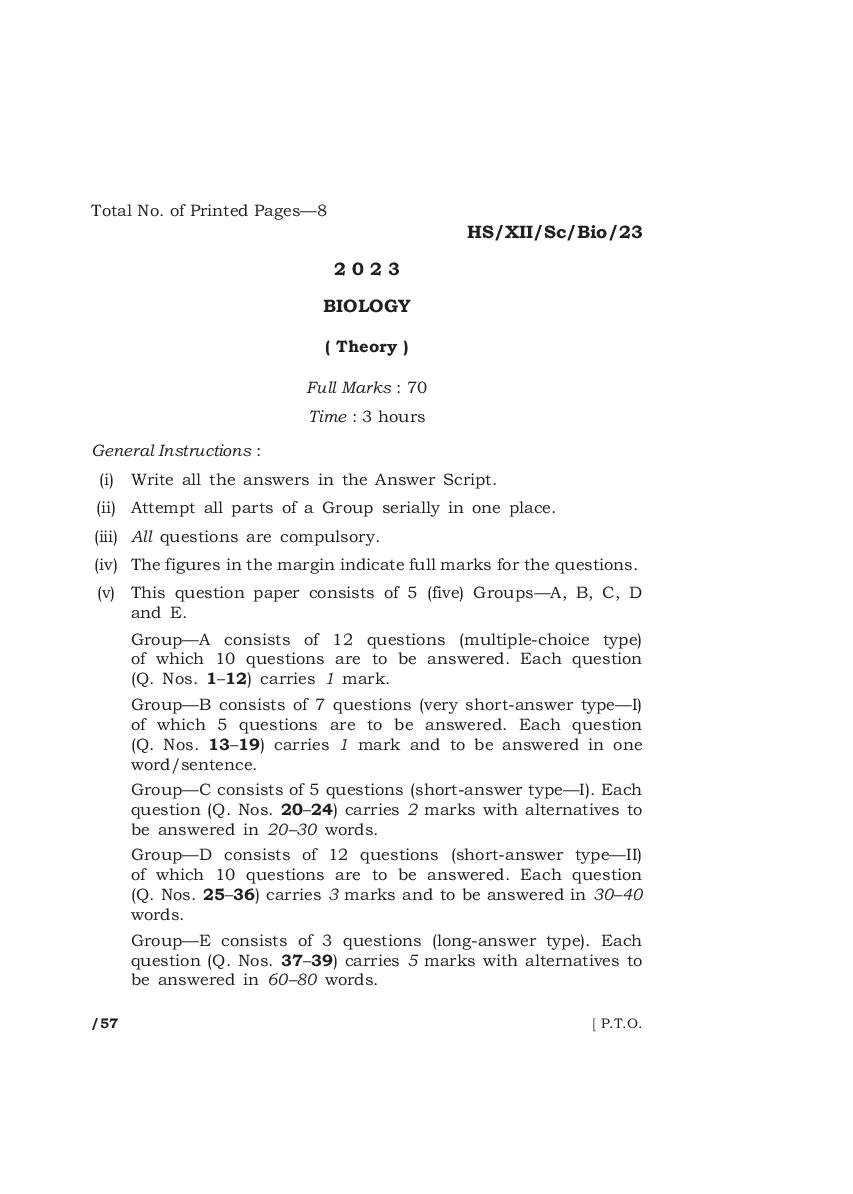
MBOSE Class 12 Question Paper 2023 for Biology – Text
Read the full text of this question paper below — useful to quickly search, copy and reference the content online without downloading the PDF.
📄 View text version (8 pages)
Page 1
HS/XII/Sc/Bio/23
2023
BIOLOGY
( Theory )
Full Marks : 70
Time : 3 hours
General Instructions :
(i) Write all the answers in the Answer Script.
(ii) Attempt all parts of a Group serially in one place.
(iii) All questions are compulsory.
(iv) The figures in the margin indicate full marks for the questions.
(v) This question paper consists of 5 (five) Groups—A, B, C, D
and E.
Group—A consists of 12 questions (multiple-choice type)
of which 10 questions are to be answered. Each question
(Q. Nos. 1–12) carries 1 mark.
Group—B consists of 7 questions (very short-answer type—I)
of which 5 questions are to be answered. Each question
(Q. Nos. 13–19) carries 1 mark and to be answered in one
word/sentence.
Group—C consists of 5 questions (short-answer type—I). Each
question (Q. Nos. 20–24) carries 2 marks with alternatives to
be answered in 20–30 words.
Group—D consists of 12 questions (short-answer type—II)
of which 10 questions are to be answered. Each question
(Q. Nos. 25–36) carries 3 marks and to be answered in 30–40
words.
Group—E consists of 3 questions (long-answer type). Each
question (Q. Nos. 37–39) carries 5 marks with alternatives to
be answered in 60–80 words.
/57 [ P.T.O.
Page 2
GROUP—A
Choose and write the correct answer of the following (any ten) :
1×10=10
1. Which of the following is released from the ovary at the
time of ovulation?
(a) Primary oocyte
(b) Oogonium
(c) Secondary oocyte
(d) Ovum
2. The first phase of embryonic development is
(a) cleavage
(b) blastulation
(c) gastrulation
(d) placentation
3. Amoebic dysentery is a disease caused by
(a) Plasmodium vivax
(b) Entamoeba histolytica
(c) Ascaris lumbricoides
(d) Wuchereria bancrofti
HS/XII/Sc/Bio/23/57 [ Contd.
Page 3
4. A process of transfer of genetic information is
(a) transversion
(b) transcription
(c) translation
(d) translocation
5. In angiosperms, triple fusion is required for the formation
of
(a) embryo
(b) endosperm
(c) fruit
(d) seed
6. The hard outer layer of pollen grain is called
(a) intine
(b) germ pore
(c) exine
(d) tapetum
7. A transgenic plant which may help in solving the problem
of night blindness is
(a) BT cotton
(b) golden rice
(c) Flavr Savr tomato
(d) starlink maize
HS/XII/Sc/Bio/23/57 [ P.T.O.
Page 4
8. Ecosystem has two components. They are
(a) plants and animals
(b) amphibians and reptiles
(c) biotic and abiotic
(d) weeds and trees
9. The organism which causes disease in plants and
animals is called
(a) vector
(b) pathogen
(c) insect
(d) worm
10. The loss of individual due to the death in a population is
called
(a) natality
(b) mortality
(c) emigration
(d) immigration
HS/XII/Sc/Bio/23/57 [ Contd.
Page 5
11. Fungal association with the roots of higher plants in
mycorrhiza is
(a) mutualism
(b) commensalism
(c) parasitism
(d) predation
12. Galapagos islands were associated with
(a) Jean Lamarck
(b) Charles Darwin
(c) Alfred Wallace
(d) Hugo de Vries
GROUP—B
Answer the following questions in one word/sentence each
(any five) : 1×5=5
13. Define xenogamy.
14. Expand GIFT.
15. Define ecosystem.
16. What is a plasmid?
17. What are Okazaki fragments?
HS/XII/Sc/Bio/23/57 [ P.T.O.
Page 6
18. What is dihybrid cross?
19. What is crossing over?
GROUP—C
20. Distinguish between self-pollination and
cross-pollination. 2
21. How is sex determined in human beings? 2
Or
Explain the law of segregation with the help of an
example.
22. Draw a well-labelled diagram of an antibody molecule. 2
Or
Draw a well-labelled diagram of human sperm.
23. Explain biopatent. 2
24. Differentiate between ‘food chain’ and ‘food web’. 2
GROUP—D
Answer the following questions (any ten) :
25. Where are Leydig cells found? What are their functions? 1+2=3
26. Define alcohol addiction. Write the damaging effects of
alcohol addiction. 1+2=3
HS/XII/Sc/Bio/23/57 [ Contd.
Page 7
27. What is menstrual cycle? Name the hormones and their
functions which regulate menstrual cycle. 1+2=3
28. Explain gene therapy with an example. 3
29. Mention the significant characteristics of plants pollinated
by water. 3
30. Briefly explain the role of microbes in sewage treatment. 3
31. Differentiate between incomplete dominance and
co-dominance with examples. 3
32. What is BT cotton plant? Explain how this cotton plant is
able to resist the infestation by bollworms. 1+2=3
33. Define predation. How does prey-predator relationship
maintain a balance in the ecosystem? 1+2=3
34. What is immunity? Distinguish between active immunity
and passive immunity. 1+2=3
35. Who discovered the first antibiotic and from where it was
extracted? Name the microbes from which cyclosporin–A
is extracted. 1+1+1=3
36. Explain briefly how comparative anatomy supports
biological evolution. 3
HS/XII/Sc/Bio/23/57 [ P.T.O.
Page 8
GROUP—E
37. Explain chromosomal theory of inheritance. Who
proposed this theory? 4+1=5
Or
What is oogenesis? Explain the major events involved in
oogenesis. 1+4=5
38. A man with blood group ‘A’ married a woman with blood
group ‘B’. They have a son with AB blood group and a
daughter with blood group ‘O’. Work out the cross and
write the phenotype and genotype of the siblings. 3+2=5
Or
Explain the mechanism of translation with the help of a
diagram. 4+1=5
39. Explain the steps involved in decomposition process. 5
Or
What is biodiversity? Describe the strategies involved in
biodiversity conservation. 1+4=5
HHH
HS/XII/Sc/Bio/23/57 K23—4930
Document Details
| Board / Org | Meghalaya Board |
| Exam | Class 12 |
| Type | Question Paper |
| Pages | 8 |
| Updated | 22 Jul 2026 |