TBSE Class 10 Sample Paper 2024 English
Finished viewing? Save it for later —
Download TBSE Class 10 Sample Paper 2024 English (PDF · 8 pages)About TBSE Class 10 Sample Paper 2024 English
TBSE Class 10 Sample Paper 2024 English is available here for free download. Published by Tripura Board for Class 10, this sample paper can be viewed online or downloaded as a PDF (8 pages). Candidates preparing for Class 10 can use TBSE Class 10 Sample Paper 2024 English to understand the exam pattern, the type of questions asked, and the overall difficulty level.
Frequently Asked Questions
How can I download TBSE Class 10 Sample Paper 2024 English?
Open this page and click the Download button to save TBSE Class 10 Sample Paper 2024 English as a PDF. It is completely free on AglaSem Docs.
Is TBSE Class 10 Sample Paper 2024 English free to download?
Yes. TBSE Class 10 Sample Paper 2024 English can be viewed online and downloaded as a PDF free of cost on AglaSem Docs.
How many pages does TBSE Class 10 Sample Paper 2024 English have?
TBSE Class 10 Sample Paper 2024 English contains 8 pages, which you can read online or download together as a single PDF.
Where can I find more Class 10 study material?
You can find more Class 10 question papers, sample papers, syllabus, and answer keys on AglaSem Docs.
TBSE Class 10 Sample Paper 2024 English – Text
Read the full text of this sample paper below — useful to quickly search, copy and reference the content online without downloading the PDF.
📄 View text version (8 pages)
Page 1
Class : X
Subject: English
Time : 3 Hours 15 Minutes Total Marks : 80
(The figures in the margin indicate full marks.)
Section A – (20 Marks)
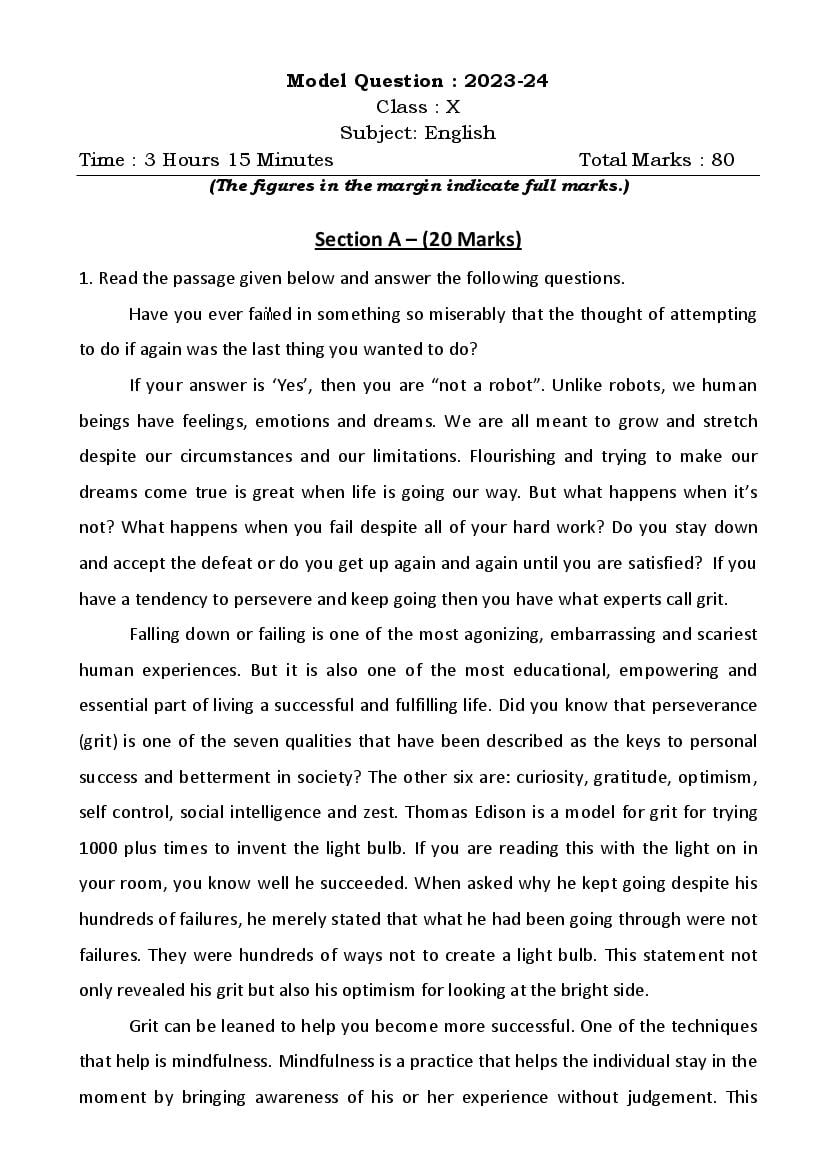
1. Read the passage given below and answer the following questions.
Have you ever failed in something so miserably that the thought of attempting
to do if again was the last thing you wanted to do?
If your answer is ‘Yes’, then you are “not a robot”. Unlike robots, we human
beings have feelings, emotions and dreams. We are all meant to grow and stretch
despite our circumstances and our limitations. Flourishing and trying to make our
dreams come true is great when life is going our way. But what happens when it’s
not? What happens when you fail despite all of your hard work? Do you stay down
and accept the defeat or do you get up again and again until you are satisfied? If you
have a tendency to persevere and keep going then you have what experts call grit.
Falling down or failing is one of the most agonizing, embarrassing and scariest
human experiences. But it is also one of the most educational, empowering and
essential part of living a successful and fulfilling life. Did you know that perseverance
(grit) is one of the seven qualities that have been described as the keys to personal
success and betterment in society? The other six are: curiosity, gratitude, optimism,
self control, social intelligence and zest. Thomas Edison is a model for grit for trying
1000 plus times to invent the light bulb. If you are reading this with the light on in
your room, you know well he succeeded. When asked why he kept going despite his
hundreds of failures, he merely stated that what he had been going through were not
failures. They were hundreds of ways not to create a light bulb. This statement not
only revealed his grit but also his optimism for looking at the bright side.
Grit can be leaned to help you become more successful. One of the techniques
that help is mindfulness. Mindfulness is a practice that helps the individual stay in the
moment by bringing awareness of his or her experience without judgement. This
Page 2
simple practice of mindfulness, individuals have the ability to stop the self-sabotaging
downward spiral of hopelessness, despair and frustration.
What did you do to overcome the negative and self-sabotaging downward
spiral of hopelessness and feelings of failure? Reflect on what you did, and try to use
those same powerful resources to help you today.
1.1. On the basis of you reading of the passage, answer the following questions in
about 30-40 words each. 2x4=8
(a) According to the passage, what are the attributes of humans?
(b) What is perceived as grit?
(c) How is ‘failing’ an educational and empowering part of human life?
(d) In what ways can grit be developed?
1.2. On the basis of the reading of the above passage, answer the following. 1x4=4
(a) The synonym of ‘prospering’ as given in para ‘2’ is –
i) persevere ii) flourishing iii) going iv) trying
(b) The synonym of ‘thankfulness’ as given para ‘3’ is _______.
(c)The antonym of ‘permission’ as given in para ‘3’ is –
i) failing ii) agonizing iii) fulfilling iv) optimism
(d) The antonym of ‘heedlessness’ as given in para ‘4’ is ____________.
2. Read the passage given below and answer the questions that follow.
Indian mythology is not confined to the epics; it goes back to the Vedic period
and appears in many forms and garbs in Sanskrit literature. The poets and the
dramatists take full advantage of it and build their stories and lovely fancies round it.
The Ashoka tree is said to have burst into flower when touched by the foot of a
beautiful woman. We read the adventures of Kama, the God of love, and his wife,
Rati (or rapture), with their friend vasanta, the God of Spring. Greatly daring Kama
shoots his flowery arrow at Shiva himself and is reduced to ashes by the fire that
flashed out of Shiva’s third eye. But he survives as Ananga, the bodiless one.
Page 3
truth and the pledged word, whatever the consequences, faithfulness unto death and
even beyond, courage, good works and sacrifice for the common good. Sometimes to
story is pure myth, or else it is a mixture of fact and myth, an exaggerated account of
some incident that tradition preserved. Facts and fiction are so interwoven as to be
inseparable, and this amalgam becomes an imagined history, which may not tell us
exactly what happened but does tell us something that is equally important, what
people believed had taken place, what they though their heroic ancestors were
capable of, and what ideals inspired them. So, whether fact or fiction, it became a
living element in their lives, ever pulling them up from the drudgery and ugliness of
their everyday existence to higher realness, ever pointing towards the path of
endeavour and right living, even though the ideal might be for off and difficult to
reach.
Thus, this imagined history, mixture of fact and fiction, or sometimes only
fiction becomes symbolically true and tells us of the minds and hearts and purposes
of the people of the particular epoch. It is true in the sense that it becomes the basis
for thought and action, for future history.
2.1. On the basis of your reading of the above passage answer the following
questions:- 1x8=8
(a) Indian mythology goes back to :
i) The Vedic Period ii) The Upanishad Period
iii) The Puranic Period iv) The Indu-Valley Period
(b) Kama was reduced to ashes by –
i) Lord Vishnu ii) Lord Shiva
iii) Lord Brahma iv) Goddess Durga
(c) Shiva in anger opens –
i) his arms ii) this third eye
iii) his locks of hair iv) his armour
(d) Kama survives as –
Page 4
iii) Kimanga even today iv) Durianga even today
(e) The myths and stories are heroic in conception (True/ False).
(f) The most appropriate sub-heading to the para 2 of the passage is –
i) Myths in India ii) Epics in India
iii) Facts in Mythology iv) Facts and Fiction in Indian Mythology
(g) Myths and stories are important as they teach us –
i) adherence to truth ii) faithfulness
iii) sacrifice for the common good iv) all of these
(h) Whether fact or fiction, it became a _________ element in their lives.
Section- B (20 Marks)
3. Answer any 10 of the following questions:- 1x10=10
Fill in the blanks with the correct form of the verbs:
i) The Police _________ four thieves last night. (catch)
ii) Water _________ on heating. (evaporate)
iii) Farmers _________ the field. (plough)
Fill in the blanks with appropriate modals:
iv) Do you _________ cook your own meal? (should/ have to)
v) You _________ consult a physician. (should/ ought to)
vi) I _________ talk to you immediately. (need to/ ought to)
Choose the correct form of the verbs given in the brackets:
vii) Ten miles _________ a long distance. (is/ are)
viii) Either boys or girls _________ telling lies. (is/ are)
Fill in the blanks with suitable determiners:
ix) She has not solved _________ sums. (many/ any)
x) He didn’t make _________ progress. (many/ much)
Change the following sentences into indirect speech:
xi) The master said to the servant, “Fetch me a glass of water.”
Page 5
4. i) Write a letter to the S.D.O.(Electricity) of your area complaining him about the
fluctuation in voltage and irregular supply of electric power in your area.
Give some useful suggestions to overcome such problems. You can invent your own
details. (100-120 words) 5x1=5
OR
ii) You are Prabhu Kumar/ Parbati of 17 E, Rani Dass Road, Kochi. Write a letter to the
Minister of Public Welfare, Kerala about the nuisance caused by loudspeakers in the
city during examination days, drawing attention of the concerned authorities to the
problem. (100-120 words)
5. i) The Pie-chart given below illustrates how internet users of 17+ prefer to brouse
the web. Summarize by writing an analytic paragraph in (100-120) words giving
necessary details and the general trend. Compare where relevant.
33% - Smartphone
30% - Laptop
19% - Tablet
14% - Desktop Computer
4% - Others
OR
ii) Read the table given below that describes postal charges among five main cities in
India, Kanpur, Mumbai, Kolkata, Delhi and Lucknow. Write a critical and analytic
description in a paragraph of 100-120 words. Compare and contrast them wherever
possible. 5x1=5
Page 6
Cities Kanpur Mumbai Kolkata Delhi Lucknow
Kanpur - 22 15 13 07
Mumbai 22 - 25 28 20
Kolkata 15 25 - 18 15
Delhi 13 28 28 - 15
Lucknow 07 15 15 15 -
Section – C (40 Marks)
6. Read the extract given below and answer the questions that follow. (any four)
i) It was during the meal that, just as Lehcho had predicted, big drops of rain began to
fall. In the north-east huge mountains of clouds could be seen approaching. The air
was fresh and sweet. The man went out for no other reason than to have the
pleasure of feeling the rain on his body, and when he returned he exclaimed, “These
aren’t raindrops falling from the sky, they are new coins. The big drops are ten cent
pieces and the little ones are fives.” 2+1+2=5
a) What had Lencho predicted?
b) Did his prediction come true?
c) What did Lencho say about the raindrops and why?
ii) We, who were outlaws not so long ago, have today been given the rare privilege to
be host to the nations of the world on our soil. We thank all of our distinguished
international guests for having come to take possession with the people of our
country of what is, after all, a common victory for justice, for peace, for human
dignity. 1+2+2=5
a) Who were the outlaws not so long ago?
b) What rare privilege were they given now?
c) Who did Mandela thank and why?
7. Read the extract given below and answer the questions that follow. (any one)
i) The way a crow 2+1+2=5
Page 7
The dust of snow
From a hemlock tree.
a) What does the crow do?
b) Where was the poet?
c) How did the snow affect the poet?
ii) Some say the world will end in fire 2+1+2=5
Some say in ice
From what I’ve tasted of desire
I hold with those who favour fire.
a) How do people differ regarding the end of the world?
b) Who does the poet favour?
c) What do you think the poet favours them?
8. Answer any four of the following questions. 3x4=12
i) How does the tiger stalk in the cage?
ii) What is the message of the poem ‘Fire and Ice’?
iii) What happened when the dust of snow fell on Robert Frost?
iv) How can you say that the makers of the famous Goan loaves are still there?
v) What does courage mean to Mandela?
9. Answer any two of the following questions. 3x2=6
i) Why is Dr. James Herriot tempted to keep Tricki as a permanent guest with himself.
ii) Why was Horace Danby not completely honest?
iii) How did the invisible man first become visible?
10. Answer any one of the following questions in not more than (100-120) words.
i) What message do you get from the poem ‘A Tiger in the Zoo’? 6x1=6
ii) Why does Mandela say that freedom is invisible?
How are the oppressed and the oppressor alike are robbed of their humanity?
11. Answer any one of the following questions in not more than (100-120) words.
Page 8
ii) How had Horace planned to loot the house at Shotover Grange?
*****