MBOSE Class 12 Question Paper 2023 for Chemistry
Finished viewing? Save it for later —
Download MBOSE Class 12 Question Paper 2023 for Chemistry (PDF · 11 pages)About MBOSE Class 12 Question Paper 2023 for Chemistry
MBOSE Class 12 Question Paper 2023 for Chemistry is available here for free download. Published by Meghalaya Board for Class 12, this question paper can be viewed online or downloaded as a PDF (11 pages). Candidates preparing for Class 12 can use MBOSE Class 12 Question Paper 2023 for Chemistry to understand the exam pattern, the type of questions asked, and the overall difficulty level.
Frequently Asked Questions
How can I download MBOSE Class 12 Question Paper 2023 for Chemistry?
Open this page and click the Download button to save MBOSE Class 12 Question Paper 2023 for Chemistry as a PDF. It is completely free on AglaSem Docs.
Is MBOSE Class 12 Question Paper 2023 for Chemistry free to download?
Yes. MBOSE Class 12 Question Paper 2023 for Chemistry can be viewed online and downloaded as a PDF free of cost on AglaSem Docs.
How many pages does MBOSE Class 12 Question Paper 2023 for Chemistry have?
MBOSE Class 12 Question Paper 2023 for Chemistry contains 11 pages, which you can read online or download together as a single PDF.
Where can I find more Class 12 study material?
You can find more Class 12 question papers, sample papers, syllabus, and answer keys on AglaSem Docs.
MBOSE Class 12 Question Paper 2023 for Chemistry – Text
Read the full text of this question paper below — useful to quickly search, copy and reference the content online without downloading the PDF.
📄 View text version (11 pages)
Page 1
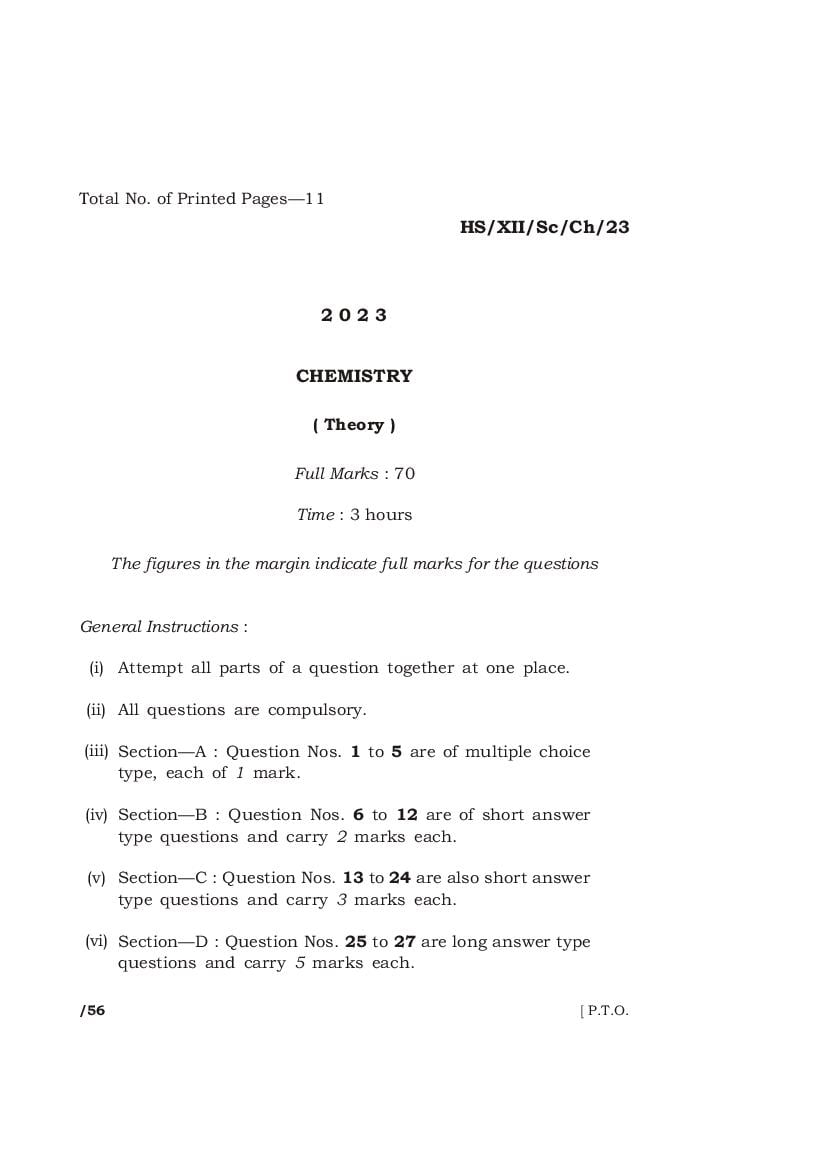
HS/XII/Sc/Ch/23
2023
CHEMISTRY
( Theory )
Full Marks : 70
Time : 3 hours
The figures in the margin indicate full marks for the questions
General Instructions :
(i) Attempt all parts of a question together at one place.
(ii) All questions are compulsory.
(iii) Section—A : Question Nos. 1 to 5 are of multiple choice
type, each of 1 mark.
(iv) Section—B : Question Nos. 6 to 12 are of short answer
type questions and carry 2 marks each.
(v) Section—C : Question Nos. 13 to 24 are also short answer
type questions and carry 3 marks each.
(vi) Section—D : Question Nos. 25 to 27 are long answer type
questions and carry 5 marks each.
/56 [ P.T.O.
Page 2
(vii) There is no overall choice. However, four questions of
2 marks, three questions of 3 marks, and two questions
of 5 marks weightage. Students have to attempt only one
of the choices in such questions.
(viii) Use of non-programmable ordinary scientific calculators
and log tables are allowed.
(ix) Mobile phones and pagers are not allowed inside the
Examination Hall.
SECTION—A
Choose and write the correct answers for the following in the
answer script :
1. The value of Henry’s law constant, kH
(a) increases with increase in temperature
(b) decreases with increase in temperature
(c) remains constant
(d) first increases and then decreases 1
2. The IUPAC name for the complex [Co (NO2 )(NH 3 )5 ]Cl2 is
(a) pentaammine nitrito-N-cobalt(II) chloride
(b) nitrito-N-pentaammine cobalt(III) chloride
(c) pentaammine nitrito-N-cobalt(III) chloride
(d) nitrito-N-pentaammine cobalt(II) chloride 1
HS/XII/Sc/Ch/23/56 [ Contd.
Page 3
3. In the reaction
CHO
conc. HNO3
X
conc. H2SO4
the compound X is
CHO
NO2
(a)
CHO
(b)
NO2
CHO
(c)
NO2
CHO
O2N NO2
(d)
NO2
1
4. The linkage which holds various amino acid units in
the primary structure of protein is
(a) glycosidic linkage
(b) hydrogen bond
(c) peptide linkage
(d) ionic bond 1
HS/XII/Sc/Ch/23/56 [ P.T.O.
Page 4
5. SN 2 mechanism proceeds through the intervention of
(a) carbonium ion
(b) transition state
(c) free radical
(d) carbanion 1
SECTION—B
6. Mention any four factors that influence the rate of
chemical reaction. 2
7. Either
(a) Based on CFT, explain why [Fe(CN)6 ] 3- is weakly
paramagnetic, while [Fe(CN)6 ] 4 - is diamagnetic. 2
Or
(b) Explain why tetrahedral Ni(II) complexes are
paramagnetic, but square planar Ni(II) complexes
are diamagnetic. 2
8. What is lanthanide contraction? What is its cause? 2
9. Either
(a) How will you convert chlorobenzene to p-nitro-
phenol? 2
Or
(b) Convert phenol to salicylic acid (2-hydroxybenzoic
acid). 2
HS/XII/Sc/Ch/23/56 [ Contd.
Page 5
10. Either
(a) Arrange the following substances in increasing order
of their basic strength in water : 1
C 6H 5 —NH2 , (C2H 5 )2 NH, (C2H 5 )3 N, C2H 5 —NH2
(b) Out of ethyl amine and ethyl alcohol, which has
higher boiling point and why? 1
Or
(c) Acetamide is a weaker base than ethyl amine.
Explain. 1
(d) Complete the following reaction : 1
D
C 6H 5 —NH2 + CHCl 3 + 3 KOH (alc.) ¾ ¾
¾® ?
11. Either
(a) A 5% solution of non-volatile solute in water has
vapour pressure 745 mm at 373 K. Calculate the
molar mass of the solute. 2
Or
(b) A solution containing 18 g of a non-volatile solute
in 200 g of water freezes at 272·07 K. Find the
molecular mass of the solute.
(K f of H2O = 1 × 86 K kg mol -1) 2
12. Identify A and B in the following reaction : 1+1=2
Å
dry ether H2O/H
Br + Mg [A] [B]
HS/XII/Sc/Ch/23/56 [ P.T.O.
Page 6
SECTION—C
13. Either
(a) Can we keep CuSO4 solution in a zinc container?
Given that
o o
E Cu 2+
/Cu
= + 0 × 34 V and E Zn 2+
/Zn
= - 0 × 76 V
1½
(b) Calculate the molar conductivity of an aqueous
solution at infinite dilution for BaCl2 , when
ionic conductances of Ba 2+ and Cl - ions are
127·30 S cm 2 mol -1 and 76·34 S cm 2 mol -1
respectively. 1½
Or
(c) In a button cell commonly used in electronic gadgets,
the following reaction takes place :
Zn (s) + Ag 2O (s) + H2O (l) ¾¾®
Zn2 + (aq) + 2Ag (s) + 2OH (aq)
where E o o
= - 0 × 76 V and E Ag = + 0 × 80 V.
Zn 2 + /Zn +
/Ag
Write the cell representation and calculate the value
o
of E cell and DG o for the reaction. 2
(d) Define molar conductivity. 1
14. (a) Why does the boiling point of a solvent increase by
the presence of a non-volatile solute in it? 1
(b) What is an isotonic solution? What is the molarity
of cane sugar (molar mass = 342) solution isotonic
with solution of urea containing 6 g of urea
(molar mass = 60) per litre? 2
HS/XII/Sc/Ch/23/56 [ Contd.
Page 7
15. Either
(a) Define half-life period of a reaction. 1
(b) Decomposition of a compound follows first-order
kinetics. If it takes 15 minutes for 20% of original
substance to decay, calculate—
(i) the rate constant;
(ii) the time at which 10% of the reactant remains
undecayed. 1+1=2
Or
(c) Define activation energy. 1
(d) The rate of a particular reaction doubles
when temperature changes from 27 °C to 37 °C.
Calculate the value of activation energy.
-1 -1
(R = 8 × 314 JK mol ) 2
16. Either
(a) Define ambident ligand with one example. 1
(b) What is a homoleptic complex? 1
(c) Name a metal present in vitamin B12 . 1
Or
(d) Name the central metal atom present in chlorophyll. 1
(e) Define linkage isomerism with example. 1
(f) Write the chemical formula of the compound
potassium trioxalatoferrate(III). 1
HS/XII/Sc/Ch/23/56 [ P.T.O.
Page 8
17. How would you convert the following? 1+1+1=3
(a) Prop-1-ene to 1-nitropropane
(b) Chlorobenzene to 2-chlorotoluene
(c) But-1-ene to but-2-ene
18. (a) Explain the mechanism of acid-catalyzed
dehydration of ethanol. 2
(b) Convert benzene diazonium chloride to phenol. 1
19. (a) Explain why aniline does not undergo Friedel-Crafts
reaction. 1
(b) Why are aliphatic amines more basic than aromatic
amines? 1
(c) Complete the following reaction : 1
(NaNO2 + HCl)
C6H5—NH2 + C6H5—OH ?
(273 K–278 K)
20. (a) Name one fibrous protein and one globular protein. 1
(b) Name the base that is found in RNA only. 1
(c) What is denaturation of proteins? 1
21. (a) Name the enzyme which is present in saliva. What
is its important function? ½+½=1
(b) What are aldoses and ketoses? 1
(c) Write the names of the anomers of glucose. 1
HS/XII/Sc/Ch/23/56 [ Contd.
Page 9
22. (a) What is Rosenmund reduction? What is the purpose
of BaSO4 and S in this reaction? 1+1=2
(b) When is the value of van’t Hoff factor ( i ) greater
than 1? 1
23. (a) How would you determine the standard electrode
potential of the system Mg 2+ / Mg? 1
(b) Define ‘pseudo first-order reaction’ with a suitable
chemical equation. 1+1=2
24. (a) Draw the geometrical isomers of [Co (NO2 )3 (NH 3 )3 ] .
½+½=1
(b) How can the following pair be chemically
distinguished? 1
Phenol and Ethyl alcohol
(c) What is Hoffmann’s bromamide reaction? Give an
example with a suitable chemical reaction. ½+½=1
SECTION—D
25. Either
(a) Why limiting molar conductivity of CH 3COOH
cannot be determined experimentally? 1
(b) Write two conditions necessary for corrosion to
occur. 1
(c) State Faraday’s first law of electrolysis. 1
(d) Write the Nernst equation for the following reaction : 2
2 Cr + 3 Fe 2 + ¾¾® 2 Cr 3 + + 3 Fe
HS/XII/Sc/Ch/23/56 [ P.T.O.
Page 10
Or
(e) Why does the blue colour of copper sulphate solution
get discharged when iron is dipped into it? 1
(f) What are fuel cells? 1
(g) Write two functions of a salt bridge. 1
(h) Write all the reactions taking place during recharging
of lead storage cell. 2
26. (a) Name a transition element which does not exhibit
variable oxidation states. 1
(b) Mention the steps involved in the preparation of
K 2Cr2O 7 from chromite ore. 2
(c) Draw the structure of a dichromate ion. 1
(d) Calculate the spin only magnetic moment of
M 2+ (aq) ion (Z = 27). 1
27. Either
(a) Formic acid reduces Tollens’ reagent while acetic
acid does not. Why? 1
(b) Complete the following reaction : 2
CN
H3O+ NaOH/CaO CH3COCl
A B C
AlCl3
Zn-Hg/HCl
D
HS/XII/Sc/Ch/23/56 [ Contd.
Page 11
(c) Arrange the following in the increasing order of their
acidic strengths : 1
Benzoic acid, 4-nitrobenzoic acid, 3,4-dinitro-
benzoic acid, 4-methoxybenzoic acid
(d) What type of aldehydes and ketones undergo aldol
condensation? 1
Or
(e) Name one reagent used to distinguish acetaldehyde
from acetone. 1
(f) With chemical equations and conditions, name an
aldehyde which can produce primary alcohol with
Grignard’s reagent. 1
(g) An alkene A with molecular formula (C 5H10 ) on
ozonolysis gives a mixture of two compounds B
and C. Compound B gives positive Fehling’s test
and also reacts with iodine and NaOH solution.
Compound C does not give Fehling’s test but forms
iodoform. Identify the compounds A, B and C. Write
the reagents needed for ozonolysis. Also give the
reaction for iodoform formation from either B or C. 3
HHH
HS/XII/Sc/Ch/23/56 K23—5130
Document Details
| Board / Org | Meghalaya Board |
| Exam | Class 12 |
| Type | Question Paper |
| Pages | 11 |
| Updated | 22 Jul 2026 |