MAHA SET 2020 Syllabus Law
Finished viewing? Save it for later —
Download MAHA SET 2020 Syllabus Law (PDF · 4 pages)About MAHA SET 2020 Syllabus Law
MAHA SET 2020 Syllabus Law is available here for free download. Published by Maharashtra Exams for Maharashtra State Eligibility Test, this syllabus can be viewed online or downloaded as a PDF (4 pages). Candidates preparing for Maharashtra State Eligibility Test can use MAHA SET 2020 Syllabus Law to understand the exam pattern, the type of questions asked, and the overall difficulty level.
Frequently Asked Questions
How can I download MAHA SET 2020 Syllabus Law?
Open this page and click the Download button to save MAHA SET 2020 Syllabus Law as a PDF. It is completely free on AglaSem Docs.
Is MAHA SET 2020 Syllabus Law free to download?
Yes. MAHA SET 2020 Syllabus Law can be viewed online and downloaded as a PDF free of cost on AglaSem Docs.
How many pages does MAHA SET 2020 Syllabus Law have?
MAHA SET 2020 Syllabus Law contains 4 pages, which you can read online or download together as a single PDF.
Where can I find more Maharashtra State Eligibility Test study material?
You can find more Maharashtra State Eligibility Test question papers, sample papers, syllabus, and answer keys on AglaSem Docs.
MAHA SET 2020 Syllabus Law – Text
Read the full text of this syllabus below — useful to quickly search, copy and reference the content online without downloading the PDF.
📄 View text version (4 pages)
Page 1
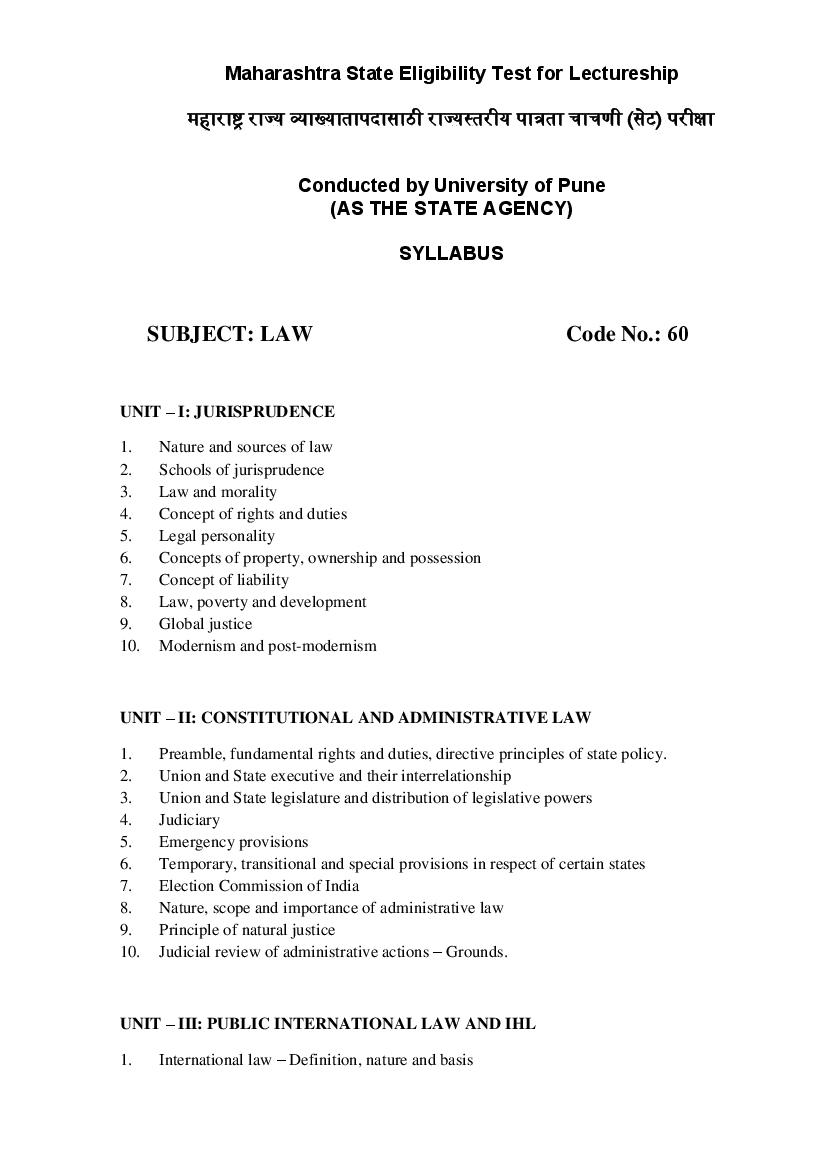
महारा� राज्य �ाख्यातापदासाठी राज्यस्तरीय पा�ता चाचणी (सेट) परीक्षा
Conducted by University of Pune
(AS THE STATE AGENCY)
SYLLABUS
SUBJECT: LAW Code No.: 60
UNIT – I: JURISPRUDENCE
1. Nature and sources of law
2. Schools of jurisprudence
3. Law and morality
4. Concept of rights and duties
5. Legal personality
6. Concepts of property, ownership and possession
7. Concept of liability
8. Law, poverty and development
9. Global justice
10. Modernism and post-modernism
UNIT – II: CONSTITUTIONAL AND ADMINISTRATIVE LAW
1. Preamble, fundamental rights and duties, directive principles of state policy.
2. Union and State executive and their interrelationship
3. Union and State legislature and distribution of legislative powers
4. Judiciary
5. Emergency provisions
6. Temporary, transitional and special provisions in respect of certain states
7. Election Commission of India
8. Nature, scope and importance of administrative law
9. Principle of natural justice
10. Judicial review of administrative actions – Grounds.
UNIT – III: PUBLIC INTERNATIONAL LAW AND IHL
1. International law – Definition, nature and basis
Page 2
3. Recognition of states and governments
4. Nationality, immigrants, refugees and internally displaced persons (IDPs)
5. Extradition and asylum
6. United Nations and its organs
7. Settlement of international disputes
8. World Trade Organization (WTO)
9. International humanitarian law (IHL) - Conventions and protocols
10. Implementation of IHL - Challenges
UNIT – IV: LAW OF CRIMES
1. General principles of criminal liability – Actus reus and mens rea, individual and
group liability and constructive liability
2. Stages of crime and inchoate crimes - Abetment, criminal conspiracy and attempt
3. General exceptions
4. Offences against human body
5. Offences against state and terrorism
6. Offences against property
7. Offences against women and children
8. Drug trafficking and counterfeiting
9. Offences against public tranquility
10. Theories and kinds of punishments, compensation to the victims of crime
UNIT – V: LAW OF TORTS AND CONSUMER PROTECTION
1. Nature and definition of tort
2. General principles of tortious liability
3. General defenses
4. Specific torts – Negligence, nuisance, trespass and defamation
5. Remoteness of damages
6. Strict and absolute liability
7. Tortious liability of the State
8. The Consumer Protection Act 1986 - Definitions, consumer rights and redressal
mechanism
9. The Motor Vehicles Act, 1988 - No fault liability, third party insurance and claims
tribunal
10. The Competition Act, 2002 - Prohibition of certain agreements, abuse of dominant
position and regulation of combinations
Page 3
1. Essential elements of contract and e-contract
2. Breach of contract, frustration of contract, void and voidable agreements
3. Standard form of contract and quasi-contract
4. Specific contracts - Bailment, pledge, indemnity, guarantee and agency
5. Sale of Goods Act, 1930
6. Partnership and limited liability partnership
7. Negotiable Instruments Act, 1881
8. Company law – Incorporation of a company, prospectus, shares and debentures
9. Company law – Directors and meetings
10. Corporate social responsibility
UNIT-VII: FAMILY LAW
1. Sources and schools
2. Marriage and dissolution of marriage
3. Matrimonial remedies - Divorce and theories of divorce
4. Changing dimensions of institution of marriage – Live-in relationship
5. Recognition of foreign decrees in India on marriage and divorce
6. Maintenance, dower and stridhan
7. Adoption, guardianship and acknowledgement
8. Succession and inheritance
9. Will, gift and wakf
10. Uniform Civil Code
UNIT –VIII: ENVIRONMENT AND HUMAN RIGHTS LAW
1. Meaning and concept of ‘environment’ and ‘environmental pollution’
2. International environmental law and UN Conferences
3. Constitutional and legal framework for protection of environment in India
4. Environmental Impact Assessment and control of hazardous waste in India
5. National Green Tribunal
6. Concept and development of human rights
7. Universalism and cultural relativism
8. International Bill of Rights
9. Group rights – Women, children, persons with disabilities, elderly persons,
minorities and weaker sections
10. Protection and enforcement of human rights in India – National Human Rights
Commission, National Commission for Minorities, National Commission for
Women, National Commission for Scheduled Castes, National Commission for
Schedule Tribes and National Commission for Backward Classes
Page 4
TECHNOLOGY LAW
1. Concept and meaning of intellectual property
2. Theories of intellectual property
3. International conventions pertaining to intellectual properties
4. Copyright and neighboring rights – Subject matters, limitations and exceptions,
infringement and remedies
5. Law of patent – Patentability, procedure for grant of patent, limitations and
exceptions, infringement and remedies
6. Law of trademark – Registration of trademarks, kinds of trademarks, infringement
and passing off, remedies
7. Protection of Geographical Indications
8. Bio-diversity and Traditional Knowledge
9. Information technology law- digital signature and electronic signature, electronic
governance, electronic records and duties of subscribers
10. Cyber crimes, penalties and adjudication
UNIT – X: COMPARATIVE PUBLIC LAW AND SYSTEMS OF GOVERNANCE
1. Comparative Law – Relevance, methodology, problems and concerns in Comparison
2. Forms of governments – Presidential and parliamentary, unitary and federal
3. Models of federalism – USA, Canada and India
4. Rule of Law – ‘Formal’ and ‘substantive’ versions
5. Separation of powers – India, UK, USA and France
6. Independence of judiciary, judicial activism and accountability – India, UK and
USA
7. Systems of constitutional review – India, USA, Switzerland and France
8. Amendment of the Constitution – India, USA and South Africa
9. Ombudsman –Sweden, UK and India
10. Open Government and Right to Information - USA, UK and India
Document Details
| Board / Org | Maharashtra Exams |
| Exam | Maharashtra State Eligibility Test |
| Type | Syllabus |
| Pages | 4 |
| Updated | 09 Jun 2026 |