CUSAT CAT 2025 Question Paper Geology
Finished viewing? Save it for later —
Download CUSAT CAT 2025 Question Paper Geology (PDF · 27 pages)About CUSAT CAT 2025 Question Paper Geology
CUSAT CAT 2025 Question Paper Geology is available here for free download. Published by Cochin University for CUSAT Common Admission Test, this question paper can be viewed online or downloaded as a PDF (27 pages). Candidates preparing for CUSAT Common Admission Test can use CUSAT CAT 2025 Question Paper Geology to understand the exam pattern, the type of questions asked, and the overall difficulty level.
Frequently Asked Questions
How can I download CUSAT CAT 2025 Question Paper Geology?
Open this page and click the Download button to save CUSAT CAT 2025 Question Paper Geology as a PDF. It is completely free on AglaSem Docs.
Is CUSAT CAT 2025 Question Paper Geology free to download?
Yes. CUSAT CAT 2025 Question Paper Geology can be viewed online and downloaded as a PDF free of cost on AglaSem Docs.
How many pages does CUSAT CAT 2025 Question Paper Geology have?
CUSAT CAT 2025 Question Paper Geology contains 27 pages, which you can read online or download together as a single PDF.
Where can I find more CUSAT Common Admission Test study material?
You can find more CUSAT Common Admission Test question papers, sample papers, syllabus, and answer keys on AglaSem Docs.
CUSAT CAT 2025 Question Paper Geology – Text
Read the full text of this question paper below — useful to quickly search, copy and reference the content online without downloading the PDF.
📄 View text version (27 pages)
Page 1
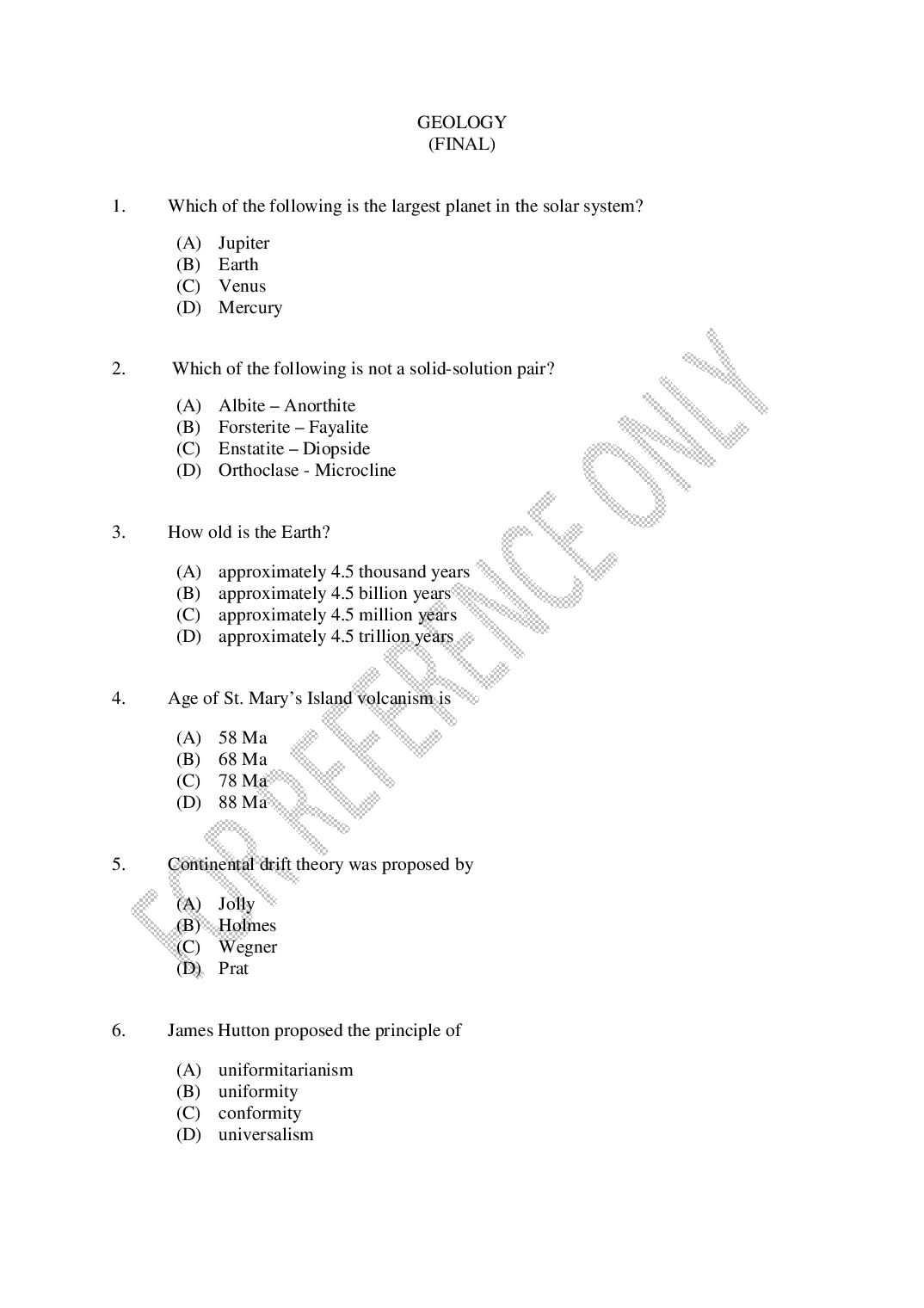
(FINAL)
1. Which of the following is the largest planet in the solar system?
(A) Jupiter
(B) Earth
(C) Venus
(D) Mercury
2. Which of the following is not a solid-solution pair?
(A) Albite – Anorthite
(B) Forsterite – Fayalite
(C) Enstatite – Diopside
(D) Orthoclase - Microcline
3. How old is the Earth?
(A) approximately 4.5 thousand years
(B) approximately 4.5 billion years
(C) approximately 4.5 million years
(D) approximately 4.5 trillion years
4. Age of St. Mary’s Island volcanism is
(A) 58 Ma
(B) 68 Ma
(C) 78 Ma
(D) 88 Ma
5. Continental drift theory was proposed by
(A) Jolly
(B) Holmes
(C) Wegner
(D) Prat
6. James Hutton proposed the principle of
(A) uniformitarianism
(B) uniformity
(C) conformity
(D) universalism
Page 2
(A) Neso
(B) Soro
(C) Phyllo
(D) lno
8. Which is the correct chronological order?
(A) Permian – Proterozoic – Pliocene – Paleocene
(B) Proterozoic – Permian - Paleocene – Pliocene
(C) Paleocene – Proterozoic – Pliocene – Permian
(D) Proterozoic – Paleocene – Permian – Pliocene
9. Which of the following instruments is used to measure the interfacial angles in a
crystal?
(A) Contact goniometer
(B) Clinometer
(C) Thermometer
(D) Restively meter
10. The concept of cycle of erosion is proposed by
(A) W.M. Davis
(B) L.C. King
(C) J Hutton
(D) A Wegner
11. Residual hill in the desert region is known as
(A) Inlier
(B) Inselberg
(C) Playa
(D) Pediment
12. Which of the minerals has piezoelectric property?
(A) Quartz
(B) Biotite
(C) Calcite
(D) Plagioclase
Page 3
called
(A) Isogyre
(B) Isohyet
(C) Isograd
(D) Isopleth
14. The Mohorovicic discontinuity is the boundary between
(A) mantle-core
(B) crust-mantle
(C) lithosphere-mantle
(D) inner core-outer core
15. The normal class of monoclinic system is …………..type
(A) Barite
(B) Beryl
(C) Gypsum
(D) Acmite
16. Read the following sentences carefully and choose the correct answer from the four
options given below:
(I) Mineral calcite crystallizes in rhombohedral class of hexagonal system
(II) There are three crystallographic axes present in the hexagonal system
(A) Sentence (I) is correct and (II) is wrong
(B) Sentence (I) is wrong and (II) is correct
(C) Both Sentence (I) and (II) are correct
(D) Both Sentence (I) and (II) are wrong
17. Calcite and Aragonite are the
(A) Isomorphs of CaCO3
(B) Polymorphs of CaCO3
(C) Isomorphs of CaMg(CO3)2
(D) Polymorphs of CaMg(CO3)2
18. Which of the following minerals has the highest hardness?
(A) Calcite
(B) Orthoclase
(C) Quartz
(D) Talc
Page 4
(A) Galena
(B) Garnet
(C) Pyrite
(D) Hematite
20. Exfoliation is a form of
(A) Chemical weathering
(B) Physical weathering
(C) Biochemical weathering
(D) Mass wasting
21. Si-O ratio in Quartz group of minerals is
(A) 1:2
(B) 1:3
(C) 4:11
(D) 2:5
22. Which of the following minerals does not have SiO4 Tetrahedron?
(A) Quartz
(B) Muscovite
(C) Halite
(D) Orthoclase
23. What is the hardness of fluorite?
(A) 1
(B) 2
(C) 3
(D) 4
24. What is the geological age of Cardita beaumonti?
(A) Upper Cretaceous to Lower Paleogene
(B) Upper Carboniferous to Triassic
(C) Lower Cretaceous to Middle Cretaceous
(D) Upper Jurassic to Lower Cretaceous
Page 5
(A) 800 m
(B) 1200 m
(C) 1600 m
(D) 2000 m
26. Which of the following crystal system has three equal and interchangeable
Crystallographic axes?
(A) Hexagonal
(B) Isometric
(C) Tetragonal
(D) Triclinic
27. In a crystal system each form of normal class is called as
(A) Holohedral form
(B) Hemihedral form
(C) Hemimorphic form
(D) Enantiomorphic form
28. How many diagonal two-fold axis of symmetry are present in the Isometric system?
(A) 4
(B) 6
(C) 3
(D) 8
29. The amount of horizontal displacement in a fault is called
(A) Throw
(B) Heave
(C) Tear
(D) Strike
30. Streak is
(A) color of the mineral
(B) color of the powder of a mineral
(C) color of the rock
(D) pleochoric color of the mineral
Page 6
(A) Quartz
(B) Diamond
(C) Clay
(D) Asbestos
32. Which of the following is a non-pleochroic mineral?
(A) Hypersthene
(B) Biotite
(C) Garnet
(D) Hornblende
33. Which of the following feldspar exhibits play of colors?
(A) Sandine
(B) Labradorite
(C) Microcline
(D) Albite
34. Which of the following mineral is also called heavy spar?
(A) Beryl
(B) Barite
(C) Bornite
(D) Bauxite
35. Chalcopyrite is an ore mineral of
(A) Copper
(B) Zinc
(C) Lead
(D) Iron
36. Repetition of beds on a geological map may be due to
(A) Folding
(B) Weathering
(C) Unconformity
(D) Disconformity
Page 7
(A) Basalt
(B) Granite
(C) Anorthosite
(D) Gabbro
38. Marble is a metamorphic rock, derived from metamorphism of
(A) Granite
(B) Limestone
(C) Sandstone
(D) Shale
39. Vesicular structures are commonly found in
(A) Basalts
(B) Granites
(C) Pegmatites
(D) Lamprophyres
40. A mass of rock exposed at the Earth's surface is called
(A) Crust
(B) Bedrock
(C) Outcrop
(D) Schorl Rock
41. From which country geological hydrogen was successfully extracted for the first
time?
(A) Australia
(B) Brazil
(C) Chili
(D) Mali
42. The smallest time division on the geologic time scale is a(n)
(A) era
(B) epoch
(C) eon
(D) period
Page 8
(A) Early Archaean to late Archaean
(B) Archaean to Proterozoic
(C) Proterozoic to Paleozoic
(D) Archaean to Phanerozoic
44. Which of the following flora belongs to lower Gondwana?
(A) Glossopteris
(B) Cladophlebis
(C) Sphenopteris
(D) Ptilophyllum
45. The regional strike of Dharwar group of rocks is
(A) N-S
(B) NW - SE
(C) E-W
(D) NNW - SSE
46. Which of the following are oldest group of rocks?
(A) Dharwar Group
(B) Sargur Group
(C) Vindhyan Group
(D) Bhima Group
47. Hematite is an ore mineral of
(A) Iron
(B) Manganese
(C) Chromite
(D) Copper
48. Bauxite deposits are of ………….. origin
(A) Hydrothermal
(B) Residual
(C) Early magmatic
(D) Late magmatic
Page 9
(A) Corallum
(B) Columella
(C) Corallite
(D) Coralina
50. Angadipuram laterite, a notified national geo-heritage museum is in which of the
following district of Kerala?
(A) Malappuram
(B) Kannur
(C) Wayanad
(D) Palakkad
51. Gastropods exhibit
(A) Bilateral symmetry
(B) Radial symmetry
(C) Biradial symmetry
(D) Asymmetry
52. Choose the odd one out
(A) Pyrolusite
(B) Magnetite
(C) Hematite
(D) Goethite
53. Which of the following is an ore of lead?
(A) Sphalerite
(B) Pyrite
(C) Galena
(D) Chalcopyrite
54. Wayanad district of Kerala is known for ………….. deposit
(A) Gold
(B) Iron
(C) Copper
(D) Bauxite
Page 10
(A) sin i
RI =
sin r
(B) nλ = 2d sin θ
(C) A = π r2
nt
r
(D) A = P 1 +
n
56. Iceland spar is the transparent variety of
(A) Calcite
(B) Gypsum
(C) Barite
(D) Quartz
57. Choose the odd one out
(A) Labradorite
(B) Bytownite
(C) Anorthite
(D) Orthoclase
58. Which of the following is not a polymorph of Al2SiO5?
(A) Corundum
(B) Andalusite
(C) Kyanite
(D) Sillimanite
59. Which of the following is orthoamphibole?
(A) Anthophyllite
(B) Hornblende
(C) Tremolite
(D) Actinolite
Page 11
options given below:
(I) Mineral kyanite is usually blue in colour
(II) Three sets cleavages are present in mineral kyanite
(A) (I) is correct and (II) is wrong
(B) (I) is wrong and (II) is correct
(C) Both (I) and (II) are correct
(D) Both (I) and (II) are wrong
61. Uniaxial minerals have ……………. optic axes
(A) Two
(B) Three
(C) One
(D) Four
62. Which of the following is a concordant intrusive body?
(A) dyke
(B) batholith
(C) sill
(D) stock
63. Quartz is a diagnostic mineral of ……….. rocks
(A) Oversaturated
(B) Saturated
(C) Unsaturated
(D) Undersaturated
64. Limestone having fish egg sized, oval shaped grains is called as ……….. limestone
(A) Oolitic
(B) Pisolitic
(C) Shelly
(D) Stromatolitic
65. Which formation of Sausar group is more important for manganese ore?
(A) Sitasaong formation
(B) Lohangi formation
(C) Mansar formation
(D) Chorbaoli formation
Page 12
(A) Iron-Manganese
(B) Gold-Silver
(C) Copper-Gold
(D) Lead-Zinc
67. Grade of the ore below which the mining is not profitable is called ………. grade
(A) average
(B) cut-off
(C) mill
(D) run of mine
68. Which of the following minerals has two sets of good cleavage planes oriented at
right angles to each other?
(A) Amphibole
(B) Calcite
(C) Mica
(D) Pyroxene
69. Which of the following minerals shows adamantine lustre?
(A) Quartz
(B) Diamond
(C) Clay
(D) Asbestos
70. Mica group of minerals exhibits
(A) Parallel extinction
(B) Inclined extinction
(C) Symmetrical extinction
(D) Wavy extinction
71. The angle between two optic axes in called as
(A) Extinction angle
(B) Optic axial angle
(C) Interfacial angle
(D) Angle of refraction
Page 13
(A) International Union of Geological Sciences
(B) Indian Union of Geological Sciences
(C) Indian United Geological Society
(D) International United Geological Society
73. The relationship between faces, edges and solid angles in a crystal form is expressed
by
(A) Prowen’s formula
(B) Nicholas’s formula
(C) Euler’s formula
(D) Powell’s formula
74. A disconformity is
(A) an erosional surface between parallel layers of sedimentary rocks
(B) an erosional surface between igneous and sedimentary rocks
(C) a rock unit that does not contain fossils
(D) a rock unit that is different from the units above or below it
75. The percentage of mafic minerals in an igneous rock is called as
(A) chemical index
(B) colour index
(C) mineral index
(D) rock index
76. Read the following sentences carefully and choose the correct answer from the four
options given below:
(I) Differentiation of magma is a magmatic evolution process
(II) It involves mixing of two magmas of diverse composition
(A) (I) is correct and (II) is wrong
(B) (I) is wrong and (II) is correct
(C) Both (I) and (II) are correct
(D) Both (I) and (II) are wrong
Page 14
(A) Winkler
(B) Niggli
(C) Eskola
(D) Tillay
78. New seafloor is created at a
(A) deep-sea trench
(B) mid-ocean ridge
(C) subduction zone
(D) transform fault
79. How many cleavage/s plane/s do sheet silicates exhibit/s?
(A) one
(B) two
(C) three
(D) four
80. Sphalerite is an ore mineral of
(A) Copper
(B) Lead
(C) Zinc
(D) Silver
81. Which of the following is an orthopyroxene?
(A) Diopside
(B) Augite
(C) Enstatite
(D) Hedenbergite
82. Which of the following mineral is isotropic under crossed polarizers?
(A) Garnet
(B) Hypersthene
(C) Hornblende
(D) Biotite
Page 15
(A) Plagioclase + Clinopyroxene
(B) Plagioclase + Hornblende
(C) Plagioclase + Orthopyroxene
(D) Orthoclase + Orthopyroxene
84. Charnockite is a ………….. metamorphic rock
(A) high grade
(B) medium grade
(C) low grade
(D) very low grade
85. Which of the following is the diagnostic mineral of greenschist facies metamorphism?
(A) Hornblende
(B) Hypersthene
(C) Chlorite
(D) Cordierite
86. Plagioclase exhibits ………… twining in thin section
(A) polysynthetic
(B) penetration
(C) simple contact
(D) concentric
87. According to the principle of uniformitarianism
(A) geologic processes we observe today have operated in the past
(B) geologic process in the past operated at the same rate as they do today
(C) all the planets formed from a uniform solar nebula
(D) early Earth was covered by a uniform magma ocean
88. What are the two most abundant elements in nebula (gas clouds) in the universe?
(A) Nitrogen and oxygen
(B) Oxygen and silicon
(C) Hydrogen and helium
(D) Iron and nickel
Page 16
(A) Accretion
(B) Subduction
(C) Divergence zone
(D) Contraction
90. Who is known as "Father of Geology"?
(A) John Butler
(B) Art Smith
(C) James Hutton
(D) Alfred Wegner
91. Chemical composition of mineral corundum is
(A) Al2O3
(B) Fe2O3
(C) Cr2O3
(D) SiO2
92. The angle of inclination of rock bed with the respect of horizontal plane is known as
(A) Strike
(B) Dip
(C) Bedding
(D) Heave
93. The fracture planes/shear planes along which there is relative movements of blocks is
called as
(A) Folds
(B) Joints
(C) Faults
(D) Intrusions
94. Which of the following is chemically formed sedimentary rock?
(A) Sandstone
(B) Gypsum
(C) Breccia
(D) Shale
Page 17
(A) Silky
(B) Vitreous
(C) Adamantine
(D) Pearly
96. Which of the following is the discontinuity between the lower and outer core?
(A) Mohorovicic discontinuity
(B) Gutenberg discontinuity
(C) Lehmann discontinuity
(D) Conard discontinuity
97. What is the age of Warkalli formation?
(A) Paleogene
(B) Neogene
(C) Quaternary
(D) Mesozoic
98. The name of the large supercontinent which existed 200 million years ago when all
the continents were together is
(A) Pangea
(B) Andrea
(C) Indian
(D) Africa
99. Which of the following mineral is carbonate of Manganese?
(A) Pyrolusite
(B) Siderite
(C) Rhodochrosite
(D) Malachite
100. Mushroom shaped structures having slender colum and wide top resulting from the
abrasive action of wind are known as
(A) Ventifacts
(B) Brazil null
(C) Pedestal rocks
(D) Drass
Page 18
(A) Anticline
(B) Antiform
(C) Monocline
(D) Synform
102. Which of the following materials might be dated using Carbon-14?
(A) granite
(B) iron ore
(C) sandstone
(D) decayed wood
103. ‘Homotaxial’ geological formations are
(A) Equivalent in lithology
(B) Equivalent in age but situated wide apart
(C) Different in age
(D) Different in age and situated at same place
104. Quartzite is a metamorphic derivative of
(A) Limestone
(B) Granite
(C) Sandstone
(D) Shale
105. Identify the correct sequence for the rank of coal from lowest to highest?
(A) Bituminous - anthracite-lignite - peat
(B) Peat - lignite - bituminous - anthracite
(C) Peat - lignite-anthracite - bituminous
(D) Anthracite - bituminous - lignite - peat
106. The hydrolysis of orthoclase results in the formation of
(A) shale
(B) kaolin
(C) lime
(D) hydrochloric acid
Page 19
(A) Graphite
(B) Mica
(C) Asbestos
(D) Clay
108. Which of the following pyroxene is diagnostic of Charnockite?
(A) Augite
(B) Hypersthene
(C) Hedenbergite
(D) Jadeite
109. Glaucophane is the characteristic mineral of ………….. facies
(A) blue schist
(B) green schist
(C) amphibolite
(D) zeolite
110. A terrigenous sedimentary rock in which the particles are mostly of silts and clay size
is called
(A) Sandstone
(B) Conglomerate
(C) Shale
(D) Breccia
111. Arkose is derived from weathering of
(A) Gabbro
(B) Granite
(C) Ultrabasic rocks
(D) Marble
112. Mechanical sedimentary rocks show ………… texture
(A) Clastic
(B) Non-clastic
(C) Coloform
(D) Reaction
Page 20
(A) Ripple marks
(B) Gadded Bedding
(C) Cross bedding
(D) Mud cracks
114. Which of the following is a monomineralic rock consisting almost exclusively of
olivine?
(A) Hazburgite
(B) Dunite
(C) Wehrlite
(D) Picrite
115. The term Anatexis denotes
(A) partial melting of rock
(B) partial recrystallization
(C) complete recrystallization
(D) complete melting of rock
116. The western continental margin of India is an example of
(A) Active Margin
(B) Passive Margin
(C) Subduction Zone
(D) Collision Zone
117. A conglomerate formed by the consolidation clasts ejected volcanic eruption is called
as
(A) Diamictite
(B) Orthoconglomerate
(C) Paraconglomerate
(D) Agglomerate
118. Which of the following is a biogenic sedimentary structure?
(A) Ripple mark
(B) Graded bedding
(C) Crawling trail
(D) Cross bedding
Page 21
(A) orthogneiss
(B) paragneiss
(C) augen gneiss
(D) porphyritic gneiss
120. Choose the odd one out
(A) Albite
(B) Sanidine
(C) Oligoclase
(D) Andesine
121. Wavy/undulose extinction is characteristically exhibited by
(A) Quartz
(B) Biotite
(C) Hornblende
(D) Hypersthene
122. Malanjkhand is known for …………….. deposits
(A) Iron
(B) Manganese
(C) Copper
(D) Bauxite
123. Which of the following is the most abundant element in the Earth’s crust?
(A) O
(B) Si
(C) Al
(D) Fe
124. Feldspar group of minerals crystallizes in which of the following crystal systems?
(A) Isometric
(B) Tetragonal
(C) Orthorhombic
(D) Monoclinic and Triclinic
Page 22
(A) KAlSi3O8
(B) NaAlSi3O8
(C) CaAlSi3O8
(D) Al2SiO5
126. What is the streak of Hematite?
(A) Black
(B) Cherry red
(C) White
(D) Yellow
127. Most of the rocks of the Central Indian Tectonic Zone evolved during
(A) Archean
(B) Proterozoic
(C) Paleozoic
(D) Mesozoic
128. Zawar Mines are famous for
(A) gold
(B) diamond
(C) lead and zinc
(D) graphite
129. Which of the following rock could be an important source of diamonds?
(A) Komatiite
(B) Gabbro
(C) Eclogite
(D) Kimberlite
130. Which of the following mineral is the carbonate of copper?
(A) Malachite
(B) Rhodochrosite
(C) Cerussite
(D) Strontianite
Page 23
called
(A) Epigenetic
(B) Syngenetic
(C) Synclogenetic
(D) Cynogenetic
132. Folds with two hinges and three planar limbs are called as ………… folds
(A) conjugate
(B) cheveron
(C) cuspate
(D) cylindrical
133. Choose the odd one out
(A) Fault Gouge
(B) Fault Breccia
(C) Mylonite
(D) Kaolinite
134. The ozone layer is found in the which of the fallowing layer of atmosphere?
(A) Troposphere
(B) Stratosphere
(C) Mesosphere
(D) Thermosphere
135. Hot molten silicate material erupted from volcano is called as
(A) Lava
(B) Magma
(C) Pyroclasts
(D) Tephra
136. Which of the following type of igneous rock has highest silica content?
(A) Ultra-mafic
(B) Mafic
(C) Intermediate
(D) Felsic
Page 24
(A) Diamond
(B) Hematite
(C) Quartz
(D) Calcite
138. In which of the following geological period mammals first appeared on the earth?
(A) Cretaceous
(B) Triassic
(C) Jurassic
(D) Tertiary
139. Which of the following is the age of fish?
(A) Devonian
(B) Silurian
(C) Cambrian
(D) Ordovician
140. Which of the following is a non-clastic sedimentary rock?
(A) Conglomerate
(B) Chalk
(C) Sandstone
(D) Shale
141. Which of the following sedimentary rock is of glacial origin?
(A) Tillite
(B) Shale
(C) Limestone
(D) Lignite
142. Ophitic texture is commonly shown by
(A) Granite
(B) Trachyte
(C) Andesite
(D) Dolerite
Page 25
(A) Orthoclase
(B) Quartz
(C) Garnet
(D) Apatite
144. Age of the Panjal Traps
(A) Cambrian
(B) Carboniferous
(C) Permian
(D) Devonian
145. A sandstone with less than 15% matrix content is known as
(A) Siltstone
(B) Mudstone
(C) Greywacke
(D) Arenite
146. Coesite is higher polymorph of
(A) Quartz
(B) Aluminosilicate
(C) Garnet
(D) Plagioclase
147. Which of the following is in decreasing order of particle size?
(A) Sandstone, Siltstone, Conglomerate
(B) Sandstone, Conglomerate Siltstone
(C) Conglomerate, Sandstone, Siltstone
(D) Siltstone, Sandstone, Conglomerate
148. In a binary system, two crystallization curves join at a point where simultaneous
crystallization of two mineral phases takes place is called as
(A) eutectic point
(B) peritectic point
(C) cotectic point
(D) anatectic point
Page 26
(A) crystal settling
(B) eutectic crystallization
(C) magma mixing
(D) fractional crystallization
150. Choose the odd one out
(A) Enstatite
(B) Bronzite
(C) Hypersthene
(D) Anthophyllite
Page 27
Subject Name: GEOLOGY
SI No. Key SI No. Key SI No. Key SI No. Key SI No. Key
1 A 31 B 61 C 91 A 121 A
2 C 32 C 62 C 92 B 122 C
3 B 33 B 63 A 93 C 123 A
4 D 34 B 64 A 94 B 124 D
5 C 35 A 65 C 95 A 125 A
6 A 36 A 66 A 96 C 126 B
7 C 37 C 67 B 97 B 127 B
8 B 38 B 68 D 98 A 128 C
9 A 39 A 69 B 99 C 129 D
10 A 40 C 70 A 100 C 130 A
11 B 41 D 71 B 101 A 131 B
12 A 42 B 72 A 102 D 132 A
13 C 43 B 73 C 103 B 133 D
14 B 44 A 74 A 104 C 134 B
15 C 45 D 75 B 105 B 135 A
16 A 46 B 76 A 106 B 136 D
17 B 47 A 77 C 107 B 137 A
18 C 48 B 78 B 108 B 138 B
19 C 49 C 79 A 109 A 139 A
20 B 50 A 80 C 110 C 140 B
21 A 51 D 81 C 111 B 141 A
22 C 52 A 82 A 112 A 142 D
23 D 53 C 83 B 113 D 143 C
24 A 54 A 84 A 114 B 144 C
25 B 55 B 85 C 115 A 145 D
26 B 56 A 86 A 116 B 146 A
27 A 57 D 87 A 117 D 147 C
28 B 58 A 88 C 118 C 148 A
29 B 59 A 89 B 119 B 149 B
30 B 60 C 90 C 120 B 150 D
Document Details
| Board / Org | Cochin University |
| Exam | CUSAT Common Admission Test |
| Type | Question Paper |
| Pages | 27 |
| Updated | 24 Sep 2026 |