MBOSE Class 12 Question Paper 2023 for Economics
Finished viewing? Save it for later —
Download MBOSE Class 12 Question Paper 2023 for Economics (PDF · 8 pages)About MBOSE Class 12 Question Paper 2023 for Economics
MBOSE Class 12 Question Paper 2023 for Economics is available here for free download. Published by Meghalaya Board for Class 12, this question paper can be viewed online or downloaded as a PDF (8 pages). Candidates preparing for Class 12 can use MBOSE Class 12 Question Paper 2023 for Economics to understand the exam pattern, the type of questions asked, and the overall difficulty level.
Frequently Asked Questions
How can I download MBOSE Class 12 Question Paper 2023 for Economics?
Open this page and click the Download button to save MBOSE Class 12 Question Paper 2023 for Economics as a PDF. It is completely free on AglaSem Docs.
Is MBOSE Class 12 Question Paper 2023 for Economics free to download?
Yes. MBOSE Class 12 Question Paper 2023 for Economics can be viewed online and downloaded as a PDF free of cost on AglaSem Docs.
How many pages does MBOSE Class 12 Question Paper 2023 for Economics have?
MBOSE Class 12 Question Paper 2023 for Economics contains 8 pages, which you can read online or download together as a single PDF.
Where can I find more Class 12 study material?
You can find more Class 12 question papers, sample papers, syllabus, and answer keys on AglaSem Docs.
MBOSE Class 12 Question Paper 2023 for Economics – Text
Read the full text of this question paper below — useful to quickly search, copy and reference the content online without downloading the PDF.
📄 View text version (8 pages)
Page 1
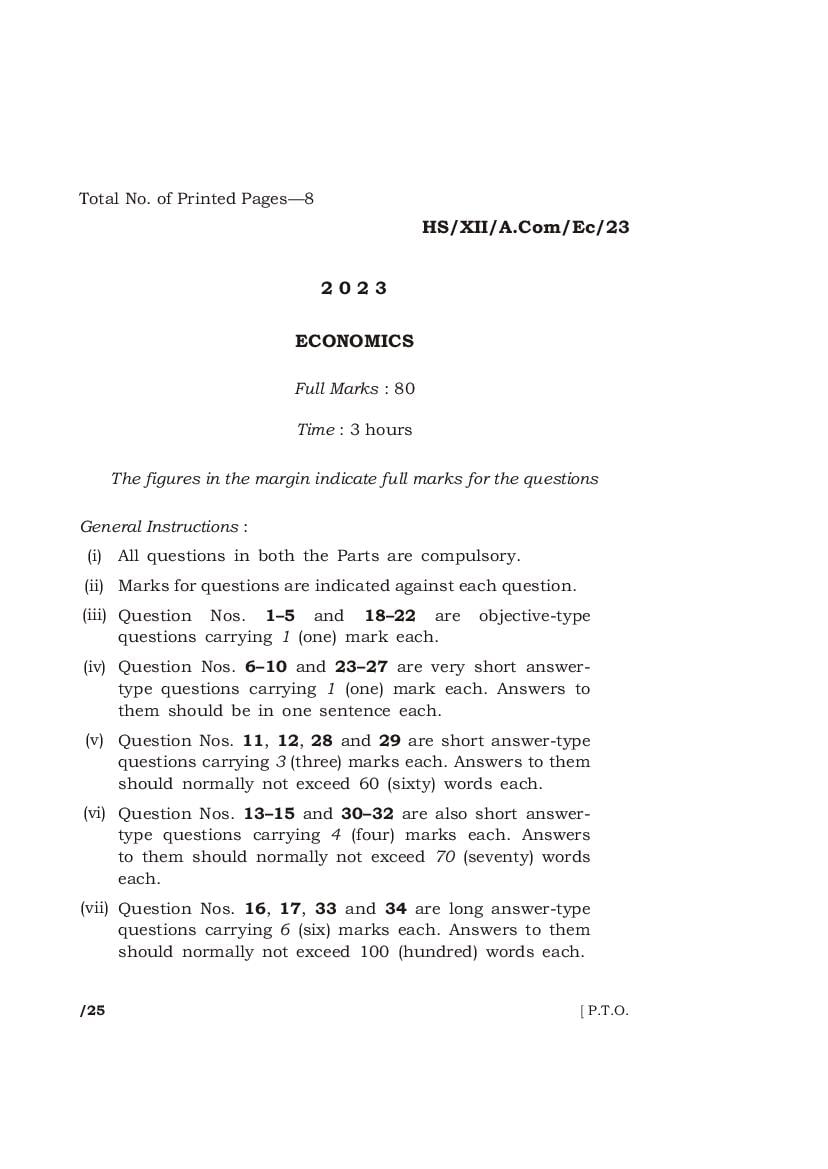
HS/XII/A.Com/Ec/23
2023
ECONOMICS
Full Marks : 80
Time : 3 hours
The figures in the margin indicate full marks for the questions
General Instructions :
(i) All questions in both the Parts are compulsory.
(ii) Marks for questions are indicated against each question.
(iii) Question Nos. 1–5 and 18–22 are objective-type
questions carrying 1 (one) mark each.
(iv) Question Nos. 6–10 and 23–27 are very short answer-
type questions carrying 1 (one) mark each. Answers to
them should be in one sentence each.
(v) Question Nos. 11, 12, 28 and 29 are short answer-type
questions carrying 3 (three) marks each. Answers to them
should normally not exceed 60 (sixty) words each.
(vi) Question Nos. 13–15 and 30–32 are also short answer-
type questions carrying 4 (four) marks each. Answers
to them should normally not exceed 70 (seventy) words
each.
(vii) Question Nos. 16, 17, 33 and 34 are long answer-type
questions carrying 6 (six) marks each. Answers to them
should normally not exceed 100 (hundred) words each.
/25 [ P.T.O.
Page 2
PART—A
( Introductory Macroeconomics )
( Marks : 40 )
1. A study of general price level is the subject matter of
(a) microeconomics
(b) macroeconomics
(c) Both (a) and (b)
(d) None of the above 1
2. In the context of commercial bank, which of the following
is correct?
(a) Note-issuing authority of the country
(b) Creates credit on the basis of cash reserves
(c) Accepts deposits from the general public
(d) Both (b) and (c) 1
3. Marginal propensity to consume is equal to
DY
(a)
DC
Y
(b)
C
DC
(c)
DY
C
(d)
Y 1
HS/XII/A.Com/Ec/23/25 [ Contd.
Page 3
4. Capital receipt is that receipt which
(a) creates a liability
(b) reduces the assets
(c) Both (a) and (b)
(d) None of the above 1
5. Surplus in balance of payments (BoP) occurs when
(a) receipts = payments
(b) receipts < payments
(c) receipts > payments
(d) Both (a) and (c) 1
6. What is barter system of exchange? 1
7. What is investment multiplier? 1
Or
Given :
Income—(Y ) = R 500 and
Consumption—(C ) = R 400
Calculate APS. 1
8. Mention two non-tax receipts of the government. 1
9. What is meant by managed floating rate of exchange? 1
10. What is balance of payments deficit? 1
HS/XII/A.Com/Ec/23/25 [ P.T.O.
Page 4
11. What are the limitations of using GDP as an index
of welfare of a country? 3
12. Distinguish between Balance of Trade and Balance of
Payments. 3
Or
From the following data, calculate the balance of
payments : 3
Items R
(in crore)
1. Exports of goods 500
2. Imports of goods 900
3. Exports of services 700
4. Imports of services 650
5. Current transfers from abroad 400
6. Current transfers abroad 150
7. Loans from abroad 100
8. Loans abroad 70
13. Explain any two instruments by which the central bank
controls the volume of credit in the economy. 2+2=4
14. Explain any two instruments of fiscal policy that are used
to correct excess demand. 2+2=4
Or
Give the meaning of—
(a) APC;
(b) MPS.
HS/XII/A.Com/Ec/23/25 [ Contd.
Page 5
Prove that—
(c) APC + APS = 1
(d) MPC + MPS = 1 1+1+1+1=4
15. Distinguish between the following : 2+2=4
(a) Revenue receipt and Capital receipt
(b) Deficit budget and Surplus budget
16. Explain the income method of calculating national
income. 6
Or
From the following data, calculate—
(a) GDP at market price;
(b) NNP at factor cost : 3+3=6
Items R
(in crore)
1. Private consumption expenditure 270
2. Gross investment 30
3. Net exports 15
4. Depreciation 10
5. Net factor income from abroad 20
6. Net indirect taxes 5
7. Government purchases of
goods and services 80
17. Explain consumption function using suitable schedule
and diagram. 2+2+2=6
HS/XII/A.Com/Ec/23/25 [ P.T.O.
Page 6
PART—B
( Indian Economic Development )
( Marks : 40 )
18. Inward looking trade strategy relies on
(a) export promotion
(b) import substitution
(c) Both (a) and (b)
(d) None of the above 1
19. The need for organic farming arises due to which of
the following reasons?
(a) It is environment friendly
(b) It sustains soil fertility
(c) Both (a) and (b)
(d) None of the above 1
20. Sustainable development is that development which
satisfies the needs of
(a) present generation only
(b) future generation only
(c) both present and future generations
(d) None of the above 1
HS/XII/A.Com/Ec/23/25 [ Contd.
Page 7
21. Which of the following countries has the lowest density
of population?
(a) India
(b) China
(c) Pakistan
(d) Bangladesh 1
22. China launched its First Five-Year Plan in the year
(a) 1951
(b) 1952
(c) 1953
(d) 1954 1
23. What is meant by subsistence farming? 1
24. What is demonetization? 1
25. What is meant by agricultural diversification? 1
26. What is meant by life expectancy? 1
27. What is commune system of farming? 1
Or
What is sex ratio? 1
HS/XII/A.Com/Ec/23/25 [ P.T.O.
Page 8
28. What is Green Revolution? Briefly explain its benefits.
1+2=3
29. What is unemployment? Distinguish between disguised
unemployment and seasonal unemployment. 1+2=3
Or
Briefly explain the changes in the workforce participation
rate in India. 3
30. Explain the growth of education sector in India. 4
Or
Explain the strategies for sustainable development. 4
31. What is cooperative society? Briefly explain its benefits.
1+3=4
32. Bring out a comparison between India and Pakistan on
the basis of—
(a) GDP growth;
(b) population growth. 2+2=4
33. Explain the features of the Industrial Policy of 1956. 6
Or
Explain the main goals of India’s Five-Year Plans. 6
34. Explain the different types of rural credit in India. 6
HHH
HS/XII/A.Com/Ec/23/25 K23—16520
Document Details
| Board / Org | Meghalaya Board |
| Exam | Class 12 |
| Type | Question Paper |
| Pages | 8 |
| Updated | 22 Jul 2026 |