MBOSE Class 12 Question Paper 2023 for Education
Finished viewing? Save it for later —
Download MBOSE Class 12 Question Paper 2023 for Education (PDF · 8 pages)About MBOSE Class 12 Question Paper 2023 for Education
MBOSE Class 12 Question Paper 2023 for Education is available here for free download. Published by Meghalaya Board for Class 12, this question paper can be viewed online or downloaded as a PDF (8 pages). Candidates preparing for Class 12 can use MBOSE Class 12 Question Paper 2023 for Education to understand the exam pattern, the type of questions asked, and the overall difficulty level.
Frequently Asked Questions
How can I download MBOSE Class 12 Question Paper 2023 for Education?
Open this page and click the Download button to save MBOSE Class 12 Question Paper 2023 for Education as a PDF. It is completely free on AglaSem Docs.
Is MBOSE Class 12 Question Paper 2023 for Education free to download?
Yes. MBOSE Class 12 Question Paper 2023 for Education can be viewed online and downloaded as a PDF free of cost on AglaSem Docs.
How many pages does MBOSE Class 12 Question Paper 2023 for Education have?
MBOSE Class 12 Question Paper 2023 for Education contains 8 pages, which you can read online or download together as a single PDF.
Where can I find more Class 12 study material?
You can find more Class 12 question papers, sample papers, syllabus, and answer keys on AglaSem Docs.
MBOSE Class 12 Question Paper 2023 for Education – Text
Read the full text of this question paper below — useful to quickly search, copy and reference the content online without downloading the PDF.
📄 View text version (8 pages)
Page 1
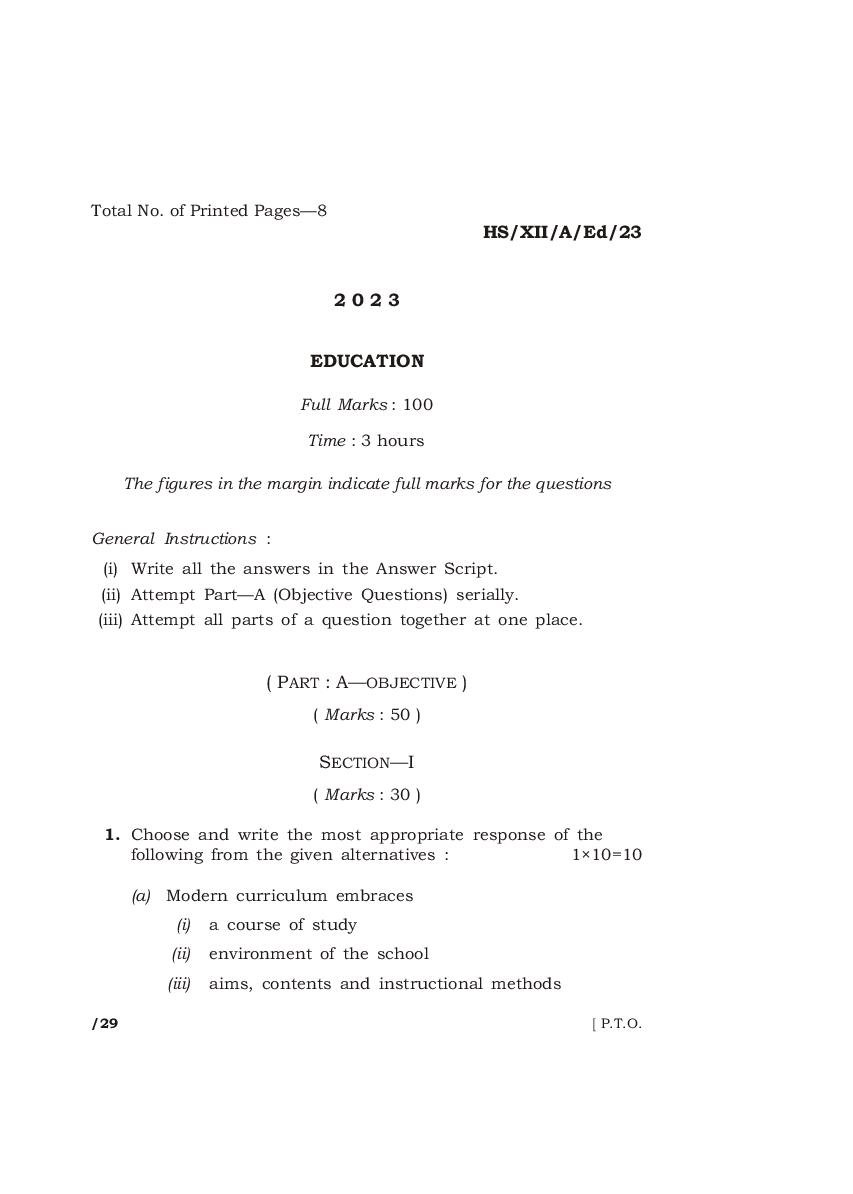
HS/XII/A/Ed/23
2023
EDUCATION
Full Marks : 100
Time : 3 hours
The figures in the margin indicate full marks for the questions
General Instructions :
(i) Write all the answers in the Answer Script.
(ii) Attempt Part—A (Objective Questions) serially.
(iii) Attempt all parts of a question together at one place.
( PART : A—OBJECTIVE )
( Marks : 50 )
SECTION—I
( Marks : 30 )
1. Choose and write the most appropriate response of the
following from the given alternatives : 1×10=10
(a) Modern curriculum embraces
(i) a course of study
(ii) environment of the school
(iii) aims, contents and instructional methods
/29 [ P.T.O.
Page 2
(b) In which year the Central Advisory Board of
Education (CABE) published a comprehensive report
called Sargent Report?
(i) 1964–66
(ii) 1944
(iii) 1986
(c) Activities at the pre-primary stage in Art education
include
(i) making puppets, creating artistic objects,
freehand sketching, dying, printing and
embroidery
(ii) poems, rhymes, exploration of sounds, simple
paper cutting and paper folding
(iii) knowledge of human body and its proportion,
creation of thematic compositions and
knowledge of local and traditional art forms
(d) The traditional curriculum is
(i) activity-centred
(ii) child-centred
(iii) subject-centred
(e) Children differ in their linguistic abilities, and at the
rate at which they learn a particular language is
(i) language ability
(ii) aptitude
(iii) attitude
HS/XII/A/Ed/23/29 [ Contd.
Page 3
(f) The part of personality that is concerned with
morality is the
(i) Id
(ii) Ego
(iii) Superego
(g) The ability to maintain a consistent behavioural
response during continuous and repetitive activity is
(i) selective attention
(ii) sustained attention
(iii) focussed attention
(h) Decay theory, interference and concept of repression
are associated with
(i) interest
(ii) memory
(iii) forgetting
(i) Thinking which involves an effort to relate all
thoughts to each other so that unity or harmony is
attained amongst them is
(i) proposition
(ii) image
(iii) reasoning
(j) Allport indicated that there is a hierarchy of
(i) 4 basic trait types
(ii) 3 basic trait types
(iii) 2 basic trait types
HS/XII/A/Ed/23/29 [ P.T.O.
Page 4
2. Write whether the following statements are True or False :
1×5=5
(a) NCERT and SCERT design and planning the
curriculum.
(b) The Open University of the United Kingdom, UKOU
was established in 1967.
(c) Dyscalculia refers to a disorder with reference to
arithmetic exercises.
(d) Questioning plays a significant role in encouraging
people to think.
(e) Heredity plays a more important role than
environment in human development.
3. Match the word(s) in Column—A relating to the
appropriate word(s) in Column—B : 1×5=5
Column—A Column—B
(a) Telecommunication (i) Visual art
(b) Extrovert (ii) Learning styles
(c) Cognitive development (iii) Carl Jung
(d) Automation (iv) Rapid transfer of
information
(e) Architectural work (v) Attention
HS/XII/A/Ed/23/29 [ Contd.
Page 5
4. Who stated the following? 1×5=5
(a) “Curriculum includes the totality of experiences that
a pupil receives through the manifold activities that
go on in the school—in the classroom, library,
laboratory, workshop, playgrounds and in the
numerous informal contacts between teachers and
pupils.”
(b) “Intelligence is the ability to solve problems, or to
create products, that are valued within one or more
cultural settings.”
(c) “A balanced intellect pre-supposes a harmonious
growth of body, mind and soul.”
(d) “Educational technology is the application of
scientific methods and techniques to education.”
(e) “Curiosity is as much a parent of attention, as
attention is of memory.”
5. Fill in the blanks : 1×5=5
(a) According to Freud, the slip of tongue phenomenon is
called the _____.
(b) In classroom, students grouped on the basis of their
ability is called within class _____.
(c) _____ has a language of its own with its signs and
symbolism which cuts across the cultures world
wide.
(d) _____ are considered as the ‘bible’ of school
education.
(e) The first test to measure intelligence was constructed
by _____.
HS/XII/A/Ed/23/29 [ P.T.O.
Page 6
SECTION—II
( Marks : 20 )
6. Answer briefly the following questions in 2 or 3 sentences
each (any ten) : 2×10=20
(a) Mention the different methods of teaching.
(b) Write on the distance education or distance learning.
(c) Mention the stages of memory.
(d) Name four causes of individual differences.
(e) State four characteristics of a ‘gifted’ or ‘talented’
child.
(f) Define personality.
(g) Write on the relationships between attention and
interest.
(h) What are the tools used in brain mapping?
(i) What are brainstorming activities?
(j) What do you understand by the term ‘lateral
thinking’ ?
(k) Mention the curriculum for drama at different stages
of school education as prescribed by the NCERT.
(l) What do you mean by the word ‘syllabus’ ?
HS/XII/A/Ed/23/29 [ Contd.
Page 7
( PART : B—DESCRIPTIVE )
( Marks : 50 )
Answer Question No. 7 and any three from the rest
7. Write short notes on any four of the following : 5×4=20
(a) Concept of Art education
(b) Physical and physiological differences in individual
(c) Clinical model of attention
(d) Thurstone’s theory of intelligence
(e) Inquiry-based learning
(f) Conventions and Laws that are related to the Rights
of the Child, 1989
(g) Causes of forgetting
(h) Conditions that stimulate thinking
8. Mention four characteristics of educational technology.
Explain, in detail, the types of educational technology.
2+8=10
9. Describe the various factors determining the personality
of an individual. 10
HS/XII/A/Ed/23/29 [ P.T.O.
Page 8
10. Why do individuals differ in intelligence? Discuss how
heredity and environment influence the intelligence of an
individual. 5+5=10
11. How are concepts represented in our mind? Explain, in
detail, the two types of concept. 4+6=10
12. Explain any two types of curriculum. 5+5=10
13. Who needs to be included in an inclusive school? 10
14. Explain the stages and processes of Art education as
prescribed by the NCERT. 10
HHH
HS/XII/A/Ed/23/29 K23—26710
Document Details
| Board / Org | Meghalaya Board |
| Exam | Class 12 |
| Type | Question Paper |
| Pages | 8 |
| Updated | 22 Jul 2026 |