WBCHSE Class 12 Syllabus 2024 Agriculture
Finished viewing? Save it for later —
Download WBCHSE Class 12 Syllabus 2024 Agriculture (PDF · 10 pages)About WBCHSE Class 12 Syllabus 2024 Agriculture
WBCHSE Class 12 Syllabus 2024 Agriculture is available here for free download. Published by West Bengal Board for Class 12, this syllabus can be viewed online or downloaded as a PDF (10 pages). Candidates preparing for Class 12 can use WBCHSE Class 12 Syllabus 2024 Agriculture to understand the exam pattern, the type of questions asked, and the overall difficulty level.
Frequently Asked Questions
How can I download WBCHSE Class 12 Syllabus 2024 Agriculture?
Open this page and click the Download button to save WBCHSE Class 12 Syllabus 2024 Agriculture as a PDF. It is completely free on AglaSem Docs.
Is WBCHSE Class 12 Syllabus 2024 Agriculture free to download?
Yes. WBCHSE Class 12 Syllabus 2024 Agriculture can be viewed online and downloaded as a PDF free of cost on AglaSem Docs.
How many pages does WBCHSE Class 12 Syllabus 2024 Agriculture have?
WBCHSE Class 12 Syllabus 2024 Agriculture contains 10 pages, which you can read online or download together as a single PDF.
Where can I find more Class 12 study material?
You can find more Class 12 question papers, sample papers, syllabus, and answer keys on AglaSem Docs.
WBCHSE Class 12 Syllabus 2024 Agriculture – Text
Read the full text of this syllabus below — useful to quickly search, copy and reference the content online without downloading the PDF.
📄 View text version (10 pages)
Page 1
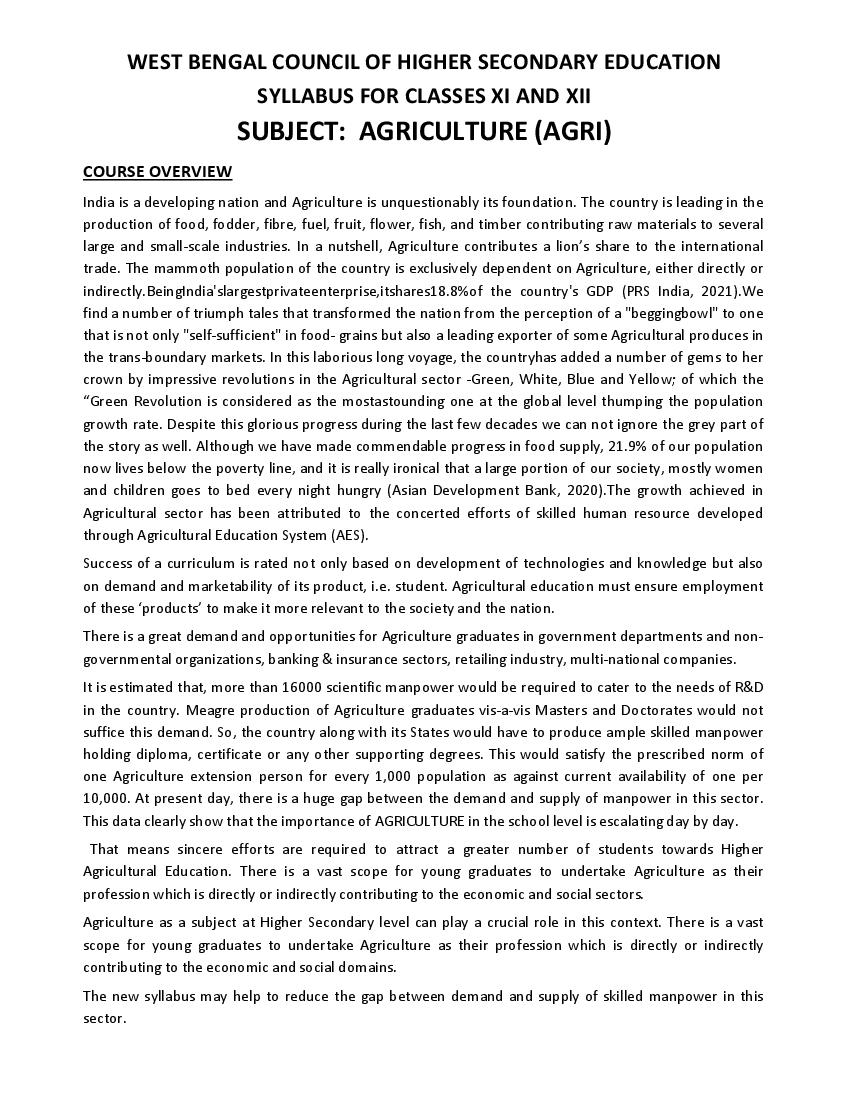
SYLLABUS FOR CLASSES XI AND XII
COURSE OVERVIEW
India is a developing nation and Agriculture is unquestionably its foundation. The country is leading in the
production of food, fodder, fibre, fuel, fruit, flower, fish, and timber contributing raw materials to several
large and small-scale industries. In a nutshell, Agriculture contributes a lion’s share to the international
trade. The mammoth population of the country is exclusively dependent on Agriculture, either directly or
indirectly.BeingIndia'slargestprivateenterprise,itshares18.8%of the country's GDP (PRS India, 2021).We
find a number of triumph tales that transformed the nation from the perception of a "beggingbowl" to one
that is not only "self-sufficient" in food- grains but also a leading exporter of some Agricultural produces in
the trans-boundary markets. In this laborious long voyage, the countryhas added a number of gems to her
crown by impressive revolutions in the Agricultural sector -Green, White, Blue and Yellow; of which the
“Green Revolution is considered as the mostastounding one at the global level thumping the population
growth rate. Despite this glorious progress during the last few decades we can not ignore the grey part of
the story as well. Although we have made commendable progress in food supply, 21.9% of our population
now lives below the poverty line, and it is really ironical that a large portion of our society, mostly women
and children goes to bed every night hungry (Asian Development Bank, 2020).The growth achieved in
Agricultural sector has been attributed to the concerted efforts of skilled human resource developed
through Agricultural Education System (AES).
Success of a curriculum is rated not only based on development of technologies and knowledge but also
on demand and marketability of its product, i.e. student. Agricultural education must ensure employment
of these ‘products’ to make it more relevant to the society and the nation.
There is a great demand and opportunities for Agriculture graduates in government departments and non-
governmental organizations, banking & insurance sectors, retailing industry, multi-national companies.
It is estimated that, more than 16000 scientific manpower would be required to cater to the needs of R&D
in the country. Meagre production of Agriculture graduates vis-a-vis Masters and Doctorates would not
suffice this demand. So, the country along with its States would have to produce ample skilled manpower
holding diploma, certificate or any other supporting degrees. This would satisfy the prescribed norm of
one Agriculture extension person for every 1,000 population as against current availability of one per
10,000. At present day, there is a huge gap between the demand and supply of manpower in this sector.
This data clearly show that the importance of AGRICULTURE in the school level is escalating day by day.
That means sincere efforts are required to attract a greater number of students towards Higher
Agricultural Education. There is a vast scope for young graduates to undertake Agriculture as their
profession which is directly or indirectly contributing to the economic and social sectors.
Agriculture as a subject at Higher Secondary level can play a crucial role in this context. There is a vast
scope for young graduates to undertake Agriculture as their profession which is directly or indirectly
contributing to the economic and social domains.
The new syllabus may help to reduce the gap between demand and supply of skilled manpower in this
sector.
Page 2
skills of Agriculture.
COURSE OBJECTIVE
The course is a planned sequence of instructions consisting of units meant for developing the
knowledge as well as skills regarding this course.
To introduce the students with the new subject of Agriculture. They can understand the importance of
Agriculture and other associated occupation related to Agriculture in Indian economy.
To expose the relationship of crop growth with weather to the students. They will get a clear
conception about different Agro climatic regions of West Bengal.
To familiarize the students with soil and physical, chemical and biological properties of soil.
To develop familiarity with the basic concept of Genetics and Plant Breeding in Agriculture. They will
get basic idea about different selection methods like hybridisation, different types of modern crop
varieties.
To introduce the students with varied cultivation practices including handling of different manures,
fertilisers, pesticides, fungicides and herbicides.
To expose the students to different package of practices (POP) of important Agricultural and
horticultural crop along with crop protection. They will get a comprehensive idea about IPM, INM, IDM
and IWM.
To help the students to comprehend the facts and importance of livestock management.
To develop knowledge about different farming systems, cropping pattern, dry land Agriculture as well
as different important schemes and policies related to Agriculture.
The major objective of practical course is to expose students with first-hand knowledge about
different aspects. They will be able to run important machines, solve practical mathematical problems,
handle semi-sophisticated tools like pH meter, barometer etc.
To make the students acquainted with the health and environmental management with special
reference to Agricultural systems management.
This course may enlighten rather steer the students in mining their future occupations / jobs through
escalating their skills and knowledge. There remains wide opportunity of selecting entrepreneurship
too.
Page 3
SEMESTER – I
FULL MARKS: 35 CONTACT HOURS: 100 Hours
COURSE CODE: THEORY
CONTACT
UNIT NO. TOPICS MARKS
HOURS
I : An Agriculture and Its Different Branches,
Introduction Relationship of Agriculture with other
12 09
to Disciplines
Agriculture Importance of Agriculture in Indian Economy,
Green Revolution
Allied Agriculture (Lac Culture, Apiculture,
Sericulture, Pisciculture)–a brief concept,
Subsidiary occupation related to Agriculture
II : Weather, Weather and Climate– A Brief Concept
Climate and Factors Affecting Weather and Crop Growth
25 10
Crop (Temperature, Sunshine, Cloud, Rainfall,
Seasons Humidity, Fog, Frost, Wind and Storm)
Cropping Seasons
Broad Classification of Crops According to Use
Agro-Climatic Regions of West Bengal
Climate Change, Global Warming, and Its
Effecton Agriculture
III : Soil and Definition of Soil, Components of Soil,
Physical Formation of Soil Weathering (Physical,
25 10
Properties Chemical and Biological), Factors of Soil
of Soil Formation
Soil Texture and Soil Structure
Density of Soil (Bulk Density, Particle Density,
Porosity and their Inter-Relationship)
Soil Profile, Soils of India (Name, Area, Basic
Properties)
Soil Water, Types of Soil Water and their
Characteristics, Soil Moisture Conservation,
Calculation of Soil Moisture
IV : Genetics Mendel’s Law of Inheritance
and Plant Concept of Gene, Allele, Mutation
18 06
breeding in Role of Genetics in Plant Breeding
Agriculture Selection Methods of Plant Breeding (Bulk
– An selection, Pure line selection, Mass selection
Introduction and Pedigree selection)
Hybridization and Tissue Culture Technique–
Basic Concept
Crop Varieties- Indigenous, HYV, Hybrid, G.M,
Page 4
examples
Contact Hours 80
Practical Work 20
Total Hours 100
Page 5
SEMESTER – II
FULL MARKS: 35 CONTACT HOURS: 100 HOURS
COURSE CODE: THEORY
CONTACT
UNIT NO. TOPICS MARKS
HOURS
V: Tillage (Definition, Objectives, Types)
Cultivation Seeds– Categories of Seeds, Seed 10 06
Practices Germination, Seed Treatment
Land Preparation and Seed Bed
Preparation, Sowing, Transplanting and
intercultural Operations, Harvesting,
Winnowing and Storage
Different Kinds of Farm Implements and
Their Uses
VI : Crop Package and Practices of Jute, Potato,
Production Onion, Maize, Pulse (Gram), Oil 25 11
seed(Mustard and Groundnut), Millet
(Jowar, Bajra)
Fodder crop(Berseem), Fruits (Papaya,
Guava)
VII : Irrigation–Concepts, Sources, Types of
Irrigation Irrigation with Special Emphasis on Micro- 15 09
and Drainage Irrigation, Fertigation
Water requirement of crops, Irrigation
Requirements, Irrigation Efficiency and
Scheduling of Irrigation.
Drainage–concept, types and importance.
VIII: Farming Farming System–Concept,Objectives,
System Components/ Enterprises 20 09
Mixed Farming, Subsistance Farming,
Specialized Farming, Crop Rotation, Mixed
Cropping, Inter-Cropping, Relay Cropping,
Paira Cropping, Multiple Cropping, Multi-
Storied Cropping, Cropping Intensity
Contact Hours 70
Practical Work 10
Home Assignment, Remedial and Tutorial Class 20
Total Hours 100
Page 6
COURSE CODE: PRACTICAL
GROUP: A (20 Marks)
1. Measurement and record of temperature, rainfall, air pressure.
2. Determination of soil texture by feel method.
3. Study of a soil profile.
4. Acquaintance with common farm implements and their operation (Country plough, mould
board plough, seed drill, sprayer and duster).
5. Determination of Test Weight, Germination Percentage.
6. Preparation of seed bed, sowing of seeds.
7. Seed treatment.
8. Calculation of the seed requirement for a particular crop related to theory syllabus.
GROUP: B (10 Marks)
1. Project work related to theory course
2. Practical notebook
3. Viva voce
Page 7
SEMESTER – III
FULL MARKS: 35 CONTACT HOURS: 100 Hours
COURSE CODE: THEORY
CONTACT
UNIT NO. TOPICS MARKS
HOURS
I : Growth of Concept of Growth and Development
Crops C3,C4,CAM Plants –in brief
12 06
Yield Components and Yield Calculation
II : Soil Different Plant Nutrients and Their
Chemical and Availability to Plants
Biological Mobility of Plant Nutrients in Soil and Plant 25 10
Properties Soil Fertility and Productivity
Soil Colloid
Soil Reaction
Problem of Soil (Acid soil, Saline soil,
Alkaline soil)
Soil MicroOrganism-Important
Bacteria, Algae, Fungi, Actinomycetes
( in brief )
Soil Organic Matter, Mineralization and
Emmobilization
Soil Erosion and Its Control
III: Manures Role of Manures and Fertilizers in
and Crop Production
Fertilizers Important Manures and Fertilizers– 25 10
Compost, Farm Yard Manure (FYM),
Green Manure, Vermicompost, Oil Cake,
Bone meal, Ammonium Sulphate, Urea,
Calcium, Ammonium Nitrate, Super-
Phosphate, Potassium Sulphate,
Potassium Chloride
Mixed Fertilizers - Their Properties and
Uses
Bio-Fertilizers
Application of Fertilizers
Law of diminishing return in fertiliser use
INM (Integrated Nutrient Management)
IV: Livestock Importance of Livestock in Agriculture
Management and Industry, White Revolution in
India 18 09
Important Breeds of Cows, Buffaloes,
Page 8
Signs of Sick Animals, Symptoms of
Common Diseases in Cattle and Poultry-
Rinderpest, Black Quarter, Foot-and-
Mouth, Mastitis, Hemorrhagic
Septicemia, Foul Pox, Ranikhet and Bird
Flu– Their Control
Artificial Insemination– Brief Concept
Contact Hours 80
Practical Work 20
Total Hours 100
CLASS - XII
SEMESTER – IV
FULL MARKS: 35 CONTACT HOURS: 100 Hours
COURSE CODE: THEORY
CONTACT
UNIT NO. TOPICS MARKS
HOURS
V : Crop Package and Practices – Land Preparation, 20 11
Production Time of Sowing, Suitable Varieties,
Cultivation Procedures, Manures and
Fertilizers Application, Irrigation and
Drainage, Intercultural Operations and
Yield of Rice, Wheat, Sugarcane, Brinjal,
Tomato, Mango and Banana (In tabular
form-Cabbage, Cauliflower, Bottle Gourd,
Bitter Gourd)
VI : Crop Concept of Pests and Pesticides (with 20 10
Protection Special Reference to Target Pests and
Mode of Action – Basic Idea)
Concept of IPM, IDM and IWM
Control of Different Insects, Diseases and
Weeds of Different Crops (Rice, Wheat,
Jute, Potato, Sugarcane, Brinjal, Mango,
Banana, Mustard, Gram)
Control of Rodents
Handling of Pesticides
Page 9
Processing Vegetables preservation
and Preparation of Jelly, Jam, Ketchup, Chips
Preservation and Their Packing
VIII : Dry Special Features of Dryland Farming / 15 07
land AGNM Rainfed Agriculture
culture and Different Important Schemes: Crop
Important Insurance, Kishan Credit Card
Policies
Contact Hours 70 35
Practical Work 10
Home Assignment, Remedial and Tutorial Class 20
Total Hours 100
Page 10
COURSE CODE: PRACTICAL
GROUP: A (20 Marks)
1. Collection of Soil sample and preparation of the soil samples for laboratory experiment.
2. Determination of soil pH by pH meter.
3. Identification of different manures and fertilisers.
4. Preparation of compost pit.
5. Identification of crop seeds (related to syllabus only), different farm weeds, important insect pests and diseases
and their damages.
6. Mathematical calculation for the formulation of spraying chemicals.
7. Calculation of yield of different crops by studying yield attributes of crop related to theory portion.
8. Mathematical calculation for the requirement of fertiliser in the crop field.
9. Determination of cropping intensity.
10. Cost of cultivation of different crops related to theory portion.
11. Students practice air layering, budding, inarching and Gooti making.
GROUP: B (10 Marks)
1. Project work related to theory course.
2. Practical notebook or laboratory notebook.
3. Viva voce.
Document Details
| Board / Org | West Bengal Board |
| Exam | Class 12 |
| Type | Syllabus |
| Pages | 10 |
| Updated | 22 Jul 2026 |