CUSAT CAT 2025 Question Paper Life Science
Finished viewing? Save it for later —
Download CUSAT CAT 2025 Question Paper Life Science (PDF · 43 pages)About CUSAT CAT 2025 Question Paper Life Science
CUSAT CAT 2025 Question Paper Life Science is available here for free download. Published by Cochin University for CUSAT Common Admission Test, this question paper can be viewed online or downloaded as a PDF (43 pages). Candidates preparing for CUSAT Common Admission Test can use CUSAT CAT 2025 Question Paper Life Science to understand the exam pattern, the type of questions asked, and the overall difficulty level.
Frequently Asked Questions
How can I download CUSAT CAT 2025 Question Paper Life Science?
Open this page and click the Download button to save CUSAT CAT 2025 Question Paper Life Science as a PDF. It is completely free on AglaSem Docs.
Is CUSAT CAT 2025 Question Paper Life Science free to download?
Yes. CUSAT CAT 2025 Question Paper Life Science can be viewed online and downloaded as a PDF free of cost on AglaSem Docs.
How many pages does CUSAT CAT 2025 Question Paper Life Science have?
CUSAT CAT 2025 Question Paper Life Science contains 43 pages, which you can read online or download together as a single PDF.
Where can I find more CUSAT Common Admission Test study material?
You can find more CUSAT Common Admission Test question papers, sample papers, syllabus, and answer keys on AglaSem Docs.
CUSAT CAT 2025 Question Paper Life Science – Text
Read the full text of this question paper below — useful to quickly search, copy and reference the content online without downloading the PDF.
📄 View text version (42 pages)
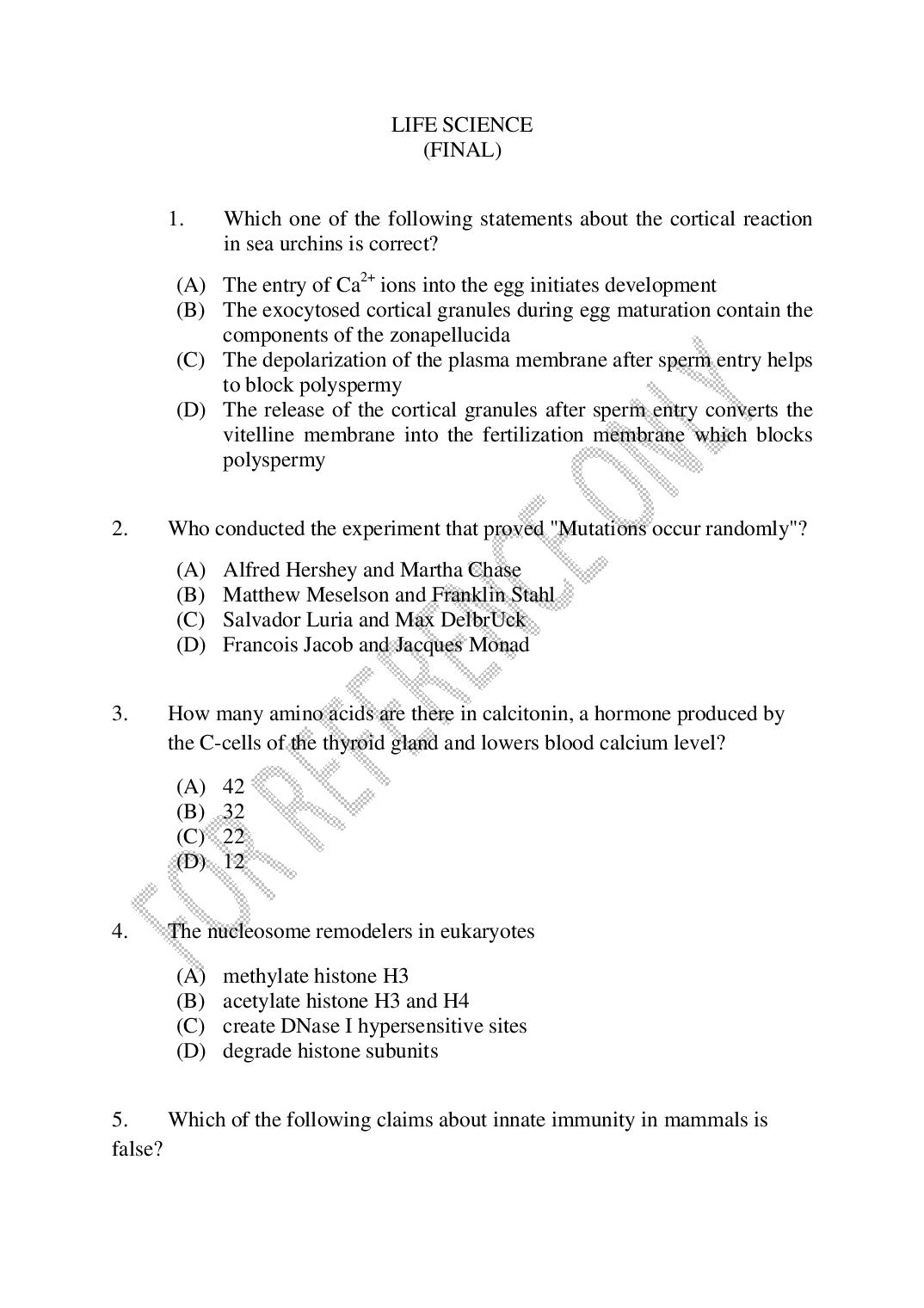
Page 1
(FINAL)
1. Which one of the following statements about the cortical reaction
in sea urchins is correct?
(A) The entry of Ca2+ ions into the egg initiates development
(B) The exocytosed cortical granules during egg maturation contain the
components of the zonapellucida
(C) The depolarization of the plasma membrane after sperm entry helps
to block polyspermy
(D) The release of the cortical granules after sperm entry converts the
vitelline membrane into the fertilization membrane which blocks
polyspermy
2. Who conducted the experiment that proved "Mutations occur randomly"?
(A) Alfred Hershey and Martha Chase
(B) Matthew Meselson and Franklin Stahl
(C) Salvador Luria and Max DelbrUck
(D) Francois Jacob and Jacques Monad
3. How many amino acids are there in calcitonin, a hormone produced by
the C-cells of the thyroid gland and lowers blood calcium level?
(A) 42
(B) 32
(C) 22
(D) 12
4. The nucleosome remodelers in eukaryotes
(A) methylate histone H3
(B) acetylate histone H3 and H4
(C) create DNase I hypersensitive sites
(D) degrade histone subunits
5. Which of the following claims about innate immunity in mammals is
false?
Page 2
immunity
(B) Serum complement proteins are part of innate immunity
(C) Innate immunity has only a narrow range of specificity
(D) The outcome of innate immunity is the rapid recognition and
phagocytosis or destruction of the pathogen
6. Both conditional and autonomous methods of cell specification are used
by Caenorhabditiselegans to establish blastomere identity. In this
context, which of the following statements is accurate?
(A) If the AB and P1 blastomeres are experimentally separated, the AB
cell will generate all cells it would normally make
(B) When AB divides to form daughter cells,ABp becomes different
from ABathrough its interaction with the P2 cell
(C) The specification of AB cell is determined by the presence of
cytoplasmic determinants
(D) The P2 cell produces a morphogen for the determination of the
ABp cell
7. Eukaryotic DNA replication is restricted to the S phase of the cell cycle
because
(A) DNA polymerase is present only in the S phase of the cell cycle
(B) Origin recognition complex (ORC) recognizes origin only in the S
phase
(C) MCM helicases get activated in the S phase of the cell cycle
(D) MCM helicases get activated in the G1 phase of the cell cycle
8. Which one of the below mentioned steps does nothappen during
ribosome-associated quality control of damaged mRNA?
(A) mRNA degradation
(B) Nascent protein degradation
(C) Disengagement of ribosome from mRNA
(D) Ribosome-mRNA monosome degradation
9. In human EEG recordings,pontogeniculo-occipital (PGO) spikes are
found
Page 3
(B) during Non-REM sleep stage 2
(C) during awake condition
(D) during Non-REM sleep stage 4
10. How many times do sound waves get amplified in the human middle ear?
(A) 16-18
(B) 6-8
(C) 9 - 12
(D) 2 -4
11. In which palaeontologytime did major events, like an increase in marine
diversity, diversification of synapsids, and first mammal-like forms,
occurred.
(A) Cretaceous
(B) Jurassic
(C) Triassic
(D) Carboniferous
12. Which metabolic activity is associated with Mitochondria-associated ER
membranes (MAM)?
(A) Protein glycosylation
(B) ATP synthesis
(C) Phospholipid metabolism
(D) Iron-sulphur cluster assembly
13. The organelle provided only by the sperm to the oocyte, after fertilization
in animals is
(A) Nucleolus
(B) Peroxisomes
(C) Mitochondria
(D) Centrioles
Page 4
allostericactivator?
(A) Phosphofructokinase : Citrate
(B) Pyruvate dehydrogenase : NADH
(C) Pyruvate carboxylase : ADP
(D) Pyruvate kinase : Fructose-1 ,6-bisphosphate
15. Cystic fibrosis is autosomal recessive disorder. Roughly one out of every
500individuals (0.20%) have this disorder. What is thepercentage of
individuals who are carriers using the Hardy-Weinberg equation?
(A) 10.2
(B) 1.0
(C) 15.2
(D) 7.6
16. The foot webbing genotype of a frog species is as follows:Non-webbed
feet (W) is dominant allele and webbed feet (w) is recessive allele. In a
population of 500 specimens, 320 specimens have the genotype WW, 160
specimens havethe heterozygous genotype of Ww, and 20 specimens
have the genotype ww.
What are the frequencies of all the three genotypes and alleles in this
population?
(A) Genotype frequencies: 0.04 WW, 0.32 Ww and 0.64 ww Allele
Frequencies W - 0.5 and w - 0.5
(B) Genotype frequencies: 0.32 WW, 0.64 Ww and 0.04 ww Allele
Frequencies W - 0.8 and w - 0.2
(C) Genotype frequencies: 0.64 WW, 0.32 Ww and 0.04 ww Allele
Frequencies W - 0.8 and w - 0.2
(D) Genotype frequencies: 0.34 WW, 0.34 Ww and 0.32 ww Allele
Frequencies W - 0.5 and w - 0.5
Page 5
relatedness between individuals of a monogamous, haplodiploid insect?
(a) A female is related to its son by 0.5
(b) A female is related to its brother by 0.5
(c) A male is related to its mother by 1
(d) A male is related to its daughter by 1
(A) a, b and c
(B) b, c and d
(C) a, b and d
(D) a, c and d
18. Which hormone is synthesized in different locations of the body?
(A) Thyrotropin releasing hormone
(B) Corticotropin releasing hormone
(C) Somatostatin
(D) Somatotropin
19. Weberianossicles can be best described as
(A) It is found in catfish and facilitates sound transmission from the
swimbladder to the inner ear
(B) It is found in sea stars and help them in detecting surface vibrations
(C) It is found in anurans and contributes to transmitting sound waves
fromthe eardrum
(D) It is found in snakes and contributes to receiving vibrations from
thesurroundings
20. Which is the most commonly used barcoding marker for theidentification
of animal species?
(A) Cytochrome oxidase I
(B) Microsatellites
(C) 28S
(D) MatK
21. The positive selection of T cells in mouse thymus is based on recognition
of
Page 6
(B) Self-antigens in association with foreign-MHC molecules
(C) Self-antigens in association with self-MHC molecules
(D) Foreign antigens in association with TLR ligands
22. Which is considered as a renal hormone?
(A) Megalin
(B) Cubilin
(C) Renalase
(D) Uroguanylin
23. Which among the following is not a principle of International Code of
Zoological Nomenclature (ICZN)?
(A) Binomial and trinomial system of nomenclature should be adopted
(B) Name of the genus should start with capital letter followed by
species with small letters
(C) The scientific name must be always written in italics or underlined
only
(D) The scientific name must be derived from Italian language only
24. Glycolipids in the plasma membrane are located at
(A) Inner leaflet of the plasma membrane
(B) The outer leaflet of the plasma membrane
(C) Evenly distributed in the inner and outer leaflets
(D) It varies according to cell types
25. The fluidity of the plasma membrane increases with
(A) Increase in unsaturated fatty acids in the membrane
(B) Increase in saturated fatty acids in the membrane
(C) Increase in glycolipid content in the membrane
(D) Increase in phospholipid content in the membrane
Page 7
of
(A) Active diffusion
(B) Facilitated diffusion
(C) Passive diffusion
(D) Random diffusion
27. Which of the following cell organelles is responsible for modifying,
packaging and transporting of proteins and lipids?
(A) Mitochondria
(B) Endoplasmic Reticulum
(C) Golgi Complex
(D) DNA
28. The cell junction is abundant in
(A) Cardiac cells
(B) Prokaryotic cells
(C) Hepatic cells
(D) Epithelial cells
29. Sarcoplasmic reticulum is found in
(A) Muscle cells
(B) Liver cells
(C) Kidney cells
(D) Neurons
30. Cristae in mitochondria serve as sites for
(A) Oxidation reduction reaction
(B) Protein synthesis
(C) Flavoprotein phosphorylation
(D) Macromolecules breakdown
31. The nucleosome contains
(A) 5 types of histones
Page 8
(C) 8 types of histones
(D) 8 histones of four different types
Page 9
(A) Microtubules
(B) Intermediate filaments
(C) Actin filaments
(D) Actin and Microtubules
33. Flagella is made up of
(A) Dynein
(B) Nexin
(C) Dynein and Nexin
(D) Actin
34. The sperms inside the human female reproductive tract undergo changes
called as
(A) Capacity
(B) Acrosome formation
(C) Capacitation
(D) Fertilization
35. Development in all the fertilized eggs occurs in a definite sequence.
Which of these is the correct sequence?
(A) Zygote, cleavage, morula, blastula, gastrula
(B) Zygote, morula, blastula, cleavage, gastrula
(C) Zygote, blastula, morula, cleavage, gastrula
(D) Zygote, morula, blastula, gastrula, cleavage
36. Eye formation is induced by
(A) Retina
(B) Corona
(C) Lens
(D) Optic nerve
37. AER is important for formation of
Page 10
(B) Proximal Distal axis of the limb
(C) Anterior Posterior axis of the limb
(D) Limb bud and wing bud
Page 11
(A) Injury, Deprogramming and Reprogramming
(B) Deprogramming and Reprogramming
(C) Injury and Reprogramming
(D) Injury and Deprogramming
39. …………….. is an example of bilaterally symmetrical and triploblastic
animal
(A) Cnidarians
(B) Roundworms
(C) Sponges
(D) Ctenophores
40. An important characteristic feature present only in phylum Coelenterata
is
(A) Flame cells
(B) Nematocysts
(C) Hermaphroditism
(D) Polymorphism
41. Periplaneta belongs to the Phylum
(A) Arthropoda
(B) Mollusca
(C) Annelida
(D) Echinodermata
42. The earliest palaeontologyperiod is
(A) Cambrian
(B) Permian
(C) Jurassic
(D) Quaternary
43. Which among the following pairs is an example of homologous organs?
(A) The arm of a human, wing of a bird
Page 12
(C) The arm of a human, wing of an insect
(D) Wing of an insect, leg of a horse
Page 13
(A) Presence of notochord
(B) Presence of triploblastic condition
(C) Presence of gill pouches
(D) Presence of coelom
45. Match the chordate group with its correct characteristic
Chordate Group Characteristic
1. Urochordata a. Notochord present throughout life
2. Cephalochordata b. Cartilaginous or bony endoskeleton
3. Vertebrata c. Marine organisms, notochord only in
larval stage
4. Amphibia d. Dual life, respiration through lungs and
skin
(A) 1-c,2-a,3-b,4-d
(B) 1-a,2-c,3-d,4-b
(C) 1-a,2-c,3-b,4-d
(D) 1-c,2-a,3-d,4-b
46. Amphibian metamorphosis requires
(A) TRF, T3, T4
(B) TRF,TSH, T3, T4
(C) Juvenile hormone and TSH
(D) Juvenile hormone and Ecdysone
47. Which of the following is NOT a function of the peroxisome in an animal
cell?
(A) Breakdown of fatty acids
(B) Detoxification of hydrogen peroxide
(C) ATP synthesis
(D) Metabolism of reactive oxygen species
Page 14
the primary effect on the cell?
(A) The cell will shrink due to excessive water loss
(B) The cell will swell and may burst due to ion imbalance
(C) The mitochondria will stop producing ATP
(D) The nucleus will disintegrate
49. Which of the following eye muscle is absent in birds?
(A) Dorsal rectus
(B) Superior oblique
(C) Retractor bulbi
(D) Lateral rectus
50. How many pairs of spiracles are found in cockroach?
(A) 3 pairs in thorax and 10 pairs in abdomen
(B) 2 pairs in thorax and 8 pairs in abdomen
(C) 2 pairs in thorax and 6 pairs in abdomen
(D) 1 pair in thorax and 7 pairs in abdomen
51. Mast cells of connective tissue contain
(A) Vasopressin and relaxin
(B) Heparin and histamine
(C) Heparin and calcitonin
(D) Serotonin and melanin
52. …………is not a physiological change that occurs in animal body due to
coccidiosis.
(A) Erosion of intestinal mucosa
(B) Intestinal haemorrhage
(C) Dysentery
(D) Brain stroke
Page 15
unpolymerized actin concentration can be as much as 50-200 µM.
However, the critical concentration for actin polymerization in-vitro is
about 0.2 µM. Some of the following proteins inhibit polymerization of
actin in cells.
(a). Thymosin – β4 (b). Capping protein CapZ (c). Tropomodulin (d).
XMAP215
Which one of the following options lists all inhibitors?
(A) (b), (c) and (d) only
(B) (a), (b) and (c) only
(C) (c), (d) and (a) only
(D) (d), (a) and (b) only
54. Which of the following modifications occurs to proteins in the Golgi
apparatus?
(A) N-linked glycosylation of proteins
(B) Cleavage of signal peptides
(C) Addition of mannose-6-phosphate to lysosomal proteins
(D) Folding into tertiary structures
55. A mutation in which of the following proteins is most likely to prevent
the G1-to-S phase transition?
(A) p53
(B) Cohesin
(C) CDK1
(D) Separase
56. The motor proteins responsible for the movement of chromosomes during
anaphase function by
(A) polymerizing microtubules at the centrosome
(B) depolymerizing microtubules at the kinetochore
(C) sliding microtubules past each other in the spindle midzone
(D) anchoring chromosomes to spindle poles
Page 16
here is the standard ECG of a normal person. The P-
P
wave represents the
(A) beginning of the systole
(B) initiation of the ventricular contraction
(C) contraction of both the atria
(D) end of systole
58. Match the parts of a kidney tubule with the function
unction of each and select the
correct one from the options given below.
below
a Henle's Loop i Reabsorption
b Glomerulus ii Maintenance of high osmolarity
c Proximal Convoluted iii Selective secretion and maintenance
tubule of pH
d Distal Convoluted iv Ultrafiltration of blood
tubule
(A) (a- iii), (b-i),
i), (c-
(c iv), (d-ii)
(B) (a-iv), (b-iii),
iii), (c-ii),
(c (d-i)
(C) (a-i), (b-ii),
ii), (c-iii),
(c (div)
(D) (a-ii), (b-iv), (c-i), (d-iii)
59. Which among the following types of arthritis is caused by an autoimmune
autoimmun
reaction?
(A) Osteoarthritis
(B) Rheumatoid arthritis
(C) Gout
(D) Septic arthritis
60. Which of the following drugs is used for the acute treatment of gout?
(A) Allopurinol
(B) Febuxostat
(C) Colchicine
(D) Probenecid
61. Breathing rate in human
hu is controlled by
Page 17
(B) Hypothalamus
(C) Thalamus
(D) Medulla oblongata
62. Smokers have shorter breathe due to
(A) Arteriosclerosis
(B) Emphysema
(C) Hypertension
(D) Cough
Page 18
(A) 500 ml
(B) 1200 ml
(C) 1500 ml
(D) 100 ml
64. Which metabolic sensor is crucial for linking energy status to
reproductive function?
(A) AMPK
(B) mTOR
(C) Leptin
(D) SIRT 1
65. Which of the following gene-editing tools is being explored for correcting
infertility-related genetic defects?
(A) ZEN
(B) CRISPR – Cas9
(C) TALEN
(D) All of the above
66. Which chromosomal disorder leads to severe intellectual disability and a
cleft lip in affected individuals?
(A) Edward’s syndrome
(B) Patau syndrome
(C) Down syndrome
(D) Cri-du-chat syndrome
67. Which of the following is NOT a function of the 3' untranslated region (3'
UTR) in mRNA?
(A) Regulation of mRNA stability
(B) Translation inititation
(C) Regulation of translation efficiency
(D) Binding to regulatory proteins
Page 19
is the expected frequency of the homozygous genotype AA under Hardy-
Weinberg equilibrium?
(A) 0.36
(B) 0.24
(C) 0.60
(D) 0.40
69. Which condition is caused by a pleiotropic gene in humans?
(A) Down syndrome
(B) Marfan syndrome
(C) Albinism
(D) Color blindness
70. Match the following.
a. Allopatric speciation 1. Evolution within the same
geographic area
b. Sympatric speciation 2. Physical barrier separates
populations
c. Peripatric speciation 3. Small population isolated at
the periphery
d. Parapatric speciation 4. Speciation occurs due to a
gradient in habitat
(A) a-2, b-1, c-3, d-4
(B) a-1, b-2, c-4, d-3
(C) a-4, b-3, c-1, d-2
(D) a-2, b-3, c-1, d-4
71. Which of the following is an example of an endangered species?
(A) Bengal Tiger
(B) House Mouse
(C) Monarch Butterfly
(D) Black Widow Spider
72. Sickle-cell anemia is an example of Single Nucleotide Polymorphism
(SNP) of
Page 20
(B) T to A mutation
(C) G to C mutation
(D) C to G mutation
73. The nucleotide sequence 5' AUG AGC CUỤC AGG UAA 3 would be
translated in the nucleus and mitochondria of a mammalian cell as
(A) Met-Ser-Leu-Arg in both the nucleus and mitochondria
(B) Met-Ser-Leu in both the nucleus and mitochondria
(C) Met-Ser-Leu in the nucleus and Met-Ser-Leu-Arg in the
mitochondria
(D) Met-Ser-Leu in the mitochondria and Met-Ser-Leu-
Arg in the nucleus
Page 21
DNA. Which of the following statements about 'junk' DNA is correct
according to our current understanding?
(A) About 1.6% of the human genome has no known function and has
been described as 'junk' DNA
(B) Bacteria have no junk DNA
(C) There are no genes in junk DNA
(D) MicroRNA genes do not code for proteins
75. The total biomass of photosynthetic autotrophs present in an ecosystem is
known as
(A) gross primary productivity
(B) standing crop
(C) net primary productivity
(D) secondary productivity
76. Environmental filtering is shaping a community of woody plants. If there
are 60 species in the regional species pool, what is the expected local
species pool for this community?
(A) 100
(B) 80
(C) 120
(D) 30
77. When it comes to the long-distance phloem transfer of photo-assimilated
carbon in plants, which of the following is the least suitable?
(A) Reducing sugars
(B) Mannitol
(C) Galactosyl-sucrose oligosaccharides
(D) Non-reducing sugars
78. Which combination of the four carbon intermediates produced by C4
plants during photosynthesis is correct?
Page 22
(B) Aspartate and Alanine
(C) Phosphoenolpyruvate and Oxaloacetate
(D) Alanine and Pyruvate
Page 23
(A) They are specialized cell-to-cell junctions
(B) They are open channels that connect the cytosol of adjacent cells.
(C) The plasma membranes of the adjacent cells extend continuously
through each plasmodesma
(D) Plasmodesmata are extensions of chloroplast that interconnects the
cytosol of the adjacent cells
80. The following information is obtained by a scientist who counts the
number of seeds generated by 10 distinct haploid ‘Arabidopsis’ plants
0, 5, 15, 25, 100,150, 200, 600, 1500, 3000
Which central tendency measure is most appropriate for describing the
above data?
(A) Mean
(B) Median
(C) Mode
(D) Standard deviation
81. Which theory from the list below best describes the co-evolution of hosts
and parasites?
(A) Kin selection
(B) Red Queen hypothesis
(C) Runaway selection
(D) Handicap principle
82. Which of the following best describes the 'Dark Reversion' of
phytochromes?
(A) Conversion of PR to PFR
(B) Conversion of PFR to PR
(C) Export of PFR from cytosol to nucleus
(D) Export of PR from cytosol to nucleus
83. It seems that tree stems compromise vessel diameter in order to maintain
hydraulic conductivity with
(A) Strength of the stem
Page 24
(C) Heartwood volume
(D) Vessel length
Page 25
hotspots
(A) Andaman - lndo-Burma; Nicobar - Sundaland
(B) Andaman - Sundaland; Nicobar - lndo-Burma
(C) Andaman - lndo-Burma; Nicobar - lndo-Burma
(D) Andaman - Sundaland; Nicobar – Sundaland
85. Guild coevolution or diffuse coevolution is described as
(A) One species uses the other as a resource
(B) Two species coevolve reciprocally, but only to each other
(C) Several species are involved in coevolutionary interactions
(D) A species escapes association from a predator and diversifies.
Later, a different predator adapts to the host and diversifies
86. The function of a GTPase activating protein (GAP) in the regulation of
heterotrimeric G proteins in plants is:
(A) Activates G-protein
(B) Inactivates Gaprotein
(C) Direct inhibition of ligand binding to GPCR
(D) Dissociation of Ga from Gβ/Gγ subunits
87. The correct combination of selfing or promote selfingin plant breeding
systems is
(A) Autogamy and allogamy
(B) Cleistogamy and geitonogamy
(C) Geitonogamy and allogamy
(D) Autogamy and herkogamy
88. Which statement correctly defines the principles of linkage mapping in
plants?
(A) Genetic markers would always show higher recombination
frequencies when they are closer to each other than if they are far
apart
(B) The genetic distance between two markers is a true representation
of the physical distance between them
(C) An ideal mapping population for a self-pollinating species is
Page 26
(D) An F2 mapping population would segregate in a 1:2:1 ratio for a
dominant marker
89. Which are the major non-native plant invaders of Indian aquatic
ecosystems?
(A) Partheniumhysterophorus, Pontederiacrassipes, Lantana camara
(B) Salviniamolesta,ProsopisJuliflora , Mikaniamicrantha
(C) Nelumbonucifera, Pogostemon erectus, Hygrophilaserpyllum
(D) Pontederiacrassipes, Salviniamolesta, Alternantheraphiloxeroides
90. The basis for phenetic classification is
(A) Dendrograms based on DNA characteristics
(B) The ancestral lineage of existing organisms
(C) Observable characteristics of existing entities
(D) Sexual characteristics
91. Brassica junceahave bisexual flowers.Thecytoplasmic male sterility
(CMS) is caused by a mitochondrial mutation. A nuclear gene called the
restorer of fertility gene (Rf)can restore CMS. One prevalent
characteristic is the return of fertility. A homozygous Rf line is crossed
with a CMS line. The resulting F1 offspring self-pollinates.What
percentage of F2 progeny will be sterilemales?
(A) 0
(B) 25
(C) 75
(D) 100
92. There is more to an ecological community than the sum of the
characteristics of the constituent species. Out of the following, which one
does not describe ecological communities?
(A) Local extinction of a species caused by demographic stochasticity
(B) Logseries species abundance distributions
(C) Stability of a food web in the face of disturbance
(D) The limits to similarity of competing species
Page 27
the Indian subcontinent?
(A) Boreal forest, tropical rainforest, tropical deciduous forest,
alluvialgrassland
(B) Temperate forest, alluvial grassland, dry thorn forest, subtropical
montaneforest
(C) Scrub forest, Chapparal vegetation, dry grasslands, riparian forest
(D) Shola grasslands, alpine grasslands, tundra, warm broad-leaved
forest
94. Which is the accurate order of increasing biological organisation?
(A) ecosystems < communities < biomes < populations
(B) populations < communities < ecosystems < biomes
(C) biomes < ecosystems < communities < populations
(D) populations < ecosystems < communities < biomes
Page 28
(A) Absence of large trees
(B) Less species diversity due to natural reasons
(C) Habitat void of large mammals due to anthropogenic impacts
(D) Loss of habitat
96. Salicylic acid (SA) controls systemic acquired resistance (SAR) in the
plant's distant tissues as well as hypersensitive response and effector-
triggered immunity at the main infection site. Regarding the role of the
Non-expressor of PR genes 1 (NPR1) in the distal tissue, which of the
following statements is true?
(A) NPR1 exists as oligomers in the nucleus and activates
hypersensitive response
(B) NPR1 degrades through its binding to NPR3 and leads to activation
of SAR response
(C) NPR1 accumulates in the nucleus and leads to activation of SAR
response
(D) Binding with NPR4 stabilizes NPR1 in the nucleus, which in turn
activates the hypersensitive response
97. Which of the following is most likely to happen if the gene encoding the
coffee plant enzyme phenylalanine ammonia-lyase (PAL) experiences a
loss of function mutation?
(A) Increased levels of caffeine
(B) Decreased lignin in cell walls
(C) Increased lignin in cell walls
(D) Decreased levels of caffeine
98. Which hormone is mostly used for rooting in plants?
(A) 2,4, -D
(B) NAA
(C) 2,4,5 – T
(D) Cytokinin
99. Auxin transport is
(A) Non-polar
Page 29
(C) Apoplast
(D) Polar
100. What is the drawback of the ‘Engler and Prantl’ classification system?
(A) Gymnosperms are placed between monocotyledons and
dicotyledons
(B) Dicotyledons are placed after monocotyledons
(C) Dicotyledons are placed before monocotyledons
(D) Gymnosperms are placed among Dicotyledons
101. Which among the following dicotyledonous families, is the most
phylogeneticallyevolved?
(A) Scrophulariaceae
(B) Acanthaceae
(C) Umbelliferae
(D) Compositae
102. ………………plant species lack xylem vessels
(A) Rose
(B) Pinus
(C) Gnetum
(D) Mango tree
103. Which among the following is a characteristic of Xylem parenchyma?
(A) They have a prominent nucleus
(B) The cell wall is thick, made of chitin
(C) Only living cells of the xylem tissue
(D) Cells have large vacuoles and are colourless
104. ………………is considered as the most advanced water-conducting
element
(A) Multiple vessels
(B) Tracheids
(C) Annular tracheids
(D) Simple vessels
Page 30
(A) Chlorenchyma
(B) Collenchyma
(C) Sclerenchyma
(D) Parenchyma
106. The flesh of fruit is mostly made of
(A) Collenchyma
(B) Parenchyma
(C) Meristem
(D) Schlerids
Page 31
(A) Water
(B) Air
(C) Soil
(D) Sunlight
108. Which of these conditions is not caused by a lack of mineral nutrition?
(A) Chlorosis
(B) Etiolation
(C) Necrosis
(D) Shortening internode
109. Match the plant group in column I with description in column II and find
the correct option
Column I Column II
1. Algae (i) First vascular plants
2. Bryophytes (ii) Amphibians of the plant kingdom
3. Pteridophytes (iii) Naked seed plants
4. Gymnosperms (iv) Simple aquatic autotrophs
5. Angiosperms (v) Enclosed seeds in fruits
(A) (1)- (iv), (2)- (ii), (3)- (i), (4)-(iii), (5)- (v)
(B) (1)- (i), (2)- (iii), (3)- (ii), (4)-(ii), (5)- (v)
(C) (1)- (v), (2)- (iv), (3)- (iii), (4)-(i), (5)- (ii)
(D) (1)- (ii), (2)- (i), (3)- (v), (4)-(iv), (5)- (iii)
110. When the margins of sepals or petals overlap one another without any
particular direction, the condition is termed as
(A) Vexillary
(B) Twisted
(C) Imbricate
(D) Valvate
111. Perisperm differs from endosperm in
(A) being a haploid tissue
Page 32
(C) being a diploid tissue
(D) its formation by fusion of secondary nucleus with several sperms
Page 33
(A) Transpiration helps in the upward movement of water
(B) Facilitated diffusion requires ATP for transport
(C) Phloem transports food in both upward and downward directions
(D) Root pressure contributes to water movement in small plants
113. Which cells play a major role in phloem loading and unloading?
(A) Companion cells
(B) Vessel elements
(C) Guard cells
(D) Tracheids
114. Frankia is associated with nitrogen fixation in
(A) Wheat and rice
(B) Legumes like peas
(C) Non-leguminous plants like Casuarina
(D) Maize and sorghum
115. Plants having the C-4 cycle are mainly found in tropical and sub-tropical
regions and are able to survive in environments with low concentration of
(A) O2
(B) N2
(C) CO2
(D) Both O2 and CO2
116. Which pathway is involved in the fixation of CO₂ in photosynthesis
through ribulosebisphosphate (RuBP)?
(A) Pentose phosphate pathway
(B) Glycolysis
(C) Citric acid cycle
(D) Uronic acid pathway
117. What are the three hormones involved in inducing cell enlargement?
(A) Auxin, Ethylene, Naphthyl acetic acid
Page 34
(C) Cytokinins, Indole-3-acetic acid, Naphthyl acetic acid
(D) Ethylene, Naphthyl acetic acid, Cytokinins
118. The hormone that induces formation more female flowers in plants is
(A) Cytokinins
(B) Naphthyl acetic acid
(C) Abscisic acid
(D) Ethylene
119. Identify the wrongly matched pair from the following:
(A) Gibberellin – Induces seed dormancy
(B) Auxin – Cell elongation and apical dominance
(C) Cytokinin – Promotes cell division
(D) Ethylene – Stimulates fruit ripening
120. In the light reaction of photosynthesis, the reducing power stored as a
result of solar energy is called
(A) NADP⁺
(B) NADPH + H⁺
(C) ADP + Pi
(D) Glyceraldehyde-3-phosphate (G3P)
121. The following statements refer to mechanisms that may cause
antibioticsresistance inbacteria
(a) Enzymes that can break down the antibiotic
(b) Efflux systems to pump out the antibiotic
(c) CRISPR-mediated defence against the antibiotic
(d) Antitoxins that can sequester the antibiotic
(e) Cell wall modification
Which combination of statements represents the correct antibiotic
resistance mechanism?
(A) (a), (b) and (e)
(B) (a), (b) and (c)
Page 35
(D) (a), (b), (c) and (e)
122. Which of the following claims regarding bacterial operons is false?
(A) Operons can encode multiple proteins with linked biological
activity
(B) An operon expresses multiple proteins from a single mRNA
(C) mRNAtranscript of an operon has only one Shine Dalgarno
sequence upstream of the first open reading frame
(D) Operon expression is often tightly regulated
123. Which of these bacterial constituents has the lowest probability of
containing antigens?
(A) Cell wall
(B) Flagella
(C) Ribosomes
(D) Capsule
124. Which of the following claims about gram staining is NOT true?
(A) Mycobacterium tuberculosis stains blue because of the thick lipid
layer
(B) Streptococcus pyogenes stains blue because of a thick
peptidoglycan layer
(C) Escherichia coli stains pink because of a thin peptidoglycan layer
(D) Mycoplasma pneumoniae is not visible in the Gram’s stain because
it has no cell wall
125. …………….is a gram-positive eubacterium
(A) Neisseria
(B) Rhizobium
(C) Legionella
(D) Clostridium
126. ……………..is diagnosed by serologic methods
(A) Actinomycosis
(B) Q-fever
(C) Pulmonary tuberculosis
Page 36
127. The genus of bacteria whose cell membrane contains sterols is
(A) Vibrio
(B) Mycoplasma
(C) Escherichia
(D) Chlamydia
128. ……………… infects other gram-negative bacteria
(A) Proteus mirabilis
(B) Haemophilus influenza
(C) Bdellovibrio
(D) Pseudomonas putida
Page 37
(A) T7
(B) M13
(C) ƛ-phage
(D) ɸ6
130. Given below are combinations showing name of disease, pathogen and its
biological group.Which of these is incorrectly matched?
(A) Pneumonia - Haemophilusinfluenzae - Bacteria
(B) Typhoid - Salmonella - Bacteria
(C) Filariasis - Microsporum - Roundworm
(D) Chikungunya - ChikungunyaVirus – Virus
131. The larval form of Taeniasolium is called
(A) Cysticeruscellulosae
(B) Cysticercoid
(C) Cysticerusbovis
(D) Hydatid cyst
132. A common biocontrol agent for plant diseases is
(A) Baculovirus
(B) Bacillus thuringiensis
(C) Glomus
(D) Trichoderma
133. Which one of the following microbes forms symbiotic association with
plants and helps them in their nutrition?
(A) Azotobacter
(B) Aspergillus
(C) Glomus
(D) Trichoderma
134. Which of the following statements is INCORRECTregarding
fermentation?
(A) Propionibacterium is used to ferment the cheese
Page 38
gas
(C) Fermentation in muscle produces ethanol
(D) Toddy is made by fermenting sap from palms
135. If chimeric mouse embryos were generated using GFP (Green
Fluorescent Protein) -expressing embryonic stem cells and RFP (Red
Fluorescent Protein) - expressing induced pluripotent stem cells (iPSCs),
which one of the following tissues from any resulting embryos will not
express any fluorescent protein?
(A) Brain
(B) Heart
(C) Intestine
(D) Placenta
136. Only one X chromosome in the aneuploid females is a characteristic of
individuals with
(A) Cri du Chat syndrome
(B) Klinefelter syndrome
(C) Down syndrome
(D) Turner syndrome
137. Which of the following cells in the renal corpuscles can influence
glomerular filtration by its contraction?
(A) Podocytes
(B) Endothelial cells of glomerular capillaries
(C) Parietal epithelial cells of Bowman’s capsules
(D) Mesangial cells
138. Least blood pressure is present in
(A) Vena Cava
(B) Aorta
(C) Capillary
(D) Vein
139. Apoenzyme is a
Page 39
(B) Carbohydrate
(C) Vitamin
(D) Amino acid
140. …………… is the enzyme responsible for catalyzing the formation of
peptide bonds during protein synthesis.
(A) Carbonic anhydrase
(B) Peptidase
(C) Carbohydrate
(D) Peptidyltransferase
141. Which of the following is a characteristic feature of Gram-positive
bacteria?
(A) Thin peptidoglycan cell wall
(B) Presence of an outer membrane
(C) Teichoic acids in the cell wall
(D) Lipopolysaccharide layer
142. A short region of a vector containing a number of unique restriction sites
into which DNA can be introduced is termed as
(A) Multiple cloning site
(B) Open reading frame
(C) Origin of replication
(D) Linker
143. From a fixed start point, each group of three bases in the coding region of
the mRNA represents a
(A) codon
(B) nucleotide
(C) gene
(D) polynucleotide
144. In nucleic acids, the bases are covalently attached to the 1-position of a
pentose sugar ring, to form a
Page 40
(B) DNA single strand
(C) Nucleoside
(D) Glycosidic bond
145. Enzymes that regulate the process of supercoiling are
(A) DNA helicases
(B) topoisomerases
(C) nucleases
(D) DNA polymerases
146. Which of the following is a 39-residue hormone of the anterior pituitary
gland?
(A) Glucagon
(B) Bradykinin
(C) Corticotropin
(D) Insulin
147. Choose the correct intermediate series in fat metabolism.
(A) Fatty acyl-CoA → trans enoyl-CoA → hydroxy acyl-CoA → Keto
acyl –CoA
(B) Fatty acyl-CoA → trans enoyl-CoA → Keto acyl –CoA →
hydroxy acyl-CoA
(C) Fatty acyl-CoA → Keto acyl –CoA → hydroxy acyl-CoA → trans
enoyl-CoA
(D) Fatty acyl-CoA → hydroxy acyl-CoA → Keto acyl –CoA → trans
enoyl-CoA
148. Choose the correct answer. A – assertion, R – reason.
A: Bile juice helps in digestion of food in small intestine
R: Bile juice contains sodium salt
(A) Both A and R are true, and R is the correct explanation of A
(B) Both A and R are true, but R is the not the correct explanation of A
(C) A is true and R is false
(D) A is false and R is true
Page 41
Assertion: Enzyme substrate complex remains throughout the
reaction.
Reason: The greater the affinity of the enzyme for a substrate, the
higher is the catalytic activity.
(A) Both A and R are true. R is the correct explanation of A
(B) A is true but R is false
(C) A is false but R is true
(D) Both are false
150. G protein-coupled receptors (GPCRs) are used to detect and respond to
many different types of signals, including neurotransmitters, hormones
involved in glycogen and fat metabolism and even photons of light.
Which one of the following statements regarding GPCR is
INCORRECT?
(A) GPCRs are a large family with a common structure of seven
membrane
- spanning α helices.
(B) GPCRs are coupled to trimeric G proteins comprising three
subunits α, β and γ.
(C) The Gα subunit is a GTPase switch protein that alternates between
an active ('on') state with bound GTP and an inactive ('off’) state
with GDP.
(D) The 'on' form gets bound to β and subunits and activates a
membrane bound effector like adenylyl cyclase, phospholipase C
or ion channel.
ANSWER KEY
Page 42
SI No. Key SI No. Key SI No. Key SI No. Key SI No. Key
1 D 31 D 61 D 91 B 121 D
2 C 32 D 62 B 92 A 122 C
3 B 33 C 63 A 93 B 123 C
4 C 34 C 64 C 94 B 124 A
5 C 35 A 65 D 95 C 125 D
6 B 36 C 66 B 96 C 126 B
7 C 37 B 67 B 97 B 127 B
8 D 38 A 68 A 98 B 128 C
9 A 39 B 69 B 99 D 129 B
10 A 40 B 70 A 100 B 130 C
11 C 41 A 71 A 101 D 131 A
12 C 42 A 72 A 102 B 132 D
13 D 43 A 73 C 103 B 133 C
14 D 44 A 74 D 104 D 134 C
15 D 45 A 75 B 105 D 135 D
16 C 46 B 76 D 106 B 136 D
17 D 47 C 77 A 107 C 137 D
18 C 48 B 78 A 108 B 138 A
19 A 49 C 79 D 109 A 139 A
20 A 50 B 80 B 110 C 140 D
21 C 51 B 81 B 111 C 141 C
22 C 52 D 82 B 112 B 142 A
23 D 53 B 83 A 113 A 143 A
24 B 54 C 84 A 114 C 144 C
25 A 55 A 85 C 115 C 145 B
26 C 56 B 86 B 116 A 146 C
27 C 57 C 87 B 117 B 147 A
28 D 58 D 88 C 118 D 148 A
29 A 59 B 89 D 119 A 149 C
30 A 60 C 90 C 120 B 150 D
Document Details
| Board / Org | Cochin University |
| Exam | CUSAT Common Admission Test |
| Type | Question Paper |
| Pages | 43 |
| Updated | 24 Sep 2026 |