CUSAT CAT 2025 Question Paper MA Economics and Finance
Finished viewing? Save it for later —
Download CUSAT CAT 2025 Question Paper MA Economics and Finance (PDF · 30 pages)About CUSAT CAT 2025 Question Paper MA Economics and Finance
CUSAT CAT 2025 Question Paper MA Economics and Finance is available here for free download. Published by Cochin University for CUSAT Common Admission Test, this question paper can be viewed online or downloaded as a PDF (30 pages). Candidates preparing for CUSAT Common Admission Test can use CUSAT CAT 2025 Question Paper MA Economics and Finance to understand the exam pattern, the type of questions asked, and the overall difficulty level.
Frequently Asked Questions
How can I download CUSAT CAT 2025 Question Paper MA Economics and Finance?
Open this page and click the Download button to save CUSAT CAT 2025 Question Paper MA Economics and Finance as a PDF. It is completely free on AglaSem Docs.
Is CUSAT CAT 2025 Question Paper MA Economics and Finance free to download?
Yes. CUSAT CAT 2025 Question Paper MA Economics and Finance can be viewed online and downloaded as a PDF free of cost on AglaSem Docs.
How many pages does CUSAT CAT 2025 Question Paper MA Economics and Finance have?
CUSAT CAT 2025 Question Paper MA Economics and Finance contains 30 pages, which you can read online or download together as a single PDF.
Where can I find more CUSAT Common Admission Test study material?
You can find more CUSAT Common Admission Test question papers, sample papers, syllabus, and answer keys on AglaSem Docs.
CUSAT CAT 2025 Question Paper MA Economics and Finance – Text
Read the full text of this question paper below — useful to quickly search, copy and reference the content online without downloading the PDF.
📄 View text version (30 pages)
Page 1
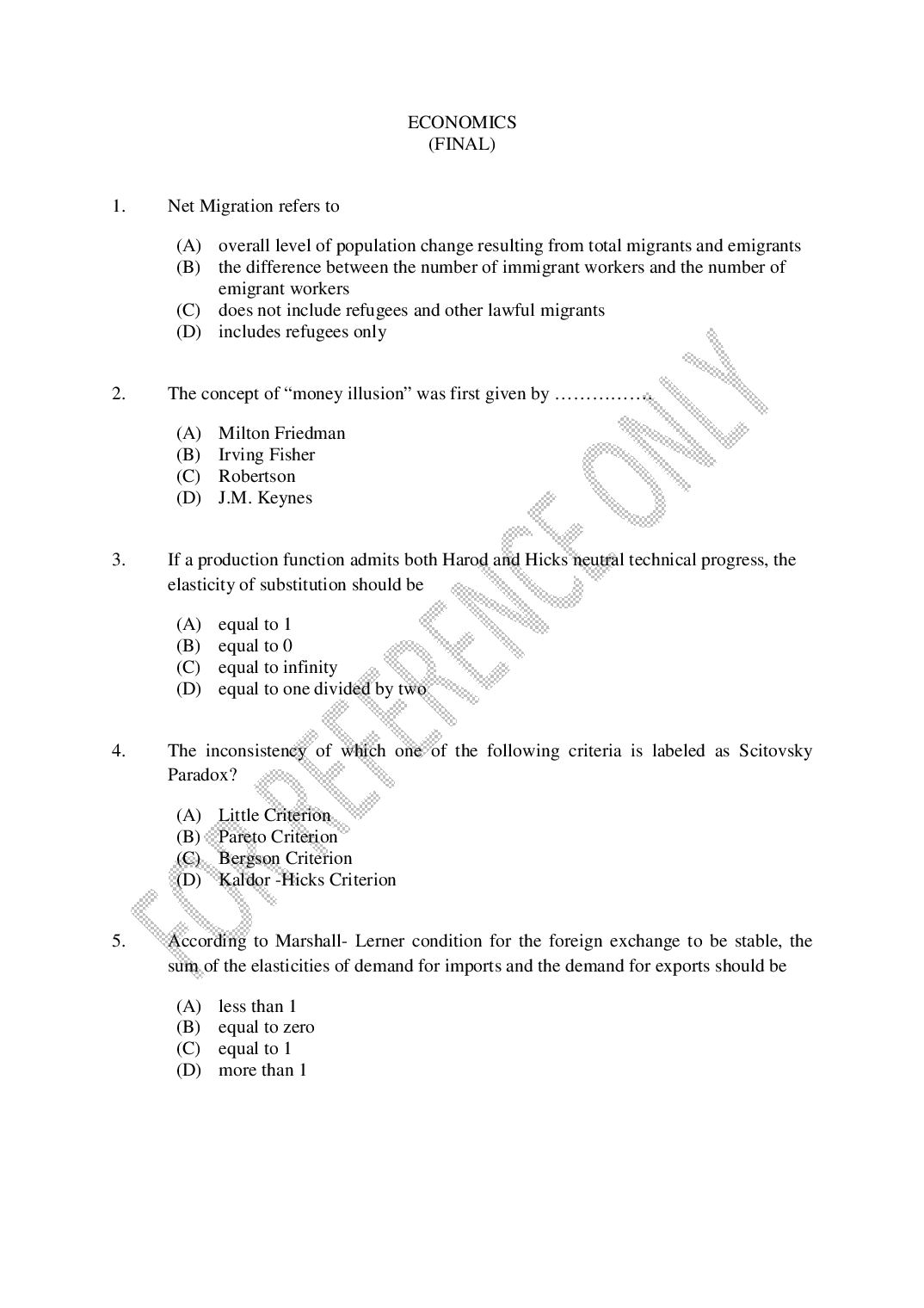
(FINAL)
1. Net Migration refers to
(A) overall level of population change resulting from total migrants and emigrants
(B) the difference between the number of immigrant workers and the number of
emigrant workers
(C) does not include refugees and other lawful migrants
(D) includes refugees only
2. The concept of “money illusion” was first given by …………….
(A) Milton Friedman
(B) Irving Fisher
(C) Robertson
(D) J.M. Keynes
3. If a production function admits both Harod and Hicks neutral technical progress, the
elasticity of substitution should be
(A) equal to 1
(B) equal to 0
(C) equal to infinity
(D) equal to one divided by two
4. The inconsistency of which one of the following criteria is labeled as Scitovsky
Paradox?
(A) Little Criterion
(B) Pareto Criterion
(C) Bergson Criterion
(D) Kaldor -Hicks Criterion
5. According to Marshall- Lerner condition for the foreign exchange to be stable, the
sum of the elasticities of demand for imports and the demand for exports should be
(A) less than 1
(B) equal to zero
(C) equal to 1
(D) more than 1
Page 2
share of capital and labour in total output are respectively, 40% and 60%, the capital
stock and labour force are growing, respectively at 8% and 3%. If the rate of growth
of output is recorded as 7% per annum then the rate of growth of total factor
productivity will be
(A) 4%
(B) 11%
(C) 10%
(D) 2%
7. To compute the “Index of Sustainable Economic Welfare”, which of the following
corrections is/are made in the value of GDP?
(A) Subtract the monetary value of depreciation
(B) Subtract the monetary value of loss due to floods and droughts
(C) Subtract the monetary value of expenditure on defence
(D) Subtract the costs of environment degradation
8. According to neo-classical theory of distribution, constancy in the wage share in
national income would come about only when the elasticity of factor substitution is
(A) less than one
(B) equal to one
(C) zero
(D) greater than one
9. Engel Curve denotes
(A) Various amounts of good which a consumer would be willing to purchase at
various price levels
(B) Various amounts of good which a consumer would be willing to purchase at
various income levels
(C) Various amounts of a good purchased when the price of its substitutes tend to
rise
(D) The relationship between income effect and substitution effect
10. A producer is said to be operating with excess capacity
(A) When he produces an output greater than that given by the minimum average
total cost
(B) When he produces an output greater than given by the maximum average total
cost
(C) When he produces an output equal to that given by the minimum average total
cost
(D) When he produces an output smaller than that given by the minimum average
Page 3
11. Walras Law implies that if there are N markets, we only need to find equilibrium
prices in
(A) 2N markets
(B) N-1 Markets
(C) N-3 Markets
(D) All of the above
12. On which of the following do Keynesians and Monetarists agree
(A) When there is recessionary gap, flexible wages will retrieve the labour market
to equilibrium quickly
(B) The most important cause of demand shock is changes in supply
(C) Output devices at times from the potential output because of demand shocks
(D) The demand for money is interest elastic
13. Liquidity Approach is also known by the name
(A) Gurley Shaw Approach
(B) Radcliffe Approach
(C) Traditional Approach
(D) Monetarist Approach
14. Which of the following concept-economist pairs is not correctly matched?
(A) Super Multiplier-J M Keynes
(B) Golden Rule of accumulation-E S Phelphs
(C) Turnpike conjecture-Dorfman, Samuelson and Solow
(D) Knife edge problem-Harrod Domar
15. The Stopler-Samuelson theorem postulates that the imposition of a tariff by a nation
causes the real income of the nation’s
(A) Abundant factor to rise
(B) Scarce factor to rise
(C) Scarce factor to fall
(D) Both (A) and (B) are possible
16. Which of the following facts forms the invisible account of balance of payments of a
country?
(A) International Trade in services
(B) Income associated with non-residual assets and liabilities
(C) Remittance of worker’s incomes
(D) All of the above
Page 4
(A) GNP at constant prices
(B) Per Capita Income at constant prices
(C) Per Capita Income at current prices
(D) GNP at current prices
18. Backward and forward Linkages are relevant for which kind of growth strategy?
(A) Unbalanced Growth
(B) Trickle down Growth
(C) Balanced Growth
(D) Equilibrium Growth
19. Arrange the indices in the chronological order and answer from the codes given below
1. Multidimensional Poverty Index
2. Human Poverty Index
3. Capability Poverty Measure
4. Human Development Index
(A) 4,3,2,1
(B) 4,2,3,1
(C) 2,1,4,3
(D) 1,2,3,4
20. Which of the statements about marginal cost is incorrect?
(A) A U-shaped marginal cost curve implies the existence of diminishing returns
overall ranges of output
(B) When marginal cost equals average cost, average cost is at its minimum
(C) In the Short run, the shape of the marginal cost curve is due to the law of
diminishing marginal returns
(D) When marginal cost is falling, total cost is rising
21. Where is the Secretariat of the Organisation of Economic Co-operation and
Development (OECD)?
(A) Tokyo, Japan
(B) London, U.K
(C) Paris, France
(D) New York, USA
Page 5
1. The market is a system that works with price mechanism
2. Market failure refers to the divergence of market equilibrium from pareto
optimality
3. Market fails to efficiently supply public goods and the same makes a case for
government intervention
4. Market efficiently works in the presence of positive externalities
5. Market efficiently works in the presence of negative externalties
Choose the correct statements
(A) 1,2,3 and 4
(B) 1,2 and 3
(C) 3,4 and 5
(D) 2 and 5
23. As output expands, LAC curve falls This is due to
(A) law of variable proportions
(B) law of diminishing returns
(C) economies of scale
(D) diseconomies of scale
24. ‘Social Welfare Function’ (SWF) refers to
(A) Ranks various social states
(B) A function performed by factors of production
(C) Tells about equilibrium of an economy
(D) None of the above
25. Technological dualism means
(A) Prevalence of different production functions in the industrial sector in
underdeveloped countries
(B) Prevalence of different technologies in agriculture sector in underdeveloped
countries
(C) Prevalence of different production function in the advanced and traditional
sectors in underdeveloped countries
(D) Prevalence of different production function in domestic and export sectors of
underdeveloped countries
Page 6
effect on their balance of payments due to
(A) Demonstration Effect
(B) Multiplier Effect
(C) Backwash Effect
(D) Spread Effect
27. L-shaped average cost curve is witnessed in the large firms because
(A) only the law of increasing return operates
(B) the law of constant returns to scale operates
(C) only the law of constant return operates
(D) the operation of law of decreasing returns is continuously postponed
28. A discriminating monopolist will charge a lower price in the market in which the
price elasticity of
(A) Demand is greater
(B) Supply is smaller
(C) Demand is smaller
(D) Supply is greater
29. The oligopoly model in which the businessman assumes that his competitors output is
fixed and simultaneously decide how much to produce is
(A) Cournot Oligopoly Model
(B) Stackelberg Oligopoly Model
(C) Chamberlin’s Oligopoly Model
(D) Bertrand Oligopoly Model
30. A tax cut has less impact on aggregate demand than an increase in government
purchase of the same size because
(A) a portion of the tax cut is saved
(B) tax cut do not increase disposable income
(C) a portion of tax cut is invested
(D) the tax cut multiplier is equal to 1
31. A monopolist sets different prices for domestic and international markets based on
demand elasticity. What type of price discrimination is this?
(A) First-degree
(B) Second-degree
(C) Third-degree
(D) Dumping
Page 7
cupcakes, increasing its sales temporarily. In the long run, what will likely happen?
(A) The bakery will sustain high profits
(B) Other bakeries will enter and imitate the flavour
(C) The bakery will exit the market
(D) The market will shift to perfect competition
33. The shut-down point for a firm occurs when price equals
(A) marginal cost
(B) average total cost
(C) average variable cost
(D) total revenue
34. The social cost of monopoly arises due to
(A) Productive efficiency
(B) Allocative inefficiency
(C) Homogeneous products
(D) Free market entry
35. A government introduces a subsidy in a competitive factor market for renewable
energy equipment. What is the likely effect on the equilibrium quantity of inputs
used?
(A) It will decrease
(B) It will remain unchanged
(C) It will increase
(D) It will depend on the elasticity of demand
36. The price elasticity of demand for gasoline is 0.3. A 20% increase in price occurs due
to a supply shock. By what percentage will the quantity demanded decrease?
(A) 6%
(B) 20%
(C) 30%
(D) 60%
37. A consumer spends all their income on two goods, X and Y. The marginal utility per
dollar for X exceeds that of Y. To maximize utility, the consumer should
(A) buy more of X and less of Y
(B) buy more of Y and less of X
(C) continue with the current consumption
(D) reduce total consumption
Page 8
changing relative prices. How will the consumer’s budget line change?
(A) It will shift outward parallelly
(B) It will shift inward parallelly
(C) It will rotate outward
(D) It will remain unchanged
39. A firm's short-run total cost increases from 500 to 550 when output increases from
100 to 120 units. What is the marginal cost for this increase in output?
(A) 0.25
(B) 2.50
(C) 5
(D) 50
40. A furniture manufacturer operates with diminishing returns in the short run. The
marginal cost of producing each additional table is increasing. However, the selling
price of tables remains constant. To maximize profits, the manufacturer should
(A) continue producing until marginal cost equals marginal revenue
(B) stop production when marginal cost exceeds total revenue
(C) focus on reducing fixed costs
(D) increase production as long as average costs are decreasing
41. A consumer's budget constraint is given as 10X + 20Y = 200, where X and Y are the
quantities of two goods. If the price of X decreases to Rs.5, what happens to the
budget line?
(A) It shifts inward
(B) It shifts outward
(C) It becomes steeper
(D) It becomes flatter
42. A country’s GDP at market prices is Rs.1,000 billion. Indirect taxes amount to Rs.200
billion, and subsidies are Rs.50 billion. What is the GDP at factor cost?
(A) Rs.750 billion
(B) Rs.850 billion
(C) Rs.1,150 billion
(D) Rs.800 billion
Page 9
(A) the separation of real and nominal variables
(B) the difference between short-run and long-run equilibrium
(C) the distinction between supply-side and demand-side policies
(D) the coexistence of unemployment and inflation
44. The marginal propensity to consume (MPC) in an economy is 0.8, and the
government increases spending by Rs.100 billion. What will be the total change in
income according to Keynesian theory?
(A) Rs. 80 billion
(B) Rs. 100 billion
(C) Rs. 400 billion
(D) Rs. 500 billion
45. If the real wage in a classical model is Rs.15 per hour and the marginal productivity
of labor decreases with additional labor employed, what happens if wages rise to
Rs.18 per hour?
(A) Employment decreases
(B) Employment increases
(C) Employment remains constant
(D) Cannot be determined
46. A government introduces a large infrastructure development program funded through
increased public debt. The project raises income levels and reduces unemployment.
What Keynesian concept does this illustrate?
(A) The liquidity trap
(B) The multiplier effect
(C) The classical dichotomy
(D) The marginal efficiency of capital
47. Which of the following best explains the relationship between bond prices and interest
rates?
(A) Bond prices and interest rates are directly proportional
(B) Bond prices and interest rates are inversely proportional
(C) Bond prices are unaffected by interest rates
(D) Bond prices increase only when the supply of money increases
Page 10
bonds, despite low nominal interest rates, fearing a possible financial crisis. This
scenario reflects
(A) Friedman’s Restatement of the Quantity Theory of Money
(B) The Liquidity Trap in Keynesian Theory
(C) The Transaction Motive for Money
(D) The Money Multiplier Effect
49. A firm evaluates the real return on its investment. The nominal interest rate is 6%, and
the inflation rate is 2%. What is the real interest rate?
(A) 8%
(B) 4%
(C) 2%
(D) 6%
50. According to Friedman’s Restatement of the Quantity Theory of Money, the demand
for money depends on the
(A) nominal interest rate only
(B) level of transactions and wealth
(C) price level exclusively
(D) velocity of money
51. An economy observes that, despite increasing the money supply by 10%, output and
prices remain unchanged in the short run. Which theory explains this situation?
(A) Keynesian Liquidity Trap
(B) Classical Quantity Theory of Money
(C) Money Multiplier Theory
(D) Friedman’s Restatement of Quantity Theory
52. If headline inflation is 8% and core inflation is 5%, which of the following could
explain the difference?
(A) A spike in energy and food prices
(B) An increase in wages across all sectors
(C) Persistent cost-push inflation in manufacturing
(D) Deflationary trends in non-essential goods
Page 11
indicate?
(A) An increase in wholesale demand
(B) Rising retail markups and service costs
(C) A drop in import prices
(D) Decreased industrial output
54. In the 1970s, stagflation posed a challenge to economic theory because
(A) it combined high inflation and low unemployment
(B) it contradicted the trade-off suggested by the phillips curve
(C) it was primarily caused by technological advancements
(D) it was resolved through fiscal expansion
55. According to Hawtrey’s theory of trade cycles, what is the primary cause of business
cycle fluctuations?
(A) Changes in aggregate demand
(B) Government fiscal policies
(C) Technological advancements
(D) Variations in the availability of credit
56. In an economy, as income increases, which of the following is true about the
relationship between the Marginal Propensity to Consume (MPC) and the Average
Propensity to Consume (APC)?
(A) MPC and APC always remain equal
(B) MPC is always greater than APC
(C) APC is always greater than MPC
(D) There is no relationship between MPC and APC
57. Which of the following best describes the relationship between government spending
cuts and deficit reduction?
(A) Spending cuts always lead to a proportional increase in GDP, making deficit
reduction easier
(B) Spending cuts directly reduce the deficit but may also reduce GDP through the
fiscal multiplier effect
(C) Spending cuts have no impact on the deficit but increase private sector
investment
(D) Spending cuts increase the deficit by reducing tax revenues
Page 12
(A) inequality decreases continuously with growth
(B) inequality first increases, then decreases as countries develop
(C) poverty remains constant throughout development
(D) economic growth always leads to reduced inequality
59. What was the primary objective of the Earth Summit (1992) held in Rio de Janeiro?
(A) To create a global fund for disaster relief
(B) To develop a comprehensive framework for sustainable development
(C) To enforce mandatory emission reductions for all countries
(D) To establish trade agreements for renewable energy
60. In the AK model of endogenous growth theory, the term "A" represents
(A) The depreciation rate of capital
(B) Total factor productivity (TFP)
(C) The capital-output ratio
(D) The growth rate of the labor force
61. Half of the villagers of a certain village have their own houses. One-fifth cultivate
paddy. One-third of the villagers are literate. Four-fifth of the villagers are under 25
years of age. Which one of the following statements is certainly correct?
(A) All the villagers who have their own house are literate
(B) Some villagers under 25 years of age are literate
(C) Only half of the villagers who cultivate paddy are literate
(D) No villager under 25 years of age has his own house
62. The average rainfall in a city for the first four days was recorded to be 0.40 inches.
The rainfall on the last two days was in the ratio of 4:3. The average of six days was
0.50 inch. What was the rainfall on the fifth day?
(A) 0.60 inch
(B) 0.70 inch
(C) 0.80 inch
(D) 0.90 inch
Page 13
70% men and 75% women cleared the qualifying test and entered the final test where
80% men and 70% women were successful. Which of the following statements is
correct?
(A) Success rate is higher for women
(B) Overall Success rate is below 50%
(C) More men cleared the examination than women
(D) Both (A) and (B) are correct
64. Two equal sums of money are lent at the same time at 8% and 7% per annum simple
interest. The former recovered 6 months earlier than the later and the amount in each
case is Rs. 2560. The sum and the time for which the sum of money were lent out are
(A) Rs. 2500, 3.5 years and 4 years
(B) Rs. 2000, 3.5 years and 4 years
(C) Rs. 2000, 4 years and 5.5 years
(D) Rs. 3000, 4 years and 4.5 years
65. The total emolument of two persons are the same, but one gets allowances to the
extent of 65% of his basic pay and the other gets allowances to the extent of 80% of
his basic pay. The ratio of the basic pay of the former to the basic pay of the latter is
(A) 16:13
(B) 5:4
(C) 7:5
(D) 12:11
66. If Delhi is coded as 73541 and Calcutta coded as 82589662, how can Calicut be
written?
(A) 5279431
(B) 5978213
(C) 5473628
(D) 8251896
67. One morning after sunrise, Mohan and Sohan were standing in a lawn with their back
towards each other. Mohan’s shadow fell exactly towards left hand side. Which
direction was Sohan’s face?
(A) East
(B) West
(C) North
(D) South
Page 14
Debu. The total marks obtained by Kunal and Shankar are more than those of
Randhir. Sonal obtained more marks than Shankar. Neha obtained more marks than
Randhir. Who amongst them obtained highest marks?
(A) Randhir
(B) Neha
(C) Sonal
(D) Data are inadequate
69. If (x – 2)(x + 3) = 0, then the value of ‘x’ are
(A) x = −2 or x = 3
(B) x = −3 or x = −2
(C) x = 2 or x = −3
(D) x = 3 or x = 2
70. The solution to the inequality 2x + 3 > 5 is
(A) x>1
(B) x<1
(C) x≥1
(D) x≤1
2
71. The roots of the quadratic equation x – 5x + 6 = 0 are
(A) −2 and −3
(B) 1 and 6
(C) 0 and 5
(D) 2 and 3
2 2
72. The value of (a + b) – (a – b) simplifies to
(A) a2 + b2
(B) 2a2 – 2b2
(C) 2a2 + 2b2
(D) 4ab
73. What is the value of x in the equation 3(x – 4) = 15?
(A) x=5
(B) x=7
(C) x=9
(D) x = 11
Page 15
74. What is the value of x in the equation + 4 = 7?
3
(A) x=6
(B) x=9
(C) x = 12
(D) x = 15
75. What is the slope of the line passing through the points (2,4) and (6,10)?
(A) 1.5
(B) 2
(C) 2.5
(D) 3
76. What is the y-intercept of the line y = 3x – 4?
(A) −3
(B) 3
(C) 4
(D) −4
77. What is the derivative of f (x) = sin(x)?
(A) −sin(x)
(B) −cos(x)
(C) sin(x)
(D) cos(x)
2
78. What is the derivative of f (x) = 3x + 2x – 5?
(A) 6x + 2
(B) 6x − 2
(C) 3x + 2
(D) 3x − 5
x
79. What is the derivative of f (x) = e ?
(A) ex
(B) xex
(C) ex + 1
(D) 0
Page 16
(A) x + C
(B) x2
(C) 2x2 + C
(D) x2 + C
81. What is the derivative of f (x) = ln(x) ?
(A) 1
x
(B) x
1
(C)
x2
(D) 0
82. What is the derivative of f (x) = x3 + 2x2 – 5x + 1?
(A) x3 + 2x – 5
(B) 3x2 + 2x – 5
(C) x3 + 4x – 5
(D) 3x2 + 4x – 5
83. What is the integral of f (x) = 3x2?
(A) x3 + C
(B) x2 + C
(C) 3x3 + C
(D) 3x + C
84. In Kruskal-Wallis test of k samples the approximate number of degrees of freedom is
(A) k
(B) k–1
(C) Nk – 1
(D) N–k
85. Arithmetic Mean, Geometric Mean and Harmonic Mean in a series are equal when
(A) the distribution is symmetrical
(B) all values are same
(C) the distribution is positively skewed
(D) the distribution is unimodal
Page 17
efficient estimator
(A) Sample mean
(B) Sample median
(C) Sample mode
(D) Largest observation
87. Which one of the following is the asymptotic efficiency of the sample median for
estimation of population means of a normal distribution?
(A) 2
π
(B) 2
π
(C) 3
π
(D) 3
π
88. Which one of the following statement is not correct?
(A) Acceptance of hypothesis does not establish its truth
(B) Rejection of hypothesis asserts that it is not true with a high degree of
confidence
(C) Level of significance is the suprenmum of the type I error
(D) Neyman- Pearson’s principle of testing attempts to reduce both the kind of
errors simultaneously so that each remains within a prescribed limit
89. A die is rolled. If the outcome is an odd number, what is the probability that it is a
prime?
(A) 1
3
(B) 1
2
(C) 2
3
(D) 1
90. Two cards are drawn from a standard deck of 52 cards without replacement. What is
the probability that both cards are aces?
Page 18
221
(B) 1
1326
(C) 1
13
(D) 1
26
91. You conduct a hypothesis test at the 5% significance level and obtain a p-value of
0.03. Which of the following is true?
(A) Fail to reject the null hypothesis
(B) Reject the null hypothesis
(C) Increase the sample size
(D) Cannot conclude anything
92. Suppose the confidence interval for a mean is (45, 55). If you want a narrower
interval, you should
(A) increase the confidence level
(B) increase the sample size
(C) decrease the sample size
(D) collect less precise data
93. In a clinical trial, a Type II error implies
(A) Rejecting a true null hypothesis
(B) Failing to reject a false null hypothesis
(C) Rejecting a false null hypothesis
(D) None of the above
94. A researcher finds a significant result with a small p-value but a very small effect size.
What should the researcher conclude?
(A) The result is highly impactful
(B) The sample size may be too small
(C) The finding may lack practical significance
(D) The null hypothesis is definitely false
Page 19
sample of 50 adults has a mean of 168 cm and a standard deviation of 6 cm. To test
the researcher’s claim, which test is most appropriate?
(A) z-test for a population proportion
(B) t-test for a population mean
(C) Chi-square test for independence
(D) ANOVA
96. A hypothesis test is conducted, and the test statistic falls within the critical region.
What does this imply?
(A) There is not enough evidence to reject the null hypothesis
(B) The null hypothesis is true
(C) The alternative hypothesis is supported by the data
(D) The p-value is greater than the significance level
97. Which of the following is a point estimate?
(A) Confidence interval
(B) Sample mean
(C) Standard error
(D) None of the above
98. The Central Limit Theorem states that the sampling distribution of the sample mean
approaches a normal distribution as
(A) the sample size decreases
(B) the sample size increases
(C) the population size increases
(D) None of the above
99. Which test is used to compare the means of two independent groups?
(A) Paired t-test
(B) Independent t-test
(C) Chi-square test
(D) ANOVA
100. Which of the following is a discrete probability distribution?
(A) Normal distribution
(B) Binomial distribution
(C) Exponential distribution
(D) None of the above
Page 20
is the probability that at least one of them is red?
(A) 1
33
(B) 17
33
(C) 19
33
(D) 10
11
102. A probability experiment results in two independent outcomes, X and Y. If P(X) = 0.3
and P(Y|X) = 0.5, what is P(X ∩ Y)?
(A) 0.15
(B) 0.3
(C) 0.5
(D) 0.75
103. In hypothesis testing, a Type I error occurs when
(A) The null hypothesis is true, but we reject it
(B) The null hypothesis is false, but we fail to reject it
(C) The null hypothesis is true, and we fail to reject it
(D) None of the above
104. Consider a sequence of independent Bernoulli Trials with probability of success in
each trail being (1/5). Then, which of the following statement is True?
(A) Expected numbers of trials to get the first success is 5
(B) Expected number of successes in first 50 trails is 10
(C) Expected number of failures preceding the first success is 4
(D) All of the above
105. A method used to deal with cyclical variations when the cyclical component does not
explain most of the variation left unexplained by the trend component is
(A) Spearman Analysis
(B) Specific Analysis
(C) Second Degree Analysis
(D) None of the above
Page 21
(I) Human Development is based on the principle that education and health are
essential to human well being
(II) In the context of human development, man himself is also an end
(A) Both Statement I and II are correct and Statement II is the explanation for
Statement I
(B) Both Statement I and II are correct and Statement II is not the correct
explanation for Statement I
(C) Statement I is correct but Statement II is incorrect
(D) Statement I is incorrect but Statement II is correct
107. The RBI using Inflation targeting through
(A) Price Index
(B) Wholesale Price Index
(C) Consumer Price Index
(D) Price Index for Industrial Goods
108. Which of the following committees has determined the poverty line on the basis of
nutritional requirement only?
(A) Separate Committee
(B) Lakdawala Committee
(C) Tendulkar Committee
(D) Rangarajan Committee
109. A farmer has a plot of four acres and requires two labourers to perform different types
of activities in his field but he engages five members. This is referred to as which type
of unemployment
(A) Structural Unemployment
(B) Disguised Unemployment
(C) Seasonal Unemployment
(D) Cyclical Unemployment
110. Which institution is set to provide emergency loans to small and medium enterprises
(MSMEs) named “SAFE PLUS”
(A) Khadi Village Industries Commission (KVIC)
(B) National Bank for Agriculture and Development (NABARD)
(C) Small Industries Development Bank of India (SIDBI)
(D) National Small Industries Corporation Limited (NSIC)
Page 22
(A) Millet
(B) Rice
(C) Pulses
(D) Wheat
112. What is use of PM-PRANAM?
(A) Balanced use of chemical fertilizers
(B) Use of Organic fertilizers
(C) Use of Clean Energy
(D) Balanced Use of Thermal Energy
113. Which of the following releases GDP estimates in India?
(A) National Sample Survey Office
(B) Central Statistical Office
(C) National Statistical Office
(D) Office of Economic Advisor
114. During which of the following Five year plans the Mid Day meal Scheme was started
(A) 8th Five Year Plan
(B) 9th Five Year Plan
(C) 10th Five Year Plan
(D) 11th Five Year Plan
115. Who among the following was the Chairman of the National Income Committee
appointed by the Government of India in 1949?
(A) C. R. Rao
(B) P.C. Mahalanobis
(C) V.K. RV Rao
(D) K.N. Raj
116. A primary securities market is where
(A) the central bank trades its superior securities
(B) Universal bonds are traded
(C) holders of primary instruments trade their securities
(D) new issue of capital are raised
117. Which of the following is not correct with reference to National Bank for Agriculture
and Rural Development (NABARD)?
Page 23
development in the country
(B) Paid up Capital of NABARD is fully owned by the Central Government
(C) NABARD obtains loans from the Government of India, World Bank and other
agencies to meet its credit requirements
(D) NABARD can also raise resources by issuing bonds and debentures guaranteed
by the Central Government
118. Which one of the following statements is not correct with respect to ‘Nidhi”
companies?
(A) Its activities are limited to members only
(B) They are controlled by the Ministry of Corporate Affairs
(C) For these it is necessary to register with RBI
(D) They are included in the definition of Non- Banking Financial Company
119. The Gini Coefficient is usually defined mathematically based on the
(A) Lorenz Curve
(B) Inflation Curve
(C) Disflation Curve
(D) Income and Expenditure Curve
120. Consider the following Statements
(i) Crude birth rate is the number of live births per 10,000 population
(ii) The number of Children born to a women in her lifetime is described as the
total fertility rate
(iii) Infant mortality is the death of children under the age of 1 year
Choose the correct code:
(A) Both (i) and (ii)
(B) Both (ii) and (iii)
(C) Both (i) and (iii)
(D) Only (i)
121. ……………. is the biggest unorganized sector of the economy accounting for more
than 90% share in total unorganized labour force
(A) Agriculture
(B) Services
(C) Industry
(D) Trade
Page 24
product in India by the various sector of the economy in last 10 years?
(A) Agriculture-Industry-Service
(B) Agriculture-Services-Industry
(C) Service-Agriculture-Industry
(D) Service-Industry-Agriculture
123. National Renewal Fund was constituted for the purpose of
(A) Providing pension of retiring employees
(B) Social Security
(C) Rural Reconstruction
(D) Reconstruction and Modernisation of Industries
124. The Ministry of Tourism launched the PRASHAD in
(A) January 2014
(B) January 2015
(C) January 2016
(D) January 2017
125. In which of the industrial policies were the major changes introduced
(i) Liberalisation of licensed capacity
(ii) Relaxation of industrial licensing
(iii) Industrialisation of backward areas
Select the correct answer
(A) Industrial Policy Resolution, 1956
(B) Industrial Policy Statement, 1977
(C) Industrial Policy of 1980
(D) Industrial Policy of 1991
126. Which of the following statements is incorrect?
(A) The Technology Mission on oil seeds was launched by the Central Government
in 1987
(B) The National Agriculture Insurance Scheme was launched from on June 1999
(C) The Kisan Credit Card Scheme was launched in August 1998
(D) Kisan Call Centre were launched in January 2004
Page 25
Programme (IWDP)?
(A) Ministry of Rural Development
(B) Ministry of Agriculture
(C) Ministry of Chemical and Fertilisers
(D) Ministry of Health and Family Welfare
128. Which of the following are the objectives of Nirmal Gram Puruskar?
(i) Bringing Sanitation to the forefront of rural development discourse
(ii) Incentivising the Panchayati Raj Institutions
(iii) Increasing social Mobilisation
(A) Both (i) and (ii)
(B) Both (ii) and (iii)
(C) Both (i) and (iii)
(D) All of the statements
129. Which of the following can be said to be essentially the parts of Inclusive
Governance?
(i) Permitting the Non-banking financial companies to do banking
(ii) Establishing effective District Planning committee in all the districts
(iii) Increasing the government spending on public health
(iv) Strengthening the Mid day meal scheme
(A) All the statements
(B) Only (i), (ii) and (iii)
(C) Only (ii) and (iii)
(D) Only (ii) and (iv)
130. Which one of the following will be included in the amendments of tax laws by Direct
Tax Codes in India?
(A) Income Tax
(B) Wealth Tax
(C) Dividend Distribution Tax
(D) All of the above
Page 26
Budgetary Management Act 2003?
(A) Elimination of revenue deficit by the end of fiscal year 2007-08
(B) Non-borrowing the Central Government from RBI except under circumstances
(C) Elimination of primary deficit by the end of the fiscal year 2008-09
(D) None of the above
132. Who chairs the Monetary Policy Committee (MPC) of India?
(A) Finance Minister of India
(B) Prime Minister of India
(C) Governor of the RBI
(D) Deputy Governor of the RBI
133. Which committee recommended the adoption of inflation targeting as the primary
objective of India’s monetary policy?
(A) Rangarajan Committee
(B) Chakravarty Committee
(C) Tarapore Committee
(D) Urjit Patel Committee
134. Which sector was referred to as the “engine of growth” in the Second Five-Year Plan,
reflecting the Mahalanobis model?
(A) Agriculture
(B) Heavy industries
(C) Small-scale industries
(D) Services
135. The concept of "Hindu Rate of Growth," which characterized India’s economic
performance before liberalization, refers to what?
(A) A growth rate driven by religious practices
(B) A period of high industrial and agricultural growth
(C) A stagnant growth rate of around 3-4% per year
(D) A stagnant growth rate of around 1-2% per year
136. Which major reform in 1969 significantly altered India's banking system?
(A) Liberalization of interest rates
(B) Introduction of Regional Rural Banks
(C) Deregulation of the financial sector
(D) Nationalization of 14 major commercial banks
Page 27
India?
(A) Oil price shocks
(B) Balance of Payments (BoP) crisis
(C) Severe drought and famine
(D) Collapse of public sector undertakings
138. The 1997 Tarapore Committee Report is associated with reforms in which area of the
Indian economy?
(A) Fiscal consolidation
(B) Industrial deregulation
(C) Agricultural modernization
(D) Capital account convertibility
139. What is the primary objective of the Direct Tax Code (DTC), as proposed in India?
(A) To replace all indirect taxes with a single tax
(B) To implement wealth taxation
(C) To regulate international trade taxation
(D) To simplify and consolidate income tax laws
140. In India, tax on agricultural income is levied by which authority?
(A) Central Government
(B) State Governments
(C) Both Central and State Governments
(D) Local Self-Governments
141. The "National Drinking Water Mission" under the Jal Jeevan Mission focuses on
achieving which key objective by 2024?
(A) Ensuring piped water supply to every rural household
(B) Providing affordable drinking water in urban areas
(C) Promoting desalination technology
(D) Enhancing groundwater recharge in rural India
142. What does LERMS, introduced in 1992, stand for in India’s foreign exchange
management?
(A) Liberalized Exchange Rate Management System
(B) Linked Exchange Rate Management Strategy
(C) Leveraged External Resource Management System
(D) Legalized Export Rate Monitoring Scheme
143. What is the distinction between "hard currency" and "soft currency"?
Page 28
domestic transactions
(B) Hard currency is backed by gold, while soft currency is not
(C) Hard currency is devalued often, while soft currency is stable
(D) Hard currency is used only in developed economies, while soft currency is
used in developing economies
144. What is a Credit Default Swap (CDS)?
(A) A derivative instrument to transfer credit risk from one party to another
(B) A method of exchanging foreign currencies in global trade
(C) A mutual fund scheme for risk-averse investors
(D) A tool for central banks to regulate market liquidity
145. What is the primary function of the Export Credit Guarantee Corporation (ECGC)?
(A) Providing life insurance to exporters
(B) Protecting exporters against payment risks in international trade
(C) Offering loans to exporters at reduced interest rates
(D) Managing the foreign exchange reserves of India
146. What is the Capital Adequacy Ratio (CAR) used to measure in the banking system?
(A) The liquidity position of banks
(B) The ratio of a bank's reserves to its total loans
(C) A bank's financial strength and ability to absorb potential losses
(D) The profitability of a bank based on its assets
147. What is the Price Stabilisation Fund (PSF) used for?
(A) Providing long-term credit to farmers
(B) Reducing the economic cost of food grains for the government
(C) Stabilizing the prices of perishable commodities like onions and potatoes
(D) Supporting exporters of agricultural goods
148. Basel III norms require banks to maintain a minimum Common Equity Tier 1 (CET1)
ratio of
(A) 4.5%
(B) 5.5%
(C) 6.0%
(D) 7.0%
Page 29
(A) Increasing India's gold imports for jewelry exports
(B) Allowing individuals to earn interest on their idle gold assets
(C) Reducing the fiscal deficit by monetizing government gold reserves
(D) Encouraging the rural population to invest in gold
150. Under the National Food Security Act (NFSA)2013, how much food grain is provided
to the priority households (per person per month) at subsidized rates?
(A) 2 kg
(B) 3 kg
(C) 5 kg
(D) 10 kg
Page 30
Subject Name: ECONOMICS
SI No. Key SI No. Key SI No. Key SI No. Key SI No. Key
1 A 31 C 61 B 91 B 121 A
2 B 32 B 62 C 92 B 122 D
3 A 33 C 63 C 93 B 123 D
4 D 34 B 64 B 94 C 124 B
5 D 35 C 65 D 95 B 125 D
6 D 36 A 66 D 96 C 126 A
7 D 37 A 67 D 97 B 127 A
8 B 38 A 68 D 98 B 128 D
9 B 39 B 69 C 99 B 129 A
10 D 40 A 70 A 100 B 130 D
11 B 41 D 71 D 101 C 131 C
12 D 42 B 72 D 102 A 132 C
13 B 43 A 73 C 103 A 133 D
14 A 44 D 74 B 104 D 134 B
15 D 45 A 75 A 105 D 135 C
16 D 46 B 76 D 106 B 136 D
17 B 47 B 77 D 107 C 137 B
18 A 48 B 78 A 108 A 138 D
19 A 49 B 79 A 109 B 139 D
20 A 50 B 80 D 110 C 140 B
21 C 51 A 81 A 111 A 141 A
22 B 52 A 82 D 112 A 142 A
23 C 53 B 83 A 113 C 143 A
24 A 54 B 84 B 114 B 144 A
25 C 55 D 85 B 115 B 145 B
26 A 56 C 86 A 116 D 146 C
27 D 57 B 87 B 117 D 147 C
28 A 58 B 88 D 118 C 148 A
29 A 59 B 89 C 119 A 149 B
30 A 60 B 90 A 120 B 150 C
Document Details
| Board / Org | Cochin University |
| Exam | CUSAT Common Admission Test |
| Type | Question Paper |
| Pages | 30 |
| Updated | 24 Sep 2026 |