LPU LPUNEST 2022 Sample Question for M.Pharm, MPT
Finished viewing? Save it for later —
Download LPU LPUNEST 2022 Sample Question for M.Pharm, MPT (PDF · 26 pages)About LPU LPUNEST 2022 Sample Question for M.Pharm, MPT
LPU LPUNEST 2022 Sample Question for M.Pharm, MPT is available here for free download. Published by LPU for LPUNEST, this sample paper can be viewed online or downloaded as a PDF (26 pages). Candidates preparing for LPUNEST can use LPU LPUNEST 2022 Sample Question for M.Pharm, MPT to understand the exam pattern, the type of questions asked, and the overall difficulty level.
Frequently Asked Questions
How can I download LPU LPUNEST 2022 Sample Question for M.Pharm, MPT?
Open this page and click the Download button to save LPU LPUNEST 2022 Sample Question for M.Pharm, MPT as a PDF. It is completely free on AglaSem Docs.
Is LPU LPUNEST 2022 Sample Question for M.Pharm, MPT free to download?
Yes. LPU LPUNEST 2022 Sample Question for M.Pharm, MPT can be viewed online and downloaded as a PDF free of cost on AglaSem Docs.
How many pages does LPU LPUNEST 2022 Sample Question for M.Pharm, MPT have?
LPU LPUNEST 2022 Sample Question for M.Pharm, MPT contains 26 pages, which you can read online or download together as a single PDF.
Where can I find more LPUNEST study material?
You can find more LPUNEST question papers, sample papers, syllabus, and answer keys on AglaSem Docs.
LPU LPUNEST 2022 Sample Question for M.Pharm, MPT – Text
Read the full text of this sample paper below — useful to quickly search, copy and reference the content online without downloading the PDF.
📄 View text version (26 pages)
Page 1
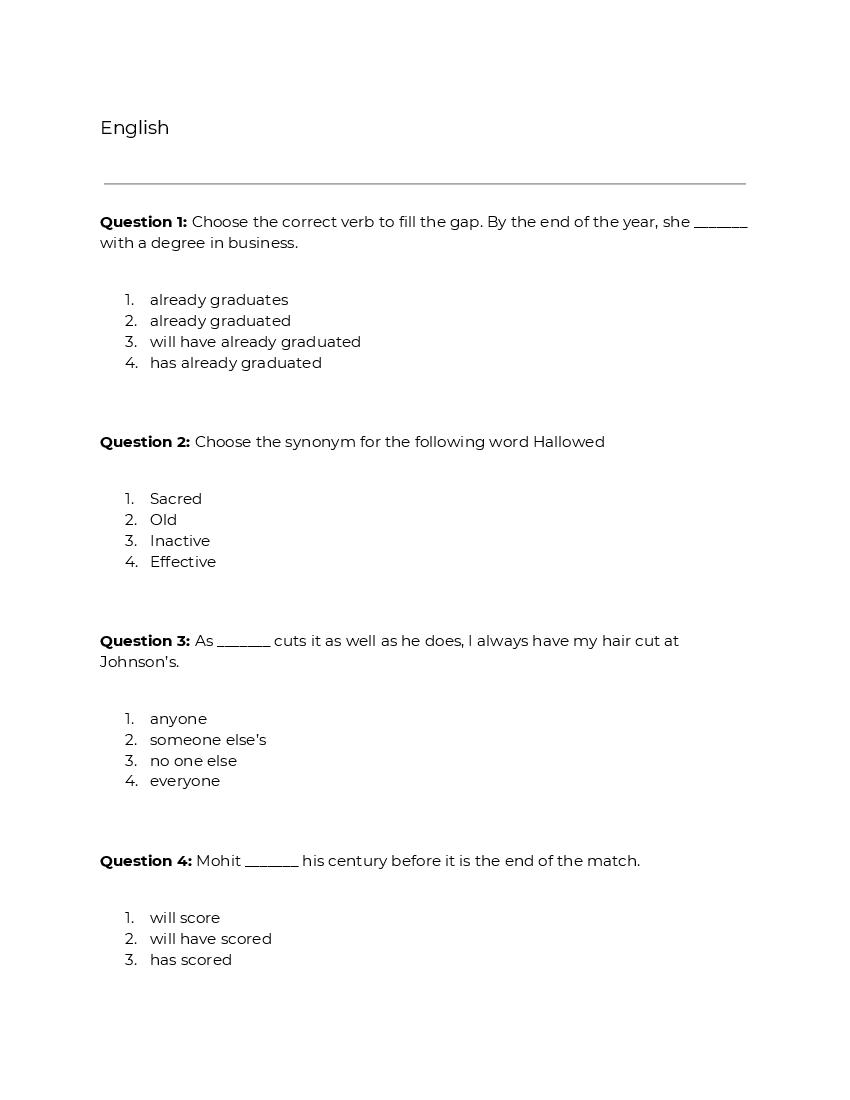
Question 1: C
hoose the correct verb to fill the gap. By the end of the year, she _______
with a degree in business.
1. already graduates
2. already graduated
3. will have already graduated
4. has already graduated
Question 2: Choose the synonym for the following word Hallowed
1. Sacred
2. Old
3. Inactive
4. Effective
Question 3: A
s _______ cuts it as well as he does, I always have my hair cut at
Johnson’s.
1. anyone
2. someone else’s
3. no one else
4. everyone
Question 4: M
ohit _______ his century before it is the end of the match.
1. will score
2. will have scored
3. has scored
Page 2
Question 5: Which word is a adverb in this sentence?
There are no interesting programmes tonight.
1. interesting
2. programmes
3. there
4. tonight
Pharmacy
Question 1 A
rtificial microscopic bilayer vesicles are:-
1. Liposomes
2. Implants
3. Resealed erythrocytes
4. Microcapsules
Question 2 When solid particles are up to 25% in a liquid, the preferred filter to
separate particles is:-
1. Edge filter
2. Plate & frame filter
3. Leaf filter
4. Rotary filter
Question 3 A
patient is renally impaired his renal function is half of the normal
person. The dosing interval is:-
Page 3
2. Half
3. Remain same
4. All of these
Question 4 H
elium pyrometer is used to measure:-
1. Particle distribution in aerosols
2. Volume of particle in powder
3. Distance between two point
4. Flash point of aerosols
Question 5 3% w/v solution contains:-
1. 3 grams of solute in 100 ml of the solvent
2. 3 grams of solute in 100 ml of the solution
3. 3 grams of solute in 1ml of the solution
4. 3 grams of solute in 1ml of the solvent
Physiotherapy
Question 1 W
hich primitive reflex is the first to integrate in a child?
1. Moro reflex
2. Righting reflex
3. Parachute reflex
4. Labyrinthine reflexes
Question 2 What is the main characteristic feature of a patient with Duchenne’s
Muscular Dystrophy?
1. Face muscle weakness
2. Tendon reflexes diminished
3. Pseudoypertrophy of calf muscles
Page 4
Question 3 G
ower’s sign is used to assess which condition?
1. Myasthenia Grevis
2. Spasiticity and Flacidity
3. Multiple Sclerosis
4. Muscular Dystrophy
Question 4 F
requency range for High TENS is:-
1. 100 and 150 Hz
2. 150 and 200 Hz
3. 50 and 100 Hz
4. 100 and 200 Hz
Question 5 Jones fracture is a fracture of:-
1. Fifth metatarsal
2. Second metatarsal
3. Tarsal bones
4. Second metacarpal
Ayurveda
Question 1: W
hich mahabhuta combination is responsible for the formation of
Kasaya Rasa?
1. Agni and Jala
2. Vayu and Prithvi
Page 5
4. Vayu and Akasha
Question 2: If the medicine is taken with every morsel (sagras), then it is useful for
treating disease of which Vayu?
1. Apan vayu
2. Udan vayu
3. Vyan vayu
4. Pran vayu
Question 3: W
hich of the following carbohydrate liberates three molecules of
monosaccharides on hydrolysis?
1. Glucose
2. Raffinose
3. Maltose
4. Fructose
Question 4: W hich parameter is performed to check the inorganic content present
in herbal drugs?
1. Foreign organic matter
2. Refractive index
3. Ash value
4. Water soluble extractive value
Question 5: Avapa is used in marana of:-
1. Copper
2. Mica
3. Copper pyrite
Page 6
Physics
Question 1 A n earthquake emits both S-waves and P-waves which travel at different
speeds through the Earth. A P-wave travels at 9,000 m/s and an S-wave travels at
5,000m/s. If P-waves are received at a seismic station 1.00 minute before an S-wave
arrives, how far away is the earthquake center?
1. 1,200 km
2. 675 km
3. 88.9 km
4. 240 km
Question 2 All people come very close to being able to float in water. What therefore
is the volume (in cubic meters) of a 50-kg woman?
1. 0.035
2. 0.050
3. 0.007
4. 0.070
Question 3 A horizontal meter stick supported at the 50-cm mark has a mass of 0.50
kg hanging from it at the 20-cm mark and a 0.30 kg mass hanging from it at the
60-cm mark. Determine the position on the meter stick at which one would hang a
third mass of 0.60 kg to keep the meter stick balanced.
1. 65 cm
2. 70 cm
3. 74 cm
Page 7
Question 4 T wo stars of masses M and 6M are separated by a distance "D".
Determine the distance (measured from M) to a point at which the net gravitational
force on a third mass would be zero.
1. 0.41 D
2. 0.37 D
3. 0.33 D
4. 0.29 D
Question 5 What is the technique used to find the age of prehistoric fossils?
1. Paleontology
2. Radio Carbon dating
3. Radio Isotope dating
4. None of these
Chemistry
Question 1 I n terms of the "Collision Theory of Chemical Kinetics", the rate of a
chemical reaction is proportional to:-
1. The number of product molecules
2. The number of collisions per second
3. The change in free energy per second
4. The change in temperature per second
Page 8
work, what is the change in the internal energy of the system?
1. +750 kJ
2. +250 kJ
3. -750 kJ
4. -250 kJ
Question 3 T
he compressibility factor for an ideal gas is:-
1. 2.0
2. 1.5
3. 1.0
4. Infinity
Question 4 W
hich statement is incorrect about zeolites?
1. No zeolites occur naturally
2. A zeolite functions as an acid catalyst, e.g. in the alkylation of aromatic
compounds
3. Each zeolite contains channels of a specific size
4. Zeolites are aluminosilicates
Question 5 If a polymer sample has polydispersity index > 1, it indicates that:-
1. The polymer chains are uniform in length
2. The number average molecular weight is equal to the weight average
molecular weight of the polymer
3. The polymer chain lengths vary over a wide range of molecular masses
4. The polymer under consideration is a natural polymer
Page 9
Question 1: T
he number of elements in the power set P(S) of the set S = {2,{1,4}} is:-
1. 8
2. 4
3. 2
4. None of these
Question 2: If A = {1,2,3,4} and R = {(1,3),(3,4),(1,4)}, then R is:-
1. Symmetric
2. Transitive
3. Reflexive
4. None of these
Question 3: I f |z| = |z - 1|, then:-
1. Re(z) = 1
2. Im(z) = 1
3. Re(z) = 1/2
4. Im(z) = 1/2
Question 4: I f the system of equations x+2y-3z=1, (p+2)z=3, (2p+1)y+z=2 is inconsistent,
then what is the value of p?
1. -1/2
2. 2
3. -2
Page 10
Question 5: If f(x) = |x + 2|, then:-
1. f(|x|) = |f(x)|
2. f(x+y) = f(x) + f(y)
3. f(x.y) = f(x).f(y)
4. None of these
Biotech
Question 1 W
hat is a smear?
1. A smear is a preparation process in which a specimen is dyed
2. A smear is a process used to identify a specimen
3. A smear is a process in which a specimen is moved beneath a microscope
4. A smear is a preparation process in which a specimen is spread on a slide
Question 2 Why is a bacterium called a prokaryotic organism?
1. A bacterium is a multicell organism that does not have a distinct nucleus
2. A bacterium is a multicell organism that has a distinct nucleus
3. A bacterium is a one-cell organism that has a distinct nucleus
4. A bacterium is a one-cell organism that does not have a distinct nucleus
Question 3 W
hat microorganisms can use oxygen when it is present and continue
to grow without it?
1. Obligate aerobes
2. Obligate anaerobes
Page 11
4. Facultative anaerobes
Question 4 A
ll of the following associations are true except one:-
1. Poliovirus can cause paralytic disease
2. Mumps virus can cause meningitis
3. Astrovirus causes gastroenteritis only in adults
4. EBV can cause nasopharyngeal carcinoma
Question 5 Which of the following is most effective for sterilizing mattresses and
plastic Petri plates?
1. Ethylene oxide
2. Ultraviolet radiation
3. Autoclave
4. Chlorine
Microbiology
Question 1 F ollowing person recognised the significance of microbes in disease for
the first time:-
1. Louis Pasteur
2. Kircher
3. Robert Koch
4. None of these
Question 2 Germ Theory is:-
Page 12
2. Presence of pathogen in infected animals
3. Spores
4. None of these
Question 3 T
heory of fermentation says that fermentation is the:-
1. Effect of a specific microbe
2. Destruction of microbes
3. Radiation
4. None of these
Question 4 O ne way to determine the size, cell morphology and grouping of
bacterial cells is to:-
1. Streak plate
2. Phenol red
3. Simple stain
4. None of these
Question 5 When many bacterial cells are embedded in a continuums matrix the
material is called:-
1. Capsule
2. Microcapsule
3. Slime
4. Spore
Botany
Page 13
medullated protostele is
1. Dictyostele
2. Siphonostele
3. Solenostele
4. Protostele
Question 2: The closed ascocarp is termed:-
1. Apothecium
2. Cleistothecium
3. Perithecium
4. Hysterothecium
Question 3: I n Gymnosperms the only mode of pollination is:-
1. Anemophily
2. Hydrophily
3. Zoophily
4. Entomophily
Question 4: D
ouble fertilization in angiosperms was discovered by:-
1. J.C. Bose
2. Strasburger
3. Maheshwari
4. Nawaschin
Question 5: Before a carbohydrate is utilized as an energy source, it gets first
converted into:-
1. Oligosaccharide
Page 14
3. Monosaccharide
4. Disaccharide
Biochemistry
Question 1 T
wo sugars which differ from one another only in configuration around a
single carbon atom are termed as:-
1. Optical isomers
2. Stereoisomers
3. Epimers
4. Anomers
Question 2 In EM pathway enolase converts 2-phosphoglycerate to:-
1. Phospho enol pyruvate
2. Enol pyruvate
3. 1,3 bisphosphoglycerate
4. Dihydroxy acetone phosphate (DHAP)
Question 3 T
he standard free energy of hydrolysis of terminal phosphate group of
ATP is:-
1. - 7,300 cal/mol
2. +7,300 cal/mol
3. 10,000 cal/mol
4. - 8,300 cal/mol
Page 15
ertiary structure of a protein describes:-
1. Loop regions of proteins
2. The ways of protein folding
3. Location of disulphide bonds
4. The order of amino acids
Question 5 The enzymes of urea synthesis are found in:-
1. Both mitochondria and cytosol
2. Mitochondria only
3. Cytosol only
4. Nucleus
Zoology
Question 1 T
he Sol-gel nature of protoplasm is due to:-
1. Its colloidal nature
2. Presence of living cell inclusions
3. Pressure of inorganic salts
4. Presence of water
Question 2 What is the latest model that is proposed to explain the structure of
plasma membrane or the latest view of molecular organization of biomembrane is
based on?
1. Fluid mosaic model
2. Unit membrane model
3. Thin lipid layer concept
Page 16
Question 3 T
he number of autosomes in a human male is:-
1. 43
2. 22 pair
3. 45
4. 46
Question 4 T
he snakes living in the deserts are mainly:-
1. Aminotelic
2. Uricotelic
3. Ammonotelic
4. Ureotelic
Question 5 Genes are involved in turning on or off the transcription of set of
structural genes are called:-
1. Operator genes
2. Redundant genes
3. Polymorphic genes
4. Regulatory genes
Agriculture
Question 1 F
arming System Research is not:-
1. Farmer participatory
2. System oriented
Page 17
4. Gender sensitive
Question 2 Actual mechanism of processes is not disclosed in which Crop Modeling?
1. Stochastic model
2. Statistical empirical model
3. Dynamic model
4. Mechanistic model
Question 3 G
lyphosate herbicide trade name is:-
1. Killer
2. Captain
3. Round Up
4. Maxim
Question 4 T
he botanical name of 6 row barley is:-
1. Hordeumdistichon
2. Hordeumvulgare
3. Hordeumplantae
4. Hordeumirregulare
Question 5 Legume is characteristic of:-
1. Fabaceae
2. Euphorbiaceae
3. Malvaceae
4. Musaceae
Page 18
Question 1 W
hich among of the following is a Sedimentary type of cycle?
1. Nitrogen cycle
2. Carbon cycle
3. Sulphur cycle
4. Oxygen cycle
Question 2 The number of species in a community is called the?
1. Species richness
2. Diversity of species
3. Equal diversity of species
4. Species abundance
Question 3 E nvironmental disaster that occurred because of release of energy from
earth are termed as:
1. Metrological disasters
2. Hydrological disasters
3. Man-made disasters
4. Geophysical disasters
Question 4 T
he number of Bio-geographical Zones in India:
1. 10
2. 7
3. 9
Page 19
Question 5 Acid rain has pH equal or below:
1. 6
2. 6.5
3. 5.5
4. 7
Forensic Sciences
Question 1 H
air can be used for analysis of ………. Metallic poison:
1. Arsenic
2. Antimony
3. Phosphorus
4. Sodium
Question 2 CODIS is:
1. Combined DNA index system
2. Combined Digital Identification system
3. Combined Digital interpretation system
4. None
Question 3 T
emporo-parietal suture is found in
1. Pelvis
Page 20
3. Long bones
4. Skull
Question 4 H
ydrocarbons can be detected by …………… in arson cases.
1. ECD
2. FID
3. PMT
4. None
Question 5 Tongue Flutter is seen in:
1. Drowning cases
2. Throttling cases
3. Hanging cases
4. All of above
Statistics and Data Analytics
Question 1
1. -1
2. -1/2
3. 1/2
4. 12
Page 21
continuous first and second order partial derivatives, then:
1.
2.
3.
4.
Question 3 I f r=fxx (a,b),s=fxy (a,b),t= fyy (a,b) at a point P(a,b), then the point P(a,b) is
said to be point of maxima if and only if:
1. (rt-s2 )>0,r>0
2. (rt-s2 )>0,r<0
3. (rt-s2 )=0
4. (rt-s2 )<0
Question 4 I f A and B are two independent events, then by law of probability:
1. P(A∪B)=P(A).P(B)
2. P(A∪B)=1
3. P(A∩B)=P(A).P(B)
4. P(A∩B)=0
Question 5 For a Poisson distribution:
1. Mean > Variance
2. Mean < Variance
3. Mean – Variance = 1
Page 22
Clinical Microbiology
Question 1: T
he capacity of a given strain of microbial species to produce disease is
known as
1. Pathogen
2. Virulence
3. Infection
4. None of these
Question 2: Factors on which disinfectivity of a disinfectant depends
1. Concentration of substance
2. Time of action
3. pH of medium and temperature suitable for chemical
4. All of the above
Question 3: C
omplement based agglutination reaction is known as
1. Haeme agglutination
2. Complement fixation
3. Conglutination
4. Schultz Dale phenomenon
Page 23
derivative (PPD) used in tuberculin test?
1. Prepared from tubercle bacilli
2. It is inferior to old tuberculin
3. Consist of filtrate of glycerol broth
4. None of the above
Question 5: The event that triggered the development and establishment of
microbiology as a science is
1. Germ theory of disease
2. Development of microscope
3. Time of action
4. Use of disinfectant
Clinical Biochemistry
Question 1: N
ormality of 1M sulfuric acid is
1. 1.0
2. 0.5
3. 4.0
4. 2.0
Question 2: Glucose 6-phosphatase is not present in
1. Kidneys and liver
Page 24
3. Muscles and adipose tissue
4. Muscles and liver
Question 3: E
nzymes catalyzing electron transport are present mainly in the
1. Ribosomes
2. Endoplasmic reticulum
3. Lysosomes
4. Inner mitochondrial membrane
Question 4: A
coenzyme required for synthesis of glycine from serine is
1. Vitamin B6
2. ATP
3. NAD
4. Tetrahydrofolate
Question 5: Tertiary structure of a protein describes the
1. Specific peptide linkage
2. Location of disulfide bonds
3. Specific way of protein folding and according to the order of amino acids
4. Specific loops
Nutrition and Dietetics
Page 25
hich of the following is not an external source of recruitment?
1. Walk-ins
2. Professional agencies
3. Word-of-mouth
4. Transfer
Question 2: Light emitted when a substance is heated is called as
1. Incandescence
2. Lightening
3. Combustion
4. None of these
Question 3: I CDS was launched in ------- in India
1. 1955
2. 1965
3. 1975
4. 1985
Question 4: D
ue to altered renal function, which of the following production
increases during pregnancy
1. Urea
2. Creatinine
3. GFR
4. All of the above
Question 5: Which one of the following statements is incorrect?
Page 26
reactions
2. Delayed introduction of complementary foods may give rise to growth
faltering
3. Breastfeeding should continue to the age of 2 years or beyond
4. Low-fat and high-fiber diets are appropriate for infants under the age of 2
Document Details
| Board / Org | LPU |
| Exam | LPUNEST |
| Type | Sample Paper |
| Pages | 26 |
| Updated | 30 Apr 2026 |