UGC NET Tourism Administration and Management Question Paper 2018
Finished viewing? Save it for later —
Download UGC NET Tourism Administration and Management Question Paper 2018 (PDF · 56 pages)About UGC NET Tourism Administration and Management Question Paper 2018
UGC NET Tourism Administration and Management Question Paper 2018 is available here for free download. Published by NTA for UGC National Eligibility Test, this question paper can be viewed online or downloaded as a PDF (56 pages). Candidates preparing for UGC National Eligibility Test can use UGC NET Tourism Administration and Management Question Paper 2018 to understand the exam pattern, the type of questions asked, and the overall difficulty level.
Frequently Asked Questions
How can I download UGC NET Tourism Administration and Management Question Paper 2018?
Open this page and click the Download button to save UGC NET Tourism Administration and Management Question Paper 2018 as a PDF. It is completely free on AglaSem Docs.
Is UGC NET Tourism Administration and Management Question Paper 2018 free to download?
Yes. UGC NET Tourism Administration and Management Question Paper 2018 can be viewed online and downloaded as a PDF free of cost on AglaSem Docs.
How many pages does UGC NET Tourism Administration and Management Question Paper 2018 have?
UGC NET Tourism Administration and Management Question Paper 2018 contains 56 pages, which you can read online or download together as a single PDF.
Where can I find more UGC National Eligibility Test study material?
You can find more UGC National Eligibility Test question papers, sample papers, syllabus, and answer keys on AglaSem Docs.
UGC NET Tourism Administration and Management Question Paper 2018 – Text
Read the full text of this question paper below — useful to quickly search, copy and reference the content online without downloading the PDF.
📄 View text version (56 pages)
Page 1
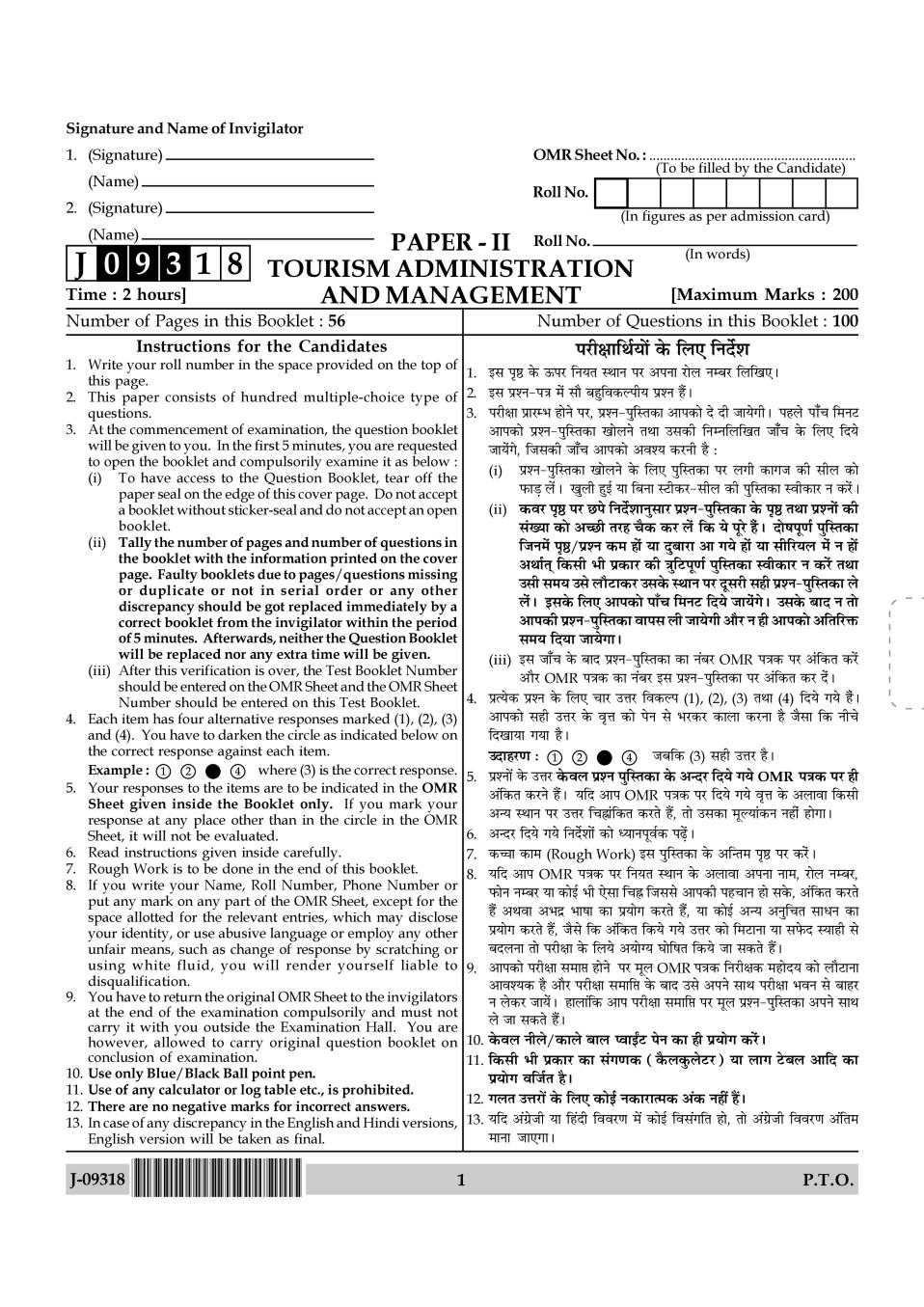
1. (Signature) OMR Sheet No. : ..........................................................
(To be filled by the Candidate)
(Name)
Roll No.
2. (Signature)
(In figures as per admission card)
(Name)
PAPER - II Roll No. (In words)
J 0 9 3 1 8 TOURISM ADMINISTRATION
Time : 2 hours] AND MANAGEMENT [Maximum Marks : 200
Number of Pages in this Booklet : 56 Number of Questions in this Booklet : 100
Instructions for the Candidates ¬⁄UˡÊÊÁÕ¸ÿÙ¢ ∑§ Á‹∞ ÁŸŒ¸‡Ê
1. Write your roll number in the space provided on the top of
1. ß‚ ¬ÎDU ∑§ ™§¬⁄U ÁŸÿà SÕÊŸ ¬⁄U •¬ŸÊ ⁄UÙ‹U Ÿê’⁄U Á‹Áπ∞–
this page.
2. This paper consists of hundred multiple-choice type of 2. ß‚ ¬˝‡Ÿ-¬òÊ ◊¢ ‚ÊÒ ’„ÈÁfl∑§À¬Ëÿ ¬˝‡Ÿ „Ò¥–
questions. 3. ¬⁄UˡÊÊ ¬˝Ê⁄êU÷ „ÙŸ ¬⁄U, ¬˝‡Ÿ-¬ÈÁSÃ∑§Ê •Ê¬∑§Ù Œ ŒË ¡ÊÿªË– ¬„‹U ¬UÊ°ø Á◊Ÿ≈U
3. At the commencement of examination, the question booklet •Ê¬∑§Ù ¬˝‡Ÿ-¬ÈÁSÃ∑§Ê πÙ‹Ÿ ÃÕÊ ©‚∑§Ë ÁŸêŸÁ‹Áπà ¡Ê°ø ∑§ Á‹∞ ÁŒÿ
will be given to you. In the first 5 minutes, you are requested ¡Êÿ¢ª, Á¡‚∑§Ë ¡Ê°ø •Ê¬∑§Ù •fl‡ÿ ∑§⁄UŸË „Ò —
to open the booklet and compulsorily examine it as below :
(i) ¬˝‡Ÿ-¬ÈÁSÃ∑§Ê πÙ‹Ÿ ∑§ Á‹∞ ¬ÈÁSÃ∑§Ê ¬⁄U ‹ªË ∑§Êª¡ ∑§Ë ‚Ë‹ ∑§Ê
(i) To have access to the Question Booklet, tear off the
paper seal on the edge of this cover page. Do not accept »§Ê«∏ ‹¢U– πÈ‹Ë „È߸ ÿÊ Á’ŸÊ S≈UË∑§⁄U-‚Ë‹U ∑§Ë ¬ÈÁSÃ∑§Ê SflË∑§Ê⁄U Ÿ ∑§⁄¢U–
a booklet without sticker-seal and do not accept an open (ii) ∑§fl⁄U ¬ÎDU ¬⁄U ¿U¬ ÁŸŒ¸‡ÊÊŸÈ‚Ê⁄U ¬˝‡Ÿ-¬ÈÁSÃ∑§Ê ∑§ ¬ÎDU ÃÕÊ ¬˝‡ŸÙ¢ ∑§Ë
booklet. ‚¢ÅÿÊ ∑§Ù •ë¿UË Ã⁄U„ øÒ∑§ ∑§⁄U ‹¢U Á∑§ ÿ ¬Í⁄U „Ò¢U– ŒÙ·¬Íáʸ ¬ÈÁSÃ∑§Ê
(ii) Tally the number of pages and number of questions in Á¡Ÿ◊¢ ¬ÎDU/¬˝‡Ÿ ∑§◊ „Ù¢ ÿÊ ŒÈ’Ê⁄UÊ •Ê ªÿ „Ù¢ ÿÊ ‚ËÁ⁄Uÿ‹U ◊¢ Ÿ „Ù¢
the booklet with the information printed on the cover •ÕʸØ Á∑§‚Ë ÷Ë ¬˝∑§Ê⁄U ∑§Ë òÊÈÁ≈U¬Íáʸ ¬ÈÁSÃ∑§Ê SflË∑§Ê⁄U Ÿ ∑§⁄¢U ÃÕÊ
page. Faulty booklets due to pages/questions missing
or duplicate or not in serial order or any other ©‚Ë ‚◊ÿ ©‚ ‹Uı≈UÊ∑§⁄U ©‚∑§ SÕÊŸ ¬⁄U ŒÍ‚⁄UË ‚„Ë ¬˝‡Ÿ-¬ÈÁSÃ∑§Ê ‹
discrepancy should be got replaced immediately by a ‹¢– U ß‚∑§ Á‹∞ •Ê¬∑§Ù ¬Ê°ø Á◊Ÿ≈U ÁŒÿ ¡Êÿ¢ª– ©‚∑§ ’ÊŒ Ÿ ÃÙ
correct booklet from the invigilator within the period •Ê¬∑§Ë ¬˝‡Ÿ-¬ÈÁSÃ∑§Ê flʬ‚ ‹Ë ¡ÊÿªË •ı⁄U Ÿ „Ë •Ê¬∑§Ù •ÁÃÁ⁄UQ§
of 5 minutes. Afterwards, neither the Question Booklet ‚◊ÿ ÁŒÿÊ ¡ÊÿªÊ–
will be replaced nor any extra time will be given. (iii) ß‚ ¡Ê°ø ∑§ ’ÊŒ ¬˝‡Ÿ-¬ÈÁSÃ∑§Ê ∑§Ê Ÿ¥’⁄U OMR ¬òÊ∑§ ¬⁄U •¢Á∑§Ã ∑§⁄¢U
(iii) After this verification is over, the Test Booklet Number
should be entered on the OMR Sheet and the OMR Sheet
•Uı⁄U OMR ¬òÊ∑§ ∑§Ê Ÿ¥’⁄U ß‚ ¬˝‡Ÿ-¬ÈÁSÃ∑§Ê ¬⁄U •¢Á∑§Ã ∑§⁄U Œ¢–
Number should be entered on this Test Booklet. 4. ¬˝àÿ∑§ ¬˝‡Ÿ ∑§ Á‹∞ øÊ⁄U ©ûÊ⁄U Áfl∑§À¬ (1), (2), (3) ÃÕÊ (4) ÁŒÿ ªÿ „Ò¢–
4. Each item has four alternative responses marked (1), (2), (3) •Ê¬∑§Ù ‚„Ë ©ûÊ⁄U ∑§ flÎûÊ ∑§Ù ¬Ÿ ‚ ÷⁄U∑§⁄U ∑§Ê‹Ê ∑§⁄UŸÊ „Ò ¡Ò‚Ê Á∑§ ŸËø
and (4). You have to darken the circle as indicated below on ÁŒπÊÿÊ ªÿÊ „Ò–
the correct response against each item. ©ŒÊ„⁄UáÊ — ¡’Á∑§ (3) ‚„Ë ©ûÊ⁄U „Ò–
Example : where (3) is the correct response. 5. ¬˝‡ŸÊ¥ ∑§ ©ûÊ⁄U ∑§fl‹ ¬˝‡Ÿ ¬ÈÁSÃ∑§Ê ∑§ •ãŒ⁄U ÁŒÿ ªÿ OMRU ¬òÊ∑§ ¬⁄U „Ë
5. Your responses to the items are to be indicated in the OMR
•¥Á∑§Ã ∑§⁄UŸ „Ò¥– ÿÁŒ •Ê¬ OMRU ¬òÊ∑§ ¬⁄U ÁŒÿ ªÿ flÎûÊ ∑§ •‹ÊflÊ Á∑§‚Ë
Sheet given inside the Booklet only. If you mark your
response at any place other than in the circle in the OMR •ãÿ SÕÊŸ ¬⁄U ©ûÊ⁄U ÁøqÊ¢Á∑§Ã ∑§⁄Uà „Ò¥, ÃÙ ©‚∑§Ê ◊ÍÀUÿÊ¢∑§Ÿ Ÿ„Ë¢ „٪ʖ
Sheet, it will not be evaluated. 6. •ãŒ⁄U ÁŒÿ ªÿ ÁŸŒ¸‡ÊÙ¢ ∑§Ù äÿÊŸ¬Ífl¸∑§ ¬…∏¢U–
6. Read instructions given inside carefully. 7. ∑§ìÊÊ ∑§Ê◊ (Rough Work) ß‚ ¬ÈÁSÃ∑§Ê ∑§ •ÁãÃ◊ ¬ÎDU ¬⁄U ∑§⁄¢U–
7. Rough Work is to be done in the end of this booklet. 8. ÿÁŒ •Ê¬ OMR ¬òÊ∑§ ¬⁄U ÁŸÿà SÕÊŸ ∑§ •‹ÊflÊ •¬ŸÊ ŸÊ◊, ⁄UÊ‹ Ÿê’⁄U,
8. If you write your Name, Roll Number, Phone Number or
put any mark on any part of the OMR Sheet, except for the
»§ÊŸ Ÿê’⁄U ÿÊ ∑§Ê߸ ÷Ë ∞‚Ê Áøq Á¡‚‚ •Ê¬∑§Ë ¬„øÊŸ „Ê ‚∑§, •¥Á∑§Ã ∑§⁄UÃ
space allotted for the relevant entries, which may disclose „Ò¥ •ÕflÊ •÷Œ˝ ÷Ê·Ê ∑§Ê ¬˝ÿʪ ∑§⁄Uà „Ò¥, ÿÊ ∑§Ê߸ •ãÿ •ŸÈÁøà ‚ÊœŸ ∑§Ê
your identity, or use abusive language or employ any other ¬˝ÿʪ ∑§⁄Uà „Ò¥, ¡Ò‚ Á∑§ •¥Á∑§Ã Á∑§ÿ ªÿ ©ûÊ⁄U ∑§Ê Á◊≈UÊŸÊ ÿÊ ‚»§Œ SÿÊ„Ë ‚
unfair means, such as change of response by scratching or ’Œ‹ŸÊ ÃÊ ¬⁄UˡÊÊ ∑§ Á‹ÿ •ÿÊÇÿ ÉÊÊÁ·Ã Á∑§ÿ ¡Ê ‚∑§Ã „Ò¥–
using white fluid, you will render yourself liable to 9. •Ê¬∑§Ù ¬⁄UˡÊÊ ‚◊Ê# „ÙŸ §¬⁄U ◊Í‹ OMR ¬òÊ∑§ ÁŸ⁄UˡÊ∑§ ◊„ÙŒÿ ∑§Ù ‹Uı≈UÊŸÊ
disqualification. •Êfl‡ÿ∑§ „Ò •ı⁄U ¬⁄UˡÊÊ ‚◊ÊÁ# ∑§ ’ÊŒ ©‚ •¬Ÿ ‚ÊÕ ¬⁄UˡÊÊ ÷flŸ ‚ ’Ê„⁄U
9. You have to return the original OMR Sheet to the invigilators Ÿ ‹∑§⁄U ¡Êÿ¢– „Ê‹Ê¥Á∑§ •Ê¬ ¬⁄UˡÊÊ ‚◊ÊÁ# ¬⁄U ◊Í‹ ¬˝‡Ÿ-¬ÈÁSÃ∑§Ê •¬Ÿ ‚ÊÕ
at the end of the examination compulsorily and must not
carry it with you outside the Examination Hall. You are ‹ ¡Ê ‚∑§Ã „Ò¥–
however, allowed to carry original question booklet on 10. ∑§fl‹ ŸË‹/∑§Ê‹ ’Ê‹U åflÊßZ≈U ¬Ÿ ∑§Ê „Ë ¬˝ÿʪ ∑§⁄¢U–
conclusion of examination. 11. Á∑§‚Ë ÷Ë ¬˝∑§Ê⁄U ∑§Ê ‚¢ªáÊ∑§ (∑Ò§‹∑ȧ‹≈U⁄U) UÿÊ ‹Êª ≈U’‹ •ÊÁŒ ∑§Ê
10. Use only Blue/Black Ball point pen. ¬˝ÿÙª flÁ¡¸Ã „Ò–
11. Use of any calculator or log table etc., is prohibited.
12. ª‹Ã ©ûÊ⁄UÊ¥ ∑§ Á‹∞ ∑§Ê߸ Ÿ∑§Ê⁄UÊà◊∑§ •¥∑§ Ÿ„Ë¥ „Ò¥–
12. There are no negative marks for incorrect answers.
13. In case of any discrepancy in the English and Hindi versions, 13. ÿÁŒ •¥ª˝¡Ë ÿÊ Á„¥ŒË Áflfl⁄UáÊ ◊¥ ∑§Ê߸ Áfl‚¥ªÁà „Ê, ÃÊ •¥ª˝¡Ë Áflfl⁄UáÊ •¥ÁÃ◊
English version will be taken as final. ◊ÊŸÊ ¡Ê∞ªÊ–
J-09318 !J-09318-PAPER-II! 1 P.T.O.
Page 2
PAPER - II
Note : This paper contains hundred (100) objective type questions of two (2) marks each. All
questions are compulsory.
1. From the following, match the correct pair of the editor/editors and title of the book :
Editor/Editors Title of the Book
(1) Fabio Cerina, Anil Markamdya (i) Sustainability, Profitability
and Michael Mcaller and Successful Tourism
(2) Aparna Raj (ii) Tourism and Sustainable
Community Development
(3) Derek Hall and Greg Richards (iii) Economics of Sustainable
Tourism
(4) C. Michael Hall, Stefan Gosshing and Daniel Scott (iv) The Routledge Handbook of
Tourism and Sustainability
2. As per the farman (King’s order) preserved in the Rajasthan State Archives, Bikaner the
haveli or havelis on which TajMahal was constructed belonged to a Rajput noble. It was
purchased from a descendent of the noble. From the following identify the noble who owned
the haveli :
(1) Mirza Raja Jai Singh (2) Mota Raja Udai Singh
(3) Raja Rai Singh (4) Raja Bir Singh Deo Bundila
3. As per India Tourism Statistics 2017 which one was not the international checkpost for
foreign tourist arrivals in India in 2016 ?
(1) Delhi (2) Jaipur (3) Goa (4) Haridaspur
4. The surrogacy (Regulation) Bill, 2016, contain certain salient features. Point out from the
below which one is not the salient feature of the bill ?
(1) The altruistic ethical surrogacy is for intending infertile couple between the age of
23 - 50 years and 26 - 55 years for female and male respectively.
(2) The intending couple should not necessarily be legally married and should not necessarily
be Indian citizens.
(3) The intending couple shall not abandon the child born out of a surrogacy procedure
under any condition.
(4) The child born through surrogacy will have the same rights as are available for the
biological child.
5. Pakistan’s Chief Justice Saqib Nisar flayed the government for its inability to safeguard one
of the Hindu minority’s most revered places of worship. Nisar described that it, being a
national heritage site, must be protected and directed authority in Punjab province to form a
committee to probe the issue. Select the correct name of the sacred place :
(1) Katas Raj temple (2) Bhera temple
(3) Hinglaj Mata temple (4) Gorakhnath temple
J-09318 !J-09318-PAPER-II! 2 Paper-II
Page 3
¬˝‡Ÿ¬òÊ - II
ÁŸŒ¸‡Ê — ß‚ ¬˝‡Ÿ¬òÊ ◊¥ ‚ÊÒ (100) ’„È-Áfl∑§À¬UËÿ ¬˝‡Ÿ „Ò¥– ¬˝àÿ∑§ ¬˝‡Ÿ ∑§ ŒÙ (2) •¢∑§ „Ò¥– ‚÷Ë ¬˝‡Ÿ •ÁŸflÊÿ¸ „Ò¥–
1. ÁŸêŸÁ‹Áπà ◊¥ ‚ ‚¥¬ÊŒ∑§/‚¥¬ÊŒ∑§Ê¥ •ÊÒ⁄U ¬ÈSÃ∑§ ∑§ ŸÊ◊ ∑§ ‚„Ë ¡Ê«∏ ∑§Ê ‚È◊Á‹Ã ∑§ËÁ¡∞ —
‚¥¬ÊŒ∑§/‚¥¬ÊŒ∑§ªáÊ ¬ÈSÃ∑§ ∑§Ê ŸÊ◊
(1) »§Á’ÿÊ ‚Á⁄UŸÊ, •ÁŸ‹ ◊Ê∑¸§ã«UÿÊ •ÊÒ⁄U ◊Êß∑§‹ ∞◊ ∑§ÊÚ‹⁄U (i) ‚S≈UŸÁ’Á‹≈UË, ¬˝ÊÒÁ»§≈UÁ’Á‹≈UË ∞¥«
‚Ä‚‚»È§‹ ≈ÍUÁ⁄Uï◊
(2) •¬áÊʸ ⁄UÊ¡ (ii) ≈Í U Á ⁄U ï ◊ ∞¥ « U ‚S≈ U Ÿ ’ ‹ ∑§êÿÍ Á Ÿ≈U Ë
«Ufl‹¬◊¥≈U
(3) «U⁄U∑§ „ÊÚ‹ •ÊÒ⁄U ª˝ª Á⁄Uø«¸˜U‚ (iii) ß∑§ÊŸÊÁ◊Ä‚ •ÊÚ»§ ‚S≈UŸ’‹ ≈ÍUÁ⁄Uï◊
(4) ‚Ë. ◊Êß∑§‹ „ÊÚ‹, S≈UË»§Ÿ ªÊÚÁ‡Ê¥ª •ÊÒ⁄U «UÁŸÿŸ S∑§ÊÚ≈U (iv) Œ ⁄UʩË¡ „Ò¥«U’È∑§ •ÊÚ»§ ≈ÍUÁ⁄ï◊ ∞¥«U
‚S≈UŸÁ’Á‹≈UË
2. ⁄UÊ¡SÕÊŸ ⁄UÊíÿ •Á÷‹πʪÊ⁄U, ’Ë∑§ÊŸ⁄U ◊¥ •ŸÈ⁄UÁˇÊà »§⁄U◊ÊŸ (⁄UÊ¡Ê ∑§Ë •ÊôÊÊ) ∑§ •ŸÈ‚Ê⁄U „fl‹Ë ÿÊ „flÁ‹ÿÊ¥ Á¡‚ ¬⁄U
ÃÊ¡◊„‹ ∑§Ê ÁŸ◊ʸáÊ „È•Ê ÕÊ ⁄UÊ¡¬Íà •◊Ë⁄U ∑§Ê ÕÊ– ß‚ •◊Ë⁄U ∑§ fl¥‡Ê¡ ‚ π⁄UËŒÊ ªÿÊ ÕÊ– ÁŸêŸÁ‹Áπà ◊¥ ‚ „fl‹Ë
∑§ SflÊ◊Ë ∑§Ë ¬„øÊŸ ∑§ËÁ¡∞ —
(1) Á◊¡Ê¸ ⁄UÊ¡Ê ¡ÿ Á‚¥„ (2) ◊ÊÃÊ ⁄UÊ¡Ê ©Œÿ Á‚¥„
(3) ⁄UÊ¡Ê ⁄UÊÿ Á‚¥„ (4) ⁄UÊ¡Ê ’Ë⁄U Á‚¥„ Œfl ’È㌋Ê
3. ÷Ê⁄Uà ¬ÿ¸≈UŸ ‚Ê¥ÁÅÿ∑§Ë 2017 ∑§ •ŸÈ‚Ê⁄U ∑§ÊÒŸ ‚Ê 2016 ◊¥, ÷Ê⁄Uà ◊¥ ÁflŒ‡ÊË ¬ÿ¸≈U∑§ •Êª◊Ÿ ∑§ Á‹∞ •¥Ã⁄U⁄UÊc≈˛UËÿ
ø∑§-¬ÊS≈U Ÿ„Ë¥ ÕÊ?
(1) ÁŒÀ‹Ë (2) ¡ÿ¬È⁄U (3) ªÊflÊ (4) „Á⁄UŒÊ‚¬È⁄U
4. ‚⁄Uʪ‚Ë (ÁflÁŸÿ◊) Áflœÿ∑§, 2016 ◊¥ ∑§Áìÿ ◊ÈÅÿ Áfl‡Ê·ÃÊ∞¥ •¥ÃÁŸ¸Á„à „Ò¥– ’ÃÊ∞¥ Á∑§ ÁŸêŸÁ‹Áπà ◊¥ ‚ ∑§ÊÒŸ-
‚Ê Áflœÿ∑§ ∑§Ë ◊ÈÅÿ Áfl‡Ê·ÃÊ Ÿ„Ë¥ „Ò?
(1) ¬⁄UÊÕʸã◊Èπ ŸÒÁÃ∑§ ‚⁄Uʪ‚Ë ∑˝§◊‡Ê— 23 - 50 fl·ÊZ •ÊÒ⁄U 26 - 55 fl·ÊZ ∑§Ë ’Ëø ∑§Ë •ÊÿÈ ∑§Ë ◊Á„‹Ê•Ê¥ •ÊÒ⁄U ¬ÈL§·Ê¥
∑§ ’¥äÿ Œ¥¬ÁÃÿÊ¥ ∑§ Á‹∞ •Á÷¬˝Ã „Ò–
(2) •Á÷¬˝Ã Œ¥¬Áà ∑§Ê ∑§ÊŸÍŸË M§¬ ‚ ÁflflÊÁ„à „ÊŸÊ •Êfl‡ÿ∑§ Ÿ„Ë¥ „Ò •ÊÒ⁄U ©Ÿ∑§Ê ÷Ê⁄UÃËÿ ŸÊªÁ⁄U∑§ „ÊŸÊ •Êfl‡ÿ∑§
Ÿ„Ë¥ „Ò–
(3) •Á÷¬˝Ã Œ¥¬Áà Á∑§‚Ë ÷Ë ÁSÕÁà ◊¥ ‚⁄Uʪ‚Ë ¬˝Á∑˝§ÿÊ ‚ ©à¬ÛÊ ’Ê‹∑§ ∑§Ê ¬Á⁄Uàÿʪ Ÿ„Ë¥ ∑§⁄UªÊ–
(4) ‚⁄Uʪ‚Ë ∑§ ◊Êäÿ◊ ‚ ©à¬ÛÊ ’Ê‹∑§ ∑§Ê fl„Ë •Áœ∑§Ê⁄U „Ê¥ª ¡Ê ¡ÒÁfl∑§ ’Ê‹∑§ ∑§ „Êà „Ò¥–
5. ¬ÊÁ∑§SÃÊŸ ∑§ ◊ÈÅÿ ãÿÊÿÊœË‡Ê ‚ÊÁ∑§’ ÁŸ‚Ê⁄U Ÿ ‚⁄U∑§Ê⁄U ∑§Ë Á„ãŒÈ •À¬‚¥Åÿ∑§ ‚◊ÈŒÊÿ ∑§ •àÿãà „Ë •ÊŒ⁄UáÊËÿ
©¬Ê‚ŸÊ SÕ‹Ê¥ ∑§Ë ⁄UˇÊÊ ∑§⁄UŸ ◊¥ ß‚∑§Ë •‚◊Õ¸ÃÊ ∑§Ë ∑§≈ÈU •Ê‹ÊøŸÊ ∑§Ë– ÁŸ‚Ê⁄U Ÿ ∑§„Ê Á∑§ ∞∑§ ⁄UÊc≈˛UËÿ Áfl⁄UÊ‚Ã
SÕ‹ „ÊŸ ∑§ ∑§Ê⁄UáÊ ß‚ •fl‡ÿ ‚¥⁄UÁˇÊà Á∑§ÿÊ ¡Ê∞ •ÊÒ⁄U ¬¥¡Ê’ ¬˝Êãà ◊¥ ¬˝ÊÁœ∑§ÊÁ⁄UÿÊ¥ ∑§Ê ÁŸŒ‡Ê ÁŒÿÊ Á∑§ ß‚ ◊Èg ∑§Ë
¡Ê¥ø ∑§ Á‹∞ ∞∑§ ‚Á◊Áà ’ŸÊ߸ ¡Ê∞– ©‚ ¬ÁflòÊ SÕ‹ ∑§Ê ‚„Ë ŸÊ◊ ’ÃÊßÿ —
(1) ∑§≈UÊ‚ ⁄UÊ¡ ◊¥ÁŒ⁄U (2) ÷⁄UÊ ◊¥ÁŒ⁄U
(3) Á„¥ª‹Ê¡ ◊ÊÃÊ ◊¥ÁŒ⁄U (4) ªÊ⁄UπŸÊÕ ◊¥ÁŒ⁄U
J-09318 !J-09318-PAPER-II! 3 Paper-II
Page 4
of extensive plateaus and gorges. The plateaus are the part of :
(1) Aravelli range (2) Vindhyachal range
(3) Himalayan range (4) Karakoram mountain range
7. The World Heritage Programme that catalogues and conserves sites of outstanding cultural
and natural importance is run by :
(1) UNICEF (2) UNESCO (3) WHO (4) INTACH
8. I’timad al-Daula, who was the father of empress Nur Jahan and father-in-law of emperor
Jahangir was an Irani noble. His tomb is one of the beautiful monuments. The white marble
tomb, about seven meters per side, is magnificently crafted and profused by in laid with semi
precious stones. It is situated in the city of :
(1) Lahore (2) Kabul (3) Lucknow (4) Agra
9. The concept of Charbagh is an Islamic mythological concept and many famous monuments
are adorned with Charbagh . The baghs enhance the beauty of tombs and this attracts the
tourists in large number. Who is known to have introduced the monuments surrounded by
Charbagh ?
Identify the king from the following :
(1) Timurlung (2) Babur (3) Humayun (4) Akbar
10. The term ‘Social tourism’ describes :
(1) assisted holidays or vacations for disadvantaged groups in society
(2) tourism for proletariats
(3) tourism which fosters group activities
(4) tourism for bourgeois class
11. Match the items in List - I with those in List - II and select the correct answer using the code
given below :
List - I List - II
(Folk Dance) (State)
(a) Bhagavatam Hikat (i) Manipur
(b) Yakshagana (ii) Karnatak
(c) Maha Rasa (iii) Rajasthan
(d) Kayanga Bajayanga (iv) J and K
Code :
(a) (b) (c) (d)
(1) (iv) (ii) (i) (iii)
(2) (ii) (i) (iv) (iii)
(3) (iii) (iv) (ii) (i)
(4) (iii) (i) (iv) (ii)
J-09318 !J-09318-PAPER-II! 4 Paper-II
Page 5
__________ ∑§Ê Á„S‚Ê „Ò¥–
(1) •⁄UÊfl‹Ë oÎ¥π‹Ê (2) Áfl¥äÿÊø‹ oÎ¥π‹Ê
(3) Á„◊Ê‹ÿ oÎ¥π‹Ê (4) ∑§Ê⁄UÊ∑§Ê⁄U◊ ¬fl¸Ã oÎ¥π‹Ê
7. Áfl‡fl Áfl⁄UÊ‚Ã ∑§Êÿ¸∑˝§◊ ¡Ê ©à∑Χc≈U ‚Ê¥S∑ΧÁÃ∑§ ÃÕÊ ¬˝Ê∑ΧÁÃ∑§ ◊„àfl ∑§ SÕ‹Ê¥ ∑§Ë ‚ÍøË ÃÒÿÊ⁄U ∑§⁄UÃÊ „Ò ÃÕÊ ßã„¥
‚¥⁄UÁˇÊà ∑§⁄UÃÊ „Ò __________ ∑§ mÊ⁄UÊ ø‹ÊÿÊ ¡ÊÃÊ „Ò–
(1) ÿÍÁŸ‚»§ (2) ÿÍŸS∑§Ê (3) «UéÀÿÍ.∞ø.•Ê. (4) ßã≈ÒU∑§
8. ßÁÃ◊ÊŒÈgÊÒ‹Ê ¡Ê ‚Ê◊˝ÊôÊÊË ŸÍ⁄U ¡„Ê° ∑§Ê Á¬ÃÊ •ÊÒ⁄U ‚◊˝Ê≈U ¡„Ê°ªË⁄U ∑§Ê ‡fl‚È⁄U ÕÊ ß¸⁄UÊŸË •◊Ë⁄U ÕÊ– ©‚∑§Ê ◊∑§’⁄UÊ ∞∑§
•àÿãà „Ë ‚È¥Œ⁄U S◊Ê⁄U∑§ „Ò– ‡flà ‚¥ª◊⁄U◊⁄U ∑§Ê ◊∑§’⁄UÊ Á¡‚∑§Ê ¬˝àÿ∑§ Á∑§ŸÊ⁄UÊ ‹ª÷ª ‚Êà ◊Ë≈U⁄U ∑§Ê „Ò, ◊¥ ÷√ÿ
Á‡ÊÀ¬∑§ÊÁ⁄UÃÊ ∑§Ë ªß¸ „Ò •ÊÒ⁄U ¬˝øÈ⁄U ◊ÊòÊÊ ◊¥ •œ¸¸ ’„È◊ÍÀÿ ⁄UàŸ ¡«∏ ª∞ „Ò¥– ÿ„ __________ Ÿª⁄U ◊¥ •flÁSÕà „Ò–
(1) ‹Ê„ÊÒ⁄U (2) ∑§Ê’È‹ (3) ‹πŸ™§ (4) •Êª⁄UÊ
9. øÊ⁄U’ʪ ∑§Ë ‚¥∑§À¬ŸÊ ßS‹Ê◊Ë Á◊Õ∑§Ëÿ ‚¥∑§À¬ŸÊ „Ò •ÊÒ⁄U •Ÿ∑§ ¬˝Á‚h S◊Ê⁄U∑§ øÊ⁄U’ʪ ‚ •‹¥∑Χà „Ò¥– ’ʪ ◊∑§’⁄UÊ¥
∑§Ë ‚È¥Œ⁄UÃÊ ∑§Ê ’…∏Êà „Ò¥ •ÊÒ⁄U ÿ„ ’«∏Ë ‚¥ÅÿÊ ◊¥ ¬ÿ¸≈U∑§Ê¥ ∑§Ê •Ê∑Χc≈U ∑§⁄UÃÊ „Ò– øÊ⁄U’ʪ ‚ ÁÉÊ⁄U „È∞ S◊Ê⁄U∑§Ê¥ ∑§Ë ‡ÊÈL§•ÊÃ
∑§⁄UŸ ∑§ Á‹∞ ∑§ÊÒŸ ¡ÊŸÊ ¡ÊÃÊ „Ò?
ÁŸêŸÁ‹Áπà ◊¥ ‚ ⁄UÊ¡Ê ∑§Ë ¬„øÊŸ ∑§ËÁ¡∞ —
(1) ÃÒ◊Í⁄U‹¥ª (2) ’Ê’⁄U (3) „È◊Êÿ°Í (4) •∑§’⁄U
10. “‚Ê◊ÊÁ¡∑§ ¬ÿ¸≈UŸ” ‡ÊéŒ fláʸŸ ∑§⁄UÃÊ „Ò —
(1) ‚◊Ê¡ ◊¥ fl¥Áøà ‚◊Í„Ê¥ ∑§ Á‹∞ ‚„ÊÿÃÊ ¬˝ŒûÊ ¿ÈUÁ^ÿÊ¥ ÿÊ •fl∑§Ê‡Ê
(2) ‚fl¸„Ê⁄UÊ ∑§ Á‹∞ ¬ÿ¸≈UŸ
(3) ¬ÿ¸≈UŸ ¡Ê ‚◊Í„ ∑§Êÿ¸∑§‹Ê¬Ê¥ ∑§Ê ¬Ê·áÊ ∑§⁄UÃÊ „Ò
(4) ’ȡȸ•Ê flª¸ ∑§ Á‹∞ ¬ÿ¸≈UŸ
11. ‚ÍøË - I ∑§ ◊ŒÊ¥ ∑§Ê ‚ÍøË - II ∑§ ◊ŒÊ¥ ‚ ‚È◊Á‹Ã ∑§ËÁ¡∞ •ÊÒ⁄U ŸËø ÁŒ∞ ª∞ ∑ͧ≈U ∑§Ê ¬˝ÿʪ ∑§⁄U ‚„Ë ©ûÊ⁄U ŒËÁ¡∞ —
‚ÍøË - I ‚ÍøË - II
(‹Ê∑§ ŸÎàÿ) (⁄UÊíÿ)
(a) ÷ʪflß Á„∑§Ã (i) ◊ÁáʬÈ⁄U
(b) ÿˇÊªÊáÊ (ii) ∑§ŸÊ¸≈U∑§
(c) ◊„Ê ⁄U‚ (iii) ⁄UÊ¡SÕÊŸ
(d) ∑§ÿÊãªÊ ’¡ÊÿãªÊ (iv) ¡ê◊Í •ÊÒ⁄U ∑§‡◊Ë⁄U
∑ͧ≈U —
(a) (b) (c) (d)
(1) (iv) (ii) (i) (iii)
(2) (ii) (i) (iv) (iii)
(3) (iii) (iv) (ii) (i)
(4) (iii) (i) (iv) (ii)
J-09318 !J-09318-PAPER-II! 5 Paper-II
Page 6
(a) Sun Temple, Konark (b) Great Living Chola Temples
(c) Rock Shelters of Bhimbetka (d) Mountain Railways of India
Code :
(1) (d), (b), (c), (a) (2) (a), (b), (d), (c)
(3) (d), (c), (b), (a) (4) (a), (b), (c), (d)
13. Match the items of List - I with items of List - II, use the code given below :
List - I List - II
(Destination) (Tourism Slogan)
(a) Japan (i) Land of creation
(b) Vietnam (ii) Where happiness finds you
(c) Fiji (iii) Endless discovery
(d) Israel (iv) Timeless charm
Code :
(a) (b) (c) (d)
(1) (ii) (i) (iii) (iv)
(2) (i) (ii) (iv) (iii)
(3) (iii) (iv) (ii) (i)
(4) (iv) (iii) (i) (ii)
14. Assertion (A) : Since the beginning of human history, people have journeyed away from
home for a multitude of reasons. The world has undergone many phases of
human development including long distance travel.
Reason (R) : Transhumance or the seasonal migration of pastoral peoples with their herds,
was an early demonstration of longer distance travel away from the village
or family.
In the context of the above two statements, which of the following is correct ?
(1) Both (A) and (R) are true and (R) is the correct explanation of (A).
(2) Both (A) and (R) are true and (R) is not the correct explanation of (A).
(3) (A) is true, but (R) is false.
(4) (A) is false, but (R) is true.
15. Thank you for being ‘AWESOMELY UNORDINARY’ has been the tag line of which Indian
Origin hotel chain, celebrating its 50 years, for guests, associates and partners in 2017 - 18 ?
(1) The Park Group of Hotels (2) The Oberoi Group of Hotels
(3) The Taj Group of Hotels (4) The ITC Welcomegroup of Hotels
J-09318 !J-09318-PAPER-II! 6 Paper-II
Page 7
(a) ‚Íÿ¸ ◊¥ÁŒ⁄U, ∑§ÊáÊÊ∑¸§ (b) ª˝≈U Á‹Áfl¥ª øÊ‹ ◊¥ÁŒ⁄U
(c) ÷Ë◊’≈U∑§Ê ∑§Ê ⁄UÊÚ∑§ ‡ÊÀ≈U⁄U (d) ÷Ê⁄Uà ∑§Ê ◊Ê©ã≈UŸ ⁄UÀfl
∑ͧ≈U —
(1) (d), (b), (c), (a) (2) (a), (b), (d), (c)
(3) (d), (c), (b), (a) (4) (a), (b), (c), (d)
13. ‚ÍøË - I ∑§ ◊ŒÊ¥ •ÊÒ⁄U ‚ÍøË - II ∑§ ◊ŒÊ¥ ∑§Ê ‚È◊Á‹Ã ∑§ËÁ¡∞, ŸËø ÁŒ∞ ª∞ ∑ͧ≈U ∑§Ê ¬˝ÿʪ ∑§ËÁ¡∞ —
‚ÍøË - I ‚ÍøË - II
(ª¥Ã√ÿ) (¬ÿ¸≈UŸ ŸÊ⁄UÊ)
(a) ¡Ê¬ÊŸ (i) ‹Ò¥«U •ÊÚ»§ Á∑˝§∞‡Êã‚
(b) ÁflÿßÊ◊ (ii) √„ÿ⁄U „ÒÁ¬Ÿ‚ »§Êßã«U‚ ÿÍ
(c) Á»§¡Ë (iii) ∞¥«U‹‚ Á«US∑§fl⁄UË
(d) ß¡⁄UÊÿ‹ (iv) ≈UÊß◊‹‚ øÊ◊¸
∑ͧ≈U —
(a) (b) (c) (d)
(1) (ii) (i) (iii) (iv)
(2) (i) (ii) (iv) (iii)
(3) (iii) (iv) (ii) (i)
(4) (iv) (iii) (i) (ii)
14. •Á÷∑§ÕŸ (A) : ◊ÊŸfl ßÁÄʂ ∑§ ¬˝Ê⁄Uê÷ ‚ ‹ÊªÊ¥ Ÿ •Ÿ∑§ ∑§Ê⁄UáÊÊ¥ ‚ ÉÊ⁄U ‚ ŒÍ⁄U ∑§Ë ÿÊòÊÊ ∑§Ë „Ò¥– ŒÈÁŸÿÊ ‹¥’Ë
ŒÍ⁄UË ∑§Ë ÿÊòÊÊ ‚Á„à ◊ÊŸfl Áfl∑§Ê‚ ∑§ •Ÿ∑§ ø⁄UáÊÊ¥ ‚ „Ê∑§⁄U ªÈ$¡⁄UË „Ò–
Ã∑¸§ (R) : ´§ÃȬ˝flÊ‚ ÿÊ ¬‡ÊÈøÊ⁄UË ‹ÊªÊ¥ ∑§Ê •¬Ÿ ¬‡ÊÈ•Ê¥ ∑§ ‚ÊÕ ◊ÊÒ‚◊Ë ¬˝fl‚Ÿ ªÊ¥fl ÿÊ ¬Á⁄UflÊ⁄U ‚ ŒÍ⁄U ‹¥’Ë
ŒÍ⁄UË ∑§Ë ÿÊòÊÊ ∑§Ê ¬˝Ê⁄UÁê÷∑§ ¬˝◊ÊáÊ „Ò–
©¬ÿȸÄà ŒÊ ∑§ÕŸÊ¥ ∑§ ‚¥Œ÷¸ ◊¥ ÁŸêŸÁ‹Áπà ◊¥ ‚ ∑§ÊÒŸ-‚Ê ‚„Ë „Ò?
(1) (A) •ÊÒ⁄U (R) ŒÊŸÊ¥ ‚„Ë „Ò¥ •ÊÒ⁄U (R), (A) ∑§Ë ‚„Ë √ÿÊÅÿÊ „Ò–
(2) (A) •ÊÒ⁄U (R) ŒÊŸÊ¥ ‚„Ë „Ò¥ (R), (A) ∑§Ë ‚„Ë √ÿÊÅÿÊ Ÿ„Ë¥ „Ò–
(3) (A) ‚„Ë „Ò Á∑¥§ÃÈ (R) ª‹Ã „Ò–
(4) (A) ª‹Ã „Ò Á∑¥§ÃÈ (R) ‚„Ë „Ò–
15. ÷Ê⁄UÃËÿ ◊Í‹ ∑§Ë ∑§ÊÒŸ-‚Ë „Ê≈U‹ oÎ¥π‹Ê „Ò, ¡Ê 2017 - 18 ◊¥ •¬Ÿ •ÁÃÁÕÿÊ¥, ‚„ÿÊÁªÿÊ¥ •ÊÒ⁄U ‚ʤÊËŒÊ⁄UÊ¥ ∑§ ∑§Ê⁄UáÊ
50 flÊ° fl·¸ªÊ¥∆U ◊ŸÊ ⁄U„Ê „Ò ∑§Ê ≈ÒUª ‹Êߟ „Ò “•ÊÚ‚◊‹Ë •Ÿ•ÊÚÁ«¸UŸ⁄UË” „ÊŸ ∑§ Á‹∞ œãÿflÊŒ–
(1) Œ ¬Ê∑¸§ ª˝È¬ •ÊÚ»§ „Ê≈UÀ‚ (2) Œ •Ê’⁄UÊÚÿ ª˝È¬ •ÊÚ»§ „Ê≈UÀ‚
(3) Œ ÃÊ¡ ªÈ˝¬ •ÊÚ»§ „Ê≈UÀ‚ (4) Œ •Ê߸.≈UË.‚Ë. fl‹∑§◊ª˝È¬ •ÊÚ»§ „Ê≈UÀ‚
J-09318 !J-09318-PAPER-II! 7 Paper-II
Page 8
for classification and approval of their hotel. The official online portal for the same is :
(1) https://www.hotelcloud.nic.in (2) https://www.nchm.nic.in
(3) https://www.thims.gov.in (4) https://www.hracc.gov.in
17. The minimum number of lettable rooms, with all rooms having provision of outside windows
and/or ventilation for any star rating category, as per latest guidelines issued by Ministry of
Tourism, Govt. of India (2018) is :
(1) 25 (2) 15 (3) 100 (4) 10
18. Match the items in List - I with those in List - II and choose the correct answer using the
code given below :
List - I List - II
(Dish) (Region)
(a) Rabadi (i) Kerala
(b) Kanhi (ii) West Bengal
(c) Shondesh (iii) Haryana
(d) Chicken Chettinad (iv) Tamil Nadu
Code :
(a) (b) (c) (d)
(1) (iii) (i) (iv) (ii)
(2) (iii) (ii) (i) (iv)
(3) (iii) (i) (ii) (iv)
(4) (i) (iii) (ii) (iv)
19. Which amongst the following is a heritage hotel ?
(1) Taj Lake Palace Udaipur (2) Oberoi Udaivilas Udaipur
(3) The Leela Palace Udaipur (4) Radisson Blu Udaipur
20. Established by Ms. Travis Kalanick and Mr. Garrett Camp in 2009, Uber Cabs has its head
office is :
(1) London (2) San Francisco - California
(3) New Delhi (4) Tokyo
J-09318 !J-09318-PAPER-II! 8 Paper-II
Page 9
’ŸÊŸ „ÃÈ fl’ ∞Áå‹∑§‡ÊŸ ‡ÊÈM§ Á∑§ÿÊ „Ò– ß‚∑§Ê •ÊÁœ∑§ÊÁ⁄U∑§ •ÊÚŸ‹Êߟ ¬Ê≈¸U‹ „Ò —
(1) https://www.hotelcloud.nic.in (2) https://www.nchm.nic.in
(3) https://www.thims.gov.in (4) https://www.hracc.gov.in
17. ¬ÿ¸≈UŸ ◊¥òÊÊ‹ÿ, ÷Ê⁄Uà ‚⁄U∑§Ê⁄U mÊ⁄UÊ ¡Ê⁄UË ŸflËŸÃ◊ ÁŒ‡ÊÊÁŸŒ¸‡ÊÊ¥ (2018) ∑§ •ŸÈ‚Ê⁄U Á∑§‚Ë ÷Ë S≈UÊ⁄U ⁄UÁ≈¥Uª üÊáÊË ∑§ Á‹∞
’Ê„⁄U ∑§Ë •Ê⁄U πÈ‹Ÿ flÊ‹Ë Áπ«∏Á∑§ÿÊ¥ •ÊÒ⁄U ÿÊ flÊÃÊÿŸ ∑§Ë √ÿflSÕÊ flÊ‹ ‚÷Ë ∑§◊⁄UÊ¥ ∑§ ‚ÊÕ Á∑§⁄UÊ∞ ¬⁄U ŒŸ ÿÊÇÿ
∑§◊⁄UÊ¥ ∑§Ë ãÿÍŸÃ◊ ‚¥ÅÿÊ „Ò —
(1) 25 (2) 15 (3) 100 (4) 10
18. ÁŸêŸÁ‹Áπà ∑§Ê ‚È◊Á‹Ã ∑§ËÁ¡∞ —
‚ÍøË - I ‚ÍøË - II
(√ÿ¥¡Ÿ) (ˇÊòÊ)
(a) ⁄UÊ’«∏Ë (i) ∑§⁄U‹
(b) ∑§Êã„Ë (ii) ¬Á‡ø◊ ’¥ªÊ‹
(c) ‚¥Œ‡Ê (iii) „Á⁄UÿÊáÊÊ
(d) Áø∑§Ÿ øÁ^ŸÊ«U (iv) ÃÁ◊‹ŸÊ«ÈU
∑ͧ≈U —
(a) (b) (c) (d)
(1) (iii) (i) (iv) (ii)
(2) (iii) (ii) (i) (iv)
(3) (iii) (i) (ii) (iv)
(4) (i) (iii) (ii) (iv)
19. ÁŸêŸÁ‹Áπà ◊¥ ‚ ∑§ÊÒŸ-‚Ê Áfl⁄UÊ‚Ã „Ê≈U‹ „Ò?
(1) ÃÊ¡ ‹∑§ ¬Ò‹‚ ©Œÿ¬È⁄U (2) •Ê’⁄UÊÚÿ ©ŒÿÁfl‹Ê‚ ©Œÿ¬È⁄U
(3) Œ ‹Ë‹Ê ¬Ò‹‚ ©Œÿ¬È⁄U (4) ⁄UÁ«U‚Ÿ é‹Í ©Œÿ¬È⁄U
20. ‚ÈüÊË ≈˛ÒUÁfl‚ ∑§Ê‹ÊÁŸ∑§ •ÊÒ⁄U üÊË ªÒ⁄U≈U ∑Ò§ê¬ mÊ⁄UÊ 2009 ◊¥ SÕÊÁ¬Ã ©’⁄U ∑Ò§é‚ ∑§Ê ◊ÈÅÿÊ‹ÿ „Ò —
(1) ‹¥ŒŸ ◊¥ (2) ‚ÒŸ »˝§Ê¥Á‚S∑§Ê - ∑Ò§Á‹»§ÊÁŸ¸ÿÊ ◊¥
(3) Ÿß¸ ÁŒÀ‹Ë (4) ≈UÊÄÿÊ
J-09318 !J-09318-PAPER-II! 9 Paper-II
Page 10
(a) Mr. Rakesh Gangwal is one of the founders of Spice Jet Airlines
(b) Mr. Naresh Goyal is one of the founders of Jet Airways
(c) Mr. Rahul Bhati is one of the founders of Indigo Airlines
(d) Mr. Bhavish Aggarwal is one of the founders of GoAir
Code :
(1) Both (a) and (b) are correct. (2) Both (b) and (c) are correct.
(3) Both (c) and (d) are correct. (4) Both (a) and (d) are correct.
22. Mascot of Indian Railways is :
(1) Maharaja (Emperor) (2) Bholu - An Elephant
(3) Panda (4) Tiger
23. Match the items in List - I with those in List - II and choose the correct answer using the
code given below :
List - I List - II
(Railway Zone) (Head Qtr)
(a) North Western Railway (i) Jaipur
(b) South Western Railway (ii) Hajipur
(c) East Central Railway (iii) Hubli
(d) South Central Railway (iv) Secunderabad
Code :
(a) (b) (c) (d)
(1) (i) (iv) (iii) (ii)
(2) (i) (iii) (ii) (iv)
(3) (i) (iii) (iv) (ii)
(4) (i) (iv) (ii) (iii)
24. Golden Quadrilateral is highway network connecting many of the major industrial,
agricultural and cultural centres of India comprises :
(1) Chennai, Kolkata, Delhi, Mumbai
(2) Srinagar, Kanyakumari, Gandhinagar, Kolkata
(3) Dehradun, Rajkot, Bengaluru, Patna
(4) Delhi, Gandhinagar, Puducherry, Shillong
J-09318 !J-09318-PAPER-II! 10 Paper-II
Page 11
(a) üÊË ⁄UÊ∑§‡Ê ª¥ªflÊ‹ S¬Êß‚ ¡≈U ∞ÿ⁄U‹Êßã‚ ∑§ ‚¥SÕʬ∑§Ê¥ ◊¥ ∞∑§ „Ò–
(b) üÊË Ÿ⁄U‡Ê ªÊÿ‹ ¡≈U ∞ÿ⁄Ufl¡ ∑§ ‚¥SÕʬ∑§Ê¥ ◊¥ ∞∑§ „Ò–
(c) üÊË ⁄UÊ„È‹ ÷Ê≈UË ß¥Á«UªÊ ∞ÿ⁄U‹Êßã‚ ∑§ ‚¥SÕʬ∑§Ê¥ ◊¥ ∞∑§ „Ò–
(d) üÊË ÷ÊÁfl‡Ê •ª˝flÊ‹ ªÊ ∞ÿ⁄U ∑§ ‚¥SÕʬ∑§Ê¥ ◊¥ ∞∑§ „Ò–
∑ͧ≈U —
(1) (a) •ÊÒ⁄U (b) ŒÊŸÊ¥ ‚„Ë „Ò¥– (2) (b) •ÊÒ⁄U (c) ŒÊŸÊ¥ ‚„Ë „Ò¥–
(3) (c) •ÊÒ⁄U (d) ŒÊŸÊ¥ ‚„Ë „Ò¥– (4) (a) •ÊÒ⁄U (d) ŒÊŸÊ¥ ‚„Ë „Ò¥–
22. ÷Ê⁄UÃËÿ ⁄U‹ ∑§Ê ‡ÊÈ÷¥∑§⁄U „Ò —
(1) ◊„Ê⁄UÊ¡Ê (2) ÷Ê‹Í-∞∑§ „ÊÕË
(3) ¬Ê¥«UÊ (4) ’ÊÉÊ
23. ‚ÍøË - I ∑§ ◊ŒÊ¥ ∑§Ê ‚ÍøË - II ∑§ ◊ŒÊ¥ ‚ ‚È◊Á‹Ã ∑§ËÁ¡∞ •ÊÒ⁄U ‚ÍøË ∑§ ŸËø ÁŒ∞ ª∞ ∑ͧ≈U ∑§Ê ¬˝ÿʪ ∑§⁄U ‚„Ë ©ûÊ⁄U
ŒËÁ¡∞ —
‚ÍøË - I ‚ÍøË - II
(⁄U‹ ¡ÊŸ) (◊ÈÅÿÊ‹ÿ)
(a) ©ûÊ⁄U ¬Á‡ø◊ ⁄U‹ (i) ¡ÿ¬È⁄U
(b) ŒÁˇÊáÊ ¬Á‡ø◊ ⁄U‹ (ii) „ʡˬÈ⁄U
(c) ¬Ífl¸ ◊äÿ ⁄U‹ (iii) „È’‹Ë
(d) ŒÁˇÊáÊ ◊äÿ ⁄U‹ (iv) Á‚∑§ãŒ⁄UÊ’ÊŒ
∑ͧ≈U —
(a) (b) (c) (d)
(1) (i) (iv) (iii) (ii)
(2) (i) (iii) (ii) (iv)
(3) (i) (iii) (iv) (ii)
(4) (i) (iv) (ii) (iii)
24. SflÁáʸ◊ øÃÈ÷ȸ¡ ÷Ê⁄Uà ∑§ •Ÿ∑§ ¬˝◊Èπ •ÊÒlÊÁª∑§, ∑ΧÁ· •ÊÒ⁄U ‚Ê¥S∑ΧÁÃ∑§ ∑¥§Œ˝Ê¥ ∑§Ê ¡Ê«∏Ÿ flÊ‹Ê ⁄UÊ¡◊ʪ¸ Ÿ≈Ufl∑¸§ „Ò,
•ãÃÿȸÄà „Ò¥ —
(1) øÛÊ߸, ∑§Ê‹∑§ÊÃÊ, ÁŒÀ‹Ë, ◊Èê’߸
(2) üÊËŸª⁄U, ∑§ãÿÊ∑ȧ◊Ê⁄UË, ªÊ¥œËŸª⁄U, ∑§Ê‹∑§ÊÃÊ
(3) Œ„⁄Uʌ͟, ⁄UÊ¡∑§Ê≈U, ’¥ª‹ÈL§, ¬≈UŸÊ
(4) ÁŒÀ‹Ë, ªÊ¥œËŸª⁄U, ¬È«ÈUø⁄UË, Á‡Ê‹Ê¥ª
J-09318 !J-09318-PAPER-II! 11 Paper-II
Page 12
code given below :
List - I List - II
(Airport) (IATA- code)
(a) Bakula Rimpoche Airport (i) GAV
(b) Biju Patnayak International Bhubaneshwar Airport (ii) BBI
(c) Borjhar Airport (iii) IXL
(d) Chennai Airport (iv) MAA
Code :
(a) (b) (c) (d)
(1) (ii) (i) (iii) (iv)
(2) (ii) (iii) (iv) (i)
(3) (iii) (ii) (i) (iv)
(4) (ii) (iii) (i) (iv)
26. Kazi Nazrul Islam Airport is located at :
(1) Raipur (2) Durgapur (3) Ranchi (4) Srinagar
27. First Shatabdi Express (1988) operated between :
(1) New Delhi - Jhansi (2) New Delhi - Chandigarh
(3) New Delhi - Amritsar (4) New Delhi - Dehradun
28. Arrange the following airlines in the order of their scheduled commercial
operationalisation :
(a) Air India (b) Spice Jet (c) Jet Airways (d) Indigo
Code :
(1) (c), (a), (b), (d) (2) (a), (d), (c), (b)
(3) (a), (c), (d), (b) (4) (a), (c), (b), (d)
29. Match the items in List - I with those in List - II and choose the correct answer using the
code given below :
List - I List - II
(Bus Station/Terminus) (City)
(a) Mahatma Gandhi Bus Station (i) Hyderabad
(b) Pandit Nehru Bus Station (ii) Vijayawada
(c) Arappalayam Bus Terminus (iii) Madurai
(d) Maharana Pratap Inter-state Bus Terminus (iv) Delhi
Code :
(a) (b) (c) (d)
(1) (i) (ii) (iii) (iv)
(2) (i) (iii) (ii) (iv)
(3) (ii) (iii) (i) (iv)
(4) (iv) (i) (ii) (iii)
J-09318 !J-09318-PAPER-II! 12 Paper-II
Page 13
ŒËÁ¡∞ —
‚ÍøË - I ‚ÍøË - II
(Áfl◊ÊŸ¬ûÊŸ) (•Ê߸.∞.≈UË.∞. - ∑ͧ≈U)
(a) ’Ê∑ȧ‹Ê Á⁄Uê¬Êø Áfl◊ÊŸ¬ûÊŸ (i) ¡Ë.∞.flË.
(b) ’Ë¡Í ¬≈UŸÊÿ∑§ •¥Ã⁄U⁄UÊc≈˛UËÿ ÷ÈflŸ‡fl⁄U Áfl◊ÊŸ¬ûÊŸ (ii) ’Ë.’Ë.•Ê߸.
(c) ’Ê⁄U¤ÊÊ⁄U Áfl◊ÊŸ¬ûÊŸ (iii) •Ê߸.∞Ä‚.∞‹.
(d) øÛÊ߸ Áfl◊ÊŸ¬ûÊŸ (iv) ∞◊.∞.∞.
∑ͧ≈U —
(a) (b) (c) (d)
(1) (ii) (i) (iii) (iv)
(2) (ii) (iii) (iv) (i)
(3) (iii) (ii) (i) (iv)
(4) (ii) (iii) (i) (iv)
26. ∑§Ê¡Ë Ÿ$¡M§‹ ßS‹Ê◊ Áfl◊ÊŸ¬ûÊŸ •flÁSÕà „Ò —
(1) ⁄UÊÿ¬È⁄U ◊¥ (2) ŒÈªÊ¸¬È⁄U ◊¥ (3) ⁄UÊ¥øË ◊¥ (4) üÊËŸª⁄U ◊¥
27. ¬„‹Ë ‡ÊÃÊéŒË ∞Ä‚¬˝‚ (1988) ø‹Ê߸ ªß¸ ÕË —
(1) Ÿß¸ ÁŒÀ‹Ë - ¤ÊÊ¥‚Ë ∑§ ’Ëø (2) Ÿß¸ ÁŒÀ‹Ë - ø¥«Ëª…∏ ∑§ ’Ëø
(3) Ÿß¸ ÁŒÀ‹Ë - •◊ÎÂ⁄U ∑§ ’Ëø (4) Ÿß¸ ÁŒÀ‹Ë - Œ„⁄Uʌ͟ ∑§ ’Ëø
28. ÁŸêŸÁ‹Áπà ∞ÿ⁄U‹Êßã‚ ∑§Ê ©Ÿ∑§ •ŸÈ‚ÍÁøà flÊÁáÊÁíÿ∑§ ¬˝øÊ‹Ÿ •Ê⁄Uê÷ ∑§⁄UŸ ∑§ ∑˝§◊ ◊¥ √ÿflÁSÕà ∑§ËÁ¡∞ —
(a) ∞ÿ⁄U ߥÁ«UÿÊ (b) S¬Êß‚ ¡≈U (c) ¡≈U ∞ÿ⁄Ufl¡ (d) ßÁã«UªÊ
∑ͧ≈U —
(1) (c), (a), (b), (d) (2) (a), (d), (c), (b)
(3) (a), (c), (d), (b) (4) (a), (c), (b), (d)
29. ‚ÍøË - I ∑§ ◊ŒÊ¥ ∑§Ê ‚ÍøË - II ∑§ ◊ŒÊ¥ ‚ ‚È◊Á‹Ã ∑§ËÁ¡∞ •ÊÒ⁄U ŸËø ÁŒ∞ ª∞ ∑ͧ≈U ∑§Ê ¬˝ÿʪ ∑§⁄U ‚„Ë ©ûÊ⁄U ŒËÁ¡∞ —
‚ÍøË - I ‚ÍøË - II
(’‚ S≈U‡ÊŸ/≈UÁ◊¸Ÿ‚) (Ÿª⁄U)
(a) ◊„Êà◊Ê ªÊ¥œË ’‚ S≈U‡ÊŸ (i) „ÒŒ⁄UÊ’ÊŒ
(b) ¬¥Á«Uà Ÿ„L§ ’‚ S≈U‡ÊŸ (ii) Áfl¡ÿflÊ«∏Ê
(c) •⁄Uå¬Ê‹ÿ◊ ’‚ ≈UÁ◊¸Ÿ‚ (iii) ◊ŒÈ⁄U߸
(d) ◊„Ê⁄UÊáÊÊ ¬˝Ãʬ ߥ≈U⁄U-S≈U≈U ’‚ ≈UÁ◊¸Ÿ‚ (iv) ÁŒÀ‹Ë
∑ͧ≈U —
(a) (b) (c) (d)
(1) (i) (ii) (iii) (iv)
(2) (i) (iii) (ii) (iv)
(3) (ii) (iii) (i) (iv)
(4) (iv) (i) (ii) (iii)
J-09318 !J-09318-PAPER-II! 13 Paper-II
Page 14
event held.
(a) IATO convention in Lahore, 3 - 5th June
(b) IATO convention in Khajuraho, 17 - 19th Dec
(c) IATO convention in Bhubaneswar, 7 - 10th Aug
(d) IATO convention in Indore, 20 - 23rd Aug
Code :
(1) (b), (c), (d), (a) (2) (a), (b), (c), (d)
(3) (d), (c), (b), (a) (4) (c), (d), (a), (b)
31. Eravikulam National Park is located in the state of :
(1) Karnataka (2) Andhra Pradesh
(3) Kerala (4) Tamil Nadu
32. Which one of the following pairs is correctly matched ?
(1) F.J. Kennedy TAAI President - 1956 - 57
(2) Inder Sharma PATA President - 1988 - 1991
(3) G.K. Khanna ATOI President - 1966 - 1969
(4) Jehangir Katgara ASTA President - 2001 - 2003
33. Who amongst the following is the founder of RedBus.in ?
(1) Ritesh Agarwal (2) Phanindra Sama
(3) Ashish Kashyap (4) Subhash Goyal
34. Who is the founder of cleartrip ?
(1) Vinay Gupta
(2) Krishna Mohan Alapati
(3) Stuart Crighton and Hrush Bhatt
(4) Dhruv Shringi, Manish Amin and Sabina Chopra
35. Which one of the following pairs is not correctly matched ?
(1) Fortaleza Brazil
(2) Bariloche Argentina
(3) Taxco Mexico
(4) Valparaiso Peru
J-09318 !J-09318-PAPER-II! 14 Paper-II
Page 15
(a) ‹Ê„ÊÒ⁄U ◊¥ •Ê߸.∞.≈UË.•Ê. ∑§ãflŸ‡ÊŸ, 3 - 5 ¡ÍŸ
(b) π¡È⁄UÊ„Ê ◊¥ •Ê߸.∞.≈UË.•Ê. ∑§ãflŸ‡ÊŸ, 17 - 19 ÁŒ‚ê’⁄U
(c) ÷ÈflŸ‡fl⁄U ◊¥ •Ê߸.∞.≈UË.•Ê. ∑§ãflŸ‡ÊŸ, 7 - 10 •ªSÃ
(d) ߥŒÊÒ⁄U ◊¥ •Ê߸.∞.≈UË.•Ê. ∑§ãflŸ‡ÊŸ, 20 - 23 •ªSÃ
∑ͧ≈U —
(1) (b), (c), (d), (a) (2) (a), (b), (c), (d)
(3) (d), (c), (b), (a) (4) (c), (d), (a), (b)
31. ߸⁄UÊflË∑ȧ‹◊ ⁄UÊc≈˛UËÿ ©lÊŸ __________ ⁄UÊíÿ ◊¥ •flÁSÕà „Ò–
(1) ∑§ŸÊ¸≈U∑§ (2) •Ê°œ˝ ¬˝Œ‡Ê
(3) ∑§⁄U‹ (4) ÃÁ◊‹ŸÊ«ÈU
32. ÁŸêŸÁ‹Áπà ¡Ê«∏Ê¥ ◊¥ ‚ ∑§ÊÒŸ-‚Ê ‚È◊Á‹Ã „Ò?
(1) ∞»§.¡. ∑§Ÿ«UË ≈UË.∞.∞.•Ê߸. ¬˝¡Ë«Uã≈U - 1956 - 57
(2) ßãŒU⁄U ‡Ê◊ʸ ¬Ë.∞.≈UË.∞. ¬˝¡Ë«Uã≈U - 1988 - 1991
(3) ¡Ë.∑§. πÛÊÊ ∞.≈UË.•Ê.•Ê߸. ¬˝¡Ë«Uã≈U - 1966 - 1969
(4) ¡„Ê°ªË⁄U ∑§≈UªÊ⁄UÊ ∞.∞‚.≈UË.∞. ¬˝¡Ë«Uã≈U - 2001 - 2003
33. ÁŸêŸÁ‹Áπà ◊¥ ‚ ∑§ÊÒŸ RedBus.in ∑§Ê ‚¥SÕʬ∑§ „Ò?
(1) ⁄UËÃ‡Ê •ª˝flÊ‹ (2) »§ŸËãŒ˝ ‚Ê◊Ê
(3) •Ê‡ÊË· ∑§‡ÿ¬ (4) ‚È÷Ê· ªÊÿ‹
34. ÁÄ‹ÿ⁄UÁ≈˛U¬ ∑§Ê ‚¥SÕʬ∑§ ∑§ÊÒŸ „Ò?
(1) ÁflŸÿ ªÈåÃÊ
(2) ∑ΧcáÊ ◊Ê„Ÿ •‹Ê¬ÁÃ
(3) S≈ÍU•≈¸U Á∑˝§ÉÊ≈UŸ •ÊÒ⁄U O· ÷^
(4) œ˝Èfl üÊÎ¥ªË, ◊ŸË· •◊ËŸ •ÊÒ⁄U ‚Á’ŸÊ øʬ«∏Ê
35. ÁŸêŸÁ‹Áπà ¡Ê«∏Ê¥ ◊¥ ‚ ∑§ÊÒŸ ‚Ê ‚È◊Á‹Ã Ÿ„Ë¥ „Ò?
(1) »§Ê≈UʸÁ‹¡Ê ’˝Ê¡Ë‹
(2) ’ÊÁ⁄U‹Ê‡Ê •¡¸ã≈UËŸÊ
(3) ≈ÒUÄ‚∑§Ê ◊ÒÁÄ‚∑§Ê
(4) flÊ‹¬Ê⁄UÊß¡Ê ¬L§
J-09318 !J-09318-PAPER-II! 15 Paper-II
Page 16
by :
(1) Thomas Cook (2) Cox and Kings
(3) Akbar Travels (4) American Express
37. Flag Air carrier of UAE is :
(1) Emirates (2) Etihad (3) Asiana (4) Aer Lingus
38. Match the items in List - I with those in List - II. Use code given below :
List - I List - II
(Past President of IATO and (Name of Travel company)
Founder of Travel company)
(a) Mr. Ram Kohil (i) Rainbow Travels (India) Pvt. Ltd.
(b) Mr. Pawan Khanna (ii) Adventure World India Pvt. Ltd.
(c) Mr. O.P. Ahuja (iii) Creative Travel Pvt. Ltd.
(d) Mr. Badri Bajaj (iv) Holiday maker Tours and Travel
Code :
(a) (b) (c) (d)
(1) (ii) (iv) (iii) (i)
(2) (iii) (i) (iv) (ii)
(3) (iv) (ii) (iii) (i)
(4) (i) (iii) (ii) (iv)
39. Match the items in List - I with those of List - II. Use code given below :
List - I List - II
(Name of Travel company) (Country in which Headquarters located)
(a) Carlson Wagonlit Travel (i) England
(b) TUI (ii) Singapore
(c) Grab Taxi (iii) China
(d) Didi Dache (iv) France
Code :
(a) (b) (c) (d)
(1) (ii) (iii) (i) (iv)
(2) (i) (ii) (iii) (iv)
(3) (ii) (i) (iv) (iii)
(4) (iv) (i) (ii) (iii)
J-09318 !J-09318-PAPER-II! 16 Paper-II
Page 17
(1) ÕÊÚ◊‚ ∑ȧ∑§ (2) ∑§ÊÚÄ‚ ∞¥«U Á∑¥§Ç‚
(3) •∑§’⁄U ≈˛ÒUflÀ‚ (4) •◊Á⁄U∑§Ÿ ∞Ä‚¬˝‚
37. ÿÍ.∞.߸. ∑§Ê •ª˝áÊË ∞ÿ⁄U ∑Ò§Á⁄Uÿ⁄U „Ò —
(1) ∞Á◊⁄U≈˜U‚ (2) ∞ÁûÊ„ÊŒ (3) ∞Á‡ÊÿÊŸÊ (4) ∞•⁄U Á‹¥ª‚
38. ‚ÍøË - I ∑§ ◊ŒÊ¥ ∑§Ê ‚ÍøË - II ∑§ ◊ŒÊ¥ ‚ ‚È◊Á‹Ã ∑§Ë¡∞, ‚ÍÁøÿÊ¥ ∑§ ŸËø ÁŒ∞ ª∞ ∑ͧ≈U ∑§Ê ¬˝ÿʪ ∑§ËÁ¡∞ —
‚ÍøË - I ‚ÍøË - II
(•Êß.∞.≈UË.•Ê. ∑§ ¬Ífl¸ ¬˝¡Ë«Uã≈U (≈˛ÒUfl‹ ∑¥§¬ŸË ∑§Ê ŸÊ◊)
•ÊÒ⁄U ≈˛ÒUfl‹ ∑¥§¬ŸË ∑§ ‚¥SÕʬ∑§)
(a) Á◊. ⁄UÊ◊ ∑§ÊÁ„‹ (i) ⁄UŸ’Ê ≈˛ÒUflÀ‚ (ߥÁ«UÿÊ) ¬˝Ê.Á‹.
(b) Á◊. ¬flŸ πÛÊÊ (ii) ∞«Ufl¥ø⁄U flÀ«U¸ ߥÁ«UÿÊ ¬˝Ê.Á‹.
(c) Á◊. •Ê.¬Ë. •Ê„Í¡Ê (iii) Á∑˝§∞Á≈Ufl ≈Ò˛Ufl‹ ¬˝Ê.Á‹.
(d) Á◊. ’Œ˝Ë ’¡Ê¡ (iv) „Ê‹Ë«U ◊∑§⁄U ≈ÍU•‚¸ ∞¥«U ≈Ò˛Ufl‹
∑ͧ≈U —
(a) (b) (c) (d)
(1) (ii) (iv) (iii) (i)
(2) (iii) (i) (iv) (ii)
(3) (iv) (ii) (iii) (i)
(4) (i) (iii) (ii) (iv)
39. ‚ÍøË - I ∑§ ◊ŒÊ¥ ∑§Ê ‚ÍøË - II ∑§ ◊ŒÊ¥ ‚ ‚È◊Á‹Ã ∑§ËÁ¡∞, ‚ÍÁøÿÊ¥ ∑§ ŸËø ÁŒ∞ ª∞ ∑ͧ≈U ∑§Ê ¬˝ÿʪ ∑§ËÁ¡∞ —
‚ÍøË - I ‚ÍøË - II
(≈˛ÒUfl‹ ∑¥§¬ŸË ∑§Ê ŸÊ◊) (Œ‡Ê Á¡‚◊¥ ◊ÈÅÿÊ‹ÿ ÁSÕà „Ò)
(a) ∑§Ê‹¸‚Ÿ flÒªŸÁ‹≈U ≈˛ÒUfl‹ (i) ߥNjҥ«U
(b) ≈UË.ÿÍ.•Ê߸. (ii) Á‚¥ªÊ¬È⁄U
(c) ª˝Ò’ ≈ÒUÄ‚Ë (iii) øËŸ
(d) ŒËŒË ŒÊ‡Ê (iv) »˝§Ê¥‚
∑ͧ≈U —
(a) (b) (c) (d)
(1) (ii) (iii) (i) (iv)
(2) (i) (ii) (iii) (iv)
(3) (ii) (i) (iv) (iii)
(4) (iv) (i) (ii) (iii)
J-09318 !J-09318-PAPER-II! 17 Paper-II
Page 18
given below :
List - I List - II
(Type of Analysis) (Description)
(a) Situation analysis (i) It is study of the potential demand for an existing
business
(b) Market analysis (ii) It is study of the potential demand for a new
hospitality and travel business
(c) Feasibility analysis (iii) It is a study of the potential demand for and
economic viability of a business
(d) Marketing Environment (iv) It looks at factors such as competition, economics,
analysis politics and legislation, society and culture,
technology and organizational objectives and
resources and their impacts
Code :
(a) (b) (c) (d)
(1) (ii) (iv) (i) (iii)
(2) (i) (ii) (iii) (iv)
(3) (iv) (i) (ii) (iii)
(4) (i) (iii) (iv) (ii)
41. Which of the following is not essential for effective positioning a hopsitality and travel
service ?
(1) Information on the needs of customers in target markets and the benefits they look for
(2) A knowledge of the organisation’s competitive strengths and weaknesses
(3) A familiarity with competitors’ strengths and weaknesses
(4) Information on how competitors perceive the organization
42. Assertion (A) : Ethics and morality have become an integral part of hospitality decisions,
from employment to truth in menus.
Reason (R) : Many corporations and businesses have developed a code of ethics.
In the context of above statements, which one of the following is correct ?
(1) (A) is correct but (R) is wrong. (2) Both (A) and (R) are correct.
(3) (A) is wrong but (R) is correct. (4) Both (A) and (R) are wrong.
43. Which of the following set of elements characterise ‘Destination Mix’ in hospitality and travel
services ?
(1) People, physical evidence, infrastructure, events and transportation
(2) Infrastructure, hospitality resources, events, transportation and people
(3) Attractions and events, facilities, infrastructure, transportation and hospitality resources
(4) Facilities, people, physical evidence, infrastructure and people
J-09318 !J-09318-PAPER-II! 18 Paper-II
Page 19
øÈÁŸ∞ —
‚ÍøË - I ‚ÍøË - II
(Áfl‡‹·áÊ ∑§Ê ¬˝∑§Ê⁄U) (Áflfl⁄UáÊ)
(a) ¬Á⁄UÁSÕÁà Áfl‡‹·áÊ (i) ÿ„ Áfll◊ÊŸ √ÿfl‚Êÿ ∑§ Á‹∞ ‚¥÷Ê√ÿ ◊Ê¥ª ∑§Ê •äÿÿŸ „Ò–
(b) ’Ê$¡Ê⁄U Áfl‡‹·áÊ (ii) ÿ„ Ÿ∞ •ÊÁÃâÿ •ÊÒ⁄U ÿÊòÊÊ √ÿfl‚ÊÿÊ¥ ∑§ Á‹∞ ‚¥÷Ê√ÿ ◊Ê¥ª ∑§Ê
•äÿÿŸ „Ò–
(c) √ÿfl„Êÿ¸ÃÊ Áfl‡‹·áÊ (iii) ÿ„ √ÿfl‚Êÿ ∑§ ‚¥÷Ê√ÿ ◊Ê¥ª •ÊÒ⁄U •ÊÁÕ¸∑§ ‹Ê÷¬˝ŒÃÊ ∑§Ê •äÿÿŸ
„Ò–
(d) Áfl¬áÊŸ ¬Á⁄Ufl‡Ê Áfl‡‹·áÊ (iv) ÿ„ ¬˝ÁÃS¬œÊ¸, •Õ¸‡ÊÊSòÊ, ⁄UÊ¡ŸËÁÃ, •ÊÒ⁄U ÁflœÊÿŸ, ‚◊Ê¡ •ÊÒ⁄U
‚¥S∑ΧÁÃ, ¬˝ÊÒlÊÁª∑§Ë •ÊÒ⁄U ‚¥ª∆UŸÊà◊∑§ ©g‡ÿ ÃÕÊ ‚¥‚ÊœŸ •ÊÒ⁄U
©Ÿ∑§ ¬˝÷Êfl ¡Ò‚ ∑§Ê⁄U∑§Ê¥ ∑§Ê ŒπÃÊ „Ò–
∑ͧ≈U —
(a) (b) (c) (d)
(1) (ii) (iv) (i) (iii)
(2) (i) (ii) (iii) (iv)
(3) (iv) (i) (ii) (iii)
(4) (i) (iii) (iv) (ii)
41. ÁŸêŸÁ‹Áπà ◊¥ ‚ ∑§ÊÒŸ-‚Ê •ÊÁÃâÿ •ÊÒ⁄U ÿÊòÊÊ ‚flÊ ∑§ ¬˝÷ÊflË SÕÊŸ-ÁŸœÊ¸⁄UáÊ ∑§ Á‹∞ •Êfl‡ÿ∑§ Ÿ„Ë¥ „Ò?
(1) ‹ÁˇÊà ’Ê$¡Ê⁄U ◊¥ ª˝Ê„∑§Ê¥ ∑§Ë •Êfl‡ÿ∑§ÃÊ•Ê¥ •ÊÒ⁄U ‹Ê÷ Á¡‚ fl πÊ¡Ã „Ò¥ ∑§ ‚¥’¥œ ◊¥ ‚ÍøŸÊ
(2) ‚¥ª∆UŸ ∑§Ë ¬˝ÁÃS¬œÊ¸à◊∑§ ÃÊ∑§Ã ÃÕÊ ∑§◊¡ÊÁ⁄UÿÊ¥ ∑§Ê ôÊÊŸ
(3) ¬˝ÁÃS¬Áœ¸ÿÊ¥ ∑§Ë ÃÊ∑§ÃÊ¥ ÃÕÊ ∑§◊¡ÊÁ⁄UÿÊ¥ ∑§Ë ‚ÈÁ÷ôÊÃÊ
(4) ¬˝ÁÃS¬œË¸ ‚¥ª∆UŸ ∑§Ê Á∑§‚ Ã⁄U„ ‚ Œπà „Ò¥ ∑§Ë ¡ÊŸ∑§Ê⁄UË
42. •Á÷∑§ÕŸ (A) : ‚ŒÊøÊ⁄U •ÊÒ⁄U ŸÒÁÃ∑§ÃÊ •ÊÁÃâÿ ÁŸáʸÿÊ¥ ◊¥ ⁄UÊ$¡ªÊ⁄U ‚ “◊ŸÍ” ◊¥ ‚ìÊÊ߸ Ã∑§ •Á÷ÛÊ Á„S‚Ê ’Ÿ ª∞
„Ò–¥
Ã∑¸§ (R) : •Ÿ∑§ ∑§Ê¬Ê¸⁄U‡ÊŸÊ¥ ÃÕÊ √ÿfl‚ÊÿÊ¥ Ÿ ‚ŒÊøÊ⁄U ‚¥Á„ÃÊ ∑§Ê Áfl∑§Ê‚ Á∑§ÿÊ „Ò–
©¬ÿȸÄà ∑§ÕŸÊ¥ ∑§ ‚¥Œ÷¸ ◊¥ ÁŸêŸÁ‹Áπà ◊¥ ‚ ∑§ÊÒŸ-‚Ê ‚„Ë „Ò?
(1) (A) ‚„Ë „Ò Á∑¥§ÃÈ (R) ª‹Ã „Ò– (2) (A) •ÊÒ⁄U (R) ŒÊŸÊ¥ ‚„Ë „Ò¥–
(3) (A) ª‹Ã „Ò Á∑¥§ÃÈ (R) ‚„Ë „Ò– (4) (A) •ÊÒ⁄U (R) ŒÊŸÊ¥ ª‹Ã „Ò¥–
43. •ÊÁÃâÿ •ÊÒ⁄U ÿÊòÊÊ ‚flÊ•Ê¥ ◊¥ “ª¥Ã√ÿ Á◊üÊ” ∑§Ë Áfl‡Ê·ÃÊ ÁŸêŸÁ‹Áπà ÃàflÊ¥ ∑§ ‚≈U ◊¥ ‚ ∑§ÊÒŸ ‚Ê ‚≈U ’ÃÊÃÊ „Ò?
(1) ‹Êª, ÷ÊÒÁÃ∑§ ‚Êˇÿ, •ÊœÊ⁄U÷Íà ‚¥⁄UøŸÊ, •ÊÿÊ¡Ÿ •ÊÒ⁄U ¬Á⁄Ufl„Ÿ
(2) •ÊœÊ⁄U÷Íà ‚¥⁄UøŸÊ, •ÊÁÃâÿ ‚¥‚ÊœŸ, •ÊÿÊ¡Ÿ, ¬Á⁄Ufl„Ÿ •ÊÒ⁄U ‹Êª
(3) •Ê∑§·¸áÊ •ÊÒ⁄U •ÊÿÊ¡Ÿ, ‚ÈÁflœÊ∞¥, •ÊœÊ⁄U÷Íà ‚¥⁄UøŸÊ, ¬Á⁄Ufl„Ÿ •ÊÒ⁄U •ÊÁÃâÿ ‚¥‚ÊœŸ
(4) ‚ÈÁflœÊ∞¥, ‹Êª, ÷ÊÒÁÃ∑§ ‚Êˇÿ, •ÊœÊ⁄U÷Íà ‚¥⁄UøŸÊ •ÊÒ⁄U ‹Êª
J-09318 !J-09318-PAPER-II! 19 Paper-II
Page 20
consumers use their own criteria. These can be ‘objective’ or ‘subjective criteria’. Which one
of the following is NOT an ‘objective’ criterion :
(1) Image of the service organization
(2) Physical characteristics of facilities
(3) Prices
(4) Locations
45. Assertion (A) : The hospitality and travel industry has not followed the same historical
evolution in markets as others.
Reason (R) : Major technological break through came later in hospitality and travel
industry than they did in other industries.
In the context of the above statements, which one of the following is correct ?
(1) (A) is correct but (R) is wrong.
(2) (A) is wrong but (R) is correct.
(3) Both (A) and (R) are correct and (R) is the correct explanation of (A).
(4) Both (A) and (R) are correct but (R) is not the correct explanation of (A).
Read the passage below and answer the questions from 46 to 50 that follow based on your
understanding of the passage :
In the Thar Desert when ‘Ker’ (Capparis Decidua) flowers profusely, people of Bhil and
Garasia tribes take drought to be imminent. But the harbinger of drought is also a saviour of sorts.
Homemakers of Rajasthan and leading companies pick its flower, buds and unripe fruits to make
aachar. People generally prefer a combination of Mango, Ker and Goonda(Cordia Mixa) fruits
made in sesame or mustard oil. Common spices and fenugreek are added to make aachar more
appetising ; some marwaris even put fennel, ginger and split chickpea.
The Ker is also a favourite vegetable of many Rajasthanis and can be cooked in 10 minutes.
The ripe Ker fruit is also called as dhalu ; its sap has a distinct sweet taste. The plant also grows in
Egypt, Namibia, Ethopia, Somalia, Iraq and Pakistan. The Ker flower contains fairly good quantities
of Vitamin C, protein and minerals. Many traditional healers prescribe Ker fruits for cardiac
diseases. The extract of immature fruits can be used to cure trachoma. The plant is an ingredient
to popular tonic Liv - 52.
White ants donot attack Ker wood and can be used to make agricultural implements like the
plough. To take advantage of these benefits we need to conserve the plant, fast disappearing
today from many parts of the Thar desert
46. The Ker plant also grows in __________ continent of the world.
(1) Europe (2) America (3) Africa (4) Australia
J-09318 !J-09318-PAPER-II! 20 Paper-II
Page 21
“flSÃÈÁŸc∆U” •ÊÒ⁄U “√ÿÁÄÃÁŸc∆U” ◊ÊŸŒ¥«U „Ê ‚∑§Ã „Ò¥– ÁŸêŸÁ‹Áπà ◊¥ ‚ ∑§ÊÒŸ-‚Ê “flSÃÈÁŸc∆U” ◊ÊŸŒ¥«U Ÿ„Ë¥ „Ò?
(1) ‚flÊ ‚¥ª∆UŸ ∑§Ë ¿UÁfl
(2) ‚ÈÁflœÊ•Ê¥ ∑§Ë ÷ÊÒÁÃ∑§ Áfl‡Ê·ÃÊ∞¥
(3) ◊ÍÀÿ
(4) •flÁSÕÁÃ
45. •Á÷∑§ÕŸ (A) : •ÊÁÃâÿ •ÊÒ⁄U ÿÊòÊÊ ©lʪ Ÿ ŒÍ‚⁄UÊ¥ ∑§Ë ÷Ê¥Áà ’Ê$¡Ê⁄UÊ¥ ◊¥ ‚◊ÊŸ ∞ÁÄÊÁ‚∑§ ©Œ˜÷fl ∑§Ê •ŸÈ‚⁄UáÊ
Ÿ„Ë¥ Á∑§ÿÊ „Ò–
∑§ÕŸ (R) : •ÊÁÃâÿ •ÊÒ⁄U ÿÊòÊÊ ©lʪ ◊¥ ¬˝◊Èπ ¬˝ÊÒlÊÁª∑§Ëÿ ‡ÊÈL§•Êà •ãÿ ©lʪʥ ∑§Ë ÃÈ‹ŸÊ ◊¥ ’ÊŒ ◊¥ „È߸–
©¬ÿȸÄà ∑§ÕŸÊ¥ ∑§ ‚¥Œ÷¸ ◊¥ ÁŸêŸÁ‹Áπà ◊¥ ‚ ∑§ÊÒŸ-‚Ê ‚„Ë „Ò?
(1) (A) ‚„Ë „Ò Á∑¥§ÃÈ (R) ª‹Ã „Ò–
(2) (A) ª‹Ã „Ò Á∑¥§ÃÈ (R) ‚„Ë „Ò–
(3) (A) •ÊÒ⁄U (R) ŒÊŸÊ¥ ‚„Ë „Ò¥ •ÊÒ⁄U (R), (A) ∑§Ë ‚„Ë √ÿÊÅÿÊ „Ò–
(4) (A) •ÊÒ⁄U (R) ŒÊŸÊ¥ ‚„Ë „Ò¥ Á∑¥§ÃÈ (R), (A) ∑§Ë ‚„Ë √ÿÊÅÿÊ Ÿ„Ë¥ „Ò–
ÁŸêŸÁ‹Áπà ¬Ê∆U ∑§Ê ¬Á…∏∞ •ÊÒ⁄U ¬Ê∆U ∑§Ê ‚◊¤Ê ∑§⁄U ©‚∑§ ’ÊŒ ÁŒ∞ ª∞ 46 ‚ 50 ¬˝‡ŸÊ¥ ∑§Ê ©ûÊ⁄U ŒËÁ¡∞ —
ÕÊ⁄U ⁄UÁªSÃÊŸ ◊¥ ¡’ “∑§⁄U” (∑§å¬ÊÁ⁄U‚ «UÁ‚«ÈU•Ê) ∑§ »Í§‹ πÍ’ Áπ‹Ã „Ò¥ ÃÊ ÷Ë‹ •ÊÒ⁄U ªÊÁ‚¸ÿÊ ¡Ÿ¡ÊÁà ∑§ ‹Êª ‚ÍπÊ
∑§Ê •Ê‚ÛÊ ◊ÊŸÃ „Ò¥– Á∑¥§ÃÈ ‚Íπ ∑§Ê •ª˝ŒÍà ∞∑§ ¬˝∑§Ê⁄U ∑§Ê ©hÊ⁄U∑§ ÷Ë „Ò– ⁄UÊ¡SÕÊŸ ∑§Ë ªÎ„ÁáÊÿÊ¥ •ÊÒ⁄U •ª˝áÊË ∑¥§¬ÁŸÿÊ¥ ß‚∑§
»Í§‹, ∑§Á‹ÿÊ¥ •ÊÒ⁄U ∑§ìÊ »§‹Ê¥ ∑§Ê •øÊ⁄U ’ŸÊŸ ∑§ Á‹∞ øÈŸÃ „Ò¥– ‹Êª ‚ÊœÊ⁄UáÊÃÿÊ ÁË ÿÊ ‚⁄U‚Ê¥ Ë ◊¥ ’ŸÊ∞ ª∞ •Ê◊,
∑§⁄U •ÊÒ⁄U ªÊ¥Œ (∑§ÊÚÁ«¸UÿÊ Á◊Ä‚Ê) ∑§ Á◊üÊáÊ ∑§Ê ¬‚¥Œ ∑§⁄Uà „Ò¥– •øÊ⁄U ∑§Ê •Áœ∑§ SflÊÁŒc≈U ’ŸÊŸ ∑§ Á‹∞ ‚Ê◊Êãÿ ◊‚Ê‹ •ÊÒ⁄U
◊ÕË «UÊ‹ ¡Êà „Ò¥, ∑ȧ¿U ◊Ê⁄UflÊ«∏Ë ‚ÊÒ¥»§, •Œ⁄Uπ •ÊÒ⁄U ∑§Ê’È‹ËøŸÊ ÷Ë «UÊ‹Ã „Ò¥–
∑§⁄U •Ÿ∑§ ⁄UÊ¡SÕÊÁŸÿÊ¥ ∑§Ë ¬‚¥ŒËŒÊ ‚é¡Ë ÷Ë „Ò •ÊÒ⁄U ß‚ 10 Á◊Ÿ≈U ◊¥ ¬∑§ÊÿÊ ¡Ê ‚∑§ÃÊ „Ò– ¬∑§ „È∞ ∑§⁄U »§‹ ∑§Ê
œÊ‹Í ÷Ë ∑§„Ê ¡ÊÃÊ „Ò, ß‚∑§ ⁄U‚ ∑§Ê ∞∑§ •‹ª „Ë ◊Ë∆UÊ SflÊŒ „ÊÃÊ „Ò– ÿ„ ¬ÊÒœÊ Á◊d, ŸÊ◊ËÁ’ÿÊ, ßÁÕÿÊÁ¬ÿÊ, ‚Ê◊ÊÁ‹ÿÊ,
ß⁄UÊ∑§ •ÊÒ⁄U ¬ÊÁ∑§SÃÊŸ ◊¥ ÷Ë ©ªÃÊ „Ò– ∑§⁄U ∑§ »Í§‹Ê¥ ◊¥ ¬ÿʸåà ◊ÊòÊÊ ◊¥ Áfl≈UÊÁ◊Ÿ “C”, ¬˝Ê≈UËŸ •ÊÒ⁄U πÁŸ¡ „ÊÃÊ „Ò– •Ÿ∑§
¬⁄Uê¬⁄Uʪà ÁøÁ∑§à‚∑§ NŒÿ ‚¥’¥œË ⁄Uʪʥ ∑§ Á‹∞ ∑§⁄U »§‹ ŸÈSπÊ ∑§ M§¬ ◊¥ ’ÃÊà „Ò¥– ∑§ìÊ »§‹Ê¥ ∑§ ‚Ê⁄U ∑§Ê ¬˝ÿʪ ≈Ò˛U∑§Ê◊Ê
(⁄UÊ„Ê) ∑§ ©¬øÊ⁄U ∑§ Á‹∞ Á∑§ÿÊ ¡Ê ‚∑§ÃÊ „Ò– ÿ„ ¬ÊÒœÊ ‹Ê∑§Á¬˝ÿ ≈UÊÚÁŸ∑§ Á‹fl - 52 ∑§Ê ∞∑§ ÉÊ≈U∑§ „Ò–
‚»§Œ øËÁ≈UÿÊ¥ ∑§⁄U ∑§Ë ‹∑§«∏Ë ¬⁄U „◊‹Ê Ÿ„Ë¥ ∑§⁄Uà „Ò¥ ÃÕÊ ßŸ∑§Ê ¬˝ÿʪ ∑ΧÁ· •ÊÒ$¡Ê⁄UÊ¥ ¡Ò‚ „‹ ∑§ ÁŸ◊ʸáÊ ∑§ Á‹∞ Á∑§ÿÊ
¡Ê ‚∑§ÃÊ „Ò– ߟ »§ÊÿŒÊ¥ ∑§Ê ‹Ê÷ ©∆UÊŸ ∑§ Á‹∞ „◊¥ ß‚ ¬ÊÒœ ∑§Ê ‚¥⁄UÁˇÊà ∑§⁄UŸ ∑§Ë •Êfl‡ÿ∑§ÃÊ „Ò ¡Ê •Ê¡ ÕÊ⁄U ⁄UÁªSÃÊŸ
∑§ •Ÿ∑§ ÷ʪʥ ‚ Ã¡Ë ‚ ‹Èåà „Ê ⁄U„ „Ò¥–
46. ∑§⁄U ¬ÊÒœÊ Áfl‡fl ∑§ __________ ◊„Êmˬ ◊¥ ÷Ë ©ªÃÊ „Ò–
(1) ÿÍ⁄Uʬ (2) •◊Á⁄U∑§Ê (3) •»˝§Ë∑§Ê (4) •ÊÚS≈˛UÁ‹ÿÊ
J-09318 !J-09318-PAPER-II! 21 Paper-II
Page 22
(a) Ker is popularly used to make pickle.
(b) The pods called Sangri from Khejri tree are used to make vegetable ‘Ker Sangri’ which
is a famous dish of Rajasthan.
(c) Ker oil is very good for health and prevents hairfall.
(d) Ker grows well in high altitude areas.
Code :
(1) (a) and (b) (2) (a), (b) and (c)
(3) (b) and (c) (4) (a) and (d)
48. Assertion (A) : The Ker flower contains fairly good quantities of Vitamin C, protein and
minerals.
Reason (R) : The Ker is a favourite vegetable of many Rajasthanis and can be cooked in
10 minutes.
In the context of two statements, which one of the following is correct ?
(1) Both (A) and (R) are true and (R) is the correct explanation.
(2) Both (A) and (R) are true but (R) is not the correct explanation.
(3) (A) is true but (R) is false.
(4) (A) is false but (R) is true.
49. Which amongst the following statements are not correct ?
(a) Flowers, buds and fruit (both unripe and ripe) of Ker are edible in some or other form.
(b) Ker is also used to extract oil.
(c) Ker is also known for its medicinal values.
(d) Ker is also used as a spice.
Code :
(1) (a) and (b) (2) (b) and (c) (3) (a) and (c) (4) (b) and (d)
J-09318 !J-09318-PAPER-II! 22 Paper-II
Page 23
(a) ∑§⁄U ∑§Ê •øÊ⁄U ’ŸÊŸ ∑§ Á‹∞ ’„Èà •Áœ∑§ ¬˝ÿʪ Á∑§ÿÊ ¡ÊÃÊ „Ò–
(b) π¡⁄UË ¬«∏ ∑§Ë »§‹Ë ‚Ê¥ª⁄UË ∑§Ê ¬˝ÿʪ “∑§⁄U ‚Ê¥ª⁄UË” ‚é¡Ë ’ŸÊŸ ∑§ Á‹∞ Á∑§ÿÊ ¡ÊÃÊ „Ò ¡Ê ⁄UÊ¡SÕÊŸ ∑§Ê ¬˝Á‚h
√ÿ¥¡Ÿ „Ò–
(c) ∑§⁄U ∑§Ê Ë SflÊSâÿ ∑§ Á‹∞ ©ûÊ◊ „Ò ÃÕÊ ÿ„ ’Ê‹Ê¥ ∑§Ê ¤Ê«∏ŸÊ ⁄UÊ∑§ÃÊ „Ò–
(d) ∑§⁄U ©ìÊ ÃÈ¥ªÃÊ flÊ‹ ˇÊòÊÊ¥ ◊¥ ÷‹Ë ÷Ê¥Áà ©ªÃÊ „Ò–
∑ͧ≈U —
(1) (a) •ÊÒ⁄U (b) (2) (a), (b) •ÊÒ⁄U (c)
(3) (b) •ÊÒ⁄U (c) (4) (a) •ÊÒ⁄U (d)
48. •Á÷∑§ÕŸ (A) : ∑§⁄U ∑§ »Í§‹ ◊¥ ¬ÿʸåà ◊ÊòÊÊ ◊¥ Áfl≈UÊÁ◊Ÿ ‘C’, ¬˝Ê≈UËŸ •ÊÒ⁄U πÁŸ¡ „Êà „Ò¥–
Ã∑¸§ (R) : ∑§⁄U •Ÿ∑§ ⁄UÊ¡SÕÊÁŸÿÊ¥ ∑§Ë ¬‚¥ŒËŒÊ ‚é¡Ë „Ò •ÊÒ⁄U ß‚ 10 Á◊Ÿ≈U ◊¥ ¬∑§ÊÿÊ ¡Ê ‚∑§ÃÊ „Ò–
ŒÊ ∑§ÕŸÊ¥ ∑§ ‚¥Œ÷¸ ◊¥ ÁŸêŸÁ‹Áπà ◊¥ ‚ ∑§ÊÒŸ-‚Ê ‚„Ë „Ò?
(1) (A) •ÊÒ⁄U (R) ŒÊŸÊ¥ ‚„Ë „Ò¥ •ÊÒ⁄U (R) ‚„Ë √ÿÊÅÿÊ „Ò–
(2) (A) •ÊÒ⁄U (R) ŒÊŸÊ¥ ‚„Ë „Ò¥ Á∑¥§ÃÈ (R) ‚„Ë √ÿÊÅÿÊ Ÿ„Ë¥ „Ò–
(3) (A) ‚„Ë „Ò Á∑¥§ÃÈ (R) ª‹Ã „Ò–
(4) (A) ª‹Ã „Ò Á∑¥§ÃÈ (R) ‚„Ë „Ò–
49. ÁŸêŸÁ‹Áπà ∑§ÕŸÊ¥ ◊¥ ‚ ∑§ÊÒŸ-‚Ê ‚„Ë Ÿ„Ë¥ „Ò?
(a) ∑§⁄U ∑§ »Í§‹, ∑§Á‹ÿÊ¥ •ÊÒ⁄U »§‹ (¬∑§ •ÊÒ⁄U ∑§ìÊ ŒÊŸÊ¥) Á∑§‚Ë Ÿ Á∑§‚Ë M§¬ ◊¥ πÊl „Ò¥–
(b) ∑§⁄U ∑§Ê ¬˝ÿʪ Ë ÁŸ∑§Ê‹Ÿ ∑§ Á‹∞ ÷Ë Á∑§ÿÊ ¡ÊÃÊ „Ò–
(c) ∑§⁄U •¬Ÿ •ÊÒ·œËÿ ◊ÍÀÿÊ¥ ∑§ Á‹∞ ÷Ë ¡ÊŸÊ ¡ÊÃÊ „Ò–
(d) ∑§⁄U ∑§Ê ¬˝ÿʪ ◊‚Ê‹Ê ∑§ M§¬ ◊¥ ÷Ë Á∑§ÿÊ ¡ÊÃÊ „Ò–
∑ͧ≈U —
(1) (a) •ÊÒ⁄U (b) (2) (b) •ÊÒ⁄U (c) (3) (a) •ÊÒ⁄U (c) (4) (b) •ÊÒ⁄U (d)
J-09318 !J-09318-PAPER-II! 23 Paper-II
Page 24
implements like the plough.
Reason (R) : To take advantage of the benefits we need to conserve the plant, fast
disappearing today from many parts of the Thar.
In the context of the two statements, which one of the following is correct ?
(1) Both (A) and (R) are true and (R) is the correct explanation.
(2) Both (A) and (R) are true but (R) is not the correct explanation.
(3) (A) is true but (R) is false.
(4) (A) is false but (R) is true.
51. Following conditions contribute to the branding decisions :
(a) The product is easy to identify by brand or trademark.
(b) Quality and standards are difficult to maintain.
(c) The product is perceived as the best value for price.
(d) The demand for the general product class is large enough to support a regional, national
or international chain.
Select the correct combination using the code given below :
(1) (a), (b) and (c) are correct. (2) (a), (b) and (d) are correct.
(3) (a), (c) and (d) are correct. (4) (b), (c) and (d) are correct.
52. Which of the following statements are correct ?
(a) Typologies of tourists are not similar to the concept of market segmentation.
(b) Quality in tourism is a Jigsaw, if any piece is missing the tourist will be dissatisfied.
(c) There are no such things as a “green tourists”, indeed there are some tourists who are
not at all green.
(d) There are similarities between nationalities in terms of tourists’ attitudes towards
environment.
Code :
(1) Both (a) and (b) are correct. (2) Both (b) and (c) are correct.
(3) Both (c) and (d) are correct. (4) Both (d) and (a) are correct.
J-09318 !J-09318-PAPER-II! 24 Paper-II
Page 25
’ŸÊŸ ◊¥ Á∑§ÿÊ ¡Ê ‚∑§ÃÊ „Ò–
Ã∑¸§ (R) : »§ÊÿŒÊ¥ ∑§Ê ‹Ê÷ ©∆UÊŸ ∑§ Á‹∞ „◊¥ ¬ÊÒœ ∑§Ê ‚¥⁄UÁˇÊà ∑§⁄UŸ ∑§Ë •Êfl‡ÿ∑§ÃÊ „Ò ¡Ê •Ê¡ ÕÊ⁄U ∑§
•Ÿ∑§ Á„S‚Ê¥ ‚ Ã¡Ë ‚ ‹Èåà „Ê ⁄U„ „Ò¥–
ŒÊ ∑§ÕŸÊ¥ ∑§ ‚¥Œ÷¸ ◊¥ ÁŸêŸÁ‹Áπà ◊¥ ‚ ∑§ÊÒŸ ‚Ê ‚„Ë „Ò?
(1) (A) •ÊÒ⁄U (R) ŒÊŸÊ¥ ‚„Ë „Ò¥ •ÊÒ⁄U (R) ‚„Ë √ÿÊÅÿÊ „Ò–
(2) (A) •ÊÒ⁄U (R) ŒÊŸÊ¥ ‚„Ë „Ò¥ Á∑¥§ÃÈ (R) ‚„Ë √ÿÊÅÿÊ Ÿ„Ë¥ „Ò–
(3) (A) ‚„Ë „Ò Á∑¥§ÃÈ (R) ª‹Ã „Ò–
(4) (A) ª‹Ã „Ò Á∑¥§ÃÈ (R) ‚„Ë „Ò–
51. “’˝ÊÁã«¥Uª Á«U‚Ë¡¥‚” ◊¥ ÁŸêŸ Œ‡ÊÊ∞° ÿʪŒÊŸ ŒÃË „Ò¥ —
(a) ’˝Êã«U ÿÊ ≈˛U«U◊Ê∑¸§ ‚ ¬˝Ê«UÄ≈U ∑§Ë ¬„øÊŸ •Ê‚ÊŸ „ÊÃË „Ò–
(b) ªÈáÊflûÊÊ •ÊÒ⁄U ◊ÊŸ∑§Ê¥ ∑§Ê ’ŸÊ∞ ⁄UπŸÊ ◊ÈÁ‡∑§‹ „ÊÃÊ „Ò–
(c) ¬˝Ê«UÄ≈U ∑§Ê ∑§Ë◊à ∑§ ’Œ‹ ‚flʸûÊ◊ ◊ÍÀÿ ∑§ M§¬ ◊¥ SflË∑§Ê⁄U Á∑§ÿÊ ¡ÊÃÊ „Ò–
(d) ∞∑§ ˇÊòÊËÿ, ⁄UÊc≈˛UËÿ ÿÊ •ãÃ⁄Uʸc≈˛UËÿ øŸ ∑§Ê •fl‹ê’Ÿ ŒŸ ∑§ Á‹ÿ •Êfl‡ÿ∑§ ¡Ÿ⁄U‹ ¬˝Ê«UÄ≈U üÊáÊË ∑§Ë ◊Ê¥ª
¬ÿʸåà „Ò–
ŸËø ÁŒÿ ªÿ ∑ͧ≈U ∑§Ê ¬˝ÿʪ ∑§⁄U∑§ ‚„Ë ‚◊ÈìÊÿ øÈÁŸ∞ —
(1) (a), (b) •ÊÒ⁄U (c) ‚„Ë „Ò¥– (2) (a), (b) •ÊÒ⁄U (d) ‚„Ë „Ò¥–
(3) (a), (c) •ÊÒ⁄U (d) ‚„Ë „Ò¥– (4) (b), (c) •ÊÒ⁄U (d) ‚„Ë „Ò¥–
52. ÁŸêŸ ◊¥ ‚ ∑§ÊÒŸ ‚ ∑§ÕŸ ‚„Ë „Ò¥?
(a) ¬ÿ¸≈U∑§Ê¥ ∑§ flªË¸∑§⁄UáÊ ’Ê$¡Ê⁄U-Áfl÷Ê¡Ÿ (◊Ê∑¸§≈U ‚ÒÇ◊Òã≈U‡ÊŸ) ∑§ Á‚hÊãà ∑§ ‚◊ÊŸ Ÿ„Ë¥ „Ò¥–
(b) ¬ÿ¸≈UŸ ◊¥ ªÈáÊflûÊÊ ∞∑§ Á¡Ç‚ÊÚ (Jigsaw) „Ò, ÿÁŒ ∞∑§ ÷Ë ≈ÈU∑§«∏Ê Áfll◊ÊŸ Ÿ„Ë¥ „Ò, ÃÊ ¬ÿ¸≈U∑§ •‚ãÃÈc≈U „ʪʖ
(c) “¬ÿʸfl⁄UáÊ-øß ¬ÿ¸≈U∑§” (ª˝ËŸ ≈ÍUÁ⁄US≈U) ¡Ò‚Ë ∑§Ê߸ øË¡ Ÿ„Ë¥ „Ò, flÊSÃfl ◊¥, ∑ȧ¿U ¬ÿ¸≈U∑§Ê¥ ◊¥ ÃÊ ¬ÿʸfl⁄UáÊ ∑§Ë
øßÃÊ Á’À∑ȧ‹ ÷Ë Ÿ„Ë¥ „ÊÃË–
(d) ¬ÿʸfl⁄UáÊ ∑§ ¬˝Áà ¬ÿ¸≈U∑§Ê¥ ∑§ ŒÎÁc≈U∑§ÊáÊÊ¥ ∑§ •ŸÈ‚Ê⁄U ÁflÁ÷ÛÊ ⁄UÊc≈˛UÊ¥ ∑§ ‹ÊªÊ¥ ∑§ ’Ëø ‚◊ÊŸÃÊ∞° „Ò¥–
∑ͧ≈U —
(1) (a) •ÊÒ⁄U (b) ŒÊŸÊ¥ ‚„Ë „Ò¥– (2) (b) •ÊÒ⁄U (c) ŒÊŸÊ¥ ‚„Ë „Ò¥–
(3) (c) •ÊÒ⁄U (d) ŒÊŸÊ¥ ‚„Ë „Ò¥– (4) (d) •ÊÒ⁄U (a) ŒÊŸÊ¥ ‚„Ë „Ò¥–
J-09318 !J-09318-PAPER-II! 25 Paper-II
Page 26
List - I List - II
(International Hotels) (Advertising slogans)
(a) La quinta Inns and Suites (i) Twice the comfort, twice the value, twice the
hotel
(b) Windsor suits Hotel (ii) Find something you were not looking for
(c) Hotel Euler (iii) It’s not a hotel, it’s way of life
(d) Le Meridien (iv) Wake up on the bright side
Code :
(a) (b) (c) (d)
(1) (i) (iii) (ii) (iv)
(2) (iv) (i) (iii) (ii)
(3) (iii) (ii) (iv) (i)
(4) (ii) (iv) (i) (iii)
54. Sales oriented pricing emphasizes __________ rather than __________.
(1) Branding, profit potential
(2) Sales volumes, profits
(3) Customer need, customer satisfaction
(4) Long term, short term
55. This consists of two lists of items and the candidate has to match an item in one list with an
item in the other. Use code :
List - I List - II
(Name of study conducted by (Nature of study)
professional institutes related
to Tourism in India)
(a) Indian institute of Public (i) The Effects of Tourism on culture and the
Administration study on environment.
models of Tourism (1970)
(b) UNDP study (2003) (ii) Type of organization and staffing pattern for
DOT, Govt. of India.
(c) UNESCO study (1993) (iii) Endogenous Tourism for Sustainable Rural
Livelihoods.
(d) INTACH (2003) (iv) Development of Rural Tourism through
conservation of Art and Artefacts.
Code :
(a) (b) (c) (d)
(1) (ii) (iii) (i) (iv)
(2) (i) (ii) (iii) (iv)
(3) (iii) (iv) (ii) (i)
(4) (iv) (ii) (i) (iii)
J-09318 !J-09318-PAPER-II! 26 Paper-II
Page 27
‚ÍøË - I ‚ÍøË - II
(•ãÃ⁄Uʸc≈˛UËÿ „Ê≈U‹) (ÁflôÊʬŸ ŸÊ⁄U-∞«Ufl≈UʸßÁ¡¥ª S‹Êª¥‚)
(a) ‹Ê ÁÄflãÃÊ ß¥‚ ∞¥«U SÿÍ≈˜U‚ (i) ≈˜UflÊ߸‚ Œ ∑§ê»§≈¸U, ≈˜UflÊ߸‚ Œ flÒÀÿÍ, ≈˜UflÊ߸‚ Œ „Ê≈U‹
(b) Áfl¥«U‚⁄U SÿÍ≈˜U‚ „Ê≈U‹ (ii) »§Ê߸ã«U ‚◊ÁÕ¥ª ÿÍ fl⁄U ŸÊÚ≈U ‹ÈÁ∑¥§ª »§ÊÚ⁄U
(c) „Ê≈U‹ ÿÍ‹⁄U (iii) ß≈˜U‚ ŸÊÚ≈U ∞ „Ê≈U‹, ß≈˜U‚ fl •ÊÚ»§ ‹Ê߸»§
(d) ‹Ë ◊Ò⁄UËÁ«UÿŸ (iv) fl∑§•¬ •ÊÚŸ Œ ’˝Ê߸≈U ‚Ê߸«U
∑ͧ≈U —
(a) (b) (c) (d)
(1) (i) (iii) (ii) (iv)
(2) (iv) (i) (iii) (ii)
(3) (iii) (ii) (iv) (i)
(4) (ii) (iv) (i) (iii)
54. “‚À‚ •ÊÁ⁄UÿÁã≈U«U ¬˝Ê߸Á‚¥ª” ◊¥ __________ ∑§Ë •¬ˇÊÊ __________ ¬⁄U ’‹ ÁŒÿÊ ¡ÊÃÊ „Ò–
(1) ’˝ÊÁã«¥Uª, ¬˝ÊÚÁ»§≈U ¬Ê≈Ò¥U‡Ê‹
(2) ‚À‚ flÊÚÀÿÍê‚, ¬˝ÊÚÁ»§≈˜U‚
(3) ∑§S≈U◊⁄U ŸË«U, ∑§S≈U◊⁄U ‚ÒÁ≈US»Ò§Ä‡ÊŸ
(4) ‹ÊÚª ≈U◊¸, ‡ÊÊÚ≈¸U ≈U◊¸
55. ß‚◊¥ ◊ŒÊ¥ ∑§Ë ŒÊ ‚ÍÁøÿÊ¥ „Ò¥ •ÊÒ⁄U ©ê◊ËŒflÊ⁄U ∑§Ê ∞∑§ ‚ÍøË ∑§ ◊Œ ∑§Ê ŒÍ‚⁄UË ‚ÍøË ∑§ ◊Œ ‚ ‚È◊Á‹Ã ∑§⁄UŸÊ „Ò,
ÁŸêŸÁ‹Áπà ¡Ê«∏Ê¥ ◊¥ ‚ ‚È◊Á‹Ã ¡Ê«∏Ê ∑§ÊÒŸ ‚Ê „Ò?
‚ÍøË - I ‚ÍøË - II
(÷Ê⁄Uà ◊¥ ¬ÿ¸≈UŸ ‚ ‚¥’¥ÁœÃ √ÿÊfl‚ÊÁÿ∑§ (•äÿÿŸ ∑§Ë ¬˝∑ΧÁÃ)
‚¥SÕÊŸÊ¥ mÊ⁄UÊ Á∑§ÿÊ ªÿÊ •äÿÿŸ)
(a) ߥÁ«UÿŸ ߥS≈UË≈˜UÿÍ≈U •ÊÚ»§ ¬Áé‹∑§ ∞«UÁ◊ÁŸS≈˛U‡ÊŸ (i) Œ ß»§Ä≈˜‚ •ÊÚ»§ ≈ÍUÁ⁄Uí◊ •ÊÚŸ ∑§Àø⁄U ∞¥«U Œ
S≈U«UË •ÊÚŸ ◊ÊÚ«UÀ‚ •ÊÚ»§ ≈ÍUÁ⁄Uí◊ (1970) ∞ãflÊÿ⁄Uã◊¥≈U
(b) ÿÍ.∞Ÿ.«UË.¬Ë. S≈U«UË (2003) (ii) ≈UÊ߬ •ÊÚ»§ •ÊÚª¸ŸÊß¡‡ÊŸ ∞¥«U S≈UÊÁ»¥§ª ¬Ò≈UŸ¸ »§ÊÚ⁄U
«UË.•Ê.≈UË. ªflŸ¸◊¥≈U •ÊÚ»§ ߥÁ«UÿÊ
(c) ÿÍŸS∑§Ê S≈U«UË (1993) (iii) ∞ã«UÊ¡ËŸ‚ ≈ÍUÁ⁄Uí◊ »§ÊÚ⁄U ‚S≈UŸ’‹ L§⁄U‹
‹ÊßflÁ‹„È«˜U‚
(d) •Ê߸.∞Ÿ.≈UË.∞.‚Ë.∞ø. (2003) (iv) «Ufl‹¬◊¥≈U •ÊÚ»§ L§⁄U‹ ≈ÍUÁ⁄Uí◊ Õ˝Í ∑¥§¡fl¸‡ÊŸ •ÊÚ»§
•Ê≈¸U ∞¥«U •ÊÁ≈U¸»Ò§Ä≈˜U‚
∑ͧ≈U —
(a) (b) (c) (d)
(1) (ii) (iii) (i) (iv)
(2) (i) (ii) (iii) (iv)
(3) (iii) (iv) (ii) (i)
(4) (iv) (ii) (i) (iii)
J-09318 !J-09318-PAPER-II! 27 Paper-II
Page 28
Assertion (A) : Anthropologists tend to study the process of acculturation in indigenous
societies, although it has proved almost impossible to isolate the impacts of
tourism from the influence of wider social, environmental, technological
and other changes.
Reason (R) : International tourism is implicated in the globalization as a part of a much
wider process of global cultural change and interchange. This makes
measuring sustainable tourism extremely feasible and easy.
Code :
(1) Both (A) and (R) are true. (2) (A) is true but (R) is false.
(3) (A) is false but (R) is true. (4) Both (A) and (R) are false.
57. Which one of the following pairs is correctly matched ?
(1) Association for Social and Health Advancement : Endogenous Tourism in
(ASHA) in collaboration with Coady Mukutmatripur in West Bengal
International Institute, Canada
(2) DHAN foundation : Community-Based Tourism in
Choti Haldwani, Uttarakhand
(3) Equations : Rural Tourism Raghurajpur,
Odisha
(4) ISHA Foundation : Heritage conservation Tourism
development in Karikudi
58. Travel - buying behaviour adapted from Mathieson and Wall in 1982 explains about five
stages of taking travel decisions. Identify the correct order in which they are placed in the
model. Use the code given below :
(a) Felt need/Travel desire
(b) Information collection and evaluation stage
(c) Travel decision (Choice between alternatives)
(d) Travel preparation and Travel experiences
(e) Travel satisfaction outcome and evaluation
Code :
(1) (c), (d), (e), (b), (a) (2) (e), (a), (c), (b), (d)
(3) (b), (a), (d), (c), (e) (4) (a), (b), (c), (d), (e)
J-09318 !J-09318-PAPER-II! 28 Paper-II
Page 29
•Á÷∑§ÕŸ (A) : ◊ÊŸfl ÁflôÊÊÁŸÿÊ¥ ∑§Ë Œ‡ÊË ‚◊Ê¡Ê¥ ◊¥ ‚¥S∑ΧÁÃ-‚¥∑˝§◊áÊ ∑§Ë ¬˝Á∑˝§ÿÊ ∑§Ê •äÿÿŸ ∑§⁄UŸ ∑§Ë ¬˝flÎÁûÊ
„ÊÃË „Ò „Ê‹Ê¥Á∑§ √ÿʬ∑§ ‚Ê◊ÊÁ¡∑§, ¬ÿʸfl⁄UáÊËÿ, ¬˝ÊÒlÊÁª∑§Ëÿ •ÊÒ⁄U •ãÿ ¬Á⁄UfløŸÊ¥ ∑§ ¬˝÷Êfl ‚
¬ÿ¸≈UŸ ∑§ ‚¥ÉÊÊà ∑§Ê ¬ÎÕ∑˜§ ∑§⁄UŸÊ ‹ª÷ª •‚¥÷fl ‚ÊÁ’à „È•Ê „Ò–
Ã∑¸§ (R) : •¥Ã⁄U⁄UÊc≈˛UËÿ ¬ÿ¸≈UŸ flÒÁ‡fl∑§ ‚Ê¥S∑ΧÁÃ∑§ ¬Á⁄UfløŸ •ÊÒ⁄U ¬⁄US¬⁄U ¬Á⁄UfløŸ ∑§ ∑§„Ë¥ √ÿʬ∑§ ¬˝Á∑˝§ÿÊ
∑§ Á„S‚Ê ∑§ M§¬ ◊¥ flÒ‡flË∑§⁄UáÊ ◊¥ ©‹¤ÊÊ „È•Ê „Ò– ÿ„ ‚ÃØ ¬ÿ¸≈UŸ ∑§ ◊ʬŸ ∑§Ë •àÿÁœ∑§
√ÿfl„Êÿ¸ •ÊÒ⁄U ‚⁄U‹ ’ŸÊ ŒÃÊ „Ò–
∑ͧ≈U —
(1) (A) •ÊÒ⁄U (R) ŒÊŸÊ¥ ‚„Ë „Ò¥– (2) (A) ‚„Ë „Ò Á∑¥§ÃÈ (R) ª‹Ã „Ò–
(3) (A) ª‹Ã „Ò Á∑¥§ÃÈ (R) ‚„Ë „Ò– (4) (A) •ÊÒ⁄U (R) ŒÊŸÊ¥ ª‹Ã „Ò¥–
57. ÁŸêŸÁ‹Áπà ¡Ê«∏Ê¥ ◊¥ ‚ ∑§ÊÒŸ-‚Ê ‚È◊Á‹Ã „Ò —
(1) ∞‚ÊÁ‚∞‡ÊŸ »§ÊÚ⁄U ‚ʇʋ ∞¥«U „ÀÕ ∞«UflÊ¥‚◊¥≈U (•Ê‡ÊÊ) : ßã«UÊ¡ËŸ‚ ≈ÍUÁ⁄Uí◊ ߟ ◊È∑ȧ≈U◊ÒòÊˬÈ⁄U ߟ flS≈U
ߟ ∑§Ê‹Ò’˝‡ÊŸ ÁflŒ ∑§Ê«UË ß¥≈U⁄UŸ‡ÊŸ‹ ߥS≈UË≈˜UÿÈ≈U, ∑§ŸÊ«UÊ ’¥ªÊ‹
(2) œÊŸ »§Ê©ã«U‡ÊŸ : ∑§êÿÈÁŸ≈UË ’S«U ≈ÍUÁ⁄Uí◊ ߟ ¿UÊ≈UË „ÀmÊŸË,
©ûÊ⁄UÊπ¥«U
(3) ßÄfl‡Êã‚ : M§⁄U‹ ≈ÍUÁ⁄Uí◊, ⁄UÉÊÈ⁄UÊ¡¬È⁄U, •ÊÁ«U‡ÊÊ
(4) ߸‡ÊÊ »§Ê©ã«U‡ÊŸ : „Á⁄U≈U¡ ∑§ã¡fl¸‡ÊŸ ≈ÍUÁ⁄Uí◊ «Ufl‹¬◊¥≈U ߟ
∑§ÊÁ⁄U∑ȧ«∏Ë
58. ÿÊòÊÊ-π⁄UËŒ √ÿfl„Ê⁄U Á¡‚ 1982 ◊ÕË‚Ÿ •ÊÒ⁄U flÊÚ‹ ‚ Á‹ÿÊ ªÿÊ ÿÊòÊÊ ÁŸáʸÿ ∑§⁄UŸ ∑§ ¬Ê°ø ø⁄UáÊÊ¥ ∑§Ë √ÿÊÅÿÊ ∑§⁄UÃÊ
„Ò– fl ◊ÊÚ«U‹ ◊¥ Á¡‚ ∑˝§◊ ◊¥ ⁄Uπ ª∞ „Ò¥ ©‚∑§ ‚„Ë ∑˝§◊ ∑§Ë ¬„øÊŸ ∑§ËÁ¡∞– ŸËø ÁŒ∞ ª∞ ∑ͧ≈U ∑§Ê ¬˝ÿʪ
∑§ËÁ¡∞ —
(a) •Êfl‡ÿ∑§ÃÊ ∑§Ê •ŸÈ÷fl/ÿÊòÊÊ ∑§Ë ßë¿UÊ
(b) ‚ÍøŸÊ ‚¥ª˝„áÊ •ÊÒ⁄U ◊ÍÀÿÊ¥∑§Ÿ ø⁄UáÊ
(c) ÿÊòÊÊ ÁŸáʸÿ (Áfl∑§À¬Ê¥ ∑§Ê øÿŸ)
(d) ÿÊòÊÊ ∑§Ë ÃÒÿÊ⁄UË •ÊÒ⁄U ÿÊòÊÊ •ŸÈ÷fl
(e) ÿÊòÊÊ ‚¥ÃÈÁc≈U, ¬Á⁄UáÊÊ◊ •ÊÒ⁄U ◊ÍÀÿÊ¥∑§Ÿ
∑ͧ≈U —
(1) (c), (d), (e), (b), (a) (2) (e), (a), (c), (b), (d)
(3) (b), (a), (d), (c), (e) (4) (a), (b), (c), (d), (e)
J-09318 !J-09318-PAPER-II! 29 Paper-II
Page 30
key driver of socio-economic development and preservation of the rich cultural heritage of
India.
Arrange the following measure initiatives as per the correct order of year of establishment.
Use the given below code :
(a) National Strategy for Promotion of Tourism
(b) National Action Plan
(c) Tourism Finance Corporation
(d) National Committee on Tourism
Code :
(1) (a), (b), (c), (d) (2) (d), (c), (b), (a)
(3) (b), (c), (d), (a) (4) (c), (b), (a), (d)
60. Assertion (A) : The realization that extraction of most renewable resources cannot be
maintained over the long term if limits are not placed on their utilization
has led to an interest in sustained yields.
Reason (R) : Deforestation, fertilization and irrigation to increase crop yields can lead to
soil erosion, salinization and water scarcity and other forms of environmental
degradation that can ultimately reduce the yield.
In the context of the two statements, choose the correct answer using the code given below.
(1) Both (A) and (R) are true. (2) (A) is true, but (R) is false.
(3) (A) is false, but (R) is true. (4) Both (A) and (R) are false.
61. The Department of Tourism, Govt. of India obtained the services of a tourism expert to
investigate the potentialities of cultural and monumental heritage of India for tourism
development through the UNESCO in 1968. Identify the name of expert from the following
given below.
(1) Dr. Karan Singh (2) Dr. F.R. Allchin
(3) Mr. L.K. Jha (4) Dr. Romila Thaper
J-09318 !J-09318-PAPER-II! 30 Paper-II
Page 31
∑§ ◊ÈÅÿ ¬˝⁄U∑§ ’‹ ∑§ M§¬ ◊¥ ¬ÿ¸≈UŸ ∑§Ê ’…∏ÊflÊ ŒŸ ∑§ Á‹∞ •Ÿ∑§ ©¬Êÿ ‡ÊÈM§ Á∑§∞ „Ò¥–
SÕʬŸÊ ∑§ fl·¸ ∑§ ‚„Ë ∑˝§◊ ∑§ •ŸÈ‚Ê⁄U ÁŸêŸÁ‹Áπà ©¬Êÿ ¬„‹Ê¥ ∑§Ê √ÿflÁSÕà ∑§ËÁ¡∞– ŸËø ÁŒ∞ ª∞ ∑ͧ≈U ∑§Ê ¬˝ÿʪ
∑§ËÁ¡∞ —
(a) ¬ÿ¸≈UŸ ∑§Ê ’…∏ÊflÊ ŒŸ ∑§ Á‹∞ ⁄UÊc≈˛UËÿ ⁄UáÊŸËÁÃ
(b) ⁄UÊc≈˛UËÿ ∑§Êÿ¸ ÿÊ¡ŸÊ
(c) ¬ÿ¸≈UŸ ÁflûÊ ÁŸª◊
(d) ¬ÿ¸≈UŸ ‚¥’¥œË ⁄UÊc≈˛UËÿ ‚Á◊ÁÃ
∑ͧ≈U —
(1) (a), (b), (c), (d) (2) (d), (c), (b), (a)
(3) (b), (c), (d), (a) (4) (c), (b), (a), (d)
60. •Á÷∑§ÕŸ (A) : ÿ„ SflË∑§Êÿ¸ÃÊ Á∑§ •Áœ∑§Ê¥‡Ê ŸflË∑§⁄UáÊËÿ ‚¥‚ÊœŸÊ¥ ∑§Ê ŒÊ„Ÿ ŒËÉʸ ∑§Ê‹ Ã∑§ Ÿ„Ë¥ Á∑§ÿÊ ¡Ê
‚∑§ÃÊ ÿÁŒ ©Ÿ∑§ ©¬ÿʪ ¬⁄U ‚Ë◊Ê∞¥ Ÿ„Ë¥ ⁄UπË ¡Ê∞¥ ∑§ ∑§Ê⁄UáÊ ‚Ãà ‹Ê÷ ◊¥ L§Áø ’…∏Ë „Ò–
Ã∑¸§ (R) : »§‚‹ ∑§ ©à¬ÊŒŸ ◊¥ flÎÁh ∑§⁄UŸ ∑§ Á‹∞ ÁŸfl¸ŸË∑§⁄UáÊ, ©fl¸⁄U ’ŸÊŸ •ÊÒ⁄U Á‚¥øÊ߸ ∑§ ∑§Ê⁄UáÊ ◊ÎŒÊ
ˇÊ⁄UáÊ, ‹fláÊË∑§⁄UáÊ •ÊÒ⁄U ¬ÊŸË ∑§Ë ∑§◊Ë ÃÕÊ ŒÍ‚⁄U ¬˝∑§Ê⁄U ∑§ ¬ÿʸfl⁄UáÊËÿ •fl∑˝§◊áÊ „Ê ‚∑§ÃÊ „Ò
¡Ê •¥Ã× »§‚‹ ©à¬ÊŒŸ ∑§Ê ∑§◊ ∑§⁄U ‚∑§ÃÊ „Ò–
©¬⁄UÊÄà ∑§ÕŸÊ¥ ∑§ ‚¥Œ÷¸ ◊¥, ŸËø ÁŒ∞ ª∞ ∑ͧ≈U ‚ ‚„Ë ©ûÊ⁄U øÈŸ¥ —
(1) (A) •ÊÒ⁄U (R) ŒÊŸÊ¥ ‚„Ë „Ò¥– (2) (A) ‚„Ë „Ò Á∑¥§ÃÈ (R) ª‹Ã „Ò–
(3) (A) ª‹Ã „Ò Á∑¥§ÃÈ (R) ‚„Ë „Ò– (4) (A) •ÊÒ⁄U (R) ŒÊŸÊ¥ ª‹Ã „Ò¥–
61. ¬ÿ¸≈UŸ Áfl÷ʪ, ÷Ê⁄Uà ‚⁄U∑§Ê⁄U Ÿ 1968 ◊¥ ÿÍŸS∑§Ê ∑§ ◊Êäÿ◊ ‚ ¬ÿ¸≈UŸ ∑§ Áfl∑§Ê‚ ∑§ Á‹∞ ÷Ê⁄Uà ∑§ ‚Ê¥S∑ΧÁÃ∑§ •ÊÒ⁄U
S◊Ê⁄U∑§Ëÿ Áfl⁄UÊ‚Ã ∑§Ë ‚¥÷ÊflŸÊ•Ê¥ ∑§Ë ¡Ê°ø ∑§⁄UŸ ∑§ Á‹∞ ¬ÿ¸≈UŸ Áfl‡Ê·ôÊ ∑§Ë ‚flÊ∞¥ ‹Ë ÕË– ÁŸêŸÁ‹Áπà ◊¥ ‚
Áfl‡Ê·ôÊ ∑§Ê ŸÊ◊ ’ÃÊßÿ —
(1) «UÊÚ. ∑§áʸ Á‚¥„ (2) «UÊÚ. ∞»§.•Ê⁄U. •Ê‹ÁøŸ
(3) üÊË ∞‹.∑§. ¤ÊÊ (4) «UÊÚ. ⁄UÊÁ◊‹Ê Õʬ⁄U
J-09318 !J-09318-PAPER-II! 31 Paper-II
Page 32
List-I List-II
(Declarations of Tourism) (Year of Declarations)
(a) The Hague Declaration on Tourism (i) 1999
(b) Agenda 21 for the Travel and (ii) 1997
Tourism industry
(c) Male Declaration on Sustainable (iii) 1996
Tourism Development
(d) CSD 7 - Tourism and Sustainable (iv) 1989
Development
Code :
(a) (b) (c) (d)
(1) (i) (ii) (iii) (iv)
(2) (ii) (iii) (iv) (i)
(3) (iv) (iii) (ii) (i)
(4) (iii) (iv) (i) (ii)
63. The formation of ITDC came into existence in 1966 with the merger of three organisations.
Find the correct organisations from the following :
(1) Hotel corporation of India, India Tourism Transport undertaking, India Tourism
Promotion Bureau
(2) India Tourism Traffic Bureau, India Trasport Corporation, Hotel Corporation of India
(3) India Tourist Corporation, India Tourism Transport undertaking, Hotel Corporation
of India
(4) India Tourist Traffic Promotion Bureau, Hotel Development Corpotion, Transport
Undertaking of India
64. A linear model of the tourism decision-making process, adapted from Wahab, Crampton
and Rothfield in 1976 highlights on nine stages of taking travel decision. Identify the correct
order in which these are placed in the model.
(1) Initial framework → Conceptual alternatives → Fact gathering → Definition of
Assumption → Design of stimulus → Cost benefits of alternatives → Forecast of
consequences - Decision - Outcome
(2) Conceptual alternatives → Fact gathering → Initial framework → Design of stimulus
→ Definition of assumption → Forecast of consequences → Cost benefits of alternatives
- outcome - Decision
(3) Initial framework → Conceptual alternatives → Fact gathering → Definition of
assumption → Design of stimulus → Forecast of consequences → Cost benefits of
alternatives - Decision - outcome
(4) Conceptual alternatives → Design of stimulus → Definition of assumption → Initial
Framework → Fact gathering → Cost benefits of alternatives → Forecast of consequences
- outcome - Decision
J-09318 !J-09318-PAPER-II! 32 Paper-II
Page 33
ÁŸêŸÁ‹Áπà ◊¥ ‚ ∑§ÊÒŸ-‚Ê ¡Ê«∏Ê ‚È◊Á‹Ã „Ò?
‚ÍøË - I ‚ÍøË - II
(¬ÿ¸≈UŸ ∑§Ë ÉÊÊ·áÊÊ∞¥) (ÉÊÊ·áÊÊ ∑§Ê fl·¸)
(a) ¬ÿ¸≈UŸ ‚¥’¥œË „ª ÉÊÊ·áÊÊ (i) 1999
(b) ÿÊòÊÊ •ÊÒ⁄U ¬ÿ¸≈UŸ ©lʪ ∑§ Á‹∞ ∞¡ã«UÊ 21 (ii) 1997
(c) ‚Ãà ¬ÿ¸≈UŸ Áfl∑§Ê‚ ‚¥’¥œË ◊Ê‹ ÉÊÊ·áÊÊ (iii) 1996
(d) ‚Ë.∞‚.«UË. 7 - ¬ÿ¸≈UŸ •ÊÒ⁄U ‚Ãà Áfl∑§Ê‚ (iv) 1989
∑ͧ≈U —
(a) (b) (c) (d)
(1) (i) (ii) (iii) (iv)
(2) (ii) (iii) (iv) (i)
(3) (iv) (iii) (ii) (i)
(4) (iii) (iv) (i) (ii)
63. •Ê߸.≈UË.«UË.‚Ë. ∑§Ê ª∆UŸ 1966 ◊¥ ÃËŸ ‚¥ª∆UŸÊ¥ ∑§ Áfl‹ÿ ∑§ ‚ÊÕ „È•Ê– ÁŸêŸÁ‹Áπà ◊¥ ‚ ‚„Ë ©ûÊ⁄U ŒËÁ¡∞ —
(1) „Ê≈U‹ ∑§Ê¬Ê¸⁄U‡ÊŸ •ÊÚ»§ ߥÁ«UÿÊ, ߥÁ«UÿÊ ≈ÍUÁ⁄Uí◊ ≈˛UÊ¥‚¬Ê≈¸U •¥«U⁄U≈UÁ∑¥§ª, ߥÁ«UÿÊ ≈ÍUÁ⁄Uí◊ ¬˝Ê◊ʇʟ éÿÍ⁄UÊ
(2) ߥÁ«UÿÊ ≈ÍUÁ⁄Uí◊ ≈˛ÒUÁ»§∑§ éÿÍ⁄UÊ, ߥÁ«UÿÊ ≈˛UÊ¥‚¬Ê≈¸U ∑§Ê¬Ê¸⁄U‡ÊŸ, „Ê≈U‹ ∑§Ê¬Ê¸⁄U‡ÊŸ •ÊÚ»§ ߥÁ«UÿÊ
(3) ߥÁ«UÿÊ ≈ÍUÁ⁄US≈U ∑§Ê¬Ê¸⁄U‡ÊŸ, ߥÁ«UÿÊ ≈ÍUÁ⁄Uí◊ ≈˛UÊ¥‚¬Ê≈¸U •¥«U⁄U≈UÁ∑¥§ª, „Ê≈U‹ ∑§Ê¬Ê¸⁄U‡ÊŸ •ÊÚ»§ ߥÁ«UÿÊ
(4) ߥÁ«UÿÊ ≈ÍUÁ⁄US≈U ≈Ò˛UÁ»§∑§ ¬˝Ê◊ʇʟ éÿÍ⁄UÊ, „Ê≈U‹ «Ufl‹¬◊¥≈U ∑§Ê¬Ê¸⁄U‡ÊŸ, ≈˛UÊ¥‚¬Ê≈¸U •¥«U⁄U≈UÁ∑¥§ª •ÊÚ»§ ߥÁ«UÿÊ
64. ¬ÿ¸≈UŸ ÁŸáʸÿ ∑§⁄UŸ ∑§Ë ¬˝Á∑˝§ÿÊ ∑§Ê ∞∑§ ⁄ÒUÁπ∑§ ◊ÊÚ«U‹ Á¡‚ 1976 ◊¥ fl„Ê’, ∑Ò˝§ê¬≈UŸ •ÊÒ⁄U ⁄UÊÕ»§ËÀ«U ‚ Á‹ÿÊ ªÿÊ „Ò
¬ÿ¸≈UŸ ÁŸáʸÿ ‹Ÿ ∑§ ŸÊÒ ø⁄UáÊÊ¥ ∑§Ê ©¡Êª⁄U ∑§⁄UÃÊ „Ò– fl ◊ÊÚ«U‹ ◊¥ Á¡‚ ∑˝§◊ ◊¥ ⁄Uπ ª∞ ©‚∑§ ‚„Ë ∑˝§◊ ∑§Ë ¬„øÊŸ
∑§ËÁ¡∞ —
(1) •Ê⁄¥UÁ÷∑§ M§¬⁄UπÊ → •flœÊ⁄UáÊÊà◊∑§ Áfl∑§À¬ → Ãâÿ ‚¥ª˝„áÊ → ◊ÊãÿÃÊ•Ê¥ ∑§Ë ¬Á⁄U÷Ê·Ê → ©à¬˝⁄U∑§ ∑§Ê
Á«U¡ÊÿŸ → Áfl∑§À¬Ê¥ ∑§Ê ‹ÊªÃ ‹Ê÷ → ¬Á⁄UáÊÊ◊Ê¥ ∑§Ê ¬ÍflʸŸÈ◊ÊŸ - ÁŸáʸÿ - »§‹
(2) •flœÊ⁄UáÊÊà◊∑§ Áfl∑§À¬ → Ãâÿ ‚¥ª˝„áÊ → •Ê⁄¥UÁ÷∑§ M§¬⁄UπÊ → ©à¬˝⁄U∑§ ∑§Ê Á«U¡ÊÿŸ → ◊ÊãÿÃÊ•Ê¥ ∑§Ë
¬Á⁄U÷Ê·Ê → ¬Á⁄UáÊÊ◊Ê¥ ∑§Ê ¬ÍflʸŸÈ◊ÊŸ → Áfl∑§À¬Ê¥ ∑§Ê ‹ÊªÃ ‹Ê÷ - »§‹ - ÁŸáʸÿ
(3) •Ê⁄¥UÁ÷∑§ M§¬⁄UπÊ → •flœÊ⁄UáÊÊà◊∑§ Áfl∑§À¬ → Ãâÿ ‚¥ª˝„áÊ → ◊ÊãÿÃÊ•Ê¥ ∑§Ë ¬Á⁄U÷Ê·Ê → ©à¬˝⁄U∑§ ∑§Ê
Á«U¡ÊÿŸ → ¬Á⁄UáÊÊ◊Ê¥ ∑§Ê ¬ÍflʸŸÈ◊ÊŸ → Áfl∑§À¬Ê¥ ∑§Ê ‹ÊªÃ ‹Ê÷ - ÁŸáʸÿ - »§‹
(4) •flœÊ⁄UáÊÊà◊∑§ Áfl∑§À¬ → ©à¬˝⁄U∑§ ∑§Ê Á«U¡ÊÿŸ → ◊ÊãÿÃÊ•Ê¥ ∑§Ë ¬Á⁄U÷Ê·Ê → •Ê⁄¥UÁ÷∑§ M§¬⁄UπÊ → Ãâÿ
‚¥ª˝„áÊ → Áfl∑§À¬Ê¥ ∑§Ê ‹ÊªÃ ‹Ê÷ → ¬Á⁄UáÊÊ◊Ê¥ ∑§Ê ¬ÍflʸŸÈ◊ÊŸ - »§‹ - ÁŸáʸÿ
J-09318 !J-09318-PAPER-II! 33 Paper-II
Page 34
(1) 0.8000 (2) 0.5000 (3) 0.6000 (4) 0.000
66. As the sample size increases :
(1) the population mean decreases
(2) the population standard deviation decreases
(3) the standard deviation for the distribution of the sample means increases
(4) the standard deviation for the distribution of the sample means decreases
67. Which of the following are not the assumptions of non-parametric test ?
(a) The nature of population is known to be normal
(b) The variables are expressed in nominal form
(c) The variables are represented by frequent counts
(d) The variables are expressed in Interval forms
Code :
(1) Both (a) and (d) (2) Both (a) and (b)
(3) Both (b) and (c) (4) Both (c) and (d)
68. The area under any normal curve that is within two standard deviations of the mean is
approximately :
(1) 0.950 (2) 0.680 (3) 0.997 (4) 0.500
69. Read the following statements and choose the correct answer from the code given below :
Assertion (A) : An orthogonal rotation strategy in principal component analysis keeps the
factors independent of each other during the rotation process.
Reason (R) : Two or more entities are independent of (not correlated with) one another
and geometrically the factors are orthogonal if they cross each other at 1208.
Code :
(1) Both (A) and (R) are true. (2) (A) is true, but (R) is false.
(3) (A) is false, but (R) is true. (4) Both (A) and (R) are false.
J-09318 !J-09318-PAPER-II! 34 Paper-II
Page 35
(1) 0.8000 (2) 0.5000 (3) 0.6000 (4) 0.000
66. ¡’ ¬˝ÁÃŒ‡Ê¸ •Ê∑§Ê⁄U ’…∏ÃÊ „Ò —
(1) ¡Ÿ‚¥ÅÿÊ ◊Êäÿ ∑§◊ „ÊÃÊ „Ò–
(2) ¡Ÿ‚¥ÅÿÊ ◊ÊŸ∑§ Áflø‹Ÿ ∑§◊ „ÊÃÊ „Ò–
(3) ¬˝ÁÃŒ‡Ê¸ ◊Êäÿ ∑§ ÁflÃ⁄UáÊ ∑§ Á‹∞ ◊ÊŸ∑§ Áflø‹Ÿ ’…∏ÃÊ „Ò–
(4) ¬˝ÁÃŒ‡Ê¸ ◊Êäÿ ∑§ ÁflÃ⁄UáÊ ∑§ Á‹∞ ◊ÊŸ∑§ Áflø‹Ÿ ∑§◊ „ÊÃÊ „Ò–
67. ÁŸêŸÁ‹Áπà ◊¥ ‚ ∑§ÊÒŸ-‚Ê “ŸÊÚŸ-¬Ò⁄UÊ◊ËÁ≈˛U∑§ ≈US≈U” ∑§Ë ◊ÊãÿÃÊ Ÿ„Ë¥ „Ò?
(a) ¡Ÿ‚¥ÅÿÊ ∑§Ë ¬˝∑ΧÁà ‚Ê◊Êãÿ ∑§ M§¬ ◊¥ ôÊÊà „Ò
(b) ø⁄UÊ¥ ∑§Ê ŸÊ◊◊ÊòÊ M§¬ ◊¥ √ÿÄà Á∑§ÿÊ ¡ÊÃÊ „Ò
(c) ø⁄UÊ¥ ∑§Ê ’Ê⁄¥U’Ê⁄U ªáÊŸÊ mÊ⁄UÊ ÁŸM§Á¬Ã Á∑§ÿÊ ¡ÊÃÊ „Ò
(d) ø⁄UÊ¥ ∑§Ê ◊äÿÊãÃ⁄U M§¬Ê¥ ◊¥ √ÿÄà Á∑§ÿÊ ¡ÊÃÊ „Ò
∑ͧ≈U —
(1) (a) •ÊÒ⁄U (d) ŒÊŸÊ¥ (2) (a) •ÊÒ⁄U (b) ŒÊŸÊ¥
(3) (b) •ÊÒ⁄U (c) ŒÊŸÊ¥ (4) (c) •ÊÒ⁄U (d) ŒÊŸÊ¥
68. Á∑§‚Ë ÷Ë ‚Ê◊Êãÿ fl∑˝§ ¡Ê ◊Êäÿ ∑§ ŒÊ ◊ÊŸ∑§ Áflø‹ŸÊ¥ ∑§ •¥Œ⁄U „Ò ∑§ •¥Ãª¸Ã ˇÊòÊ ‹ª÷ª „Ò —
(1) 0.950 (2) 0.680 (3) 0.997 (4) 0.500
69. ÁŸêŸÁ‹Áπà ∑§ÕŸÊ¥ ∑§Ê ¬…∏¥ •ÊÒ⁄U ŸËø ÁŒ∞ ª∞ ∑ͧ≈U ‚ ‚„Ë ©ûÊ⁄U ŒËÁ¡∞ —
•Á÷∑§ÕŸ (A) : ¬˝◊Èπ ÉÊ≈U∑§ Áfl‡‹·áÊ (Á¬˝¥Á‚¬‹ ∑§ê¬ÊŸ¥≈U ∞ŸÊÁ‹Á‚‚) ◊¥ ‹ê’∑§ÊáÊËÿ ÉÊÍáʸŸ ⁄UáÊŸËÁà ÉÊÍáʸŸ
¬˝Á∑˝§ÿÊ ∑§ ŒÊÒ⁄UÊŸ ∑§Ê⁄U∑§Ê¥ ∑§Ê ∞∑§ ŒÍ‚⁄U ‚ SflÃ¥òÊ ⁄UπÃÊ „Ò–
Ã∑¸§ (R) : ŒÊ ÿÊ •Áœ∑§ ‚àfl ∞∑§ ŒÍ‚⁄U ‚ SflÃ¥òÊ (‚¥’¥ÁœÃ Ÿ„Ë¥) „Êà „Ò¥ •ÊÒ⁄U íÿÊÚÁ◊ÃËÿ M§¬ ‚ ∑§Ê⁄U∑§
‹ê’∑§ÊáÊËÿ „Êà „Ò¥ ÿÁŒ fl ∞∑§ ŒÍ‚⁄U ∑§Ê 1208 ¬⁄U ∑§Ê≈Uà „Ò¥–
∑ͧ≈U —
(1) (A) •ÊÒ⁄U (R) ŒÊŸÊ¥ ‚„Ë „Ò¥– (2) (A) ‚„Ë „Ò Á∑¥§ÃÈ (R) ª‹Ã „Ò–
(3) (A) ª‹Ã „Ò Á∑¥§ÃÈ (R) ‚„Ë „Ò– (4) (A) •ÊÒ⁄U (R) ŒÊŸÊ¥ ª‹Ã „Ò¥–
J-09318 !J-09318-PAPER-II! 35 Paper-II
Page 36
logical sequence. Use code given below :
(a) The researcher tests a theory.
(b) Concepts and variables are operationalized.
(c) An instrument is used to measure the variation in the theory.
(d) Hypothesis or research questions are derived from the theory.
(e) Verification of the Hypothesis.
Code :
(1) (a), (b), (c), (d), (e) (2) (a), (d), (b), (c), (e)
(3) (a), (c), (b), (d), (e) (4) (a), (d), (c), (b), (e)
71. Match the items of List - I with those in List - II. Choose the correct answer using the code
given below the lists :
List - I List - II
(Scales) (Description)
(a) Nominal Scale (i) Used when a set of objects is to be differentiated
on known variables
(b) Ordinal Scale (ii) Quantitative classification of a set of objects
with the help of ranking
(c) Interval Scale (iii) Assumes existence of absolute zero
(d) Ratio Scale (iv) Based on equal units of measurement
Code :
(a) (b) (c) (d)
(1) (i) (ii) (iii) (iv)
(2) (i) (ii) (iv) (iii)
(3) (ii) (iii) (iv) (i)
(4) (i) (iii) (ii) (iv)
J-09318 !J-09318-PAPER-II! 36 Paper-II
Page 37
ŸËø ÁŒ∞ ª∞ ∑ͧ≈U ∑§Ê ¬˝ÿʪ ∑§ËÁ¡∞ —
(a) ‡ÊÊœ∑§ûÊʸ Á‚hÊãà ∑§Ë ¡Ê°ø ∑§⁄UÃÊ „Ò–
(b) •flœÊ⁄UáÊÊ•Ê¥ ÃÕÊ ø⁄UÊ¥ ∑§Ê ¬˝øÊ‹ŸªÃ Á∑§ÿÊ ¡ÊÃÊ „Ò–
(c) Á‚hÊãà ◊¥ Áflø‹Ÿ ∑§ ◊ʬŸ ∑§ Á‹∞ ‚ÊœŸ ∑§Ê ¬˝ÿʪ Á∑§ÿÊ ¡ÊÃÊ „Ò–
(d) Á‚hÊãà ‚ ¬Á⁄U∑§À¬ŸÊ ÿÊ ‡ÊÊœ ¬˝‡ŸÊ¥ ∑§Ê ÁŸ∑§Ê‹Ê ¡ÊÃÊ „Ò–
(e) ¬Á⁄U∑§À¬ŸÊ ∑§Ê ‚àÿʬŸ
∑ͧ≈U —
(1) (a), (b), (c), (d), (e) (2) (a), (d), (b), (c), (e)
(3) (a), (c), (b), (d), (e) (4) (a), (d), (c), (b), (e)
71. ‚ÍøË - I ∑§ ◊ŒÊ¥ ∑§Ê ‚ÍøË - II ∑§ ◊ŒÊ¥ ‚ ‚È◊Á‹Ã ∑§ËÁ¡∞– ‚ÍÁøÿÊ¥ ∑§ ŸËø ÁŒ∞ ª∞ ∑ͧ≈U ∑§Ê ¬˝ÿʪ ∑§⁄U ‚„Ë ©ûÊ⁄U
ŒËÁ¡∞ —
‚ÍøË - I ‚ÍøË - II
(S∑§‹) (Áflfl⁄UáÊ)
(a) ŸÊÚÁ◊Ÿ‹ S∑§‹ (i) ∑§Ê Ã’ ¬˝ÿʪ Á∑§ÿÊ ¡ÊÃÊ „Ò ¡’ flSÃÈ•Ê¥ ∑§ ‚≈U ∑§Ê ôÊÊà ø⁄UÊ¥ ∑§ •ÊœÊ⁄U
¬⁄U Áfl÷ŒË∑Χà Á∑§ÿÊ ¡ÊÃÊ „Ò
(b) •ÊÚÁ«¸UŸ‹ S∑§‹ (ii) ⁄Ò¥UÁ∑¥§ª ∑§Ë ‚„ÊÿÃÊ ‚ flSÃÈ•Ê¥ ∑§ ‚≈U ∑§Ê ◊ÊòÊÊà◊∑§ flªË¸∑§⁄UáÊ
(c) ߥ≈U⁄Ufl‹ S∑§‹ (iii) ¬⁄U◊ ‡ÊÍãÿ ∑§ •ÁSÃàfl ∑§Ê ◊ÊŸ ‹ÃÊ „Ò
(d) ⁄UÁ‡ÊÿÊ S∑§‹ (iv) ◊ʬŸ ∑§Ë ‚◊ÃÈÀÿ ß∑§ÊßÿÊ¥ ¬⁄U •ÊœÊÁ⁄UÃ
∑ͧ≈U —
(a) (b) (c) (d)
(1) (i) (ii) (iii) (iv)
(2) (i) (ii) (iv) (iii)
(3) (ii) (iii) (iv) (i)
(4) (i) (iii) (ii) (iv)
J-09318 !J-09318-PAPER-II! 37 Paper-II
Page 38
(a) ‘Central Limits Theorem’ describes the characteristics of sample means.
(b) In case of large randomly selected samples, the sampling distribution of sample means
is assumed to be normal.
(c) Parametric tests are based on the assumption that the variables described are expressed
in nominal or ordinal scales of measurement.
(d) When the size of the sample is small, the t-distribution lies under the normal curve but
the tails of the curve are lower than the corresponding parts of the normal curve.
Code :
(1) Both (a) and (b) are correct. (2) Both (b) and (c) are correct.
(3) Both (a) and (c) are correct. (4) Both (a) and (d) are correct.
73. Match the items of List - I with those in List - II and choose the correct answer using the
code given below the lists :
List - I List - II
(Words) (Abbreviation)
(a) Place cited (i) Op.cit.
(b) Previously cited (ii) ibid
(c) Same reference (iii) idem
(d) Same person (iv) loc.cit
Code :
(a) (b) (c) (d)
(1) (i) (ii) (iii) (iv)
(2) (ii) (iii) (iv) (i)
(3) (iv) (iii) (i) (ii)
(4) (iv) (i) (ii) (iii)
74. The steps involved in the process of content analysis include :
(a) Contingency Analysis
(b) Constructing content analysis outline
(c) Specifying variables and categories
(d) Frequency, direction and intensity of units
(e) Sampling of units
Arrange the above steps in a correct order using the code given below :
(1) (a), (b), (c), (d), (e) (2) (b), (c), (d), (a), (e)
(3) (c), (d), (e), (b), (a) (4) (c), (d), (a), (e), (b)
J-09318 !J-09318-PAPER-II! 38 Paper-II
Page 39
(a) “‚¥≈˛U‹ Á‹Á◊≈˜U‚ âÿÊ⁄U◊” ¬˝ÁÃŒ‡Ê¸ ◊ÊäÿÊ¥ ∑§Ë Áfl‡Ê·ÃÊ•Ê¥ ∑§Ê ’ÃÊÃÊ „Ò–
(b) ÿÊŒÎÁë¿U∑§ M§¬ ‚ øÿÁŸÃ ’΄Ø ¬˝ÁÃŒ‡ÊÊZ ∑§Ë ÁSÕÁà ◊¥ ¬˝ÁÃŒ‡Ê¸ ◊Êäÿ ∑§ ¬˝ÁÃøÿŸ ÁflÃ⁄UáÊ ∑§Ê ‚Ê◊Êãÿ ◊ÊŸÊ
¡ÊÃÊ „Ò–
(c) ¬Ò⁄UÊ◊ËÁ≈˛U∑§ ¡Ê¥ø ß‚ ◊ÊãÿÃÊ ¬⁄U •ÊœÊÁ⁄Uà „Êà „Ò¥ Á∑§ flÁáʸà ø⁄U ◊ʬŸ ∑§ ŸÊÚÁ◊Ÿ‹ ÿÊ •ÊÚÁ«¸UŸ‹ S∑§‹Ê¥ ◊¥ √ÿÄÃ
Á∑§∞ ¡Êà „Ò¥–
(d) ¡’ ¬˝ÁÃŒ‡Ê¸ ∑§Ê •Ê∑§Ê⁄U ¿UÊ≈UÊ „ÊÃÊ „Ò Ã’ t ÁflÃ⁄UáÊ ‚Ê◊Êãÿ fl∑˝§ ∑§ ŸËø „ÊÃÊ „Ò Á∑¥§ÃÈ fl∑˝§ ∑§Ê •¥ÁÃ◊ ¿UÊ⁄U
‚Ê◊Êãÿ fl∑˝§ ∑§ ÃŒ˜ŸÈM§¬Ë Á„S‚Ê¥ ‚ ŸËø „ÊÃÊ „Ò–
∑ͧ≈U —
(1) (a) •ÊÒ⁄U (b) ŒÊŸÊ¥ ‚„Ë „Ò¥– (2) (b) •ÊÒ⁄U (c) ŒÊŸÊ¥ ‚„Ë „Ò¥–
(3) (a) •ÊÒ⁄U (c) ŒÊŸÊ¥ ‚„Ë „Ò¥– (4) (a) •ÊÒ⁄U (d) ŒÊŸÊ¥ ‚„Ë „Ò¥–
73. ‚ÍøË - I ∑§ ◊ŒÊ¥ ∑§Ê ‚ÍøË - II ∑§ ◊ŒÊ¥ ‚ ‚È◊Á‹Ã ∑§ËÁ¡∞ •ÊÒ⁄U ‚ÍÁøÿÊ¥ ∑§ ŸËø ÁŒ∞ ª∞ ∑ͧ≈U ∑§Ê ¬˝ÿʪ ∑§⁄U ‚„Ë ©ûÊ⁄U
ŒËÁ¡∞ —
‚ÍøË - I ‚ÍøË - II
(‡ÊéŒ) (‚¥∑§ÃÊˇÊ⁄U)
(a) ©Œ˜œÎà SÕÊŸ (i) Op.cit.
(b) ¬Ífl¸ ©Œ˜œÎà (ii) ibid
(c) fl„Ë ‚¥Œ÷¸ (iii) idem
(d) fl„Ë √ÿÁÄÃ (iv) loc.cit
∑ͧ≈U —
(a) (b) (c) (d)
(1) (i) (ii) (iii) (iv)
(2) (ii) (iii) (iv) (i)
(3) (iv) (iii) (i) (ii)
(4) (iv) (i) (ii) (iii)
74. Áfl·ÿflSÃÈ Áfl‡‹·áÊ ∑§Ë ¬˝Á∑˝§ÿÊ ◊¥ ‡ÊÊÁ◊‹ ø⁄UáÊ „Ò¥ —
(a) •Ê∑§ÁS◊∑§ÃÊ Áfl‡‹·áÊ
(b) Áfl·ÿflSÃÈ Áfl‡‹·áÊ M§¬⁄UπÊ ∑§Ê ÁŸ◊ʸáÊ ∑§⁄UŸÊ
(c) ø⁄UÊ¥ •ÊÒ⁄U üÊÁáÊÿÊ¥ ∑§Ê ÁflÁŸÁŒ¸c≈U ∑§⁄UŸÊ
(d) ß∑§ÊßÿÊ¥ ∑§Ë ’Ê⁄Uê’Ê⁄UÃÊ, ÁŒ‡ÊÊ •ÊÒ⁄U ‚ÉÊŸÃÊ
(e) ß∑§ÊßÿÊ¥ ∑§Ê ¬˝ÁÃøÿŸ
ŸËø ÁŒ∞ ª∞ ∑ͧ≈U ∑§Ê ¬˝ÿʪ ∑§⁄U ©¬ÿȸÄà ø⁄UáÊÊ¥ ∑§Ê ‚„Ë ∑˝§◊ ◊¥ √ÿflÁSÕà ∑§ËÁ¡∞ —
(1) (a), (b), (c), (d), (e) (2) (b), (c), (d), (a), (e)
(3) (c), (d), (e), (b), (a) (4) (c), (d), (a), (e), (b)
J-09318 !J-09318-PAPER-II! 39 Paper-II
Page 40
given below the lists :
List - I List - II
(Elements of organisation structure) (Description)
(a) Work specialization (i) It refers to degree to which jobs within
the organization are standardized
(b) Centralization (ii) It refers to degree to which activities in
organization are divided into separate
jobs
(c) Formalization (iii) It refers to the number of levels and
managers an organization has
(d) Span of control (iv) It refers to the degree to which decision
making is concentrated at a single point
in the organization
Code :
(a) (b) (c) (d)
(1) (ii) (iv) (i) (iii)
(2) (i) (ii) (iii) (iv)
(3) (iv) (i) (ii) (iii)
(4) (iii) (iv) (i) (ii)
76. Following are various stages of conflict process. Arrange the stages in a logical sequence
using the code that follows the stages :
(a) Potential opposition or incompatibility
(b) Intentions
(c) Cognition and personalization
(d) Outcomes
(e) Behavior
Code :
(1) (a), (b), (c), (d), (e) (2) (c), (a), (b), (d), (e)
(3) (b), (a), (c), (d), (e) (4) (a), (c), (b), (e), (d)
J-09318 !J-09318-PAPER-II! 40 Paper-II
Page 41
øÈÁŸ∞ —
‚ÍøË - I ‚ÍøË - II
(‚¥ª∆UŸ …∏Ê¥øÊ ∑§ Ãàfl) (Áflfl⁄UáÊ)
(a) ∑§Êÿ¸ ∑§Ë Áfl‡Ê·ôÊÃÊ (i) ÿ„ ©‚ ◊ÊòÊÊ ∑§Ê ‚¥ŒÁ÷¸Ã ∑§⁄UÃÊ „Ò Á¡‚◊¥ ‚¥ª∆UŸ ∑§ •¥Œ⁄U ∑§Ê◊
◊ÊŸ∑§Ë∑Χà „Ò¥–
(b) ∑§ãŒ˝Ë∑§⁄UáÊ (ii) ÿ„ ©‚ ◊ÊòÊÊ ∑§Ê ‚¥ŒÁ÷¸Ã ∑§⁄UÃÊ „Ò Á¡‚◊¥ ‚¥ª∆UŸ ∑§ ∑§Êÿ¸∑§‹Ê¬
¬ÎÕ∑§ ∑§Ê◊ ◊¥ Áfl÷ÊÁ¡Ã „Ò¥–
(c) •ÊÒ¬øÊ⁄UË∑§⁄UáÊ (iii) ÿ„ Á∑§‚Ë ‚¥ª∆UŸ ◊¥ SÃ⁄UÊ¥ •ÊÒ⁄U ¬˝’ãœ∑§Ê¥ ∑§Ë ‚¥ÅÿÊ ∑§Ê ‚¥ŒÁ÷¸Ã
∑§⁄UÃÊ „Ò–
(d) ÁŸÿ¥òÊáÊ ∑§Ê ÁflSÃÊ⁄U (iv) ÿ„ ©‚ ◊ÊòÊÊ ∑§Ê ‚¥ŒÁ÷¸Ã ∑§⁄UÃÊ „Ò Á¡‚◊¥ ÁŸáʸÿ ‚¥ª∆UŸ ◊¥ ∞∑§ „Ë
Á’¥ŒÈ ¬⁄U ∑§ãŒ˝Ë∑Χà „ÊÃÊ „Ò–
∑ͧ≈U —
(a) (b) (c) (d)
(1) (ii) (iv) (i) (iii)
(2) (i) (ii) (iii) (iv)
(3) (iv) (i) (ii) (iii)
(4) (iii) (iv) (i) (ii)
76. ÁŸêŸÁ‹Áπà m¥m ¬˝Á∑˝§ÿÊ ∑§ ÁflÁ÷ÛÊ ø⁄UáÊ „Ò¥– ø⁄UáÊÊ¥ ∑§ ’ÊŒ ÁŒ∞ ª∞ ∑ͧ≈U ∑§Ê ¬˝ÿʪ ∑§⁄U Ã∑¸§‚¥ªÃ ∑˝§◊ ◊¥ ø⁄UáÊÊ¥ ∑§Ê
√ÿflÁSÕà ∑§ËÁ¡∞ —
(a) ‚¥÷ÊÁflà Áfl⁄UÊœ ÿÊ •‚¥ªÁÃ
(b) ß⁄UÊŒÊ
(c) ôÊÊŸ •ÊÒ⁄U √ÿÁÄêà ’ŸŸÊ
(d) ¬Á⁄UáÊÊ◊
(e) √ÿfl„Ê⁄U
∑ͧ≈U —
(1) (a), (b), (c), (d), (e) (2) (c), (a), (b), (d), (e)
(3) (b), (a), (c), (d), (e) (4) (a), (c), (b), (e), (d)
J-09318 !J-09318-PAPER-II! 41 Paper-II
Page 42
Reason (R) : We cannot count on law to keep people ethical
In the context of the two statements which of the following is correct ?
(1) Both (A) and (R) are correct and (R) is the correct explanation of (A).
(2) Both (A) and (R) are correct but (R) is not the correct explanation of (A).
(3) (A) is correct, but (R) is incorrect.
(4) (A) is incorrect, but (R) is correct.
78. In addition to various leadership tracts, which of the following identifiable practices are
common to leaders ?
(a) Challenge the process (b) Inspire a shared vision
(c) Act alone (d) Model the way
Select the correct answer in accordance with the code provided.
(1) (a), (b) and (c) are correct. (2) (a), (b) and (d) are correct.
(3) (b), (c) and (d) are correct. (4) (a), (c) and (d) are correct.
79. Match the items of List - I with items of List - II and select the correct answer using the code
given below the lists :
List - I List - II
(Managerial Roles) (Description)
(a) Figurehead role (i) It includes coaching, motivating and encouraging
employees
(b) Leader role (ii) The role entails spending some time performing
ceremonial duties
(c) Liaison role (iii) The role involves spending lot of time to contact other
people within and outside the organisation
(d) Spokesperson role (iv) It involves being representative and voice of the
organisation
Code :
(a) (b) (c) (d)
(1) (i) (ii) (iii) (iv)
(2) (ii) (i) (iii) (iv)
(3) (iv) (ii) (i) (iii)
(4) (iii) (iv) (i) (ii)
J-09318 !J-09318-PAPER-II! 42 Paper-II
Page 43
Ã∑¸§ (R) : „◊ ‹ÊªÊ¥ ∑§Ê ‚ŒÊøÊ⁄UË ’ŸÊ∞ ⁄UπŸ ∑§ Á‹∞ ∑§ÊŸÍŸ ¬⁄U ÷⁄UÊ‚Ê Ÿ„Ë¥ ∑§⁄U ‚∑§Ã–
©¬ÿȸÄà ŒÊ ∑§ÕŸÊ¥ ∑§ ‚¥Œ÷¸ ◊¥ ÁŸêŸÁ‹Áπà ◊¥ ‚ ∑§ÊÒŸ-‚Ê ‚„Ë „Ò?
(1) (A) •ÊÒ⁄U (R) ŒÊŸÊ¥ ‚„Ë „Ò¥ •ÊÒ⁄U (R), (A) ∑§Ë ‚„Ë √ÿÊÅÿÊ „Ò–
(2) (A) •ÊÒ⁄U (R) ŒÊŸÊ¥ ‚„Ë „Ò¥ Á∑¥§ÃÈ (R), (A) ∑§Ë ‚„Ë √ÿÊÅÿÊ Ÿ„Ë¥ „Ò–
(3) (A) ‚„Ë „Ò Á∑¥§ÃÈ (R) ‚„Ë Ÿ„Ë¥ „Ò–
(4) (A) ‚„Ë Ÿ„Ë¥ „Ò Á∑§ãÃÈ (R) ‚„Ë „Ò–
78. ÁflÁ÷ÛÊ ŸÃÎàfl ‹ˇÊáÊÊ¥ ∑§ •ÁÃÁ⁄UÄà ÁŸêŸÁ‹Áπà ¬„øÊŸ ÿÊÇÿ ¬˝ÕÊ•Ê¥ ◊¥ ‚ ∑§ÊÒŸ ŸÃÊ•Ê¥ ◊¥ •Ê◊ „Ò?
(a) ¬˝Á∑˝§ÿÊ ∑§Ê øÈŸÊÒÃË ŒŸÊ (b) ‚ʤÊË ŒÎÁc≈U ∑§Ê ¬˝Á⁄Uà ∑§⁄UŸÊ
(c) •∑§‹ ∑§Ê⁄¸UflÊ߸ ∑§⁄UŸÊ (d) ◊ʪ¸ ∑§Ê •ÊŒ‡Ê¸ ¬˝SÃÈà ∑§⁄UŸÊ
ÁŒ∞ ª∞ ∑ͧ≈U ∑§ •ŸÈ‚Ê⁄U ‚„Ë ©ûÊ⁄U øÈÁŸ∞ —
(1) (a), (b) •ÊÒ⁄U (c) ‚„Ë „Ò– (2) (a), (b) •ÊÒ⁄U (d) ‚„Ë „Ò–
(3) (b), (c) •ÊÒ⁄U (d) ‚„Ë „Ò– (4) (a), (c) •ÊÒ⁄U (d) ‚„Ë „Ò–
79. ‚ÍøË - I ∑§ ◊ŒÊ¥ ∑§Ê ‚ÍøË - II ∑§ ◊ŒÊ¥ ‚ ‚È◊Á‹Ã ∑§ËÁ¡∞ •ÊÒ⁄U ‚ÍÁøÿÊ¥ ∑§ ŸËø ÁŒ∞ ª∞ ∑ͧ≈U ‚ ‚„Ë ©ûÊ⁄U ŒËÁ¡∞ —
‚ÍøË - I ‚ÍøË - II
(¬˝’ãœ∑§Ë ÷ÍÁ◊∑§Ê∞°) (Áflfl⁄UáÊ)
(a) ŸÊ◊œÊ⁄UË ‡ÊÊ‚∑§ ∑§Ë ÷ÍÁ◊∑§Ê (i) ß‚◊¥ ∑§◊¸øÊÁ⁄UÿÊ¥ ∑§Ê ∑§ÊÁø¥ª, ¬˝⁄UáÊÊ •ÊÒ⁄U ¬˝Êà‚Ê„Ÿ ‡ÊÊÁ◊‹ „Ò
(b) ŸÃÎàfl ÷ÍÁ◊∑§Ê (ii) ß‚ ÷ÍÁ◊∑§Ê ◊¥ ‚◊Ê⁄UÊ„ ‚¥’¥œË ∑§Ã¸√ÿÊ¥ ∑§ ÁŸc¬ÊŒŸ ◊¥ ∑ȧ¿U ‚◊ÿ
ŒŸÊ „ÊÃÊ „Ò–
(c) ‚¥¬∑¸§ ÷ÍÁ◊∑§Ê (iii) ß‚ ÷ÍÁ◊∑§Ê ◊¥ ‚¥ª∆UŸ ∑§ •¥Œ⁄U •ÊÒ⁄U ‚¥ª∆UŸ ∑§ ’Ê„⁄U •ãÿ ‹ÊªÊ¥ ‚
‚¥¬∑¸§ SÕÊÁ¬Ã ∑§⁄UŸ ◊¥ ∑§Ê»§Ë ‚◊ÿ ŒŸÊ „ÊÃÊ „Ò–
(d) ¬˝flÄÃÊ ÷ÍÁ◊∑§Ê (iv) ß‚◊¥ ‚¥ª∆UŸ ∑§Ê ¬˝ÁÃÁŸÁœ •ÊÒ⁄U ©‚∑§Ë •ÊflÊ¡ „ÊŸÊ ‡ÊÊÁ◊‹ „Ò–
∑ͧ≈U —
(a) (b) (c) (d)
(1) (i) (ii) (iii) (iv)
(2) (ii) (i) (iii) (iv)
(3) (iv) (ii) (i) (iii)
(4) (iii) (iv) (i) (ii)
J-09318 !J-09318-PAPER-II! 43 Paper-II
Page 44
controlled less directly by the home office.
Reason (R) : The distance keeps managers from being able to observe work directly.
In the context of above statements, which one of the following is correct ?
(1) (A) is true, but (R) is false.
(2) (A) is false, but (R) is true.
(3) Both (A) and (R) are true, and (R) is the correct explanation of (A).
(4) Both (A) and (R) are true, but (R) is not the correct explanation of (A).
81. Which one of the following is not a barrier to effective Interpersonal Communication ?
(1) Perception (2) Ambiguity (3) Semantics (4) Motivation
82. Match items of List - I with items of List - II and select the correct answer using the code
given below the lists :
List - I List - II
(Contemporary Organization Designs) (Description)
(a) Team Based Structure (i) It is organization structure that assigns
specialists from different departments to
work on a project
(b) Independent Business Units (ii) Either the complete organization or a
part of it is made up of units that perform
the duties necessary to delight the guest
(c) Boundaryless organizations (iii) An organization whose design is not
defined by or limited to the horizontal,
vertical or external boundaries imposed
by a predefined structure
(d) Matrix structures (iv) An organization design that involves
making decisions with little or no need
to get approval for routine operational
decisions
Code :
(a) (b) (c) (d)
(1) (i) (ii) (iii) (iv)
(2) (iv) (i) (ii) (iii)
(3) (ii) (iv) (iii) (i)
(4) (ii) (iii) (i) (iv)
J-09318 !J-09318-PAPER-II! 44 Paper-II
Page 45
¬˝àÿˇÊ M§¬ ‚ ÁŸÿ¥ÁòÊà „ÊŸ ∑§Ë ¬˝flÎÁûÊ „ÊÃË „Ò–
Ã∑¸§ (R) : ŒÍ⁄UË ¬˝’ãœ∑§Ê¥ ∑§Ê ¬˝àÿˇÊ M§¬ ‚ ∑§Êÿ¸ ∑§Ë Œπ⁄Uπ ◊¥ •ˇÊ◊ ∑§⁄UÃÊ „Ò–
©¬ÿȸÄà ∑§ÕŸÊ¥ ∑§ ‚¥Œ÷¸ ◊¥ ÁŸêŸÁ‹Áπà ◊¥ ‚ ∑§ÊÒŸ-‚Ê ‚„Ë „Ò?
(1) (A) ‚„Ë „Ò Á∑¥§ÃÈ (R) ª‹Ã „Ò–
(2) (A) ª‹Ã „Ò Á∑¥§ÃÈ (R) ‚„Ë „Ò–
(3) (A) •ÊÒ⁄U (R) ‚„Ë „Ò¥ •ÊÒ⁄U (R), (A) ∑§Ë ‚„Ë √ÿÊÅÿÊ „Ò–
(4) (A) •ÊÒ⁄U (R) ŒÊŸÊ¥ ‚„Ë „Ò¥ Á∑¥§ÃÈ (R), (A) ∑§Ë ‚„Ë √ÿÊÅÿÊ Ÿ„Ë¥ „Ò–
81. ÁŸêŸÁ‹Áπà ◊¥ ‚ ∑§ÊÒŸ-‚Ê ¬˝÷ÊflË •ãÃflÒ¸ÿÁÄÃ∑§ ‚¥flÊŒ ∑§Ê ’Êœ∑§ Ÿ„Ë¥ „Ò?
(1) ¬˝àÿˇÊ ôÊÊŸ (2) •S¬c≈UÃÊ (3) ‡ÊéŒÊÕ¸ Áfl·ÿ∑§ (4) ¬˝⁄UáÊÊ
82. ‚ÍøË - I ∑§ ◊ŒÊ¥ ∑§Ê ‚ÍøË - II ∑§ ◊ŒÊ¥ ‚ ‚È◊Á‹Ã ∑§ËÁ¡∞ •ÊÒ⁄U ‚ÍÁøÿÊ¥ ∑§ ŸËø ÁŒ∞ ª∞ ∑ͧ≈U ∑§Ê ¬˝ÿʪ ∑§⁄U ‚„Ë ©ûÊ⁄U
ŒËÁ¡∞ —
‚ÍøË - I ‚ÍøË - II
(‚◊∑§Ê‹ËŸ ‚¥ª∆UŸ Á«U¡ÊÿŸ) (Áflfl⁄UáÊ)
(a) ≈UË◊ •ÊœÊÁ⁄Uà …∏Ê¥øÊ (i) ÿ„ ‚¥ª∆UŸ …∏Ê¥øÊ „Ò ¡Ê ÁflÁ÷ÛÊ Áfl÷ʪʥ ∑§ Áfl‡Ê·ôÊÊ¥ ∑§Ê ¬Á⁄UÿÊ¡ŸÊ ∑§Ê ∑§Êÿ¸
‚ÊÒ¥¬ÃÊ „Ò–
(b) SflÃ¥òÊ √ÿfl‚Êÿ ß∑§Ê߸ (ii) ÿÊ ÃÊ ¬Íáʸ ‚¥ª∆UŸ ÿÊ ß‚∑§Ê ∞∑§ Á„S‚Ê ©Ÿ ß∑§ÊßÿÊ¥ ‚ ’ŸÊ „Ò ¡Ê •ÁÃÁÕ
∑§Ê •ÊŸ¥ÁŒÃ ∑§⁄UŸ „ÃÈ •Êfl‡ÿ∑§ ∑§Êÿ¸ ∑§Ê ÁŸflʸ„ ∑§⁄UÃÊ „Ò–
(c) ‚Ë◊Ê„ËŸ ‚¥ª∆UŸ (iii) ∞∑§ ‚¥ª∆UŸ Á¡‚∑§Ê Á«U¡ÊÿŸ ¬Ífl¸ ¬Á⁄U÷ÊÁ·Ã …∏Ê¥øÊ ∑§ mÊ⁄UÊ •Áœ⁄UÊÁ¬Ã
ˇÊÒÁá ©äfl¸ ÿÊ ’Ês ‚Ë◊Ê•Ê¥ ∑§ mÊ⁄UÊ ¬Á⁄U÷ÊÁ·Ã ÿÊ ‚ËÁ◊à Ÿ„Ë¥ „Ò–
(d) ◊ÒÁ≈˛UÄ‚ …∏Ê¥øÊ (iv) ∞∑§ ‚¥ª∆UŸ …∏Ê¥øÊ Á¡‚◊¥ ÁŸÿÁ◊à ¬˝øÊ‹ŸÊà◊∑§ ÁŸáʸÿÊ¥ ∑§ Á‹∞ SflË∑ΧÁÃ
‹Ÿ ∑§Ë •àÿÀ¬ ÿÊ ∑§Ê߸ •Êfl‡ÿ∑§ÃÊ Ÿ„Ë¥ „Ò ÁŸáʸÿ ‹ŸÊ ‡ÊÊÁ◊‹ „Ò–
∑ͧ≈U —
(a) (b) (c) (d)
(1) (i) (ii) (iii) (iv)
(2) (iv) (i) (ii) (iii)
(3) (ii) (iv) (iii) (i)
(4) (ii) (iii) (i) (iv)
J-09318 !J-09318-PAPER-II! 45 Paper-II
Page 46
information system that relates to both the front-end and back-office
activities.
Reason (R) : Property Management Systems are used to help complete many tasks within
a short period of time.
In the context of above statements, which one of the following is correct ?
(1) Both (A) and (R) are true and (R) is the correct explanation of (A).
(2) (A) is true but (R) is false.
(3) (A) is false but (R) is true.
(4) Both (A) and (R) are true, but (R) is not the correct explanation of (A).
84. Following are the stages usually followed in the performance appraisal process. Arrange the
stages in a logical sequence using the code that follows the stages :
(a) Job Description (b) Performance standards setting
(c) Job specification (d) Performance appraisal
Code :
(1) (a), (b), (c), (d) (2) (b), (a), (c), (d)
(3) (a), (c), (b), (d) (4) (c), (a), (b), (d)
85. Under inflationary conditions, FIFO method of inventory valuation leads to :
(1) Low profit (2) High profit
(3) Higher sales (4) No change in sales
86. Which of the following statements are correct ?
(a) Operating leverage exits if there are funds bearing fixed financial payments.
(b) If Financial Break Even Point is less than EBIT, EPS will decrease.
(c) According to Modigliani Miller Approach weighted average cost of capital of a firm is
independent of its capital structure.
(d) According to Walter’s dividend model, the optimum dividend payout ratio can be either
zero or 100.
Code :
(1) Both (a) and (b) are correct. (2) Both (b) and (c) are correct.
(3) Both (c) and (d) are correct. (4) Both (a) and (d) are correct.
J-09318 !J-09318-PAPER-II! 46 Paper-II
Page 47
∞ã«U •ÊÒ⁄U ’Ò∑§-•ÊÚÁ»§‚ ∑§Êÿ¸∑§‹Ê¬Ê¥ ŒÊŸÊ¥ ‚ ‚¥’¥ÁœÃ „Ò–
Ã∑¸§ (R) : ‚¥¬ÁûÊ ¬˝’㜟 ¬˝áÊÊ‹Ë ∑§Ê ¬˝ÿʪ ‹ÉÊÈ ‚◊ÿÊflÁœ ◊¥ •Ÿ∑§ ∑§ÊÿÊZ ∑§Ê ¬Í⁄UÊ ∑§⁄UŸ ∑§ Á‹∞ Á∑§ÿÊ
¡ÊÃÊ „Ò–
©¬ÿȸÄà ∑§ÕŸÊ¥ ∑§ ‚¥Œ÷¸ ◊¥ ÁŸêŸÁ‹Áπà ◊¥ ‚ ∑§ÊÒŸ ‚Ê ‚„Ë „Ò?
(1) (A) •ÊÒ⁄U (R) ŒÊŸÊ¥ ‚„Ë „Ò¥ •ÊÒ⁄U (R), (A) ∑§Ë ‚„Ë √ÿÊÅÿÊ „Ò–
(2) (A) ‚„Ë „Ò Á∑¥§ÃÈ (R) ª‹Ã „Ò–
(3) (A) ª‹Ã „Ò Á∑¥§ÃÈ (R) ‚„Ë „Ò–
(4) (A) •ÊÒ⁄U (R) ŒÊŸÊ¥ ‚„Ë „Ò¥, Á∑¥§ÃÈ (R), (A) ∑§Ë ‚„Ë √ÿÊÅÿÊ Ÿ„Ë¥ „Ò–
84. ∑§Êÿ¸ ÁŸc¬ÊŒŸ ◊ÍÀÿÊ¥∑§Ÿ ¬˝Á∑˝§ÿÊ ◊¥ ‚Ê◊ÊãÿÃÿÊ •ŸÈ‚⁄UáÊ Á∑§∞ ª∞ ø⁄UáÊ ÁŸêŸÁ‹Áπà „Ò¥– ∑ͧ≈U ¡Ê ø⁄UáÊÊ¥ ∑§Ê •ŸÈ‚⁄UáÊ
∑§⁄UÃÊ „Ò ∑§Ê ¬˝ÿʪ ∑§⁄U ÿÈÁÄÂ¥ªÃ ∑˝§◊ ◊¥ ø⁄UáÊÊ¥ ∑§Ê √ÿflÁSÕà ∑§ËÁ¡∞ —
(a) ŸÊÒ∑§⁄UË ∑§Ê Áflfl⁄UáÊ (b) ∑§Êÿ¸ ÁŸc¬ÊŒŸ ◊ÊŸ∑§ ‚Á≈¥Uª
(c) ŸÊÒ∑§⁄UË ∑§Ê Áfl‡Ê· Áflfl⁄UáÊ (d) ∑§Êÿ¸ ÁŸc¬ÊŒŸ ◊ÍÀÿÊ¥∑§Ÿ
∑ͧ≈U —
(1) (a), (b), (c), (d) (2) (b), (a), (c), (d)
(3) (a), (c), (b), (d) (4) (c), (a), (b), (d)
85. ◊ÈŒ˝ÊS»§ËÁà ∑§Ë Œ‡ÊÊ•Ê¥ ◊¥ ◊Ê‹-‚ÍøË ◊ÍÀÿÊ¥∑§Ÿ ∑§Ë ∞»§.•Ê߸.∞»§.•Ê. ¬hÁà ∑§ ∑§Ê⁄UáÊ „ÊÃÊ „Ò —
(1) ∑§◊ ‹Ê÷ (2) ©ìÊ ‹Ê÷
(3) •Áœ∑§ Á’∑˝§Ë (4) Á’∑˝§Ë ◊¥ ∑§Ê߸ ¬Á⁄UfløŸ Ÿ„Ë¥
86. ÁŸêŸÁ‹Áπà ∑§ÕŸÊ¥ ◊¥ ‚ ∑§ÊÒŸ ‚Ê ‚„Ë „Ò¥?
(a) ÿÁŒ ÁŸÿà ÁflûÊËÿ ÷ȪÃÊŸÊ¥ flÊ‹Ë ÁŸÁœ „Ê ÃÊ ¬˝øÊ‹ŸÊà◊∑§ ÁflûÊËÿ ©ûÊÊ‹Ÿ ÁflŒ˜ÿ◊ÊŸ ⁄U„ÃÊ „Ò–
(b) ÿÁŒ ÁflûÊËÿ ‹Ê÷-•‹Ê÷ ÁSÕÁà ߸.’Ë.•Ê߸.≈UË. ‚ ∑§◊ „Ò ÃÊ ß¸.¬Ë.∞‚. ◊¥ ∑§◊Ë •Ê∞ªË–
(c) ◊ÊÁŒªÁ‹ÿÊŸË Á◊‹⁄U ©¬Êª◊ ∑§ •ŸÈ‚Ê⁄U Á∑§‚Ë »§◊¸ ∑§Ë ¬°Í¡Ë ∑§Ë ÷ÊÁ⁄Uà •ÊÒ‚Ã ‹ÊªÃ ß‚∑§Ë ¬°Í¡Ë ‚¥⁄UøŸÊ ‚
SflÃ¥òÊ „ÊÃË „Ò–
(d) flÊÀ≈U⁄U ∑§ ‹Ê÷Ê¥‡Ê ◊ÊÚ«U‹ ∑§ •ŸÈ‚Ê⁄U ßc≈UÃ◊ ‹Ê÷Ê¥‡Ê ÷ȪÃÊŸ •ŸÈ¬Êà ‡ÊÍãÿ ÿÊ 100 „Ê ‚∑§ÃÊ „Ò–
∑ͧ≈U —
(1) (a) •ÊÒ⁄U (b) ŒÊŸÊ¥ ‚„Ë „Ò¥– (2) (b) •ÊÒ⁄U (c) ŒÊŸÊ¥ ‚„Ë „Ò¥–
(3) (c) •ÊÒ⁄U (d) ŒÊŸÊ¥ ‚„Ë „Ò¥– (4) (a) •ÊÒ⁄U (d) ŒÊŸÊ¥ ‚„Ë „Ò¥–
J-09318 !J-09318-PAPER-II! 47 Paper-II
Page 48
Reason (R) : Operating profitability is not influenced by the sources from which funds
are raised.
In the context of these statements, which of the following is correct ?
(1) Both (A) and (R) are correct . (2) Both (A) and (R) are incorrect.
(3) (A) is correct but (R) is incorrect. (4) (A) is incorrect but (R) is correct.
88. Match the items in List - I with those in List - II and select correct match using the code
given below :
List - I List - II
(Decision outcome) (Financial Decision)
(a) Long term asset-mix (i) Dividend decision
(b) Profit allocation (ii) Liquidity decision
(c) Net Working capital (iii) Capital structure decision
(d) Financial risk (iv) Capital Budgeting decision
Code :
(a) (b) (c) (d)
(1) (iv) (iii) (ii) (i)
(2) (iv) (iii) (i) (ii)
(3) (iv) (i) (ii) (iii)
(4) (i) (ii) (iii) (iv)
89. Assertion (A) : Maximising market share doesnot result in highest price for a company’s
shares.
Reason (R) : Market value is not a function of market share.
In the context of the two statements, which of the following is correct ?
(1) Both (A) and (R) are correct and (R) is the correct explanation of (A).
(2) Both (A) and (R) are correct but (R) is not the correct explanation of (A).
(3) (A) is correct and (R) is incorrect.
(4) (A) is incorrect and (R) is correct.
J-09318 !J-09318-PAPER-II! 48 Paper-II
Page 49
Ã∑¸§ (R) : ¬˝øÊ‹Ÿ ‹Ê÷¬˝ŒÃÊ ©Ÿ dÊÃÊ¥ Á¡Ÿ‚ ÁŸÁœ ¡È≈UÊ߸ ªß¸ „Ò ‚ ¬˝÷ÊÁflà Ÿ„Ë¥ „ÊÃÊ „Ò¥–
ߟ ∑§ÕŸÊ¥ ∑§ ‚¥Œ÷¸ ◊¥ ÁŸêŸÁ‹Áπà ◊¥ ‚ ∑§ÊÒŸ ‚Ê ‚„Ë „Ò?
(1) (A) •ÊÒ⁄U (R) ŒÊŸÊ¥ ‚„Ë „Ò¥– (2) (A) •ÊÒ⁄U (R) ŒÊŸÊ¥ ª‹Ã „Ò¥–
(3) (A) ‚„Ë „Ò Á∑¥§ÃÈ (R) ª‹Ã „Ò– (4) (A) ª‹Ã „Ò Á∑¥§ÃÈ (R) ‚„Ë „Ò–
88. ‚ÍøË - I ∑§ ◊ŒÊ¥ ∑§Ê ‚ÍøË - II ∑§ ◊ŒÊ¥ ‚ ‚È◊Á‹Ã ∑§ËÁ¡∞ •ÊÒ⁄U ŸËø ÁŒ∞ ª∞ ∑ͧ≈U ∑§Ê ¬˝ÿʪ ∑§⁄U ‚„Ë ¡Ê«∏Ê øÈÁŸ∞ —
‚ÍøË - I ‚ÍøË - II
(ÁŸáʸÿ ¬Á⁄UáÊÊ◊) (ÁflûÊËÿ ÁŸáʸÿ)
(a) ŒËÉʸ ∑§Ê‹ËŸ •ÊÁSà Á◊üÊ (i) ‹Ê÷Ê¥‡Ê ÁŸáʸÿ
(b) ‹Ê÷ •Êfl¥≈UŸ (ii) Ÿ∑§ŒË ¬˝flÊ„ ÁŸáʸÿ
(c) ÁŸfl‹ ∑§Êÿ¸‡ÊË‹ ¬°Í¡Ë (iii) ¬°Í¡Ë ‚¥⁄UøŸÊ ÁŸáʸÿ
(d) ÁflûÊËÿ ¡ÊÁπ◊ (iv) ¬°Í¡Ë ’¡≈UŸ ÁŸáʸÿ
∑ͧ≈U —
(a) (b) (c) (d)
(1) (iv) (iii) (ii) (i)
(2) (iv) (iii) (i) (ii)
(3) (iv) (i) (ii) (iii)
(4) (i) (ii) (iii) (iv)
89. •Á÷∑§ÕŸ (A) : ’Ê$¡Ê⁄U ◊¥ Á„S‚ŒÊ⁄UË ∑§Ê •Áœ∑§Ã◊ ∑§⁄UŸ ∑§ ¬Á⁄UáÊÊ◊SflM§¬ ∑¥§¬ŸË ∑§ ‡Êÿ⁄UÊ¥ ∑§Ê ◊ÍÀÿ •Áœ∑§Ã◊
Ÿ„Ë¥ „ÊÃÊ „Ò–
Ã∑¸§ (R) : ’Ê$¡Ê⁄U ◊ÍÀÿ ’Ê$¡Ê⁄U Á„S‚Ê ∑§Ê ∑§Êÿ¸ Ÿ„Ë¥ „Ò–
ߟ ŒÊ ∑§ÕŸÊ¥ ∑§ ‚¥Œ÷¸ ◊¥, ÁŸêŸÁ‹Áπà ◊¥ ‚ ∑§ÊÒŸ ‚Ê ‚„Ë „Ò¥?
(1) (A) •ÊÒ⁄U (R) ŒÊŸÊ¥ ‚„Ë „Ò¥ •ÊÒ⁄U (R), (A) ∑§Ë ‚„Ë √ÿÊÅÿÊ „Ò–
(2) (A) •ÊÒ⁄U (R) ‚„Ë „Ò¥ Á∑¥§ÃÈ (R), (A) ∑§Ë ‚„Ë √ÿÊÅÿÊ Ÿ„Ë¥ „Ò–
(3) (A) ‚„Ë „Ò •ÊÒ⁄U (R) ‚„Ë Ÿ„Ë¥ „Ò–
(4) (A) ‚„Ë Ÿ„Ë¥ „Ò •ÊÒ⁄U (R) ‚„Ë „Ò–
J-09318 !J-09318-PAPER-II! 49 Paper-II
Page 50
(a) Interest accrued on investment (b) Loose tools
(c) Sundry debtors (d) Work in progress
(e) Stock in trade (f) Stores and spare parts
The correct chronological order of their disclosure is :
(1) (a), (b), (c), (d), (e), (f) (2) (a), (f), (b), (e), (d), (c)
(3) (b), (c), (d), (e), (f), (a) (4) (c), (d), (e), (f), (a), (b)
91. Which one of the following is not an assumption of Walter’s model of Dividend policy ?
(1) Constant Internal Rate of Return
(2) Constant cost of equity capital
(3) 100% payout or retention
(4) No Internal financing
92. Launching a product in a small part of market is called :
(1) Commercialization (2) Competitive analysis
(3) Competitive response (4) Test marketing
93. Working capital leverage measures the sensitivity of :
(1) EPS to changes in the level of current assets
(2) ROCE to changes in the level of net current assets
(3) EPS to changes in the level of net current assets
(4) ROCE to changes in the level of current assets
94. The capital budget of a Five-star hotel comprises of the following stages :
(a) Project Selection (b) Project Planning
(c) Project evaluation (d) Project implementation
(e) Project control (f) Project Review
The correct sequence of these stages is :
(1) (a), (b), (c), (d), (e), (f) (2) (b), (c), (a), (d), (e), (f)
(3) (c), (d), (e), (a), (b), (f) (4) (d), (e), (f), (b), (c), (a)
J-09318 !J-09318-PAPER-II! 50 Paper-II
Page 51
(a) ÁŸfl‡Ê ¬⁄U ¬˝Êåà éÿÊ¡ (b) πÈ‹ •ÊÒ$¡Ê⁄U
(c) ÁflÁflœ ´§áÊË (d) ø‹ ⁄U„Ê ∑§Êÿ¸
(e) √ÿʬÊ⁄U ◊¥ S≈UÊÚ∑§ (f) ÷¥«UÊ⁄U •ÊÒ⁄U ∑§‹¬È¡¸
©Ÿ∑§ ¬˝∑§≈UŸ ∑§Ê ‚„Ë ∑˝§◊ „Ò —
(1) (a), (b), (c), (d), (e), (f) (2) (a), (f), (b), (e), (d), (c)
(3) (b), (c), (d), (e), (f), (a) (4) (c), (d), (e), (f), (a), (b)
91. ÁŸêŸÁ‹Áπà ◊¥ ‚ ∑§ÊÒŸ flÊÀ≈U⁄U ∑§Ë ‹Ê÷Ê¥‡Ê ŸËÁà ◊ÊÚ«U‹ ∑§Ë ◊ÊãÿÃÊ Ÿ„Ë¥ „Ò?
(1) ÁSÕ⁄U •Ê¥ÃÁ⁄U∑§ ¬˝ÁËÊ÷ ∑§Ë Œ⁄U
(2) ßÁÄfl≈UË ¬°Í¡Ë ∑§Ë ÁSÕ⁄U ‹ÊªÃ
(3) ‡Êì˝ÁÇÊà ÷ȪÃÊŸ ÿÊ •flœÊ⁄UáÊ
(4) ∑§Ê߸ •Ê¥ÃÁ⁄U∑§ ÁflûʬʷáÊ Ÿ„Ë¥
92. ’Ê$¡Ê⁄U ∑§ ∞∑§ ‹ÉÊÈ ÷ʪ ◊¥ Á∑§‚Ë ©à¬ÊŒ ∑§Ê ¬˝Ê⁄Uê÷ ∑§⁄UŸ ∑§Ê ∑§„Ê ¡ÊÃÊ „Ò —
(1) flÊÁáÊíÿ∑§⁄UáÊ (2) ¬˝ÁÃS¬œÊ¸ Áfl‡‹·áÊ
(3) ¬˝ÁÃS¬œÊ¸ ¬⁄U ¬˝ÁÃÁ∑˝§ÿÊ (4) ’Ê$¡Ê⁄U ∑§Ê ¬⁄ËUˇÊáÊ
93. ∑§Êÿ¸‡ÊË‹ ¬°Í¡Ë ©ûÊÊ‹Ÿ ‚¥flŒ ‡ÊË‹ÃÊ ∑§Ê ◊ʬŸ ∑§⁄UÃÊ „Ò —
(1) flø◊ÊŸ •ÊÁSÃÿÊ¥ ∑§ SÃ⁄U ◊¥ ߸.¬Ë.∞‚ ◊¥ ¬Á⁄UfløŸ
(2) ÁŸfl‹ flø◊ÊŸ •ÊÁSÃÿÊ¥ ∑§ SÃ⁄U ◊¥ •Ê⁄U.•Ê.‚Ë.߸. ◊¥ ¬Á⁄UfløŸ
(3) ÁŸfl‹ flø◊ÊŸ •ÊÁSÃÿÊ¥ ∑§ SÃ⁄U ◊¥ ߸.¬Ë.∞‚. ◊¥ ¬Á⁄UfløŸ
(4) flø◊ÊŸ •ÊÁSÃÿÊ¥ ∑§ SÃ⁄U ◊¥ •Ê⁄U.•Ê.‚Ë.߸. ◊¥ ¬Á⁄UfløŸ
94. Á∑§‚Ë ¬¥ø Á‚ÃÊ⁄UÊ „Ê≈U‹ ∑§ ¬°Í¡Ë ’¡≈U ◊¥ ÁŸêŸÁ‹Áπà ø⁄UáÊ ‡ÊÊÁ◊‹ „Êà „Ò¥ —
(a) ¬Á⁄UÿÊ¡ŸÊ øÿŸ (b) ¬Á⁄UÿÊ¡ŸÊ •ÊÿÊ¡Ÿ
(c) ¬Á⁄UÿÊ¡ŸÊ ◊ÍÀÿÊ¥∑§Ÿ (d) ¬Á⁄UÿÊ¡ŸÊ ∑§ÊÿʸãflÿŸ
(e) ¬Á⁄UÿÊ¡ŸÊ ÁŸÿ¥òÊáÊ (f) ¬Á⁄UÿÊ¡ŸÊ ‚◊ˡÊÊ
ߟ ø⁄UáÊÊ¥ ∑§Ê ‚„Ë ∑˝§◊ „Ò —
(1) (a), (b), (c), (d), (e), (f) (2) (b), (c), (a), (d), (e), (f)
(3) (c), (d), (e), (a), (b), (f) (4) (d), (e), (f), (b), (c), (a)
J-09318 !J-09318-PAPER-II! 51 Paper-II
Page 52
the passage. Answer the question (from 95 to 100) :
One’s perspective on natural versus cultural heritage as a contested hegemony is, to some
extent, governed by one’s geographical position. By this I do not just mean a position on the globe,
but a discursive position within ongoing discourses concerning the heritage of one’s place on the
globe. In discourses influenced by the natural sciences, culture is a heritage of nature, where as in
those deriving from the humanities and social sciences, nature is defined socio - culturally.
Scandinavia in view :
If one looks at the definition of Scandinavia in a standard dictionary, it becomes clear that
Scandinavia is a function of whether we choose to define it on the basis of natural or cultural
criteria. In definition (1) Scandinavia is a ‘peninsula N Europe occupied Norway and Sweden’.
This definition leaves those out who reside in Denmark. Definition (2), however counts Dane in,
because here Scandinavia is : Denmark, Norway, Sweden and sometimes also Iceland the Faeroe
islands, and Finland. Denmark is included because culture not nature, now provides the apparent
common denominator for the countries defined as belonging to Scandinavia.
95. Which one of the perspectives is correct ?
(1) Natural heritage and Cultural heritage are the two distinct characteristics and are not
influenced, by each other.
(2) Natural heritage and Cultural heritage are supplementary and complementary to each
other.
(3) Men and beasts are not influenced by natural heritage of a region.
(4) Natural heritage influences only animals and their way of life.
96. Scandinavia is called Peninsula because :
(1) Scandinavia People are residing there.
(2) It is surrounded by mountains and forest.
(3) Three sides of Scandinavia are surrounded by sea.
(4) Scandinavia is defined by nature and not by culture.
97. Is it correct to say ?
(1) Culture is heritage of nature
(2) Nature is not the heritage of culture
(3) The way of life of the inhabitants is not influenced by nature or natural heritage
(4) The food production and food habits of the people are largely influenced by the natural
heritage
J-09318 !J-09318-PAPER-II! 52 Paper-II
Page 53
(95 ‚ 100) —
∞∑§ ÁflflÊÁŒÃ ¬˝◊ÈπÃÊ ∑§ M§¬ ◊¥ ¬˝Ê∑ΧÁÃ∑§ ’ŸÊ◊ ‚Ê¥S∑ΧÁÃ∑§ Áfl⁄UÊ‚Ã ‚¥’¥œË Á∑§‚Ë ∑§Ê ¬Á⁄U¬˝ˇÿ ©‚∑§Ë ÷ÊÒªÊÁ‹∑§
ÁSÕÁà ‚ ÁŸÿ¥ÁòÊà „ÊÃÊ „Ò– ß‚‚ ◊⁄UÊ ÷Í◊¥«U‹ ¬⁄U ÁSÕÁà ‚ •Õ¸ ◊ÊòÊ Ÿ„Ë¥ •Á¬ÃÈ ÷Í◊¥«U‹ Á∑§‚Ë ∑§ SÕÊŸ ∑§Ë Áfl⁄UÊ‚Ã ‚
‚¥’¥ÁœÃ ¡Ê⁄UË ∑§ÕŸ ∑§ •¥Œ⁄U Ã∑¸§◊Í‹∑§ ÁSÕÁà „Ò– ¬˝Ê∑ΧÁÃ∑§ ÁflôÊÊŸÊ¥ ‚ ¬˝÷ÊÁflà ∑§ÕŸÊ¥ ◊¥ ‚¥S∑ΧÁà ¬˝∑ΧÁà ∑§Ë Áfl⁄UÊ‚Ã „Ò
¡’Á∑§ ◊ÊŸÁfl∑§Ë •ÊÒ⁄U ‚Ê◊ÊÁ¡∑§ ÁflôÊÊŸÊ¥ ‚ ¡Ê √ÿÈà¬ÛÊ „Ò¥ ¬˝∑ΧÁà ∑§Ë ¬Á⁄U÷Ê·Ê ‚Ê◊ÊÁ¡∑§ - ‚Ê¥S∑ΧÁÃ∑§ M§¬ ◊¥ ∑§Ë ªß¸ „Ò–
S∑Ò§Áã«UŸÁflÿÊ ∞∑§ ŒÎÁc≈U ◊¥ —
ÿÁŒ ∑§Ê߸ ◊ÊŸ∑§ ‡ÊéŒ∑§Ê· ◊¥ S∑Ò§Áã«UŸÁflÿÊ ∑§Ë ¬Á⁄U÷Ê·Ê ŒπÃÊ „Ò ÃÊ ÿ„ S¬c≈U „Ê ¡ÊÃÊ „Ò Á∑§ S∑Ò§Áã«UŸÁflÿÊ ÄÿÊ „◊
ß‚∑§Ë ¬Á⁄U÷Ê·Ê ¬˝Ê∑ΧÁÃ∑§ ÿÊ ‚Ê¥S∑ΧÁÃ∑§ ◊ÊŸŒ¥«UÊ¥ ∑§ •ÊœÊ⁄U ¬⁄U ∑§⁄UŸÊ ¬‚¥Œ ∑§⁄¥Uª ∑§Ê ∑§Êÿ¸ „Ò– ¬Á⁄U÷Ê·Ê ◊¥ (1) S∑Ò§Áã«UŸÁflÿÊ
“©ûÊ⁄U ÿÍ⁄Uʬ ◊¥ ∞∑§ ¬˝Êÿmˬ „Ò Á¡‚¬⁄U ŸÊÚfl¸ •ÊÒ⁄U Sfl«UŸ ∑§Ê •Áœ∑§Ê⁄U „Ò¥– ÿ„ ¬Á⁄U÷Ê·Ê ©Ÿ ‹ÊªÊ¥ ∑§Ê ¿UÊ«∏ ŒÃÊ „Ò ¡Ê «UŸ◊Ê∑¸§
◊¥ ⁄U„à „Ò¥– ¬Á⁄U÷Ê·Ê (2) ÃÕÊÁ¬ «UŸ ∑§Ë ÷Ë ªáÊŸÊ ∑§⁄UÃÊ „Ò ÄÿÊ¥Á∑§ ÿ„Ê° S∑Ò§Áã«UŸÁflÿÊ — «UŸ◊Ê∑¸§, ŸÊÚfl¸, Sfl«UŸ •ÊÒ⁄U ∑§÷Ë-
∑§÷Ë •Êß‚‹Ò¥«U »§⁄UÊ •Êß‹Ò¥«˜U‚ •ÊÒ⁄U Á»§Ÿ‹Ò¥«U ÷Ë „Ò– «UŸ◊Ê∑¸§ ‚¥S∑ΧÁà Ÿ Á∑§ ¬˝∑ΧÁà ∑§ ∑§Ê⁄UáÊ ‡ÊÊÁ◊‹ Á∑§ÿÊ ªÿÊ „Ò, •’
S∑Ò§Áã«UŸÁflÿÊ߸ Œ‡ÊÊ¥ ∑§ M§¬ ◊¥ ¬Á⁄U÷ÊÁ·Ã Œ‡ÊÊ¥ ∑§ Á‹∞ ¬˝àÿˇÊ ‚ʤÊÊ ŸÊ◊ ¬˝ŒÊŸ ∑§⁄UÃÊ „Ò–
95. ∑§ÊÒŸ-‚Ê ∞∑§ ¬Á⁄U¬˝ˇÿ ‚„Ë „Ò?
(1) ¬˝Ê∑ΧÁÃ∑§ Áfl⁄UÊ‚Ã •ÊÒ⁄U ‚Ê¥S∑ΧÁÃ∑§ Áfl⁄UÊ‚Ã ŒÊ Á÷ÛÊ Áfl‡Ê·ÃÊ∞¥ „Ò¥ •ÊÒ⁄U ∞∑§-ŒÍ‚⁄U ‚ ¬˝÷ÊÁflà Ÿ„Ë¥ „Êà „Ò¥–
(2) ¬˝Ê∑ΧÁÃ∑§ Áfl⁄UÊ‚Ã •ÊÒ⁄U ‚Ê¥S∑ΧÁÃ∑§ Áfl⁄UÊ‚Ã ∞∑§ ŒÍ‚⁄U ∑§ ¬Í⁄U∑§ •ÊÒ⁄U •ŸÈ¬Í⁄U∑§ „Ò¥–
(3) ◊ÊŸfl •ÊÒ⁄U ¬‡ÊÈ ˇÊòÊ ∑§Ë ¬˝Ê∑ΧÁÃ∑§ Áfl⁄UÊ‚Ã ‚ ¬˝÷ÊÁflà Ÿ„Ë¥ „Ò¥–
(4) ¬˝Ê∑ΧÁÃ∑§ Áfl⁄UÊ‚Ã ∑§fl‹ ¬‡ÊÈ•Ê¥ •ÊÒ⁄U ©Ÿ∑§Ë ¡ËflŸ‡ÊÒ‹Ë ∑§Ê ¬˝÷ÊÁflà ∑§⁄Uà „Ò¥–
96. S∑Ò§Áã«UŸÁflÿÊ ∑§Ê ¬˝Êÿmˬ ∑§„Ê ¡ÊÃÊ „Ò ÄÿÊ¥Á∑§ —
(1) S∑Ò§Áã«UŸÁflÿÊ߸ ‹Êª fl„Ê° ⁄U„ ⁄U„ „Ò¥–
(2) ÿ„ ¬fl¸ÃÊ¥ •ÊÒ⁄U flŸ ‚ ÁÉÊ⁄UÊ „Ò–
(3) S∑Ò§Áã«UŸÁflÿÊ ÃËŸ •Ê⁄U ‚◊ÈŒ˝ ‚ ÁÉÊ⁄UÊ „Ò–
(4) S∑Ò§Áã«UŸÁflÿÊ ¬˝∑ΧÁà ‚ •ÊÒ⁄U Ÿ Á∑§ ‚¥S∑ΧÁà ‚ ¬Á⁄U÷ÊÁ·Ã „Ò–
97. ÄÿÊ ÿ„ ∑§„ŸÊ ‚„Ë „Ò?
(1) ‚¥S∑ΧÁà ¬˝∑ΧÁà ∑§Ë Áfl⁄UÊ‚Ã „Ò–
(2) ¬˝∑ΧÁà ‚¥S∑ΧÁà ∑§Ë Áfl⁄UÊ‚Ã Ÿ„Ë¥ „Ò¥–
(3) ÁŸflÊÁ‚ÿÊ¥ ∑§Ë ¡ËflŸ‡ÊÒ‹Ë ¬˝∑ΧÁà ÿÊ ¬˝Ê∑ΧÁÃ∑§ Áfl⁄UÊ‚Ã ‚ ¬˝÷ÊÁflà Ÿ„Ë¥ „ÊÃÊ „Ò–
(4) πÊl ©à¬ÊŒŸ •ÊÒ⁄U ‹ÊªÊ¥ ∑§Ë πÊŸ-¬ÊŸ ‚¥’¥œË •ÊŒÃ¥ ◊ÈÅÿ M§¬ ‚ ¬˝Ê∑ΧÁÃ∑§ Áfl⁄UÊ‚Ã ‚ ¬˝÷ÊÁflà „ÊÃË „Ò¥–
J-09318 !J-09318-PAPER-II! 53 Paper-II
Page 54
(1) Region of Northern Europe (2) West of France
(3) North-South of Germany (4) Mediterranean sea
99. From the following select group of countries which are identified with Scandinavia by natural
and cultural heritage ?
(1) France, Germany and Norway (2) Germany, Sweden and Spain
(3) Norway, Sweden and Denmark (4) Sweden, Scotland and Italy
100. Denmark is identified with the Scandinavia Peninsula because of :
(1) Natural heritage
(2) Cultural heritage
(3) Natural and Cultural heritage both
(4) Common language and way of life
-o0o-
J-09318 !J-09318-PAPER-II! 54 Paper-II
Page 55
(1) ©ûÊ⁄UË ÿÍ⁄Uʬ ∑§ ˇÊòÊ ◊¥– (2) »˝§Ê¥‚ ∑§ ¬Á‡ø◊ ◊¥–
(3) ¡◊¸ŸË ∑§ ©ûÊ⁄U-ŒÁˇÊáÊ ◊¥ (4) ÷Í◊äÿ‚ʪ⁄U ◊¥
99. ÁŸêŸÁ‹Áπà ◊¥ ‚ Œ‡ÊÊ¥ ∑§ ‚◊Í„ ∑§Ê øÈÁŸ∞ Á¡ã„¥ ¬˝Ê∑ΧÁÃ∑§ •ÊÒ⁄U ‚Ê¥S∑ΧÁÃ∑§ Áfl⁄UÊ‚Ã ∑§ mÊ⁄UÊ S∑Ò§Áã«UŸÁflÿÊ߸ ∑§ M§¬ ◊¥
¬„øÊŸÊ ¡ÊÃÊ „Ò?
(1) »˝§Ê¥‚, ¡◊¸ŸË •ÊÒ⁄U ŸÊÚfl¸ (2) ¡◊¸ŸË, Sfl«UŸ •ÊÒ⁄U S¬Ÿ
(3) ŸÊÚfl¸, Sfl«UŸ •ÊÒ⁄U «UŸ◊Ê∑¸§ (4) Sfl«UŸ, S∑§ÊÚ≈U‹Ò¥«U •ÊÒ⁄U ß≈U‹Ë
100. «UŸ◊Ê∑¸§ ∑§Ë ¬„øÊŸ S∑Ò§Áã«UŸÁflÿÊ߸ ¬˝Êÿmˬ ∑§ ‚ÊÕ ∑§Ë ¡ÊÃË „Ò ÄÿÊ¥Á∑§ —
(1) ¬˝Ê∑ΧÁÃ∑§ Áfl⁄UÊ‚Ã
(2) ‚Ê¥S∑ΧÁÃ∑§ Áfl⁄UÊ‚Ã
(3) ¬˝Ê∑ΧÁÃ∑§ •ÊÒ⁄U ‚Ê¥S∑ΧÁÃ∑§ Áfl⁄UÊ‚Ã ŒÊŸÊ¥
(4) ‚◊ÊŸ ÷Ê·Ê •ÊÒ⁄U ¡ËflŸ ‡ÊÒ‹Ë
-o0o-
J-09318 !J-09318-PAPER-II! 55 Paper-II
Page 56
J-09318 !J-09318-PAPER-II! 56 Paper-II
Document Details
| Board / Org | NTA |
| Exam | UGC National Eligibility Test |
| Type | Question Paper |
| Pages | 56 |
| Updated | 30 Apr 2026 |