MBOSE Class 12 Question Paper 2023 for Geography
Finished viewing? Save it for later —
Download MBOSE Class 12 Question Paper 2023 for Geography (PDF · 8 pages)About MBOSE Class 12 Question Paper 2023 for Geography
MBOSE Class 12 Question Paper 2023 for Geography is available here for free download. Published by Meghalaya Board for Class 12, this question paper can be viewed online or downloaded as a PDF (8 pages). Candidates preparing for Class 12 can use MBOSE Class 12 Question Paper 2023 for Geography to understand the exam pattern, the type of questions asked, and the overall difficulty level.
Frequently Asked Questions
How can I download MBOSE Class 12 Question Paper 2023 for Geography?
Open this page and click the Download button to save MBOSE Class 12 Question Paper 2023 for Geography as a PDF. It is completely free on AglaSem Docs.
Is MBOSE Class 12 Question Paper 2023 for Geography free to download?
Yes. MBOSE Class 12 Question Paper 2023 for Geography can be viewed online and downloaded as a PDF free of cost on AglaSem Docs.
How many pages does MBOSE Class 12 Question Paper 2023 for Geography have?
MBOSE Class 12 Question Paper 2023 for Geography contains 8 pages, which you can read online or download together as a single PDF.
Where can I find more Class 12 study material?
You can find more Class 12 question papers, sample papers, syllabus, and answer keys on AglaSem Docs.
MBOSE Class 12 Question Paper 2023 for Geography – Text
Read the full text of this question paper below — useful to quickly search, copy and reference the content online without downloading the PDF.
📄 View text version (8 pages)
Page 1
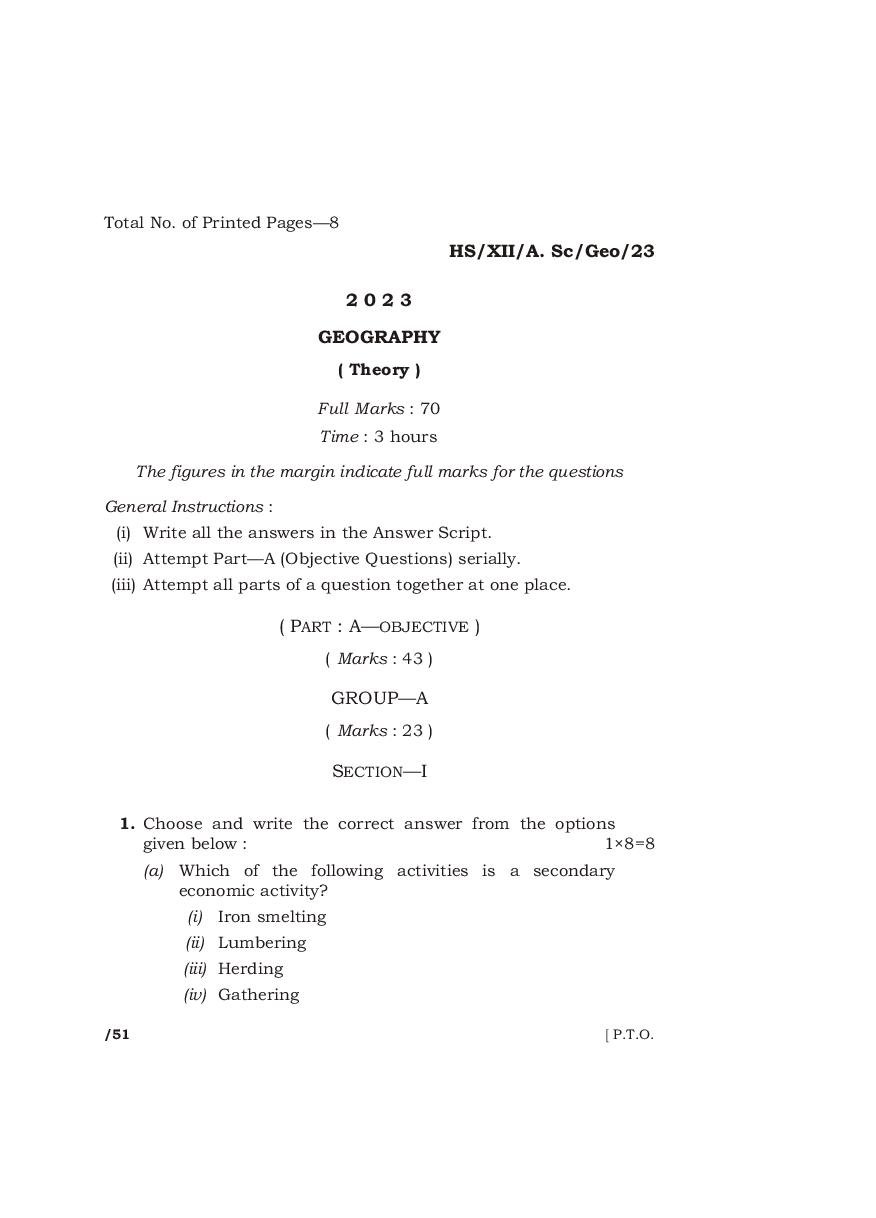
HS/XII/A. Sc/Geo/23
2023
GEOGRAPHY
( Theory )
Full Marks : 70
Time : 3 hours
The figures in the margin indicate full marks for the questions
General Instructions :
(i) Write all the answers in the Answer Script.
(ii) Attempt Part—A (Objective Questions) serially.
(iii) Attempt all parts of a question together at one place.
( PART : A—OBJECTIVE )
( Marks : 43 )
GROUP—A
( Marks : 23 )
SECTION—I
1. Choose and write the correct answer from the options
given below : 1×8=8
(a) Which of the following activities is a secondary
economic activity?
(i) Iron smelting
(ii) Lumbering
(iii) Herding
(iv) Gathering
/51 [ P.T.O.
Page 2
(b) The State with the lowest female literacy rate as per
2011 Census is
(i) Uttar Pradesh
(ii) Punjab
(iii) Bihar
(iv) Assam
(c) Which of the following is the most important and
busiest ocean routes in the world?
(i) Suez Canal route
(ii) South Pacific route
(iii) North Atlantic route
(iv) Cape of Good Hope route
(d) Who among the following scholars introduced the
concept of Human Development Index?
(i) Adam Smith
(ii) Dr. Mahbub ul Haq
(iii) Ellen C. Semple
(iv) Prof. Amartya Sen
(e) Which of the following countries is not a member of
SAARC?
(i) Pakistan
(ii) Mauritius
(iii) Bangladesh
(iv) India
HS/XII/A. Sc/Geo/23/51 [ Contd.
Page 3
(f) Which of the following types of industries produces
raw material for other industries?
(i) Footloose industry
(ii) Basic industry
(iii) Cottage industry
(iv) Small-scale industry
(g) Most of the India’s foreign trade is carried through
which route?
(i) Land and air
(ii) Sea and air
(iii) Sea only
(iv) Land and sea
(h) What is India’s total population as per 2011 Census?
(i) 1210 million
(ii) 869 million
(iii) 1001 million
(iv) 990 million
HS/XII/A. Sc/Geo/23/51 [ P.T.O.
Page 4
2. Fill in the blank spaces by choosing the correct answer
from the options given below : 1×8=8
(a) The longest transcontinental railway is ———.
(i) Trans-Canadian Railways
(ii) Trans-Siberian Railways
(iii) Australian Transcontinental Railways
(iv) Union and Pacific Railways
(b) One of the most polluted rivers of India caused from
urban and industrial sources is ———.
(i) Krishna River
(ii) Godavari River
(iii) Narmada River
(iv) Ganga River
(c) The highest motorable road of India is located in the
State/Union Territory of ———.
(i) Uttarakhand
(ii) Arunachal Pradesh
(iii) Sikkim
(iv) Jammu and Kashmir
HS/XII/A. Sc/Geo/23/51 [ Contd.
Page 5
(d) ——— is regarded as the Father of Modern Human
Geography.
(i) Friedrich Ratzel
(ii) Carl Ritter
(iii) Jean Brunhes
(iv) Ellsworth Huntington
(e) ——— is not the subfield of Human Geography.
(i) Biogeography
(ii) Economic Geography
(iii) Gender Geography
(iv) Agricultural Geography
(f) The main reason for male migration in India is ———.
(i) social insecurity
(ii) marriage
(iii) employment
(iv) education
(g) ——— is an example of transhumance.
(i) Khasi-Jaintia
(ii) Munda-Bhil
(iii) Apatanis-Mishmis
(iv) Gujjars-Bakarwals
HS/XII/A. Sc/Geo/23/51 [ P.T.O.
Page 6
(h) Cropped area in the year under consideration is
called ———.
(i) barren land
(ii) net sown area
(iii) wasteland
(iv) current fallow
SECTION—II
3. Give direct answers to the following questions : 1×7=7
(a) Name two important methods of mining practices.
(b) Name two main branches of Geography.
(c) Name at least two cropping seasons of India.
(d) Name two medieval towns of India.
(e) What are the two main types of land transport?
(f) Name the city located in the East Coast of India and
having the most modern iron and steel plant.
(g) What are the two distinct forms of rural settlements?
HS/XII/A. Sc/Geo/23/51 [ Contd.
Page 7
GROUP—B
( Marks : 20 )
SECTION—I
4. Answer any four of the following questions (within 2 or
3 sentences each) : 2×4=8
(a) Define conurbation. Give example.
(b) What is balance of trade?
(c) Define sex ratio.
(d) What is a port? Give two examples.
(e) What are mining towns?
(f) Define population growth.
SECTION—II
5. Answer any four of the following questions (within 5 or
6 sentences each) : 3×4=12
(a) What are the major problems of slums?
(b) Mention three reasons why rural to urban migration
takes place in India.
(c) What are the functions of World Trade Organization?
(d) What is rainwater harvesting?
(e) What is meant by globalization?
(f) What is Green Revolution?
HS/XII/A. Sc/Geo/23/51 [ P.T.O.
Page 8
( PART : B—DESCRIPTIVE )
( Marks : 27 )
6. What are the different types of human activities? Describe
the primary or secondary activities in detail. 2+7=9
Or
Define the term ‘tourism’. Explain the factors which attract
tourist in the world. Name the important tourist regions of
the world. 1+6+2=9
7. What are the chief means of transportation? Describe the
advantages and disadvantages of any one means of
transport. 3+6=9
Or
What is international trade? Name the types of
international trade. Write a note on any three regional
Trade Bloc. 2+1+6=9
8. Explain the main problems of Indian agriculture. Why is
irrigation needed in India? 6+3=9
Or
Give a detailed account on the relief features of Meghalaya.
Support your answer with the help of a sketch map. 7+2=9
HHH
HS/XII/A. Sc/Geo/23/51 K23—1970
Document Details
| Board / Org | Meghalaya Board |
| Exam | Class 12 |
| Type | Question Paper |
| Pages | 8 |
| Updated | 22 Jul 2026 |