MBOSE Class 12 Question Paper 2019 for Education
Finished viewing? Save it for later —
Download MBOSE Class 12 Question Paper 2019 for Education (PDF · 8 pages)About MBOSE Class 12 Question Paper 2019 for Education
MBOSE Class 12 Question Paper 2019 for Education is available here for free download. Published by Meghalaya Board for Class 12, this question paper can be viewed online or downloaded as a PDF (8 pages). Candidates preparing for Class 12 can use MBOSE Class 12 Question Paper 2019 for Education to understand the exam pattern, the type of questions asked, and the overall difficulty level.
Frequently Asked Questions
How can I download MBOSE Class 12 Question Paper 2019 for Education?
Open this page and click the Download button to save MBOSE Class 12 Question Paper 2019 for Education as a PDF. It is completely free on AglaSem Docs.
Is MBOSE Class 12 Question Paper 2019 for Education free to download?
Yes. MBOSE Class 12 Question Paper 2019 for Education can be viewed online and downloaded as a PDF free of cost on AglaSem Docs.
How many pages does MBOSE Class 12 Question Paper 2019 for Education have?
MBOSE Class 12 Question Paper 2019 for Education contains 8 pages, which you can read online or download together as a single PDF.
Where can I find more Class 12 study material?
You can find more Class 12 question papers, sample papers, syllabus, and answer keys on AglaSem Docs.
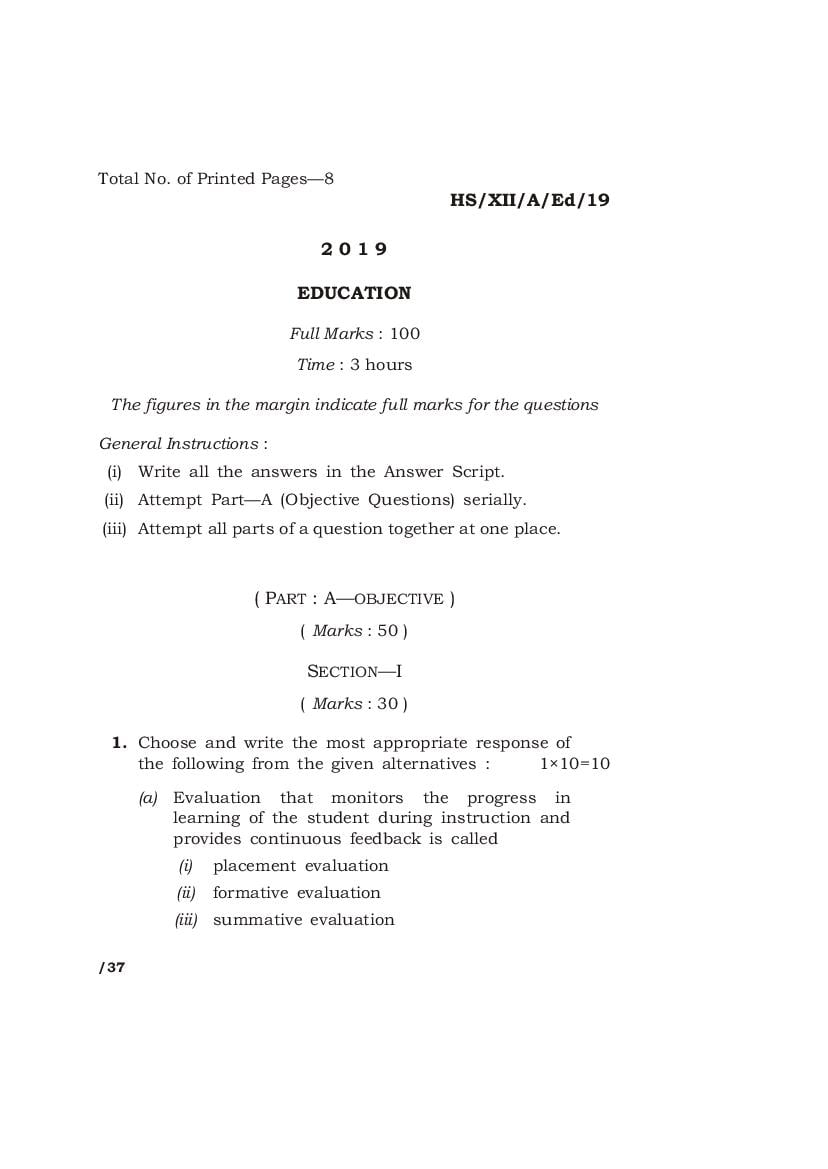
MBOSE Class 12 Question Paper 2019 for Education – Text
Read the full text of this question paper below — useful to quickly search, copy and reference the content online without downloading the PDF.
📄 View text version (8 pages)
Page 1
HS/XII/A/Ed/19
2019
EDUCATION
Full Marks : 100
Time : 3 hours
The figures in the margin indicate full marks for the questions
General Instructions :
(i) Write all the answers in the Answer Script.
(ii) Attempt Part—A (Objective Questions) serially.
(iii) Attempt all parts of a question together at one place.
( PART : A—OBJECTIVE )
( Marks : 50 )
SECTION—I
( Marks : 30 )
1. Choose and write the most appropriate response of
the following from the given alternatives : 1×10=10
(a) Evaluation that monitors the progress in
learning of the student during instruction and
provides continuous feedback is called
(i) placement evaluation
(ii) formative evaluation
(iii) summative evaluation
/37
Page 2
(b) “Every child is an artist. The problem is how to
remain an artist once he grows up” was defined
by
(i) Oscar Wilde
(ii) Tagore
(iii) Pablo Picasso
(c) Inclusion is a philosophy which
(i) admits the child
(ii) welcomes the child
(iii) provides opportunities
(d) The Open University of the United Kingdom
(UKOU) was established in the year
(i) 1969
(ii) 1967
(iii) 1996
(e) Forgetting is caused by
(i) decay
(ii) registration
(iii) clarity
Page 3
(f) Stimuli from the environment are registered in
our
(i) short-term memory
(ii) sensory memory
(iii) long-term memory
(g) Who among the following was the founder of
psychoanalysis?
(i) Sigmund Freud
(ii) Allport
(iii) Ryckman
(h) The ability to respond discretely to specific
visual, auditory or tactile stimuli is
(i) sustained attention
(ii) selective attention
(iii) focussed attention
(i) Thinking is a process in which
(i) we concentrate on events or things
(ii) we concentrate upon a particular issue in
our mind
(iii) attention is caused to focus on an object or
an event
(j) The process in logic that helps us to validate our
arguments and reach a conclusion is known as
(i) reasoning
(ii) thinking
(iii) problem solving
Page 4
2. Write whether the following statements are True
or False : 1×5=5
(a) Encoding is the creation of a permanent record
of the encoded information.
(b) All our primitive and innate urges are id.
(c) Overt attention is the act of directing sense
organs towards a stimulus source.
(d) Allport’s trait theory is similar to Freud’s theory.
(e) Person With Disability (PWD) Act was enforced
in the year 1996.
3. Match the word(s) in Column—A relating to the
appropriate word(s) in Column—B : 1×5=5
Column—A Column—B
(a) Subject-centred (i) Technique of
curriculum memorization
(b) A measure of a (ii) Aristotle
person’s intelligence
(c) Syllogism (iii) Cognitive framework
(d) Mnemonics (iv) Essentialism
(e) Schemas (v) IQ
Page 5
4. Who stated the following? 1×5=5
(a) “With a subject matter as broad as life itself, the
arts easily relate to aspects of almost everything
else that is taught.”
(b) “A man is but the product of his thoughts, what
he thinks he becomes.”
(c) “Talking is the fundamental form of expression
for each individual and is located ‘between’
persons as conversation. It is the basic vehicle
for personal engagement with others and serves
to develop thought and identity.”
(d) “No two individuals of the same race are quite
alike, we may compare millions of faces, and
each will be distinct.”
(e) “Curiosity is as much a parent of attention, as
attention is of memory.”
5. Fill in the blanks : 1×5=5
(a) According to Cattell, there are _____ traits that
constitute personality of an individual.
(b) _____ is a selective act of mind.
(c) _____ 2005 recommends making art education a
compulsory subject up to class X.
(d) _____ deepens human emotions and harmonises
them with each other.
(e) The word ‘curriculum’ is derived from the Latin
word _____.
Page 6
SECTION—II
( Marks : 20 )
6. Answer briefly the following in 2 or 3 sentences
each : 2×10=20
(a) Define the term ‘pedagogy’.
(b) What is visual art?
(c) Differentiate between the terms ‘disability’ and
‘handicap’.
(d) Write the four steps in problem solving.
(e) State four causes of forgetting.
(f) Write a note on the importance of computers in
education.
(g) State any four important principles of
curriculum construction.
(h) Write on the steps in construction of project
work.
(i) What is theme-based writing?
(j) Write the tools used in brain-mapping.
Page 7
( PART : B—DESCRIPTIVE )
( Marks : 50 )
Answer Question No. 7 and any two from the rest
7. Write short notes on any three of the following : 6×3=18
(a) Subject-centred curriculum
(b) Instructional media
(c) Types of Specific Learning Disability (SLD)
(d) Brainstorming activities
(e) Implications of individual differences for
classroom teaching
8. Define norm-referenced evaluation and criterion-
referenced evaluation. Write on other different types
of evaluation. 6+10=16
9. Give the meaning of art education. Explain the stages
and processes of art education as prescribed by
NCERT. 6+10=16
10. Give the objectives of educational technology.
Discuss the types of technology in the field of
education. 8+8=16
Page 8
11. Define intelligence. Explain Spearman’s and
Thurstone’s theories of intelligence. 4+12=16
12. Define personality. Discuss Sigmund Freud’s
psychoanalytic theory of personality. 4+12=16
13. What is inclusive education? Who needs to be
included in inclusive schools? 4+12=16
HHH
HS/XII/A/Ed/19/37 K9—25570
Document Details
| Board / Org | Meghalaya Board |
| Exam | Class 12 |
| Type | Question Paper |
| Pages | 8 |
| Updated | 15 Jul 2026 |